Lifestyle
7 genius tips for avoiding preschooler meltdowns (and bankruptcy) at Disneyland

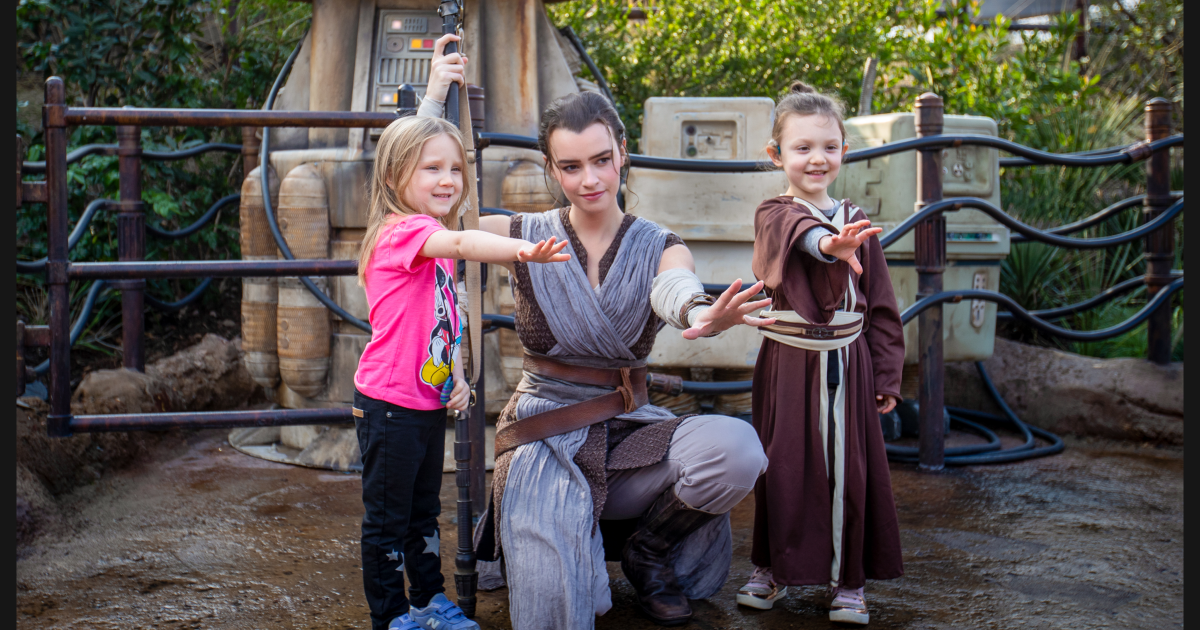
When you figure in the high cost, endless lines, height restrictions and miles of walking, does it ever make sense to take a preschooler to Disneyland?
Yes, as long as their adults adjust their expectations, plan carefully and slow waaay down. Because, let’s face it, most preschoolers are too young to understand what Disneyland is all about. It’s the parental (and grandparental) excitement and expectations that are really driving this visit.
Case in point: When we took my Seattleite granddaughter to Disneyland for her fourth birthday, her parents and I spent most of the time watching her reactions, which, I must admit, were pretty gratifying.
Craft an epic visit to Disneyland and California Adventure with our comprehensive guide.
It’s full of expert tips and fresh perspectives.
Following the advice of Disneyland enthusiasts and L.A. Times readers, we were right in front when the park opened its gates. We were making a beeline to Fantasyland when out of the corner of my eye I saw Minnie and Mickey Mouse waving by the train station. Ordinarily, with my teen (and now adult) kids, nothing would have deterred us from racing to our favorite ride. But this was my granddaughter’s first visit, and all she really knew about Disneyland was that it was Mickey Mouse’s home. How could we ignore this introduction?
So we turned, which was hard, since she was already laser focused on Sleeping Beauty Castle, but when she finally saw Mickey and his gang cavorting just a few feet away, she reared back and started shaking so hard I feared she was going into shock. She couldn’t approach them or even wave; she just stared and vibrated, like an awestruck cartoon character with her finger in a light socket.
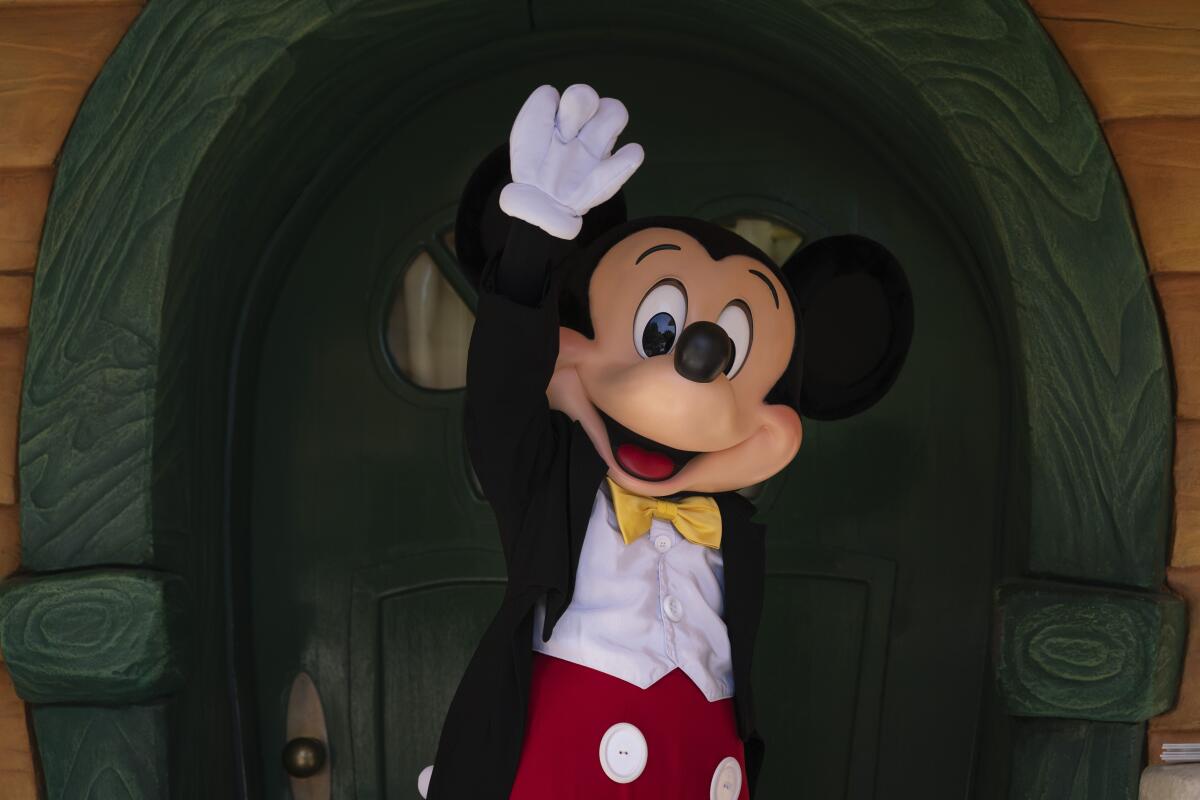
Meeting Mickey and Minnie was an emotional start to the day.
(Jae C. Hong / Associated Press)
I wanted photos, but her parents and I were so busy wiping away our tears we could barely hold the camera. It was a pretty intense start to the morning, and we had barely left the entrance.
“Going when they’re preschoolers may be the best time, because everything is a wonderment at that age,” said Kristen Carr, of Orange, a “Disney mom” of four (ages 10, 9 and 6-year-old twins) who podcasts, blogs and organizes Disney-related activities.
Don’t expect to go on massive thrill rides with preschoolers, Carr said, “but many of the rides feel very well suited for children 3 to 4. Some of my most fun memories are from when my kids were that age.”
Most of the 35 readers who responded to our question “What can you do with a preschooler at Disneyland?” agreed with Carr. Only four said taking preschoolers to Disneyland was a waste of money and time; the rest came down squarely in the plan-ahead-and-you’ll-love-it camp. We followed most of their top tips when we made this Disneyland pilgrimage and almost all were winners. Plus, we discovered rides and experiences at the park we’d never really noticed before.
1. Adjust your expectations
Focus on visiting just one park, and missing most of the big rides. We were in Disneyland from 8 a.m. until 9 p.m., but between rests, meals, more rests and endless lines, we only managed eight rides — the carousel, Storybook Land and Casey’s Railroad in Fantasyland, the junior roller coaster in Toontown (after an hour wait to visit Minnie at her house), the Thunder Mountain roller coaster, Finding Nemo Submarine Voyage (almost too scary), the Jungle Boat Cruise and the Winnie the Pooh ride, plus the Tiki Room, the Toontown playground and the parade.
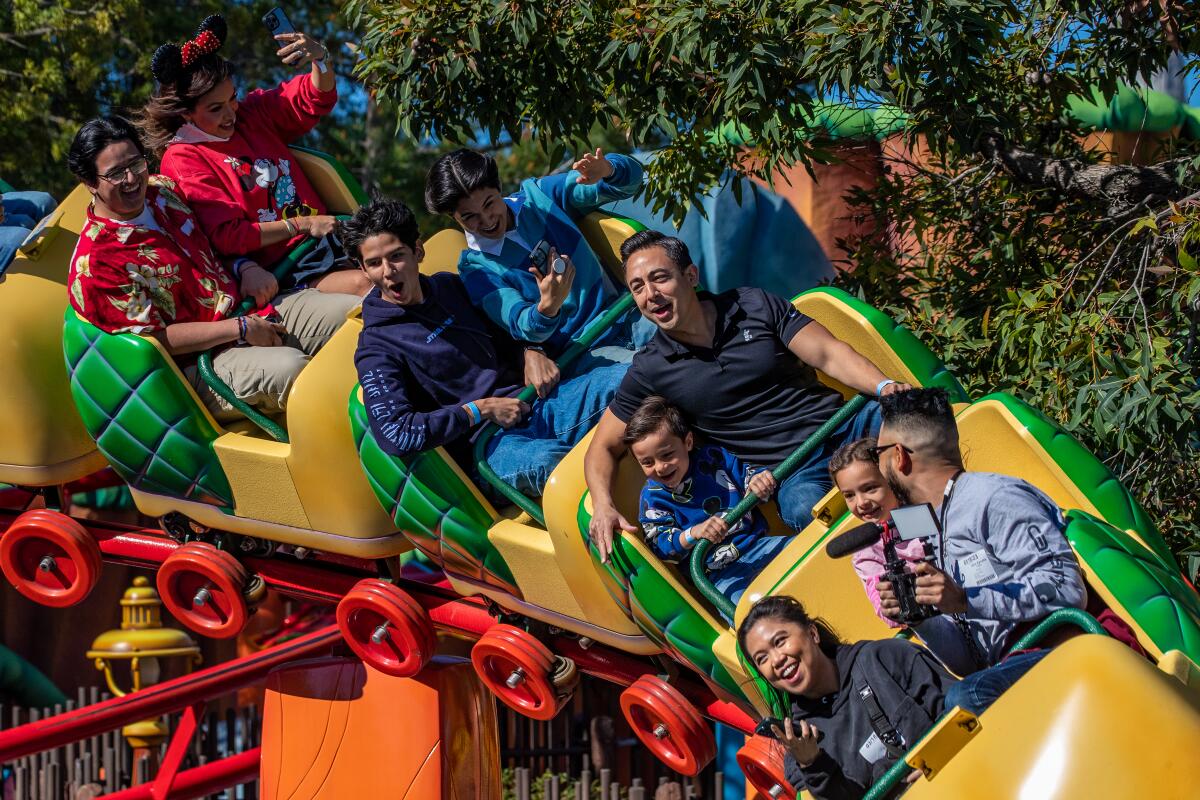
Chip ‘n’ Dale’s Gadget’s Go Coaster at Toontown is a good introduction to roller coasters for small children — although larger adults may feel crippled for hours after having wedged themselves into the seats.
(Irfan Khan / Los Angeles Times)
But we had no meltdowns and she was smiling when we left. (Of course, she was also carrying a new toy purchased just before our departure, but you know, what are grandmothers for?) If the adults must go on a big-person ride, make sure you have someone in your party to take the preschooler to something they’ll enjoy — in my case, we bought a balloon, ate some pre-packed snacks and watched the parade (which she loved) while her parents waited 90 minutes for their first ride on Star Wars: Rise of the Resistance (which they loved).
2. Get a stroller
OK, I wasn’t going to do this because I’ve always hated the herd of strollers blocking everyone’s path in Disneyland, but Carr said it was an absolute must, even for her 6-year-old twins, and most of our readers agreed. The kids start out strong, but when they get tired (which happens quickly for little legs), your choices are to carry them or try to find a quiet bench for a nap (good luck). So we rented a big-kid stroller ($38 for 24 hours), which was delivered to our hotel, and it gave us a place to stash our snacks, extra clothing, and a cuddly blanket so she could relax later in the day. Worth every penny.
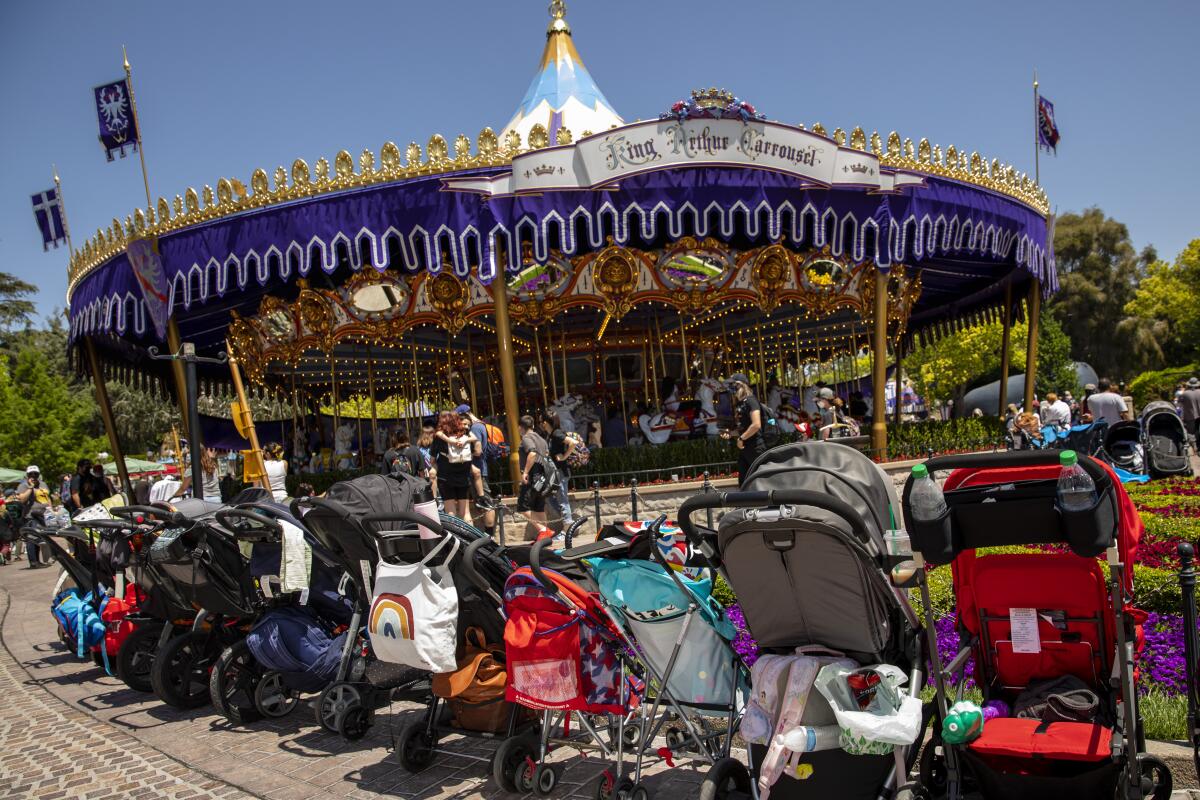
The sea of strollers at Disneyland, here at the King Arthur Carrousel, was long a subject of scorn in my family until we discovered their value in keeping young children happy (and as a place to stash all our gear).
(Jay L. Clendenin / Los Angeles Times)
Carr notes: If you don’t have your own, rent a good sturdy stroller outside the park; Disney’s are hard plastic and not very comfortable, she said. Umbrella strollers are too little for big kids and back breakers for whoever is pushing them. Plus, you won’t have to wait in line at Disneyland to rent and return a stroller. Our stroller was delivered to the hotel about 30 minutes before our departure, and all we had to do was leave it at the front desk when we returned that evening, which was a godsend since we had to walk back to the hotel.
3. Pack water and non-sugary snacks
You can get plenty of sweet stuff at Disneyland, “but a lot of sugar equals a lot of breakdowns” for little ones, Carr said. Bring a small cooler loaded with water, apple slices, carrot sticks, grapes and/or sandwiches, but also do yourself a favor, Carr said: If your child has a favorite snack they eat every day, be sure you pack some of that too.
4. Arrive early, before the park opens
In our case, that meant leaving our off-site hotel at 7 a.m. and running the gauntlet through metal detectors, bag searches and guard dogs so we could be at the gates when they opened at 8 a.m. People who stay in park hotels might be able to enter even earlier. The point is to get in early, before the crowds and head for Fantasyland first, which has the greatest concentration of little-kid rides but also the worst lines once the park starts filling up. Several Fantasyland rides, like Pinocchio, are too dark and scary for preschoolers, but once you get your fill of the sunnier ones, Carr said, you can stop mid-morning, have a late breakfast and plan out the rest of your day.
5. Download the Disneyland app
With preschoolers, I’m not convinced it’s worth the extra $35-$50 per person to get the Genie+ and Lightning Lane passes that let you skip the line at the most popular rides, but the free Genie app is mandatory for ordering food (so you don’t wait in yet another line to eat), keeping track of special events in the park and seeing what rides have the longest lines or are shut down. Pro tip: Bring a portable phone charger.
6. Prep your child for what to expect
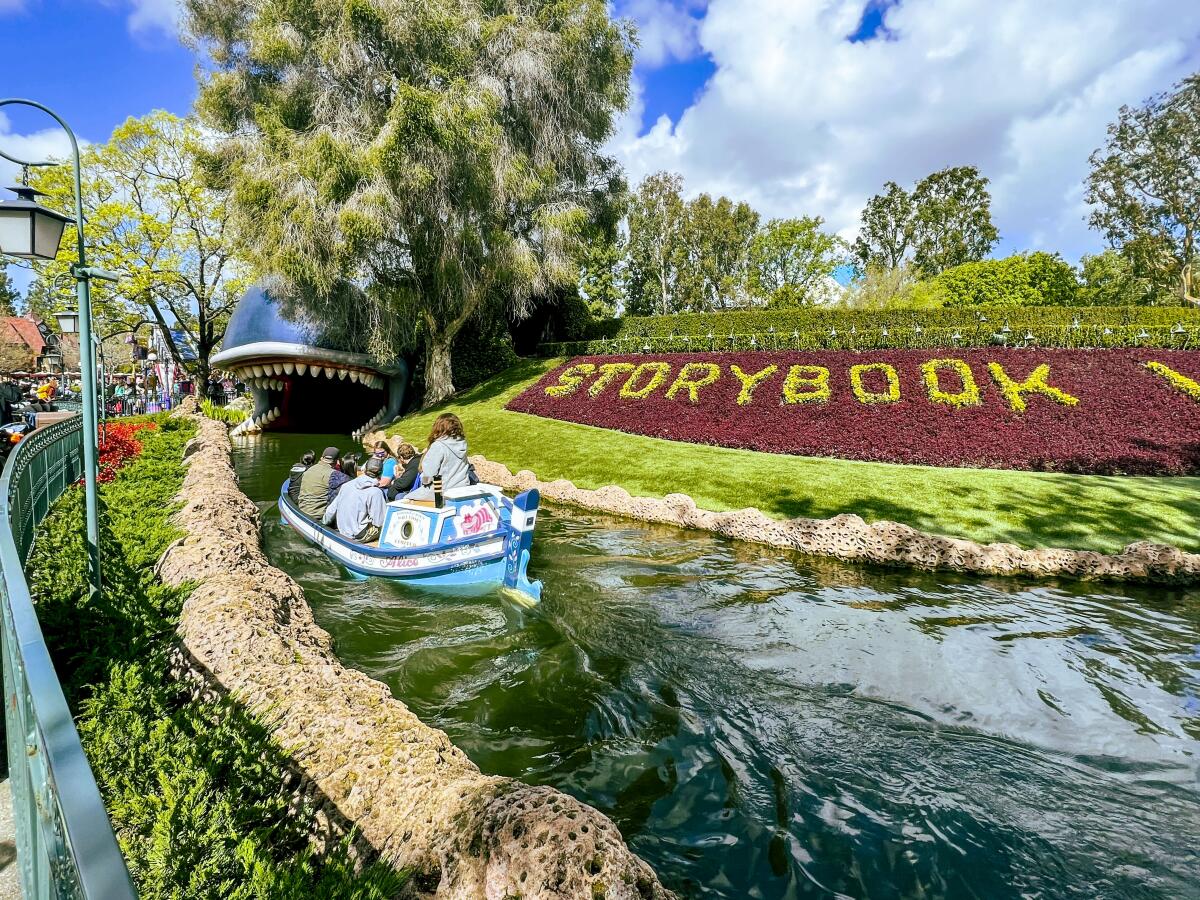
The Storybook Land Canal Boats almost resulted in a major meltdown when the boat left while we waited in line. Our 4-year-old Disneyland newbie didn’t understand that new boats would keep coming.
(Todd Martens / Los Angeles Times)
We almost had a meltdown at the first ride, when my granddaughter thought the boat we were waiting for at the Storybook Land canal left without us. It took about four boats coming and going before she began to understand that their appearance was continuous and we would eventually get our turn to climb aboard. Nothing will truly prepare them for the experience IRL, but you can at least explain how the rides and lines work and show them some photos of what they’ll see.
7. Gird your loins and watch your spending
The nickle-and-diming at Disneyland is intense. Preschoolers want just about everything they see, and doting adults are eager to oblige, but between $30 Ariel bubble wands (which need refilling almost immediately), $20 Mickey Mouse balloons, $30 Star Wars stuffies and $50 sweatshirts, it’s easy to overspend. One of the biggest lures for little ones is the Bibbidi Bobbidi Boutique, where “magical makeovers for royalty-in-training ages 3-12” start at $100, a fee that includes a princess hairstyle, nail polish, sash, T-shirt and “shimmering makeup and face gem.” The prices go up from there, to nearly $500 for all of the above, plus a princess gown, tiara and satin hanger (every preschooler’s dream). There’s also the $80 Deluxe Knight Package, which includes a knight costume, gel hairstyling and a “mighty sword and shield.”
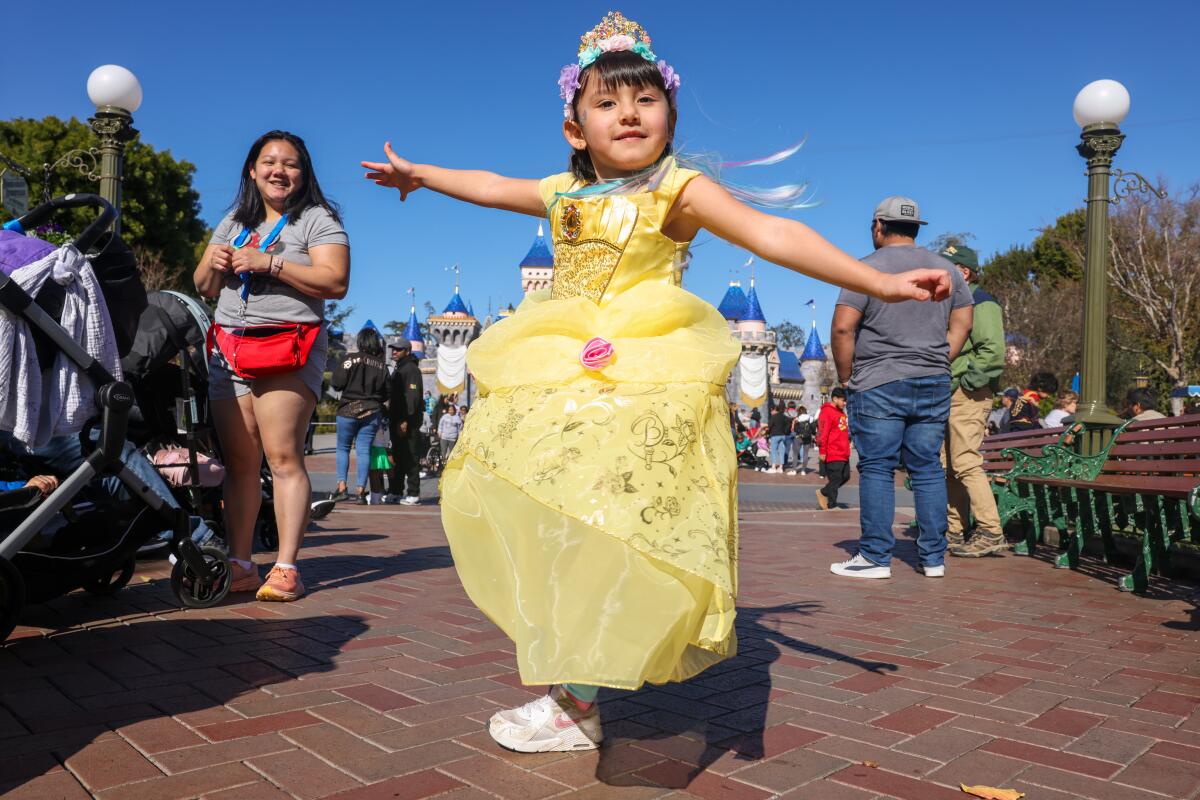
Emily San Miguel, 6, beams as she shows off her fancy “Belle” dress at Disneyland, but the price of a princess “makeover” can have a decidedly different effect on adult pocketbooks.
(Dania Maxwell / Los Angeles Times)
Here’s where advance planning can pay off, Carr said. She bought her daughter’s favorite princess gown online for a fraction of the park price, showed it to her the morning of their trip and let her wear that to the park. They still visited the boutique, she said, but only to get a free sprinkling of pixie dust (a.k.a glitter) anyone can request. I can’t emphasize this enough: Plan ahead for what purchases are a must ($6.50 bowls of Dole Whip are non-negotiable in my family) and let your children and accompanying adults know they can’t have everything they want.
Bonus: The lasting memories may surprise you
With two nights at an off-site hotel ($525), four admissions to the park (only $602, thanks to a short-time $50 deal for young children), meals, treats and souvenirs, our one-day visit in early February cost about $1,500, or $375 per person. That’s an eye-popping figure, but truth be told, we had a lot of fun, and if we’d curbed our souvenir shopping and been willing to spend nearly three hours driving home after a long day at the park, it could have been at least $300 cheaper.
Note this, because four months after our trip, I asked my granddaughter, “What was your favorite part about Disneyland?” Her answer was immediate: When the servers at Café Orleans brought her a tiny cake — basically three blobs of whipped cream in the shape of Mickey Mouse’s head — with a little candle on top. We all sang happy birthday while she beamed and blew the candle out, and that precious moment came free of charge.



new video loaded: Prada Peels Back the Layers at Milan Fashion Week
By Chevaz Clarke and Daniel Fetherston
February 27, 2026

Bill Cosby
Rape Accuser Says Cosby Won’t Take Stand At Trial
Published
Bill Cosby‘s rape accuser Donna Motsinger says the TV star can’t be bothered to show up to court for a trial in a lawsuit she filed against him.
According to new legal docs, obtained by TMZ. Motsinger says Bill will not testify in court … she claims it’s “because he does not care to appear.”

Motsinger says Bill won’t show his face at the trial either … and the only time the jury will hear from him will be a previously taped deposition.
As we previously reported, Motsinger claims Bill drugged and raped her in 1972. In the case, Bill admitted during a deposition that he obtained a recreational prescription for Quaaludes that he secured from a gynecologist at a poker game.
TMZ.com
Bill also said he planned to use the pills to give to women in the hopes of having sex with them.
Motsinger alleged Bill gave her a pill that she thought was aspirin. She claimed she felt off after taking it and said she woke up the next day in her bed with only her underwear on.
Here, it sounds like Motsinger wants to play the deposition for the jury.
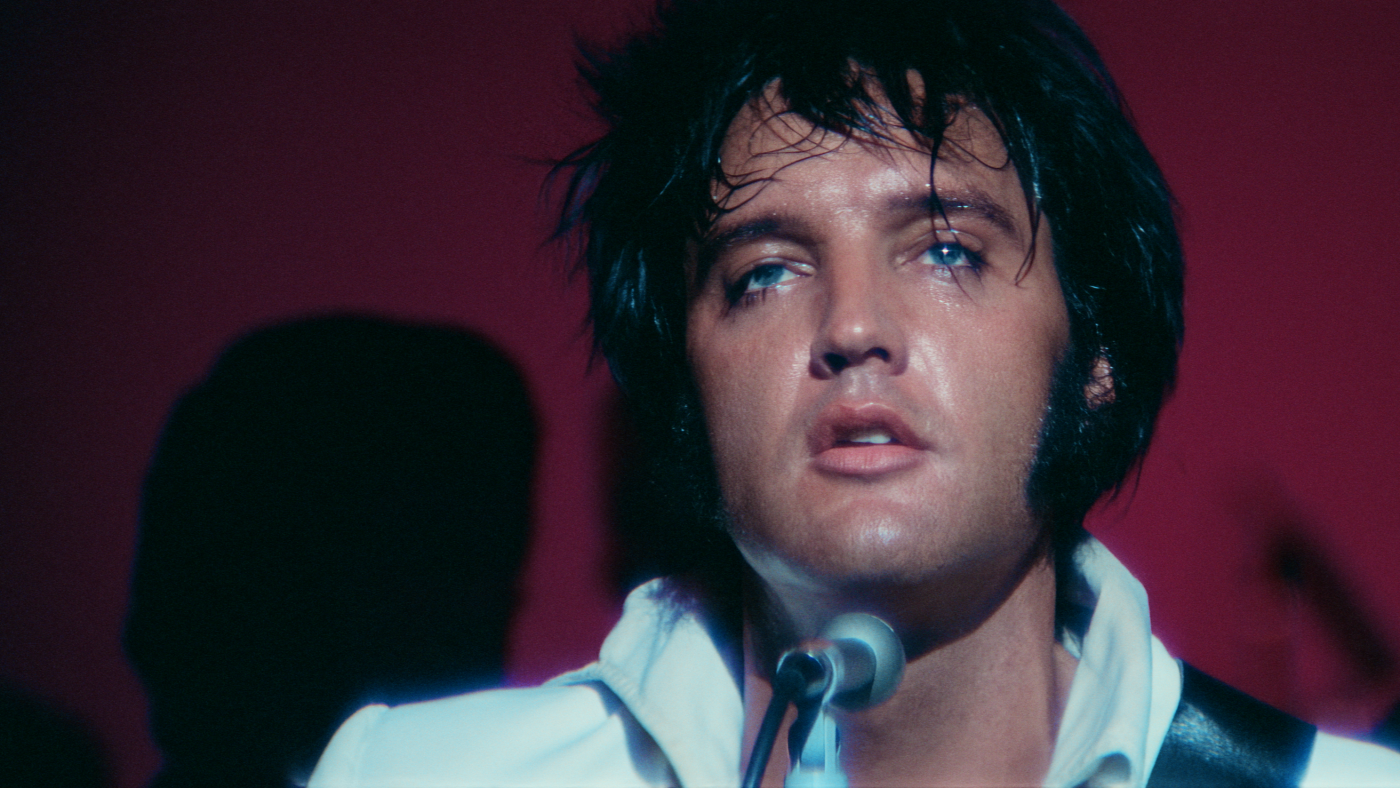
Elvis Presley in Las Vegas in Aug. 1970.
NEON
hide caption
toggle caption
NEON
“You are my favorite customer,” Baz Luhrmann tells me on a recent Zoom call from the sunny Chateau Marmont in Hollywood. The director is on a worldwide blitz to promote his new film, EPiC: Elvis Presley in Concert — which opens wide this week — and he says this, not to flatter me, but because I’ve just called his film a miracle.
See, I’ve never cared a lick about Elvis Presley, who would have turned 91 in January, had he not died in 1977 at the age of 42. Never had an inkling to listen to his music, never seen any of his films, never been interested in researching his life or work. For this millennial, Presley was a fossilized, mummified relic from prehistory — like a woolly mammoth stuck in the La Brea Tar Pits — and I was mostly indifferent about seeing 1970s concert footage when I sat down for an early IMAX screening of EPiC.
By the end of its rollicking, exhilarating 90 minutes, I turned to my wife and said, “I think I’m in love with Elvis Presley.”
“I’m not trying to sell Elvis,” Luhrmann clarifies. “But I do think that the most gratifying thing is when someone like you has the experience you’ve had.”
Elvis made much more of an imprint on a young Luhrmann; he watched the King’s movies while growing up in New South Wales, Australia in the 1960s, and he stepped to 1972’s “Burning Love” as a young ballroom dancer. But then, like so many others, he left Elvis behind. As a teenager, “I was more Bowie and, you know, new wave and Elton and all those kinds of musical icons,” he says. “I became a big opera buff.”
Luhrmann only returned to the King when he decided to make a movie that would take a sweeping look at America in the 1950s, ’60s, and ’70s — which became his 2022 dramatized feature, Elvis, starring Austin Butler. That film, told in the bedazzled, kaleidoscopic style that Luhrmann is famous for, cast Presley as a tragic figure; it was framed and narrated by Presley’s notorious manager, Colonel Tom Parker, portrayed by a conniving and heavily made-up Tom Hanks. The dark clouds of business exploitation, the perils of fame, and an early demise hang over the singer’s heady rise and fall.
It was a divisive movie. Some praised Butler’s transformative performance and the director’s ravishing style; others experienced it as a nauseating 2.5-hour trailer. Reviewing it for Fresh Air, Justin Chang said that “Luhrmann’s flair for spectacle tends to overwhelm his basic story sense,” and found the framing device around Col. Parker (and Hanks’ “uncharacteristically grating” acting) to be a fatal flaw.
Personally, I thought it was the greatest thing Luhrmann had ever made, a perfect match between subject and filmmaker. It reminded me of Oliver Stone’s breathless, Shakespearean tragedy about Richard Nixon (1995’s Nixon), itself an underrated masterpiece. Yet somehow, even for me, it failed to light a fire of interest in Presley himself — and by design, I now realize after seeing EPiC, it omitted at least one major aspect of Elvis’ appeal: the man was charmingly, endearingly funny.
As seen in Luhrmann’s new documentary, on stage, in the midst of a serious song, Elvis will pull a face, or ad lib a line about his suit being too tight to get on his knees, or sing for a while with a bra (which has been flung from the audience) draped over his head. He’s constantly laughing and ribbing and keeping his musicians, and himself, entertained. If Elvis was a tragedy, EPiC is a romantic comedy — and Presley’s seduction of us, the audience, is utterly irresistible.
Unearthing old concert footage
It was in the process of making Elvis that Luhrmann discovered dozens of long-rumored concert footage tapes in a Kansas salt mine, where Warner Bros. stores some of their film archives. Working with Peter Jackson’s team at the post-production facility Park Road Post, who did the miraculous restoration of Beatles rehearsal footage for Jackson’s 2021 Disney+ series, Get Back, they burnished 50-plus hours of 55-year-old celluloid into an eye-popping sheen with enough visual fidelity to fill an IMAX screen. In doing so, they resurrected a woolly mammoth. The film — which is a creative amalgamation of takes from rehearsals and concerts that span from 1970 to 1972 — places the viewer so close to the action that we can viscerally feel the thumping of the bass and almost sense that we’ll get flecked with the sweat dripping off Presley’s face.
This footage was originally shot for the 1970 concert film Elvis: That’s The Way It Is, and its 1972 sequel, Elvis on Tour, which explains why these concerts were shot like a Hollywood feature: wide shots on anamorphic 35mm and with giant, ultra-bright Klieg lights — which, Luhrmann explains, “are really disturbing. So [Elvis] was very apologetic to the audience, because the audience felt a bit more self conscious than they would have been at a normal show. They were actually making a movie, they weren’t just shooting a concert.”
Luhrmann chose to leave in many shots where camera operators can be seen running around with their 16mm cameras for close-ups, “like they’re in the Vietnam War trying to get the best angles,” because we live in an era where we’re used to seeing cameras everywhere and Luhrmann felt none of the original directors’ concern about breaking the illusion. Those extreme close-ups, which were achieved by operators doing math and manually pulling focus, allow us to see even the pores on Presley’s skin — now projected onto a screen the size of two buildings.
The sweat that comes out of those pores is practically a character in the film. Luhrmann marvels at how much Presley gave in every single rehearsal and every single concert performance. Beyond the fact that “he must have superhuman strength,” Luhrmann says, “He becomes the music. He doesn’t mark stuff. He just becomes the music, and then no one knows what he’s going to do. The band do not know what he’s going to do, so they have to keep their eyes on him all the time. They don’t know how many rounds he’s going to do in ‘Suspicious Minds.’ You know, he conducts them with his entire being — and that’s what makes him unique.”

Elvis Presley in Las Vegas in Aug. 1970.
NEON
hide caption
toggle caption
NEON
It’s not the only thing. The revivified concerts in EPiC are a potent argument that Elvis wasn’t just a superior live performer to the Beatles (who supplanted him as the kings of pop culture in the 1960s), but possibly the greatest live performer of all time. His sensual, magmatic charisma on stage, the way he conducts the large band and choir, the control he has over that godlike gospel voice, and the sorcerer’s power he has to hold an entire audience in the palm of his hands (and often to kiss many of its women on the lips) all come across with stunning, electrifying urgency.
Shaking off the rust and building a “dreamscape”
The fact that, on top of it all, he is effortlessly funny and goofy is, in Luhrmann’s mind, essential to the magic of Elvis. While researching for Elvis, he came to appreciate how insecure Presley was as a kid — growing up as the only white boy in a poor Black neighborhood, and seeing his father thrown into jail for passing a bad check. “Inside, he felt very less-than,” says Luhrmann, “but he grows up into a physical Greek god. I mean, we’ve forgotten how beautiful he was. You see it in the movie; he is a beautiful looking human being. And then he moves. And he doesn’t learn dance steps — he just manifests that movement. And then he’s got the voice of Orpheus, and he can take a song like ‘Bridge Over Troubled Water’ and make it into a gospel power ballad.
“So he’s like a spiritual being. And I think he’s imposing. So the goofiness, the humor is about disarming people, making them get past the image — like he says — and see the man. That’s my own theory.”
Elvis has often been second-classed in the annals of American music because he didn’t write his own songs, but Luhrmann insists that interpretation is its own invaluable art form. “Orpheus interpreted the music as well,” the director says.
In this way — as in their shared maximalist, cape-and-rhinestones style — Luhrmann and Elvis are a match made in Graceland. Whether he’s remixing Shakespeare as a ’90s punk music video in Romeo + Juliet or adding hip-hop beats to The Great Gatsby, Luhrmann is an artist who loves to take what was vibrantly, shockingly new in another century and make it so again.

Elvis Presley in Las Vegas in Aug. 1970.
NEON
hide caption
toggle caption
NEON
Luhrmann says he likes to take classic work and “shake off the rust and go, Well, when it was written, it wasn’t classical. When it was created, it was pop, it was modern, it was in the moment. That’s what I try and do.”
To that end, he conceived EPiC as “an imagined concert,” liberally building sequences from various nights, sometimes inserting rehearsal takes into a stage performance (ecstatically so in the song “Polk Salad Annie”), and adding new musical layers to some of the songs. Working with his music producer, Jamieson Shaw, he backed the King’s vocals on “Oh Happy Day” with a new recording of a Black gospel choir in Nashville. “So that’s an imaginative leap,” says Luhrmann. “It’s kind of a dreamscape.”
On some tracks, like “Burning Love,” new string arrangements give the live performances extra verve and cinematic depth. Luhrmann and his music team also radically remixed multiple Elvis songs into a new number, “A Change of Reality,” which has the King repeatedly asking “Do you miss me?” over a buzzing bass line and a syncopated beat.
I didn’t miss Elvis before I saw EPiC — but after seeing the film twice now, I truly do.

Wisconsin Lottery Mega Millions, Pick 3 results for Feb. 27, 2026

As Mountaineers try to move forward from recent struggles, freshman sensation Dybantsa awaits – WV MetroNews

University Of Wyoming Budget Spared (For Now), Biz Council Reined In

Better Cryptocurrency to Buy With $5,000 and Hold Forever: XRP vs. Ethereum | The Motley Fool

Cornell Administrator Warren Petrofsky Named FAS Finance Dean | News | The Harvard Crimson

Florida High School Football Rankings: Top 25 teams – Oct. 21

Cleary's 21 help Le Moyne down Central Connecticut State 69-64 in OT

How old is Bo Nix? What to know about Oregon quarterback ahead of 2024 NFL Draft

99th annual Pony Swim held in Virginia

Indiana Members Credit Union announced as new anchor tenant at Bottleworks District

ICE blasts Washington mayor over directive restricting immigration enforcement

Did the EU bypass Hungary’s veto on Ukraine’s €90 billion loan?

How the federal government is painting immigrants as criminals on social media

Where Iran’s ballistic missiles can reach — and how close they are to the US

Has India’s influence in Afghanistan grown under the Taliban?
-

 World2 days ago
Exclusive: DeepSeek withholds latest AI model from US chipmakers including Nvidia, sources say
-

 Massachusetts2 days ago
Mother and daughter injured in Taunton house explosion
-

 Montana1 week ago
2026 MHSA Montana Wrestling State Championship Brackets And Results – FloWrestling
-

 Louisiana5 days ago
Wildfire near Gum Swamp Road in Livingston Parish now under control; more than 200 acres burned
-

 Denver, CO2 days ago
10 acres charred, 5 injured in Thornton grass fire, evacuation orders lifted
-

 Technology7 days ago
YouTube TV billing scam emails are hitting inboxes
-

 Technology7 days ago
Stellantis is in a crisis of its own making
-

 Politics7 days ago
OpenAI didn’t contact police despite employees flagging mass shooter’s concerning chatbot interactions: REPORT