Lifestyle
40 years after 'Purple Rain,' Prince’s band remembers how the movie came together


Prince on the custom motorcycle featured in Purple Rain.
Cinematic/Alamy
hide caption
toggle caption
Cinematic/Alamy
Wendy Melvoin, guitarist for Prince’s genre bending band The Revolution, remembers one of their most iconic songs started with an idea — and a challenge — from the boss himself.
Prince broached the topic during a band rehearsal. “He came to the table with this beautiful idea … most of the songs [on the album] had already been done,” says Melvoin, “He said ‘I have this idea and sounds a little like this…whattaya you guys got?’”
What Wendy had was an idea for a mournful cascade of guitar chords that proved the perfect starting point.
“I came up with that intro and that chord progression to get us into the song,” she adds. “And it ended up being one of the most iconic intros to a pop ballad ever.”
The song Purple Rain would become the surprising, anthemic climax for a film of the same name that emerged as one of the most successful and influential musical films in history. The movie hit theaters 40 years ago, breaking barriers in the music world while signaling the ascendancy of Prince as a pop music superstar.
Putting Purple Rain on the silver screen
Filmed around the band’s Minneapolis hometown, Purple Rain had a simple story. Prince’s character — known only as The Kid – is rocked by his dad constantly beating his mother at home, struggling to connect with his bandmembers and a new romantic interest, a beautiful singer named Apollonia.
Drummer Bobby Rivkin, known onstage as Bobby Z, says the idea of showcasing Prince’s songs and The Revolution in a film was inspired by the success of MTV and its focus on music videos.
“Prince was always someone who took a step bigger than the cultural [stuff] that was happening at the times,” he adds. “Once MTV started playing his videos, I think he just gravitated to something bigger and said ‘I’ll just take it to the next level.’’”
Melvoin says she and The Revolution — including Rivkin, keyboardists Lisa Coleman and Matt Fink and bassist Brown Mark — found out they would be working on a movie when Prince announced it in a matter-of-fact way at a rehearsal. But she wasn’t worried about whether she could act or how the band would look onscreen.
“I guess if I had any concern back then, it was just literally, ‘was the story going to be any good?’” she says, laughing. “I didn’t have any doubt the music sequences would be fantastic. But I didn’t have a good sense of whether the narrative of the film was going to work.”

Turns out, it all worked pretty well. Purple Rain was a hit, with the film and its soundtrack earning an Oscar, two Grammy awards and status as a groundbreaking musical film.
It also introduced a film audience to Prince’s scorching performance style, his unerring ability to craft hit tunes, and his distinctive fashion sense. Prince’s network of bands and performers also got some attention – including the girl-fronted group Apollonia 6 and the funk band The Time.
The Time lead singer Morris Day and his onstage foil Jerome Benton became the film’s comic center, with the two riffing on a version of Abbott and Costello’s classic routine “Who’s on First?”.
“Honestly, we weren’t trying to be funny … we always clowned around at the time because we were young,” Day says, responding to questions via email. He noted, even though the cast took acting and dance classes in preparation for filming, “we were just being ourselves. If anything, I was more conscious of being cool than funny.”

Morris Day of The Time performs in Chicago in 1983, before Purple Rain came out.
Raymond Boyd/Getty Images
hide caption
toggle caption
Raymond Boyd/Getty Images
He’s not surprised people are still talking about the film four decades after its initial release.
“The film was groundbreaking on so many levels … it was the first of its kind,” adds Day, who says he’s only watched the film in its entirety one time, at its Hollywood premiere on July 26, 1984. “It somehow reminds people of a special period in their lives during the ‘80s, which is a period we all at times wish we could reclaim.”
Building the drama in Purple Rain
Fans know the film tells a more combative story behind the genesis of the song Purple Rain.
Onscreen, Melvoin and her then-girlfriend, keyboardist Lisa Coleman write the song, fighting a reluctant Prince – known only as The Kid in the movie – to let The Revolution play it onstage.
“Everytime we give you a song, you say you’re going to use it, but you never do,” Melvoin shouts at Prince during the scene, delivering some of the best acting from the musicians who mostly fill out the cast. “You think we’re doing something behind your back…you’re just being paranoid as usual.”
When Prince finally agrees to play Purple Rain onstage at the Minneapolis club First Avenue – launching into an emotional rendition topped by one of the best guitar solos in pop music – he wows the crowd and saves the band. But Melvoin says now that the friction they acted out was “movie magic” conjured to build a story; in real life, she, Lisa and Prince were very close collaborators.

Prince, alongside Wendy Melvoin (left) and Lisa Coleman (right) accepts Purple Rain‘s Oscar for best original score in 1985.
HARMS/AFP via Getty
hide caption
toggle caption
HARMS/AFP via Getty
Powered by hits like the title track and the percolating dance jam I Would Die 4 U, Purple Rain burst like a lavender-tinged explosion across the pop culture landscape – launching Prince’s growing fame into the stratosphere.
The innovative dance hit When Doves Cry, recorded by Prince with no bass guitar, became his first Number One single on Billboard’s Hot 100 singles list. That was followed by his second Number One single, the rock and soul classic Let’s Go Crazy, which showcased his guitar skills at a time when rock guitar wasn’t heard often on R&B records.
Giving fans a peek behind the mystique
Prince had developed a mystique by rarely talking to the press. So, in the days before YouTube and Tik Tok, Purple Rain offered a sustained – if fictionalized – look at the inner workings of the band and his origin story for fans eager to know more.
And it centered a group of performers who were a mix of identities and ethnicities in the Midwest, making music that crossed all kinds of cultural barriers, at a time when people like that were rarely seen on the silver screen.
“That film was Prince’s version of social media,” Melvoin says. “This is funk rock and nobody’s seen a movie based on this kind of life. It [was] a trip for people to see.”
But there were also criticisms. Many of the film’s performers were amateurs, which showed in their performances. And female characters were often treated badly on screen: in one scene, Jerome Benton gets rid of a hostile woman confronting Day by tossing her into a dumpster.
“Given today’s culture, I’m certain there are moments in the film that ruffle a few feathers,” Day says. “Overall, I would like to think we did something great. And based on the overwhelming majority [of public reaction], I believe we did.”
The film ultimately proved the perfect showcase for Prince’s expansive creativity – from his ruffled shirts and big shouldered clothes to his mix of religion and sexuality in lyrics, innovative ways of recording and his seemingly endless supply of high-quality songs.

Bobby Rivkin, otherwise known as Bobby Z, during a recording session in 1989.
Jim Steinfeldt/Michael Ochs Archives/Getty Images
hide caption
toggle caption
Jim Steinfeldt/Michael Ochs Archives/Getty Images
“MTV opened the door a little bit — just a teeny crack of light — and he would kick it open,” Rivkin adds. “He was innovative in fashion and culture. And it was a remarkable time for him. From humble beginnings to control [of] black culture, crossover culture … rock, funk, pop … He was on fire for quite a while.”
Continuing on without the boss
A couple of years and albums later, Prince disbanded The Revolution. But the group has reunited a few times – notably for a benefit concert after Rivkin had his first heart attack in 2010 – and after Prince died in 2016, at age 57 from an accidental fentanyl overdose. More recently, the group came together last month to perform during a five-day event in Minneapolis celebrating Purple Rain’s 40th anniversary.
Both Melvoin and Rivkin say they hope The Revolution can play more shows commemorating Purple Rain’s anniversary over the next year. But they also admit it can be challenging performing without their dynamic leader and frontman, even as playing together helps them process the loss.
“After he passed, it’s the only thing that we could think of to do — to be together and grieve,” Melvoin says.
And what would The Kid himself think about the legacy of his blockbuster film and album? Day says he’s not sure.
“[Prince] never liked staying in the past,” the singer adds. “He was always evolving. Once Purple Rain was done, he was on to the next. But now that I’m thinking about it, he might have thrown a big celebration at Paisley Park for the fans. Probably would have been one hell of a jam session.”


The scoreboard shows the results of the women’s singles final match between Iga Swiatek of Poland and Amanda Anisimova of the U.S. at the Wimbledon Tennis Championships in London, Saturday, July 12, 2025.
Kirsty Wigglesworth/AP
hide caption
toggle caption
Kirsty Wigglesworth/AP
Fifteen points in tennis? Nice. Thirty, 40 — even better. Advantage — that sounds good. “Love” — that also must be great, right? Well, not quite.
As the French Open rolls on and Serena Williams has announced her return to the sport, maybe you’ve been paying a little more attention to tennis. The sport’s scoring system is notably distinct, and can sometimes be hard to grasp for newcomers. But even tennis aficionados might not know why, or how, “love” became the unmistakable callout for zero points. For this installment of NPR’s Word of the Week, we’re exploring how a word that signifies trailing behind got such a sweet name.
“Love” comes from the heart — or an egg?
It’s hard to pinpoint when the first tennis ball went over the net. Tennis is a derivative of lots of other sports, such as “jeu de paume,” a handball game played in France, said JT Buzanga, the collections manager at the International Tennis Hall of Fame museum.

But tennis became a patented, official sport in 1874, said Steve Flink, a journalist whose tennis coverage got him inducted into the International Tennis Hall of Fame. It has retained its unique, mysterious scoring system ever since.
“By and large, the original system has held up almost entirely,” Flink said.
The use of “love” goes back to the late 18th century, said Jesse Sheidlower, a lexicographer. But it was used earlier than that in card games such as whist and bridge. Before the term made its way to tennis, the sport favored plain old “nothing,” or “nil,” he said.
Why love in the first place, though? Historians don’t really know for sure, but there are a few theories.
The French could have something to do with it. Some historians believe “love” derives from “l’oeuf,” which means “the egg” in French. Because eggs are shaped like zeros, terms such as “goose egg” and “duck’s egg” have been used in other contexts to mean zero, Sheidlower said.
It’s also possible English speakers mispronounced l’oeuf as “love.” But Sheidlower isn’t convinced that’s the answer.
“It’s the French equivalent of an English expression. But since that expression doesn’t appear in French, the French word wouldn’t have been used,” he said.
To be sure, France has had a lot of influence on tennis culture, Buzanga said. For example, “deuce” or a game tied at 40 points, comes from the French word for “two”: “deux.” But he prefers another prominent theory: that “love” comes from the idiom “for the love of the game.” Even if a player hasn’t scored, it doesn’t matter, because their heart is in it. It’s the theory Sheidlower said is the most plausible, because the idiom was used by the English before tennis was popularized.

Another variation of the “love of the game” theory is that the word could have come from the Dutch “lof,” or “honor” — or the Latin “amare,” meaning “to love,” Flink said.
But if tennis’ “love” doesn’t come from a French word, the theory at least has a French sensibility.
“I think the ‘for the love of the game’ is kind of romantic,” Buzanga said.
“Love” probably isn’t going anywhere
Tennis used to be a sport of leisure. The style of play has changed a lot over the years; players are more athletic and competitive, for instance, Flink said. But the rules of the sport are more steadfast, he said.
“There’s this incredible, enduring respect for tradition in tennis,” he said. “Changes are not made easily.”
There has been one major change in modern history: the tie-break. Matches can go on and on because players have to score two consecutive points to break a deuce, or by two games to break a tied set. But the onset of television meant matches would have to get shorter if the sport wanted to capture a larger audience, Flink said.

Change even came for “love.” An alternative sprouted up in the 1970s, and is still used today: “bagel,” named for its zero shape, Sheidlower said. Novices may say “zero,” and insiders will understand what they mean, but they “will needle them about it,” Flink said.
But “love” still prevails.
“People kind of like it,” Flink said. “It’s different. Why say zero when you can say love?”

On a 75-mile cliff-hugging stretch of highway in California, traffic is way up, despite soaring gas prices. And locals expect the busiest summer in years.
The road is Highway 1 in Big Sur, which reopened in January after three years of repair and reconstruction following a pair of landslides. Drivers can once again embark on the state’s most famous road trip, covering the 100 miles between Cambria to the south and Carmel to the north without leaving the two-lane coastal highway. And they’re heading out in big numbers.
Caltrans estimates that as of May, Big Sur restaurant and retailer guest counts are up 40% from last year, and that northbound traffic at Ragged Point, the southern gateway to Big Sur, has risen 900% year-over-year.
People pose for photos near Bixby Bridge. Monterey County’s Board of Supervisors voted to explore a 12-month ban on parking around the bridge.

Safety cones prevent parking along Coast Road near the Bixby Bridge.
“Take your time,” said Kirk Gafill, co-owner of the popular Nepenthe restaurant and president of the Big Sur Chamber of Commerce, offering advice to travelers. “You’re going to be sharing the road with a number of people.”
As travelers rediscover the road, the cost of driving has been shooting skyward. California’s average gas price ($6.11 per gallon as of May 26) is up 26% from the year before. In early April, rates hit $9.99 at the isolated gas station in the Big Sur community of Gorda.
For spring and summer travelers, these numbers would seem to pose a stark question: Stay home and save money, or head for the coast because the road is finally open and it’s still cheaper than flying?
So far, the latter answer is winning big.

Fog lingers off the coast of Highway 1.
“We are definitely seeing a huge uptick in our reservations,” said Megan Handy, assistant general manager at the upscale Treebones resort. She estimated that bookings are 30% or more ahead of last year, and rates are unchanged since then. But “it’s still not feeling super crowded, which is nice. Everything still feels kind of calm.”
But added traffic has raised some anxiety. On May 19, Monterey County’s Board of Supervisors voted to explore a 12-month ban on parking at Bixby Bridge, one of the region’s top photo spots.
Over the years, the number of cars parking near the bridge — often illegally, sometimes impeding emergency vehicles — has risen. The proposed parking moratorium won’t take effect until the supervisors discuss it further.

-
Share via
Busy as things are, several business owners pointed out that many international travelers have not yet returned — perhaps because most make their plans more than six months ahead, perhaps because of global politics, perhaps a little of each.
The biggest challenge for businesses during this resurgence? “Restaffing and retaining,” said Handy at Treetops.
At Nepenthe, Gafill said his business has seen a 45% boost in guest volume since the road’s reopening. Gafill said he would have expected a 35% pickup, “simply by virtue of reopening the highway.” The additional 10%, he said, might be “all that pent-up demand,” aided by “a very beautiful and very dry winter,” followed by a mild spring.

A lunch crowd dines at popular restaurant Nepenthe.
Another possible factor: Nobody can be sure how long the road will remain open.
To cope with the influx of people, Gafill said, “everybody is trying to recruit and retain their existing staff.”
At the Ragged Point Inn, where rates dropped as low as $149 nightly last fall, rates are back over $200 and staffers are suggesting that customers book at least six months ahead. The inn has reopened its snack bar for the first time since early 2023, and management is investing in capital upgrades and staging live music on weekends throughout the summer.
Business “is up over 100%,” said Diane Ramey, whose family owns the inn. “I know not all of our neighbors are having the same lift, but everybody is doing better.”
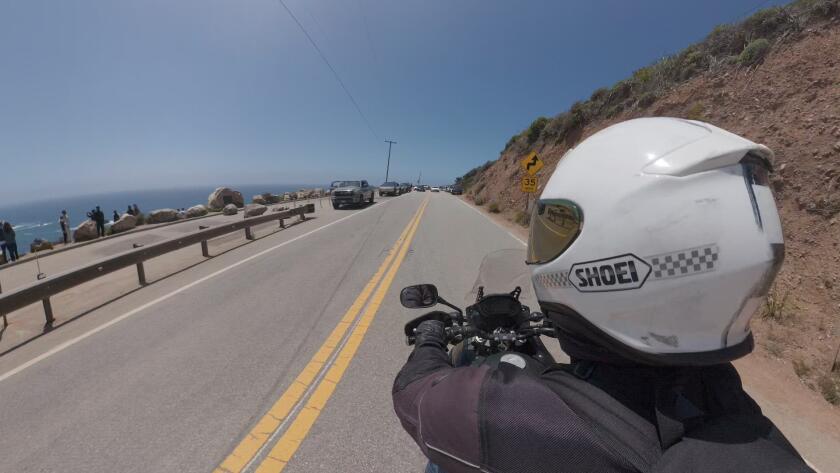
Traffic approaching Bixby Bridge.

A visitor poses in an oversized chair at Big Sur River Inn.
Even at the New Camaldoli Hermitage, a Benedictine monastery above Lucia, the road’s reopening and coming summer season have made a difference. Bookings are up an estimated 30% at the hermitage, which rent rooms and cottages (for two nights or more) to visitors who agree to its requirement of silence.
Big Sur business owners advise visitors to travel on weekdays for less traffic and the best hotel rates, and to get on the road as early as possible.
Since its opening in 1937, the highway has been vulnerable to landslides and shifting ground, operating on a longstanding cycle of landslide, closure, repair, reopening and then another landslide, or sometimes a fire. The U.S. Geological Survey has identified the Big Sur coastline as one of the most landslide-prone areas in the western United States. The 2023-2026 closure was the longest in the highway’s history.
Over time, road crews have used increasingly sophisticated strategies. In the most recent efforts, Caltrans said, it used drones to help survey the slopes and remotely operated bulldozers and excavators to reduce risks to workers.
During the closure, no traffic was allowed on 6.8-mile span from just north of Lucia until about a mile south of the Esalen Institute. Drivers detoured inland by way of U.S. 101.

Correspondents of CBS’ 60 Minutes pose for a portrait in 2023. From left to right, they are Sharyn Alfonsi, L. Jon Wertheim, Bill Whitaker, Lesley Stahl, Scott Pelley, Cecilia Vega, and Anderson Cooper. Former Executive Producer Bill Owens sits on the far right. Only Wertheim, Whitaker and Stahl remain at the program.
CBS Photo Archive/CBS via Getty Images/CBS
hide caption
toggle caption
CBS Photo Archive/CBS via Getty Images/CBS
Stay up to date with our Up First newsletter sent every weekday morning.
When CBS fired Scott Pelley on Tuesday night, the new 60 Minutes executive producer, Nick Bilton, told Pelley it was for insubordination at a staff meeting the day before.
The veteran correspondent argues he was defending the DNA of 60 Minutes and the integrity of its journalism.
The battle royale over the network’s most prestigious and profitable news program is part of a broader fight over the direction of CBS News.
And given CBS’s acquisition by a billionaire family whose business interests have become intertwined with the political interests of President Trump, it reflects a larger war over control of the media in the current moment.

That father and son, Larry and David Ellison, bought CBS’ parent company, Paramount, last summer. In January, they became co-owners of TikTok’s U.S. operations. Now they’re seeking approval from Trump’s regulators to buy Warner Bros. Discovery, the parent company of CNN.
A glamorous show shorn, for now, of most its stars

CBS fired Cecilia Vega, a correspondent, and Tanya Simon, the executive producer, from 60 Minutes last week. They are shown in this photo at the 2026 White House Correspondents’ Association Dinner on April 25, 2026 in Washington, D.C.
Kristina Bumphrey/Variety via Getty Images/Variety
hide caption
toggle caption
Kristina Bumphrey/Variety via Getty Images/Variety
But the specifics of this individual episode matter — for 60 Minutes, CBS, its audience of millions, and even the news business itself.
The program has been the most glamorous post in broadcast news. The correspondents are the stars of the show. And now, there are just three of them.
Anderson Cooper left last month, concerned over the direction of the network’s coverage. Last week was a virtual bloodbath: correspondents Cecilia Vega and Sharyn Alfonsi were fired. So were a producer and two show executives — including Tanya Simon, a longtime staffer who had stepped up as executive producer when her predecessor resigned in protest before the Ellisons’ takeover.

With Pelley’s ouster, only correspondents Lesley Stahl, Bill Whitaker, and Jon Wertheim remain. Now they are considering whether to resign, according to two associates with knowledge.
Their brand-new boss, Bilton, was previously a tech reporter for The New York Times and an investigative reporter for Vanity Fair. He executive-produced a documentary for Netflix about a couple accused of laundering Bitcoin and has been a producer on several other films.
Notably, he has no experience in television news.
Neither does Bari Weiss, whom David Ellison installed as the network’s editor in chief last October. The Ellisons also bought her center-right views-and-news site, The Free Press.
She has maintained that the network of Walter Cronkite needs a makeover for the digital moment. She has also contended for years that CBS, along with the rest of mainstream media, is too reflexively anti-Trump, anti-Israel, and too woke.
A rejection of CBS News executives’ overtures

The new executive producer of 60 Minutes, Nick Bilton, has been a tech journalist and documentary filmmaker, but lacks experience in broadcast news.
Matt Winkelmeyer/Getty Images/Getty Images North America
hide caption
toggle caption
Matt Winkelmeyer/Getty Images/Getty Images North America
Bilton attempted to set a conciliatory tone at Monday’s meeting — his first with the show. Pelley, a formidable veteran correspondent and former CBS Evening News anchor, wasn’t having it.
Pelley called Bilton unwelcome and unqualified. And Pelley said that Weiss was attempting to “murder” the program.
In firing Pelley on Tuesday, Bilton said the journalist had hijacked the meeting and rejected overtures to work constructively through their differences. (NPR obtained a copy of the firing notice.) Bilton wrote that Pelley’s “antipathy to the future of the show came through loud and clear.”
In his own statement late Tuesday evening, shared with NPR, Pelley accused CBS’s new news leadership of killing 60 Minutes‘ DNA and pushing him “to inject falsehoods and bias into a politically sensitive story” and “to include assertions that are unverified.”
The accusations, to which CBS has not yet responded, echo those made by Alfonsi and Vega, the two correspondents fired last week.
Earlier this year, Alfonsi publicly complained after Weiss held one of her stories at the last minute, and kept it frozen for weeks, demanding an on-camera interview with a Trump White House official that never played out. It ran, unchanged from the intended version, with additional statements from the administration tacked on to the end.
After being fired, Vega said in a statement obtained by NPR that her team had “experienced efforts to insert political bias into our stories.”
“Let’s call this what it is: censorship, both censorship and self-driven” Vega continued. “It is dangerous for the show and dangerous for democracy.”
Weiss previously rejected Alfonsi’s and Vega’s allegations. (CBS said Vega’s claims, for example, were “not based in reality” while expressing appreciation for her work.)
Weiss and Bilton say digital threat requires a 60 Minutes overhaul now
In a meeting this morning, Weiss said that Pelley chose his own path — that is, to be fired rather than to find a way to work through his concerns, according to attendees. The network and Weiss have not yet publicly addressed Pelley’s accusations of interference.
Bilton and Weiss say they respect the show’s traditions, its accomplishments and its legacy of enterprise reporting, extended interviews and visual storytelling. It rose in the ratings 9% over the past season under Simon.
The two news leaders say, however, 60 Minutes needs to be overhauled before it becomes increasingly irrelevant in the era of streamers and other sources of news, information and entertainment in the digital age.
Interviews with 12 current and former CBS News staffers, from producers to executives, suggest great reservations and suspicions remain about Weiss’ judgment and her ability to handle the prominent and even famous journalists on whom her division relies.
Weiss had initially sought to reinvent the CBS Evening News, dropping a two-anchor format that had sagged in the ratings. Cooper turned down Weiss’ overtures to anchor it and left the network altogether, concerned about her approach, according to associates. (They spoke on condition of anonymity because Cooper has not chosen to speak publicly on the matter.)

David Ellison became chairman and CEO of CBS’ parent company, Paramount, after buying it last year.
Noam Galai/Getty Images for Paramount/Getty Images North America
hide caption
toggle caption
Noam Galai/Getty Images for Paramount/Getty Images North America
The ratings have continued to sag under new anchor Tony Dokoupil. And some CBS journalists, including producers who have left the Evening News, have publicly accused Weiss of making editorial decisions driven by politics. She has rejected those claims.
The decision to take on overhauling two key shows — one listing, one highly profitable, both high profile — carries significant risks for Weiss and the network, even apart from other considerations.
But the Ellisons’ presence cannot be ignored.

When Shari Redstone was negotiating the sale of CBS’s parent company, Paramount, to the Ellisons’ Skydance Media last year, the network announced the end of Stephen Colbert’s late night show. He had been one of the president’s most biting and acerbic critics.
David Ellison also made a series of concessions directly to Trump’s chief broadcast regulator, Federal Communications Commission Chair Brendan Carr, gutting CBS’s diversity, equity and inclusion initiatives and appointing a conservative ombudsman to field complaints of bias against its news reporting.
Carr and other regulators approved the Paramount deal last summer.
The accommodations echo those made by other media titans.
Amazon and Blue Origin founder Jeff Bezos remade the editorial pages of the Washington Post, which he owns, into a far more hospitable zone for Trump at the outset of his second term. So did Los Angeles Times owner Dr. Patrick Soon-Shiong, a noted medical device inventor. Amazon and Blue Origin have multi-billion dollar contracts with the federal government. Soon-Shiong’s medical research firm routinely has patent applications up for review with federal regulators. One was approved Tuesday.
The Ellisons are hoping to win approval from federal regulators next month for their purchase of Warner Bros. Discovery in a deal valued at more than $110 billion. It would include Warner Bros. Studio, HBO and CNN, among other properties.
As Weiss routs CBS News’ old guard, the question of what role she might play at CNN — and what changes that portends at CBS — hangs over journalists at the two networks. The fate of 60 Minutes serves as a high-stakes case study for both.
-

 Maryland35 seconds ago
Spotted lanternflies are reemerging in Maryland. Here’s what to know.
-
 Michigan6 minutes ago
2 historic Michigan lighthouses to split $120K in preservation grants
-

 Massachusetts13 minutes ago
Karen Read files lawsuit against Massachusetts State Police and Canton Police
-

 Minnesota16 minutes ago
School bus company’s inspection history in question after kids hurt in Hamline University crash
-

 Mississippi21 minutes ago
Ferris, West to discuss Mississippi folk artists at UM Museum – The Oxford Eagle
-

 Missouri28 minutes ago
American Shaman agrees to suspend kratom sales in Missouri
-

 Montana31 minutes ago
Montana Supreme Court Decides International Child Custody Case – Transnational Litigation Blog
-

 Nebraska36 minutes ago
Big Ten coaches give strange quotes about Nebraska football

