Short, no-equipment workouts are racking up billions of views as consumers ditch traditional gym routines for fast, accessible fitness that fits into everyday life
Gym membership might be at an all-time high, but there’s a whole population of people going after their workout goals without a a traditional location or routine.
Just as people are drawn to short-form content on social media, they’re also gravitating toward short-form fitness — also known as “exercise snacks.”
Data from AI-powered analytics platform Virlo scoured more than 1,000 online videos with more than 2.2 billion views, finding that 5–15 minute routines on social media are outperforming traditional gym content, achieving higher engagement as they lower friction and make fitness feel immediately achievable.
Over three-quarters (76%) of trending fitness content across TikTok, Instagram and YouTube was no-equipment workouts that catered to audiences short on time, the report found.
Within that content, videos pushing specific body part targeting and transformation — especially abs, glutes and arms — had three to five times more engagement, while phrases like “no equipment,” “home workout” and “do anywhere” amplified shares. Videos that promised results within a certain number of days or expressed urgency (“lose fat fast” or “10 days to abs”) also saw higher views, especially repeat visits.
Advertisement
The trend reflects a broader shift online toward low-commitment, accessible and quick-results fitness that can seamlessly fit into the confines of everyday life. The videos are typically being posted by “micro-creators” without huge followings who post relatively simple routines.
These mini workouts appeal to the ubiquitous desire for instant gratification, while reducing the intimidation of structured gym routines, potentially increasing the chance of people who might not work out at all engaging in some form of exercise.
While the credibility of these creators’ claims to transform body composition in short windows with these movements is up unknown, there is science backing the effectiveness of exercise snacks.
A meta-analysis from last year found that short, structured bouts of movement — about five minutes of moderate-to-vigorous exercise — significantly improved cardiovascular fitness in adults, and slightly improved endurance among older adults, supporting the idea that any movement is better than none, especially if it lowers the barrier to entry to exercise.
Lenny Kravitz has shared the secret to his incredible physique, but it’s not what you’d expect.
Alongside his intensive workout regimen, what the 62-year-old singer wears while working out also plays a huge role in keeping him in check – namely, his famed leather pants.
Lenny Kravitz works out just as he performs: in leather pants. Adam Berry
The star is known for performing in tight, restrictive outfits like denim and leather, and it makes sense to him to train in the same materials.
“I perform onstage in leather, denim, whatever, so those are the pants I wear to train,” he recently told Men’s Health.
Advertisement
“It also means I can fit in a workout anytime, anywhere.”
It was words from his good friend Denzel Washington that gave him the idea, sharing that the actor told him, “The pants don’t lie.”
“I can gauge everything by how I’m in my pants,” he said.
“Like, if my pants are a little tight, I know I’m getting outta’ shape.”
Kravitz is not the only health-conscious celebrity with a wacky approach to fitness.
Advertisement
Mark Wahlberg previously revealed his crazily early wake-up time to squeeze a workout in.
The 62-year-old prefers working out in restrictive materials. Instagram/@lennykravitz
In 2022, the actor shared the details of his workout schedule with a photographer on the streets of New York.
“Tomorrow I’m getting up [at] 2.30, in the gym [by] 3.30, finish about 5.30, go to work 7.30,” he said, as per Fox News.
He also shared the rest of his bizarre routine to his Instagram stories back in 2018. It read:
Mark Wahlberg wakes up incredibly early to get to the gym. Instagram
2:30am wake up
2:45am prayer time
3:15am breakfast
3:40 – 5.15am workout
5:30am post-workout meal
6:00am shower
8:00am snack
9:30am cryo chamber recovery
10:30am snack
11:00am family time/meetings/work calls
1:00pm lunch
2:00pm meetings/work calls
3:30pm pick up kids @school
3.30pm snack
4:00pm workout
5:00pm shower
5:30pm dinner/family time
7.30pm bedtime
Fans were shocked by the early bedtime, though it makes sense with his early start time.
Meanwhile, The Hills star Audrina Patridge swears by an unusual hack for a home workout while making the most of her time: vacuuming in heels.
Advertisement
Audrina Patridge swears by vacuuming in heels for an at-home workout. Getty
“When I’m sitting in front of the TV, I lift five-pound weights or do squats,” she said, as per Just Jared.
“And I wear heels when I vacuum because it works my calves and my butt.”
Liam Gallagher is another celebrity with a peculiar workout habit, having been spotted by The Sun running backwards on the streets of north London in 2014.
Liam Gallagher was once spotted running backwards in London Getty
The Oasis star took part in the “retro running” trend, which has been used widely by athletes who play sports where they need to go in multiple directions.
The exercise targets different muscle groups and agility.
“We naturally lose muscle mass, reaction speed and balance as we age,” says this elite Hollywood coach who’s trained everyone from Margot Robbie and Scarlet Johansson to Richard Madden and Pedro Pascal — but recommends doing step-ups to undo the damage of aging in your glutes, quads and calves
There’s a reason why some of the most effective exercises tend to mirror movements in real life. It’s not because personal trainers and coaches lack imagination, but because the body doesn’t care how creative your programming is — it cares whether you can climb a flight of stairs without grabbing the banister, for example, or if you can catch yourself from a stumble.
These are just a few of the benchmarks that matter in later life, and for elite performance coach David Higgins — who has trained everyone from Margot Robbie and Scarlett Johansson to Samuel L. Jackson, David Harbour, Game of Thrones’ Richard Madden and the entire cast of The Batman, among many others — one exercise sits at the top of the list for anyone over 50: the step-up. Here’s why.
Lower-body power matters so much after 50
Most people understand that strength declines with age. What they underestimate, however, is how quickly it begins to matter in practical terms, despite not being able to be measured on the best smartwatches’ fitness age metrics.
Latest Videos From
“Lower body power becomes critical after 50 because we naturally lose muscle mass, reaction speed and balance as we age,” says Higgins. “The glutes, quads and calves are what keep you upright, stable and independent.”
If you can’t generate force through the floor, he says, “everyday movements like climbing stairs, getting out of a chair or catching yourself from a fall become harder.” The step-up addresses all of this in a single movement: “it trains strength, balance and coordination all at once and mirrors real life better than most gym exercises.” It’s slightly similar to the farmer’s carry, an application of a real-life movement.
It’s also the reason Higgins places it above more popular alternatives. Walking is excellent, of course, but doesn’t load the body enough to preserve muscle. Squats are bilateral — they share the work equally between both legs, which means they don’t expose or address the kind of side-to-side imbalances that tend to develop quietly over decades. Step-ups, however, are unilateral, as each leg works independently, building the stability and gait mechanics that bilateral training misses.
“If I could only choose one lower-body movement after 50,” says Higgins, “step-ups would be near the top because they combine strength, stability, balance, gait mechanics and unilateral control in one movement; they bridge the gap between rehab and performance.”
Sign up for breaking news, reviews, opinion, top tech deals, and more.
Watch the tutorial video below for advice on how to do a step up:
The mistake most older adults make
Before thinking about adding height, load or additional reps, Higgins is more concerned with something more fundamental: the quality of the movement itself. “The biggest mistake older adults make is chasing fatigue instead of quality movement,” he says. “Rushing through reps, leaning through the hips, or pushing through the stronger side of the body.” Your nervous system, he says, “has to trust the movement before your body can own it.”
Advertisement
Rushing through step-ups doesn’t just reduce the benefit — it reinforces the compensations you’re trying to correct. If you’re relying on the trailing leg to push you up, or leaning forward as you step, you’re not actually building the unilateral strength and hip control the exercise is there to develop.
Instead, Higgins’ coaching cue is worth memorising: “push the floor away and finish tall through the glutes.” Most people pull themselves up through the knee, instead of driving through the hip. It’s a subtle distinction, but makes an enormous difference to where the effort is actually made.
How to get started — and when to progress
(Image credit: Getty Images / Ildar Abulkhanov)
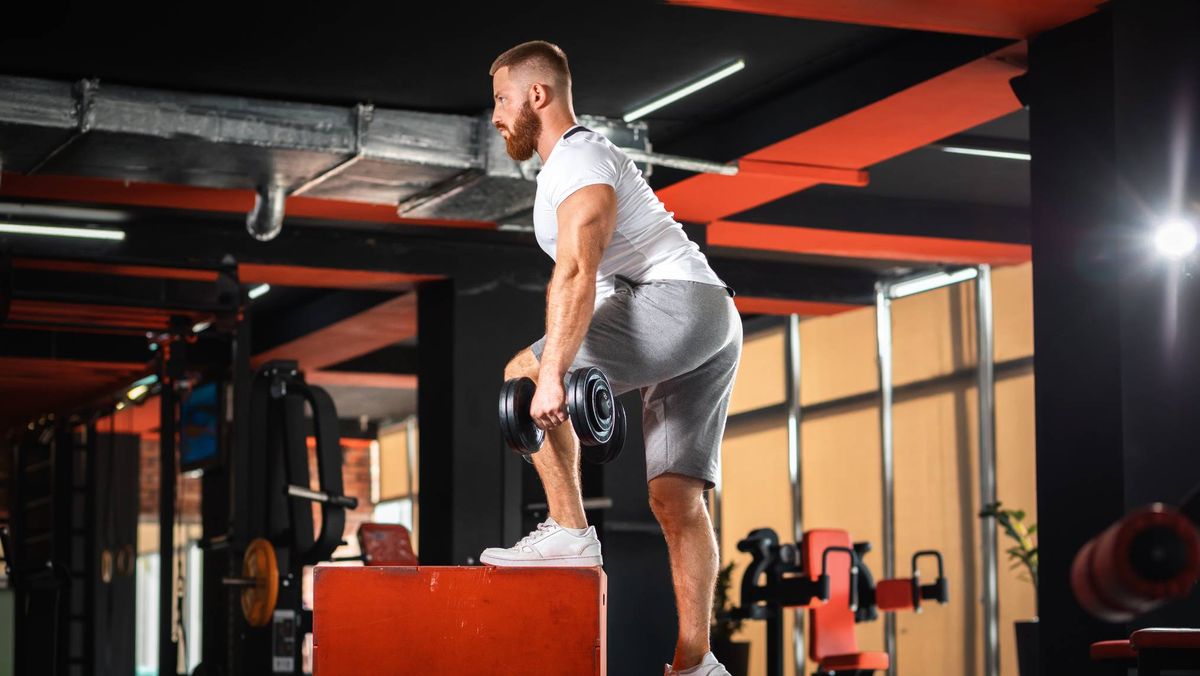
To perform the step-up, stand facing a sturdy bench, box, or step. Place one foot fully on the platform, then drive through that heel to lift your body up until both feet are on the step. Step back down with control and repeat for the desired reps before switching legs. Keep your chest up and avoid pushing off excessively with the trailing leg.
For step height, beginners should start with a low box, roughly ankle to mid-shin height. “You want control, not compensation,” he says. Fitter adults with solid mobility, balance and hip control can work up to knee height.
Advertisement
As for volume, Higgins prescribes 2–3 sets of 8–12 controlled reps per leg. “Tempo matters more than volume,” he says. Drive through the whole foot, stand tall at the top and lower slowly under control.
Higgins confirms that just your bodyweight is sufficient resistance to begin with and, for many people over 50, it’s exactly where they should stay — probably for longer than they’d expect. “Most people over 50 need to relearn movement patterns before adding load,” he says. “Once control, balance and posture improve, adding dumbbells or a weighted vest is a brilliant progression.” The dumbbells can wait. As for frequency? Two to three sessions a week is enough to see real benefit, Higgins says. “Consistency beats intensity every time.”
Precautions
Step-ups are accessible to most people, but Higgins flags a few situations worth considering. Anyone with severe knee osteoarthritis, significant balance issues or acute hip pain should approach the exercise carefully and ideally with professional guidance. “Often it’s not that the exercise is wrong,” he says, “it’s that the height is too ambitious or the body isn’t controlling the movement properly yet.” Low and slow is always the right answer.
What leg-day moves are your go-tos in the gym? Have you tried the step-up yet? Let us know below.
Follow TechRadar on Google News andadd us as a preferred source to get our expert news, reviews, and opinion in your feeds.
HFA urges targeted trade policies to protect the fitness industry.
This week, HFA submitted comments to the Office of the US Trade Representative (USTR) on two important trade policy dockets that could have significant implications for exercise equipment manufacturers, suppliers, and fitness facility operators.
Section 301 Tariff Proceeding USTR sought comment on proposed tariffs from its Section 301 forced labor investigation, including possible product exclusions based on domestic availability and economic impact.
HFA submitted comments that advocated excluding exercise/rehabilitation equipment and critical components, citing irreplaceable global supply chains and the industry’s role in public health, chronic disease prevention, and military readiness.
US- China Board of Trade
Advertisement
USTR proposed a new Board to identify non-sensitive products for reciprocal tariff reductions with China.
In comments submitted to USTR, HFA recommended designating exercise equipment as “non-sensitive” and eligible for negotiation, prioritizing products that boost US manufacturing and affordability, and setting criteria recognizing public health, productivity, and military readiness benefits.
The HFA thanks member operators, manufacturers, and suppliers whose data strengthened these submissions. Your efforts are helping HFA advocate for trade policy that supports the fitness industry.