Entertainment
Finn Wolfhard is taking ‘control of the narrative’

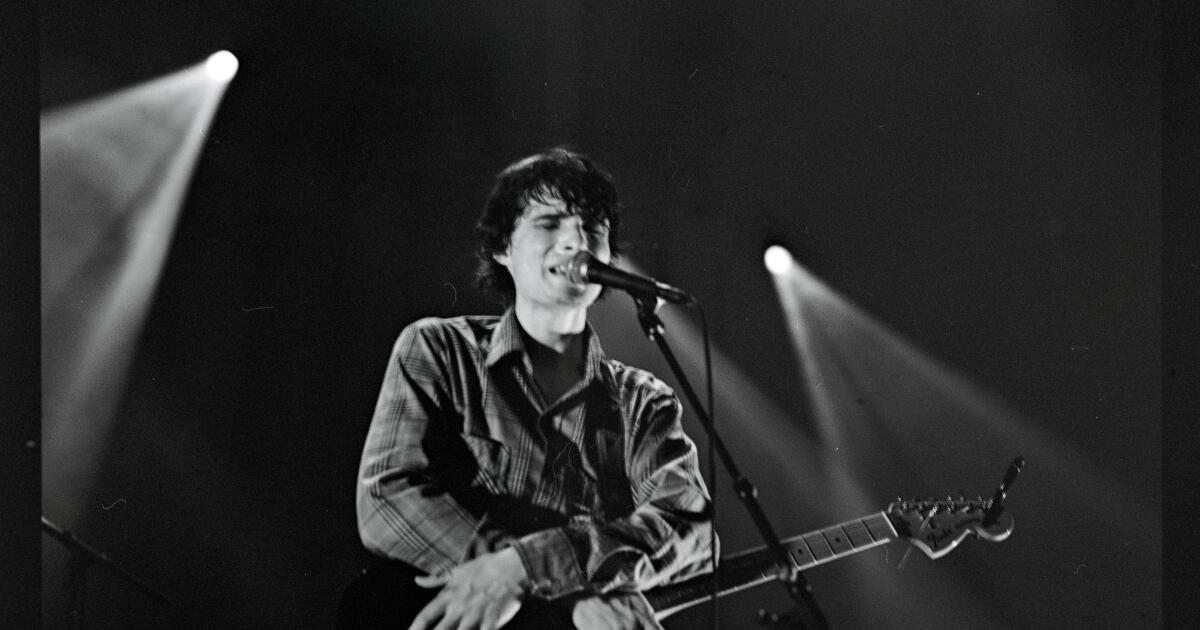
Thinking back on the last two years of his life full of album releases, filming schedules and tour dates, Finn Wolfhard requires squint-inducing concentration to keep it all straight.
“Jesus, a lot has happened,” he says, looking surprised. That’s an understatement.
In that time, the 23-year-old not only finished filming the Netflix hit show “Stranger Things,” which catapulted him to global stardom, and promoted the final season upon its premiere. He also released his feature film directorial debut (“Hell of a Summer,” co-directed with Billy Bryk, which hit theaters in April 2025). Then, he starred in another movie (A24’s creature feature “The Legend of Ochi”), directed a posthumous George Harrison stop-motion music video, wrote, recorded and put out his first solo album (“Happy Birthday”), and embarked on a 22-date tour before recording a new album.
On a video call from his family home in Vancouver, Canada, where he lives with his parents and older brother, he’s chatting about the release of that record, the eclectic, guitar-driven “Fire From the Hip,” which dropped Friday.
“I think it’s a nice day?” he offers when I ask what’s happening in Vancouver. “I don’t know. I’ve been in my basement studio all day, so I don’t … I think it’s nice.”
He’s been down in the basement doing press calls like this, he explains, undoubtedly a familiar routine after so many years in the limelight. He wears a baseball cap and an oversize brown sweater, tugging on the sleeves while he ponders.
Even if Wolfhard is exhausted by the press marathon, he doesn’t show it. He’s excited for the chance to be known on his own terms. He never fails to express gratitude for the projects that afforded him recognition and opportunity, but he’s ready to “take control of the narrative.”
“I spent my whole childhood standing on marks that other people told me to stand on and saying lines that other people told me to say,” he says. “Why wouldn’t I want to make my own stuff?”
Being in control also means being the face of the operation. Before “Happy Birthday” and “Fire From the Hip,” Wolfhard released a total of two records and an EP, plus a whole bunch of singles, with his previous bands, Calpurnia and the Aubreys. Being in a band was a natural fit for Wolfhard, who thrives in an ensemble where he can “hide behind the band name.”
Touring last year was his first time seeing his own name on the marquee.
“It’s just straight up me, and if I suck, I suck,” he laughs. “It’s not like I can be like, ‘Oh, man, we’re having disagreements in the band.’ It’s like, no, that’s you. So there was a little more pressure early on.”
Finn Wolfhard released “Fire From the Hip” on Friday.
(Victoria Stevens)
Stepping into the spotlight required Wolfhard, who admits he shies away from conflict, to own both the pressure and the power of being the one audiences came to hear.
When he got sick and had to cancel a show in Portland, Ore., he remembers feeling crushingly sad “letting down” his fans and bandmates — who, of course, assured him it was outside of his control and urged him not to be so hard on himself.
Wolfhard introduced many of the songs that ended up becoming “Fire From the Hip” to his bandmates while they were still on tour, and he says playing them live “cultivated the spirit” of the eventual recordings. Despite his collaborative ethos, there was a moment during the process where he had to learn how to put his foot down in real time.
“I remember suggesting something and people being like, ‘Ah, I don’t know if I want to do that.’ And I was like, ‘No, you don’t get to do that to me. It’s my record,’” he remembers. “It was very innocent — I don’t think there was much ego on either side. But I think I maybe set up too collaborative of an experience that day.”
“I think I sometimes make it feel like a democracy, which it is in a lot of ways,” he adds. “But also, in the end, it is up to me.”
That thought is echoed in the album’s cover art, an image of two miniature Finn Wolfhards facing off, donning colonial garb and brandishing weapons. It’s meant to represent dueling impulses inside of him, he explains.
Wolfhard, a true-blue music nerd, has been described online as an archetypical example of the “child of a Gen X cool dad,” in the same vein as Olivia Rodrigo. (His dad, a former screenwriter turned lawyer and Indigenous rights researcher, does sound cool, but it was his mom who first introduced him to the Beatles. His parents apparently met over a Stone Roses record.)
That sensibility is evident in his musical influences — “I wanted everything [on drums] to sound like the first two Wilco records,” he says — and in his approach to recording. “Happy Birthday” was recorded almost entirely on four-track cassette tapes, while “Fire From the Hip” uses 24-track reel-to-reel.
The album runs the gamut from its cheeky, surf-rock opener “I’ll Let You Finish” (yes, that is a reference to Kanye West’s infamous speech at the 2009 VMAs) to more ’90s alt-inspired tunes to a surprising dose of straightforward country-folk.

Lyrically, Wolfhard divides his songs into two categories: the “very personal” and the story songs written around books he was reading (“Knockemstiff” by Donald Ray Pollock) or quotes that made him laugh. The personal themes he explores are exactly what you would expect from an early-20s rocker raised in the public eye — namely, relationship expectations and existential fears about the future.
On the nostalgic piano ballad “Good Morning,” he imagines what it might be like to settle down somewhere “with a dog and a wife.”
“I haven’t lived that part of my life yet,” he says now. “So I can really easily get lost in thinking about what that looks like.”
When it comes to sharing his music, especially the more vulnerable tracks, Wolfhard knows his “Stranger Things” fame is the elephant in the room. Anything he sings can and might be used against him in the court of public opinion.
“I could either kind of say nothing and be totally private, because it is scary knowing that everything I say, at least one person will take it a certain way that I wouldn’t want them to. But I just don’t have the control,” he says.
“So if I don’t have the control, then there’s nothing really that I can do, other than try to be as truthful and passionate and well-meaning as I possibly can, you know?”
The double-edged sword of fandom hasn’t stopped Wolfhard or his musically-inclined “Stranger Things” co-stars from pursuing this path. Fellow Hawkins alums Joe Keery (who releases music under the moniker Djo) and Maya Hawke are indie darlings in their own right, and Wolfhard has previously referred to Keery as a mentor. None of them face the unique challenge of relatability in quite the same way, however.
“I’m aware that my specific problems are maybe not as relatable because of how specific of a life I have,” he said. “The only thing I can hope for is that some other person out there listens to it and relates to the same things that I do.”
Sometimes an air of wistfulness accompanies these admissions. When asked about how he feels about Los Angeles, he tells me that it’s complicated: “I think if I wasn’t a young actor, it would be a very different situation.” His favorite parts of the city are its repertory cinemas and lush neighborhoods like Mount Washington, where his godfather resides, because they look the most like Vancouver.
That said, he’s not through with Hollywood. He’ll be back in L.A. for an Oct. 13 show at the Fonda Theatre, and acting and directing are still on the agenda. He would like his next film project — other than the Matt Johnson and Bong Joon Ho projects he’s already committed to, of course — to be something more “personal.”
For now, though, the focus is music. Wolfhard launches a new tour this month, and he’s most looking forward to “doing dumb s—” with his friends.
He tells a quick story to illustrate: When he and the band last toured in Glasgow, Scotland, he was trying to leave the venue without being noticed. (“I have a hard time dealing with fan interaction,” he says.)
“We kind of made it into this joke thing, knowing it wouldn’t work, where me and Rand, my guitarist, were like, ‘let’s switch clothes.’ Rand pretended to be me and I pretended to be Rand,” he says. Miraculously, it worked up until the “very last second” before they stepped on the bus.
“I couldn’t help myself,” he says: He instinctively made eye contact with someone in the crowd. “They did a double take, like, ‘Wait, what?’”
It sounds like a scene straight out of “A Hard Day’s Night” — or maybe inspiration for his next film.
“I’m pretty in my head about things and want them to be a certain way,” he says. “The thing that I have to remind myself all the time is that, like, dude, you’re with your friends, you’re playing music — it’s the best.”

Movie Reviews
‘Fruit Gathering’ Review: A Factory Worker Falls for Her Female Colleague in a Delicate Burmese Debut

Caught between rural roots and urban opportunities, familial duty, friendship and forbidden carnal desire, young San Kyi (Nandar Myat Aung) struggles to find her place in Fruit Gathering, a sensitive Myanmar-Czechia-France co-production that just won Karlovy Vary’s top prize.
That’s an impressive achievement for Burmese writer-director Aung Phyoe, making his feature debut after several shorts. His flair for blending realist drama with more poetic, painterly imagery makes for a dreamy, hypnotic viewing experience, eased along by a confident, open-hearted performance from Nandar Myat Aung in the lead role. Fruit Gathering will be ripe for picking at further festivals, especially ones specializing in Asian and/or LGBTQ+ fare, possibly followed by niche distribution.
Fruit Gathering
The Bottom Line Juicy but not too sweet.
Venue: Karlovy Vary Film Festival
Cast: Nandar Myat Aung, Nandar Myint Lwin, Tin Tin Ei, Thida Soe Khant, Wutt Yeet Kyaw, Htet Aung Lynn, Khet Suu Myat, Min Nyo, Zun Pwint Phyu
Director/screenwriter: Aung Phyoe
1 hour 37 minutes
Self-transplanted with her mother (Tin Tin Ei) and grandmother from the countryside to industry-rich Yangon, San Kyi has so far managed to resist the pressure from her mom to get married or pursue a career in something upmarket like tech. Instead, eager for a job that doesn’t demand too much thinking, San Kyi works in a massive clothing factory, sewing seams all day in a ferociously noisy, scrap-strewn environment where the supervisor gets snotty if she takes a bathroom break without seeking permission first.
Incidentally, while the factory hardly looks inviting, the conditions don’t seem to be too bad compared to those seen in older documentaries about East and South Asian sweatshops. They’re comparable to what’s on display in, say, Chinese director Wang Bing’s doc Youth but without the company-owned residential housing. At least the workers are allowed to submit petitions circulated by labor organizers requesting better pay and more safety measures, although tellingly San Kyi refuses to sign lest she might get fired for it. A union leader (Wutt Yee Kyaw) pours scorn on her for not showing more solidarity with her colleagues.
Later, after she’s injured herself by a sewing accident, San Kyi will rethink her position on workers’ rights, but industrial relations in the textile industry are not the film’s main focus. It’s all background color, as much a part of the vivid landscape as the interludes where we see San Kyi back home visiting the mango farms and spirit-dance ceremonies of her agrarian childhood.
At least it’s at this factory that San Kyi meets Theint Theint Oo (Nandar Myint Lwin), a young co-worker around the same age as San Kyi with a radiant smile and street sense to burn. The two young women start out just hanging together during their lunch breaks but soon grow inseparable. The script suggests early on that Theint Theint may be the kind of pal who always forgets to bring enough cash for dinner. A darker interpretation might posit that she sees San Kyi as little more than a mark, but the truth probably falls somewhere in a grayer area.
Either way, by the time San Kyi is buying nearly identical blouses for the two of them to wear on strolls around town, it’s pretty clear that she’s smitten with Theint Theint. The latter is ambiguously flirtatious and keen to have languid girls’ night sleepovers in the same bed, but also open about the fact that she’s got a man in the background, who is conveniently always away working in another country. Afraid of losing her new limerent object of desire, San Kyi entertains the thought of going abroad with Theint Theint to work as housekeepers or factory workers in somewhere affluent like Singapore or Malaysia.
Clearly, things are heading for a smash up when San Kyi lends Theint Theint a substantial amount of money. Somehow the tension is heightened by the fact that Theint Theint gets closer to San Kyi’s family, even accepting a job offer that comes through the local guy whom San Kyi’s mom was trying to set San Kyi up with as a potential husband. It all serves to underscore how narrowly female relationships are usually defined in highly traditional, painfully patriarchal Myanmar society. The intense feeling between these two young women could never be openly romantic, although no one bats an eye when they walk hand and hand through the streets, much the way Queen Victoria is said to have refused to sign legislation banning lesbianism because she wouldn’t acknowledge such a thing even existed.
Aung Phyoe suggests the messy, uncontrollable nature of desire via some slightly heavy-handed imagery of flooded apartments and generally juicy, watery, somewhat soluble imagery. But the story surprisingly shifts tack halfway through and becomes less interested in the two women’s relationship and more in San Kyi’s personal development, especially after some hard knocks change how she sees the world.
Every so often, the camera will linger on a tiny detail like a vase that has some emotional significance, or the light coming in a window. There’s a tiny hint that these cinematic still life pictures are being seen through San Kyi’s eyes, like scenes in a book told through limited third-person point of view. Indeed, there’s a faintly literary quality to the filmmaking, as if inspired by romance and high-brow fiction, but Aung Phyoe’s touch is feathery soft, as gentle as the soft thud of a mango falling from a tree.

Tom Segura and Christina Pazsitzky have reportedly split.
The comedy power couple are calling it quits after 18 years of marriage, according to TMZ. A source told the outlet that the pair separated a couple of months ago but remain amicable and plan to continue co-hosting their podcast, “Your Mom’s House.”
Reps for Segura and Pazsitzky did not immediately respond to The Times’ request for comment.
Segura, 47, and Pazsitzky, 50, tied the knot in November 2008. Segura told “TigerBelly” podcast in 2018 that he met Pazsitzky while they were both doing open mic nights around Los Angeles. She was in a relationship with someone else (whom she lived with), so Segura and Pazsitzky were just friends. According to Segura, there was no flirtation in the early days, and he treated her with the respect he did any other fellow comic.
“I always thought she was attractive, but she was taken,” he said. “And then I got the call from one of my spies. … They broke up. And I was like, ‘I’m gonna swing in there, see what’s up.’”
According to Segura, he tried to ask Pazsitzky on what he thought was an L.A.-appropriate date — a hike — and she said no. He thought that meant she wasn’t interested in him, when, really, she just wasn’t interested in hiking.
“I called her the next time, and she’s like, ‘Hey, I know this bar you can still smoke at. Do you want to go there?’ And I was like, ‘OK. This is why she doesn’t want to go on a hike.’ So then, yeah, we went on dates and it just continued.”
Both comedians have used their marriage as source material for their comedy routines over the years and discuss their relationship on various podcast appearances, but especially on their own podcast, “Your Mom’s House,” which debuted in 2012.
In 2024, Pazsitzky told The Times that when they launched the podcast “we lived in a crummy two-bedroom apartment, we were newlyweds and we had no money. We got a mixing board, two mics and a computer, and at that point, we slept in one room and used the other room as an office. It bordered this other house where this lady would cook the smelliest food and have aggressive sex.”
“Oh, yeah, she was newly divorced and very performative with orgasms too,” Segura added.
The couple, who have two children, also spoke about their relocation from Los Angeles to Austin, Texas, in search of a slower pace and easier travel while touring. “Our lives are very normal, and we’re grounded family people. At the end of the day, we come home, our kids fart on Tom’s head, and I make dinner.”

Olivia Wilde, Seth Rogen, Edward Norton and Penélope Cruz star in The Invite.
A24
hide caption
toggle caption
A24
The new comedy film The Invite centers on an unhappy married couple who host another couple — they live upstairs — for an uncomfortable, and revelatory, evening of dinner and charcuterie. The film’s screenwriters, Rashida Jones and Will McCormack, are actors who are also longtime writing and producing partners.
Jones and McCormack met decades ago, when McCormack’s sister (actor Mary McCormack) set them up on a date. It didn’t work out as a romantic pairing. Instead, it was the start of a long-running creative partnership.

“We’re really like brother and sister who dated briefly, which is not weird,” McCormack jokes. “I think we both knew right from the very beginning that we were connected and that we had to be in each other’s lives. And it took us a minute to sit down to write, but finally we did, and I’m so glad we did.”
Jones says she and McCormack share a voice: “The two of us have the same clip, the same rhythm, and we’re so different in so many ways, but we just kind of like fit like puzzle pieces conversationally very quickly, which is a wonderful thing to have with a writing partner.”
Inspired by the 2020 Spanish film The People Upstairs, The Invite takes place over the course of one night in a chicly appointed apartment in San Francisco. Two couples gather for dinner, and as the evening unfolds, the stories they’ve been telling themselves about their relationships and about themselves fall apart.
McCormack describes the film as a sex comedy that’s not really about sex. “It’s about wanting to be seen and heard and valued,” he says. “You live with someone for so long and it’s really hard.”
Jones says it’s no accident that their work tends to focus on relationships and middle age: “Selfishly, it’s great that we can channel the thing we’re most interested in, which is relationships, living with other people, being parents, losing parents, being alive, getting older, being middle-aged, looking straight down the barrel of the back half of life. All these things we got to bring to this script.”
Interview highlights

Will McCormack and Rashida Jones attend the Los Angeles premiere of The Invite on June 23, 2026.
Valerie Macon/AFP via Getty Images
hide caption
toggle caption
Valerie Macon/AFP via Getty Images
On their working relationship
Jones: We write separately. We write together. We’re in an open relationship as writers, a very healthy, open relationship. But when we come together, there’s a thing that happens.
McCormack: I think we always found the same things funny. … And I think also the same things sort of broke our hearts, and I think that we wanted to try to say something together. There were movies that appealed to us both, and there was a voice that we shared from the beginning. There was just an easy rapport.
On acting out the dialogue together as they’re writing it
Jones: Well, we act while we’re writing, but that’s our discovery process of dialogue because we’re lucky, we both started as actors and can do a good job with that. So often we act out the scenes and if it’s not working, it doesn’t feel right … that’s easy to fix.
On why they’re drawn to stories about heartache

McCormack: Life is really just a series of losses. It’s one loss and one heartbreak after another. When your little summer ends and you don’t want it to end, and then you get your heart broken, and then you have kids, and they’re gonna break your heart, and then your parents die and then [you] start to lose bone density. …
Those moments can actually be the funniest because they’re so raw. And it’s when we feel connected, right? Like, heartbreak is the thing that binds us. Like, no matter who you are or no matter where you are or no amount of how old you are, like you’re gonna go through heartache. … And to be able to dig into some of those moments with Rashida has just been such a gift, and I don’t take that for granted to be able to do that for a living.
On Quincy, her documentary about her dad, Quincy Jones, and experiencing anticipatory grief
Jones: I filmed for six years, and the second to last year of filming, he went into a diabetic coma, and we stopped filming, and luckily my brother filmed a little bit in the hospital because we were going to kind of show him what he had been through if and when he came out and we were so lucky he did come out at 82. … But having that moment where he was that close to death, and then deciding to put that in the film and show him overcoming that, I think was my way of sort of preparing for the inevitable, you know? And I was so lucky to have him for another nine years after that, but ultimately, I knew what was coming, and it was really a love letter to my dad, but also a way to hopefully reach out to other people and say, listen, we’re all going to go through this and we want to be honest about what it’s like for our family to come to the other side of this.

My dad is obviously an icon and a culture shifter, and he had been documented a lot before. And what I felt like people missed, because he’s so successful at what he did, was they missed his personality. They missed the personal side of him, which is a very important part to why he was successful. It’s not just his talent and his hard work, but he had this gift with people. And he had a way of relating and being honest and getting to the heart and the honesty of something and the intimacy of something so fast with a stranger, with his kids, with the people who loved him, the people didn’t know him. And I really wanted that to be on screen.
On what they bring out in each other
Jones: Will is like my closest chosen family in a way. … I don’t wanna get emotional, but I feel like Will, and I see the child versions of ourselves and can really take care of that little kid in each other, because we’re both very hard on ourselves. … We sort of like, very kind of gently, love and respect each other and give each other the benefit of the doubt that we might not give ourselves. And then, I think, born of that is this sort of thing that lives in the intersection between pain and humor, and maybe hopefully something divine, like hopefully we leave some room, as my dad always said, “for God to walk in the door,” because that’s really our job ultimately is to channel. And so hopefully there’s something about us coming together that allows that to happen.
McCormack: I don’t want to get emotional either, but what she said.
Ann Marie Baldonado and Susan Nyakundi produced and edited this interview for broadcast. Bridget Bentz, Molly Seavy-Nesper and Meghan Sullivan adapted it for the web.
-
 Lifestyle50 seconds ago
Why your favorite international artist might be reconsidering their next U.S. tour
-

 Technology13 minutes ago
Nintendo’s Switch 2 bundle that includes a game is $50 off
-

 World19 minutes ago
Inside Israel’s mission to train civilians to stop the next Oct 7-like terror attack
-

 Politics25 minutes ago
Trump reveals who he’s eyeing to replace Lindsey Graham
-

 Health31 minutes ago
Notable figures who died from the same heart condition linked to Lindsey Graham’s death
-

 Sports37 minutes ago
Folarin Balogun admits that red-card reversal affected USA World Cup teammates: ‘A lot of outside noise’
-

 Technology43 minutes ago
Humanoid robots perform live surgery in world first
-
 Business49 minutes ago
A ‘next generation studio’ for YouTube creators

