Finance
Financing opportunity: Q&A with Harold Pettigrew on the future of the CDFI Sector – Kresge Foundation

As the community finance field enters a new era—shaped by economic uncertainty, shifting capital flows, and growing calls for accountability—how can CDFIs prepare for what’s ahead? The Kresge Foundation spoke with Harold Pettigrew, the president and CEO of the Opportunity Finance Network (OFN) to help answer that question. This article is part of a series highlighting the impact of CDFIs and how the sector is adapting to the current environment.
MD: CDFIs play a unique role in our financial ecosystem, often serving communities that mainstream banks overlook. Why are CDFIs so critical for advancing economic growth and creating opportunities in underserved communities?
HP: In every corner of America, CDFIs show that impact and financial performance aren’t at odds—they reinforce each other. We address market gaps and go where traditional capital doesn’t: listening first, solving for need, and providing capital to people and financing projects that strengthen families and communities. Whether it’s a small business on Main Street or a housing development in a rural town, CDFIs make investments that build wealth and create opportunities that reach people and communities that need it most.
MD: CDFIs seem to have broad support in Congress, even when some administrations have looked to reduce funding or support. Is bipartisan support materially different today? What role has OFN played in telling the CDFI story and maintaining that support?
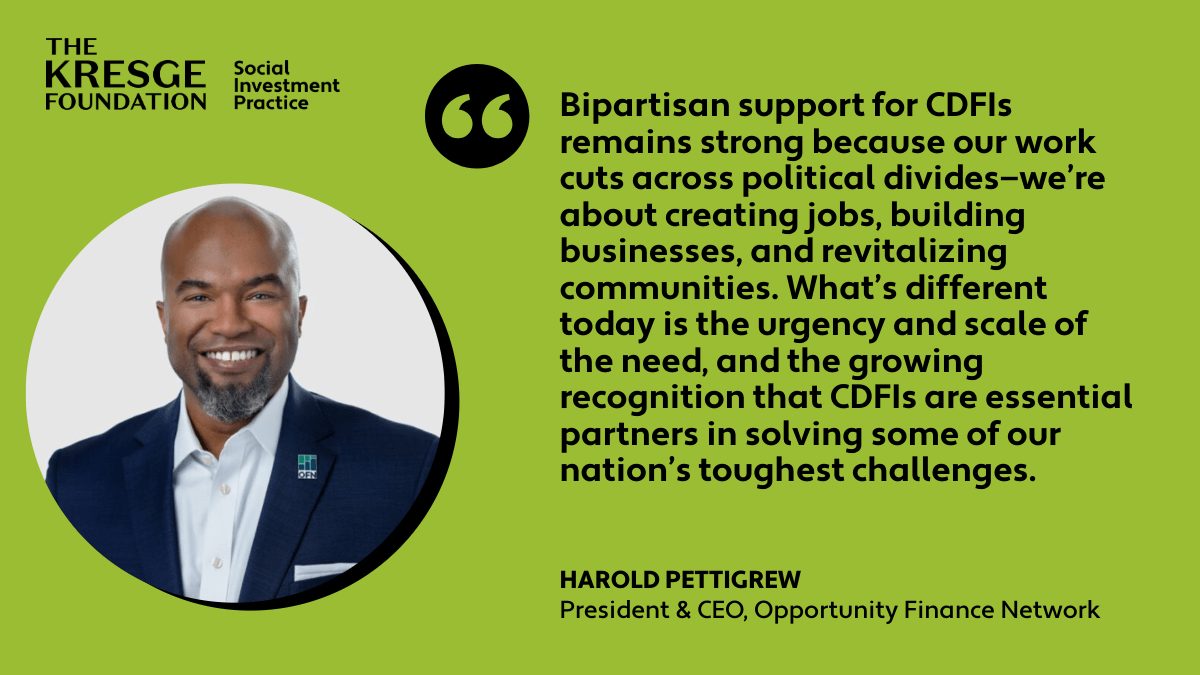
HP: Bipartisan support for CDFIs remains strong because our work cuts across political divides — we’re about creating jobs, building businesses and revitalizing communities. What’s different today is the urgency and scale of the need, and the growing recognition that CDFIs are essential partners in solving some of our nation’s toughest challenges. OFN and CDFIs tell real stories of impact—stories of people across the country whose lives and livelihoods have changed thanks to the capital provided by CDFIs. Through advocacy, research, and direct engagement with policymakers, we’ve elevated a clear, consistent message: For over 30 years, CDFIs have delivered results addressing market gaps in providing access to capital to communities across the country.
MD: Beyond federal funding concerns, what are the current challenges and needs CDFIs are facing in their day-to-day efforts to support communities?
HP: CDFIs are navigating a complex economic environment— rising interest rates, tighter capital markets, and growing community needs are stretching our resources like never before. Many CDFIs are being asked to do more with less, while also investing in their own operations to scale effectively and sustainably. OFN is working to develop diverse pools of flexible capital, make deeper investments in talent and technology, and new policy frameworks that support and recognize the unique value CDFIs bring. The demand is clear — what’s needed now is bold investments to meet the moment and craft new solutions for the future.
MD: Philanthropies and community development departments of banks and insurance companies have always been crucial partners for CDFIs — how can they best support and invest in CDFIs right now?
HP: Our partners in philanthropy and financial services have been critical to the success of CDFIs, and now they have a critical opportunity to strengthen the CDFI industry for the future. That means moving beyond transactional grantmaking to long-term, trust-based partnerships. It means offering flexible, risk-tolerant capital that lets CDFIs innovate and expand, and it means investing in the infrastructure — people, systems, data — that helps us operate at scale.
MD: What keeps you optimistic about the future of the CDFI sector?
HP: What keeps me optimistic is the impact and commitment I see every day, from the entrepreneurs we finance, to the communities we serve, to the CDFI leaders innovating with courage and conviction. The sector is growing, diversifying and deepening its impact. We’re not just responding to the moment — we’re helping define the future of expanded access to finance and financial services. And with every new loan, every new partnership, every life changed, we’re proving that when we expand access to opportunity — we don’t just finance projects, we shape the future of communities across the country.
Harold Pettigrew is the President and CEO of Opportunity Finance Network (OFN)


A girl from a disadvantaged rural family in central China topped this year’s gaokao, attracting numerous live-streamers eager to finance her education, which she declined.
The home of 18-year-old secondary school graduate Han Yaping in a Henan province village was recently bustling with live-streamers.
This attention came after Han achieved an impressive score of 699 out of 750 in the gaokao, China’s national college entrance exam.
She has received offers from China’s two leading universities, Tsinghua University and Peking University.
Han’s accomplishment is particularly remarkable given her family’s impoverished circumstances.
Her mother suffers from ankylosing spondylitis, an inflammatory arthritis affecting the spine, preventing her from working. Her father, who earns a living through farming and odd jobs, serves as the family’s sole provider. Han also has a younger sister.

The UK’s Financial Conduct Authority (FCA) published a landmark review on Monday that proposes recommendations to regulate the impact of artificial intelligence (AI) on the financial decisions made by consumers.
The review, titled the Mills Review, anticipates that both consumers and firms will start delegating “more financial decision-making to AI systems,” including for agreements, initiating transactions, and executing decisions “within agreed parameters.” One of the key findings of the review outlined that while AI can help bridge advice gaps and “support growth,” there remain risks “associated with fraud, cyber security, and consumer harm.” Conducting the review, Sheldon Mills highlighted that “AI can also amplify risks: bias, discrimination, exclusion, opaque decision-making (particularly when multiple AI models interact), misleading or hallucinatory advice and erosion of consumer trust.”
The review stated that presently, one in five adults in the UK are “already open to AI making decisions for them,” particularly when decisions feel “complex or high stakes.” It found that roughly 26 percent of the population “trust general-purpose tools such as ChatGPT, Claude or Gemini for financial advice” with little awareness that such platforms provide no “formal routes to recourse” or protections.
Overall, the Mills Review identified four areas that it anticipates will be impacted by AI in the financial sector: “the transformation of firms,” “new consumer journeys,” “a reshaped competition landscape,” and “amplified financial crime and cyber risk.” The FCA projected the shift in how consumers and firms consult AI to take place by 2030.
The Mills Review put forth seven “priority” recommendations to be considered by the FCA Board. It recommended that any transitions to autonomous AI models be monitored and that regulatory frameworks and perimeters be adapted and secured. The review called for the strengthening of “system-wide coordination and oversight,” the scaling up of the FCA’s AI Lab to enable it to support AI models and innovation for agentic finance, and an “AI-enabled agentic supervisory model” to be built and adopted. Finally, it recommended that a trusted “public-interest AI-enabled financial capability service” be developed.
The FCA announced, in the press release, that it will launch an AI “good and poor practice publication” in late 2026.
Finance
Fayette County Public Schools Board of Education approves audit contract, new finance director position

LEXINGTON, Ky. (WKYT) – The Fayette County Public Schools Board of Education approved a one-year audit contract capped at $131,750 plus $225 per hour during a virtual meeting Monday, along with a new finance director job description.
The contract is with Mauldin & Jenkins Certified Public Accountants, an Atlanta-based firm, and covers the 2025-26 fiscal year and the restatement of the 2024-25 fiscal year and ancillary services through FY 2029-2030. The work is set to be completed by Nov. 15.
The board approved the contract in a 5-0 vote.
Audit contract details
Interim Chief Financial Officer Kyna Koch said the cost is already accounted for in the district’s budget.
“And is actually less than we expected given our current situation — we were thrilled with the bid,” Koch said.
Koch said she believes this is Mauldin & Jenkins’ first school district audit in Kentucky, but that the firm works with school districts of more than 100,000 students throughout the Southeast.
“Quite frankly when I spoke to the folks at KDE they were thrilled because we’re running kind of short of auditors who want to do school district audits — so all around I think this was a win-win for everyone,” Koch said.
New finance director position
The board also approved a new job description for the position of Director of Finance. Acting Superintendent Dr. Bill Bradford said the title will replace two associate director positions.
“Which will not only save the school district money but it’s also going to streamline our work and align internal controls to make room for a more efficient unit,” Bradford said.
Koch said the position will be posted as soon as possible following the board’s approval.
Closed session
The board went into closed session for more than an hour to discuss pending investigations that could lead to employee discipline. When the board returned, it took no action and adjourned the meeting.
Copyright 2026 WKYT. All rights reserved.
-

 Los Angeles, Ca41 minutes ago
Bicyclist killed by hit-and-run driver in Long Beach
-

 Detroit, MI59 minutes ago
Child shot while riding bike outside home on Detroit’s west side, police say
-

 San Francisco, CA1 hour ago
Bay Area restaurant has strict policy on acceptable children behavior
-

 Dallas, TX1 hour ago
Detroit Pistons trade Marcus Sasser to Dusty May’s Dallas Mavericks
-

 Miami, FL1 hour ago
The offseason has been a massive success for the Miami Heat
-

 Boston, MA1 hour ago
Can’t afford Boston’s priciest restaurants? Try these instead. – The Boston Globe
-

 Denver, CO1 hour ago
City of Denver says images of piling waste a case of illegal dumping
-

 Seattle, WA2 hours ago
14-year-old dies in electric motorcycle crash at Seattle bike park

