Finance
Financing opportunity: Q&A with Harold Pettigrew on the future of the CDFI Sector – Kresge Foundation

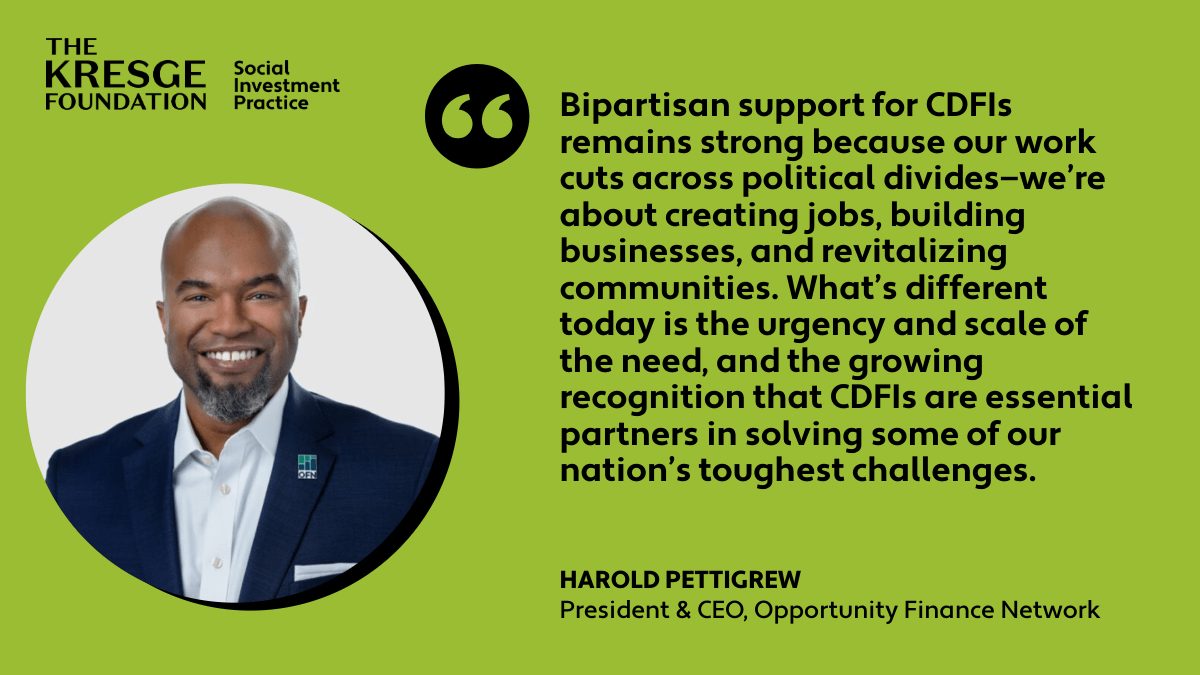
As the community finance field enters a new era—shaped by economic uncertainty, shifting capital flows, and growing calls for accountability—how can CDFIs prepare for what’s ahead? The Kresge Foundation spoke with Harold Pettigrew, the president and CEO of the Opportunity Finance Network (OFN) to help answer that question. This article is part of a series highlighting the impact of CDFIs and how the sector is adapting to the current environment.
MD: CDFIs play a unique role in our financial ecosystem, often serving communities that mainstream banks overlook. Why are CDFIs so critical for advancing economic growth and creating opportunities in underserved communities?
HP: In every corner of America, CDFIs show that impact and financial performance aren’t at odds—they reinforce each other. We address market gaps and go where traditional capital doesn’t: listening first, solving for need, and providing capital to people and financing projects that strengthen families and communities. Whether it’s a small business on Main Street or a housing development in a rural town, CDFIs make investments that build wealth and create opportunities that reach people and communities that need it most.
MD: CDFIs seem to have broad support in Congress, even when some administrations have looked to reduce funding or support. Is bipartisan support materially different today? What role has OFN played in telling the CDFI story and maintaining that support?
HP: Bipartisan support for CDFIs remains strong because our work cuts across political divides — we’re about creating jobs, building businesses and revitalizing communities. What’s different today is the urgency and scale of the need, and the growing recognition that CDFIs are essential partners in solving some of our nation’s toughest challenges. OFN and CDFIs tell real stories of impact—stories of people across the country whose lives and livelihoods have changed thanks to the capital provided by CDFIs. Through advocacy, research, and direct engagement with policymakers, we’ve elevated a clear, consistent message: For over 30 years, CDFIs have delivered results addressing market gaps in providing access to capital to communities across the country.
MD: Beyond federal funding concerns, what are the current challenges and needs CDFIs are facing in their day-to-day efforts to support communities?
HP: CDFIs are navigating a complex economic environment— rising interest rates, tighter capital markets, and growing community needs are stretching our resources like never before. Many CDFIs are being asked to do more with less, while also investing in their own operations to scale effectively and sustainably. OFN is working to develop diverse pools of flexible capital, make deeper investments in talent and technology, and new policy frameworks that support and recognize the unique value CDFIs bring. The demand is clear — what’s needed now is bold investments to meet the moment and craft new solutions for the future.
MD: Philanthropies and community development departments of banks and insurance companies have always been crucial partners for CDFIs — how can they best support and invest in CDFIs right now?
HP: Our partners in philanthropy and financial services have been critical to the success of CDFIs, and now they have a critical opportunity to strengthen the CDFI industry for the future. That means moving beyond transactional grantmaking to long-term, trust-based partnerships. It means offering flexible, risk-tolerant capital that lets CDFIs innovate and expand, and it means investing in the infrastructure — people, systems, data — that helps us operate at scale.
MD: What keeps you optimistic about the future of the CDFI sector?
HP: What keeps me optimistic is the impact and commitment I see every day, from the entrepreneurs we finance, to the communities we serve, to the CDFI leaders innovating with courage and conviction. The sector is growing, diversifying and deepening its impact. We’re not just responding to the moment — we’re helping define the future of expanded access to finance and financial services. And with every new loan, every new partnership, every life changed, we’re proving that when we expand access to opportunity — we don’t just finance projects, we shape the future of communities across the country.
Harold Pettigrew is the President and CEO of Opportunity Finance Network (OFN)


Finance
Stamford Finance Students Wow Judges, Take Home Trophy in Regional CFA Competition – UConn Today

A tenacious team of finance majors, who sacrificed most of their winter break to prepare for the CFA Institute Research Challenge, took first place in that regional competition last week.
Students Hunter Baillargeon, Dylan Fischetto, Richard Opper, Philip Ochocinski and Rushit Chauhan were tasked with researching and analyzing a major utility company, and then producing a 10-page report about whether to buy, hold, or sell its stock. They chose to sell.
One of the CFA judges said both the team’s report and presentation were among the best he had seen in many years.
“As a team, we were thrilled our hard work paid off and our many hours of work allowed us to achieve what we did,’’ Baillargeon said. “What we accomplished couldn’t have been done without working with such a cohesive and collective unit.’’
“From a technical perspective, I realize how valuable true analysis is and the importance of looking where others don’t for a differentiated approach,’’ Baillargeon said.
The first round of competition featured 24 college teams from the Stamford-Hartford-Providence region. The Stamford team, composed of seniors all of whom all participate in UConn’s Student Managed Fund program, received its first-place award Feb. 26 in a ceremony in Hartford. The team will advance to the East Coast competition later this month.
Stamford Finance Program is Robust
“The Stamford team’s advancement in this competition reflects not only the students’ exceptional talent and work ethic, but also the rigor and applied focus of the UConn finance curriculum,’’ said professor Yiming Qian, head of the Finance Department.
“Our Stamford campus hosts approximately 200 financial management majors. The Stamford program is a vital part of the School and continues to demonstrate outstanding strength,” she said.
Professors Steve Wilson and Jeff Bianchi, who combined have 75 years of experience in the investment industry, were the team’s advisers and were supported by academic director Katherine Pancak.
Wilson said the task of analyzing a utility is particularly complex because of the company’s structure and the regulatory environment in which it operates.
“I believe the Stamford team stood out because of the depth of their research, and willingness to take a bold stand, including the decision to ‘go out on a limb’ and recommend selling the stock,’’ he said. “They didn’t ‘play it safe.’’’
“This clean-sweep was a true team effort. They were tireless throughout, and sleepless too often, but they never wavered from their desire to always dig deeper and uncover any information that would strengthen our investment case,’’ he said. “What a phenomenal job they did!’’
Competition in Hong Kong Is Ultimate Goal
The Stamford team will compete against Loyola, Canisius, Sacred Heart; Seton Hall, Villanova, St. Michaels, Western New England, University of Maine, Fordham and Penn State next. In total, some 8,000 students are expected to participate in various competitions worldwide, culminating in a championship round in Hong Kong in May.
Wilson said the financial industry is always welcoming of new talent. And when one of the judges told him that the Stamford team produced some of the best work that he’d seen in years, Wilson felt tremendous pride for the students.
“Finance is an open playing field. In investments, the best idea wins,’’ he said.
Baillargeon said he will always appreciate the whole team’s dedication.
“What I’ll remember most is the help of our advisers and our cohesive, close-knit team where everyone pulled their weight,’’ Baillargeon said. “We put in long hours, did a tremendous amount of research, and collaborated well together. I hope when I enter the workforce I get to work with a team as committed as this one is.’’
Finance
Board Advances Motion to Address LAHSA’s Failure to Pay Service Providers – Supervisor Lindsey P. Horvath

Board Advances Motion to Address LAHSA’s Failure to Pay Service Providers
Board Advances Motion to Address LAHSA’s Failure to Pay Service Providers
https://lindseyhorvath.lacounty.gov/wp-content/uploads/2023/03/image003-1024×888.jpg
1024
888
Supervisor Lindsey P. Horvath
//lindseyhorvath.lacounty.gov/wp-content/uploads/2023/03/horvath.light_.pink_.v3.png

Iowa House OKs ‘3 strikes’ bill with 20-year prison terms. What to know

RESULTS: NE Kansas high schools to play Saturday after Wednesday sub-state wins

Northern Kentucky claims 4 titles at Class 3A indoor track state meet

Shavers leads ULM past Louisiana 79-63

NECEC conservation plan will not protect Maine’s mature forests | Opinion

Florida High School Football Rankings: Top 25 teams – Oct. 21

Cleary's 21 help Le Moyne down Central Connecticut State 69-64 in OT

How old is Bo Nix? What to know about Oregon quarterback ahead of 2024 NFL Draft

99th annual Pony Swim held in Virginia

Indiana Members Credit Union announced as new anchor tenant at Bottleworks District

DHS defends McLaughlin against allegations husband’s company profited millions from ad contracts: ‘Baseless’

Sánchez defies Trump in political gamble as Madrid say no to war

Satellite images show Iran school strike hit more buildings than earlier reported

US submarine sinks Iranian warship by torpedo in a first since World War II

Which oil and gas facilities in the Gulf have been attacked?
-

 World1 week ago
Exclusive: DeepSeek withholds latest AI model from US chipmakers including Nvidia, sources say
-

 Massachusetts1 week ago
Mother and daughter injured in Taunton house explosion
-

 Wisconsin3 days ago
Setting sail on iceboats across a frozen lake in Wisconsin
-

 Maryland4 days ago
AM showers Sunday in Maryland
-

 Denver, CO1 week ago
10 acres charred, 5 injured in Thornton grass fire, evacuation orders lifted
-

 Florida4 days ago
Florida man rescued after being stuck in shoulder-deep mud for days
-

 Oregon6 days ago
2026 OSAA Oregon Wrestling State Championship Results And Brackets – FloWrestling
-

 Massachusetts2 days ago
Massachusetts man awaits word from family in Iran after attacks