
Connect with us

Entertainment

Why Amazon Prime's hit anti-superhero series 'The Boys' keeps getting bigger

Published

on

Why Amazon Prime's hit anti-superhero series 'The Boys' keeps getting bigger

As the real world seems to get crazier, Amazon‘s superhero satire “The Boys” just gets more popular.

Coincidence? Perhaps. The fourth season of the audacious series set in a society where superheroes are ingrained in every aspect of American life, and often not in a good way, is the most-watched so far, according to Amazon.

The company’s internal data show 55 million viewers have watched some portion of Season 4 of “The Boys” throughout the world in the 39 days since it premiered. The audience has increased 20% compared with Season 3.

In the U.S., “The Boys” — a title that refers to the band of vigilantes out to take down the out-of-control “supes” — has lodged in Nielsen’s top 10 streaming shows for four straight weeks since entering the list in June, with the entire series topping 1 billion minutes viewed each week.

The current batch of eight episodes is the second most-watched season of a TV series in Prime Video’s history, said Vernon Sanders, head of television at Amazon MGM Studios, which produces “The Boys” with Sony Pictures Television.

Advertisement

Ratings growth in the fourth season of a series is a rarity. Sanders, who once oversaw current programs at NBC, is more used to seeing audiences drift away as shows age.

But Sanders said he understands why “The Boys,” created by Eric Kripke and based on the comic book series by Garth Ennis and Darick Robinson, keeps gaining new fans. He believes those who initially passed over it thinking it was another capes-and-tights saga in the tiered superhero genre are taking another look.

“The packaging is deceptive,” Sanders said. “There a lot of people who probably initially thought a show called ‘The Boys’ about bad superheroes won’t really have anything for me. And as they keep hearing about it, they give it a shot and realize how rich and complex it is.”

The endurance of “The Boys” is good news for Prime Video as it moves aggressively into the ad-supported streaming business. Prime Video’s 3% share of all TV viewing is about a third of streaming behemoth Netflix’s share, according to Nielsen. But the tech giant has the potential to reach 115 million U.S. viewers with commercials (Netflix’s nascent ad-supported tier reportedly has around 13 million users). The more hits Prime Video has to offer to advertisers, the better.

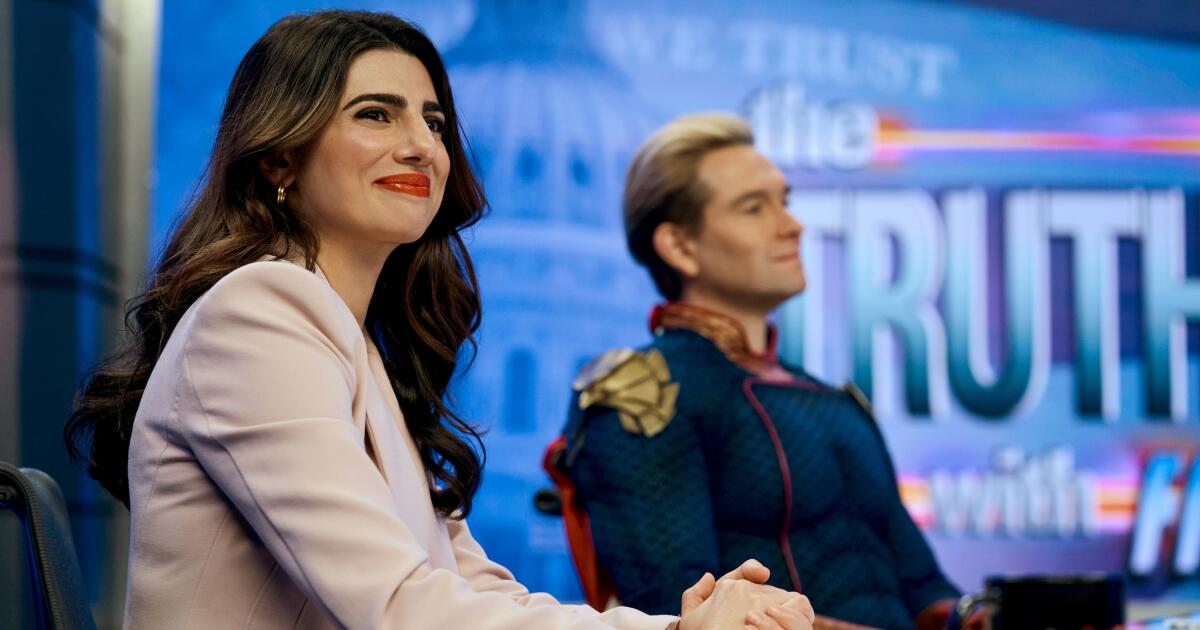
The series provides a humorously snarky look at social media, marketing, TV news, corporate corruption and the extremist political views of our times (as the supes expand their power into government, a TV news commentator says, “Let’s make America super again”).

Advertisement

Even in the fast-moving pop culture landscape where last week’s satire can become this week’s reality, the show has managed to hold onto its currency.

“The Boys” had a scarily on-the-nose moment last month as its fourth season finale depicted a presidential assassination attempt. The episode was scheduled to drop just days after a shooter tried to take the life of former President Trump at an outdoor rally in Pennsylvania. Prime Video changed the title of the episode, originally called “Assassination Run,” and added a disclaimer denouncing political violence.

“There was a lot of nervousness,” said Sanders. “After taking a few days and absorbing it… we realized we were going to release this one way or the other and we felt the best thing to do was to stick to our schedule.”

The show’s look at how fear mongering can corrode a democratic system is also resonating outside of the U.S. “The Boys” is performing especially well in the United Kingdom, India, France and Brazil, all countries that have been dealing with right-wing populist political movements.

The popularity of spin-off “Gen V,” which features a youthful Legion of Super-Heroes-type version of the “supes” of the original series, has also helped. Sanders noted that the younger, female audience for “Gen V,” which has been renewed for a second season, is finding its way to “The Boys.”

Advertisement

Producers are keeping “The Boys” in the pop culture conversation with unexpected cameos and guest stars, such as Will Ferrell turning up as a coach in a fictionalized movie about superhero A-Train. Sanders believes every time a big name appears on the series, more viewers sample it.

The sustained success has led to Amazon discussing ways to keep the franchise going beyond next year’s fifth season, which the producers say will be its last.

“We’ve definitely been in conversations,” Sanders said. “Eric Kripke and the team have been thinking about other things they want to do in the universe.”

Advertisement

Movie Reviews

Movie Review: ‘Supergirl’ – Catholic Review

Published

on

Movie Review: ‘Supergirl’ – Catholic Review

NEW YORK (OSV News) – At what is meant to be a poignant moment in the DC Comics adaptation “Supergirl” (Warner Bros.), the title character, played by Milly Alcock, is told by her mother (Emily Beecham) that she doesn’t have to be nice but she must be good. The recipient of this advice takes it to heart in a way that lends the whole film an unpleasant tone.

We’re not talking Deadpool depths of obscene snark here. Yet scrappy Supergirl, aka Kara Zor-El, in contrast to her affable cousin — and fellow Kryptonian — Superman (David Corenswet), does not come across as especially likeable.

Nor is she a figure to be imitated since, before she embarks on the quest to which most of the running time is devoted, early scenes show her waking up with a succession of staggering hangovers. She gets blotto, we later learn, in an effort to blot out her troubled past. The only positive ingredient in her current life is the bond she shares with her beloved dog, Krypto.

So when evil alien Krem of the Yellow Hills (Matthias Schoenaerts) wounds Krypto with a poisoned dart, leaving him with only hours to live, Supergirl is desperate to help the pup survive. Learning that Krem carries the antidote with him wherever he goes, she sets off on an interplanetary hunt for the villain, racing against time.

Supergirl has already crossed paths with another of Krem’s victims, Ruthye (Eve Ridley). Having watched as Krem slaughtered her entire family, Ruthye is out for revenge and wants to join forces with Supergirl.

Advertisement

Since Ruthye, though courageous, is undersized and completely untrained for combat, Supergirl initially tries to ditch her. But Ruthye is not to be so easily rebuffed.

The unlikely duo eventually acquire an informal ally in the person of cigar-chomping, motorcycle-riding freelance warrior Lobo (Jason Momoa). Lobo has reasons of his own for hating the band of brigands Krem leads.

As scripted by Ana Nogueira, director Craig Gillespie’s scifi adventure includes more than one exchange in which Supergirl warns Ruthye about the morally corrupting effects of exacting vengeance. Yet this thoroughly respectable ethical message is completely undermined as the action reaches its climax.

“Supergirl” may not be a dose of Kryptonite. But it’s no energy-infusing sunbath either.

The film contains much harsh but bloodless violence, a scene of urination, a passing reference to nonscriptural religious ideas, a couple of mild oaths, several uses each of crude and crass language and an obscene gesture. The OSV News classification is A-III – adults. The Motion Picture Association rating is PG-13 — parents strongly cautioned. Some material may be inappropriate for children under 13.

Advertisement

Read More Movie & Television Reviews

Copyright © 2026 OSV News

Continue Reading

Entertainment

Movies, books, art and music to explore as America turns 250

Published

on

Movies, books, art and music to explore as America turns 250

A crazed newscaster prompts his viewers to do a wild thing: open their windows and shout, “I’m as mad as hell and I’m not going to take this anymore.” And they do it, from Atlanta to Baton Rouge, so much yelling. It’s a prescient scene in “Network” from 1976, the year of America’s bicentennial. Fast forward to the semiquincentennial and Americans holler versions of that slogan through windows in real life, just on phones and computers.

When the national mood wobbles, we turn to the arts, which have the power to free buried desires, soothe souls and cross divides. So as America turns 250, the Entertainment team considered how this country’s ups and downs have shaped what we watch, listen to and read. Throughout this week those stories will appear here. Bookmark this page to come back for more.

To start, “Network” makes our list of movies that illustrate frictional historical moments. (“Team America: World Police” does too so expect range!) We also spotlight a new generation of playwrights reimagining Americanness with a sense of hope that America’s best years are still ahead of us. —Brittany Levine Beckman, Entertainment and Features editor

Advertisement
Continue Reading

Movie Reviews

‘Balaramana Dinagalu’ review: A restrained look at the gangster mind

Published

on

‘Balaramana Dinagalu’ review: A restrained look at the gangster mind

In K M Chaitanya’s Aa Dinagalu (2007), actor Atul Kulkarni, playing gangster Agni Sreedhar, says man is the biggest weapon in the underworld. “The rest are just properties,” he adds. The yesteryear Kannada crime drama, based on the real incidents from a big chapter of the Bengaluru underworld, stood out for its understated storytelling.

In Balaramana Dinagalu, which has the skeleton of a sequel to Aa Dinagalu, weapons are seen in the first scene. As the film progresses, we encounter an arsenal of knives, razors, machetes, and guns — each an extension of the gangsters’ identities and an indispensable tool in their quest to remain feared and lethal. Chaitanya attempts to make the movie a mix of reality and entertaining tropes.

Balaramana Dinagalu (Kannada)

Director: K M Chaitanya

Cast: Vinod Prabhakar, Priya Anand, Atul Kulkarni, Ashish Vidyarthi, Ramesh Indira

Runtime: 151 minutes

Advertisement

Storyline: Balarama, an ordinary young man from a remote village in Karnataka, becomes a dreaded gangster who rules Bengaluru

The director has roped in the same cast, who played the dreaded gangster trio of Kotwal Ramachandra (essayed by Sharath Lohitashwa), Jayaraj (Ashish Vidyarthi), and Agni Sreedhar (Atul) in Aa Dinagalu. That’s what makes one instantly curious about Balaramana Dinagalu. The only difference in the latest movie from the previous one is the fictionalised names of the real dons. Jayaraj becomes Jayaram, Sreedhar is Shashidhar, and Muthappa Rai is called Monnappa Rai (played by Ramesh Indira).

Even if these characters are the big draw in the movie, the plot revolves around the journey of Balarama, a character with a small yet significant presence in Aa Dinagalu. Vinod Prabhakar’s portrayal of the titular role is the film’s biggest takeaway. He makes us feel for the character, and is quite impressive in the final portions of the movie, where Balarama struggles to break free from the underworld’s trap.

Balaramana Dinagalu is impressive when it reflects the psychology of a gangster. Jayaram is shown helping the needy while Balarama urges young boys to focus on education. It’s as if these men who commit heinous acts, have a heart as well. Shashidhar is often called “intellectual gangster”, as the film reflects how the underworld fears well-read men in the field. Politicians and policemen, the supposedly the protectors of people being part of the crime nexus, strengthen the movie’s world-building.

The film falters in its inability to rise above the plot’s predictability. Balarama’s journey is no different from the often-seen life of an innocent man from a small town who becomes a gangster owing to uncontrollable circumstances. I wish the film had delved a bit more into Balaram’s personality. Why does he not resist becoming a gangster? What dreams did he have when he moved to Bengaluru from a small town?

Advertisement

“My hands speak louder than my words,” says Balarama. This signals that he is someone who settles conflicts with fists rather than conversations. Despite this detail, Balaram’s entry into the underworld feels too sudden. The predictability strips the sheen away from the well-shot action sequences, as the result of every fight is known beforehand.

Chaitanya is careful not to glorify the act of violence. He wants to portray the negative effects of violence on the children in a family, as the movie ends with a hard-hitting frame. It’s impressive that the actor-director duo has delivered a non-hero-worshipping gangster saga.

That said, the movie could have benefited from a couple of gripping episodes. While it’s important not to romanticise the life of a gangster, there is no harm in delivering moments of peak tension, the biggest plus of the genre. 

The assassination of Jayaram, the impact of Kotwal’s elimination on the underworld, or the Sakleshpura incident involving Monnappa Rai, had the potential to offer edge-of-the-seat, high-stakes portions, but they are rushed. The love story is simple, but it lacks emotional intensity between the lead couple. Santhosh Narayanan’s dance numbers are forgettable (despite it being his forte) while his montage melodies are beautiful.

Balaramana Dinagalu adopts a restrained, almost clinical approach to the gangster genre. While that keeps it from glorifying violence, it also leaves the narrative feeling a touch too neat and emotionally muted.

Advertisement

Balaramana Dinagalu is currently running in theatres

Published – June 28, 2026 07:58 pm IST

Continue Reading
Advertisement

Trending
