Entertainment
'Who am I?' For 'Fantasmas' star Martine, Vanesja is one part of her persona


In a show that boasts appearances by the likes of Emma Stone, Bowen Yang, Amy Sedaris and Aidy Bryant, Julio Torres’ “Fantasmas” may well make a TV star out of someone who aptly goes by a single name: Martine.
“This is the biggest role I’ve ever had,” Martine, a trans visual and performance artist, says via Zoom. “I’m officially the star of a television show. And it might also be my favorite TV show.”
For anyone who’s watched “Fantasmas,” that endorsement should double as insight into Martine’s own aesthetic and artistic sensibility. Because “Fantasmas” isn’t like any other television show out there.
The six-part urban fairy tale, which premiered June 7 on HBO and drops episodes weekly on Fridays through July 12, imagines a New York City where ExxonMobil builds developments and rideshare apps called Chester — with a driver named Chester — exist alongside mermaid sales reps and rodent nightclubs-turned-CVS pharmacies.
Within that fantastical vision of New York, Torres’ Julio (who was hit by lightning as a child and is allergic to the color yellow) is constantly trying to eke out a living with the help of his robot assistant, Bibo (voiced by Joe Rumrill), and his agent, Vanesja (the “j” is silent), played by Martine.
“The show itself is kind of postgenre,” Martine suggests. “It’s very much a genre-building show. It’s hard to explain what you should expect to see.”
Every set piece in “Fantasmas” — whether it’s a sitcom called “MELF ” that riffs on “ALF ” and features Paul Dano, or a vignette focused on a zealous customer service rep played by “Euphoria’s” Alexa Demie — lays bare its crafted theatricality. It’s always clear that audiences are watching something shot on a set, with painted backdrops and makeshift props. This is a fanciful world that never pretends to be anything more than an absurd and absurdist take on everyday life.
1
2

1. Paul Dano, right, is featured in a skit about an “ALF”-like puppet named MELF. (Atsushi Nishijima/HBO) 2. Alexa Demie plays an overzealous customer service rep. (Monica Lek/HBO)
“It felt like theater,” Martine says of working on the show. “It felt like being onstage with an audience. Everything was built inside this one giant soundstage and it was all repurposed: The school becomes the nightclub, the nightclub becomes a rooftop. And the audience was everyone on set.”
Within this funhouse mirror of a show, which blends sketch comedy with a farcical plot that finds Julio wanting to avoid getting an ID that would serve as his “proof of existence,” Martine was similarly encouraged to play with her own identity — as a performer, artist and actor.
“I don’t recognize myself in the show,” she says. “Because it’s Vanesja. And I think Vanesja happened because I was so nervous about my performance. The only way for me to move ahead was to say, ‘You don’t have to be yourself. You can put forward some kind of armor, some kind of stronger, idealized person you want to move through the world as.’”
For Martine, the very idea of being “yourself” is elusive. Questioning the rigidity of our sense of self has long been at the heart of her art, which has been featured in galleries and art museums all over the country — not to mention at the Venice Biennale — and in magazines like Interview and Artforum.
“Who am I?” she wonders aloud. “I think I’m constantly trying to shed that definition. I think I’m constantly throwing it away, discarding the old skin, shedding it, as it were, to move into some wider, broader, stronger, faster model. Or predator or something.”
Such facetious language, which moves from the probing to the preposterous with ease and humor, is arguably why she gets along with Torres. Martine first met the Salvadoran comedian close to a decade ago at an archery championship. “It’s truly an unbelievable story,” she recalls. “Julio was there at the buffet. He’s vegan, and I was kind of pretending to be vegan at the same time.”
They both reached for the last tater tot, and at the moment when their fingers touched and their eyes met, Martine knew she’d found a new friend. Maybe even more. “This is your sister wife,” she remembers thinking. “This is your kindred spirit, and you’re both starving … to be seen.”
What Torres most remembers about his first encounter with Martine was something equally ineffable. “Her ability to subvert her own physicality, to find humor in beauty,” he recalls via email.
Their friendship blossomed in between archery practices and congenial DMs as their careers bloomed in separate if complementary directions. While Torres joined the “Saturday Night Live” writing staff and later premiered his own comedy special (“My Favorite Shapes”), Martine was busy creating art installations that satirized advertising campaigns (Martine Jeans), a publication that similarly critiques glossy high-fashion magazines (Indigenous Woman) and sci-fi-set live performances (“Circle”) that toyed with ideas around gender, femininity and self-expression in equally cheeky and wryly self-serious ways.
Their earlier collaborations — Martine previously played an unimpressed gallerist in Torres’ feature film debut, “Problemista,” and an impaled beauty queen in his Peabody award-winning show “Los Espookys” — feel like playful preambles to their work together on “Fantasmas.” Vanesja is, after all, a performance artist who’s been playing Julio’s talent agent for so long, she’s lost track of whether it’s still a performance.
“Without Martine, there is no Vanesja,” Torres says. “That’s how I work sometimes, in collaboration with a performer to create something tailor-made for them. She first planted the seeds of Vanesja when leaving me cryptic voicemails. Something about closing a big deal and not being able to discuss it. We welcomed each other into our worlds.”
In the surreal world that is “Fantasmas,” Vanesja is a reminder of how we ourselves can often be indistinguishable from the makeshift roles we play.
“I think a lot of the show’s motifs exist in my work too,” Martine says. “I love mannequins. I love asking a lot of questions broadly about identity and using costumes and using personas to try and get to some deeper truth. And it was so refreshing to lean into that with comedy because the art world is so unbearably serious.”
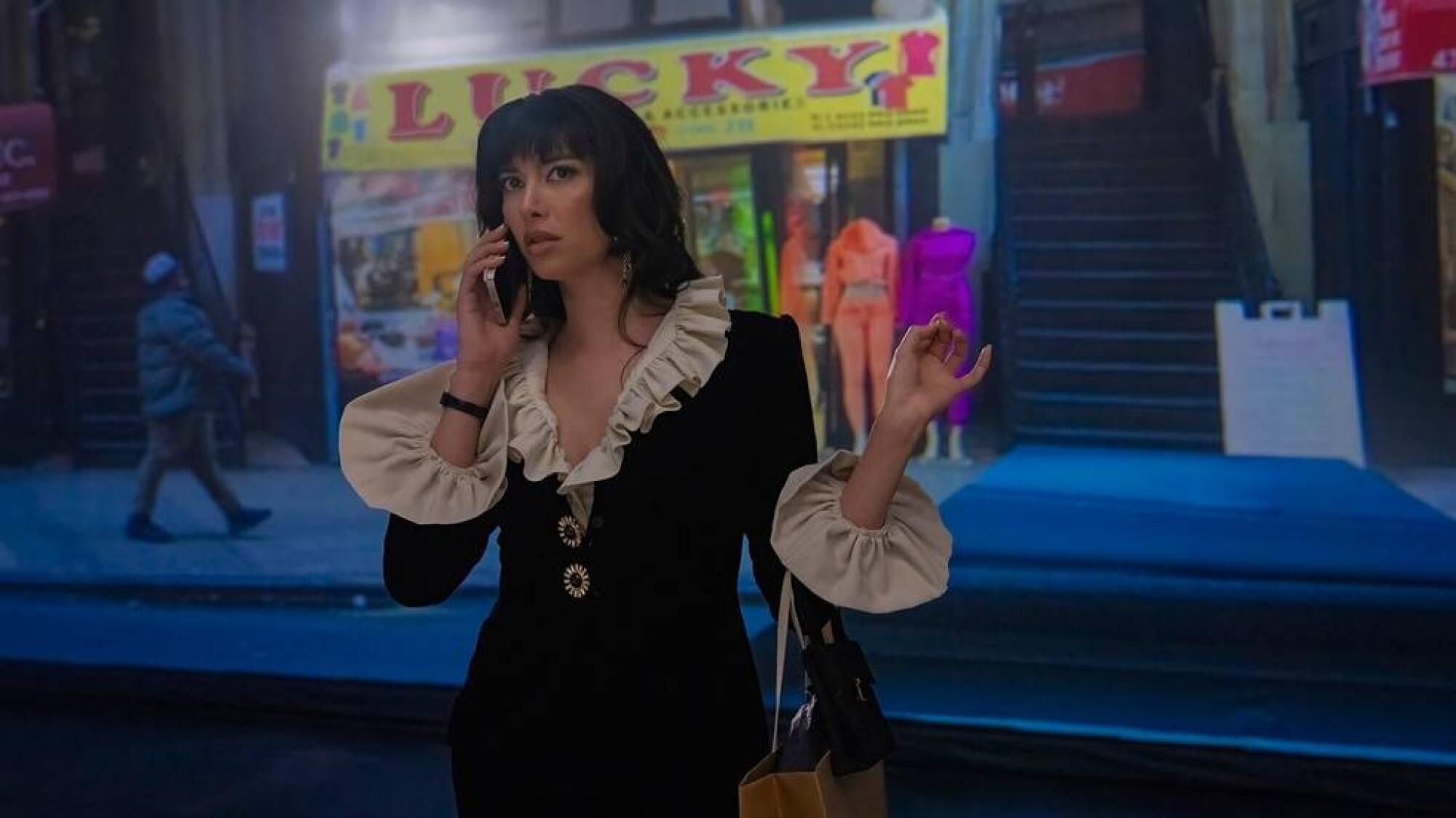
“I love mannequins. I love asking a lot of questions broadly about identity and using costumes and using personas to try and get to some deeper truth,” Martine says.
(Monica Lek / HBO)
With Vanesja, you see Martine reveling in that comedy. With her droll sense of humor intact and Vanesja’s aesthetic aching to be described as “business executive realness,” she’s constructed a dry-witted performance of an artist-cum-agent whose indifference to the world around her is bewitching. There’s her voice, for starters, which is sultry and breathy, marked by a glacial pace that makes Julio and audiences alike become engrossed by her every word. She almost feels plucked from the late 1990s, when the blazers and pencil skirts Vanesja wears were synonymous with a feminine, if not outright feminist, brand of seriousness.
“Vanesja is classically binary,” Martine says. “She has both the charm of a woman and all the strength of a man.”
In working within such a gendered binary, I bluntly ask how she was able to create this entrancing character who seems aloof yet interested, cold yet warmhearted. How did she do it?
“How does she Vanesja?” she asks herself, in between laughter, wanting to clarify my question — knowing, perhaps, that she’s arrived at a key philosophical way of understanding her process and her character alike. “I Vanesja every day. I try to Vanesja at least once a day, just for flexibility and my health, my mental health.”
For Martine, getting a chance to create Vanesja alongside Torres was a joy because it allowed her to unearth parts of herself and her work that exist at the surface yet get at deep-seated ideas about who we are and how we present ourselves. At a purely visual level, though, she had a very simple reference in mind.
“I’m obsessed with Ursula from ‘The Little Mermaid’ when she becomes a cis woman,” she says. “Her name is Vanessa, and I do feel like there is a resemblance between that Vanessa and myself, just like out of drag. This was me trying to implement a villainous persona that I personally feel lives inside me.”
That hint of Disney wasn’t the only personal touch Martine brought to “Fantasmas.” She is to thank for what has already become one of the most talked-about images teased from the show, and seen in Friday’s episode: her scene partner, “Teen Wolf” star Dylan O’Brien, wearing red lacy undergarments, with garters and stockings to match.
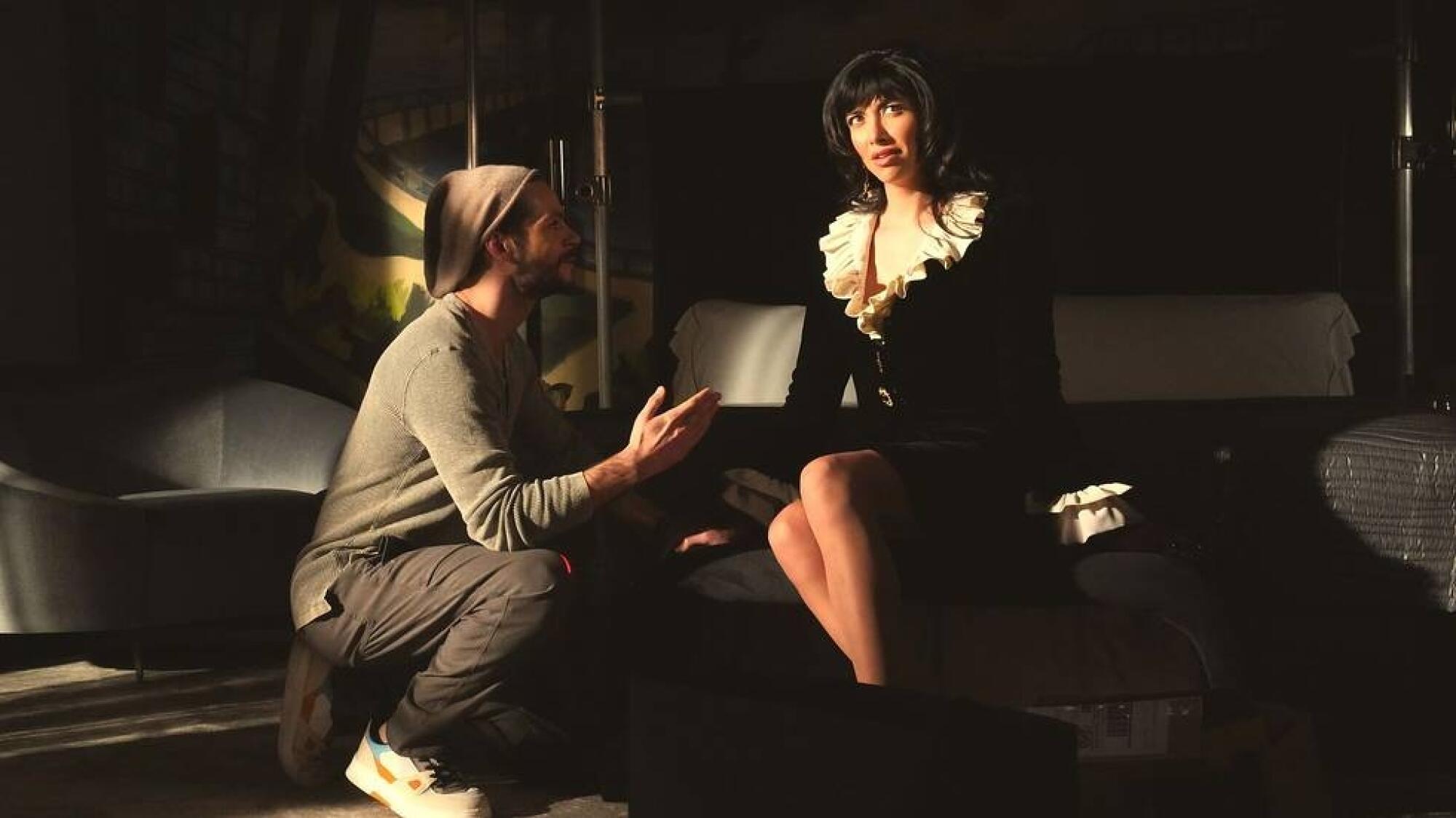
Dylan O’Brien and Martine in “Fantasmas.”
(Monica Lek / HBO)
“That was probably my one contribution, narratively, to the show,” she admits. “It’s a personal taste thing. I think it’s really sexy to see a man in women’s lingerie. Dylan had no problems with it. He was so down. And he looked great.”
Such an incongruous image (in a scene that’s quite melancholy, not really all that steamy, in fact) doesn’t feel out of place in “Fantasmas.” The show, like Vanesja, embraces binaries only to bridge them. Or break them. Or perhaps just toy with them. But it can do so only because the series is fascinated by the personal dramas we all carry within. There’s a push toward empathy for the other that runs through the show, even in its most outlandish moments.
“‘Fantasmas’ is the people who populate it,” as Torres puts it. It’s a show “about characters who, with little screen time, aim to capture the curiosity of the viewers.”
Further echoing those words and in trying to sum up this off-kilter show’s ambitions, Martine is reminded of Jon Brion’s song “Little Person,” which he co-wrote with Charlie Kaufman for the filmmaker’s meta-theatrical opus “Synecdoche, New York.”
That 2008 film is centered on a theater director eager to celebrate the mundanity of real experiences. The only way he knows how is to put on a stage show of his own life and that of everyone he comes into contact with. “I’m just a little person,” Martine sings. “One person in a sea of many little people, who are not aware of me.”
“I feel like that’s everyone in New York,” she says. “And also everyone in ‘Fantasmas.’ You get this everything, everywhere all at once TikTok universe where every story is simultaneous. Where everyone is the lead in their own narrative. Which is kind of the closest thing to reality that you can get.”



Entertainment
Lucas Museum to give free annual passes to South L.A. neighbors, host community preview day

The Lucas Museum of Narrative Art, which is moving at light speed toward its Sept. 22 opening, announced Thursday that it will give free annual passes to its South L.A. neighbors living in the 90037 ZIP Code. The 300,000-square-foot, $1-billion museum located in Exposition Park will also host a special community preview day on Sept. 13, more than a week before the general public gets to step inside.
The 90037 ZIP Code has a population of more than 65,000 and is bordered roughly by the 110 Freeway to the west, Slauson Avenue to the south, Central Avenue to the east and Martin Luther King Jr. Boulevard to the north. Residents can register for passes at lucasmuseum.org/lm37 and will be alerted in August when the program launches. Pass holders can reserve tickets for themselves and one guest.
Tickets for non-pass holders go on sale July 21. They cost $25 for adults and $21 for seniors. Kids 17 and under are free.
“Storytelling has the power to bring people together and create a sense of community,” said Lucas Museum Chief Executive Tracey Bates in a news release about the program. “Through LM37, we are inviting our South Los Angeles neighbors to make the museum part of their lives and take their own path of discovery through the art, programs and experiences that will help shape this new cultural hub for Los Angeles.”
The community preview day is designed to give local business owners, community partners, civic leaders and registered LM37 pass holders a sneak peak of the 10,000 square feet of exhibition space, as well as the expansive gardens with 11 acres of park space.
The opening programming, curated by co-founder George Lucas, features 20 inaugural exhibitions across more than 30 galleries, including one titled “Star Wars in Motion,” containing vehicle designs, high-speed racers, flying vessels, props, costumes and illustrations from the first six films in the beloved franchise.
More than 1,200 objects will be on display from Lucas’ personal collection of narrative art. Highlights include work by Norman Rockwell and Dorothea Lange, as well as a variety of manga, children’s book illustrations and comics.

Last year’s “Superman” ended with Iggy Pop singing “Because I’m a punk rocker, yes I am” — an ironic coda for a superlatively square hero. But it rings straightforwardly true for Superman’s cousin.
Milly Alcock’s Kara Zor-El, or Supergirl, sports not a spandex suit but a Blondie T-shirt. When we meet her in Craig Gillespie’s “Supergirl,” she’s been on an interstellar bender for days. She’s more Courtney Love than Clark Kent.
Nonchalant and sarcastic, Kara is also a little Han Solo-ish, you might say, given that she moves capriciously through the galaxy in her junky spaceship while getting in fights in extraterrestrial bars. She’s a welcome, jagged riff on more buttoned-up superheroes, and Alcock is terrific in the role. If only “Supergirl” was as good as she is.
While the latest DC release, and second under James Gunn’s stewardship, has its moments, “Supergirl” struggles to match Kara’s punk-rock energy with an equally spirited supporting cast and story.
Skepticism seems to have gathered for “Supergirl” ahead of its release. Many fans have argued it wasn’t the right next step for DC Universe. But I’m not so sure. Alcock’s breezy cameo in “Superman” was one of that movie’s highlights. Handing the follow-up to her, and her faithful floating dog Krypto, strikes me as an extremely natural next step. When in doubt, follow the dog.
And much of “Supergirl” is winning. It resides almost entirely in space, touching down only momentarily on Earth. In its consistently creative production design, clever needle drops and underdog story arc, “Supergirl” resides a little closer to Gunn’s “Guardians of the Galaxy” movies than other DC entries. Its outer space is filled with cosmic detritus, mean characters and cute critters. Seth Rogen as the voice of a tiny alien co-piloting a space bus is an inspired concoction, as is a shabbier sci-fi realm with rest stops along the intergalactic highway.
Entertainment
Justin Baldoni and wife break silence after ‘It Ends With Us’ legal battle with Blake Lively

Justin Baldoni has broken his silence after reaching a settlement in a lengthy and highly publicized legal dispute with Blake Lively.
Baldoni and his wife, Emily Baldoni, presented a united front in an Instagram video the couple shared Wednesday that began, “So we have not spoken publicly for the better part of the last two years, and it’s not because we haven’t had anything to say, because Lord knows we have.”
The “It Ends With Us” actor and director said that although they’d wanted to address the debacle that involved dueling lawsuits with Lively, nearly two years of tit-for-tat fodder and culminated in a confidential settlement, “something was telling us not to.”
The couple said they prayed about when to make a public statement. “This feels like the moment,” Emily said.
“What does feel important,” she continued, “is that we can genuinely say that we are sitting here today feeling immense gratitude for so many things and so many people and so many things that have happened to us.”
“Gratitude has saved us,” Justin added.
“I also feel that it’s important as we say that — in that gratitude — it doesn’t negate the injustice and the pain that we have also felt in the last few years, and we’ve had to wrestle with so many things and try to understand so many things,” Emily said. “How could something like this even happen? Let alone disguised as a fight for women. So much to unpack. And the truth is, reality is, is that there’s been a lot of trauma for us to move through as a family, which also makes it hard to speak.”
“We don’t even know this is the right thing to say, but we just know we need to share something,” Justin said. “What I will say is that there have been so many painful things that have been spoken into existence — “
“Untruthful,” Emily broke in.
“We didn’t want to add to the noise, so we just wanted to let the justice system run its course,” he said.
“And the truth and the facts have spoken for themselves,” Emily said.
The couple’s statement comes a year and a half after Lively filed a bombshell lawsuit against Baldoni alleging sexual harassment, retaliation and several other charges on the heels of a messy “It Ends With Us” summer release and press tour that fueled rumors of on-set turmoil.
Less than a month after the allegations against Baldoni rallied Hollywood against him, he countersued Lively, her publicist Leslie Sloane and her husband, Ryan Reynolds, for $400 million in damages, claiming they’d smeared his name in the press and wrestled away his control of the film. His suit was later dismissed.
In May, two weeks ahead of the trial, Lively and Baldoni reached an agreement to resolve their legal dispute, bringing an abrupt end to the contentious battle.
“The parties in the Blake Lively and Wayfarer Studios litigation have reached an agreement to resolve the matters,” lawyers for both sides said in a joint statement.
“The end product — the movie ‘It Ends With Us’ — is a source of pride to all of us who worked to bring it to life. Raising awareness, and making a meaningful impact in the lives of domestic violence survivors — and all survivors — is a goal that we stand behind. We acknowledge the process presented challenges and recognize concerns raised by Ms. Lively deserved to be heard. We remain firmly committed to workplaces free of improprieties and unproductive environments. It is our sincere hope that this brings closure and allows all involved to move forward constructively and in peace, including a respectful environment online.”
In June, a federal judge ordered Baldoni and his production company to pay Lively’s attorney fees related to his unsuccessful defamation lawsuit against her, but rejected her bid for additional damages.
“So, how are we doing?” the filmmaker said in the Instagram video. “We are healing, and if you’ve ever been through something traumatic, you know that healing isn’t linear. It lives different every day, and we have had to rethink for ourselves what is real. What matters, and it’s this. It’s our family. It’s our friends. It’s our community. It’s our faith.”
Times staff writer Josh Rottenberg contributed to this report.
-
World14 seconds ago
AI notetakers promise easy meeting recaps, but some professionals question their use
-
Culture42 minutes ago
Which Version of the ‘Odyssey’ Should You Read?
-
 Lifestyle45 minutes ago
Terry Tempest Williams on why women with big ideas get labeled ‘crazy’ : Wild Card with Rachel Martin
-

 Technology57 minutes ago
Google’s Nest Thermostat has hit its best price of the year
-

 World1 hour ago
Argentinian flight instructor jumps to death from plane, 22-year-old student forced to land alone
-

 Politics1 hour ago
Omar’s disclosures erased millions, leaving her with potential negative net worth. She won’t explain why.
-

 Health1 hour ago
Dr Oz links obesity to chronic disease surge, says GLP-1s can ‘jumpstart’ better health
-

 Sports1 hour ago
Pirates star pitcher makes unfortunate history after being taken out in middle of perfect game bid

