
Connect with us

Entertainment

What's in the new IATSE deal? Wage increases, AI rules and more

Published

on

What's in the new IATSE deal? Wage increases, AI rules and more

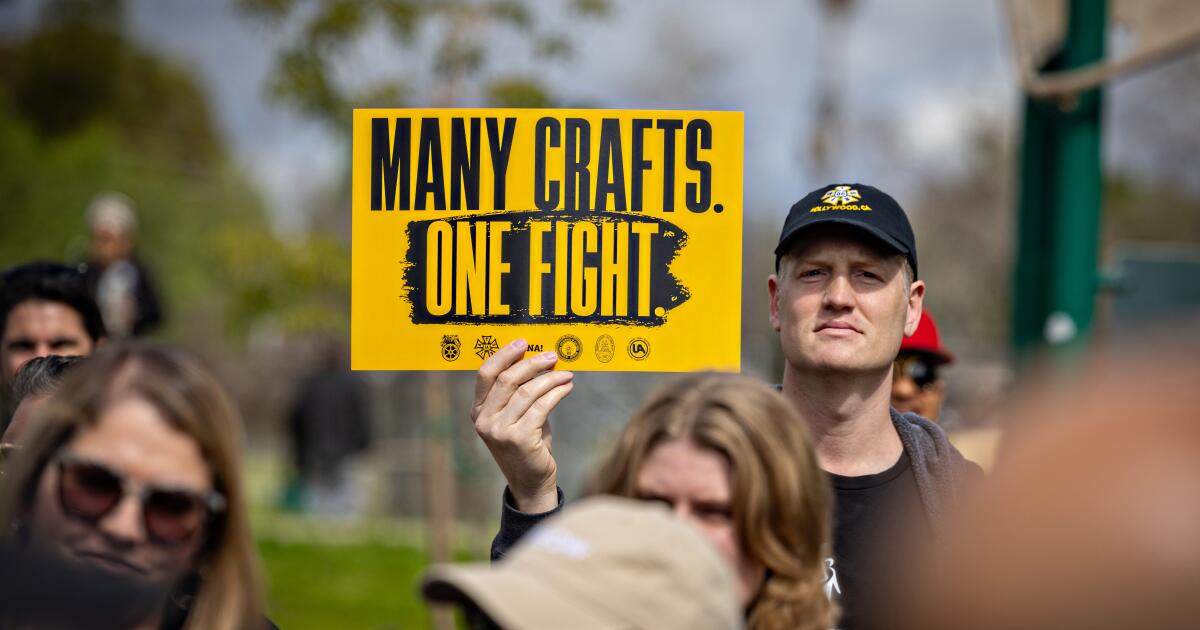
The crew members union IATSE released a summary over the weekend of its new tentative agreement with the top Hollywood studios, including terms related to pay, pension and health benefits, working conditions, streaming residuals and artificial intelligence.

The International Alliance of Theatrical Stage Employees and the Alliance of Motion Picture and Television Producers arrived at a resolution Tuesday on the Hollywood Basic Agreement, which spans three years and covers some 50,000 craftspeople primarily based in the Los Angeles area.

In a memo to members, the union said it would release an abridged version of the deal, followed by a full copy of the document that workers can review before participating in a contract ratification vote.

Here’s a summary of the seven-page summary (which can be viewed here in its entirety).

Advertisement

Pay

The deal contains wage increases of 7%, 4% and 3.5% spaced out over the three-year term.

It also stipulates that hourly workers are entitled to triple pay whenever a workday exceeds 15 hours and that on-call employees qualify for double pay on the seventh consecutive workday.

Both of these overtime provisions are part of an effort by the union to discourage employers from requiring crew members to spend an excessive number of hours on set. Below-the-line workers have long complained about marathon shooting schedules sometimes exceeding 12, 14 or even 20 hours in a single day.

This issue received extra attention following the death of studio grip Rico Priem, who suffered cardiac dysfunction while driving home at 4:30 a.m. on a Saturday after working back-to-back,14-hour overnight shifts. When Priem died, IATSE and the AMPTP paused their negotiations, and the union put out a statement declaring its “renewed commitment” to improving crew members’ working conditions.

In the same vein, employers would be required to pay double time when rest and/or meal periods are skipped.

Advertisement

Other gains in this area include a travel allowance for those required to work outside a certain radius and a bump in severance pay.

Artificial intelligence

The deal mandates that “no employee is required to provide AI prompts in any manner that would result in the displacement of any covered employee,” according to a memo issued Tuesday by the union.

Establishing AI regulations has become a top priority for the entertainment unions in recent years as anxiety about the technology encroaching on creatives’ jobs has intensified.

Any time employers plan to implement AI behind the scenes, they would be required to negotiate with the union how the technology might affect crew members working on the production — with “very limited exceptions.”

Crew members who voluntarily use their own AI programs as a tool in their work (employer permitting) would be entitled to a negotiable “kit rental fee” for their technological contributions to a project.

Advertisement

Once the contract is ratified, a committee would be formed to create AI training programs educating craftspeople on how to use the technology.

The agreement also states that employers must obtain consent from individual crew members before scanning them for AI purposes. Notably, consent forms must include language clarifying that “signing is not a condition of employment” — an added layer of protection that was controversially absent from the actors’ new contract with the AMPTP.

As technology evolves, the union would have the option to request quarterly and biannual meetings with entertainment companies to revisit AI guidelines throughout the course of the contract.

Pension and health benefits

The union was able to secure more than $700 million for its pension and health plans, funded in part by payments from employers, travel-only days and an updated streaming residual system.

The deal further ensures that covered workers will have uninterrupted access to health and pension services for the remainder of the plan year. Additionally, those who recorded at least 65 hours of work last year will receive a year’s worth of credit toward their pension plan to “account for the reduction in employment in 2023.”

Advertisement

Looking forward to the future, the deal states that crew members’ contingent pension benefit will increase to 15% from 10% at the start of 2027. At the same time and rate, a bonus contribution will be made retroactively to cover the period from 2024 to 2027.

As for the health plan, studios are required under the new deal to contribute an added amount of at least $1.09 for each hour worked or guaranteed in the first year of the agreement. Extra payments apply to companies that meet certain qualifications in the second and third years of the term.

The deal also recommends that trustees of the Motion Picture Industry launch a 401(k) plan funded by voluntary contributions from workers.

While the new contract is in effect, healthcare coverage costs, benefits and prescription drug co-payments will remain fixed for members and their dependents.

Streaming residuals

A variety of new streaming residuals have been created as part of the contract to help fund the union’s pension and health plans.

Advertisement

Collectively, the residuals cover programs that play on streaming services, TV and basic cable.

Bonus pension residuals will also be distributed depending on how well shows perform on their respective streaming platforms.

Working conditions

As part of the effort to prevent accidents involving crew members driving home late, call sheets would now include contact information for the person coordinating rides and rooms for workers.

Producers would also be required to purchase up front and reserve temporary lodging for employees for the entirety of their post-work rest period or until they are needed back on set. Additionally, producers would be responsible for providing rides, as well as secure parking for the entirety of an employee’s overnight stay.

The summary does not specify under what conditions — such as consecutive hours worked or distance traveled — the accommodations would apply.

Advertisement

Time off

For the first time in IATSE’s history, the tentative deal recognizes Juneteenth as a holiday, and employees will not be required to work on June 19 starting in 2025.

To account for lost employment opportunities in 2023, only 40 days of work during that period would be needed to qualify for a year’s worth of vacation-time accrual, instead of the standard 100 days.

The contract would also increase the maximum amount of accrued sick days to 10 from six.

Advertisement

Entertainment

Former Live Nation executive says he was fired after raising ‘financial misconduct’ concerns

Published

on

Former Live Nation executive says he was fired after raising ‘financial misconduct’ concerns

A former executive at Live Nation, the world’s largest live entertainment company, is suing the company, alleging that he was wrongfully terminated after he raised concerns about alleged financial misconduct and improper accounting practices.

Nicholas Rumanes alleges he was “fraudulently induced” in 2022 to leave a lucrative position as head of strategic development at a real estate investment trust to create a new role as executive vice president of development and business practice at Beverly Hills-based Live Nation.

In his new position, Rumanes said, he raised “serious and legitimate alarm” over the the company’s business practices.

As a result, he says, he was “unlawfully terminated,” according to the lawsuit filed Thursday in Los Angeles County Superior Court.

“Rumanes was, simply put, promised one job and forced to accept another. And then he was cut loose for insisting on doing that lesser job with integrity and honesty,” according to the lawsuit.

Advertisement

He is seeking $35 million in damages.

Representatives for Live Nation were not immediately available for comment.

The lawsuit comes a week after a federal jury in Manhattan found that Live Nation and its Ticketmaster subsidiary had operated a monopoly over major concert venues, controlling 86% of the concert market.

Rumanes’ lawsuit describes a “culture of deception” at Live Nation, saying its “basic business model was to misstate and exaggerate financial figures in efforts to solicit and secure business.”

Such practices “spanned a wide spectrum of projects in what appeared to be a company-wide pattern of financial misrepresentation and misleading disclosures,” the lawsuit states.

Advertisement

Rumanes says he received materials and documents that showed that the company inflated projected revenues across multiple venue development projects.

Additionally, Rumanes contends that the company violated a federal law that requires independent financial auditing and transparency and instead ran Live Nation “through a centralized, opaque structure” that enables it to “bypass oversight and internal checks and balances.”

In 2010, as a condition of the Live Nation-Ticketmaster merger, the newly formed company agreed to a consent decree with the government that prohibited the firm from threatening venues to use Ticketmaster. In 2019 the Justice Department found that the company had repeatedly breached the agreement, and it extended the decree.

Rumanes contends that he brought his concerns to the attention of the company’s management, but his warnings were “repeatedly ignored.”

Advertisement
Continue Reading

Movie Reviews

‘Madhuvidhu’ movie review: A light-hearted film that squanders a promising conflict

Published

on

‘Madhuvidhu’ movie review: A light-hearted film that squanders a promising conflict

At the centre of Madhuvidhu directed by Vishnu Aravind is a house where only men reside, three generations of them living in harmony. Unlike the Anjooran household in Godfather, this is not a house where entry is banned to women, but just that women don’t choose to come here. For Amrithraj alias Ammu (Sharafudheen), the protagonist, 28 marriage proposals have already fallen through although he was not lacking in interest.

When a not-so-cordial first meeting with Sneha (Kalyani Panicker) inevitably turns into mutual attraction, things appear about to change. But some unexpected hiccups are waiting for them, their different religions being one of them. Writers Jai Vishnu and Bipin Mohan do not seem to have any major ambitions with Madhuvidhu, but they seem rather content to aim for the middle space of a feel-good entertainer. Only that they end up hitting further lower.

Continue Reading

Entertainment

Dataland, the world’s first museum of AI arts, sets opening date and first exhibition

Published

on

Dataland, the world’s first museum of AI arts, sets opening date and first exhibition

After more than two and a half years of research, planning and construction, Dataland, the world’s first museum of AI arts, will open June 20.

Co-founded by new media artists Refik Anadol and Efsun Erkılıç, the museum anchors the $1-billion Frank Gehry-designed Grand LA complex across the street from Walt Disney Concert Hall in downtown Los Angeles. Its first exhibition, “Machine Dreams: Rainforest,” created by Refik Anadol Studio, was inspired by a trip to the Amazon and uses vast data sets to immerse visitors in a machine-generated sensory experience of the natural world.

The architecture of the space, which Anadol calls “a living museum,” is used to reflect distant rainforest ecosystems, including changing temperature, light, smell and visuals. Anadol refers to these large-scale, shimmering tableaus as “digital sculptures.”

“This is such an important technology, and represents such an important transformation of humanity,” Anadol said in an interview. “And we found it so meaningful and purposeful to be sure that there is a place to talk about it, to create with it.”

The 35,000-square-foot privately funded museum devotes 25,000 square feet to public space, with the remaining 10,000 square feet holding the in-house technology that makes the space run. Dataland contains five immersive galleries and a 30-foot ceiling. An escalator by the entrance will transport guests to the experiences below. The museum declined to say how much Dataland, designed by architecture firm Gensler, cost to build.

Advertisement

An isometric architectural rendering of Dataland. The 25,000-square-foot AI arts museum also contains an additional 10,000 square feet of non-public space that holds its operational technology.

(Refik Anadol Studio for Dataland)

Dataland will collect and preserve artificial intelligence art and is powered by an open-access AI model created by Anadol’s studio called the Large Nature Model. The model, which does not source without permission, culls mountains of data about the natural world from partners including the Smithsonian, London’s Natural History Museum and the Cornell Lab of Ornithology. This data, including up to half a billion images of nature, will form the basis for the creation of a variety of AI artworks, including “Machine Dreams.”

“AI art is a part of digital art, meaning a lineage that uses software, data and computers to create a form of art,” Anadol explained. “I know that many artists don’t want to disclose their technologies, but for me, AI means possibilities. And possibilities come with responsibilities. We have to disclose exactly where our data comes from.”

Advertisement

Sustainability is another responsibility that Anadol takes seriously. For more than a decade, Anadol has devoted much thought to the massive carbon footprint associated with AI models. The Large Nature Model is hosted on Google Cloud servers in Oregon that use 87% carbon-free, renewable energy. Anadol says the energy used to support an individual visit to the museum is equivalent to what it takes to charge a single smartphone.

Anadol believes AI can form a powerful bridge to nature — serving as a means to access and preserve it — and that the swiftly evolving technology can be harnessed to illuminate essential truths about humanity’s relationship to an interconnected planet. During a time of great anxiety about the power of AI to disrupt lives and livelihoods, Anadol maintains it can be a revolutionary tool in service of a never-before-seen form of art.

“The works generate an emergent, living reality, a machine’s dream shaped by continuous streams of environmental and biological data. Within this evolving system, moments of recognition and interpretation emerge across different forms of knowledge,” a news release about the museum explains. “At the same time, the exhibition registers loss as part of this expanded field of perception, most notably in the Infinity Room, where visitors encounter the 1987 recording of the last known Kauaʻi ʻŌʻō, a now-extinct bird whose unanswered call becomes part of the work.”

“It’s very exciting to say that AI art is not image only,” Anadol said. “It’s a very multisensory, multimedium experience — meaning sound, image, video, text, smell, taste and touch. They are all together in conversation.”

Advertisement
Continue Reading
Advertisement

Trending
