Entertainment
Sterling K. Brown and James Marsden say ‘Paradise’ brings twists and existential questions


Can “This Is Us” collaborators Dan Fogelman and Sterling K. Brown reunite without making viewers cry?
It’s possible in the new TV world of Fogelman’s creation, Hulu’s “Paradise,” which stars Brown as CIA agent Xavier Collins, who is suspected of killing the president, Cal Bradford, played by James Marsden.
But did he? Or is someone else responsible? And is that the only question we should be focused on?
For six seasons, Fogelman’s “This Is Us” had viewers on their emotional toes with the time-jumping drama that told the sentimental story of a family across decades, infusing it with twists and turns uncommon to the genre but inherent to life. With “Paradise,” Fogelman puts his affinity for twists and turns to use, this time in a political conspiracy thriller. There may be less tears, but a death hangs over this series, too. In true Fogelman fashion, though, the final moments of the pilot reveal there’s also something bigger at play: This story is set inside an underground community funded by a tech billionaire, played by Julianne Nicholson, after a massive catastrophe threatens the extinction of the human race.
“Ironically, it’s a show that’s pretty void of politics completely, even though it’s about a president and it also — I don’t think it necessarily lectures on things like climate change — it’s just you watch a series of events unfold,” Fogelman says. “I’m not smart enough to write anything with an agenda. I just write. But clearly, there are things in the ether and there are things in the air right now that are underneath the show.”
And the questions that drive the season, according to Fogelman, won’t overstay their welcome.
“I wanted to serve a complete meal to people that watch a show in the first season,” Fogelman said. “A big challenge we had during ‘This Is Us’ was it was not a murder mystery, but it had this one mystery that was propulsive — it took us 14 episodes to answer it. With the time it’s taken to get things back on the air, and also just what the conception of the show is, I felt it was important that by the end of the first season, all eight episodes, you should have every question you’ve asked answered.”
Three of the season’s eight episodes are now streaming. During a recent sit-down in Los Angeles, Brown and Marsden spoke about the show’s big twist, how they would respond to crisis their characters confront, and backside acting.
James Marsden, left, as President Cal Bradford and Sterling K. Brown as CIA agent Xavier Collins in Hulu’s “Paradise.”
(Brian Roedel/Disney)
Dan typically keeps things close to the vest when it comes to his twists and reveals. How much did you know about that final twist at the end of the pilot?
Brown: He didn’t tell me anything. He just wants you to read it. And this is something that he does in general. He doesn’t really tend to pitch things out because I don’t think he wants anybody’s notes. He just wants to present them [with the script] and say, “This is what the show is gonna be. If you like it, great. If you don’t, I’ll go somewhere else.” So I read it and really just enjoying the world of it — very similar to how I was enjoying “This Is Us” — then you get to the end of it, and your mind just goes [eyes grow wide]. I couldn’t believe he did it to me again. I did not see it coming. Kudos to him for always finding a way to make something rich that much richer.
Marsden: His [Dan’s] interest and curiosity about the human experience, and the range of experience we can have, and the confusion with emotions and relationships and the complexities of relationships, is this real fertile ground for him. No matter how ornate and spectacular or destructive or whatever the circumstances are within the plot, the core of that in a Dan show is the humans, it’s the relationships and how they’re affected by all of that.
At the end of the first episode, Sterling, your character is told some top secret security news, which is that the world is nearing the extinction of the human race. Can you keep that secret, Sterling?
Brown: I would be worried how people would react. I would probably be prone to tell people who I knew would be like, “OK, I’m gonna tell you something that’s gonna be crazy, but I need you to use this information for your benefit without sort of freaking out.” There would probably be some people that I would share it with, but it would be a very small group because that’s an enormous responsibility. And if you would have just blasted it out, it probably wouldn’t have been the reaction that you want from the world at large either. It’s a very difficult predicament to hold that.
Marsden: Yeah, I would have real regret if I didn’t and it negatively affected the people I care about. But I guess what we get into in the show a little bit is like, “OK, well, if you can keep this secret, then it will benefit you? Is that even fair?” My instinct would be that: I’m telling you this, but if the response to this is a panic or telling the wrong person, we’re gonna be f— even quicker.
Brown: You could have had to take me out, bro. If I didn’t feel well with this information, you might have been like, “All right, he’s off the [CIA] detail.”
Marsden: Are we looking at this like it’s terminal? Like, there’s no Paradise hope? I think I would probably not say.

Sterling K. Brown stars in the new Hulu series, “Paradise,” as a CIA agent suspected of killing the president.
(Christina House/Los Angeles Times)
It’s almost too timely to ask this question in light of recent events, but how do you think you’d react in a moment like that? The fear, figuring out what you would take with you if faced with it.
Brown: It’s interesting because the [Los Angeles] fires just transpired … so my heart goes out to everybody who’s dealing with that. I had a few friends lose their homes. You know about the folks from “This Is Us,” [former co-star Milo Ventimiglia lost his home, and Mandy Moore’s sustained damage in the fires earlier this month] but a buddy of mine from Stanford who’s a lawyer, his home of about 12 years burned to the ground. I was actually out of the country shooting [a project]. We have this Marco Polo group thread and I was like, “Dude, what is the process like of deciding what you take? What are the things that you absolutely want to hold on to?” He’s like, “Dude, I left thinking that I was going to go back to the house. I didn’t even have a chance to really get all the stuff that I wanted.” So my wife and I started this conversation: What would I take? And she started getting mad at me about the things that I decided to take. And I was like, “There’d be a few mementos, but I really need my workout clothes because I need to work out the next day.” And she’s like, “You can go buy some more.” That’s where my head went. But it is a moment of analytical paralysis because it’s so big to consume. I guess you have to give yourself a thought experiment or otherwise you’re just frozen in that.
Marsden: I was out driving and as I was driving back to my house — there in the Hollywood Hills was the Sunset fire, so we evacuated as well; obviously nothing near [as bad as] Palisades and Altadena, but I remember being washed over with a sort of worrisome calm. It was like, “OK, you’re down here, you’re not up there.” I hate to say this because people lost their houses and things and valuables and children’s photos. But for me, it was like, “My kids are safe, my family is safe. I’m OK. There are others in way worse positions than I right now and I’m gonna be all right.” I didn’t feel compelled to race up there and try to get things out. Maybe that’s shock or some sort defense mechanism, or shutting down.
James, you have played a real president before, John F. Kennedy — so, you had something to emulate and build from in playing that. What were the conversations like with Dan as he talked about the kind of leader Cal would be, especially in a moment of crisis like this?
Marsden: He did bring up Kennedy a couple of times in the context of [how] the man was a great communicator, he was the smartest guy in the room, but he knew to surround himself with other very exceptional individuals. But ultimately he would put that through his decoder and his processor and do what was right for the people. I think Cal’s similar in that way. We never were trying to recreate. It wasn’t like a blueprint from a U.S. president we were taking, but it was more about who is this person as a human being. I found it really interesting that Dan told me that he [Cal] has the job, but he doesn’t really want the job. He’s here because he’s been conditioned to become that by his family. That was a really interesting template to dive off of creatively as a character because OK, what makes this guy tick? What interests him? What sort of regrets does he have about mistakes he’s made in his life, and how can he figure out a way of fulfilling the promises that maybe he hasn’t really been so great at holding true to. There was real great evolution of the character through the show, and that was exciting to me, that it was a person, it wasn’t a president.
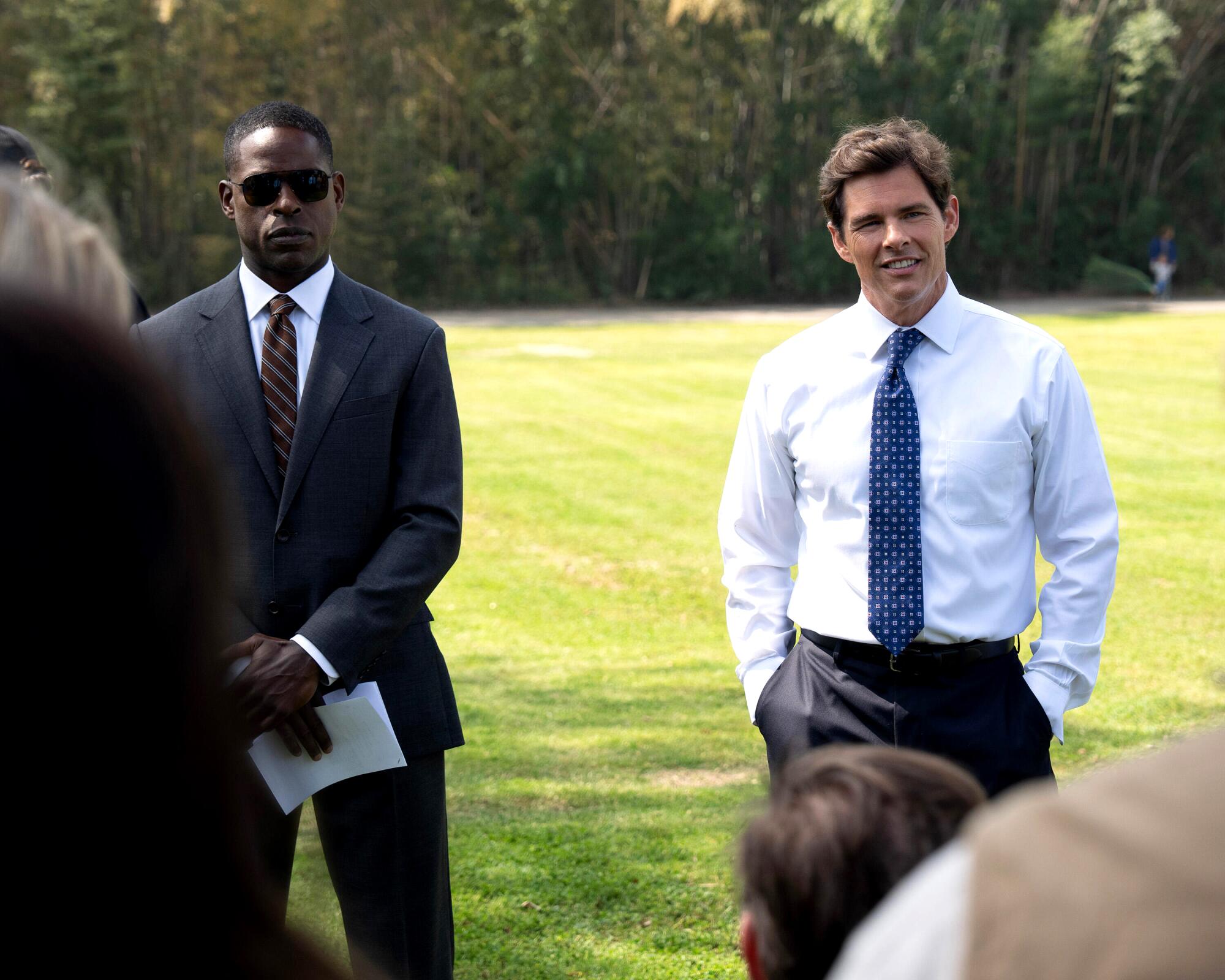
Sterling K. Brown and James Marsden in Hulu’s “Paradise.” “There was real great evolution of the character through the show, and that was exciting to me, that it was a person, it wasn’t a president,” Marsden says.
(Ser Baffo/Disney)
I know this idea has been percolating with Dan for about a decade and the show doesn’t necessarily intend to touch on the political points of the current moment. But time has caught up — whether it’s concerns with the climate right now or what’s unfolding on the political stage.
Brown: Yeah, it’s hard not to notice. I do think the show asks a very interesting question regarding who holds real power. What is the nature of that real power? The strange bedfellows of capitalism and politics, and should they necessarily be so closely intertwined with one another? Do we need a little bit more separation? I think the show, or at least I argue that the answer to that is, yes. I was listening to something on my IG [Instagram] the other day [that said something like] the 400 wealthiest white people had the collective income of all the Black people in America; the collective 1000 richest white people in America have the collective resources of all African Americans and Latinos in America. And I’m like, “Wow” [eyes grow wide]. So, is government for the people or is government for the people that are able to fund the campaign? I think the show tangentially touches on that little bit. In terms of climate, I think the show is saying, “You gotta take care of this planet, man.” We cannot be cavalier. We’ve got a lot of people giving us a lot of warnings of what is going to happen if we don’t change.
Marsden: It’s harrowing. Nobody wants this to be the case. And what do we do? And how do we separate the facts when there’s so much misinformation? Is this a reality that we’re going to have to accept at some point or is it not?
So, you’re told that there’s an underground community happening in Colorado and you’ve been selected. Are you likely to go or would you be like, ”I don’t want to be underground.” And what necessities or essentials do you want there with you?
Marsden: Your people. If you can’t have your people, I’m staying.
Brown: I agree with that. If it’s a matter of life or death, I’m going if I can take my people with me. If I’m going to be alone by myself, without my kids and my wife, I’d rather be with my kids and my wife, and we’ll all go to heaven.
Marsden: I feel like, if this would have happened, it’d have to be a very quick lottery. As much as your survival instinct kicks in, and you want to go and have all your people in — and then you’re there, watching the rest of the world perish. I would be feeling so guilty and terrible, but also happy that you have your people.

James Marsden plays the president in a pre- and post-apocalyptic U.S. in Hulu’s “Paradise.”
(Christina House/Los Angeles Times)
And the chili cheese fries, which are apparently a must in this makeshift world.
Brown: That are not made with real milk. The lack of animal product is tough, but we can’t be releasing methane up in a cave. It’s not a good look.
Sterling, the third episode’s final moments has a reveal of a different sort for you: your backside in the shower scene. I wondered what both your reactions were in reading that in the script. Was that a twist you expected?
Marsden: I’m an admirer of the human physique, male or female. Thank God it’s him.
Brown: [laughs]
Marsden: And I thought I was in shape!
Brown: You are in shape. You’re in great shape. I focus on the posterior chain. It’s important to me. A lot of power lays in the back.
Marsden: What is the posterior chain?
Brown: Posterior chain is everything up and down the backside of your body and the posterior.
Marsden: I have a posterior ch—. Not a fully developed chain.
Brown: James’ [character] is dead. But if James is free, and as I go to the writers room, if there’s a possible flashback, hopefully we can get him back for Season 2 if and when we get picked up to work for that butt shot.
Marsden: I could work this thing out for 20 years and I would never look like this man.

Movie Reviews
‘Night Nurse’ Review: A Caretaker Explores Her Kink for Elder Abuse in the Year’s Strangest Erotic Thriller

There are any number of erotic thrillers in which rich old men are robbed blind and/or left for dead, but Georgia Bernstein’s admirably bizarre “Night Nurse” might be the first movie of its kind where elder abuse is the source — and possible subject— of its erotic thrills. If there are others, I’m not sure I want to know.
But this woozy debut feature doesn’t rely on its audience being turned on by the relationship between a nubile caretaker and her dementia-addled patient. Their psychosexual bond, meanwhile, hinges on cold-calling vulnerable old people under the guise of a grandchild in financial distress. (“I’m in trouble, nana, send me $10,000 or I’ll be left to rot in jail!” That sort of thing). With its slim wisp of a premise stretched into a Strickland-esque dreamscape that substitutes kink for conflict, the film itself hardly seems convinced by its own wrinkled lust — all desperate kisses and non-touching poses of subservience. More important to Bernstein is what that lust reveals about her characters’ deepest needs, specifically how their need to care and be cared for can be as easily perverted as any other form of desire.

As moody and weightless as the noir-accented score that blows through the movie like a curlicue gust of wind in an old cartoon (credit to musicians Sam Clapp and Steven Jackson), “Night Nurse” lacks the pulse required for its stray feelings to come alive. Still, the film ambiently taps into the latent eroticism of teasing out the distance between how you see yourself and who you really are. Bernstein plays with that distance like a telephone cord wrapped around her fingers, and Eleni — played by the excellent newcomer Cemre Paksoy, powerfully helpless — only frays even more as the receiver is brought near the hook. “Everything I did before today wasn’t me,” the nurse tells co-worker Mona (Eleonore Hendricks) after starting a new job at an Illinois retirement home. “It was somebody else.”
What she did before today remains unexplored (specifically, what she did to get herself fired from her last gig), but I’m guessing she’s probably changed less than she thought. There’s a faraway flicker in her eyes the moment she catches the vibe between Mona and Douglas (a ribald and elusive Bruce McKenzie), a white-haired seventysomething who shows early signs of dementia but still commands an undiminished sexual energy. “I’m not an invalid,” he coos as Mona bathes him in the tub, to which she replies, “yes, you are,” in a supplicant tone that hints at a rich history of power games between them.
Later that same night, Douglas will force Eleni to call a stranger, pretend that she’s their granddaughter, and ask for money — he’ll wrap the phone cord around the nurse’s body as she talks and shove her against the wall as they kiss. She’s into it. So into it that he has to clarify the terms of his whole deal: “If you’re looking for a pogo stick, I’m really not your guy.” But Eleni isn’t looking for anything to bounce on. She just wants to be needed, and maybe to need someone in return. Someone who will see her for who she really is and allow her the fantasy of pretending she isn’t being herself when she cons vulnerable strangers out of their money — when she exploits how enthralled those strangers are by the care they have for their loved ones.
“Night Nurse” doesn’t belabor the psychology, as Bernstein prefers to express her story through heavy-lidded suggestion. Somnambulating from the moment it starts, the film moves through a series of beautifully arranged poses that stretch their latent meaning thin across the surface (Lidia Nikonova’s cinematography lacquers every shot with a seductive dreaminess). We see Douglas smoking in a lawn chair with Mona and Eleni curled around his feet. Eleni riding in the backseat of a convertible as the wind blows through her curls. The full staff of nurses — all of them under Douglas’ sway — stumbling around his condo in a state of zonked out bliss as they roll on the prescription drugs they’ve stolen from the residents.
Once you’ve seen one shot of this movie, you’ve practically seen them all, at least until things escalate during a rushed and unsatisfying third act that forces Eleni into an honest confrontation with herself. People will do just about anything to feel needed — they’ll give whatever degree of care allows them to receive it in return. “Night Nurse” understands that desire, but remains far too numb to treat it.
Grade: C+
The Independent Film Company will relase “Night Nurse” in theaters on Friday, July 10.
Entertainment
Lucas Museum to give free annual passes to South L.A. neighbors, host community preview day

The Lucas Museum of Narrative Art, which is moving at light speed toward its Sept. 22 opening, announced Thursday that it will give free annual passes to its South L.A. neighbors living in the 90037 ZIP Code. The 300,000-square-foot, $1-billion museum located in Exposition Park will also host a special community preview day on Sept. 13, more than a week before the general public gets to step inside.
The 90037 ZIP Code has a population of more than 65,000 and is bordered roughly by the 110 Freeway to the west, Slauson Avenue to the south, Central Avenue to the east and Martin Luther King Jr. Boulevard to the north. Residents can register for passes at lucasmuseum.org/lm37 and will be alerted in August when the program launches. Pass holders can reserve tickets for themselves and one guest.
Tickets for non-pass holders go on sale July 21. They cost $25 for adults and $21 for seniors. Kids 17 and under are free.
“Storytelling has the power to bring people together and create a sense of community,” said Lucas Museum Chief Executive Tracey Bates in a news release about the program. “Through LM37, we are inviting our South Los Angeles neighbors to make the museum part of their lives and take their own path of discovery through the art, programs and experiences that will help shape this new cultural hub for Los Angeles.”
The community preview day is designed to give local business owners, community partners, civic leaders and registered LM37 pass holders a sneak peak of the 10,000 square feet of exhibition space, as well as the expansive gardens with 11 acres of park space.
The opening programming, curated by co-founder George Lucas, features 20 inaugural exhibitions across more than 30 galleries, including one titled “Star Wars in Motion,” containing vehicle designs, high-speed racers, flying vessels, props, costumes and illustrations from the first six films in the beloved franchise.
More than 1,200 objects will be on display from Lucas’ personal collection of narrative art. Highlights include work by Norman Rockwell and Dorothea Lange, as well as a variety of manga, children’s book illustrations and comics.

Last year’s “Superman” ended with Iggy Pop singing “Because I’m a punk rocker, yes I am” — an ironic coda for a superlatively square hero. But it rings straightforwardly true for Superman’s cousin.
Milly Alcock’s Kara Zor-El, or Supergirl, sports not a spandex suit but a Blondie T-shirt. When we meet her in Craig Gillespie’s “Supergirl,” she’s been on an interstellar bender for days. She’s more Courtney Love than Clark Kent.
Nonchalant and sarcastic, Kara is also a little Han Solo-ish, you might say, given that she moves capriciously through the galaxy in her junky spaceship while getting in fights in extraterrestrial bars. She’s a welcome, jagged riff on more buttoned-up superheroes, and Alcock is terrific in the role. If only “Supergirl” was as good as she is.
While the latest DC release, and second under James Gunn’s stewardship, has its moments, “Supergirl” struggles to match Kara’s punk-rock energy with an equally spirited supporting cast and story.
Skepticism seems to have gathered for “Supergirl” ahead of its release. Many fans have argued it wasn’t the right next step for DC Universe. But I’m not so sure. Alcock’s breezy cameo in “Superman” was one of that movie’s highlights. Handing the follow-up to her, and her faithful floating dog Krypto, strikes me as an extremely natural next step. When in doubt, follow the dog.
And much of “Supergirl” is winning. It resides almost entirely in space, touching down only momentarily on Earth. In its consistently creative production design, clever needle drops and underdog story arc, “Supergirl” resides a little closer to Gunn’s “Guardians of the Galaxy” movies than other DC entries. Its outer space is filled with cosmic detritus, mean characters and cute critters. Seth Rogen as the voice of a tiny alien co-piloting a space bus is an inspired concoction, as is a shabbier sci-fi realm with rest stops along the intergalactic highway.
-

 Miami, FL5 minutes ago
Miami-Dade Schools names six semifinalists for superintendent
-

 Boston, MA8 minutes ago
Lawsuit: ICE detained East Boston father despite legal status
-

 Denver, CO13 minutes ago
Victor Marx wins GOP primary for Colorado governor, defeating veteran lawmaker after unorthodox campaign
-

 Seattle, WA20 minutes ago
Widower of pregnant woman who was shot to death in Seattle sues homelessness authority
-

 San Diego, CA23 minutes ago
Terrifying moment huge sea lions chase tourists off popular California beach
-

 Milwaukee, WI35 minutes ago
Milwaukee leaders condemn ICE arrests as agency ignores City mask ordinance
-

 Atlanta, GA38 minutes ago
Georgia Secretary of State opens investigation into voter registration mailers sent to deceased residents
-

 Minneapolis, MN43 minutes ago
Minneapolis chief communications officer Adam Fetcher out amid possible criminal charges

