Entertainment
Ridley Scott's 'Modville' graphic novel debuts during a tough time for comics. Can it survive?


When Ridley Scott, visionary director of “Alien,” “Blade Runner” and “Gladiator,” connects with your story, it’s probably a good idea to explore it in any medium possible.
“Modville,” a four-issue neo-noir graphic novel set in New Orleans in 2169 that unfolds in a world of crime and artificial humans (known as mods), was just that story. Created by Jesse Negron, co-written by Joe Matsumoto and with art by Hendry Prasetya and Eko Puteh, the comic touches on themes of father-daughter relationships, morality and humanity. The comic series bucks the current trend of reframing superhero narratives. Instead, it’s an original idea that will go direct to consumers (versus being released by a big publisher like Diamond and Penguin Random House) and initially be printed in a prestige format (a 200-page hardcover instead of single issues). It’ll also have an idiosyncratic schedule, free of month-to-month pressures.
Negron, who had previously worked with the director and his late brother, Tony Scott, pitched the seemingly radical idea of doing a comic book to Tom Moran, senior vice president of Ridley Scott’s film and TV company Scott Free Productions.
“Tony was a big fan of Jesse’s. We met and talked about his ideas, and I said, ‘Well, what do you want to do? Film or TV?’ He said, ‘I really want to do comics, but you guys don’t do that.’ I said, ‘Why not?,’” said Moran. “As an entertainment company, especially these days, you have to evolve. We have to reach out and expand to new forms of entertainment. Honestly, Ridley was probably like, ‘We should have done this a long time ago.’ He’s such a good artist himself.”
Director Ridley Scott said doing a graphic novel felt like “a natural evolution.”
(Scott Free Productions)
“Collaborating with Jesse Negron and Mechanical Cake on graphic novels feels like a natural evolution for myself and Scott Free,” said Ridley Scott via email.
Through his company Mechanical Cake, Negron will be introducing the graphic novel, as well as a “Modville”-style booth, at WonderCon in Anaheim this weekend. Negron, Moran, publisher and editor Dave Elliott, and Anthony Francisco, a senior visual development artist for Marvel Studios, will discuss the ins and outs of the company in a panel Saturday.
Launching ‘Modville’
Negron has been working on the idea for “Modville” for at least 5 years. Negron and Chief Financial Officer Tom Sanders launched Mechanical Cake in 2015 to not only create comics but to also cultivate new ideas in multimedia.
“Mechanical Cake is a world-building [intellectual property] creation team that is focused in the sci-fi-fantasy-action-adventure genre,” said Sanders. “The goal of any creative is not only to tell the story but to get it to the world and get the fans involved.”
The company’s association with Scott already adds cachet to the title, but obtaining his blessing was only the first step.
“There’s no doubt that for me to launch at the bar of Ridley Scott, it’s a lot of pressure to be honest,” said Negron. “It’s sometimes very difficult to work at the level he works at because he’ll just go, ‘Meh, I don’t know.’ To work at his level where he goes, ‘Whoa, you guys keep doing this. Whoa, you did that!?’ That was really important to me.”

Jesse Negron built the motorcycle prop he’s sitting on as part of the “Modville” booth that will be assembled for WonderCon.
(David Roberson)
Getting on the same page as your business partners is only one of the hurdles to overcome when launching an independent comic book. With the sale of Diamond Comic Distributors to Alliance Entertainment, the comics industry may breathe a sigh of relief, but market leaders still tend to dominate attention and shelf space, limiting sales for small presses and direct-to-market players. Diamond helped unknown titles get the word out through its Previews catalog, but with its bankruptcy and subsequent sale, it’s unclear how the acquisition will affect the comics industry.
Of the 40 most popular graphic novels in 2024 (based on units sold), only four titles weren’t published by the leading comics companies — which include Marvel Comics, DC Comics, Image Comics, IDW Publishing, Dark Horse Comics and BOOM! Studios. Those titles include “Dog Man: The Scarlet Shedder” by Graphix, “Uzumaki” and “Chainsaw Man, Vol. 1” — both by VIZ Media — and “Jimi Hendrix: Purple Haze” by Titan Comics. This trend is seen with periodical comic books too, with only four franchises outside of Marvel and DC able to crack the top 50 comics of 2024. Those all happened to be well-known ’80s titles such as Image’s G.I. Joe and Transformers, IDW’s Teenage Mutant Ninja Turtles and Dynamite Entertainment’s Thundercats.
But it’s an uncertain time for all entertainment sectors. Like the movie industry, comic book sales and consumer trends indicate that introducing an original story, without an established distribution network, like the one Diamond provided for decades, is a daunting and risky task.
Film and comics have a lot in common, which is also why the union of Scott Free Productions and Mechanical Cake makes sense to the parties involved.
“They deliver like nobody else on the planet in this genre. Science fiction, action, the edge of fantasy. I can’t think of a better partner to team up with than Scott Free,” said Sanders. “Doing a comic book is like doing a film or TV show but with more details. Everything on the panel is intentionally put there, just like you do in a film or TV show. If you’ve done it right, you pretty much have laid out a storyboard that anyone should be able to follow. We want to build a world for others to create stories in as well.”
Scott, known for his detailed storyboards, was also drawn to the comics because of his background as an artist.
“To watch Ridley draw is amazing. He’s such a visionary, from mind to pen to hand to paper. You can flip through his storyboards and see the whole movie. It’s truly an art form, and that’s essentially what you’re getting from comics,” said Moran.
Bill Sienkiewicz is one of the prominent artists who will help create the visual language for “Modville,” specifically in crafting covers for the series. Sienkiewicz said he enjoys the “grunge” technology in the story, which harks back to something familiar.

Poster art from “Modville” by artist Bill Sienkiewicz.
(Mechanical Cake)
“What I’m enjoying about ‘Modville’ is that, while it may not be a direct corollary to ‘Blade Runner,’ it has enough of the DNA to make it feel like it’s at least adjacent. I love the idea of investigating on deeper levels what constitutes humanity and morality,” said Sienkiewicz. “When you’re doing a monthly book, you can afford to be a little more subtextual and be intriguing for it’s own sake.”
Publishing path
”Modville” has also carved out its own route into a crowded marketplace. It’ll launch with a prestige format (200-page books) and hardcovers then transition to soft covers and to a wider market. Unlike traditional comics and graphic novels, these editions won’t be reprinted, making them one-of-a-kind commodities. Elliott said he wants Mechanical Cake to be accessible to the public but also to make sure the creative process isn’t rushed to meet market demands.

Publisher Dave Elliott wants Mechanical Cake to “treat the publishing [of comics] the way the Europeans do with graphic novels and the way the publishing world used to treat novels.”
(Dave Elliott)
“More books are being published by Kickstarter at the moment than almost anybody else. So that model of working directly with the people who are fans of what you’re doing is something that is so important today,” said Elliott.
“But a lot of other publishers you look at, they’re trapped into that, ‘It’s a new month. We have to have something out every month.’ I’m like, ‘No, we don’t.’ We put something out when it’s ready but not before. I wanted us to treat the publishing the way the Europeans do with graphic novels and the way the publishing world used to treat novels.”
It’s a mind-set that goes against what retailers and consumers may be used to. Paul Grimshaw, owner of Burbank’s House of Secrets comic book store, prefers serialized comic books and graphic novels that “come out on a monthly basis and keep people interested,” but he says being unique is also key. One of his top-selling comics over the past year has been “Saga,” an epic space opera/fantasy series written by Brian K. Vaughan from Image.
“Honestly, all you need to do is be good. If you’ve got well-written, well-illustrated books, they will find an audience. Gimmicks are gimmicks. Gimmicks only last for a short amount of time. My favorite books are the ones that have good artists and are telling a solid story,” Grimshaw said.
Ridley Scott’s influence
Besides lending his name to the project, Scott also contributed to shaping the story and a critical eye to the art direction. It dawned on Elliott early on that Scott could see the relationship colors played to viewers onscreen and to readers on paper.
“In the beginning, the colors were a bit brighter and more vivid. And [Scott would say], ‘Maybe you can mute it a bit, desaturate it a bit.’ This was when I realized that he understood the difference between comics and film. We were talking about the fact that comics use color in a way [Scott] can’t use in film. It is a more muted palette so you can trigger emotion [differently],” said Elliott.
“I started out as an artist, sketching every storyboard for each of my films, and it’s remarkable how instinctively the visual language of storytelling in ‘Modville’ unfolds,” said Scott.

A page of art from “Modville,” which is set in a futuristic version of New Orleans, where music also plays a part in setting the mood.
(Mechanical Cake)
Scott and Negron’s sensibilities seem to align well. Negron’s stylistic and storytelling influences are varied: from the retro technology and stylish imagery of “The Rocketeer” to a Southern Gothic aesthetic born of a Baptist upbringing.
When Negron sent Scott his first draft of “Modville,” the director made him dial back some of the more controversial and gratuitous elements. Though he had been working on the story and art for years, Negron realized that Scott wasn’t trying to change his vision, he was making sure that it would grab readers and keep them coming back.
“He goes, ‘I’ve had a room of 6,000 people turn against me.’ So we toned it down a little bit in the opening [for ‘Modville’], and I think it was a good choice.”

Entertainment
Justin Baldoni and wife break silence after ‘It Ends With Us’ legal battle with Blake Lively

Justin Baldoni has broken his silence after reaching a settlement in a lengthy and highly publicized legal dispute with Blake Lively.
Baldoni and his wife, Emily Baldoni, presented a united front in an Instagram video the couple shared Wednesday that began, “So we have not spoken publicly for the better part of the last two years, and it’s not because we haven’t had anything to say, because Lord knows we have.”
The “It Ends With Us” actor and director said that although they’d wanted to address the debacle that involved dueling lawsuits with Lively, nearly two years of tit-for-tat fodder and culminated in a confidential settlement, “something was telling us not to.”
The couple said they prayed about when to make a public statement. “This feels like the moment,” Emily said.
“What does feel important,” she continued, “is that we can genuinely say that we are sitting here today feeling immense gratitude for so many things and so many people and so many things that have happened to us.”
“Gratitude has saved us,” Justin added.
“I also feel that it’s important as we say that — in that gratitude — it doesn’t negate the injustice and the pain that we have also felt in the last few years, and we’ve had to wrestle with so many things and try to understand so many things,” Emily said. “How could something like this even happen? Let alone disguised as a fight for women. So much to unpack. And the truth is, reality is, is that there’s been a lot of trauma for us to move through as a family, which also makes it hard to speak.”
“We don’t even know this is the right thing to say, but we just know we need to share something,” Justin said. “What I will say is that there have been so many painful things that have been spoken into existence — “
“Untruthful,” Emily broke in.
“We didn’t want to add to the noise, so we just wanted to let the justice system run its course,” he said.
“And the truth and the facts have spoken for themselves,” Emily said.
The couple’s statement comes a year and a half after Lively filed a bombshell lawsuit against Baldoni alleging sexual harassment, retaliation and several other charges on the heels of a messy “It Ends With Us” summer release and press tour that fueled rumors of on-set turmoil.
Less than a month after the allegations against Baldoni rallied Hollywood against him, he countersued Lively, her publicist Leslie Sloane and her husband, Ryan Reynolds, for $400 million in damages, claiming they’d smeared his name in the press and wrestled away his control of the film. His suit was later dismissed.
In May, two weeks ahead of the trial, Lively and Baldoni reached an agreement to resolve their legal dispute, bringing an abrupt end to the contentious battle.
“The parties in the Blake Lively and Wayfarer Studios litigation have reached an agreement to resolve the matters,” lawyers for both sides said in a joint statement.
“The end product — the movie ‘It Ends With Us’ — is a source of pride to all of us who worked to bring it to life. Raising awareness, and making a meaningful impact in the lives of domestic violence survivors — and all survivors — is a goal that we stand behind. We acknowledge the process presented challenges and recognize concerns raised by Ms. Lively deserved to be heard. We remain firmly committed to workplaces free of improprieties and unproductive environments. It is our sincere hope that this brings closure and allows all involved to move forward constructively and in peace, including a respectful environment online.”
In June, a federal judge ordered Baldoni and his production company to pay Lively’s attorney fees related to his unsuccessful defamation lawsuit against her, but rejected her bid for additional damages.
“So, how are we doing?” the filmmaker said in the Instagram video. “We are healing, and if you’ve ever been through something traumatic, you know that healing isn’t linear. It lives different every day, and we have had to rethink for ourselves what is real. What matters, and it’s this. It’s our family. It’s our friends. It’s our community. It’s our faith.”
Times staff writer Josh Rottenberg contributed to this report.
Movie Reviews
‘The Guest’ Review: Trine Dyrholm Gives a Scorcher of a Performance in a Gutsy Danish Party-Gone-Wrong Drama

A family and friends gather for a naming-day ceremony at a Danish seaside hotel, but an unexpected appearance by one uninvited attendee (Trine Dyrholm) ruptures the veil of bland, happy-clappy familial unity in director Mads Mengel’s gutsy, well-wrought debut feature, The Guest.
The most audacious move here may be Mengel and co-screenwriter Christian Bengtson’s choice to write something that will inevitably invite comparisons with Festen (The Celebration), arguably the most notorious Danish-language film of the last 30 years, which similarly revolved around a bougie gathering disrupted by angry revelations. But there’s a savvy 2026 vibe about the way the film refuses to create florid melodrama out of quotidian crisis, and instead observes with generosity as the characters grope awkwardly toward emotional détente and mutual forgiveness.
The Guest
The Bottom Line When wetting the baby’s head goes too far.
Venue: Karlovy Vary Film Festival
Cast: Simon Bennebjerg, Trine Dyrholm, Josephine Park, Peter Gantzler, Petrine Agger, Mette Klakstein Wiberg, Kristine Kujath Thorp, Buster Lund Luscher
Director: Mads Mengel
Screenwriter: Christian Bengtson, Mads Mengel
1 hour 40 minutes
Festen-alumnus Dyrholm, having a bit of a career moment with outstanding performances both here and in the recent The Girl With the Needle among others, leads a uniformly excellent cast in a work that deserves celebration on the festival circuit and beyond.
Dyrholm’s Vibeke is technically the first person we meet, although she’s seen only in shadow at first as she smokes and drives while her unattached seatbelt, caught outside by a closed door, clatters on the road. This is the kind of unsafe driving her son Karl (Simon Bennebjerg) so deplores, a point of contention later on in the story when he will steal her car keys in interest of her own safety and that of others.
But well before we get to that flashpoint, the film introduces Karl, effectively the film’s protagonist, as he arrives at the swanky resort with his wife Emilie (Mette Klakstein Wiberg) and their infant son Elliot (Buster Lund Luscher). The young family, who’ve chosen this new, secular tradition instead of a christening to welcome their child to the world, are there a day before the ceremony to meet up with core family members.
As this advance party settles down for dinner, a table that includes Karl’s sister Rikke (Josephine Park) and Emilie’s parents Frank (Peter Gantzler) and Kirsten (Petrine Agger), there’s a surprise: Vibeke is coming, courtesy of Rikke’s invitation. Karl is quietly furious and seems determined to turn her away, even when she shows up minutes later. Poor Frank and Kirsten look on confused, determinedly polite in their insistence that all family members should be welcome.
Bengtson and Mengel’s economical script carefully dripfeeds backstory as the film unfolds to explain that Karl hasn’t spoken to his mother in years, that Rikke has taken over all the daily mom management and that she’s very worn out by it. Even so, she insists Vibeke is regularly taking her medication and isn’t a problem these days, although to Karl every weird anecdote and moment of emotional intensity is an augur of impending chaos. Rikke counters that their mother is just “big, that’s her personality not her condition.”
Interestingly, that specific condition is never named throughout, although armchair diagnosticians might spot many of the signs of bipolar disorder. But the film’s emotional focus on the person and her actions rather than the label is also very contemporary, reflecting a more holistic, inclusive mindset and approach to dealing with mental health issues.
Which is all fine and dandy, until Vibeke duly does skip a dosage and starts getting manic. One of the first signs of chemical imbalance arrives during the ceremony on the beach, when Vibeke carries little Elliot much further away from the shore than anyone wants, creating a panic. From there it just gets worse as Vibeke picks up on the censorious feeling emerging from the other party guests, who had found her so charming the night before when she’d led everyone to the casino to play roulette and diverted a bunch of partying teenagers from the room next to Karl and Emilie so they could get some sleep. When the toasts at the formal dinner begin, Vibeke’s mood darkens much further, and if we’ve all learned one thing from Festen, it’s be very afraid when a Dane gets up to make a toast.
Cinematographer David Bauer’s nimble-footed lensing and use of natural light does indeed hark back considerably to the look of those Dogme 95 movies back in the day, as does the naturalistic editing style deployed by Louis Emil Ramm Seeberg. But there are plenty of sins against the rules of cinematic chastity that marked that movement, such as the ample space made for Lasse Aagaard’s affecting, low-key score that amps up the anxiety as Vibeke starts to spiral.
That said, Mengel keeps things simple in sonic terms when it really counts, letting the musicality of Dyrholm’s deep, sonorous voice ring out on its own in the big monologue scenes. She is, as ever, utterly mesmerizing but the performance is made even more powerful by the muted, expressive reactions of the rest of the cast as they look on, frozen like deer in the headlights of the car crash of pseudo-christening. Moments of levity puncture the gloom, but the final feeling is one of numbed sorrow and pity for all these kind, fallible people, just trying to do their best.
Entertainment
Rhea Seehorn celebrates her ‘Pluribus’ Emmy nomination as she waits to hear about Carol and the atom bomb
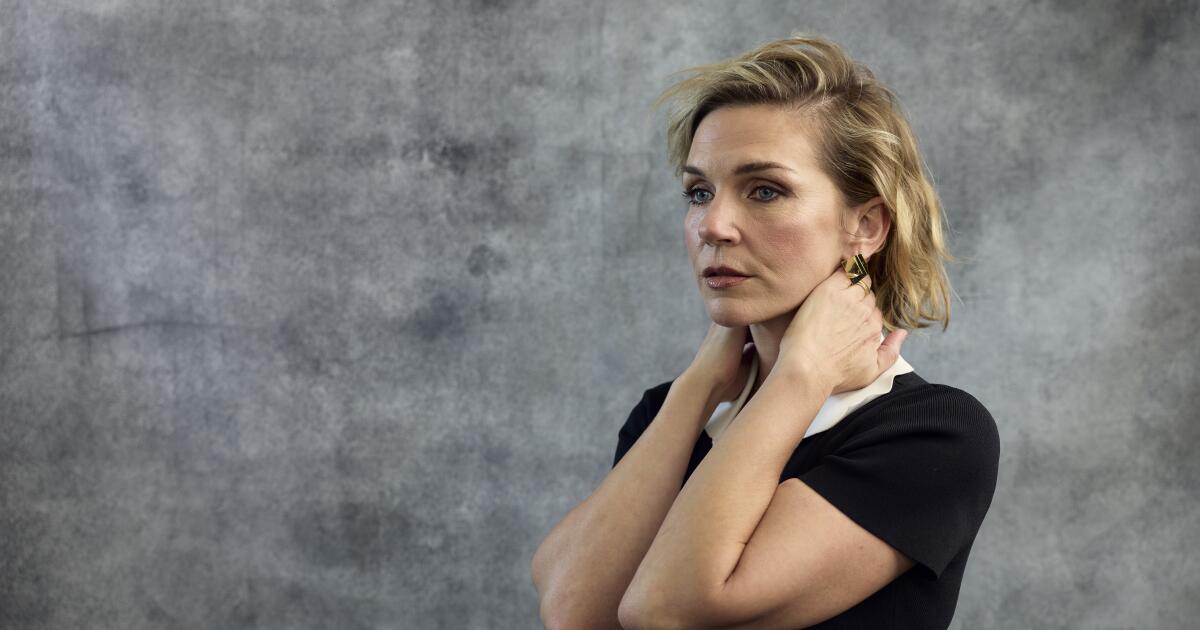
Rhea Seehorn was nervous about whether “Pluribus” would be recognized by Emmy voters Wednesday when nominations were announced. So she was jubilant when she and the surreal sci-series on Apple TV scored 18 nominations, the most for a first-year drama.
“I’m just so grateful,” the actor said in a phone interview. “People were like, ‘Why were you nervous?’ Honestly, you never actually know. I’m just so thrilled for the show, my co-stars, the production design, the editing, the writing, the music, the sound. I haven’t moved from my couch since they first announced everything because I’m still trying to call everybody on the show.”
Seehorn received a nomination for lead actress in a drama series for her portrayal of cynical Carol Sturka, a fantasy romance author who finds herself in a mystifying situation after a virus seems to have wiped out most of Earth’s population. The series was created by Vince Gilligan, who created the acclaimed series “Breaking Bad” and co-created its spinoff “Better Call Saul,” which also featured Seehorn.
The actor compared her experience of being nominated for “Pluribus” to “Better Call Saul,” which earned her two supporting actress nominations: “ ‘Better Call Saul’ was such a family that supported and cheered each other on, and I’m so grateful I have that environment again. People could not be happier for each other, and we get to celebrate the show together.”
She added, “The only part that feels different is that it’s my first nomination as a lead. It’s the process of Vince writing this for me and seeing the mountain which he wanted me to climb and going through that process. The whole thing has been its own journey, so ending up with awards and nominations, and being so well received by critics and fans is not lost on me.”
The series has been applauded for its mix of drama, comedy and strangeness in its portrait of a woman coming to terms to what seems like an impossible dilemma.
“I love the storytelling, how much Vince and I would drill down on making this as authentic as we could in terms of an everyman who has to deal with an insane situation,” Seehorn said. “Most of us are just not heroic or leaping off the couch to go save the world. And Carol is dealing with immense grief and confusion in an utter dystopian crisis. I love the humor and the drama that comes out of us being as realistic as we can with her amidst an unrealistic event.”
Fans of “Pluribus” have been relentlessly curious since the finale in December about when the second season will launch.
“I don’t know anything about that,” Seehorn said. “I don’t have to keep secrets because I’m not great at keeping them, and I know nothing. I don’t know what I’m doing with an atom bomb in the driveway. I can’t wait to find out. The writers want to have the same quality and reward the intelligence of the fans and never phone a single thing in. So their process is their process.”
-
Entertainment7 minutes ago
Justin Baldoni and wife break silence after ‘It Ends With Us’ legal battle with Blake Lively
-
 Lifestyle10 minutes ago
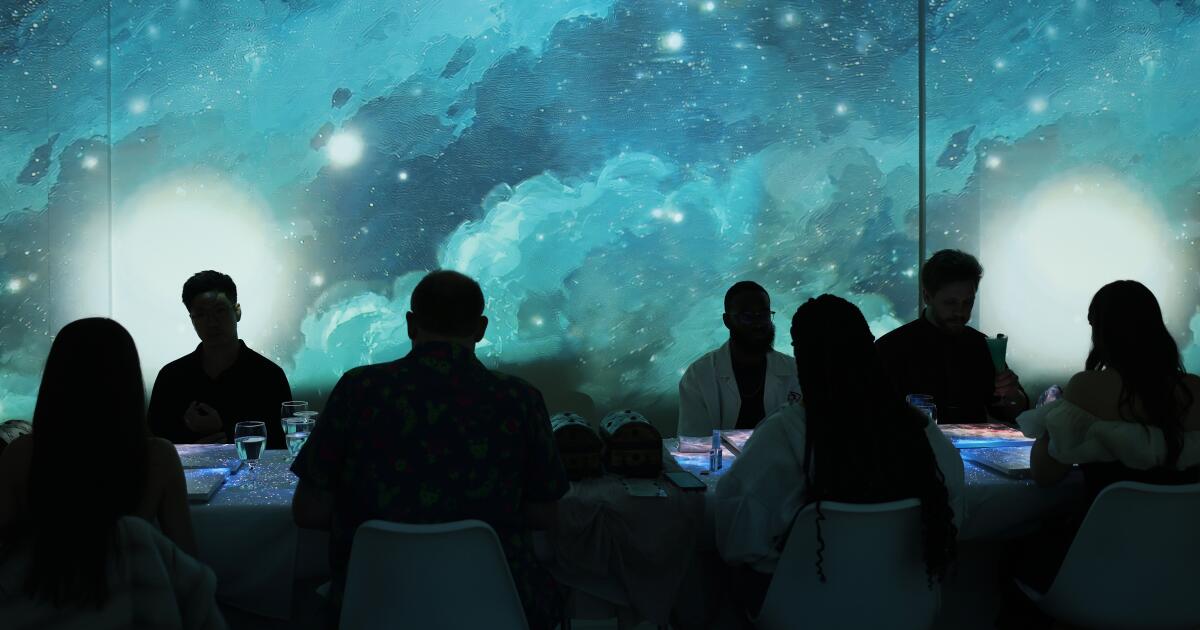
A meal with an animated Mona Lisa? Immersive dining goes high tech — but will L.A. eat it up?
-
 Politics15 minutes ago
Nexstar launches its first digital subscription service with The Hill Insider, aimed at political junkies
-
 Science22 minutes ago
Not everyone is leaving California. A new commercial battery maker just landed in Sacramento
-
 Sports25 minutes ago
Mookie Betts’ eighth-inning single gives Dodgers the win over the Rockies
-
World37 minutes ago
From sewers to swimming sites: how Europe's cities reclaim their rivers
-

 News1 hour ago
Three more people charged with damaging Reflecting Pool after Trump’s multimillion-dollar restoration | CNN Politics
-

 Los Angeles, Ca2 hours ago
Loved ones search for missing 34-year-old Southern California woman

