Entertainment
Review: ‘DMV’ drives a pleasant sitcom into L.A.’s most dreaded office


Work! It’s the thing most of us have to do, some of us like to do and many of us would rather not do, and it’s no surprise that it’s the subject of so much TV.
Workplace comedy has been responsible for some of television’s greatest series — “Taxi,” “Barney Miller,” “NewsRadio,” “Parks and Recreation,” “30 Rock,” “The Office,” obviously, “Abbott Elementary,” just off the top of my head — and some of its shortest lived. Anywhere a job gets done can theoretically support one — pick a workplace (sushi bar, travel agency, magic shop, museum, whatever), write a pitch, get an agent and, presto, you’re a TV writer. You can put the characters in later.
Okay — it’s not quite that easy. But there is a common Mad Libs structure to such series, whether filmed before a live audience or single camera, placing a variety pack of individuals into a shared space. Some characters might be related; there may be romantic attraction between a couple. Not much actual work will get done, and what gets done may make no real-world sense, but the office is the box that holds them and colors their lives. “The Paper,” “Animal Control,” “St. Denis Medical,” “Going Dutch” and “Shifting Gears” are among those currently airing and streaming and, minor stylistic variation notwithstanding, they have more in common than not.
Of all the offices a person might be required to visit, the Department of Motor Vehicles, with its purgatorial air, has one of the worst reputations. It’s a safe bet that, sitting there waiting for your number to be called, you never thought, “I would really love to work here,” but this being Hollywood, you may have thought, “There’s a show in this.”
Indeed, the most surprising thing about “DMV,” a single-camera, non-mockumentary sitcom premiering Monday on CBS, is that it took so long to arrive. Created by Dana Klein (and inspired by Katherine Heiny’s short story “Chicken-Flavored And Lemon-Scented”), it’s a representative example of its kind, not bad, not exceptional, a platform for some good actors to do their work. Its perfect averageness makes it easy to dismiss, but it’s a painless, pleasant half-hour, with a smattering of genuine laughs. And like every such show, it can be expected to ripen with age, if age comes.
In one episode of “DMV,” a broken air conditioner causes havoc on a sweltering L.A. day.
(Bertrand Calmeau / CBS)
Harriet Dyer plays Colette, sweet and awkward and nominally the ensemble’s main character. A driving examiner, she has the nickname “E-Z Pass,” because she never flunks an applicant. She has a crush-at-first-sight on new hire Noa (Alex Tarrant), a charming, cheery hunk/lunk from Down Under. Manager Barbara (Molly Kearney) loves her job “and every single person who works here”; Vic (Tony Cavalero) is the series’ inexplicable oddball, intense, pumped-up; Ceci (Gigi Zumbado) is the staff photographer, who in her mind is shooting for Vogue. Finally there’s Tim Meadows, as Gregg, whose patented deadpan I have found a highlight of every show he’s ever landed in. Both as actor and character — jaded, cynical, satisfied — he’s the series’ sane old pro, who will instruct Noa in the art of taking a cigarette break without a cigarette.
Situations are classic. Cost-cutting consultants arrive to interview the employees (“I requested time off because my mama passed away, but was denied,” says Vic, “and it’s happened twice”) and decide whether the branch will live. (There are four Hollywood branches in this alternative universe — as if.) Colette gives Noa, who needs an American license, his driving test, and he’s terrible. It’s a very hot day and none of the employees are allowed to touch the air conditioning. In a variant of a situation that has likely appeared in two out of every three sitcoms ever produced, an old friend of Colette’s, now a TV star, shows up at the branch; Colette tells elaborate lies about having followed her own dream of becoming a veterinarian, compounded by the “assistance” of a wig-wearing Vic as her husband. Of course, a dog will become sick. There will be pranks.
“What we do here makes a difference,” Barbara tells the consultants in an inspirational speech, making the point that “DMV” is not out to denigrate the institution or the people who work there. However bored the person helping you at the window may seem, or if they’re disinclined to return your cheery hello, that person in line before you may have been a jerk. Remember that when your license expires.



They say write what you know, which is probably why there are so many damn films about Hollywood. The latest navel-gazer, Jay Kelly, is about an aging movie star (played, not coincidentally, by aging movie star George Clooney) reflecting on his life and his choices. The film is directed with care and style and generous (if occasionally gimmicky) wit by Noah Baumbach and the performances by both Clooney and Adam Sandler as Ron Sukenick, Jay’s long-suffering manager, are excellent. But a little part of me was like, remind me again why I’m supposed cares about this vain multimillionaire and his extremely niche problems?
Having just wrapped his latest film, the 60-year-old Jay is having an existential crisis, of sorts. It has dawned on him that he spent so much time building his career, his life is empty. He’s neglected the two most important relationships of his life, namely with his daughters. He doesn’t really know who he is beyond the glamorous façade and he has no real friends, other than Ron, who is on the payroll.
If you’re thinking this all sounds a bit familiar that’s because a very similar film came out of Norway earlier this season, Sentimental Value. I’m not going to make broad generalizations about American vs. European films—especially since Baumbach is the spiritual successor to Woody Allen who was deeply influenced by the European greats—but suffice it to say that the Norwegian one, which focused mainly on the inner lives of the abandoned daughters, was better.
The crux of Jay Kelly is that our titular hero is always surrounded by a coterie that includes his manager, a stylist (Emily Mortimer, who co-wrote the script), a bodyguard-cum-butler, a publicist (Laura Dern), and various other hangers on, but he’s supremely lonely. (An on-going joke has Jay complaining he’s always alone just as his bodyguard hands him a cold drink.)
And Ron is beginning to reassess his devotion to Jay. He’s given the better part of his life to this man—willing to drop any other commitment, including to his own children, on a dime to attend to him—but was it all worth it? Are they even friends?
“Friends don’t take 15 percent,” Jay snaps to Ron during one particularly bruising fight.
But at least Ron still has his family—although his wife (Baumbach’s real-life partner Greta Gerwig in what amounts to an extended cameo) blames him for their daughter’s almost debilitating anxiety. Jay, however, is essentially on his own. His oldest daughter, Jessica (Riley Keough), has all but given up on him. “You know how I know you didn’t want to spend time with me?” she asks him bitterly. “Because you didn’t spend time with me.”
Oof.
And he now he finds himself desperate to connect with his younger daughter, Daisy (Grace Edwards), who is about to embark on a European vacation with her friends before heading off for college.
Daisy has more fondness, or at least more patience, with her dad—she finds him amusing—but she isn’t going to suddenly disrupt her life to spend time with him. She heads off on her own.
Jay Kelly occasionally employs an A Christmas Carol-style structure where Jay revisits pivotal scenes of his life. One comes after he finds out that the director who gave him his first big break, Peter Scheider (Jim Broadbent), has died. Jay is indebted to Schneider, or should be, at least—and they’ve remained friends. But one of those flashbacks has Schneider begging Jay to do his latest film, as he needs the money. With a kind of cold efficiency masking as kindness, Jay refuses him. We see this a lot with Jay. He is good at indicating friendship and generosity of spirit, but there’s no substance behind his cheer.
At Schneider’s funeral, Jay reconnects with his old acting school roommate, Timothy (Billy Crudup). Turns out, despite his eagerness to grab a beer, Timothy despises Jay—blames him for stealing his life. It is, in fact, not an exaggeration. In another flashback we see cocky young Jay (now played by Charlie Rowe, not quite convincingly) snatch an audition for Schneider’s film right out from under Timothy (Louis Partridge), even using Timothy’s own improvements to the script that Timothy was too shy to incorporate. (The suggestion here is twofold: Yes, Jay stole from Timothy. But also, Jay had the kind of ballsiness to make those embellishments to the script. When he tells Timothy he didn’t have what it took, was he possibly…right?)
Finding out that his old friend, about whom he has warmly nostalgic feelings, actually hates his guts is another turning point for Jay. He’s more determined than ever to repair his relationship with Daisy—perhaps his last hope for redemption—so decides to track her down in Europe, using a lifetime achievement award he’ll be receiving from the Tuscan Film Festival as his excuse.
In one of the film’s most irritating scenes, he is forced to take a train from Paris to Rome with the actual little people, who are depicted as kindly, salt-of-the-earth types; a train full of Mrs. Clauses and Geppettos. Jay watches them, moist-eyed, thinking this is what he has missed in life. It’s beyond patronizing, although Baumbach adds a small dose of reality when someone points out to Jay that the people are on their best behavior because they’re in front of a movie star. Later in the train ride, Jay pulls a Tom Cruise and catches a purse snatcher—it’s a clear inside joke as Clooney even does Cruise’s intense, arm pumping run to catch up to him. Jay is hailed as a hero, but even that is complicated. The man who stole the purse isn’t a hardened criminal but a family man off his meds. (Again, it felt like Baumbach was fighting against his own impulses in that scene.)
Recently, after watching Jerry Maguire for the first time in years, I complained that they didn’t make middlebrow films like that anymore—that is, smart and satisfying, if somewhat facile, films for grownups. This is definitely that. And there’s excellent here work from Clooney, who gives arguably his best performance ever in this a meta dissection of his own career and of the strange paradox of having a life that belongs to everyone but yourself.
[WARNING: HERE COMES A SPOILER OF SORTS BECAUSE I WANT TO DISCUSS THE FINAL SCENE]
Jay Kelly is ultimately a film about a man living with the consequences of his own narcissism but the final scene, at the Tuscan film festival, does hedge its bets a bit: We see a montage of Jay/Clooney’s films and it brings tears to his eyes. He was great. He did move people. It was a wonderful life, in its own way. He’s so touched by what he sees on screen that he reaches out for the hand of a loved one—but there’s only Ron, so he clutches his hand instead. It’s both sad and kind of beautiful. The film has sneakily been a love story between these two hollow men the whole time.
Entertainment
Review: ‘Zodiac Killer Project’ pursues a doc never made, revealing a filmmaker’s own obsession
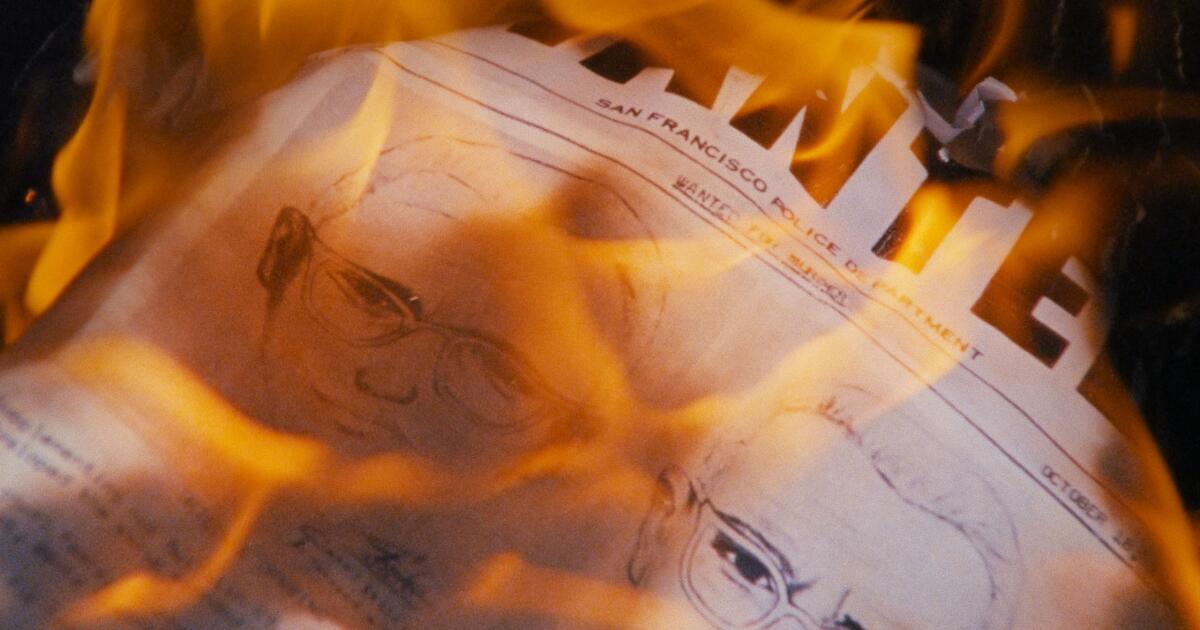
No mystery is solved in Charlie Shackleton’s essayistic doodad “Zodiac Killer Project,” but the true-crime genre itself is certainly staked out and interrogated like a prime suspect. Then again, there’s nothing like the tweezer focus of an obsessive — either trying to crack a maddening case or devouring shows about them on Netflix — to put our darker yearnings for fulfillment on queasy display, while reveling in minutiae at the same time.
Shackleton, a British filmmaker with an avant-garde sensibility, was all set to make his own opus, based on the investigative musings of a Vallejo cop who believed he’d discovered the identity of the infamous Zodiac killer who terrorized the Bay Area in the late ’60s, taunting police with letters and cryptograms, never to be caught. Shackleton’s fascination with former highway patrol officer Lyndon Lafferty’s speculative memoir “The Zodiac Killer Cover-Up,” which details a years-long quest to bring his pinpointed suspect to justice in the face of a perceived conspiracy, led to a bid for the rights. When that fell through, a different film project emerged.
Composed of original footage and the director’s conversational voice-over, “Zodiac Killer Project” is the chalk outline of his missing and presumed dead documentary. Shackleton explains his conceptual framework for it over long takes of serene, sunny Vallejo locations: an empty parking lot, a church, an intersection, a wooded house. We hear what perfectly designed re-creation he would have mounted there — or, since these aren’t necessarily the sites specified in Lafferty’s narrative and Shackleton is nothing if not honest, filmed at a place just like it.
In one sense, what we’re watching is a wittily rueful pitch session for an Errol Morris-style homage that never was, flecked with inserts we learn are called “evocative b-roll” (the swinging overhead lamp, the gun in someone’s hand), shots meant to be artfully slotted alongside his imagined interviews with key participants. Shackleton, glimpsed on camera in the studio where he vamped his narration, knows his act breaks and thematic beats.
And yet his abandoned undertaking is also a mischievous explosion of a storytelling format, a knowing critique of this most-wanted genre’s longstanding tropes: the eerie credit sequences, montages and music cues. Don’t expect a rehash of the Zodiac case, nor the parts of Lafferty’s book he can’t legally talk about. Settle in for some amusing dissections of popular docuseries like “Making a Murderer” and “The Jinx,” as well as the simultaneously moralizing and exploitative “Monster: The Jeffrey Dahmer Story.”
Of course, Shackleton is an openly avid connoisseur of those titles too, and it’s sometimes difficult to discern from the glibness of his tone whether he’s pointing the finger at himself or pining over rejection from a club he clearly wanted to join. That can leave the occasionally repetitive “Zodiac Killer Project” with a shallow aftertaste to go with its smarts. But in a year that’s seen a valuable rethink of how we process crime stories — from the eye-opening documentaries “Predators” and “The Perfect Neighbor” to Caroline Fraser’s deeply researched book “Murderland” — Shackleton’s perspective is still an intriguing, worthy provocation regarding our cultural bloodlust.
‘Zodiac Killer Project’
Not rated
Running time: 1 hour, 32 minutes
Playing: Opens Friday, Dec. 5 at Alamo Drafthouse DTLA and Laemmle Glendale

Dust Bunny, 2025.
Written and Directed by Bryan Fuller.
Starring Sophie Sloan, Mads Mikkelsen, Sigourney Weaver, David Dastmalchian, Rebecca Henderson, Sheila Atim, and Nóra Trokán.
SYNOPSIS:
An eight-year-old girl asks her scheming neighbor for help in killing the monster under her bed that she thinks ate her family.

As far as cinematic metaphors go, the idea of monsters as hitmen from the perspective of an eight-year-old girl is rather inspired. It also works since writer/director Bryan Fuller doesn’t stop at just the idea, but also grounds Dust Bunny in a fantasy-lite world that keeps viewers on their toes, wondering what is real and what is magical, even when we begin to suspect where the filmmaker will inevitably go with the answers.
Similarly, the script is also whimsical, sometimes rhymes, and peppered with humor that brings to mind a children’s fairytale. Everything about Bryan Fuller’s narrative vision is so confidently and imaginatively realized that it also doesn’t matter that he doesn’t necessarily have the financial backing to ensure the CGI is top-of-the-line, although it is serviceable for the material.

Terrified of the monster under her bed (a monstrously oversized dust bunny), Aurora’s (Sophie Sloan) parents naturally assume she is fibbing and that her fears are the result of a hyperactive imagination. Her parents are murdered offscreen, though, by something, and given that much of the film is from her perspective, that is accomplished through special-effects-driven moving floorboards and destruction. The monster also seems to come out only when someone touches the floor (which no one believes Aurora about), meaning the now-orphaned girl moves around her house in a makeshift boat. This also means that this is not the first time monsters have gotten her parents.
One night, Aurora notices a stranger (credited as Intriguing Neighbor and played by regular Bryan Fuller collaborator, the endlessly engaging no matter the role, Mads Mikkelsen, here in what is tonally a riff on Leon the Professional by way of Guillermo del Toro) sneaking around and trying to remain undetected, seemingly focused on something with great purpose. It turns out the man is an assassin of monsters, taking down a multi-eyed dragon in Chinatown during what appears to be a highly festive celebration of the Chinese New Year. Naturally, Aurora gets the idea to send over an envelope of money, hiring him to kill the monster under her bed. The neighbor (who is amusingly always being corrected for pronouncing Aurora as “Erora”) insists that he doesn’t kill monsters. Meanwhile, Aurora assures him she knows what she saw.

Working with his handler, Laverne (Sigourney Weaver), the neighboring assassin can deduce that whoever killed Aurora’s parents got the wrong apartment number and had meant to kill him. Much more cold-blooded and straight to the point, she also encourages him to get rid of the girl since she knows his face. However, this violent hitman also has a soft spot and takes it upon himself to inquire into the girl’s life and to offer protection, feeling responsible for the death of her parents.
The film also works so well as a two-hander that it can be occasionally frustrating, and it doesn’t quite work whenever the story incorporates smaller supporting players into the mix (these scenes also come across as padding to fill time). There also isn’t much concern about fleshing out this assassination world or the types of clients the neighbor is generally tasked with taking out.

By the time another group of hitmen, led by underappreciated character actor David Dastmalchian, enters the picture, Bryan Fuller is ready to fully merge reality and fantasy into an exciting piece of cleanly shot, wondrous action. Dust Bunny relies heavily on its central metaphor but is elevated by the charm of its lead performances and their interplay. Sure, there isn’t much here regarding depth, but that’s more than made up for with the imagination on hand.
Flickering Myth Rating – Film: ★ ★ ★ / Movie: ★ ★ ★
Robert Kojder

New South Carolina signee named one of Rivals’ top Signing Day flips

State vaccine survey results are ‘concerning,’ health advocates say

Illinois Basketball Grades: Evaluating the Illini Against Tennessee

Texas A&M Basketball Suffers Overtime Heartbreaker to SMU

Gov. Cox calls Utah Legislature into special session on redistricting, to repeal collective bargaining ban

Florida High School Football Rankings: Top 25 teams – Oct. 21

Cleary's 21 help Le Moyne down Central Connecticut State 69-64 in OT

How old is Bo Nix? What to know about Oregon quarterback ahead of 2024 NFL Draft

99th annual Pony Swim held in Virginia

Video: ‘It Didn’t Have to Happen This Way:’ U.Va. Faculty Call for Review of Police Response to Protests

NYC mayor-elect tells residents how to resist ICE agents knocking at their door in new video

Hamas and Israel move towards phase two of US-backed Gaza plan

Ilhan Omar says Trump’s anti-Somali tirade ‘completely disgusting’

Congress faces holiday crunch as health care fix collides with shrinking calendar

European Greens declare Usula von der Leyen`’s EPP enemy number one
-

 Alaska1 day ago
Howling Mat-Su winds leave thousands without power
-

 Politics5 days ago
Trump rips Somali community as federal agents reportedly eye Minnesota enforcement sweep
-

 Ohio4 days ago
Who do the Ohio State Buckeyes hire as the next offensive coordinator?
-

 News5 days ago
Trump threatens strikes on any country he claims makes drugs for US
-

 World5 days ago
Honduras election council member accuses colleague of ‘intimidation’
-

 Texas2 days ago
Texas Tech football vs BYU live updates, start time, TV channel for Big 12 title
-

 Politics6 days ago
Trump highlights comments by ‘Obama sycophant’ Eric Holder, continues pressing Senate GOP to nix filibuster
-

 Politics7 days ago
War Sec Pete Hegseth shares meme of children’s book character firing on narco terrorist drug boat