Movie Reviews
‘Ready or Not 2: Here I Come’ Review: Samara Weaving Gets Trapped in a More Dangerous — and Luridly Preposterous — Game


“Ready or Not,” the 2019 horror-comedy hit that turned “The Most Dangerous Game” into an aristocratic Victorian funhouse slasher movie, was nothing more (or less) than a well-executed piece of ultraviolent schlock. Yet there’s a funny way in which that movie has more resonance now than it did then. Its depiction of a clan of homicidal sickos, who in accordance with the family “rules” end up trying to murder their son’s new bride by dawn (she’s played by Samara Weaving, who comes on like a final-girl-gone-psycho version of Margot Robbie), anticipated our current fixation on the hidden horrors of the Epstein class.
Given all that, you’d expect the follow-up to be even timelier. And “Ready or Not 2: Here I Come,” a go-more-splattery-or-go-home sequel, is a film that very much taps into our vision of “the elites” as a global cabal of evil. It’s also more gruesomely over-the-top than “Ready or Not” (if that’s even possible), not to mention more operatic, more debased, more macabre, and more of a luridly preposterous cartoon. But all of that made it an ideal film to showcase to a crowd of screaming hellcats at SXSW, where the movie premiered tonight.
Is “Ready or Not 2” the bloody megaplex bash as knowing midnight movie? Does it combine honest laughs with a general invitation to crack up at its overboiled misanthropic cheesiness? Does it make up rules as it goes along? Yes and yes and yes, though we increasingly live in a movie world where all those things are attributes. “Ready or Not 2” delivers exactly what it promises: a garishly booby-trapped, winkingly clever-dumb good time. If that’s your idea of a good time.
The film opens by replaying the final scene of “Ready or Not”: Samara Weaving’s Grace, drenched in blood and pierced with wounds, having dispatched the most threatening members of the La Domas family (the rest of them exploded into bloody smithereens — cursed by her having survived The Game), sits on the steps outside the mansion that’s going up in flames behind her. She lights a cigarette and takes a weary victory puff, at which point a rescue worker asks, “What happened to you?” She replies, “In-laws.” She is then taken to a Connecticut hospital, where she wakes up handcuffed to the bed, with a cop informing her that she is wanted for murder and arson.
But that’s just a red herring. At the clinic, Grace is reunited with her younger sister, Faith (Kathryn Newton), who’s been estranged from her for seven years. Attacked by a coked-up goon who’s a harbinger of threats to come, Grace changes from her hospital duds back into her signature bloody wedding dress and dirty yellow sneakers, and that’s when she and Faith find themselves, bound and ball-gagged, sitting before the Council, a star chamber that consists of the representatives of six families, one of whom were the La Domases.
There’s another game afoot — or, at least, another Inviolable Rule dictated by the late Mr. Le Bail, who founded the La Domas fortune. (But why would his rules apply to other families? Oh, never mind.) A second dusk-till-dawn challenge looms: With the Le Domases gone, one member of each of the Council’s remaining clans must try to kill Grace. Whoever does will occupy the high seat and become the most powerful person on Earth. (If they fail, Grace will occupy the high seat.)
We meet the ailing old man who currently occupies that post — Chester Danforth, played by the legendary film director David Cronenberg, who makes his quizzical dourness felt for one scene. Chester has two adult twins, Ursula (Sarah Michelle Gellar) and Titus (Shawn Hatosy), who are theoretically aligned but will duke it out for power. The other families are represented by characters who are like suspects in a third-rate “Knives Out” movie. But once again: Are we laughing with or at what low-kitsch nitwits they are? Maybe there’s no longer any difference.
“Ready or Not,” set inside the La Domas mansion, had a compact trap-door video-game ingenuity. The action of “Ready or Not 2” sprawls all over the grounds that make up the Council compound, and for a while the film is a ham-handed and rather scattershot slaughter fest. Viraj (Nadeem Umar-Khitab), a stoned club hound, proves to be a bumbler with a shotgun; other would-be assassins strike out in comparable ways. This gives Grace and Faith, between attempted killings, a chance to air their differences and engage in some sisterly therapy. But their relationship, as dramatized by Guy Busick and R. Christopher Murphy’s screenplay, is overdone and unconvincing. Faith despises Grace…for having “abandoned” her by going off to college. For years, both have been living in New York City…without any awareness of the fact. Are we supposed to believe any of this? It’s just a mechanism. The film’s co-directors, Matt Bettillini-Olpin and Tyler Gillett, who made the first film (which won them the right to direct the rebooted “Scream” and “Scream VI”), are kinesthetic gamesmen who are also one-dimensional psychologists.
Yet they know how to bang the thriller puzzle pieces together, and to stage a scene of personal combat so that you feel the existential viciousness. At one point, they get two ultraviolent duels going at once: Grace facing off against Francesca (Maia Jae), who was originally engaged to Alex La Domas (it’s a cat fight on steroids), while the depraved rich boy Titus, in another locale, shows his murderous colors, the whole double fight set to “Total Eclipse of the Heart” (are you laughing yet?). Titus and Ursula make tasty villains, with Sarah Michelle Gellar turning up the icy hauteur, and Shawn Hatosy amusingly evoking the entitled blankness of George W. Bush. Standing above it all is Elijah Wood as the Council lawyer, who seems to be silently smirking at everything that happens, which is not an inappropriate response.
It all climaxes with another wedding, this one unfolding in the church of Satan. It’s a scene that suggests “Eyes Wide Shut” as remade by Jerry Bruckheimer, and in that sense you could say that it taps into current obsessions. Will “Ready or Not 2” satisfy the audience that made “Ready or Not” a hit? No doubt. The way Bettinelli-Olpin and Gillett work, the film has enough pulp craft to walk the line between violence and camp. Weaving, even more than before, makes Grace an ingénue gone banshee. But if there’s ever a “Ready or Not 3,” it would be good to see the elites in it do something that’s as interesting as it is brutal.



When I spend time around fellow writers, regardless of their achievements, conversation is much the same as in any other context. When I watch groups of fictional writers in films, they are continually striving to outdo one another, to show off their brilliant intellects. It’s a constant process of trying too hard, and it’s exhausting. To his credit, Dustin Hoffman, who plays established literary genius David in this torrid tale of family conflict, doesn’t come across this way, rising above the clumsy script thanks to his patient approach. The same cannot be said of the other actors, all of whom have proved their talent elsewhere yet seem seduced by the notion that this is how intelligent people behave.
The plot here is fairly simple, and not without potential. David’s son Jacob (Tom Sturridge) is a copywriter and successful creator of jingles, but after his wife Elise (Alison Brie) wins a major award, he starts getting insecure, wanting to prove that he can make it as a proper literary type. The obvious way to do this seems to be to write a biography of David, but David has no interest in engaging with this. He provides a number of reasonable justifications for this. Underlying them is the fact that we all tend to frame ourselves in different ways for different people. What one might be willing to say to the great anonymous public is not necessarily something one might feel able to say to one’s son.

This stalemate is broken by the arrival of John (André Holland, fresh from the similarly awkward – but smarter – The Dutchman), an old friend of Jacob whom David remembers fondly. At Elise’s instigation, a secret deal is made: John will look after the increasing fragile older man during the day and, in the process, extract his stories from him, giving them to Jacob for his book. John agrees to this because he needs the money Jacob offers him, and it seems like a sweet deal. It immediately sets up a power imbalance, however.
Complicating matters further are John’s past as a literary protégé who failed to fulfil his promise; the fact that he was once in a relationship with Elise, whose dissolution she regrets; and the pressure that she’s under to match her great success, from an agent who subscribes to the popular but rather tedious belief that inspiration is most easily found in bad behaviour.
Another way writers in films differ from those in the real world is that for them, critical success comes with money, so they don’t have to write very much. A good deal of this film is spent listening to them whine about how hard it is, as if under the misapprehension that it’s not really a form of work. Sturridge is particularly unfortunate; between this and Jacob’s whining about issues with his parents, he doesn’t get much else to do. Brie has a little more to work with as the film flirts with the idea that we’re caught up in Elise’s imaginary scenarios, but this doesn’t really convince. Holland manages to salvage something, but it’s only Hoffman who is really able to interject some energy into proceedings – ironic given that he spends a lot of his scenes in a haze of cannabis smoke.
It’s not terrible. Writer/director Alex Vlack frames scenes nicely enough and all the technical work is carried out to a good standard. There’s just little reason for viewers to invest. Like its characters, it’s intent on trying to communicate cleverly, but has very little to say.
Reviewed on: 04 Jul 2026
Movie Reviews
1986 Movie Reviews – About Last Night, Big Trouble in Little China, The Great Mouse Detective, Howling II, Psycho III, Under the Cherry Moon | The Nerdy

Welcome to an exciting year-long project here at The Nerdy. 1986 was an exciting year for films giving us a lot of films that would go on to be beloved favorites and cult classics. It was also the start to a major shift in cultural and societal norms, and some of those still reverberate to this day.
We’re going to pick and choose which movies we hit, but right now the list stands at nearly four dozen.
Yes, we’re insane, but 1986 was that great of a year for film.
The articles will come out – in most cases – on the same day the films hit theaters in 1986 so that it is their true 40th anniversary. All films are also watched again for the purposes of these reviews and are not being done from memory. In some cases, it truly will be the first time we’ve seen them.
This time around, it’s July 4, 1986, and we’re off to seeAbout Last Night, Big Trouble in Little China, The Great Mouse Detective, Howling II, Psycho III, and Under the Cherry Moon.
About Last Night
St. Elmo’s Fire was awful. This feels like a make-good for two of the actors.
Danny Martin (Rob Lowe) meets Debbie Sullivan (Demi Moore) and their chemistry is electric and immediate. They waste no time becoming serious, and moving in together, despite neither of them having ever had a serious relationship. They quickly discover it’s not quite as easy as just sharing an apartment like you do with a roommate.
I didn’t love the movie (mainly due to Jim Belushi’s Bernie character), but I did enjoy it far more than I anticipated.Moore and Lowe’s on-screen chemistry really clicked far more than most on-screen couples.
It’s a good character study, and keeps you engaged. Is it essential viewing? That’s up to you.
Where to watch: Available to stream.
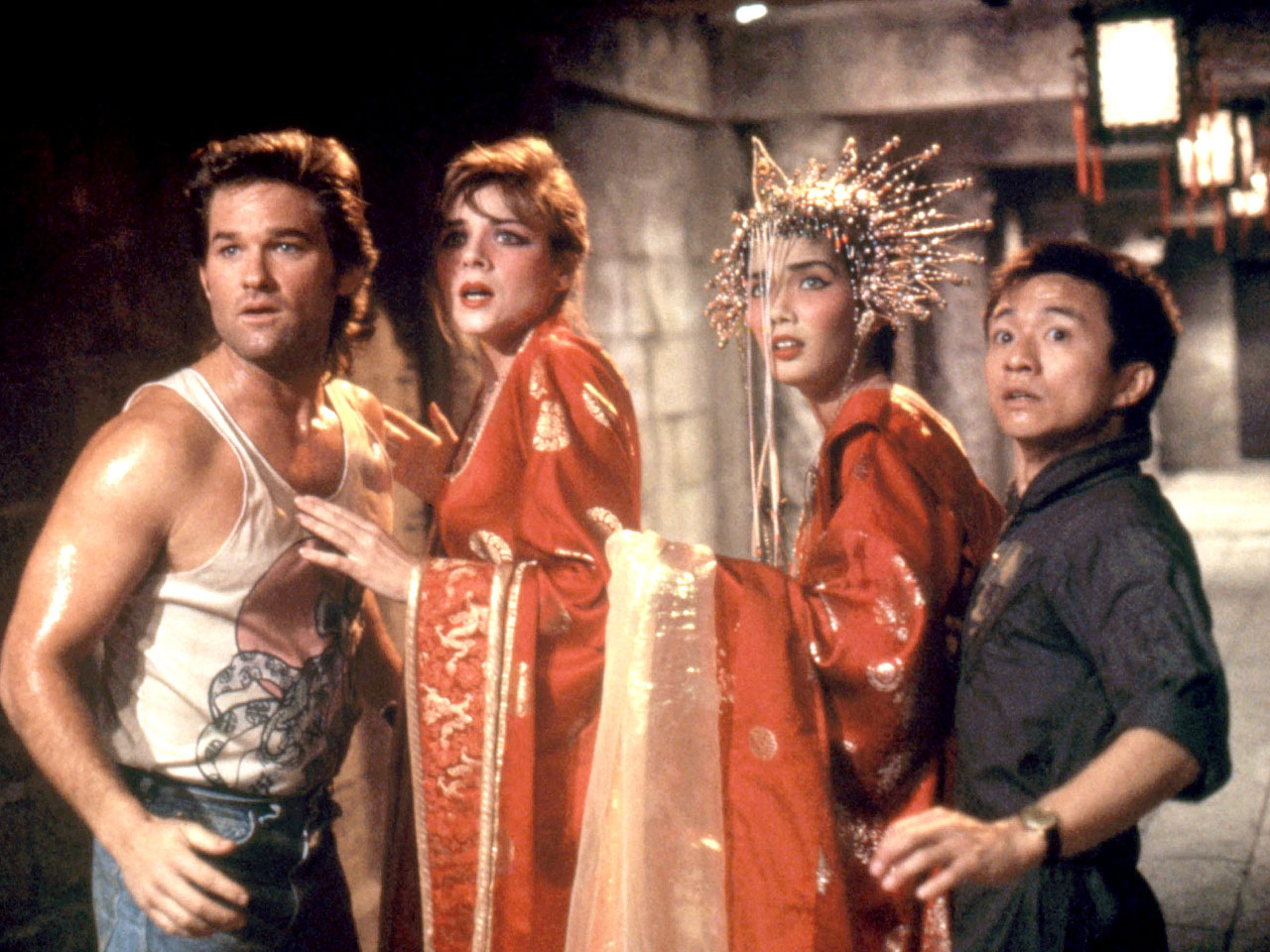
Big Trouble in Little China
If there was ever a poster child for a movie that found a second life in rentals and on cable, this is it.
Jack Burton (Kurt Russell) is a over-the-road trucker with a lot of thoughts on life and how important reflexes are. While making a delivery in Chinatown, he gets sucked into a situation with an ancient Chinese evil trying to regain its humanity, and all Jack really wants is to get his truck back.
John Carpenter wasn’t quite a household name, but with films such as Halloween, The Thing and Escape From New York to his name, people were taking notice. Teaming with Russell for another outing seemed like it would be another win, but this one proved just a little too odd for mainstream audiences. Once it got into our homes, however, everyone fell in love with it.
As Jack Burton always says, it’s a must-see for any 80s journey.
Where to watch: Available to stream.

The Great Mouse Detective
I had never seen it, and as Disney films go, I would have been fine keeping it that way.
Set in Longon in 1897, a young mouse named Olivia Flaversham witnesses her toymaker father get kidnapped. She seeks out Basil of Baket Street, also known as the Great Mouse Detective. Along with David Q. Dawson, recently returned from serving in the military in Afghanistan, the three of them try to stop Professor Ratigan from replacing the Queen.
It’s just a Sherlock Holmes story, but with mice. I didn’t find anything that compelling about it. It was pretty enough to look at, but the story just left me fairly empty.
Where to watch: Available to stream.

Howling II
I… have a lot of thoughts.
Following up on the end of the The Howling, Ben White (Reb Brown) buries his sister Karen White, and quickly learns she was a werewolf. He teams up with werewolf hunter Stedan Crosscoe (Christopher Lee) to take down Stirba (Sybil Danning), the queen of the werewolves who is about to celebrate her 1,000th birthday, and stop the spread of the werewolf curse.
On paper it sounds fine, in execution it is just… horrible. Poorly lit, horrible acting, low-grade effects, and costuming that leaves you more confused than anything else.
Avoid at all costs.
Where to watch: Available to stream.

Psycho III
I have to admit, so far these sequels haven’t been horrible.
Following up shortly after the vents of Psycho II, Norman (Anthony Perkins) is still hiding the body of Emma Spool, and having issues again with seeing “Mother.” He hires drifter Duane Duke (Jeff Fahey) to run the motel. He also meets Maureen (Diana Scarwid), a nun on the run after she accidentally kills one of her sisters. With a new woman in his life, Mother has some thoughts on what Norman should be doing.
In general I actually enjoyed this new outing in the franchise, although it feels it missed some opportunities at the end of the story of Norman and Maureen working together. What if Maureen had actually been the one manipulating Norman this time? There was another movie lurking in the background that sadly never gets broached.
What we did end up with, however, was entertaining.
Where to watch: Available to stream.

Under the Cherry Moon
This film was unfairly maligned.
Christopher Tracy (Prince) and Tricky (Jerome Benton) as wooing women in France in hopes of getting enough money to head back to Miami one day. When Christopher hears about Mary Sharon (Kristin Scott Thomas) inherting a trust fund of $50 million for her 21st birthday, she becomes his next mark, but little does he know how it will end for him.
Following Purple Rain, Prince could do no wrong in Hollywood and was given a blank check for his next film. Audiences and critics did not warm to this film as it wasn’t Purple Rain 2 and it lived with a bad reputation for years.
I hadn’t seen it in 35 years or more when I watched it for this report, and… I really enjoyed it. It’s over-the-top, but in the right way. Prince was clearly paying homage to the silent movie romance films, and it works for what it is. Is he a great actor? No. Does it work for this film? Yes.
Honestly, this may be one of the most enjoyable films I’ve had in this project in several weeks. It’s worth a reassessment.
Where to watch: Available to stream.
1986 Movie Reviews will continue on July 11, 2026, with Club Paradise.
Movie Reviews
Movie Review: ‘Minions & Monsters’ is a very yellow mash note to Hollywood – Sentinel Colorado

-

This image released by Universal Pictures shows a scene from Illumination’s “Minions & Monsters.” (Universal Pictures via AP) -

This image released by Universal Pictures shows minions with the alien character Goomi, voiced by Trey Parker, right, in a scene from Illumination’s “Minions & Monsters.” (Universal Pictures via AP) -

This image released by Universal Pictures shows minion Henry, voiced by Pierre Coffin, left, and Goomi, voiced by Trey Parker, in a scene from Illumination’s “Minions & Monsters.” (Universal Pictures via AP) -

This image released by Universal Pictures shows a scene from Illumination’s “Minions & Monsters.” (Universal Pictures via AP)
Every once in a while, Hollywood gets high on its own supply and makes a love letter to moviemaking. It happened recently with Steven Spielberg’s “The Fabelmans” and George Clooney’s “Jay Kelly.” Now it’s time for the unlikeliest of love-letter writers: canary-yellow, gibberish-speaking, overall-wearing mini-monsters.
“Minions & Monsters” — the third chapter in the ongoing standalone adventures of the “Despicable Me” pint-sized enablers — is about the sheer greatness of moviemaking, and it’s a navel-gazing misfire. Few industries — maybe journalism, sure — is as enamored at making its profession seem heroic.
The Minions this time find themselves at the dawn of both the movie business in Hollywood and the last push by suffragists to get the vote. It’s a weird confluence that writers Brian Lynch and Pierre Coffin fumble.
The movie has playful references to old screen gods — Harold Lloyd dangling from the hands of a clock and Charlie Chaplin swallowed by the gears of a mechanical system — along Hollywood nods to “Casablanca” and the punny title “The Good, the Bad and the Stupid” — but the kids in the audience won’t get them and their parents are just too tired. Harold Lloyd jokes don’t hit as hard in 2026.
Two of the legion of faceless Minions step forward this time — best friends James and Henry, creative misfits amid a smear of yellow drones — to unite and make a movie. (Who knew there was a Minion counterculture?)
Things go very well at first — turns out adding a Minion or two to a cowboy or a heist movie makes them instant kings of the box office — and they soon move into a Beverly Hills mansion and become insufferable. James dreams of winning an Oscar, which in this case is a statuette of a gold banana, a Minion obsession.
But they hit a wall when silent movies turn to talkies. And since they spout nothing but nonsense — “Fantastico” “miso soup” and “vamos” — can’t make the transition. They’re dumped out of the studio system.
That’s when James and Henry finally get the plot going: Make their own killer monster movie by conjuring up real monsters. The first one they try turns out a little weird: The gigantic, fearsome octopus-dragon they request turns out to be a cute green Funko Pop-like critter called Goomi, voiced by Trey Parker. Goomi promises to find them some real monsters. But should we trust him?
Coffin, making his first solo directing effort after co-helming all three “Despicable Me” films and the first “Minions,” voices all the Minions — he must be fun to have at parties — and is an assured hand. The violence levels are a little high for PG, including a beheading and various impalings, plus the usual senseless mayhem.
The screenwriters have included a romantic subplot involving a suffragette voiced by Zoey Deutch who falls for a robot-alien (standout work by Jesse Eisenberg) in a storyline that makes less and less sense. And the framing device — a museum tour guide explaining how Minions shaped Hollywood — sags awkwardly.
Adults can keep awake looking for the Easter eggs Coffin has left for serious cinephiles: “20,000 Leagues Under the Sea,” “Steamboat Bill, Jr.,” “A Trip to the Moon,” “Metropolis,” “Citizen Kane” and “The Blob.” Maybe the best moment in the movie is almost a throwaway: Director George Lucas, appearing as himself.
“Hooray for Hollywood” is on the soundtrack and that might have been the subtitle for the movie itself. There are some people whose eyes get moist thinking about picking up a film camera and following their muse, having their work play in a dark theater to cheers. And then there are others who just want to get on with it already. “Vamos!”
“Minions & Monsters,” a Universal Pictures release that opens in theaters July 1, is rated PG by the Motion Picture Association for “violence/action, language, and rude/macabre humor.” Running time: 90 minutes. One and a half stars out of four.
Related
-
 News6 minutes ago
Paul Pelosi in hit-and-run in California, car left with major damage, authorities say
-

 Los Angeles, Ca1 hour ago
Firefighters battle Fourth of July blazes around Los Angeles
-

 Detroit, MI2 hours ago
Storm chances linger into the start of the week across Metro Detroit
-

 San Francisco, CA2 hours ago
Relay for America runs flag from San Francisco to D.C. in message of unity
-

 Dallas, TX2 hours ago
Cowboys newcomer already looks like a waste of money in Dallas
-

 Miami, FL2 hours ago
Police search for suspect after man is shot while on a boat near hotel in Fort Lauderdale on 4th of July
-

 Boston, MA2 hours ago
Sonny Gray shines again, and the Red Sox make it two straight wins at the Angels to start grinding road trip – The Boston Globe
-

 Denver, CO2 hours ago
Aldi expanding into Colorado, applies for permits at two Denver locations

