News
Torn by war, Israelis and Palestinians tie their fortunes together


This year’s cohort of Israeli and Palestinian entrepreneurs taking part in 50:50 Startups is smaller than usual, because the war prevented many from travelling. 50:50 co-founder Amir Grinsteen (third from right) founded the program seven years ago, believing that building businesses together would also build lasting bridges, that could advance the cause of peace.
Dena Yadin
hide caption
toggle caption
Dena Yadin
BOSTON – Salah Hussein was 11 years old when he was woken up in the middle of the night by Israeli soldiers in his family home in Nablus in the West Bank. It left him traumatized and terrified for years.
It was “triggering” to see any Israeli in uniform, he says. “For me, all of them were a threat.”
But decades later, Hussein, now a 33-year-old entrepreneur, has willingly and purposefully tied his fortune to his co-founder, who is an Israeli Jew.
Hussein is one of about 35 entrepreneurs taking part in a start-up accelerator program called 50:50 Startups, where mixed teams of Palestinians, Israeli Arabs and Israeli Jews spend six months in a kind of business bootcamp, going to workshops, lectures and connecting with mentors. The program culminates with a session in Boston, where the entrepreneurs pitch their ideas to potential investors.
The cross-the-divide collaboration brings an extra layer of challenge to what is already a heavy lift. By most estimates, about 90% of startups fail. But Hussein is fiercely determined, not only because of pragmatic considerations, like the need for resources and access to capital for his business, but also the more lofty ideals.

Salah Hussein, a Palestinian from Nablus, is excited about investors’ interest in his venture that uses AI and cameras to detect and prevent greenhouse pests.
Tovia Smith/NPR
hide caption
toggle caption
Tovia Smith/NPR
“If we are not the ones looking for change, who will be? We are the right people at the right place, at the right time. We have to move on,” he says. “I don’t want my kids to be living in a world full of hatred.”
Yana Shaulov is the Jewish Israeli on Hussein’s team. A 37-year-old molecular biologist, she joined 50:50 hoping to launch an idea of her own, but ended up joining Hussain’s team instead. Having grown up in a mixed neighborhood of Haifa, she says, she’s used to coexistence.
“It’s not always easy, you can feel the tension sometimes, but [Israelis and Palestinians] are both here to stay, and we have to live together at the end of the day,” Shaulov says. She concedes that the small collaborations at 50:50 are just “a small start,” but believes what they’re doing will be “contagious.”
“It’s already worth it just to show other people that it’s possible,” she says.
The team also includes two others: a Palestinian from the West Bank and a Christian woman who is an Israeli citizen. Their company, Qanara Tech, is developing AI cameras to detect and prevent insects in greenhouses growing food. Other teams include one with a patent pending to build a better heart monitor, and another that uses egg shells and plant seeds as the filter in a water purification system.
Sometimes, even when the ideas are viable, the partnership is not. Hussein says he had a previous venture that fell apart shortly after Hamas’s deadly attack on Israel on October 7th, 2023, and the war that ensued. The tension was just too much, both within the team and especially from hardliners back home. The scorn and backlash can be so intense, Hussain says, it’s hard to keep it from getting in your own head.
“Sometimes even thinking about what I’m doing right now fills me with some negative [voices], like, ‘Salah, you’re a normalizer. Be careful!’, he says. But then the “other voice” in his head chimes in, “Keep going, Keep moving! All these tiny effects can lead to change.”
Israelis participating in the program, like 27-year old Aviv Meir, say they feel it, too.
“It’s hard to put yourself in the enemy’s shoes,” she says with a sigh. “You need to have so much strength to feel safe, and to understand that understanding their side will not demolish your side. It’s sometimes making you crazy.”
Meir has been involved in bridge-building initiatives since she was a teenager. She’s the type you’d expect to sign up for a program like this. But 50:50 is also drawing in participants not already inclined toward dialogue.
The hard conversations
Salah Elsadi, a Palestinian who lived in Gaza for 15 years, says he wasn’t even aware of the peace-building aspect of 50:50 when he applied to the program. He was interested in building his business, not bridges. But he has learned to lean in when he has to. For example, at a recent 50:50 event in Boston that was open to the public, a French Israeli woman, Sarah Blum, drew Elsadi into conversation. A short while in, she told him that about 10 years ago, a Palestinian man from Jerusalem attacked her with a knife.
“He wanted to kill me,” she said.
Elsadi was visibly taken aback, but continued listening as Blum shared that some of the first people who called to check in on her were close friends who were Palestinian, and how important it is to continue dialogue even in the most difficult moments.
Then, in what seemed to be a bid to ease the moment, she asked Elsadi how his family in Gaza was doing. But it did little to diffuse the tension.
“Not good,” he answered. “They’re struggling to find water or food. My youngest brother has chronic disease and can’t get medicine.”
Blum said she could understand.
“I have close family friends who were in Kfar Aza on October 7th who are traumatized from the massacre, and some who lost loved ones [who were] taken hostage and killed in Gaza, and [did not have] access to medicine when they were in captivity,” she said.
It’s the kind of conversation that could have easily spiraled out, but Blum and Elsadi managed to take in each other’s pain. The encounter ended with a hug, and both said afterward that it just reinforced their conviction that focus must shift from past grievances to future possibilities.
“We need to start a new thing, not just to remember the last things which remind us that ‘Oh, I need to take revenge,” Elsadi says. “We cannot continue war, war, war, war. How long do we want it to continue?”
Program leaders take pains to say that 50:50 is not a political organization. That’s what allows it to create an environment where each side can see the other as people, not enemies.
In one stark example, a Palestinian man who grew up in a refugee camp near Hebron was sharing how he felt humiliated and harangued by IDF soldiers at checkpoints. Then he found out one of the Israelis he had come to know in the program was actually one of the soldiers stationed near his home. It was striking, he says, to hear that former Israeli soldier share how terrified he and others were of Palestinians.
“They feel [the Palestinians] will attack them, or maybe shoot them, so they always stand by, [with] nerves tense,” the Palestinian man said. “At the end of the day [the soldier is] a human being. He’s someone like me who just wants to get back home safe and have dinner with [his] family.”
But that kind of talk doesn’t go over well back home, this Palestinian man says, which is why he asked that his name not be used in this report.
“People say it’s like betraying, especially in this situation, [where] everything is on fire,” he said. “I don’t want to be a target to [be] hurt or something.”
Building trust organically
The 50:50 Startups program was co-founded by Israeli-American Amir Grinstein in 2019, and the program later partnered with Tel Aviv University and Northeastern University in Boston, where he’s a marketing professor. The idea is that short of marriage, creating a business together may be the most profound way to bond two people together; it’s a partnership based on equality, a shared goal and a mutual trust and reliance on each other’s support.
“Its very intimate, it’s very intense, it’s up and down like a roller coaster, and it’s long term,” Grinstein says. “They have to try hard to work together. They’ll fail together or they’ll succeed together.”
As a start-up itself, 50:50 has had to pivot and iterate through challenges Grinstein could never have imagined: COVID, October 7th, and several wars. Each has made it difficult or impossible for the entrepreneurs to travel to Boston for the capstone session at Northeastern. This year, because of the ongoing war in the region, more than half the entrepreneurs could only attend by Zoom.

Israeli and Palestinian entrepreneurs in the 50:50 Startups program attend a workshop at Harvard Business School about data analysis.
Salah Hussein
hide caption
toggle caption
Salah Hussein
“You are still under missiles with this war raging outside, and we hope it will be over soon,” Grinstein says at the start of a recent class. He then pivots to the day’s lesson, which happens to be about negotiation and rebuilding trust when things become tense or adversarial, an especially apt lesson for these entrepreneurs.
But that’s as close as 50:50 gets to any specific instruction on cross-the-divide collaboration. Unlike other coexistence programs, there are no dialog workshops or trust-building exercises. Grinstein says that just happens organically.
“The elephant is obviously in the room, so we’re not ignoring it,” Grinstein says. “But what I want is to see the Israelis and Palestinians develop friendships that transcend the business, and then naturally you will have coffee with your partners and you might be in a better position – after you build trust, after you work together — to have conversations that are tough and challenging.”
Still a relatively small program, 50:50 has taken on some 320 participants since it began. But Grinstein says the relationships they forge have significant ripple effects on friends, and family, as well as on the Northeastern undergraduates who are part of his class, and work as interns for the start-ups.
Senior Alexa Garcia, says just watching the entrepreneurs working together, laughing and teasing each other, was a lightbulb moment for her.
“Sometimes it’s so easy to forget that they’re on such different sides of a conflict because they seem like such good friends, like the banter is crazy,” she says. “A lot of times it’s just completely out of my mind that they are on two different sides of conflict.”
Garcia and two other students who stopped to talk after class say they each started the semester with a clear leaning toward either the Israelis or Palestinians. But that changed, they say, as they got to know the entrepreneurs personally and came to understand the hardships suffered by both sides, like when team meetings were delayed because a Palestinian was stuck at a checkpoint, or an Israeli had to run to a bomb shelter.
All three say their views have now shifted toward the middle.
“Both sides have been through so much, both have done right, both have done wrong,” says Garcia. “The more I learn, there’s no side for me.”
A ‘hippie heart’ and a ‘capitalist brain’
The 50:50 session in Boston ends with a Shark Tank-style chance for the teams to pitch their ventures to potential investors and hope an investor will bite, or at least offer some useful feedback.
For their part, investors grill the entrepreneurs about not only their ideas, but also their partnerships; they’re investing in a team as much as a product. And while some see the collaborations as inherently risky, others see them as an asset – at least potentially.
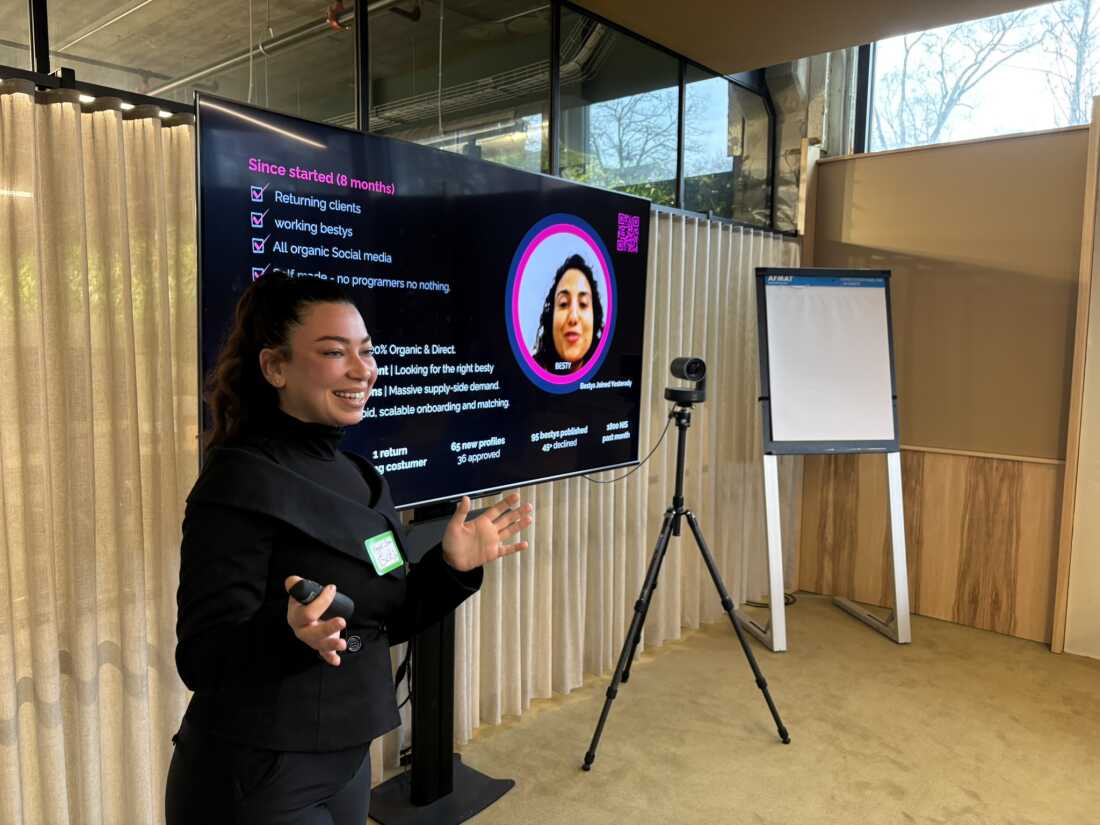
Hagar Shmaia, from Israel, was one of about a dozen Israeli and Palestinian entrepreneurs who pitched their ideas to a room of investors, as part of the 50:50 Startups program. Shmaia has designed an online platform called “Besty” that allows women to find a wide range of support on-demand
Tovia Smith/NPR
hide caption
toggle caption
Tovia Smith/NPR
“I always say I have a hippie heart and a capitalist brain,” says Brian Abrams, founder of B Ventures, one of the investors who listened to the pitches. “My hippie heart loves this kind of collaboration. My capitalist brain insists it makes business sense.”
In a best-case scenario, Abrams says, the Israeli-Palestinian partnerships could create a “halo-effect” around a brand, helping a start-up to build momentum.
“The collaboration builds the brand, attracts other people, helps them get bigger, and at best that becomes a virtuous cycle,” Abrams says.
Ultimately, the case could be made that startups run by these unlikely co-founders could actually be safer investments, says Tomer Cohen, Co-Founder and Director of Tech2Peace, a bridge-building program similar to 50:50 for younger participants.
“If the entrepreneurs have managed to come together in spite of the political reality, it actually says a lot about them as individuals, that they will be more resilient and can overcome most of the challenges that [entrepreneurs] face in early-stage ventures,” he says.
So far, Grinsteen says, 50:50 ventures are beating the odds. It’s still early for many, but of the roughly 55 start-ups, about a half are still in the game.

News
Trump’s ‘American Flag Blue’ in the Lincoln Memorial pool is already gray — and the Olympic canoer ‘vandal’ is fighting his arrest | Fortune

The newly drained Lincoln Memorial Reflecting Pool’s bottom surface has noticeably faded since it was lined with a protective coating in a color President Donald Trump called “American flag blue” this spring.
An Associated Press reporter and photographer viewed the fenced-off Reflecting Pool on Wednesday from the top of the Washington Monument. The new liner appears grayer than when the pool was repainted and refilled with water in early June. Debris that had been visible earlier this week after the pool was drained is now largely gone, after work crews removed it.
Trump’s problem-plagued effort to revamp the landmark has stretched well past his initial goal of having the Reflecting Pool ready by July 4 for the nation’s 250th birthday.
The president at first suggested his renovations would cost $1.5 million, but the bill ballooned to more than $16 million by June.
Trump had said the repairs would last a century, but within days of the project’s initial completion last month, the water was beset by an algae bloom and pieces of the new coating appeared to be peeling off the bottom.
Ohio-based Green Water Solutions, also known as Greenwater Services, was given a $1.7 million contract to install a water-purification system in the Reflecting Pool, while Virginia-based Atlantic Industrial Coatings was awarded $14.7 million to repaint and waterproof the pool’s concrete floor.
Vandalism charges were levied against a former Olympic canoeist
Trump has repeatedly blamed vandals for the peeling paint, though critics allege it’s from shoddy repair work.
Trump has said, without citing evidence, that vandals made a “350-foot gash” in the liner and caused other problems. No large slash marks were immediately visible Wednesday from the Washington Monument view. It was not possible to do a more up-close inspection of the entire pool due to a dark fence surrounding the perimeter.
Interior Secretary Doug Burgum, whose agency oversees the National Park Service, said that after the water is drained and debris is cleaned from Independence Day fireworks, the plan for the pool is straightforward: “Repair the vandalism that was done. Fill it back up again.” He was speaking with conservative podcaster Katie Miller.
Court documents show that the National Park Service reported to the U.S. Park Police a June 9 incident in which a sharp knife or razor was said to have cut the pool’s new liner.
Former Olympic canoe racer David Hearn pleaded not guilty last week in D.C. Superior Court to deliberately damaging the Reflecting Pool. Hearn has said he reached inside the pool to examine the peeled sealant and let go of a chunk when he was told to by a park worker.
His attorneys and other Trump administration critics have derided the case as an abuse of prosecutorial power and maintain he is being scapegoated for the poor job done fixing up the Reflecting Pool.
At least three other people have been charged in the same court with misdemeanors for allegedly removing pieces of paint from the pool, court records show. All three pleaded not guilty during initial court appearances.
The work on the Reflecting Pool is just one of a number of projects Trump has spearheaded across the nation’s capital. Most prominently, he demolished the White House’s East Wing to build a $400 million ballroom and plans to build a towering arch. between the Lincoln Memorial and Arlington National Cemetery.

Argentina’s Lionel Messi celebrates the team’s second goal by Lautaro Martínez during their World Cup semifinal against England on Wednesday in Atlanta. Argentina defeated the English 2-1 to advance to Sunday’s final against Spain.
Shaun Botterill/Getty Images
hide caption
toggle caption
Shaun Botterill/Getty Images
ATLANTA — Argentina, the death-defying defending World Cup champion, will play for a second consecutive title after scoring two late goals to beat England in the semifinal, 2-1.

For a fourth straight knockout game, Argentina survived a heart-stoppingly close call. First was Cape Verde, the African island nation underdog, who took the champions to extra time. Then was the furious miracle comeback after Egypt took a 2-0 lead. Then, in the quarterfinal, a shorthanded Switzerland squad forced extra time despite a 72nd-minute red card.
This gutsy Argentina squad prevailed in all three games, and Wednesday, they pulled it off yet again. In the 55th minute, England took a 1-0 lead when forward Anthony Gordon tapped in a cross.
But, as the clock ticked up, Argentina turned up the intensity. A relentless onslaught yielded near miss after near miss before finally midfielder Enzo Fernández scored off a rocket from outside the penalty area to equalize the game at 1-1 in the 85th minute.
Then, in stoppage time, forward Lautaro Martínez sent the Argentina crowd into delirium with a header off a cross from 39-year-old superstar Lionel Messi, who assisted on both goals.
“I think that this team plays the best when we are facing a difficult situation, with adversity, ” said Argentina coach Lionel Scaloni afterward. “We had a challenging game, a challenging situation. There was blood in the water, and we went for it.”
In Sunday’s final they will face Spain, which defeated France on Tuesday 2-0 to contend for their second-ever title.

England’s Anthony Gordon celebrates scoring his team’s first goal during the World Cup semifinal against Argentina on Wednesday in Atlanta.
Justin Setterfield/Getty Images
hide caption
toggle caption
Justin Setterfield/Getty Images
Wednesday’s game, the sixth meeting between these two teams at the men’s World Cup, was the newest chapter in their storied rivalry. That history includes the infamous “Hand of God” goal scored by Diego Maradona in the 1986 World Cup, four years after a war between the two countries over the Falkland Islands. The British won the war, but the sovereignty of the territory is still under dispute.
(Asked Tuesday about the “Hand of God,” which was the first of two goals scored by Maradona, coach Scaloni slyly deflected. “I think all of the world remembers that game, remembers Diego’s performance, remembers above all the second goal,” he said.)
To hear England’s coach, none of that mattered on Wednesday. “We respect our opponent, but we don’t dip in historic events, and we don’t make it bigger than it is,” Thomas Tuchel told reporters the day before the match.
Yet from the opening kick, both teams eagerly played a physical game: Collisions, jersey tugs, tough tackles, bodies flying to the ground. Referee Ismail Elfath, the first American man to work a World Cup semifinal, awarded a yellow card to each team before halftime.

And after the game, as Argentina’s players celebrated on the field, midfielder Giovani Lo Celso, who did not play in the match, unfurled a white banner bearing the words “Las Malvinas son Argentinas,” or “the Malvinas are Argentine,” a reference to the Argentine name for the Falkland Islands. The banner appeared to have been first held by Argentina fans in the stands.
For England fans, the pain is a familiar one as they watched the team fall short in yet another major tournament knockout game. England lost in the Euros final in both 2024 and 2020, and the last time they reached the World Cup semifinal in 2018, they lost by the same score as Wednesday’s match, 2-1, despite scoring first.

England’s forward Harry Kane (#9) and teammates react after losing their World Cup semifinal match 2-1 against Argentina.
Odd Andersen/AFP via Getty Images
hide caption
toggle caption
Odd Andersen/AFP via Getty Images
“It’s a similar story to what’s happened in previous tournaments,” England Captain Harry Kane conceded afterward. “We’d done so well for that 60 minutes. We scored. We deserved to be ahead. And then, for one reason or another, we struggled to keep the ball. We struggled to put pressure on the ball and it just allowed them to create more momentum.”
The atmosphere inside Mercedes-Benz Stadium in Atlanta was raucous and ear-splitting. Argentine fans by the thousands wore the white and sky blue striped jerseys bearing the name of their star Messi. The English celebrated their team wearing all-white or all-red jerseys of their scoring sensations: Kane and Jude Bellingham.
But neither star could save England from another defeat, extending what has already been an agonizing 60-year wait to return to the final.
NPR’s Russell Lewis contributed reporting from Atlanta
News
ICE should do traffic stops despite recent shootings, Trump says, seeming to oppose new suspension

WASHINGTON (AP) — The Immigration and Customs Enforcement agency should continue vehicle stops after recent fatal shootings, President Donald Trump said on Wednesday, seeming to oppose a new suspension of the practice used as part of his immigration crackdown.
ICE is “doing a GREAT job, one that has to be done,” Trump wrote on his social media site.
The Republican president said that to remove criminals he claims were let into the country under the previous Democratic administration “we must be strong, tough, and smart, and we CANNOT give up one of ICE’s most important and effective Crime Fighting tools, THE TRAFFIC STOP!” Trump said, “Once we do, we are playing right into the criminal’s hands.”
Trump administration officials have told Immigration and Customs Enforcement officers to suspend most vehicle stops after two deadly shootings within a week, people familiar with the decision said Tuesday.
The suspension was ordered after an ICE officer shot and killed a Colombian driver Monday in Maine and a week after another officer shot and killed a motorist in Houston, renewing criticism of the agency’s enforcement tactics that were widely condemned last winter after the killings of Alex Pretti and Renee Good in Minnesota.
In Florida on Tuesday, a third man in roughly a week died during an encounter with immigration officers. This time, a 28-year-old man was killed after he was hit by a tractor trailer while running from immigration and other federal officers, authorities said.
It’s a narrative that has been repeated again and again since the Trump administration’s immigration crackdown began, with federal officers confronting drivers and then saying they opened fire when the drivers’ vehicles became a danger. That’s despite decades of warnings from policing experts that shooting into moving cars presents a danger of its own and should almost always be avoided.
There have been at least 10 deaths involving encounters with immigration agents since Trump launched his deportation campaign. At least four of those deaths involved people in vehicles, including the one last week in Houston, a trend so troubling that U.S. Sen. Susan Collins, R-Maine, said Tuesday that she had urged Department of Homeland Security Secretary Markwayne Mullin “to cease all non-urgent vehicle stops.”
John Sandweg, who was acting director at ICE, which is part of DHS, during President Barack Obama’s Democratic administration, estimated recently that there have been roughly 18 traffic stop shootings during the Trump immigration crackdown.
The office of Maine Sen. Angus King, an independent who caucuses with Democrats, was told by DHS that ICE was suspending traffic stops, office spokesperson Matthew Felling said.
ICE, which has been under pressure to beef up arrest and deportation numbers, often says people it’s trying to arrest are increasingly resistant to leaving their homes. ICE officers blame immigration advocates who advise immigrants to stay in their homes unless ICE produces a warrant signed by an independent judge instead of the administrative warrants the agency generally uses that are signed by another ICE officer. So, ICE officers say, they’re forced to find other areas in which to make arrests.
Shooting angers Maine
Hundreds of people in Maine protested Tuesday over the fatal shooting of Johan Sebastián Durán Guerrero, a 25-year-old Colombian national. Advocacy groups said Guerrero, who had a wife and a young daughter, was authorized to work in the United States.
DHS said Monday that an officer, “fearing for public safety,” shot and killed Durán Guerrero while officers were watching the home of someone they believed was in the U.S. illegally and facing a final order of removal from the country. It said in a post on X that when ICE tried to stop a car driven by someone who came from the home, the person attempted to flee in the vehicle and the officer fired.
That was a shift from how King earlier described the encounter, when he said Mullin told him the officer opened fire after the man tried to use his vehicle as a weapon. King said Mullin told him the officers were trying to serve an arrest warrant but not for the man who was shot.
In a scathing post on X, outgoing Colombian President Gustavo Petro called the shooting a targeted killing “at the hands of the U.S. government.”
Petro, who has openly quarreled with Trump, urged Trump to provide an explanation and accused ICE officers of treating Durán Guerrero as “an inferior being without rights.”
In Wednesday’s social media post, Trump told ICE to be “judicious, fair and smart, and go back and do your very important job.”
Maine’s congressional delegation on Tuesday demanded a “comprehensive, transparent, and expedited investigation.”
Questions surround the shooting
Photos showed bullet holes in Durán Guerrero’s car windshield, but the officers involved in the shooting didn’t have body cameras, leaving many questions. Among them are how close the officer was to the vehicle when shooting, whether officers told Durán Guerrero to stop and why ICE believes he had put the public in danger.
Border czar Tom Homan told reporters Tuesday that the investigation needs to play out and that officers will be held accountable if they are found to have acted inappropriately or illegally.
Maine’s attorney general’s office, which said it is working with federal agencies to investigate, said initial statements suggest the driver was trying to flee in the direction of the officer, whose name hasn’t been released and who was placed on leave.
Collins said Mullin told her the DHS inspector general is investigating in cooperation with the FBI.
Democrats seeking to unseat Collins in November have sought to connect her with ICE’s methods, which have drawn public scrutiny and derision. Collins later said in a statement that although ICE needs to improve, eliminating the agency would make the nation less safe.
Maine Secretary of State Shenna Bellows, a Democrat who is vying for Collins’ seat, called the ICE officers at the shooting “thugs” during a vigil Tuesday in Lewiston.
___
Whittle contributed from Biddeford, Maine; Brook from New Orleans; and Sisak from New York.
-
 Science5 minutes ago
California employer health premiums will cost as much as a new car in 2027
-
 Sports11 minutes ago
How Spain ‘recaptured the spirit of 2010’ in its run to the World Cup final
-

 World23 minutes ago
Fake Hezbollah video threatening attack on France possibly Russia-tied
-

 News53 minutes ago
Trump’s ‘American Flag Blue’ in the Lincoln Memorial pool is already gray — and the Olympic canoer ‘vandal’ is fighting his arrest | Fortune
-

 Los Angeles, Ca2 hours ago
Water main break floods West Hollywood streets, traps cars
-

 Detroit, MI3 hours ago
Detroit’s air quality early Thursday ranked as hazardous, worst in the world
-

 San Francisco, CA3 hours ago
‘It was a scene from the Titanic’: Fishermen recall rescuing passengers from sinking boat in SF Bay
-

 Dallas, TX3 hours ago
Big picture takeaways from the Dallas Mavericks first week at Summer League

