Lifestyle
Mind-bending photos by anonymous cousins show the pain and dreams of Afghan women

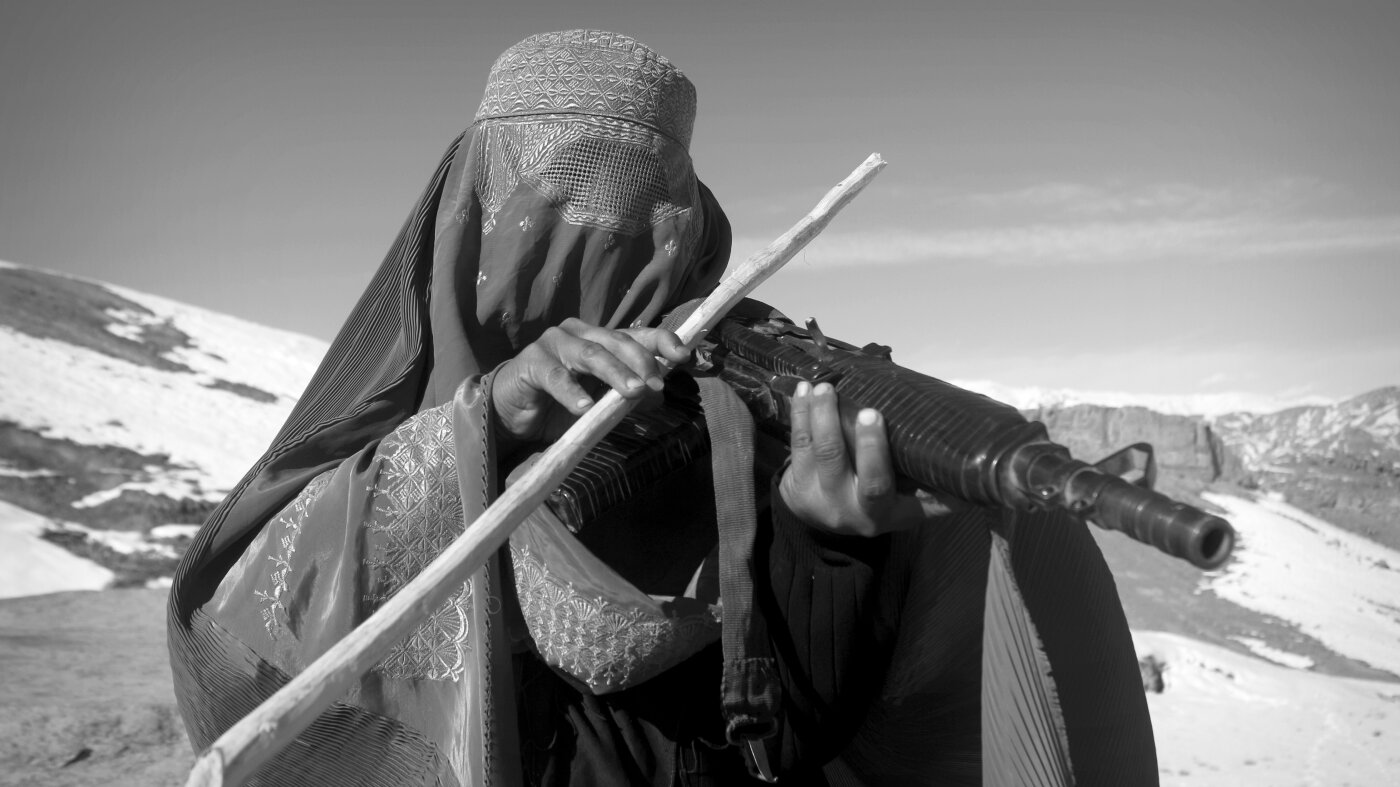
This photo, from a series of pictures by two anonymous cousins, is entitled “The Music of Poverty and Violence.” The subject is playing an automatic weapon as if it were a string instrument.
Mahnaz Ebrahimi|January 2026
hide caption
toggle caption
Mahnaz Ebrahimi|January 2026
Do these photos depict fiction or reality … or both?
A bicyclist whose dark, flowing burka enfolds her body from head to ankles sits with hands perched on the handlebar, seemingly undaunted by the meshed veil that covers her eyes and restricts her sight. Her determination is suggested by the photo’s title, “It will not stand in my way.”

This photo of a woman wearing a burka while riding a bicycle is titled “It will not stand in my way.”
Somayeh Ebrahimi/February 2025
hide caption
toggle caption
Somayeh Ebrahimi/February 2025
A similarly clad figure swirls so swiftly that the billowing fabric appears to lift her into the air like a bird in flight; scribbled in Farsi across the brick wall in front of her is the phrase, “I dreamed that my homeland was prosperous.”

“Courage means being afraid and trembling in the face of adversity, but with the courage, dance!” says photographer Somayeh Ebrahimi.
Somayeh Ebrahimi | February 2025
hide caption
toggle caption
Somayeh Ebrahimi | February 2025
A third burka-draped figure places an automatic rifle on her shoulder as she would a violin, “bowing” it with a long wooden stick as if to make music. The photo’s title is “The Music of Poverty and Violence.”
Two Afghan cousins who created these starkly evocative black-and-white photographs. They do not want their real names revealed because they fear Taliban retribution for their work. So they use the pseudonyms Mahnaz Ebrahimi (born in 2000) and Somayeh Ebrahimi (born in 2001). They live in a remote Afghan mountain farming village. They and their families, all members of the Hazara ethnic group and Shia Muslims, had previously worked as carpet weavers in Kabul. When the Taliban regained power in 2021, they left, seeking refuge from the repression and persecution permitted under the laws of the country’s ultra-conservative Sunni rulers.
Neither cousin had any training in photography when they started taking photos on their cellphones in 2022 or so, says Madrid-based curator and gallery director Edith Arance. She came across their work on Instagram and was struck by the skillful melding of their bleak surroundings with messages ranging from the poetic to the political.
“I know a little Farsi [the Persian language] so I could approach them,” she says. The cousins and Arance worked together via Instagram. In November 2024, Arance presented their work in Madrid, at her Galería Sura, which specializes in emerging photographers from Southwest Asia and Africa.
The photos, which document the sparse reality of the cousins’ lives today and their hopes for a less gloomy future, are on display through May 30 at the Photoville Festival in Brooklyn, New York. Arance uses the literary term auto-fiction to describe their work because, as in that genre, these photos also combine autobiography and fiction. While the images are set against the autobiographical backdrop of where they live, the poses struck by those photographed and their interactions with their physical and natural surroundings suggest interior dreams and fantasies, played out before the camera.
For Arance, the use of light and shadow, and the use of trees, leaves, plants and butterflies as symbols, are also akin to the literary style known as magic realism. The captions and poems accompanying were written by the cousins and translated by Arance.
In “Life Is Today” a young girl dances on a barren ridge overlooking snow-capped mountains. Arance comments: “There’s a sense of play, which should not be unusual. But this is Afghanistan, and this girl is not wearing a veil or a burka, she is just being free. Her shadow looks like an airplane flying away.”

This photo is titled “Life is today.” The photographers say the image is a call to live in the present as the future is uncertain.
Somayeh Ebrahimi/March 2024
hide caption
toggle caption
Somayeh Ebrahimi/March 2024
Other photos similarly question the highly constricted lives of women under Taliban rule.
“Liberation” shows a woman, her back turned to the camera showing the decorations in her hair (which are prohibited by the Taliban), as she throws her burka up and away into the sky. In its accompanying poem, Mahnaz Ebrahimi writes, “In the name of being a woman,/today I will free myself from oppression/and darkness to the breeze/to the height of the sky.”
“Girl by the Door” emphasizes contrasts in light and shadow, as a girl holding a tattered schoolbook stands with half her face hidden by a pale wooden door with multiple chains, the other half dimly lit against the dark background behind her.
The commentary by Mahnaz reads: “The image here is imbued with symbolism. For a time, after learning about the new law [prohibiting education for females after sixth grade], girls risked their lives by going to school. Attacks followed, intended to discourage families from allowing their daughters to attend classes throughout 2022. Light, knowledge, life resides outside. Darkness is the interior of the domestic space to which girls and women are relegated.”
The dichotomy between constriction and freedom is dramatized in the photo of a young girl wearing sunglasses and laughing with uproarious delight titled, “When Will We Laugh From the Bottom of Our Hearts Again”? But there is still the possibility of youthful delight, as shown in “Autumn Games,” in which three young girls throw leaves up into the sky.
Their photos pose questions about other restrictions imposed on girls and women. “Vestiges of the Present” captures a female figure in colorful garb, shown only from the shoulders down, holding a boombox that her still stance tells us is silent; “music, dancing and singing are prohibited for women [in public] in Afghanistan,” the caption reminds us.

This photo addresses the Taliban prohibition forbidding women to make music in public.
hide caption
toggle caption
In an outdoor scene, a young girl cowers as an unseen gunman points a rifle at her, but she holds on to a school notebook with a message in Farsi that reads, “There is no justice,” referring to the limits on girls attending school.
Taken as a whole, Arance says, the photos declare that “The Taliban may say that this is the destiny of women in Afghanistan, but I’m saying this is not my destiny.” As for that hoped-for future, aspirational glints appear in photos such as “From the Depths of Darkness,” which shows, against a black backdrop, a woman holding in her hand a mound of dirt and twigs from which a butterfly is emerging.
Similarly, “And the Glory of Growing Happens Within Us” captures, in profile, a burka-covered woman cradling in her hands a growing, blossoming plant, and perhaps finding inspiration in the ongoing life of its sprouts and buds.
Diane Cole writes for many publications, including The Wall Street Journal and The Washington Post. She is the author of the memoir After Great Pain: A New Life Emerges. Her website is DianeJoyceCole.com


A gold-colored item embossed with the word “President” sits on the Resolute desk in the Oval Office of the White House on Nov. 10, 2025.
Jacquelyn Martin/AP
hide caption
toggle caption
Jacquelyn Martin/AP
The New York Times journalist Jonathan Swan has spent the past 11 years covering President Trump through three political campaigns, his first, and now second, term in office and the ongoing war with Iran. Swan says aside from the COVID-19 pandemic, he can’t remember a time where Trump looked “as stuck as he looks right now.”
“It’s pretty clear he realizes that this war [with Iran] has not gone well, has not played out the way that Netanyahu pitched him or that Trump himself thought [it] would play out,” Swan says. “Trump is someone who is naturally given to hubris, but I think we saw a very extreme version of that with this war.”
Swan and his co-author Maggie Haberman spoke with more than 1,000 sources for their new book, Regime Change: Inside the Imperial Presidency of Donald Trump. The book paints a picture of an unrestrained president remaking the American government and its international relations in profound ways.

Swan notes that the president, who sat for an interview for the book, has been particularly fixated on becoming a “great man of history” during his second term. During one interview, Trump showed Swan and Haberman a document that compared him to notorious historical figures like Mao, Stalin, Hitler, Attila the Hun and Genghis Khan.
“[The list had] nothing to do with morality, all just about pure power projection. And Trump was relishing being in their company,” Swan says. “Maggie and I talked about it afterwards, and it really occurred to us that when you look at it through that lens, his second term makes a lot more sense.”
Swan says the president’s fixation on power is reflected in his decisions to go to war in Iran and implement regime change in Venezuela. But he also sees it manifested in Trump’s White House decor, which leans on what Swan calls the president’s “inner Louis XIV” style.
“He’s gilded almost every corner of the Oval Office,” Sway says. “The history of the Oval Office in the White House has been of modesty when it comes to design and decoration, reflecting the fact that America is a republic, not a monarchy. Trump has no use for that history.”
In a post on Truth Social, Trump referred to Regime Change as “mostly made up, Fake News, largely fiction, as have been most of the things [Haberman] has written about me for so many years.”
Interview highlights

On how Trump’s second term differs from his first
This term is unrecognizable from term one. And I still think a lot of people view [this] administration and government through the lens of the first term. It just couldn’t be more different. One of the ways in which it’s different is the team around him.
I remember in term one covering Trump, and you would have so many conversations with senior officials, including senior national security officials, and the overwhelming impression that you would receive from talking to these people was, A, they thought they were working for someone who was dangerous. And they saw their own roles as protecting the country and the world from the person that they were ostensibly working for. Those types of people don’t exist anymore in this administration. …
At a senior level, it’s really a group of people who believe in him, are loyal to him, in some cases went through the campaign with him. Many of them were radicalized on the campaign through the investigations and the efforts to prosecute Donald Trump. Many of them received some subpoenas themselves and viewed the stakes of the 2024 election as not so much about policy, but about staying out of prison.
So that’s the mindset of Trump and his inner circle. And it’s created a situation where there’s very little friction between a Donald Trump idea that might’ve just leapt straight from his internal monologue out of his mouth, with no filter, to an effort to make it actual American policy and execution.
On Trump’s meeting style
Meetings have no beginning, middle or end. There’s almost no delineation. And what often ends up happening is it’s essentially one meeting that just rolls throughout the afternoon with different people joining and leaving. And Trump [is] engaged or not engaged, people who have no business being in the meeting sometimes joining, whether it’s a pro wrestler, or a crypto investor, or foreign somebody from a golf monarchy, or a CEO. …
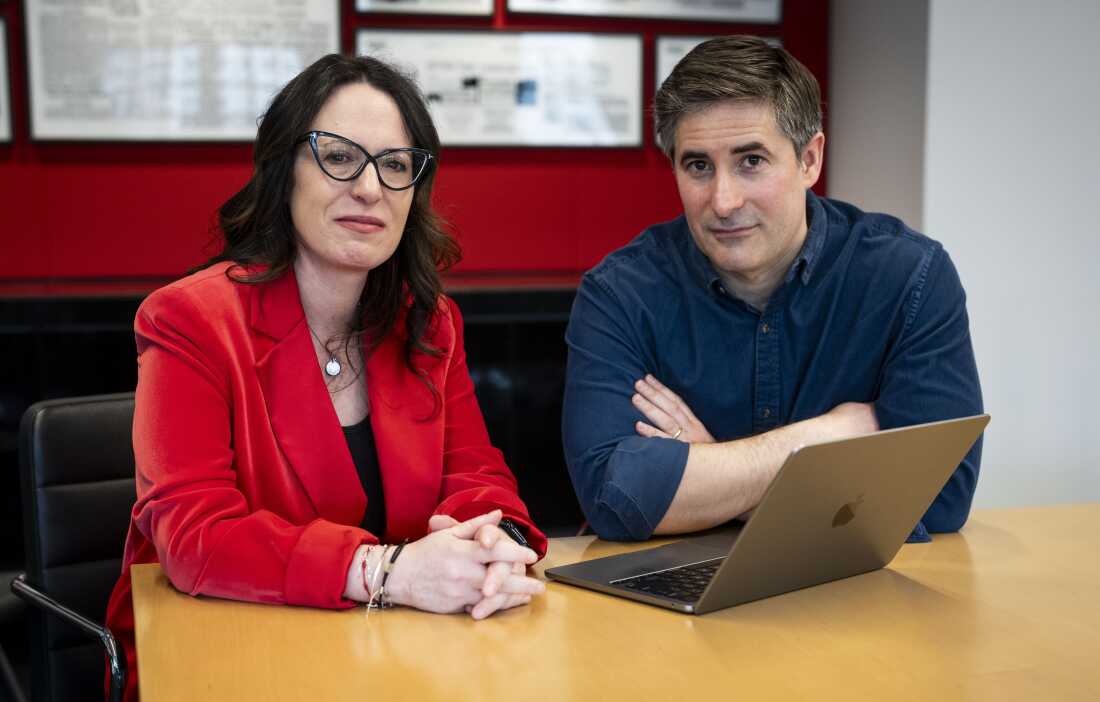
The New York Times journalists Maggie Haberman and Jonathan Swan are the authors of Regime Change: Inside the Imperial Presidency of Donald Trump.
Doug Mills/The New York Times
hide caption
toggle caption
Doug Mills/The New York Times
The conversations are non-linear. Trump will get fascinated about one thing that has nothing to do with the topic and that can derail a meeting. We have a scene in the book where he’s having a conversation, a very small meeting, which is highly classified about a defense program, and this guy comes in, just walks into the Oval, salt of the earth, kind of country looking guy, and he’s holding stone samples for the Rose Garden … and the two go off and sort of start conferring, looking out the window, talking about the paving and the stone and this and that, gets on the phone with another contractor. And before time’s up, the meeting’s ended, they haven’t actually resolved the issue they were going to resolve.
On the higher level of secrecy in Trump’s second term
When there are issues that Trump really cares about, or his team wants to keep secret, they can be incredibly secretive, to the point of great frustration across the government. And when it comes to the weightiest issues like the planning of going to war with Iran, we found that very, very senior people in the government were, A, completely cut out of the loop and, B, had no idea about what was being discussed in the Oval Office.
On Trump’s focus on decorating the White House

I traveled with President Trump to the Middle East, palace after palace. And it was really instructive to watch him with these Middle Eastern rulers in Saudi Arabia and Qatar and the United Emirates. He was just in a state of absolute pleasure, going from one palace to the next, admiring the marble, looking at most rarefied displays of state wealth on Earth. And that’s essentially what he’s trying to create at the White House. … He’s building this grand ballroom. He seemed to almost be competing with Melania as to who had had the better bedroom. They have separate bedrooms and he was taking objects that she had placed in the center hall of the residence and putting them in his bedroom.
YouTube
On the challenge of interviewing Trump
An interview with Trump requires an enormous amount of preparation if you want to hope to come out of it with any level of success. He’s a really difficult interview… He’s an overwhelming presence and you are confronted with a sort of tidal wave of words. Many of the words and the sentences are detached from reality or completely false. And you have to make judgments in real time about what you let go. You can’t fact-check everything. You just can’t. You can pick your moments.
I see my role in every interview as the representative of the people in that chair. You’re the one who’s lucky enough to be sitting in that chair interviewing the president of the United States. What would regular people want to know and want me to do in that situation? And I think that when you’re interviewing a president of the United States, you want to find the balance between letting them explain themselves and not cutting in every two seconds, but finding moments that are really important to puncture the bubble. Trump creates an unreality bubble. It’s the way he operates. … Tucker Carlson actually described it publicly as like being under a spell and I certainly wouldn’t ascribe a supernatural dimension to it, but I know what he’s getting at.
Thea Chaloner and Susan Nyakundi produced and edited this interview for broadcast. Bridget Bentz, Molly Seavy-Nesper and Meghan Sullivan adapted it for the web.

The real spectrum of housing insecurity
Annika McFarlane/Getty Images/Getty Images
hide caption
toggle caption
Annika McFarlane/Getty Images/Getty Images
Who counts as homeless in America?
If you ask the Department of Housing and Urban Development, around 750,000 people are homeless in America. If you ask the Department of Education, that number shoots up into the millions. What does this discrepancy tell us? And how do our cultural ideas about homelessness shape who we see as homeless, and who gets help? To find out, Brittany talks with Dr. Margot Kushel, Director at the UCSF Benioff Homelessness and Housing Initiative, and Dr. Molly Richard, assistant professor in the Department of Public Health at the University of Rhode Island’s College of Health Sciences.
Want more deep dives on cultural taboos? Check out these episodes:
The truth about men on the ‘down low’
Why can’t we be normal about polyamory?
Support Public Media. Join NPR Plus.
Follow Brittany on Instagram: @bmluse
For handpicked podcast recommendations every week, subscribe to NPR’s Pod Club newsletter at npr.org/podclub.
This episode was produced by Corey Antonio Rose. It was edited by Neena Pathak. We had engineering support from Josephine Nyounai. Our Supervising Producer is Cher Vincent. Our Executive Producer is Barton Girdwood. Our VP of Programming is Yolanda Sangweni.
Lifestyle
They just completed all of L.A. Times’ 101 Best California Experiences — and we’ve got questions!

By December of 2023, Paul Preston realized that his girlfriend Susan Huckle was a big fan of road trips and lists. So for Christmas, he gave her L.A. Times’ ”101 Best California Experiences” zine, a traveler’s bucket list highlighting my top destinations throughout my four decades of traveling the state.
The gift, I’m delighted to hear, was a hit.
Preston and Huckle went through it and checked off locations they’d seen already. Then they hit the road.
And now, after two and a half years of roaming the state between work assignments, they’re back to report that they’ve covered all 101 locations on that list. Though the two have also traveled beyond state lines, the quest to cover California “totally informed our lives for the last two or three years,” said Huckle, who sent me a note of thanks after ticking the last box.
After the note arrived, I was eager to call them and learn more. I caught the couple, of course, in the middle of a day trip.
Susan Huckle and Paul Preston set out to visit every spot on the L.A. Times’ 2023 list of “101 Best California Experiences.” Along the way, they got married in Yosemite Valley.
(Nick Wuthrich)
“We’re out exploring,” Preston said. “So you’re getting what we’re about.”
They’re also now married. That happened last July in Yosemite Valley, which, yes, was on the list.
Huckle, 41, an actress, a host on “L.A. This Week” on Channel 35, a Universal Studios performer and an author, grew up in Santa Maria on California’s Central Coast.
Preston, 56, is also an actor. He leads movie location tours and hosts podcasts, movie trivia nights and special events. He grew up and went to college on the East Coast, so he had fewer California miles under his belt when the couple met in 2020.
Their California 101 travels began in early 2024 with a trip to Paso Robles, where they saw the green slopes along Highway 46, Morro Rock and the elephant seals at Piedras Blancas near Hearst Castle.
“And then,” Preston said, “we just kept going.”
Some of their most satisfying stops, the two agreed, were places they hadn’t heard of, such as Orange Works in the Central Valley town of Strathmore and Angel Island State Park, sometimes known as the Ellis Island of the West. Huckle called Angel Island “a marriage of natural beauty with great, powerful, historic information.”
By early this year, there were only a few destinations left to check.
In April, they did the Indian Canyons and Sunnylands estate near Palm Springs, the Integratron near Joshua Tree and the Cheech Marin Center for Chicano Art & Culture in Riverside. In June, they rafted the South Fork of the American River, along with stops in Old Sacramento and, last of all, Columbia State Historic Park. Then they made their own favorites lists.
Susan Huckle’s top 10:
Yosemite Valley
Badwater Basin
Mammoth Mountain
Angel Island State Park
Cheech Marin Center
Joshua Tree National Park
American River South Fork
The Marshall Store on Tomales Bay
Santa Cruz Island
Sunnylands
Paul Preston’s top 10:
Yosemite Valley
Hollywood Bowl
Griffith Observatory
Catalina
Mammoth Mountain
American River South Fork
Erick Schats’ Bakery in Bishop
Huntington Library and Gardens
Palm Springs Aerial Tramway
Balboa Park, San Diego
Now that they’ve seen so much of the state, I had questions. For one, which spots not on the list would they have included?
Alcatraz, they agreed. Also, as an admirer of redwoods, Preston liked Calaveras Big Trees State Park. As an avid cyclist, Huckle liked the 22-mile Marvin Braude Bike Trail from Torrance to Pacific Palisades.
And was anything on the list a disappointment?
“The Carmel Mission,” Huckle said quickly. “It’s beautiful and the missions are an important part of California history.” But she said the mission’s account of its own history seemed “whitewashed,” saying little about the Native loss and trauma that historians are increasingly recognizing in accounts of the missions.
Said Huckle: “I was like, ‘C’mon guys, nobody really thinks this any more, right?’”
Now that they’re done with the Times’ “101 Best California Experiences,” what what will shape their next trips?
They have a list for that. Huckle picked up an L.A. guide, Danny Jensen’s “Secret Los Angeles,” and the couple plans to start where the book does, with the Triforium, a many-colored sculpture that went up outside City Hall in 1975 (and once featured music).
After that? Maybe the Faces of Elysian Valley, a traffic circle sculpture that Huckle said “looks like Easter Island in the middle of Cypress Park.”
That will leave only about 138 more destinations in the book to cover.
If anybody can do it, it’s these two.
-
Politics4 seconds ago
Trump seeks prime-time spotlight for election claims, sparking concerns he’ll intervene
-
 Science6 minutes ago
California employer health premiums will cost as much as a new car in 2027
-
 Sports12 minutes ago
How Spain ‘recaptured the spirit of 2010’ in its run to the World Cup final
-

 World24 minutes ago
Fake Hezbollah video threatening attack on France possibly Russia-tied
-

 News54 minutes ago
Trump’s ‘American Flag Blue’ in the Lincoln Memorial pool is already gray — and the Olympic canoer ‘vandal’ is fighting his arrest | Fortune
-

 Los Angeles, Ca3 hours ago
Water main break floods West Hollywood streets, traps cars
-

 Detroit, MI3 hours ago
Detroit’s air quality early Thursday ranked as hazardous, worst in the world
-

 San Francisco, CA3 hours ago
‘It was a scene from the Titanic’: Fishermen recall rescuing passengers from sinking boat in SF Bay

