Movie Reviews
‘Maria’ Review: Angelina Jolie’s Maria Callas Suffers at a Chilly Distance in Pablo Larraín’s Biopic


In Jackie and Spencer, Pablo Larraín removed any trace of starch from the historical bio-drama to examine, with penetrating intimacy, famous women in moments of extreme emotional distress played out in the glare of a global spotlight. Intimacy is the key factor lacking in the third part of the gifted Chilean director’s unofficial trilogy, Maria. Starring Angelina Jolie as revered operatic soprano Maria Callas over the final week of her life in Paris, the movie is like a glittering jewel in a glass showcase, inviting you to look but not touch.
That doesn’t mean it’s uninvolving or that Jolie’s technically precise interpretation isn’t impressive. But there’s a meta collision between a star whose celebrity has long eclipsed her acting achievements, making it all but impossible for her to disappear into a character, and a subject who constructed an imperious persona for herself, performing even when she wasn’t on a stage.
Maria
The Bottom Line Sings but misses the high notes.
Venue: Venice Film Festival (Competition)
Cast: Angelina Jolie, Pierfrancesco Favino, Alba Rohrwacher, Valeria Golino, Haluk Bilginer, Stephen Ashfield, Valeria Golino, Kodi Smit-McPhee, Vincent Macaigne, Lydia Koniordou, Aggelina Papadopoulou
Director: Pablo Larraín
Screenwriter: Steven Knight
2 hours 3 minutes
Doubling down on icons brings a lot of weight for a role to bear. It results less in a kinship between actor and character than a twofold remove — an exercise in character study, a tad glacial and distancing, rather than a flesh-and-blood portrait.
The movie is beautifully crafted, of course, graced with sumptuous visuals from the great Ed Lachman. The cinematographer captures the City of Light in 1977 in soft autumnal shades highly evocative of the period and shifts into black-and-white or grainy color stock for Callas’ many retreats into memory. Lachman, who was Oscar-nominated for his breathtaking chiaroscuro work on Larraín’s last feature, El Conde, shot Maria using a textured mix of 35mm, 16mm and Super 8mm, along with vintage lenses.
The DP’s outstanding work enhances the refined contributions of production designer Guy Hendrix Dyas and costume designer Massimo Cantini Parrini. The latter’s stunning gowns include chic ensembles worn at public occasions and exquisite costumes for Callas’ famed stage roles, some of which the singer is seen burning as she separates herself from the past.
“I’m in the mood for adulation,” Callas tells a Paris waiter when he suggests she might be more comfortable inside than at an outdoor café table. “I come to restaurants to be adored.”
Larraín and screenwriter Steven Knight, who previously penned Spencer, comply to a degree. Their film is an act of mournful worship for a diva who seems almost too arch, too cloaked in affectation to read as a vulnerable human being — even as her body is shutting down and she’s racked with insecurities about her voice while planning to sing again, more than four years after she last performed. Often, it feels like the filmmakers are scrutinizing Callas with the disorienting effect of a magnifying glass.
The balance doesn’t seem quite right when you feel more for the loyal household staff who love and protect her than you do for the woman lying dead on the carpet by the grand piano. That image opens the movie, preceded only by a slow pan around Callas’ stately apartment.
Knight employs the pedestrian framing device of an interview, with a TV arts reporter and cameraman coming to Maria’s home. The journalist’s name, Mandrax (Kodi Smit-McPhee in a thankless role), is a tipoff that he’s a product of Maria’s mind given that it’s also the name of the medication on which she’s most dependent — more commonly sold as Quaaludes in the U.S.
In what seems a ritual maintained for some time, Maria’s hyper-vigilant butler, Ferruccio (Pierfrancesco Favino), removes the pills from her dressing table and later from the handbags and coat pockets where she has stashed handfuls of them around the room. She has also stopped eating for days at a time, feeding meals prepared by her housekeeper Bruna (Alba Rohrwacher) to her poodles.
She becomes peevish about the dire warnings of her medic, Dr. Fointainebleau (Vincent Macaigne), that her heart and liver are completely shot and that the stress of attempting to perform plus the meds she would need to get through it risk killing her.
The dominant thread becomes not that grim final week, punctuated by abortive rehearsals with a gently coaxing accompanist (Stephen Ashfield), but the singer’s mental forays into her past, from her unhappy childhood with an exploitative mother (Lydia Koniordou) through her love affair with Aristotle Onassis (Haluk Bilginer), whose aggressive charms instantly shoved her husband to the sidelines. Since the Greek shipping magnate eventually left her for Jackie Kennedy, there’s a satisfying full-circle completion with the subject of Larraín’s first film in the trilogy. But don’t expect a cameo from Jackie star Natalie Portman.
Maria’s memories are additionally crowded with her triumphs in the world’s most prestigious opera houses — Covent Garden, The Met, La Scala — flooding the movie with glorious music. The naked emotionality and piercing tragedy of the immortal operatic heroines is a poignant fit for Callas’ end-of-life story and a useful counterpoint to her studied poise and aloofness in this interpretation. The power of work by Verdi, Puccini, Bellini, Donizetti, Catalani and Cherubini goes a long way toward delivering the pathos that often seems muted by Larraín’s approach.
Passages from some of the most celebrated classical operas effectively supplant the role of a score. The soul-stirring choice of musical bookends for the film starts with Desdemona’s supplicant prayer, “Ave Maria,” from Otello, and closes with “Vissi d’Arte” from Tosca, in which a woman who lived for art and love feels abandoned by God. Opera enthusiasts will find much here to savor when the movie drops on Netflix at a date to be determined.
Commendably, Jolie undertook more than six months of rigorous vocal training for the part, also working on breathing and posture alongside specifics like accent. The singing we hear in Maria is a synthesized mix of star and subject. Arias from her prime are predominantly Callas recordings, but her voice in the 1977 scenes, older and rustier after years of vocal strain and a long absence from the stage, blends in a significant amount of Jolie. Neither lip-syncing nor karaoke, it’s a more intricate hybrid.
A number of striking moments use music to show memory and fantasy bleeding into Callas’ diminishing hold on reality. For instance, Maria strolling through the city with the Eiffel Tower in the background, in her mind marshaling a crowd of everyday Parisians singing the “Anvil Chorus” from Il Trovatore; or a full orchestra on the steps of one of the French capital’s grand historic buildings, playing in the rain while a throng of costumed geishas perform the “Humming Chorus” from Madama Butterfly. That ineffably moving passage of music, representing Butterfly’s calm vigil as she waits for Pinkerton’s return, adds emotional heft to the tragedy looming in Maria’s life.
Conflict surfaces when a music reporter for Le Figaro pulls a dirty trick and then confronts Maria outside the rehearsal auditorium with the view that her voice is irreparably ragged. But Knight’s script doesn’t capitalize on this as a moment of self-reckoning, instead limiting the scene to a distressing invasion of privacy.
The movie aims to depict a celebrated woman, whose life has been as much about sacrifice as reward, seeking to take control, to look back and see the truth as death approaches. But its moments of illumination are hazy. There’s little that comes close to the compassion and insight Larraín brought to his portraits of Jackie Kennedy and Princess Diana, even though it’s very much of a piece with those movies.
The tenderness of a scene in which Maria’s sister (Valeria Golino) urges her to put her troubled childhood behind her (“Close the door, little sister”) inadvertently points up how few opportunities we are given to get on comparably intimate terms with the protagonist.
In fact, the most heartbreaking moment for me came at the end, when the film returns to the day of Callas’ death from a heart attack, aged just 53. A high-pitched shriek that at first sounds like some strangled note from an aria is revealed to have come from one of her poodles, the dog’s cry of anguish becoming a loud expression of the hushed sorrow shown by Ferruccio and Bruna (Favino and Rohrwacher are both wonderful) as they reach for each other’s hand for comfort.
Still, Maria is a far more daring and unconventional take on the final chapter of the legendary soprano’s life than Franco Zeffirelli’s boilerplate 2002 biopic, Callas Forever, starring Fanny Ardant. And Larraín’s film becomes retroactively more affecting when the lovely archival images of Callas over the end credits, full of vitality at the peak of her career, widen the perspective on her sad, accelerated decline.



By and large, the zombie subgenre has bitten off more than it can chew in modern times. Between George Romero survival films and camp comedies, the well has become pretty infected. But once in a while, along comes a movie like This Is Not A Test.
Let’s sink our teeth into this new release and see how it stacks up against the classics.
The tone and tenor of this film represent the classic survival movies like Night Of The Living Dead. But the thing that grabs the audience about This Is Not A Test is the trauma of the characters. Holt shines as a withdrawn survivor of an abusive home, trying to cut through the wreckage to reunite with her sister. Each of the main characters have standout traits, and they bathe in strongly acted moments as the stress of the situation changes who they are.
The gore in This Is Not A Test is pretty strong. The attacks spring quickly and when they do, the special effects team does a good job showcasing the battle scars. The camera work is also frenetic in a good way, because the chaos of the chase scenes puts the viewers in a first-person perspective. This film lets you feel like a part of the survivors, so their journeys are interactive.

Longtime fans may say that there’s nothing new in This Is Not A Test, and maybe they’re right. There’s no fresh take on the monsters here, no crazy origin, nothing that we haven’t seen in the past fifty-eight years. But the pacing nails a great balance between getting to know the characters and getting the zombie splatter fest. The mental meltdowns of the characters feel well earned, and the arc of Sloane and her sister brings a lot of heart and investment to the story. Even the most jaded zombie horror fans will find something to appreciate here, even as a background movie.
Adam MacDonald has made another intense hit here, and This Is Not A Test is currently available to stream on Shudder.

- THE ODYSSEY
- Starring: Matt Damon, Tom Holland and Anne Hathaway
- Directed by: Christopher Nolan
- Rated: R
- Running time: 2 hrs 45 mins
- Universal
Our score: 4.5 out of 5
EPIC. If I was asked to describe Christopher Nolan’s latest film, that is the word I would use. He has mounted a film that rivals the greatest achievements of filmmakers like Cecil B. DeMille or David Lean. And, like the films of those mentioned, it’s runs a tad too long.
I was shocked, but pleased, to see that my 12-year-old granddaughter recently did a school paper on King Agamemnon. Thank goodness they’re still teaching History in our schools. Based on Homer’s “The Odyssey,” the film tells the story of King Odysseus (Damon) and his adventures which, if you’ve read “The Odyssey,” include the Trojan Horse, the Cyclops and assorted angry Greek gods. The film covers each of these adventures in great detail, sparing nothing in the production design department. While Odysseus is away – and he’s gone for a l-o-n-g time, his wife Penelope (Hathaway) has to endure a never ending string of “suitors,” men lining up in the hopes of replacing the King should he not return. The men are nothing more then scavengers, taking advantage of the law of Zeus, which decrees no one should be turned away. This angers the Queen’s son, Telemachus (Holland), who must control his temper when the men try to bait him into a fight, the idea being if Telemachus is killed, the new husband would become the King. It’s all very interesting and complicated. And long.
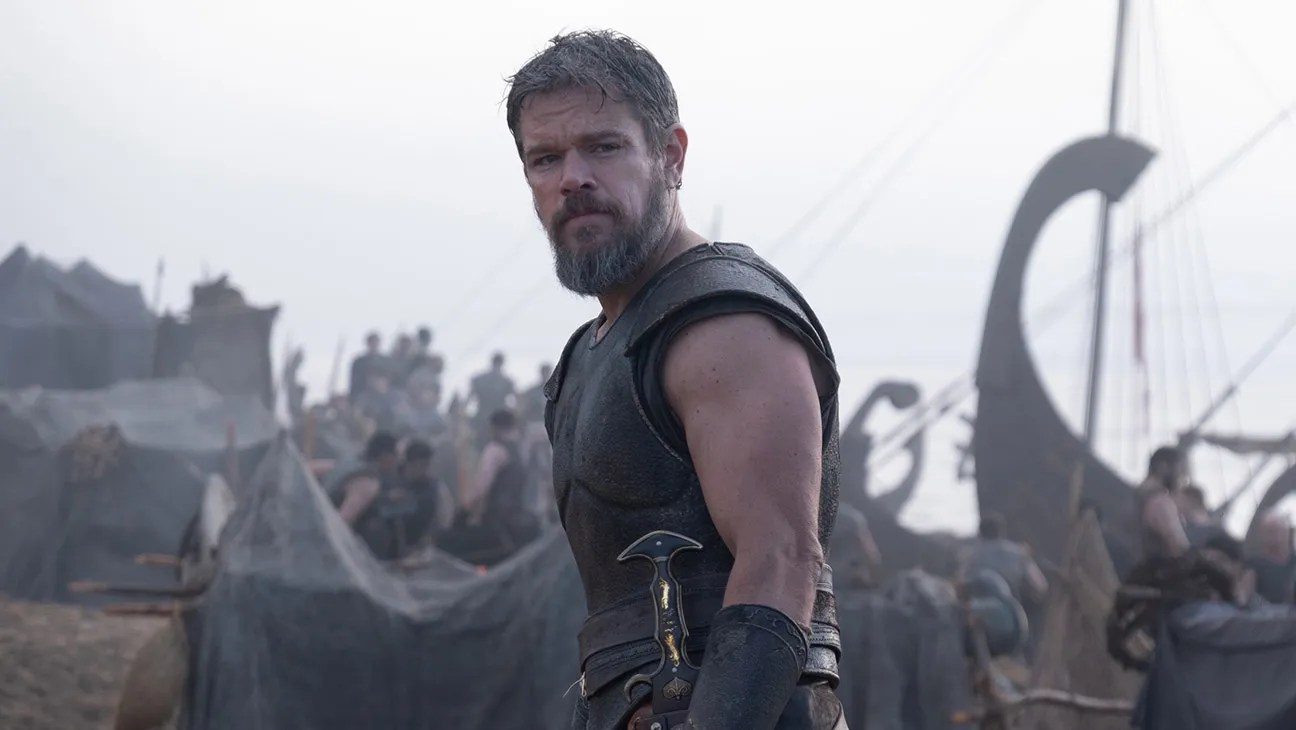
Director Nolan is one of the rare filmmakers who, in my opinion, has never made a bad film. From “Memento” to the “Dark Knight” trilogy to the Oscar-winning “Oppenheimer,” he has proven himself a true master of cinema. “The Odyssey” only adds to that distinguished resume’
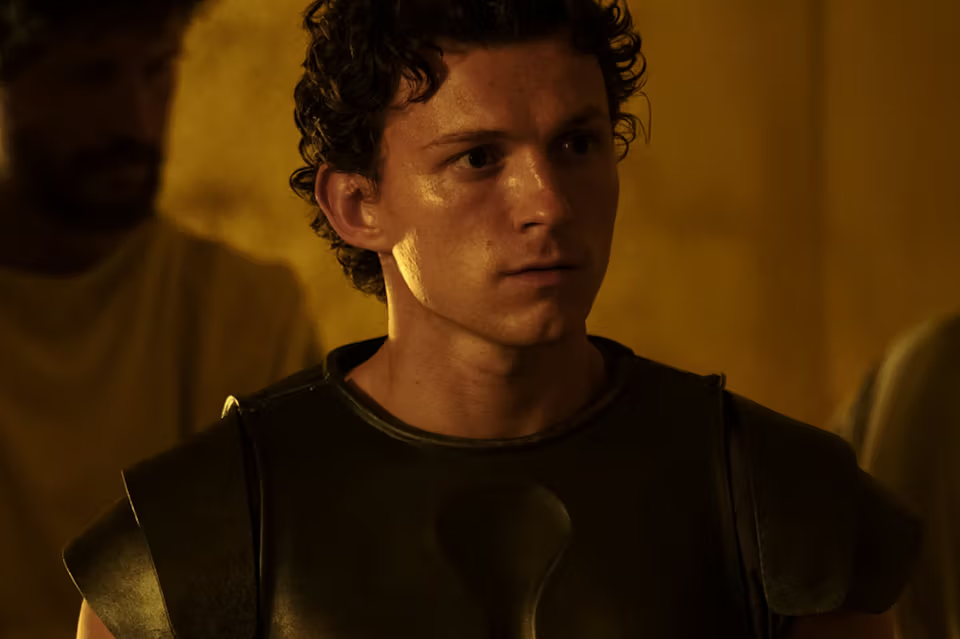
The cast is a tribute to Nolan himself who, like Woody Allen, can pretty much get anyone he wants for his films because, as an actor, why wouldn’t you want a credit in one of his films. Besides the three stars named above, the cast includes Robert Pattinson, John Leguizamo, Zendaya, James Remar, Jon Bernthal, Oscar nominees Samantha Morton and Elliot Page as well as Oscar winners Charlize Theron and Lupita Nyongo. As MGM used to advertise, “more stars than there are in heaven.”
The script and story are pretty faithful to the source material, though for some reason it bothered me whenever Telemacus referred to Odysseus as “dad.” Never father. The weird things you notice. Visual.y the film is stunning and the Trojan Horse and battle of Troy are worth the price of admission alone. I will add that I did see the film in 70 mm and, if that format is playing in your town, I urge you to see it in that format.
On a scale of zero to five, “The Odyssey” receives ★★★★ ½
Movie Reviews
Saari Review: Memory, Betrayal and Identity Converge at River Valley Film Festival – Hollywood Times


Premiering at the 2026 River Valley Film Festival, Saari uses fragmented memories, Finnish landscapes and restrained performances to explore betrayal, identity and reconciliation.
By Valerie Milano
Palm Springs, CA (The Hollywood Times) 7/14/26 – In the visually striking short film Saari—Finnish for “island”, a peaceful family retreat becomes the setting for the slow collapse of a relationship.
Co-written by Justin Seegmueller, Corey L’Esperance and Suvi Härkönen, the film follows Daniel, played by Seegmueller, as he reflects on the choices that damaged his relationship with Liina, portrayed by Ilona Karppanen. Told through fragments of the past, present and future, Saari gradually reveals how secrecy and betrayal can transform a place of safety into one of emotional confinement.
The nonlinear structure was not simply a stylistic choice. The project was developed and filmed over more than a decade, with footage captured in Finland, Boston and the desert. L’Esperance explained that the filmmakers divided the story into “past, present and future,” allowing audiences to experience the relationship from both characters’ perspectives.
Click below for our exclusive interview:
He described Daniel and Liina as two people who are “stuck in these moments in time,” making the fragmented narrative especially appropriate.
Seegmueller said Daniel’s internal struggle is rooted in the questions, “Am I that person? Am I still that person?” His restrained performance captures a man attempting to reconcile his current identity with the damage caused by earlier decisions.
For Seegmueller, the film is fundamentally about choice.
“It’s all about decision-making,” he said. “Are you an accumulation of all your decisions?”
Finland’s lush island scenery contrasts sharply with Daniel’s later isolation in the barren desert. Seegmueller described the progression as “lush and then dead,” a simple but effective visual representation of a relationship moving from intimacy and possibility to emotional aftermath.
For Liina, the island represents family history, comfort and security. By inviting Daniel there, she welcomes him into her sanctuary. His secrets, however, begin to contaminate that protected space.
“You let me into your life,” Seegmueller explained, “and now I’m here almost ruining your sense of security.”

 Because the couple reaches the island by rowboat, the setting also creates a sense of entrapment as suspicion and resentment begin to surface. L’Esperance noted that once they are there, “there’s not really anywhere you can go.”
The film’s cross-cultural perspective was strengthened by the collaboration between American co-director L’Esperance and Finnish co-director Härkönen. Their responsibilities shifted according to which character dominated a scene. L’Esperance generally led sequences centered on Daniel, while Härkönen took a stronger role when Liina’s experience was at the emotional forefront.
That approach helps prevent Liina from existing only as a reaction to Daniel’s behavior. Her journey eventually becomes more compelling than his guilt.
Karppanen traveled to the United States for the first time to film the Boston scenes, which were completed approximately three years after the original Finland footage. Seegmueller said the friendship they developed during production can be seen in the warmth between their characters during the relationship’s happier moments.
The filmmakers deliberately avoid explaining every detail of Daniel’s betrayal. Earlier edits revealed even less, but test audiences needed additional narrative guidance.
“We do need to have some breadcrumbs,” L’Esperance said, explaining that without them, the story became “a little too lost on the audience.”

 The challenge was to provide enough information while maintaining the film’s quiet, interpretive tone. L’Esperance said they wanted to leave room for viewers to “fill in some of the blanks.”
The lengthy production process also changed how the filmmakers viewed Daniel. L’Esperance acknowledged that they initially saw him as “this hero,” but over time recognized that “he is kind of a bad guy in some of these aspects.”
That evolving perspective gives the film greater moral complexity. Daniel is not granted an easy redemption, and his introspection does not erase the harm he caused.
Karppanen brings strength and emotional restraint to Liina, who emerges from the experience as what L’Esperance called “a completely different person.” A final city scene suggests that she is beginning to reclaim her identity and imagine a future beyond Daniel and the relationship that betrayed her.
Subtle, atmospheric and open to interpretation, Saari asks whether people are defined by their worst decisions, and what reconciliation means when the damage cannot simply be undone.
After more than 10 years of work, the film’s world premiere at the River Valley Film Festival is especially meaningful. Both L’Esperance and Seegmueller attended film school in Philadelphia, making the Pennsylvania premiere a return to the state where their filmmaking journeys began.

 Seegmueller hopes the film encourages audiences to examine their own choices and personal histories.
“What does that say about you?” he asked. “What does that say about your story and your own narrative?”
Saari will have its world premiere at the 2026 River Valley Film Festival. Seegmueller will attend the premiere in person, while members of L’Esperance’s family are expected to represent him at the festival.
-
 Politics32 seconds ago
Trump seeks prime-time spotlight for election claims, sparking concerns he’ll intervene
-
 Science7 minutes ago
California employer health premiums will cost as much as a new car in 2027
-
 Sports13 minutes ago
How Spain ‘recaptured the spirit of 2010’ in its run to the World Cup final
-

 World25 minutes ago
Fake Hezbollah video threatening attack on France possibly Russia-tied
-

 News55 minutes ago
Trump’s ‘American Flag Blue’ in the Lincoln Memorial pool is already gray — and the Olympic canoer ‘vandal’ is fighting his arrest | Fortune
-

 Los Angeles, Ca3 hours ago
Water main break floods West Hollywood streets, traps cars
-

 Detroit, MI3 hours ago
Detroit’s air quality early Thursday ranked as hazardous, worst in the world
-

 San Francisco, CA3 hours ago
‘It was a scene from the Titanic’: Fishermen recall rescuing passengers from sinking boat in SF Bay

