Movie Reviews
A Different Man Film Review: Sebastian Stan Stuns


A Different Man is a strikingly original film with a career redefining performance from Sebastian Stan that will unsettle audiences.
A Different Man is one of the darkest satires I’ve ever seen. Edward (Sebastian Stan) has a highly troubled life, not only because of his deeply disfigured face, but also due to the way he carries himself. When he participates in an experimental drug trial that drastically changes his appearance, he finally starts to live the life he’s always wanted. This dream life quickly turns into a nightmare when a play sparks Edward’s desires to change and he becomes obsessed with trying to reclaim what he’s lost.
From the very start of A Different Man, I knew that I was witnessing a totally unique artistic vision. Writer and director Aaron Schimberg has control of every frame, and even if the story isn’t for everyone, the high quality production value of this film is undeniable. The framing in particular is always fascinating, and performance driven. Schimberg always knows when to have an actor’s face fill up the whole frame and it feels as if he has control over every single emotion the audience feels during the runtime.
The beginning of A Different Man, before Edward’s transformation, feels very different than what follows. His life is riddled with anxiety, and the audience feels every bit of that. It feels like a more toned down version of the first act of Beau is Afraid, where everything seems to be going wrong. Every sudden noise is jarring, and you feel the discomfort that Edward has because he looks different. At this time, Stan’s makeup is some of the best that will come all year. We have seen actors buried under makeup plenty of times before, but I’ve never seen makeup like this where I questioned if there were two different actors playing Edward.
A Different Man’s satire looks at self confidence and the obsession we all have with how others perceive us. Because of Edward’s facial disfigurement, he carries himself in a victimized manner. This is completely understandable because while we never see anyone directly treat him poorly, he is clearly seen as other. Who wouldn’t want to change that if given the opportunity? The tragic and painfully funny part of this story kicks in when we get to witness how much Edward’s quality of life improves after his procedure.

While it’s nice to see someone who was in such emotional turmoil striving with his new life, this joy becomes a tough watch when Oswald (Adam Pearson) enters his life. Oswald also has a facial disfigurement, but is a lot more confident in his own skin. Both Edward and the audience start to realize how different society treats Oswald because of this confidence, especially compared to the way Edward was initially treated. This knowledge and unrealized potential is what starts to lead him to a downward spiral and creates a truly unpredictable ending.
The main highlight of A Different Man are the three core performances. Sebastian Stan gives a performance I was unaware he was capable of, especially on a physical level. By the end of the film, Edward has to go through so much, and without an actor that is so in command of his craft. There are so big swings A Different Man takes, and with Stan didn’t make his portrayal so believable, none of the satire would pay off. Even though I saw this film at the very start of 2024, I would be shocked if he didn’t receive some accolades during the 2025 awards season.
Supporting players Renate Reinsve and Adam Pearson are quite phenomenal here as well as Ingrid and Oswald. Reinsve feels like she is giving two different performances from where we first meet her and where her arc ends up. Ingrid is an incredibly flawed person whose morals are never known and Reinsve makes every scene she’s in a facianiting watch. Pearson is incredibly charismatic and a pure scene stealer. In the scenes that Edward and Oswald share, Edward is in a lot of emotional pain, but Pearson’s star power is so alluring that just like everyone in the film, you’re too drawn to Oswald to care.
Almost any criticism I had with A Different Man, the film addressed in some way. For example, the way that disabled people are represented in this film could be perceived as offensive, especially since Sebastian Stan is playing a member of that community. However, Ingrid and Edward eventually have a conversation about this very topic when discussing a play she is writing. I constantly felt like this film was always one step ahead of my thoughts, and I was always impressed with everything happening on screen.
Overall, A Different Man is an original achievement that I absolutely adored. It is certainly not for everyone, with some of the disturbing imagery, but I was always immensely entertained. The makeup work, direction and score will be some of the best works I’ll see all year and the satire brings up some interesting ideas that I can’t wait to discuss with others. A24 has another hit on their hands with A Different Man, and hopefully a bold film like this will find its audience and become the classic I believe it is.
A Different Man premiered at the 2024 Sundance Film Festival and will be distributed by A24. Read all our Sundance reviews!

Fresh (Hulu) Film Review – Loud And Clear Reviews
Review: Sebastian Stan shines as a flesh-eating psychopath in Fresh (Hulu), a horror/thriller with a great premise but many familiar tropes.
Image credit for the header: Sebastian Stan’s Instagram.



Heat Advisory
from THU 12:00 PM EDT until THU 8:00 PM EDT, Eastern Montgomery County, Lower Bucks County, Philadelphia County, Delaware County, Eastern Chester County, Gloucester County, Northwestern Burlington County, Camden County, Mercer County, New Castle County

By and large, the zombie subgenre has bitten off more than it can chew in modern times. Between George Romero survival films and camp comedies, the well has become pretty infected. But once in a while, along comes a movie like This Is Not A Test.
Let’s sink our teeth into this new release and see how it stacks up against the classics.
The tone and tenor of this film represent the classic survival movies like Night Of The Living Dead. But the thing that grabs the audience about This Is Not A Test is the trauma of the characters. Holt shines as a withdrawn survivor of an abusive home, trying to cut through the wreckage to reunite with her sister. Each of the main characters have standout traits, and they bathe in strongly acted moments as the stress of the situation changes who they are.
The gore in This Is Not A Test is pretty strong. The attacks spring quickly and when they do, the special effects team does a good job showcasing the battle scars. The camera work is also frenetic in a good way, because the chaos of the chase scenes puts the viewers in a first-person perspective. This film lets you feel like a part of the survivors, so their journeys are interactive.

Longtime fans may say that there’s nothing new in This Is Not A Test, and maybe they’re right. There’s no fresh take on the monsters here, no crazy origin, nothing that we haven’t seen in the past fifty-eight years. But the pacing nails a great balance between getting to know the characters and getting the zombie splatter fest. The mental meltdowns of the characters feel well earned, and the arc of Sloane and her sister brings a lot of heart and investment to the story. Even the most jaded zombie horror fans will find something to appreciate here, even as a background movie.
Adam MacDonald has made another intense hit here, and This Is Not A Test is currently available to stream on Shudder.

- THE ODYSSEY
- Starring: Matt Damon, Tom Holland and Anne Hathaway
- Directed by: Christopher Nolan
- Rated: R
- Running time: 2 hrs 45 mins
- Universal
Our score: 4.5 out of 5
EPIC. If I was asked to describe Christopher Nolan’s latest film, that is the word I would use. He has mounted a film that rivals the greatest achievements of filmmakers like Cecil B. DeMille or David Lean. And, like the films of those mentioned, it’s runs a tad too long.
I was shocked, but pleased, to see that my 12-year-old granddaughter recently did a school paper on King Agamemnon. Thank goodness they’re still teaching History in our schools. Based on Homer’s “The Odyssey,” the film tells the story of King Odysseus (Damon) and his adventures which, if you’ve read “The Odyssey,” include the Trojan Horse, the Cyclops and assorted angry Greek gods. The film covers each of these adventures in great detail, sparing nothing in the production design department. While Odysseus is away – and he’s gone for a l-o-n-g time, his wife Penelope (Hathaway) has to endure a never ending string of “suitors,” men lining up in the hopes of replacing the King should he not return. The men are nothing more then scavengers, taking advantage of the law of Zeus, which decrees no one should be turned away. This angers the Queen’s son, Telemachus (Holland), who must control his temper when the men try to bait him into a fight, the idea being if Telemachus is killed, the new husband would become the King. It’s all very interesting and complicated. And long.
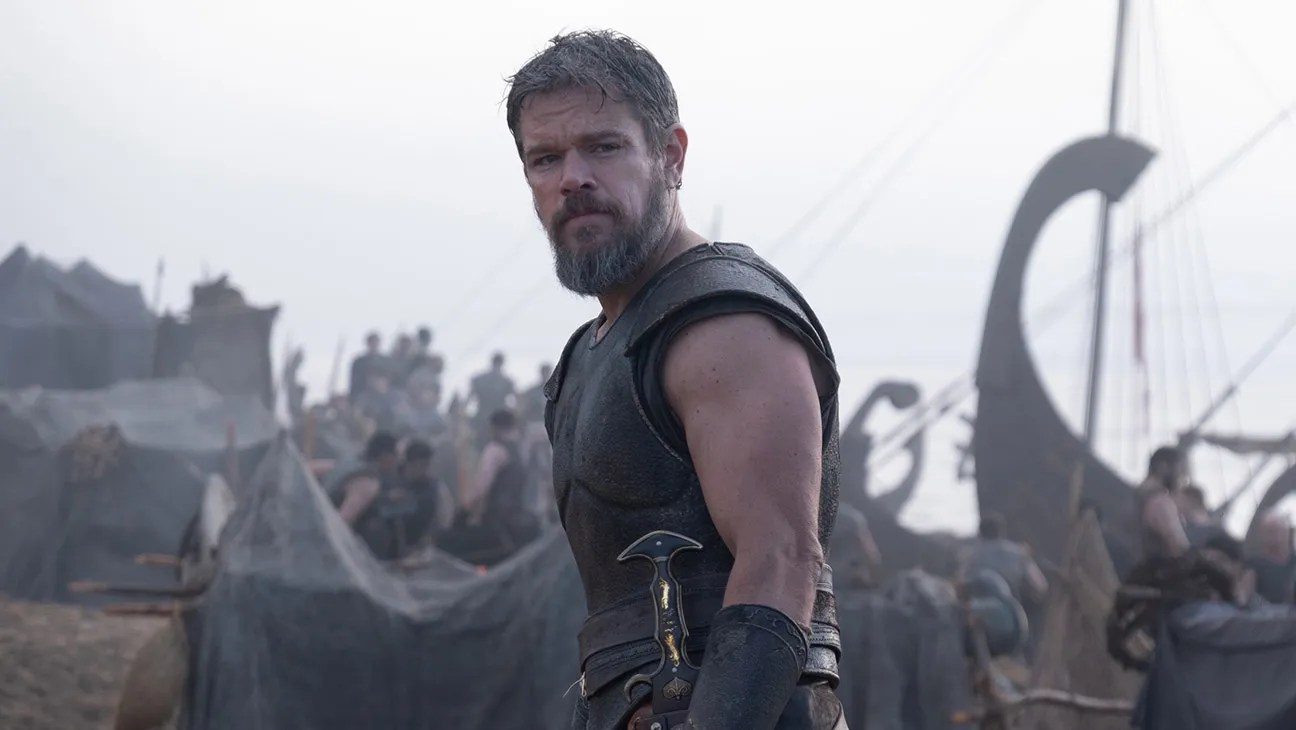
Director Nolan is one of the rare filmmakers who, in my opinion, has never made a bad film. From “Memento” to the “Dark Knight” trilogy to the Oscar-winning “Oppenheimer,” he has proven himself a true master of cinema. “The Odyssey” only adds to that distinguished resume’
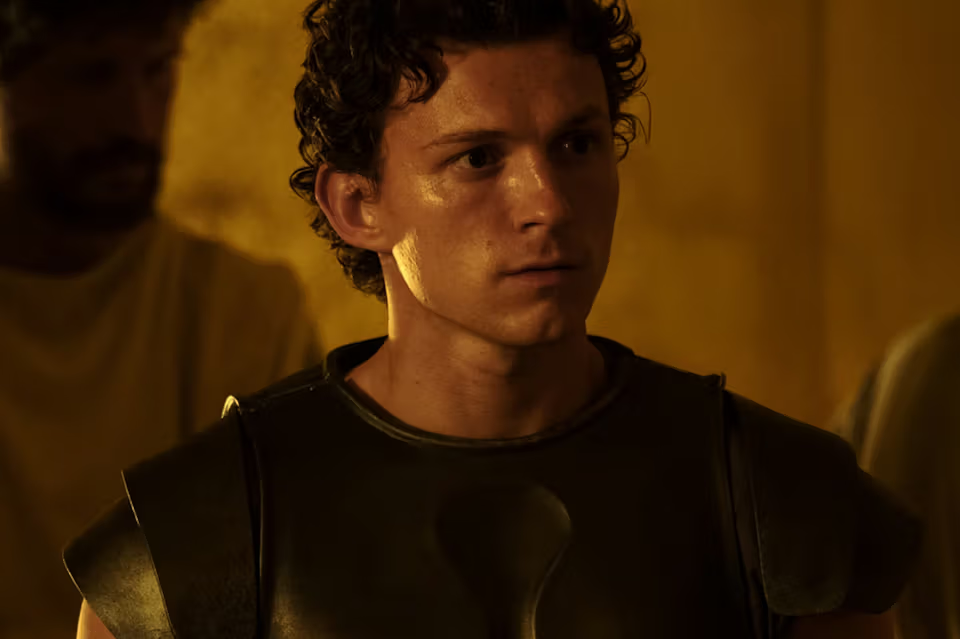
The cast is a tribute to Nolan himself who, like Woody Allen, can pretty much get anyone he wants for his films because, as an actor, why wouldn’t you want a credit in one of his films. Besides the three stars named above, the cast includes Robert Pattinson, John Leguizamo, Zendaya, James Remar, Jon Bernthal, Oscar nominees Samantha Morton and Elliot Page as well as Oscar winners Charlize Theron and Lupita Nyongo. As MGM used to advertise, “more stars than there are in heaven.”
The script and story are pretty faithful to the source material, though for some reason it bothered me whenever Telemacus referred to Odysseus as “dad.” Never father. The weird things you notice. Visual.y the film is stunning and the Trojan Horse and battle of Troy are worth the price of admission alone. I will add that I did see the film in 70 mm and, if that format is playing in your town, I urge you to see it in that format.
On a scale of zero to five, “The Odyssey” receives ★★★★ ½
-

 Pittsburg, PA6 minutes ago
Pittsburgh-area family finds large void under garage of house built by Ryan Homes
-

 Augusta, GA12 minutes ago
Driver taken into custody after chase, rollover crash in Augusta
-

 Washington, D.C18 minutes ago
IndyCar announces start time for highly anticipated Freedom 250 Grand Prix on the streets of Washington, DC
-

 Cleveland, OH24 minutes ago
Dangerous air quality, wildfire smoke descends on Cleveland – The Land
-

 Austin, TX30 minutes ago
More dangerous Texas floods expected after at least 2 killed and hundreds of people rescued in high water, governor says – WTOP News
-

 Alabama36 minutes ago
Soccer officials needed in Alabama
-
Alaska42 minutes ago
Natural gas supplies ‘not looking good’ for Southcentral Alaska this winter, Enstar says
-

 Arizona48 minutes ago
Judge weighs whether Arizona anti-DEI measure can be on November ballot | Arizona Capitol Times


