Entertainment
'MaXXXine' is Ti West's Hollywood horror story. The real-life locations are even scarier

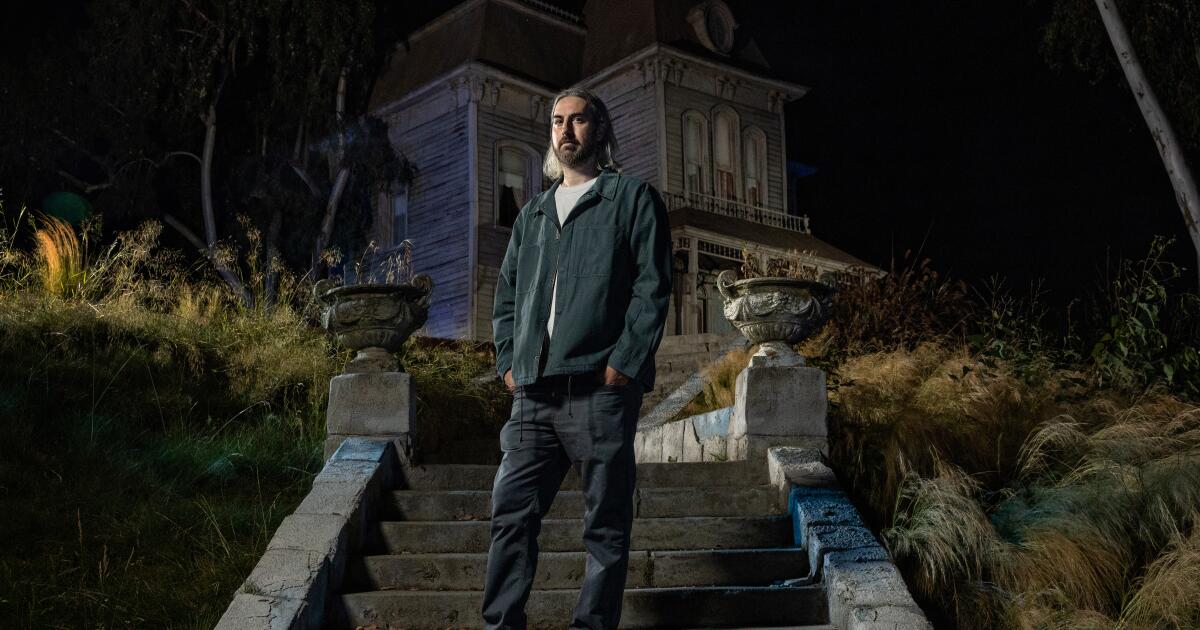
Horror filmmaker Ti West steps out of the blackness behind the Bates Motel hours after the last tourist tram has made it to safety. Behind him looms the “Psycho” house where Mrs. Bates lurked in the window monitoring the movements of Janet Leigh’s Marion Crane — a shot West references in his 2022 slasher “X,” set in 1979, about an elderly farm wife named Pearl who becomes murderously inflamed by a troupe of adult actors shooting a skin flick in her barn. Pearl, an aspiring performer herself, got her own movie the following year in West’s eponymous prequel that rewinds to 1918, when the psychotic failed starlet fed her rival to an alligator named Theda Bara.
Now, West is releasing the third chiller in the series, “MaXXXine,” which finds Maxine Minx, the sole survivor of the first film’s “Texas porn star massacre,” hellbent on becoming a legitimate movie star in 1980s Los Angeles. After six years of sex work, Maxine, played ferociously by Mia Goth, has finally landed her first mainstream role in a sequel called “The Puritan 2.” But her past is still in pursuit, with one chase scene sending Maxine fleeing for her life across the Universal Studios backlot, through the Old West facades to the New York stoops, eventually scampering up the jagged “Psycho” stairs right behind him.
“It’s a weird thing to point a camera at if you’re not making ‘Psycho,’” says West, 43, as he heads farther into the darkness, lighted only by a handful of eerie red lanterns. He calls his trilogy “movie-flavored movies” — artifice and dreams are the top notes. “X” is about scrappy strivers trying to break into the business; “Pearl,” about the dangers of buying into the fantasies onscreen. “MaXXXine,” the highest-profile film of West’s career, wrestles with accepting that Hollywood isn’t quite what one hopes.
Mia Goth in the movie “MaXXXine,” her third with West. “It was the first time I had that dynamic between me and a director where it felt there was something really intimate to it,” she says.
(A24)
“He was ready to deal with this kind of scale, and it’s definitely something he was hungry for,” Goth says, chiming in over Zoom. In addition to playing multiple roles across this mini-franchise, Goth co-wrote “Pearl” and executive-produced the last two films. “We just kind of manifested it,” she continues, “built this entire trilogy into existence. And it’s been incredible to see it unfold.”
West, however, tends to be scrupulously anti-hype. “It is not lost on me that there is a meta thing happening with these movies and me and Mia, and that’s gratifying and strange,” he says. “And it’s also something that we’ve never taken any time to stop and talk about. We were too busy making movies.”
While the marketing team at A24 is all in on “MaXXXine” — “I’ve never had a billboard before,” the director beams — West has been a legitimate filmmaker for well over a decade. His resume of well-regarded independent movies includes the 2016 cowboy vengeance drama “In a Valley of Violence” with Ethan Hawke and John Travolta, plus a string of festival hits like 2009’s “The House of the Devil,” which disposed of a pre-celeb Greta Gerwig early on in a marvelously nasty Hitchcock-esque shock.
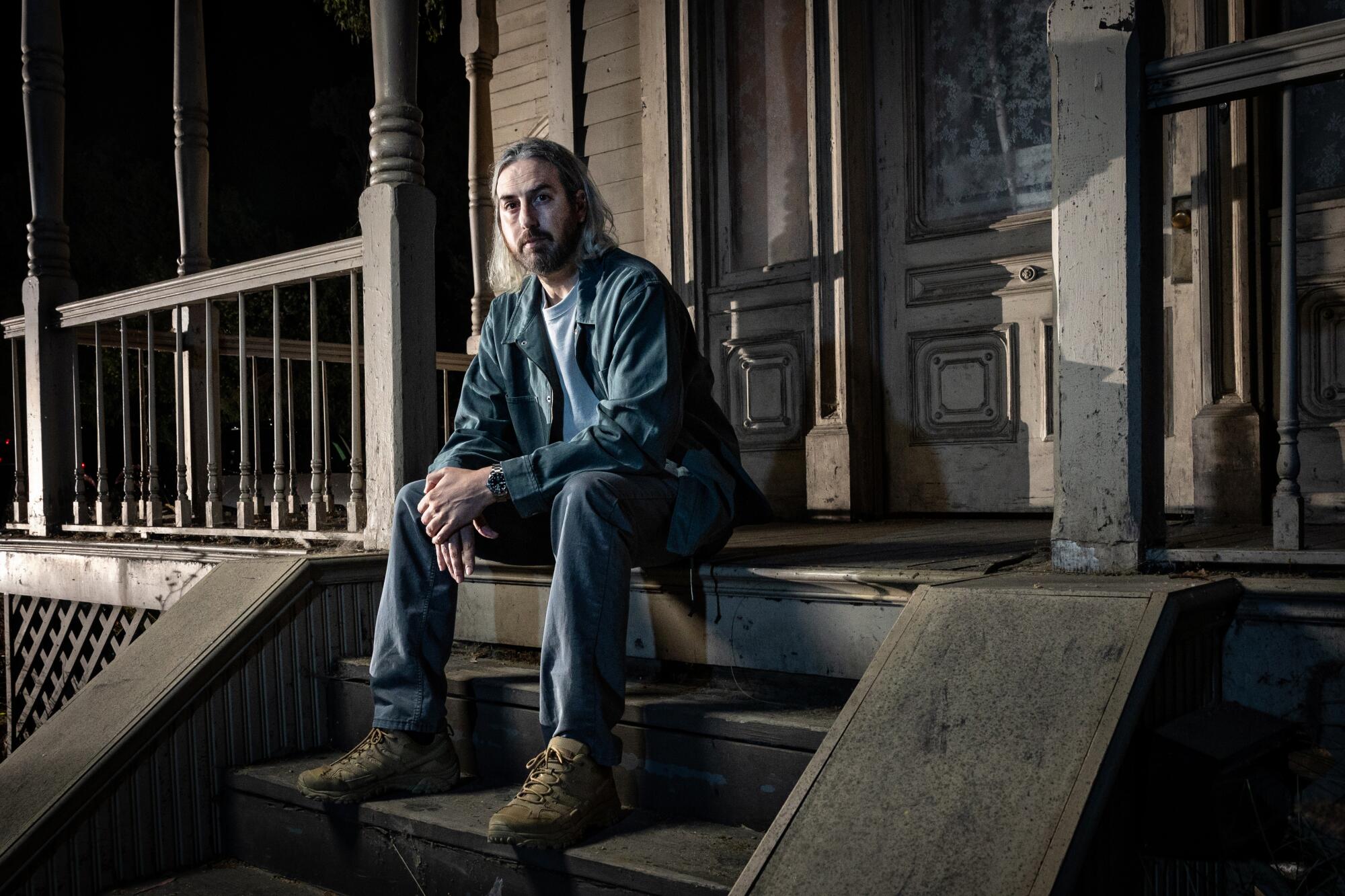
“It hasn’t lost its mystique,” West says of the “Psycho” house, a “MaXXXine” location. “Even tonight it’s still like: What a rare opportunity to actually walk up the steps.”
(Jason Armond / Los Angeles Times)
Still, he’s come a long way since his first trip to the Bates Motel. When he was in middle school, he and his family vacationed at Universal Studios Florida, which had just wrapped “Psycho IV” on its own copy of the set. As a promotional tie-in, the park launched an attraction that taught fans the camera tricks behind the famous shower scene. One volunteer got to brandish a rubber knife and learn how to stab a Marion Crane scream-a-like. West wasn’t chosen, but he went back home with a pair of Bates Motel souvenir slippers and an appreciation for film craft.
“Now that’s all gone, and it’s a Shrek ride or something,” he shrugs. “No offense to Shrek.”
West spent the rest of his youth in Wilmington, Del., renting five VHS tapes for $5 on Fridays at his local video store. One weekend, he rented “Habit,” a grungy but brilliant microbudget vampire flick made by filmmaker Larry Fessenden. Shortly after, he moved to New York and took a film class taught by director Kelly Reichardt, who’d played a cameo in the film. Reichardt introduced the two and Fessenden became West’s mentor, eventually producing his debut feature, “The Roost,” shot exactly 20 years ago with more moxie than money.
“Apparently, now we’re mentioned on the tour,” West adds of his upgraded circumstances, in mild disbelief. “I feel a little bit like I’ve made it.” Filming on the lot took Herculean coordination. Some theme-park trams were rerouted, others couldn’t be. Shots were hastily filmed in the gaps between gawkers. Once, the timing went awry and a few dozen tourists interrupted a take. Cameras out, the visitors snapped away at Goth and Elizabeth Debicki like they were tigers in a zoo.
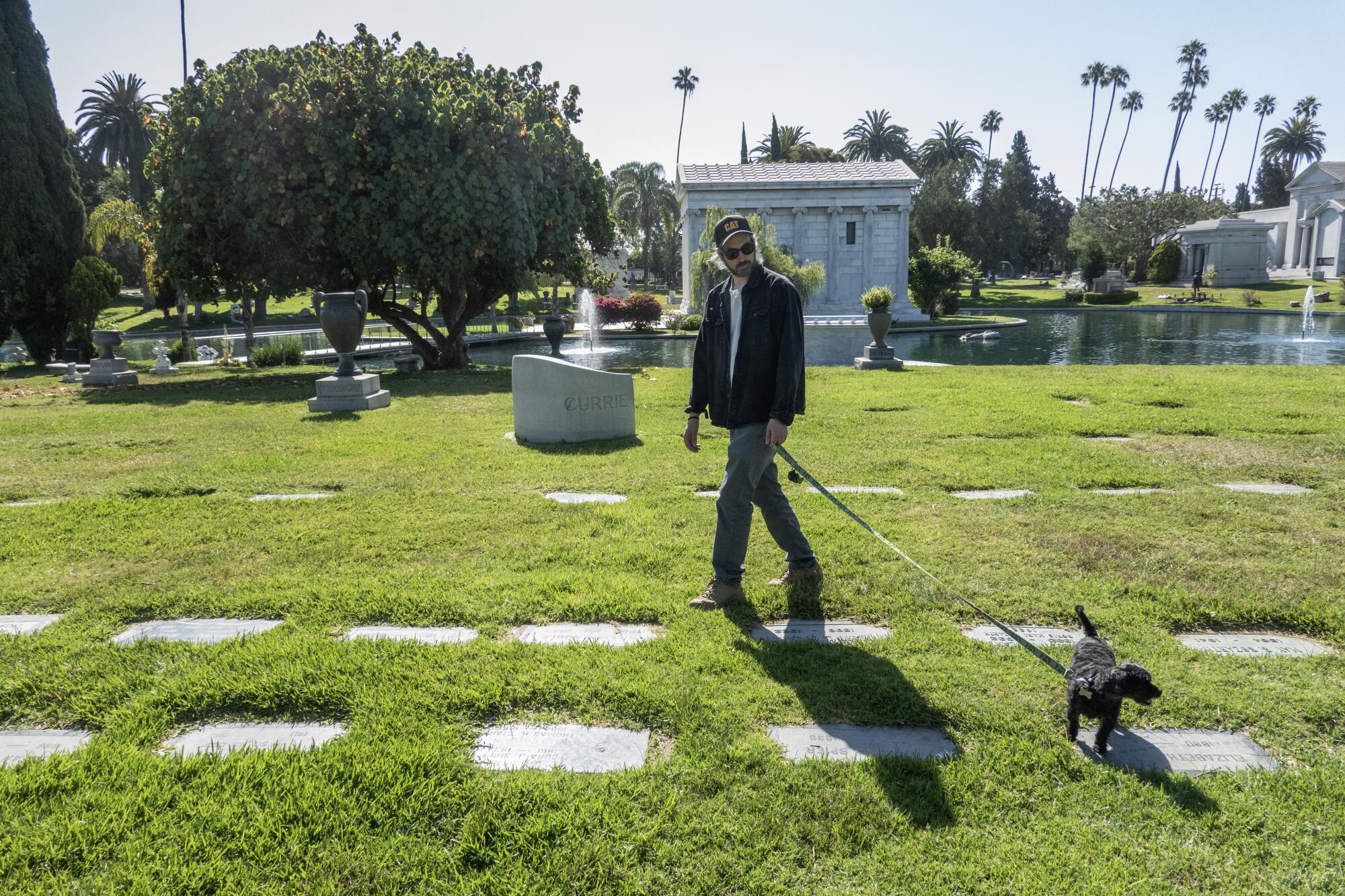
West and his dog, Molly, visit Hollywood Forever Cemetery, one of the filming locations for “MaXXXine.”
(Myung J. Chun / Los Angeles Times)
If West is now a Hollywood animal himself, the only affectation he’s adopted is a tiny 12-pound black dog named Molly who accompanies him everywhere. During this night stroll, she’s quietly tucked into a sling around his hips. On set, Molly had her own chair that read “Executive Paw-ducer.” The next morning, as our personal tour of “MaXXXine’s” locations continues, she’s wearing an A24-branded leash and trying to sneak sips of West’s iced oat-milk latte.
Today, he and Molly and a photographer are piled into an SUV that stops at Hollywood Forever Cemetery, the location where two of the film’s detectives, played by Michelle Monaghan and Bobby Cannavale, make a grisly discovery. (Molly insists on relieving herself in a spot without any graves — she’s a professional.) The fictional corpses planted here by the production were mutilated in the manner of Richard Ramirez, popularly known as the Night Stalker, the real-life L.A. serial killer who murdered at least 13 people during the ’80s. That paranoia is the film’s terrifying backdrop, just as the Spanish flu pandemic leaves scars on “Pearl.”
But this isn’t a Night Stalker story — there’s already half a dozen of those. “MaXXXine,” like West’s “The House of the Devil” before it, vibrates with the tension of Reagan-era Satanic panic, a moment of media-hyped conspiracy that manages to feel both old-fashioned and contemporary.
“When I was growing up, you could get arrested for skateboarding, and now it’s going to be in the Olympics,” West says. But grandstanding moralists stay the same, even if A24 had to hire faux protesters to wave placards that read, “Honor God, End Smut.”
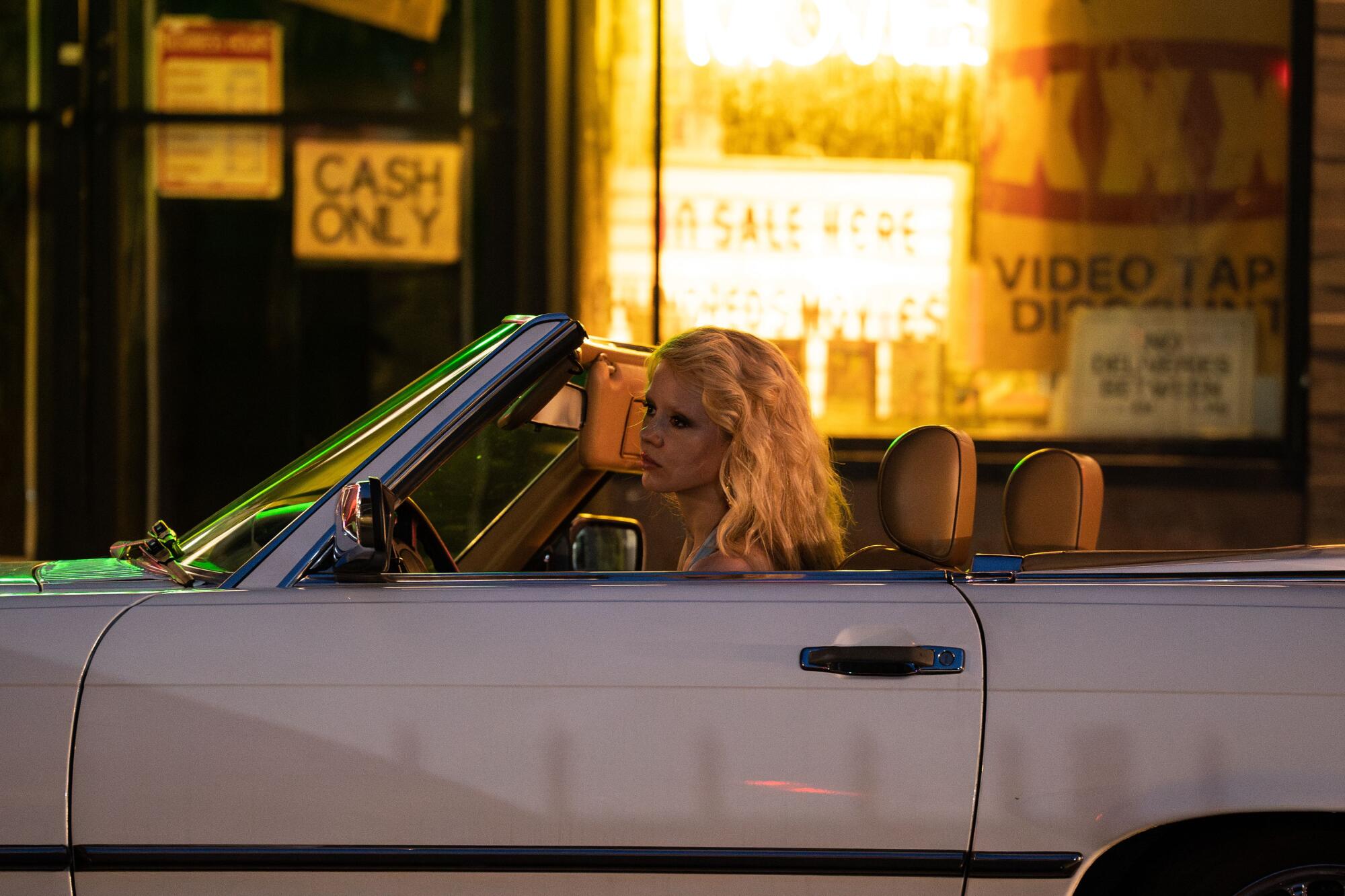
“I’m hopeful that this October there are people that are going to dress up as her from all three movies,” West says of Goth’s many incarnations, including “MaXXXine,” pictured. “That’ll be really strange.”
(A24)
West puts a lot of emphasis on making the past look real, not cartoonish. No ridiculous zebra prints, no suburban mall pastels. Authenticity is baked into everything, from the camera techniques and practical effects to Maxine’s fried split ends.
The “MaXXXine” review embargo has just broken as our car arrives at Hollywood Boulevard and Wilcox Avenue, but West barely glances at his phone. “It’ll be the appropriate mixture of ‘best movie of the three,’ ‘worst movie ever,’” he says calmly. So far, the critics like it, but West seems more fulfilled by the act of making, promoting and releasing three films in four years with barely a day off. During that same time span, he also met his fiancée, DJ Alison Wonderland, and welcomed his first child, who was born two weeks after the trilogy wrapped. (Wonderland, nine months pregnant at the time, cameos in the film spinning records at a nightclub.)
“Weirdly enough, my first place in Los Angeles was also on Hollywood Boulevard,” West says, crossing the street toward Maxine’s second-story dump, which usually houses overstock from the Hollywood Suit Outlet next door.
He moved to L.A. in 2005 after wrapping “The Roost,” figuring the natural progression of things was to head west and write another script. Relocation was daunting. “There’s no real sense of where you’re supposed to live and who to send the script to,” he laughs. His first spot was quieter — “a little garden apartment, very L.A.” — but it amused him to get mail addressed to Ti West, Hollywood Blvd.
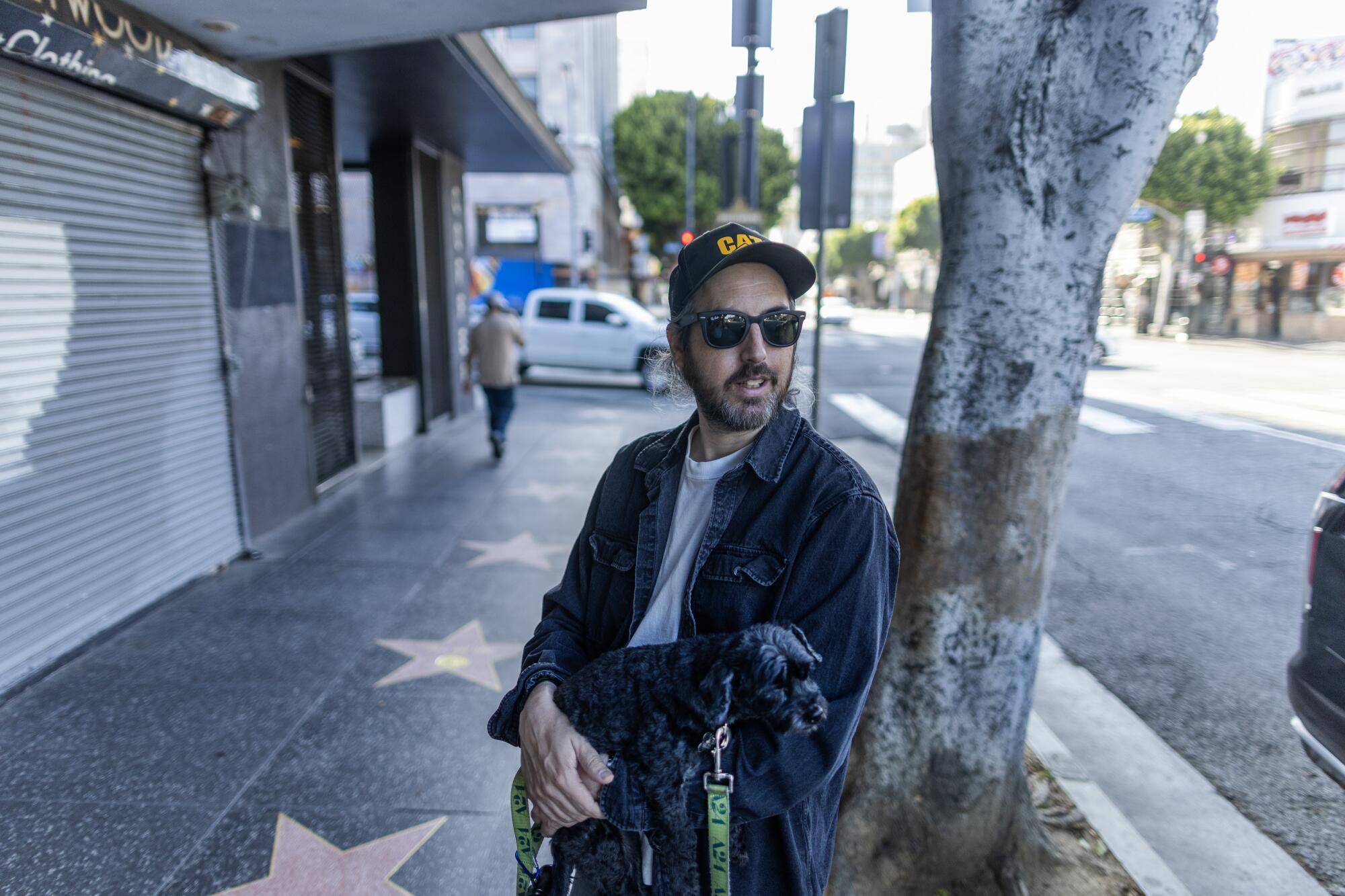
“I didn’t have an interest in telling that ‘Hollywood chews you up and spits you out’ story,” says West, on Hollywood Boulevard where the movie was shot.
(Myung J. Chun / Los Angeles Times)
Nearly two decades later, he’s lived and worked here for so long that he pokes fun at being that naive kid who hoped he’d be instantly handed the keys to the city. In truth, his ascent has been a grind. West kept at it, as did colleagues Joe Swanberg and Andrew Bujalski and the Duplass Brothers, who also premiered films alongside “The Roost” at the South by Southwest Festival in Austin, Texas, the year that mumblecore became a movement.
They were all “making very tiny movies,” West remembers. “I think that’s where the chip on your shoulder comes from: Why doesn’t someone just realize all the work I’ve been putting in? Why don’t they know that I’m up 19 hours a day, seven days a week, working on this thing?” He describes those lean, exhausting years like someone who’s scaled his share of mountains.
“But I came of age in the ’90s, when making independent movies was cool,” he continues. “Are the 25-year-olds sleeping on floors doing that now? Or do they want to be making influencer content? Probably I would have wanted to do that too because if it goes viral, you just jump ahead. If you’re trying to change your life, that’s a quicker path.”
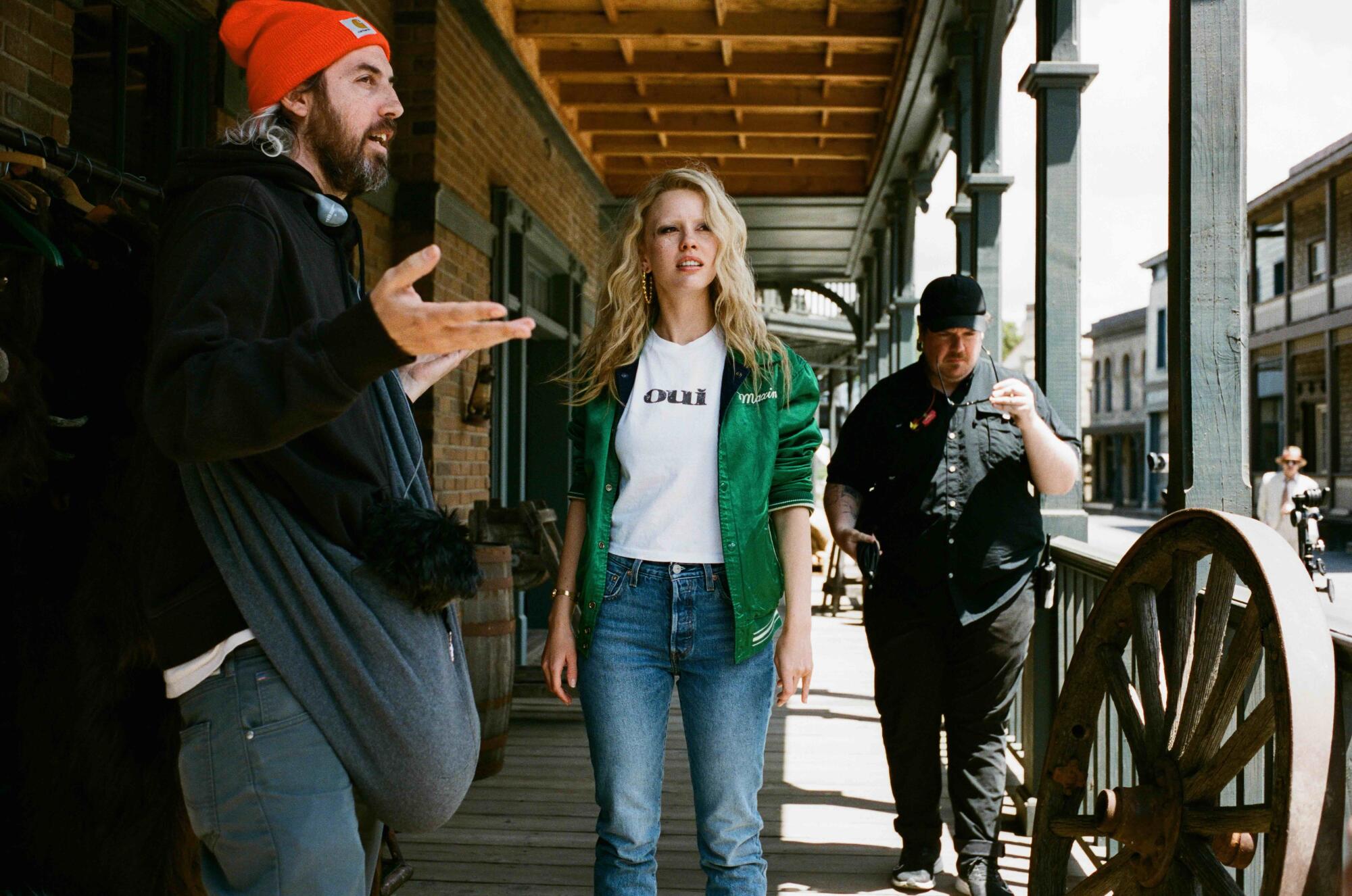
“We were in the Old West town and I was like, ‘Ti, this is the coolest job in the world,’” says Goth. “And he looked at me like, ‘I know.’ And we were just so giddy.”
(A24)
West’s first climb when he arrived in town was a hike up to the Hollywood sign before more fences and alarms were erected around it. “I had to do it,” he recalls. “I just thought, ‘Are they really going to arrest me?’” He hesitates, then chuckles. “Maybe the answer’s yes.” But he got away with it and was permitted to legally return while scouting for “MaXXXine” as he wanted to stage a showdown under the letters. For practical reasons, he was forced to rebuild the sign nearly to scale in Santa Clarita. Even so, the shoot was so tight on time and money that he had just eight hours to film at the duplicate site, including a lunch break and the commute up and down the hill.
“PTSD,” West mutters, flashing back to the hectic pace as he continues down Hollywood Boulevard and turns into the alleyway where Maxine gets menaced by a Buster Keaton clone. Every scene shot on the busy street — and there are a lot of them — had to be completed in four days, with the vintage store fronts mostly erected the morning-of to make sure the sets weren’t destroyed. When the film’s phony video shop went up, West’s phone buzzed with texts from friends who’d happened to drive by. A few asked if he was behind the fake signage; others mistakenly celebrated it as real.
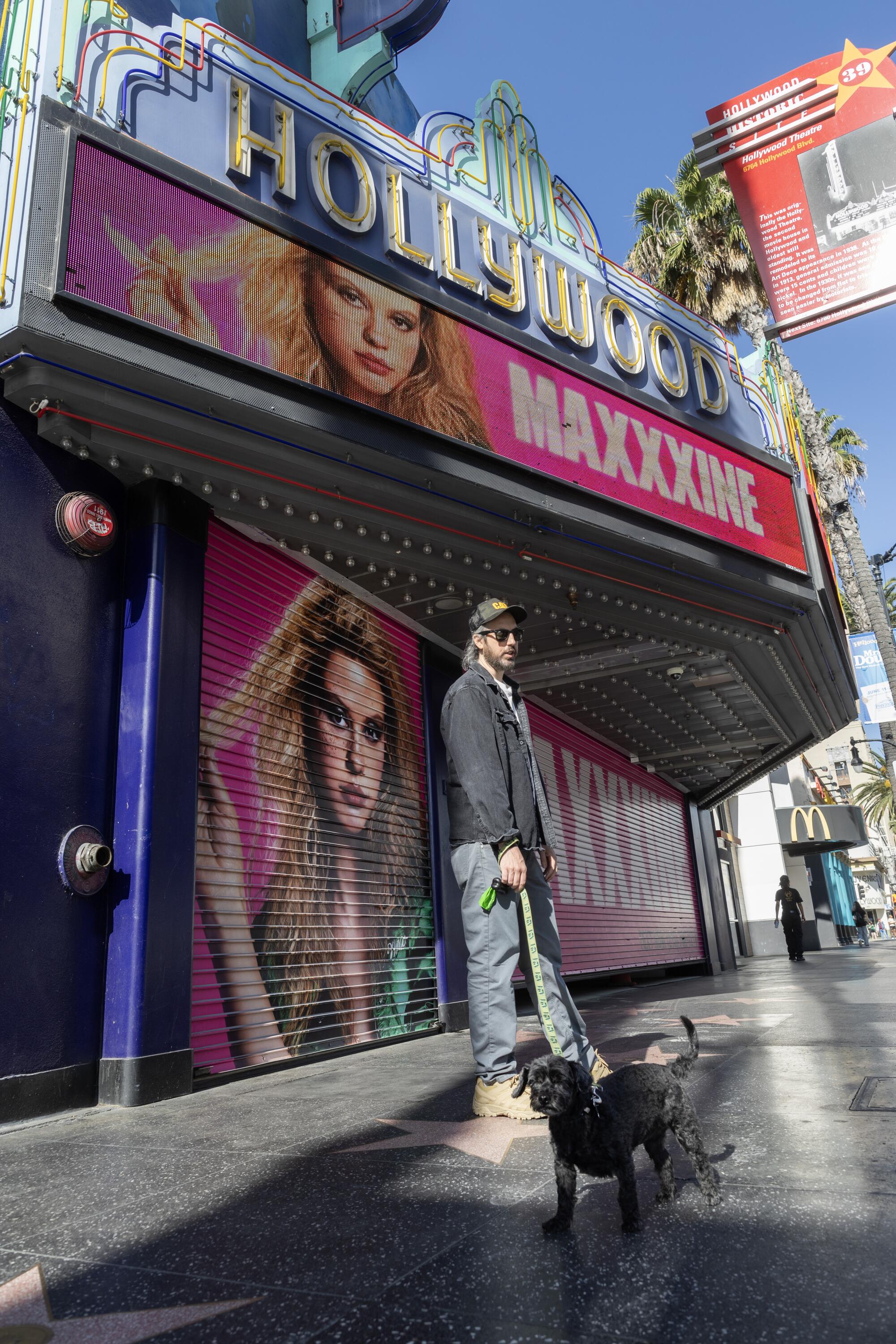
“It’s just a circus at all times and nobody really cares that you’re shooting a movie,” says West, in front of the Hollywood Theatre.
(Myung J. Chun / Los Angeles Times)
“To turn this all into an X-rated area was a very big project, lots of neon,” West says. As he gestures toward the marquees of the Déjà Vu gentlemen’s club and the Vine Theatre (both seen in “MaXXXine”), a bus pulls up and unloads 50 or so Scientologists in matching navy skirts and trousers who politely ignore his descriptions of sin as they head into the L. Ron Hubbard Life Exhibition. West is also unfazed. “We had to be out here in the chaos of it all. It shows in the movie.”
Some days, he got lucky. West wanted an insert shot of Theda Bara’s star on the Walk of Fame as a nod to Pearl’s pet gator, and, magically, it was just steps from the Déjà Vu. Kevin Bacon, playing one of “MaXXXine’s” heavies, has his own star across the intersection, while Giancarlo Esposito, cast in a memorable role as Maxine’s agent, is embedded three streets to the east.
But this is also the block where an angry driver smashed through the barricades and crashed into a parked car in the middle of filming. The cops who were hired to guard the set had to abandon their posts in pursuit. West and the cast and crew held their positions and finished the scene.
“From making a movie here, I realize it’s difficult to get permits because the neighborhoods just don’t want movies shooting,” West says. “But it’s Hollywood. If there’s ever a reason to be in traffic, it should be because Will Smith is flipping a car in the middle of the street. Every other reason to be stuck in traffic sucks.”
West hopes to stage his next movie in a more controlled environment. He’s 40 pages into that script — “It will not be a trilogy, I assure you of that” — and already imagining the comforts of constructing a set that’s “meticulous and complicated.” He’s challenging himself to surprise audiences and top all three Maxine films combined. “That’s the goal: You put in the reps and you keep getting better.”
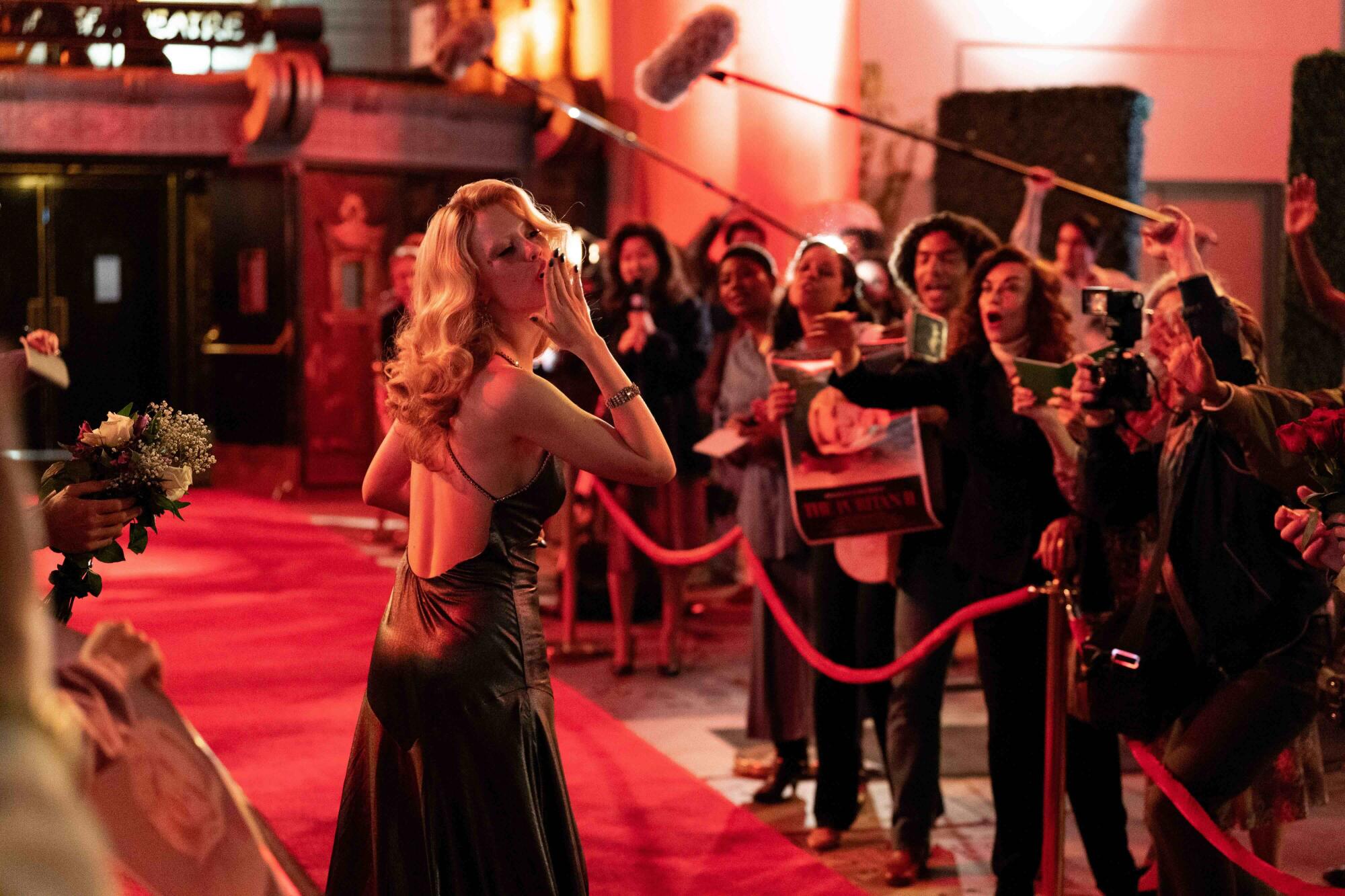
“She’s not trying to work for UNICEF,” West says of Goth’s Maxine Minx, “but I’m just trying to put you on her side in the movie so that by the end of ‘MaXXXine,’ you’re like, ‘I’m just glad she made it.’”
(A24)
But for now, he’s focused on getting people to root for the trials and tribulations of his marvelously wicked Maxine Minx. Right after the car crash, West and Goth hustled to film a scene of Maxine strutting the red carpet at Mann’s Chinese.
Eventually, “MaXXXine” itself will debut there too: an ’80s-chic world premiere with Angelyne parked outside in her pink Corvette and attendees dressed like Gordon Gekko and Sunset Strip metal heads. West wears a white suit jacket — “very ‘Miami Vice,’” he says — while his toddler sports “Risky Business”-style sunglasses and charms paparazzi by giving them a let’s-do-lunch-babe finger point.
That was a couple days ago and West is back with us at the Chinese’s autographed concrete, still finding his footing in the surreality of it all. He nods approvingly that the town hasn’t swapped out its shoe prints of classic stars for, well, Shrek.
“The movies aren’t going anywhere, because telling stories is how people communicate,” he says. Tenacious creatives like Maxine and Pearl and yes, even he and Goth, are now part of Hollywood lore. West exhales. “Maybe someday, someone will say, ‘I really like those old movies — like ‘MaXXXine.’”



(Credits: Far Out / Elevation Pictures)
Maxime Giroux – ‘In Cold Light’
The action is relentless in the complex thriller In Cold Light, a tense combination of crime and fugitive tale and family drama. It is the third feature and first English language film by Maxime Giroux, best known for a very different kind of film, the critically acclaimed 2014 drama Felix & Meira.
The tension and high energy of In Cold Light almost overwhelm the film, but are relieved, barely, by moments of character development and introspection that keep the audience pulling for the restrained and outwardly cold main character.
Speaking at the film’s Canadian premiere, director Giroux admitted he found creating an action film a challenge. Part of his approach was using very minimal dialogue, especially for the central character, letting the action speak for itself, and allowing silence to intensify suspense. Giroux has said he likes the lack of dialogue and speaks highly of the importance of silence in cinema; he prefers using “physical aspects of communication” in his films.
Young Ava Bly (Maika Monroe) is a competent and businesslike drug dealer, working in partnership with her brother Tom (Jesse Irving) and a small team. As the film begins, Ava has just been released from a brief prison sentence. She is hoping to return to her former position, but her brother’s associates consider her a risk due to her recent incarceration. While she works to re-establish herself, a shocking encounter with a corrupt police officer sends Ava’s life into chaos and forces her to go on the run.
Ava’s fugitive experience introduces a new character, to whom Ava turns for help: her father, Will Bly, played by Troy Kotsur, known for his excellent performance in CODA. Their first interaction is handled in a fascinating way, as Will is deaf and the two communicate through sign language. This, of course, provides another form of the silent interaction the director prefers; he explained that much of the father-daughter interaction was rewritten with the actor in mind. Their conflict is nicely expressed through a scene in which their initial conversation is intermittently cut off by a faulty light which goes out periodically, making communication through sign momentarily impossible, nicely expressing the rift between father and daughter.
As Ava continues to evade danger, her escape becomes complicated by new information, placing her in a painful dilemma. We gradually learn more about Ava, her background, and her character through occasional flashbacks and glimpses of her dreams. The plot becomes more complex and more poignant, and gains features of a mystery as well as an action tale, as she is pressed to choose from among equally unacceptable alternatives.
The climax of her efforts to protect both herself and those close to her comes to a head as she meets with the director of a rival drug gang. Veteran actress Helen Hunt is perfect in the minor but significant role of Claire, the rival drug lord, who plays odd mind games with Ava in an intriguing psychological fencing match. It’s an unusual scene, in which Ava’s personality is made clearer, and Claire’s understated dominance and casual speech do not quite conceal the threat she represents.
The frantic pace and emotional turmoil are enhanced by the camera work, which tends to focus tightly on Ava, and by a harsh, minimal musical score that sets the tone without distracting from the action. Giroux chose to shoot the film in Super 60; he describes digital as “too perfect” for the look he was going for, and since “Ava is rough,” the film portrays her better. The director describes the entire movie as “rough,” in fact, and deliberately chose a dark, washed-out look for much of the footage, occasionally using light and colour, in the form of fireworks, lightning, or a colourful carnival, to both relieve and emphasise the darkness.
The dynamic, intense story holds the attention in spite of the lengthy, sometimes repetitive chase scenes and subdued dialogue. Ava’s predicament, and the difficult decisions she is forced to make, are made surprisingly relatable, from the initial disaster that starts the action to the surprising flash-forward that concludes the film, on as high a note as the situation could allow. Fans of action movies will definitely enjoy this one.

The House of Pies, a Los Feliz institution, is bustling on a chilly January morning.
It wouldn’t be shocking if some of the patrons here for breakfast were casually chit-chatting about the cultural behemoth that “KPop Demon Hunters” has become. After all, the 2025 animated saga about three music stars fighting otherworldly foes is now the most-watched movie ever on Netflix; “Golden,” its showstopping track, has since become the first Korean pop song to ever win a Grammy.
But for Danya Jimenez, 29, who sits across from me sipping coffee, the reception to the movie she began writing on back in 2020 isn’t entirely surprising, but certainly delayed.
“When we first started working on it, I was like, ‘People are going to be obsessed with this. It’s going to be the best thing ever,’” she recalls. But as several years passed, and she and her writing partner and best friend Hannah McMechan, 30, moved on to other projects. They weren’t sure if “KPop” would ever see the light of day. Production for animation takes time.
It wasn’t until she learned that her Mexican parents were organically aware of the movie that Jimenez considered it could actually live up to the potential she initially had hoped for.
“Without me saying anything, my parents were like, ‘People are talking about this’ — like my dad’s co-workers or my aunt’s friends — that’s when I started to realize, ‘This might be something big,’” she says.
“But never in my life did I think it would be at this scale.”
“KPop Demon Hunters” is now nominated for two Academy Awards: animated feature and original song. And that’s on top of how ubiquitous the characters — Rumi, Mira and Zoey — already are.
“Everyone sends me photos of knockoff ‘KPop Demon Hunters’ dolls from across the border,” Jimenez says laughing. “My friend got me a shirt from Mexicali with the three girls, but they do not look anything like themselves. She even got my name on it, which was awesome.”
After graduating from Loyola Marymount University in 2018, Jimenez and McMechan quickly found their footing in the industry, as well as representation. But it was their still unproduced screenplay, “Luna Likes,” about a Mexican American teenage girl obsessed with the late chef and author Anthony Bourdain, that tangentially put them on the “KPop” path.
“Luna Likes” earned the pair a spot at the prestigious Sundance Screenwriters Lab, where Nicole Perlman, who co-wrote “Guardians of the Galaxy,” served as one of their advisors. Perlman, credited as a production consultant on “KPop,” thought they would be a good fit.
Jimenez didn’t see the connection between her R-rated comedy about a moody Mexican American teen and a PG animated feature set in the world of K-pop music, but the duo still pitched. Their idea more closely resembled an indie dramedy than an epic action flick.
“If [our version of ‘KPop’] were live-action, it would’ve been a million-dollar budget. It was the smallest movie ever. Our big finale was a pool party,” Jimenez says. “We had all of the girls and the boys with instruments, which obviously is not a thing in K-pop, and everyone was making out.”
Even though their original pitch wouldn’t work for the film, Maggie Kang, the co-director and also a co-writer, believed their voices as two young women who were best friends, roommates and creative collaborators could help the movie’s heroines feel more authentic.
“Maggie had already interviewed all of the more established writers, especially older men,” Jimenez says. “She knows the culture. She knew K-pop, she’s an animator. She just needed the girls’ voices to come through, so I think that’s why we got hired.”
Kang confirms this via email: “It’s always great to collaborate with writers who are the actual age of your characters! Hannah and Danya were exactly that,” she says. “They were very helpful in bringing a fresh, young voice to HUNTR/X.”
Neither Jimenez nor McMechan were K-pop fans at the time. As part of their research, they both started watching K-pop videos, but it was McMechan who got “sucked into the K-hole” first. Still, it didn’t take long until the video for BTS’ “Life Goes On” entranced Jimenez.
“K-pop is a river that you fall into, and it just takes you,” Jimenez says. BTS and Got7 are her favorite groups. For McMechan, the ensemble that captivates her most is Stray Kids.
In writing the trio of demon hunters, the co-writers modeled them after themselves. The characters’ propensity for ugly faces, silliness and a bit of grossness too, stems from the portrayals of girlhood and young womanhood that appeal to them. Jimenez, who says she was an angsty teen, most closely identifies with the rebellious Mira.
“I have a monotone vibe,” says Jimenez. “People always think that I’m a bitch just because I have a resting bitch face,” she says. “But as you can see in the movie, Mira cares so much about having everyone be really close. I feel like that’s how I’m with all my friends.”
Characters with strong personalities that are not simplistically likable feel the truest to Jimenez. In “Luna Likes,” the prickly protagonist is directly inspired by her experiences growing up, as well as the bond she shared with her dad over Bourdain’s “Parts Unknown” show.
“There’s a pressure to show that Mexicans are nice people and we’re hard workers. I was like, ‘Let’s make her kind of bitchy and very flawed,’” Jimenez says about Luna. “She’s a teenager in America and she should be given all the same opportunities — and also the forgiveness for being an ass— and [as] selfish at that age as anybody else.”

Hannah McMechan, left, and Danya Jimenez, co-writers of “KPop Demon Hunters,” met in college.
(Carlin Stiehl / For The Times)
Though their upbringings were markedly different, it was their shared comedic sensibilities that connected Jimenez and McMechan when they met in college. The two were close long before deciding to pen stories together. “Having a writing partner is the best. I feel bad for people who don’t have a writing partner, no offense to them,” says Jimenez.
McMechan explains that their writing partnership works because it’s grounded on true friendship. And she believes they would not have gotten this far without each other. While McMechan’s strong suit is looking at the bigger picture, Jimenez finds humor in the details.
“Danya is definitely funnier than me,” says McMechan. “It’s really hard to write comedy in dialogue versus comedy in a situation because if you’re putting the comedy in the dialogue, it can sound so forced and cringey. But she’s really good at making it sound natural but still really funny.”
Though she had been writing stories for herself as a teen, Jimenez didn’t consider it a career path until as a high schooler she watched the romantic comedy “No Strings Attached,” in which Ashton Kutcher plays a production assistant for a TV series.
“He is having a horrible time. But I was so obsessed with movies and TV, and I was like, ‘That looks incredible. I want to be doing what he’s doing,’” she recalls. “And my dad was like, ‘That’s a job.’”

Danya Jimenez grew up in Orange County.
(Carlin Stiehl / For The Times)
As an infant, Jimenez spent some time living in Tijuana, where her parents are from, until the family settled back in San Diego, where she was born. And when she was around 5 years old, Jimenez, an only child, and her parents relocated to Orange County. Until then, Jimenez mostly spoke Spanish, which made for a tricky transition when starting school.
“I knew English, but it just wasn’t a habit,” she recalls. “I would raise my hand and accidentally speak Spanish in class. My teachers would be like, ‘We’re worried about her vocabulary.’ That was always an issue, so it’s really funny that I turned out to be a writer.”
As she points out in her professional bio, it was movies and TV that helped with her English vocabulary, especially the Disney sitcom “Lizzie McGuire.”
Jimenez describes growing up in Orange County with few Latinos around outside of her family as an alienating experience. She admits to feeling great shame for some of her behaviors as a teenager afraid of being treated differently and desperate to fit in.
“I would speak Spanish to my mom like in a corner because I didn’t want everyone else to hear me speak Spanish,” Jimenez confesses. “If my mom pulled up to school to drop me off playing Spanish hits from the ‘80s or banda, I was like, ‘Can you turn it down please?’”
Like a lot of young Latinos, she’s now taking steps to connect with her heritage, and, in a way, atone for those moments where she let what others might think rob her of her pride.
“During the pandemic I cornered my grandma to make all of her recipes again so I could write them down,” she recalls. “Now I have them all written down on a website. Or if my mom corrects me for something that I’m saying in Spanish, I now listen.”
At the risk of angering her, Jimenez describes her mother as a “cool mom,” and compares her to Amy Poehler’s character in “Mean Girls.” Raised in a household without financial struggles, Jimenez doesn’t often relate to stories about Latinos in the U.S. that make it to film and TV. Her hope is to expand Latino storytelling beyond the tropes.
“That’s very important to me, to just tell Latino stories or Mexican stories in a way that’s just authentic to me and hopefully someone else is like, ‘Yes, that’s me,’” she says. “A lot of people have certain expectations for Latino stories that I’m not willing to compromise on.”
Though they still would like to make “Luna Likes” if given the chance, for now, Jimenez and McMechan will continue their rapid ascent.
They’re “goin’ up, up, up” because it is their “moment.” They recently wrapped the Apple TV show “Brothers” starring Matthew McConaughey and Woody Harrelson that filmed in Texas. They are also writing the feature “Attack of the Fifty Foot Woman” for Tim Burton to direct, with Margot Robbie in talks to star.
“I feel like I’ve just been operating in a state of shock for the past, I don’t know how many months since June,” says Jimenez in her signature deadpan affect. “But if I think about it too much, I’d be a nervous wreck.”

PopHorror had the chance to check out Anacoreta (2022) ahead of its streaming release! Does this meta-horror flick provide interesting story telling or is it a confusing mess.
Let’s have a look…
Synopsis
A group of friends heads to a secluded woodland cabin for a weekend getaway, planning to film an experimental horror movie. As the shoot progresses, the project begins to fall apart—until a real and terrifying presence emerges from the darkness.
Anacoreta is directed by Jeremy Schuetze. It was written by Jeremy Schuetze and Matt Visser. The film stars Antonia Thomas (Bagman 2024), Jesse Stanley (Raf 2019), Jeremy Schuetze (Jennifer’s Body 2009), and Matt Visser (A Lot Like Christmas 2021)
My Thoughts
Antonia Thomas delivered an outstanding performance as the female lead in Anacoreta. It was remarkable to watch her convey such a wide range of emotions with authenticity and depth. I was continually impressed by her ability to switch seamlessly between different dialects. I absolutely loved her delivery of the dialogue of telling The Scorpion and the Frog fable.
Anacoreta employs a distinctive, meta-horror style of storytelling. The narrative follows a group of friends creating a “scripted reality” horror film, and as the plot unfolds, the boundary between their staged production and their actual lives becomes increasingly blurred. This was interesting, but at the same time frustrating as a viewer.

Check out Anacoreta on Prime Video and let us know your thoughts!

Report: Broncos expected to ‘make a splash’ at running back

Huard: Rams’ trade a ‘direct’ response to Seattle Seahawks

Military bases in San Diego County increase security following Iran attacks

MPD officer accused of using Flock cameras to monitor dating partner resigns

Same DNA, new address: Muchacho expands to West Midtown

Florida High School Football Rankings: Top 25 teams – Oct. 21

Cleary's 21 help Le Moyne down Central Connecticut State 69-64 in OT

How old is Bo Nix? What to know about Oregon quarterback ahead of 2024 NFL Draft

99th annual Pony Swim held in Virginia

Indiana Members Credit Union announced as new anchor tenant at Bottleworks District

US submarine sinks Iranian warship by torpedo in a first since World War II

Which oil and gas facilities in the Gulf have been attacked?

Mojtaba Khamenei, son of former supreme leader, tipped to become Iran’s next head of state

Video: Senators Question Kristi Noem on ICE Immigration Tactics

Combustible Republican Senate primary in Texas heading into overtime
-

 World7 days ago
Exclusive: DeepSeek withholds latest AI model from US chipmakers including Nvidia, sources say
-

 Massachusetts1 week ago
Mother and daughter injured in Taunton house explosion
-

 Denver, CO1 week ago
10 acres charred, 5 injured in Thornton grass fire, evacuation orders lifted
-

 Wisconsin3 days ago
Setting sail on iceboats across a frozen lake in Wisconsin
-

 Louisiana1 week ago
Wildfire near Gum Swamp Road in Livingston Parish now under control; more than 200 acres burned
-

 Florida4 days ago
Florida man rescued after being stuck in shoulder-deep mud for days
-

 Maryland4 days ago
AM showers Sunday in Maryland
-

 Oregon5 days ago
2026 OSAA Oregon Wrestling State Championship Results And Brackets – FloWrestling