Politics
Column: A trip to the U.S. Capitol reminds me what I celebrate this Fourth of July

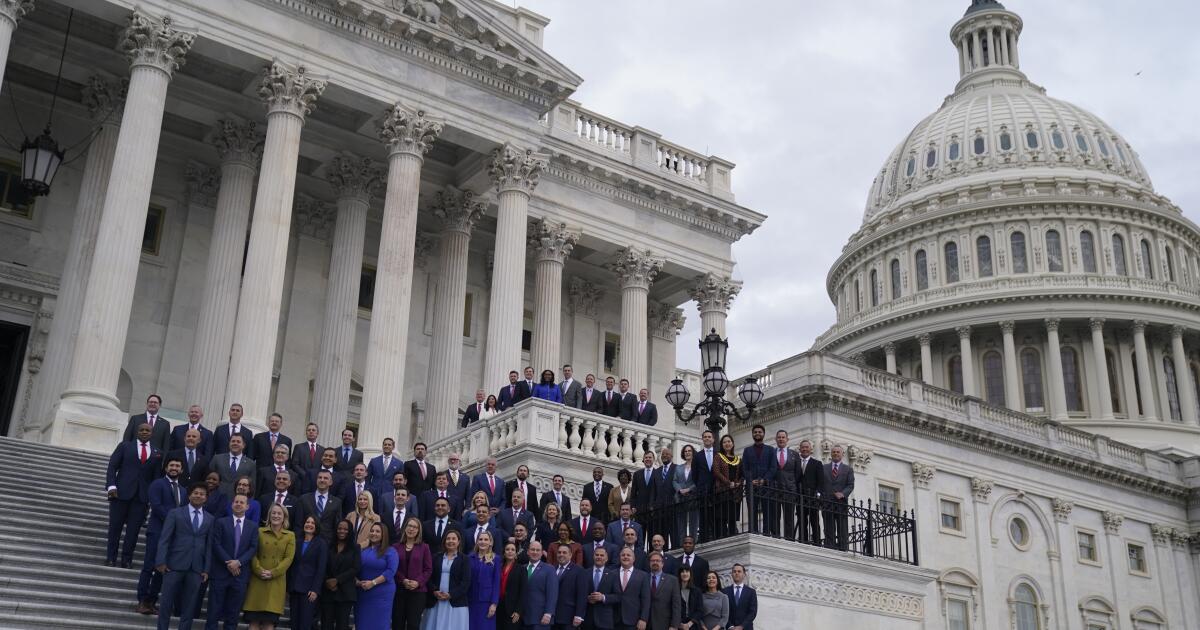
The air was muggy, and the afternoon sun baked the streets of the nation’s capital. But when I visited last month, I made a point to walk the two miles from my hotel to the U.S. Capitol instead of taking an Uber, so I could see it in all its glory.
I didn’t have much time for sightseeing, but a pilgrimage to the seat of American government was a must. Since Jan. 6, 2021, when a mob of thousands stormed it to try to stop the electoral vote count that would officially make Joe Biden president, the symbol of our democracy has stood as a reminder of how tenuous it is.
Before that wannabe coup, the U.S. Capitol was an abstraction for me, a series of images — that stunning dome, those imposing columns, but especially the magnificent steps — where a bunch of politicians passed laws but mostly grandstanded. Hell, I didn’t even know there was a front and back entrance until I approached from Pennsylvania Avenue. I had been to D.C. before but hit the Lincoln Memorial, the Washington Monument and a few other landmarks, not the Capitol.
It’s huge! The white building gleams like a promontory of power, with trees from across the U.S. spread across the grounds below. Its magnetism was such that I paid no attention to the Reflecting Pool, the Ulysses S. Grant Memorial or the Peace Monument below it.
What broke the spell was the people around me.
Filipino men in barongs and Muslim women in hijabs. Argentines joking around in lilting Spanish and Australians with their distinctive garrulous accent. I’m not sure if they were foreign tourists or immigrants, but it was easy to distinguish them from the locals, who rushed toward the rest of their day uninterested in the splendor the rest of us basked in. We lookie-loos used the Capitol as the backdrop for group photos and selfies, paying little attention to the barricades and police officers blocking us from ascending the steps of the West End.
That scene is on my mind on the 248th birthday of this country, especially after the horror show that was last week’s presidential debate between Biden and the man the insurrectionists wanted to keep in office, Donald Trump. All anyone talked about in the immediate aftermath was Biden’s performance, with some, including Democrats, deriding it as akin to the Crypt Keeper from “Tales from the Crypt.”
Biden was no silver-tongued Socrates — but he never has been, and the commander in chief improved as the night went along. Besides, I’ll take his fuddy-duddiness over the dictatorial doom-and-gloom and lies Trump offered that night.
But Biden broke my heart, because he stayed mostly silent while Trump lambasted immigrants as the gravest threat this nation has ever faced. The convicted felon barely bothered to distinguish legal from illegal immigrants. He claimed Biden “open[ed] up our country to people that are from prisons, people that are from mental institutions, insane asylums, terrorists,” going on to mention “mental institutions” two more times, as if mentally ill people are subhuman. He described the U.S.-Mexico border as “the worst … in the history of the world” and “the most dangerous place anywhere in the world,” which will come as news to residents of Gaza and those on the front lines of the Ukraine war.
When we needed someone to stand up for our nation’s newcomers, to brag about how this country remains a beacon for the tired and poor huddled masses of the world instead of the “failing nation” Trump thinks we are (a point he repeated five times), Biden instead insisted he was far better at cracking down on illegal immigration than Trump made him out to be.
Trump’s most damning line of the night — “I really don’t know what he [Biden] said at the end of that sentence. I don’t think he knows what he said either” — was in response to the president mumbling his way through a boast about increasing the number of Border Patrol agents and making it harder to claim asylum.
If Biden won’t stand up to xenophobic bull spouted by a bully, who will?
Supporters of then-President Trump try to break through a police barrier on Jan. 6, 2021, at the Capitol in Washington.
(Julio Cortez / Associated Press)
I’ve lived my life hearing that unchecked immigration, legal or not, will ruin the United States. I’ve never seen this apocalypse come. Nah, it’s been mostly native-born white Americans who keep whining that we’re no longer great, yet do little to make things better, other than moving to Tennessee or Idaho. It’s immigrants and their descendants who have kept the embers of the American way from dying by emphasizing hard work, community and personal responsibility.
Newcomers who want to better their lives are who we should celebrate on the Fourth of July. Yet multiple polls show that a majority of Americans — even Latinos — feel our borders are under assault. The temperature around immigration is even nastier than during the days of Prop. 187, the ballot initiative that California voters passed 30 years ago in an attempt to make life miserable for undocumented immigrants. Back then, people banded together to fight back. Now? Few seem to care.
The weight of it hit me as I walked around the Capitol to see its official entrance, where the insurrectionists invaded on Jan. 6. The sun was setting right behind the dome, casting a long, frigid shadow even on a hot day. Police were everywhere. Metal barricades blocked people from climbing the steps that led to the House of Representatives and the Senate chambers, and the Rotunda. A few tourists lingered alongside me but quickly left.
I approached an unfenced area, and a police officer politely but firmly told me to move on. It felt like a crime scene — and the victims are us.
Both sides of the political aisle claim it’s now evening in America, but I’ll forever remain an optimist. What else can I do? This country exceeded the expectations of my Mexican immigrant parents, and mine. It’s nowhere near perfect, but that’s what makes it so great — the United States belongs to those who work it, those who hope.
The day after my Capitol visit, I walked past the tourist entrance to the White House. The free public tours didn’t start until 9:30 in the morning, but the line to enter wound up and down the gate two hours before. Men in turbans stood next to college students wearing University of Wisconsin T-shirts. English and Spanish and Mandarin filled the air.
The American flags some people sported on their hats or as jewelry didn’t come off as a political statement but rather a symbol of communion. The guards who stood sentry were jovial. There were no complaints, nothing but excitement at the shared joy of what they were about to see.
That is the America I celebrate this Fourth of July — and pray that remains, come election day.


President Trump, a former real estate mogul who knows a few things about construction projects, says there is “no harder zoning thing to get” than a helipad. But he is building one at the White House, and building it fast.
Such projects usually require a developer to navigate a complex web of zoning laws, airspace regulations and environmental impact studies, while negotiating with town councils and fighting off community pushback. Construction at the White House can often face additional hurdles.
But Mr. Trump has encountered no such difficulties as he quickly proceeds with construction of a black granite helipad on the South Lawn. He has not asked Congress or any review panel, such as the Commission of Fine Arts, to approve the project.
Past presidents have involved Congress and review panels in changes to the White House grounds, though Mr. Trump has asserted that he has the right to undertake major construction projects, such as a new 90,000-square-foot ballroom, without congressional approval. That project is currently the subject of litigation.
A White House spokesman said in an email that “operational upgrades to the White House grounds, such as the helipad installation, do not require commission reviews.”
Work on the helipad — which will be 100 feet in diameter and feature a presidential seal — started last month, shortly after a makeshift stadium built to host an Ultimate Fighting Championship fight significantly damaged the South Lawn.
Dana White, the U.F.C. president, said that his organization had set aside $700,000 to repair the lawn after the June 14 event. But Mr. Trump instead decided to forge ahead immediately with a helipad he had long wanted.
Why Trump is building a helipad
The helipad would allow Mr. Trump to use the latest generation of Sikorsky helicopters as Marine One on White House grounds — a move multiple administrations had avoided because the new, more powerful helicopters were likely to damage the South Lawn during landing.
The Navy began the search in 2010 for helicopters to replace the two models that have been used to transport the president and vice president for more than four decades — the VH-3D and the VH-60N. It purchased 23 VH-92A helicopters, including two test aircraft, at about $215 million apiece, with a total cost estimated at $5 billion, according to the Government Accountability Office.
The new helicopters are produced by Sikorsky, a subsidiary of Lockheed Martin, which is building the helipad as a donation. They joined the fleet between 2014 and 2021 and underwent a period of testing. The new generation of helicopters has occasionally been known to scorch the grass with engine exhaust while landing — an issue found during a training session in September 2018.
President Joseph R. Biden Jr. was the first president to fly on a VH-92A, on his way to the Democratic National Convention in Chicago in August 2024. But no new helicopter has yet transported a president to and from the South Lawn.
Marine One landed on the South Lawn grass for decades, and portable aluminum pads were rolled out to catch the wheels.
Mr. Trump said the new helicopters were “more powerful than the old ones. And when you land on the grass, it’s not that the grass gets discolored, it gets ripped out.”
The VH-92A has two engines with more than three times the capacity of those of the VH-3D, the current Marine One model, pushing more heat to the ground.
Lockheed Martin, a major defense contractor, is paying for the helipad project, which Mr. Trump estimated would cost between $5 million and $6 million.
“They didn’t tell us how powerful these helicopters were, and they felt a little bit guilty,” Mr. Trump said.
According to a spokesperson for Lockheed Martin, the company has a “long history of supporting projects in both the Washington, D.C., area and across the country. This specific contribution was made to the National Park Service. Our engagement with the federal government is guided by rigorous ethics and compliance standards and conducted in full accordance with all applicable laws and regulations.”
More red tape for a Mar-a-Lago helipad
Mr. Trump is also trying to build a helipad at his Mar-a-Lago resort in Palm Beach, Fla. But that project is moving much more slowly than the one at the White House.
The Mar-a-Lago project has been the subject of local historic preservation commission review, multiple public hearings, negotiations with town lawyers and votes by the Town Council.
Because Mar-a-Lago is a historic property, any changes there must be approved by the Palm Beach Landmarks Preservation Commission, said Joanne O’Connor, the town attorney for Palm Beach.
Mr. Trump had installed a helipad at the resort during his first administration, but it was dismantled after he left office.
The town is allowing Mr. Trump to build a new helipad at Mar-a-Lago but has placed limits on its use after his presidency. Any helicopter trips to or from Mar-a-Lago after he leaves office can be carried out only if approved by the Secret Service and in the event of an emergency, Ms. O’Connor said. The helipad cannot be used, for instance, to facilitate a golf outing.
“The concern was balancing the health, safety and welfare of the president with the interests of the town residents and the quiet enjoyment of their residential property,” Ms. O’Connor said.
No such review is taking place for the changes Mr. Trump is making at the White House.
Mr. Trump spoke recently about the difficulty most people encounter when trying to have helipads approved at their properties.
“I always was lucky, I always got helipads,” he said in remarks from the Oval Office. “Other people don’t. Very hard to get. The hardest thing to get is a helipad, OK?”
The South Lawn’s future
The helipad would significantly reshape the South Lawn, which has historically hosted events and ceremonies, including the annual White House Easter Egg Roll.
A White House official said events on the South Lawn would not be affected by the new helipad and would continue as usual.
“It can be used for other things when helicopters aren’t landing,” Mr. Trump said this month. “You can have other things out there like events. You could have news conferences literally on it because it’s the right size. So by doing this, we solved the problem, and we’ll be able to finally retire 45-year-old helicopters.”
Previous administrations have prioritized preservation of the White House property over permanent changes to the South Lawn. During the Biden administration, building a helipad was not high on the president’s priority list, said Andrew Bates, who served as a White House spokesman.

NEWYou can now listen to Fox News articles!
Acting Attorney General Todd Blanche came out swinging against Sen. Adam Schiff on Wednesday, denying allegations of self-dealing and intentional refusal-to-recuse in President Donald Trump’s cases, while accusing the California Democrat of lying.
Schiff sparred with Blanche over several legal matters he said prove the nominee is unfit for the job of America’s top law enforcement officer, citing what he described as serious conflicts of interest. Blanche denied the allegations while telling Schiff he was misstating ethics rules and botching key timelines.
Schiff pressed Blanche on whether he met with Justice Department ethics lawyers about his prior representation of Trump in the Stormy Daniels, Mar-a-Lago classified documents, and Jan. 6 cases.
TRUMP’S AG NOMINEE RACKS UP MASSIVE SUPPORT AHEAD OF CONFIRMATION HEARING: ‘REAL RESULTS’
Sen. Adam Schiff, left, and acting Attorney General Todd Blanche. (Al Drago/Getty Images; Eric Lee/Getty Images)
Blanche affirmed and said he has recused himself from future litigation or Justice Department business involving any of those suits. But Schiff countered that Blanche reportedly told a crowd at the Conservative Political Action Conference (CPAC) that there was no conflict of interest in the Justice Department firing prosecutors linked to Jan. 6 or other cases.
Blanche soon fired back when Schiff criticized him for moving to vacate Jan. 6-related convictions for 12 members of far-right groups.
“I was the acting attorney general – so yes, my department moved to dismiss,” he said, adding that there was no reason for him to recuse himself when Schiff pressed him further.
BIDEN SPECIAL COUNSEL’S ‘RUNAWAY TRAIN’ SCOOPED UP SENSITIVE LAWMAKER INFO: ‘ABUSE OF POWER’
“From the Proud Boys matter?” Blanche responded with a puzzled look.
“You’re a lawyer, you know the rules,” Blanche told the Massachusetts-born graduate of Harvard Law.
OBAMA JUDGE HANDS PROGRESSIVES A WIN OVER ANTI-TRUMP ’86 47′ MESSAGE AMID RISING THREATS
“There are rules that say when I have to recuse and that’s not one of them,” Blanche said.
“There are rules,” Schiff agreed. “And when you’re told to recuse yourself from investigations that you handle for the president…” – “I always do,” Blanche cut in – “you’re supposed to recuse yourself,” Schiff finished.
Schiff noted that the second volume of special counsel Jack Smith’s report on Trump has not been released and said the Justice Department has opposed making it available.
Blanche denied having anything to do with the decision and pointed out it is not the Justice Department, but a federal judge in Miami, that has prohibited its release.
“If you went into court asking them to release it, it would be released by now,” Schiff argued.
Blanche shot back: “What you’re saying happens not to be true – I did not do that.”
“You can’t accuse me of violating my ethical rules and then lie about what I did,” he continued,
Schiff asked Blanche at length what allegedly evolved in his professional life that led him to be under such criticisms.
“What I don’t understand, Todd Blanche, is what happened to the Todd Blanche who was a prosecutor in the Southern District of New York? What happened to the prosecutor people had respect for,” he said.
“What happened to the prosecutor who said that there wouldn’t be a whiff of political partisanship and then prosecutes the president’s enemies over seashells cases, over making a video stating the plain law in the Constitution?” Schiff said – appearing to reference investigations into former FBI Director Jim Comey’s “8647” post that critics said amounted to a threat on Trump’s life.
“I think Robert Caro had it right when he said that power doesn’t corrupt as much as it reveals. I suspect it has just revealed who you are and who you are as someone willing to sacrifice everything you once believed in for that title, for that position of attorney general,” Schiff claimed.
“I am still here. I am the same exact person I was when I was a federal prosecutor in the SDNY,” Blanche replied.
The exchange led to further criticism of Schiff, including from the Trump-appointed prosecutor in his home region:
SIGN UP TO GET THE POLITICS NEWSLETTER
“Facts are not Senator Schiff’s strong suit,” claimed First Assistant U.S. Attorney for Central California Bill Essayli.
CLICK HERE TO DOWNLOAD THE FOX NEWS APP
Former Alabama federal prosecutor Jay Town called the exchange “excellent.”
“What [Blanche] is essentially saying is that the Justice Department has gone back to the fundamentals of increasing prosecutions and lowering crime nationwide, unlike the Garland DOJ targeting parents, Catholics, etc.”
Fox News Digital reached out to Schiff for comment.

WASHINGTON — President Trump appeared poised to question the security of U.S. elections with a planned prime-time speech Thursday night, eliciting fears from Democrats and voting rights advocates that he is planning yet another play for federal control over voting in November’s midterms.
The exact reason for the speech has not been disclosed by the White House, with Trump only characterizing it to reporters this week as “really, really big news.” He confirmed it would have to do with “free and fair elections.”
The Washington Post reported, citing sources, that Trump planned to argue that there are vulnerabilities in the nation’s election infrastructure and claim that China had accessed U.S. voter data. The White House declined to confirm any such details Wednesday.
The announcement of the speech set off concerns among the president’s political opponents, as well as elections experts and voting rights advocates, that Trump could again escalate claims that the nation’s voting system is vulnerable to domestic fraud and foreign attacks.
He has previously said that Republicans should “nationalize” election administration, a job that falls to the states under the Constitution, and has pressured his party to tighten federal voting rules.
“We don’t know anything about what he might say … or what he might try to do with his very limited powers, as the president, over elections,” said David Becker, executive director of the nonpartisan Center for Election Innovation and Research. “I expect we’re going to hear a lot of rehashed and debunked claims.”
The president could potentially use new claims to argue that the nation is facing an emergency in upcoming elections that necessitates further federal intervention into voting, Rep. Joseph Morelle of New York, the ranking Democrat on the House Administration Committee, which has oversight of elections, said in an interview with The Times.
“This is going to be the rationale for declaring a national emergency,” Morelle said. “It’s transparent that he is creating the emergency and he’s creating the evidence out of whole cloth to suggest there is an emergency.”
Sen. Alex Padilla (D-Calif.), the top Democrat on the Senate Rules Committee, which oversees federal elections, told The Times on Wednesday that Trump was using a known playbook to “[sow] doubt about the outcome before a single vote has been cast.”
“All signs show that tomorrow’s speech will be more of the same: debunked conspiracy theories offered up not because they’re true, but because chaos and doubt are the only cards he has left to play,” Padilla said.
The speech, which Trump announced on social media Monday, comes four months ahead of midterm elections that will determine whether his party retains legislative control in Washington.
White House spokesperson Karoline Leavitt dismissed news reports about what Trump might say in the 6 p.m. PDT speech as speculation, and said “nobody knows yet what President Trump will ultimately say.”
The address also comes as Trump’s ceasefire with Iran has fallen apart, renewing expectations for increased gas prices, and his approval rating on the economy has steadily dropped. On Tuesday, it also became public that Trump had paid $5.6 million to the writer E. Jean Carroll, as ordered by a jury that in 2023 found Trump liable for sexually abusing and defaming her.
“What we’re going to be talking about Thursday is, it doesn’t get bigger,” Trump told reporters who asked Tuesday about the speech. “Because without free and fair elections you don’t have a country.”
Trump has spread baseless claims of widespread election fraud for years. But his prioritization of his claims about the voting system — even as much of the nation’s attention is on cost-of-living issues — has been on particularly clear display in recent days.
He has aggressively lobbied reluctant Republican senators to pass his voter ID legislation, refusing to sign a bipartisan housing bill over it; he fired all remaining members of the bipartisan U.S. Elections Assistance Commission; and his Justice Department said it would send election monitors to six states.
Since the midterm primaries began, Trump has also sown doubt about election security — chiefly in California, where he suggested Democrats had cheated or attempted to in the gubernatorial and Los Angeles mayoral primaries.
Georgia Democratic Sen. Jon Ossoff, whose state was often at the center of Trump’s 2020 fraud claims, said the president’s speech posed a threat to voting rights.
“I expect him to use whatever he puts out there on Thursday as a pretext, either for some attempted unconstitutional use of federal power to interfere in the election,” Ossoff said Tuesday on MS Now, “or to give his proxies and loyalists in state and local jurisdictions some cover for whatever they might attempt, or to lay the groundwork for challenging the result.”
Any effort to federalize or take over elections would face serious legal obstacles, said Nahal Kazemi, a Chapman University law professor. Although Congress can pass laws regarding election administration, as it did with the Voting Rights Act, the executive branch doesn’t play a role in running elections.
“You run into essentially a brick wall that is the Constitution, which makes very plain that states run elections,” Kazemi said.
When it comes to concerns about foreign interference, experts say there is little evidence of other countries attempting to hack systems or change votes. Instead, foreign actors have largely operated via disinformation campaigns, as the U.S. determined had occurred in the 2016 and 2020 elections.
“Of the information that is available to us now, there’s no reason to be alarmed about the possibility that a foreign adversary is going to take over election systems,” said Kazemi, who has studied foreign election interference.
One of the things that helps make American elections generally secure, she said, is that they are not centralized but are run by thousands of counties. Hacking into so many voting systems would be extraordinarily difficult for a foreign adversary, she said.
Jenny Farrell, executive director of the League of Women Voters of California, said California “takes elections security extremely seriously” and has one of the most secure systems in the country, subject to strict voter verification measures and intense chain of custody and auditing procedures.
Democrats have worked with elections experts in recent months on attempts to assure the public that U.S. elections are safe and secure. They have also tried to counter claims by Trump that mail ballots and voting machines are unreliable.
A slew of 2020 election reviews, including by Trump’s first administration, concluded that Trump lost and Biden won. Election experts say there is no evidence that widespread fraud determined the outcome of the election.
A judge also found that claims pushed by Trump and his attorneys that the company Dominion Voting Systems manipulated votes cast through its machines in favor of Biden were untrue.
-
/https://tf-cmsv2-smithsonianmag-media.s3.amazonaws.com/filer_public/7f/38/7f38918b-31e3-42f8-942d-06eedb65924d/figure-4.jpg?w=400&resize=400,240&ssl=1 "This Meteorite Crashed Into a New Jersey Home in 2024. Now, Scientists Say It Contains Some of the Building Blocks of Life")
/https://tf-cmsv2-smithsonianmag-media.s3.amazonaws.com/filer_public/7f/38/7f38918b-31e3-42f8-942d-06eedb65924d/figure-4.jpg?w=80&resize=80,80&ssl=1 "This Meteorite Crashed Into a New Jersey Home in 2024. Now, Scientists Say It Contains Some of the Building Blocks of Life") New Jersey6 minutes ago
New Jersey6 minutes agoThis Meteorite Crashed Into a New Jersey Home in 2024. Now, Scientists Say It Contains Some of the Building Blocks of Life
-

 New Mexico12 minutes ago
Think New Mexico Hosts Four 2026 Summer Leadership Interns To Assist In Researching And Developing Policy Proposals – Los Alamos Daily Post
-

 North Carolina18 minutes ago
Gunman killed after opening fire outside North Carolina gay bar
-

 North Dakota24 minutes ago
Vernon Krause
-

 Ohio30 minutes ago
Man pleads guilty to inappropriate conduct with minor in Howland
-

 Oklahoma36 minutes ago
Local Star Goose Hutchens Reclassifies, Will Join Oklahoma for 2027 Season
-

 Oregon42 minutes ago
Meet Miss Oregon at the Ross Ragland Theater Next Month – KOBI-TV NBC5 / KOTI-TV NBC2
-

 Pennsylvania48 minutes ago
Wildfire smoke puts Pittsburgh under Code Red air quality alert

