Sports
Gregg Berhalter rebuilt the USMNT. Will he be the one to lead them in 2026?


When Gregg Berhalter took over as U.S. men’s national team head coach five and a half years ago, the program was still fighting to emerge from the darkest moment in its history.
The 2017 loss to Trinidad and Tobago that meant the U.S. failed to qualify for the following year’s World Cup in Russia was more than a wake-up call. It forced leadership at U.S. Soccer to examine every blemish in the mirror. It highlighted the failures of previous cycles to develop young talent. A year after that game, Berhalter was put in place to move the national team forward.
Now, after an unsuccessful group stage at Copa America on home soil, the U.S. program must once again face its failures.
This time, part of that evaluation is whether Berhalter is the right person to lead the program into the 2026 World Cup, which the United States co-hosts with neighbors Canada and Mexico.
If it’s up to Berhalter, the answer is simply, “Yes.” The coach only had one word to share when asked after the loss to Uruguay on Monday that sent his team out of Copa America after the group stage if he believed he was still the right person for the job. He also acknowledged that the decision would not be up to him. U.S. Soccer leadership will evaluate Berhalter over the coming days.
GO DEEPER
Inside the VAR review of Uruguay’s winning goal against the USMNT
“Our tournament performance fell short of our expectations. We must do better,” U.S. Soccer sporting director Matt Crocker wrote in a statement provided by the federation 90 minutes after the Uruguay game ended. “We will be conducting a comprehensive review of our performance in Copa America and how best to improve the team and results as we look towards the 2026 World Cup.”

The U.S. lost to Panama and Uruguay during the Copa America group stage. (Photo by Hector Vivas/Getty Images)
Berhalter’s task when he was hired was not a simple one, nor was it one that involved linear progress.
His first U.S. teams were a mix of the old and the new, trying to find a blend between experience and pure, stark youth. His first tournament call-ups in the summer of 2019 included Weston McKennie, Tyler Adams and Christian Pulisic, all of whom had yet to play in a Gold Cup, as well as Jozy Altidore and Michael Bradley, who both had more than 100 caps. Berhalter next called up a competitive roster for the 2021 Nations League. The team’s progress under his direction was evident.
The roster was built mostly around youth, with players such as Sergino Dest (then with seven caps), Antonee Robinson (10), Adams (12), McKennie (21), Yunus Musah, Brenden Aaronson (both four), Pulisic (15), Gio Reyna (also four), Josh Sargent (13) and Tim Weah (10).
The U.S. went on to win that tournament, picking up its first signature win over Mexico in the process. It was the first of three consecutive Nations League titles, and Berhalter continued adding new, young faces into the program.
He successfully navigated 2022 World Cup qualifying with one of the youngest teams in international soccer. And while getting back to the World Cup was an imperfect path — the U.S. finished third in CONCACAF qualifying — getting to the tournament in Qatar allowed the program to close the door on that 2018 failure. Berhalter’s young team then impressed in the World Cup, performing well in the group phase before bowing out to the Netherlands in the first knockout round.

Berhalter helped the U.S. return to the World Cup in 2022 after the team failed to qualify in 2018 (Photo by Tim Nwachukwu/Getty Images)
The idea behind the entire process was to build toward that home World Cup in 2026.
Berhalter did a good job in the first cycle with this team, but the past year has felt far more halting. U.S. Soccer leaders must now determine whether the coach who engineered the transition from 2018 to 2022 is the right person to continue building toward that 2026 tournament.

GO DEEPER
How Uruguay’s masterly man-marking shut the USMNT out of the Copa America
Crocker has said “yes” to that question once already, when he and U.S. Soccer’s leadership team, including president Cindy Parlow Cone and CEO and secretary general JT Batson, brought Berhalter back last summer. But the USMNT’s failure to get out of its Copa America group has caused yet another referendum on the program.
Taken in isolation, it would be harsh to put all of the blame for this failure on Berhalter and the coaching staff. Weah’s first-half red card undoubtedly impacted the Panama result, which altered the path to the knockout rounds. But the results as a whole over the past year suggest stagnation more than progress. Berhalter’s teams still lack a signature win over a top opponent. These last 12 months have seen losses to Germany and Colombia, the latter by an embarrassing 5-1 scoreline. A draw against Brazil was a positive, but it was followed within weeks by this Copa America exit.
The failure to get out of the group was a massive missed opportunity on multiple levels, from the growth of the team to the potential impact on growing the sport in the U.S. in a summer of soccer that can capture new fans and build toward 2026.
Berhalter is a process-oriented coach, precisely attuned to the details of his program. His grinding work ethic is well-known to anyone who has been around the team over these five and a half years. For Berhalter, what happened in the Copa America was a setback.
“We know we’re capable of more, and in this tournament, we didn’t show it,” Berhalter said. “It’s really as simple as that.” But, much as he has done throughout his tenure, Berhalter also framed it as a moment from which to take lessons and build.
“When you’re in tournament football, there’s very little that separates success from failure,” Berhalter said. “It’s one action, it’s one decision from the referee, and you could be in trouble. For us, it’s having this understanding that every time we step on the field, it has an impact. And I think we’re getting there, but we’re not always there. And that’s something that we can improve.”

Players credit Berhlater for creating the group’s close bond. (Photo by Michael Reaves/Getty Images)
After Monday’s loss at Kansas City’s Arrowhead Stadium, players in the mixed zone backed Berhalter with some of the same ideas they discussed during the job’s most recent hiring process. The culture of the team, which they have largely credited to Berhalter, remained a strength in the group. There was a trust in one another, they said.
“I believe we all have a comfort with Gregg, and we all understand him and we’ve had him for a long time,” McKennie said in the mixed zone. “He’s progressed the team very far from where we started. I think the connection that we have with him is what’s important, in having a coach players would run through a brick wall for, players that listen to him. And so I think whatever happens, happens, but I think if he’s the coach, we’re all happy.”
Only now, U.S. Soccer must weigh whether that comfort is a strength or, potentially, a weakness.
Is that comfort level within the group under Berhalter preventing them from pushing on? Are the red cards — specifically Weah’s and defender Dest’s in a Nations League game in Trinidad last November — signs of too much leeway? Is a group filled with young players too accustomed to discussion around their team as a ‘golden generation’ growing complacent?
The results at the Copa, one win and two defeats, and over the past year, should at least challenge the way this team is discussed.
Yes, the group is filled with players who are playing across Europe, including a handful who are at some of the biggest clubs in the world. And yes, it was still the second-youngest team across both the Copa America and European Championship, going on in parallel in Germany this summer. But their roles for those clubs vary.
Few are asked to carry their team, and compared to the world’s best international sides, arguably outside of Pulisic, the U.S. still lacks bonafide stars, the difference-makers that can turn games on their head at the highest levels. That has manifested itself with a team that has struggled to create enough goals, both in Qatar and this summer.
This U.S. team has talent, but in the grand scheme of global soccer, it remains an upstart trying to challenge the very best. The team cannot afford to believe it has arrived. It’s an idea that veteran center-back Tim Ream seemed to hint at in the mixed zone after the Uruguay game.
“This is a fantastic group, as everyone knows and one that is very close, but sometimes the intensity falls through the cracks,” Ream told Univision. “We have to continue to put our heads down and continue to work, continue to be humble enough to know there are things we can continue to improve, every single day, every single training session, every single game.
“If guys have that mindset, then they can continue to be on an upward trajectory. When we start to think that we are a finished product, then guys are going to stagnate and just stay at the level they are at.”
Some of that should fall on the players, of course. That was most certainly a theme from the team after Monday’s defeat. “I don’t think this tournament really had anything to do with the staff or the tactics or the way we play,” Reyna said. “I think it was more individual mistakes.”
But some of it also falls on Berhalter and the staff.
If the leaders at U.S. Soccer feel this team must be challenged to get to the next level, there are legitimate questions as to whether the culture in the program right now is set up to do that, and if it is, whether Berhalter is the person to do it.
“I don’t think so. I don’t think we’ve progressed enough since the World Cup,” USMNT legend Clint Dempsey said on Fox on Monday night, when asked if Berhalter is still the right voice to lead the program. “We’re not on the right track. … For me, it hasn’t been good enough.”
As for the next steps, there are many factors beyond just on-field performance U.S. Soccer will consider. The federation likely is aware of the discourse around Berhalter and the national team, in which a growing sector of fans has trained its focus on the coach as the problem. “Berhalter out” has been a rallying cry on social media, ubiquitous in any discussion or debate around the team.
The biggest question, though, is who they would look to if they were to replace Berhalter.
There aren’t obvious candidates for the position.
One finalist from the last hiring cycle, Jesse Marsch, only recently took the Canada job. Notably, Canada advanced to the knockout stage of the Copa America, albeit with just one goal in the three group games. Some of the big-name candidates that fans would hope to see cost many multiples of the salary U.S. Soccer currently pays Berhalter, and that doesn’t even begin to account for whether those names would even want the gig.
The decision U.S. Soccer makes in the coming days, and, if it chooses to move on from Berhalter, the weeks that follow, will have a massive impact on what happens in two years when the World Cup comes back to these shores. The disappointment of a similar result in that tournament would dwarf this current failure.
Considering the stakes and the expectations, the USMNT job feels bigger than even the monumental task of climbing out of that failure in Trinidad nearly seven years ago.
GO DEEPER
USMNT’s Copa America exit raises major questions. But is Pulisic the one to answer them?
(Top photo: Julio Aguilar/Getty Images)




NEWYou can now listen to Fox News articles!
All Elite Wrestling (AEW) star Kenny Omega blasted a social media user over a remark made about Will Ospreay and Charlie Kirk.
The X user made a critique about Ospreay’s mic skills on Thursday, writing, “Will Ospreay is as bad on the mic as charlie kirk, but can’t sell the neck as well as he did.”
COMPLETE PRO WRESTLING COVERAGE ON FOX NEWS DIGITAL
Kenny Omega enters the ring during the New Japan Pro-Wrestling Wrestle Dynasty event at Tokyo Dome in Tokyo, Japan, on Jan. 5, 2025. (Etsuo Hara/Getty Images)
Omega, who is friends with Ospreay inside and outside the ring, slammed the poster.
“What the f— is wrong with you? It isn’t hard to try having some class,” he wrote in response.
“A dear friend battles back from a career threatening injury, is no doubt still fighting pain today, and is somehow mocked and compared to a dude that was murdered. I get that a joke is a joke but these things should really be kept separate in my opinion.”
Kenny Omega looks on after the tag match during the Power Struggle – Super Jr. Tag League 2018 at Edion Arena Osaka on November 03, 2018 in Osaka, Japan. (Etsuo Hara/Getty Images)
When one X user came to the defense of the commenter, Omega responded once more.
“Please extend my apologies, genuinely. Perhaps I’ve become too sensitive after my own brush with death. I also know of Will’s efforts behind the scenes more than most so it was sad to see such a harsh comparison,” the current AEW champion added.
Kirk, a conservative commentator and the founder of Turning Point USA, was shot and killed during an event on the campus of Utah Valley University in September. Tyler Robinson was arrested in Kirk’s murder.
Turning Point USA founder Charlie Kirk spoke during his “American Comeback Tour” at Utah Valley University on Sept. 10, 2025, in Orem, Utah. Kirk was fatally shot while appearing at the event. (Trent Nelson/The Salt Lake Tribune/Getty Images)
CLICK HERE TO DOWNLOAD THE FOX NEWS APP
Robinson’s trial is currently ongoing.

The final weekend of the 2026 FIFA World Cup is here, with France and England playing for third place on Saturday before defending champion Argentina takes on 2010 winner Spain for the title on Sunday.
Here’s everything you need to know about the last two matches of the 39-day, 48-team tournament in North America (all times Pacific).

Saturday’s third-place game
France vs. England
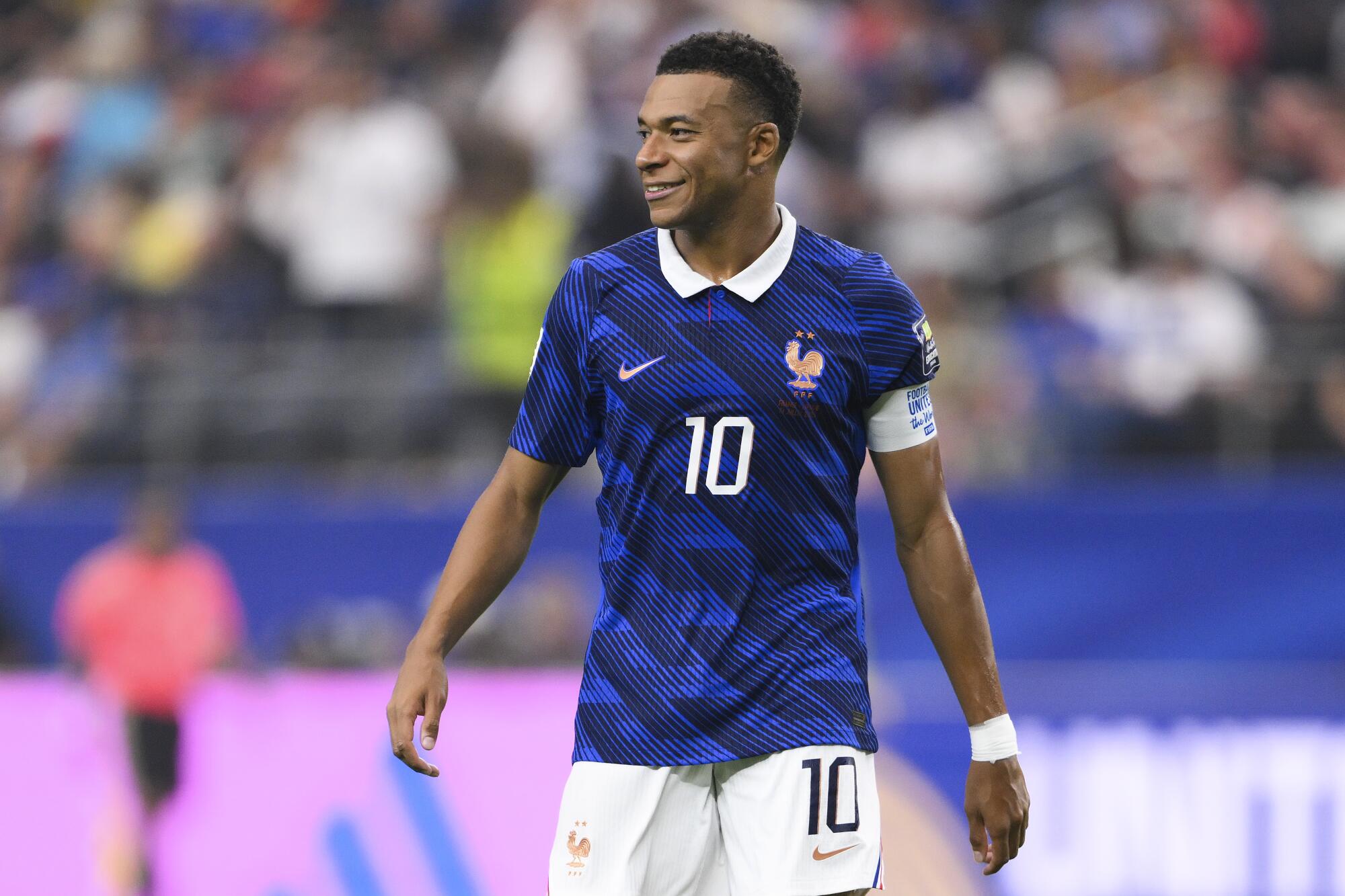
France star Kylian Mbappé smiles during a World Cup semifinal match against Spain on Tuesday.
(David Ramos / Getty Images)
Where: Hard Rock Stadium, Miami Gardens, Fla.
Time: 2 p.m.
TV: Fox, Telemundo | Streaming: Fox One, Peacock
The buzz: This is a game neither team really wants to play. The disappointment of missing the final is fresh and the weather report calls for temperatures in the high 80s with 68% humidity and a chance of thundershowers — a brutal South Florida summer day. The $2-million difference in prize money between third and fourth place isn’t likely to make any of that more palatable. Still, the game will have meaning for France since it will be the final match for coach Didier Deschamps, the winningest World Cup manager in history. And captain Kylian Mbappé, tied with Argentina’s Lionel Messi for most goals in the tournament (8), has a chance to become the first player to win consecutive Golden Boots. England is playing in the consolation final for the second time in three World Cups; it lost to Belgium 2-1 in 2018. But this one will probably sting even more since the Three Lions were five minutes away from their first final in six decades before collapsing against Argentina. This could be the last World Cup game for England’s Golden Generation of Harry Kane, Jordan Pickford, John Stones and Jordan Henderson.
Sunday’s championship game
Spain vs. Argentina

Argentina star Lionel Messi celebrates after a win over England in the World Cup semifinals on Wednesday.
(Buda Mendes / Getty Images)
Where: MetLife Stadium, East Rutherford, N.J.
Time: Noon
TV: Fox, Telemundo | Streaming: Fox One, Peacock
The buzz: Argentina has a chance to become the first repeat World Cup champion since Brazil in 1962, which would give Messi another grand achievement in his sixth and likely final World Cup. Messi enters the weekend as the all-time leader in goals, assists and games played in tournament history. But unbeaten Argentina hasn’t made things easy, with its winning goals in the four knockout-round games coming in the 92nd minute or later. Spain, the reigning European champion, will be playing to put a second star on its jersey to match the one it won in 2010. La Roja, with the sixth-youngest roster in the World Cup, got to the final on the strength of spectacular defense led by Unai Simón, who has six clean sheets in seven games. Mikel Oyarzabal is the team’s leading scorer with five World Cup goals. The teams had one common opponent in this tournament, tiny Cape Verde, a World Cup debutante. It played Spain to a scoreless draw in its opener, then held Argentina to a 1-1 standoff into extra time before falling.


NEWYou can now listen to Fox News articles!
One of the most memorable moments of the 2026 Winter Olympics came early, when skier Lindsey Vonn delivered a gutsy performance for the ages by competing at 41 just a week after injuring her knee in a crash.
Unfortunately, as admirable as her perseverance was, she injured herself badly in another crash just 13 seconds into her run in the women’s downhill final.
Five months later, Vonn is still very much dealing with her injuries.
MARCELLO HERNÁNDEZ ROASTS JAKE PAUL, TIGER WOODS AND BILL BELICHICK IN ESPYS MONOLOGUE
Lindsey Vonn speaks on stage during the 2026 ESPYs. (Mike Coppola/Getty Images)
“It’s been a very slow process,” Vonn told People while attending the ESPYs Wednesday in New York City. “It’s been five months since I’ve been able to actually go to the gym in a somewhat meaningful way. And walking is actually still really hard for me. My ankle is still broken.”
Regardless of the outcome, her decision to attempt that run remains one of the most courageous moments of the Games.
Lindsey Vonn was involved in a serious crash during the women’s downhill event at the 2026 Winter Olympics. (Screengrab by IOC via Getty Images)
ZERO BS. JUST DAKICH. TAKE THE DON’T @ ME PODCAST ON THE ROAD. DOWNLOAD NOW!
Remember when I mentioned that injury before the Olympics? That wasn’t just a minor bump in the road; it was a completely ruptured ACL.
There was no questioning her courage, but the aftermath has been difficult.
Lindsey Vonn walks through pit lane ahead of the 2026 Monaco Grand Prix. (Beata Zawrzel/NurPhoto)
“I was in a wheelchair for so long. I was on crutches for so long,” Vonn said. “It was honestly almost 3½ months that I was unable to walk unassisted. I got very emotional when I was able to walk on my own.”
CLICK HERE TO DOWNLOAD THE FOX NEWS APP
This week, Vonn posted an update on her recovery and said she has “a very long road ahead.”
-

 Nebraska5 minutes ago
Nebraska DHHS evaluating USDA guidelines that could limit food access for undocumented immigrants
-
 Nevada11 minutes ago
Nevada secures $30 million from generic drugmaker in nationwide antitrust case
-

 New Hampshire17 minutes ago
Antique And Vintage Market | Yard Sales | Farmers Markets | Music | More: The Portsmouth Patch Weekender
-

 New Jersey23 minutes ago
Meteorite that crashed into New Jersey home contains building blocks of life, astronomers say
-

 New Mexico29 minutes ago
Crews battling tank battery fire in Lea County
-

 North Carolina35 minutes ago
SBI IT volunteers pack 5,200 meals, 1,300 food bags for North Carolina families
-

 North Dakota41 minutes ago
Clyde Oster
-

 Ohio47 minutes ago
Humane agents removing chickens from Youngstown property

