Entertainment
j-hope of BTS on his Billboard success and becoming the first solo Korean artist to headline BMO Stadium


You would think most people would need a break after spending 18 months in the military. But most people aren’t international pop stars such as Jung Ho-seok, better known as j-hope of BTS. It seemed like the international pop icon had barely changed out of his uniform in October of last year before he was boarding a plane to Los Angeles, ready to work on new material. It would be his first release since his critically acclaimed 2022 grunge-rock-meets boom bap hip-hop debut album “Jack in the Box.”
Although “Jack in the Box” was his first official album, his solo discography goes back further to “1 Verse,” his 2015 SoundCloud release which sampled The Game and Skrillex’s “El Chapo” released that same year.
The 2016 BTS album “Wings” was the first to feature solo works from all seven members. Up until then, the focus had been on j-hope’s swaggy, growling, rap delivery (he is undeniably BTS’s swagmaster) and dance ability rooted in his early days as a member of the Gwangju, South Korea-based Neuron dance crew.
With “MAMA” his solo effort contribution to Wings, he stretched himself as a vocalist leveraging the soulful qualities of his voice in a tribute to his mother.
BTS member j-Hope poses for a portrait ahead of one of his L.A. shows.
(Jason Armond/Los Angeles Times)
2018 marked another turning point when he released “Hope World,” a six-track mix-tape. The following year, j-hope released “Chicken Noodle Soup.” Although the bouncy hip-hop track sampled a 2006 song by New York artists DJ Webstar and Young B, it featured Inglewood-raised vocalist Becky G and lyrics in Korean, English and Spanish. So it seemed fitting when he took a trip to L.A. to film its music video, with members of the L.A. dance community, performing its choreography in front of local joint Chicken Shack’s signature yellow car.
Since his group announced a temporary hiatus in 2022 to focus on solo work — based on the Western idea of boy bands this worried fans that they were breaking up (they’re not) — all of the members have released albums, to individual success, and even pre-recorded projects to be released during their departure.
While still in service, j-hope released “Hope on the Street: Vol. 1,” a soundtrack to his documentary series of the same name in which he explored street dance in different cities across the world. On that album, he worked with L.A.-based Benny Blanco and Blake Slatkin, two producers he turned to once again for his latest releases “Sweet Dreams” (featuring Miguel) and his latest, the catchy, viral dance-inducing hit “Mona Lisa.”
In January, j-hope announced his Hope On The Stage tour, his first as a soloist with North American dates in Brooklyn, Chicago, Mexico City, San Antonio and Oakland. The tour is divided into sections spanning the narrative of his career. The production includes a live band, and uses 28 moving lifts that reconfigure depending on the stage.
Both “Sweet Dreams” and “Mona Lisa” were surprisingly played on tour, and a third single is planned for the Asian leg, which kicks off in the Phillipines on April 12.
Each stop has included tailored engagement with “ARMY,” BTS’s famously diverse and passionate fandom. The experiences span regional food, site specific merchandise, some designed with input by the famously fashion-forward artist, and dance challenges. Fans also had the option to purchase a package where they could “send off” j-hope.
As the tour has gone along, Instagram’s “For You” pages have steadily yielded selfies with the famously upbeat star and cute interactions. With each successive city he seems to up the ante: dancing in cowboy hats and boots in San Antonio, speaking full sentences in Spanish in Mexico, even getting close enough at points to exchange hugs and hold hands.
Ahead of the last stops of the tour’s North American dates, Friday and Sunday at BMO Stadium, The Times caught up with the global star nearby the stadium downtown. In an intimate post-photo shoot conversation squeezed in between his promotional events on Thursday (he popped up at that night’s Lakers game shortly after), we talked about his relationship with the city, his artistry, love for ARMY and future ambitions.

“I’ve come to realize how many people are loving and connecting with my music, and at the same time, that pushes me to think about what kind of music I should create next as an artist,” j-hope said.
(Jason Armond/Los Angeles Times)
Congratulations—”Mona Lisa” is in the Billboard Hot 100 as of this week and it’s your seventh song as a solo artist to reach that milestone.
Wow.
You’re tied with Jung Kook.
[laughs] It’s such an honor to have so many of my songs on the chart, and I’m incredibly grateful in so many ways. I’ve come to realize how many people are loving and connecting with my music, and at the same time, that pushes me to think about what kind of music I should create next as an artist. I feel that my life at the moment is filled with greater anticipation and excitement for what’s to come.
With “Jack in the Box” you weren’t necessarily concerned about charting, but you seem more ambitious with these releases. Is that true?
Yes, you’re very on point. I feel like this was a challenge that I needed to take on after my military service. And up until now, I focused on what I liked, but this time, I wanted to collaborate with great producers who have a deeper understanding of the culture. I was curious about their take on j-hope as an artist. Once I took that step forward, I felt it would open up new opportunities for me to experiment and take my music to the next level. I truly feel this is a great time for me.
“Jack in the Box” was incredible but “Sweet Dreams” and “Mona Lisa” have a different kind of sexy vibe and the ARMY is loving it. Have you been enjoying the response?
Well, you know I didn’t have too much of this on my mind when I was making these songs but I wanted to make a song that kind of expressed my maturity after the military service. So, it kind of came naturally. So, I wanted to show another visual side of me as j-hope and I want to show something new, a new facet of me for my fans.
Can we talk about Jay?
Jay? [laughs] Yes, ARMY calls.
It’s been kind of a fun thing between you and U.S. ARMY that you kind of turn into “Jay” when you land in the U.S. How would you describe him?
You know, I find it very funny too. I love the vibe in the U.S. I’m enjoying myself and having fun, and because of that, it allows me to show a more genuine side. Fans really seem to like it too and so I feel great about what I’ve been able to share here in the States.

“Of course I could not have imagined back then that I would have this kind of life and I really appreciate what I have currently,” j-hope said. “As time passes by, I’m really grateful to see more and more people listening to and enjoying my music.”
(Jason Armond/Los Angeles Times)
You seem to be having the time of your life on this tour. You’re interacting with the fans a lot more on a personal level, going out into the audience when you perform “=Equal Sign” picking someone [to interact with]. Has one of those moments stood out to you?
I think you know me inside out by now and I really appreciate that. I wanted to show something great for the fans who’ve been waiting for such a long time and I wanted to connect at a very personal level through these concerts and performances. There’s a song called “=Equal Sign.” and its first lyric is about how we view each other as equals — “There is no one above us/There is no one under us.” Staying true to that message, instead of me being on stage on a higher level with the audience below, I wanted to truly connect with my fans by engaging with them directly and seeing them eye-to-eye. This connection with my fans has been incredibly meaningful.
With these upcoming performances you become the first solo Korean artist to headline BMO Stadium (he is also the first Korean male artist to headline a stadium show in North America). Do you think the Jung Ho–seok of 2013 who seemed surprised to even receive a packet of fan mail could have envisioned this?
Of course I could not have imagined back then that I would have this kind of life and I really appreciate what I have currently. As time passes by, I’m really grateful to see more and more people listening to and enjoying my music. I feel like it’s their support and passion that allow me to be the artist I am today.
“Hope on the Stage” in part, is a tribute to your origins as a street dancer but you also do a lot of singing [in the show] with a live band. You’ve downplayed your vocal ability a little bit, but you have a great voice that’s really flexible. When did you first realize that you can sing? Was it a natural extension of rapping?
It’s an interesting question. As I pursue music, I think I’ve developed a style that embraces versatility. Throughout this process, I tried to explore and experiment with my voice in various ways and I believe that’s reflected in my vocals nowadays. I try to deliver my vocals in a natural way without forcing anything and it seems like the audience appreciates that. Are my vocals perfect? That’s something I need to think about, but I’m committed and striving to make it better. It’s a bit hard to pinpoint a specific moment. Before my debut, I had vocal lessons and as I started recording, my vocal style naturally began to develop. It’s difficult to say exactly when the shift occurred, but it was a gradual process.
While working here you went to In-N-Out, and had all the “L.A.” experiences. In the early days of BTS you filmed a reality show where you were mentored by Warren G and Coolio — they even took you to Long Beach’s VIP Records…
You watched this — wow [laughs].
Yeah…[laughs] American Hustle Life. Is there something you learned about hip-hop from that experience that you keep with you today?
It was more than just a musical influence. I was very young at that time, and if I had the chance to go back now, I think I could understand and take in a lot more. At the time, though, it was a process to adapt to a new culture, different from the one I grew up in. And I believe that those moments were crucial for my growth and shaped who I am today. That’s the most important lesson I took from that experience.
Rest in peace, Coolio.



Entertainment
Commentary: As ‘The Pitt’ suffers a digital meltdown, a human with analog experience saves the day
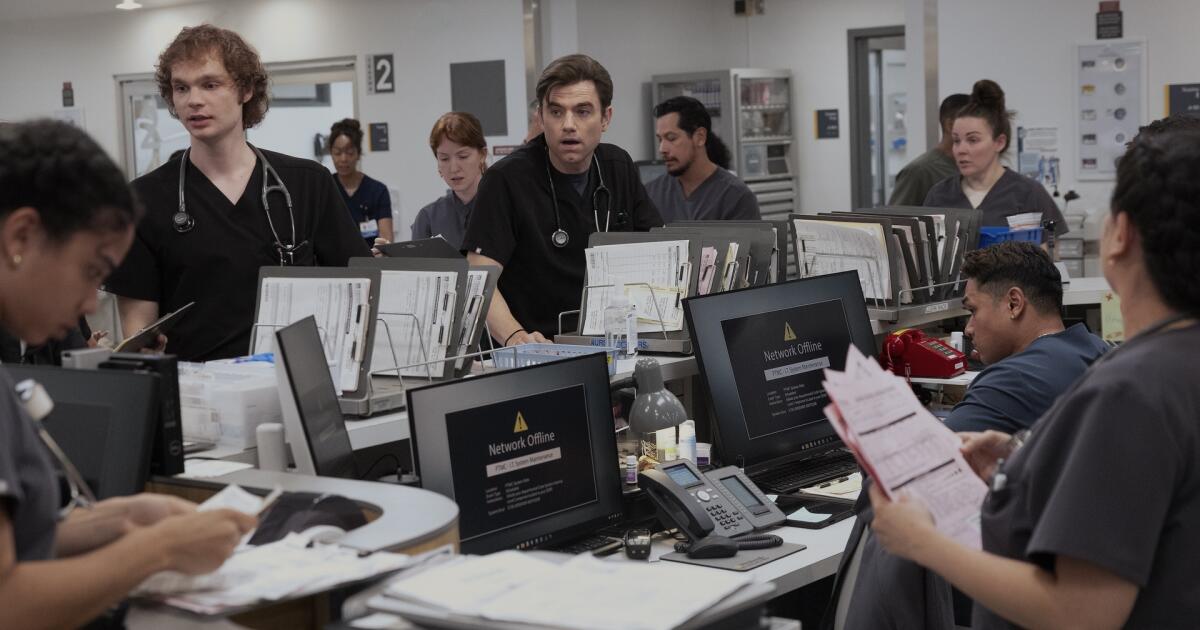
This article contains spoilers for Season 2, Episode 9 of “The Pitt.”
Midway through Season 2, “The Pitt” has taken on the perils of the digital age and given me a reason to love the show as much as everyone else does.
Don’t get me wrong — I understand perfectly why so many people, including recent Emmy and Golden Globe voters, have lost their minds over the HBO Max medical drama: The propulsive day-in-the-life of a Pittsburgh ER conceit, the dazzling ensemble cast, the writers’ heroic attempts to showcase our perilously broken healthcare system, the healing power of empathy and, of course, the Noah Wyle-ness of it all. His brilliant and gentle-voiced Dr. Michael “Robby” Robinavitch is as aspirational a character on television as we’ve ever seen.
But having recently spent almost six hours passing out and vomiting from pain in the waiting room of my local ER (which was empty except for one other man), while being told there was nothing anyone could do until the next shift arrived, I confess I have watched “The Pitt” with a jaundiced eye. The regular crowd shots of the waiting room too often reduce the afflicted into a zombie-like horde bent on making life more difficult for our beloved medical staff.
Sure it’s tough to work in an ER when you are worried about your mother’s expectations, grieving your dead mentor, struggling with addiction or worrying about your sister, but no doubt many of those in the waiting room are experiencing similar issues while also in terrifying and hideous pain.
I’m just saying.
In this second season, however, “The Pitt” gave me reason to cheer. It chronicles the day before Robby is set to leave on a three-month sabbatical, and in the early hours, we meet his temporary replacement, Dr. Baran Al-Hashimi (Sepideh Moafi). Having already attempted to force those suffering in waiting rooms to create their own “patient portals,” Dr. Al-Hashimi goes on to advocate for an AI-supported system to aid the doctors with pesky paper work.
Robby, of course, does not think any of this is a good idea and since he is always right (and no television writer is going to openly promote AI), her plan backfires almost immediately. First, with a medical notes transcription that gets Very Important words wrong and then after a complete digital blackout.
After a nearby hospital is hacked and ransomed, the higher-ups decide to defend its system by shutting it down, which means business must be conducted in the old-fashioned, paper-and-clipboards way.
The result is chaos, and a few too many jokes about young people not knowing how to work a fax machine or manage paper. Some of the more seasoned staff, including and especially the indefatigable charge nurse Dana Evans (Katherine LaNasa), remember the days before everyone carried an iPad well enough to keep things moving. Even so, Dana wisely calls upon the services of “retired” clerk Monica Peters (Rusty Schwimmer).
When the computer system at the Pitt is shut down, Dana (Katherine LaNasa), center, calls in Monica (Rusty Schwimmer), far right, who arrives to help.
(Warrick Page / HBO Max)
“Laid off by the digital revolution, not retired,” Monica corrects her. “And how’s all this digital s— working out for you now?”
This is where I cheered. I love the digital world as much as the next person currently typing on a computer to file a story that I have discussed with my editors on Slack and that I will not see in hard copy until it appears in the physical paper. But like pretty much everyone, I have suffered all manner of digital breakdowns and mix-ups, not to mention the inevitably increased workload that comes with the perception that I can do the work of previous multitudes with a few additional strokes of a keypad.
Except, of course, that’s a lie — a keypad is capable of nothing on its own. Neither are fingers, for that matter. They must be manipulated by someone whose brain has to figure out and execute whatever needs to be done. This requires an ability to navigate the ever-changing tech systems that store and distribute information (often in ways that are not at all intuitive) while also understanding the essentials of the actual work being done.
In “The Pitt,” that is the emergency medical treatment of human beings, which requires all manner of physical tasks. As this storyline makes clear, many of the medical staff do not quite understand how to order or handle these tasks without a screen to guide them.
Hence the need for Monica, representative of a large number of support workers who do understand because it was once their job to keep everything moving, to answer all manner of questions, prioritize what needs to be fast-tracked and make sure nothing falls through the cracks while also engaging with all and sundry on a human level.
The shutdown is obviously an attempt to underline the limits of AI but it also serves as a fine and necessary reminder of how readily we have surrendered people like Monica, with their knowledge and experience, to keyboards and touch pads (which, of course, don’t require salaries, benefits or lunch breaks).
But — and this is important — computers are tools not workers. Alas, that has not kept companies in virtually every industry from drastically cutting back on trained and experienced employees and handing large portions of their work (mental if not physical) to people, in this case doctors and nurses, who already have demanding jobs of their own.
But hey, you get a company iPad!

Nurse Dana (Katherine LaNasa), left, and Dr. Baran Al-Hashimi (Sepideh Moafi) have to resort to paper, clipboards and white boards to keep track of patients after the hospital’s systems are shut down.
(Warrick Page / HBO Max)
Often, including with those patient portals, what was once paid labor lands in the lap of the consumers, who in “The Pitt” are people sitting in an emergency room and likely not at the top of their game when it comes to filling out forms about their medical history or coming up with a unique password.
ER dramas, like the “The Pitt,” are inevitably fueled by the tension between the demands for speed and the need for humane care, something that is increasingly true, if not as intrinsically necessary, in all facets of our culture.
With computers in our pockets, we now expect everything to be available instantly. But when something in our online experience goes wrong, we need an actual human to help us fix it. Unfortunately, as the overwhelmed staff of the Pitt discover, those people are increasingly difficult to find because they have been laid off — even nurse Dana can’t do everything!
Dr. Al-Hashimi, like many, believes that patient portals and AI-assisted medical notes will save time, allowing the doctors and nurses to spend more of that precious commodity with their patients. But, as Dr. Robby and Dana repeatedly argue, what they really need is more staff.
There’s no point in saving a few minutes at the admittance window, or on an app, if you are then going to have to spend hours waiting for or trying to find someone who can actually help you when you need it.
That is certainly true in the medical sector, where digital technology has done little to eradicate long wait times for medical appointments or in emergency rooms. Being treated in a hospital hallway by people who can barely stop to talk to you is not an uncommon occurrence for many Americans. The U.S. is facing a critical shortage in hospital staff, with the ranks of registered nurses and other medical personnel having plummeted post-pandemic, often due to burn out.
The amount of time the staff of “The Pitt” spend with each patient, while dramatically satisfying, is almost as aspirational as the wisdom and goodness of Dr. Robby.
None of these problems is going to be solved by AI or any other “time-saving” device. We have not, as far as I know, figured out a way to extend an hour beyond 60 minutes or modified the human body so that it does not require seven to nine hours of sleep each night.
Medical institutions aside, I can’t think of any place I have visited lately that wouldn’t have benefited from more paid and experienced workers, especially those who know how to do things when computers glitch or fail.
The minute Monica sits down and starts barking orders in the ER, everyone feels much better. Here is someone who understands what needs to be done, why, and how to make it happen. Moreover, she has eyes, ears, hands and human experience enough to know that, in the end, people are less interested in saving time than getting the care they need.
In the ER and everywhere else.
Movie Reviews
Peaky Blinders: The Immortal Man review – Tommy Shelby returns for muddy, bloody big-screen showdown

After six TV series from 2013 to 2022, which caused a worrying surge in flat cap-wearing among well-to-do men in country pubs, Peaky Blinders is now getting a hefty standalone feature film, a muscular picture swamped in mud and blood. This is the movie version of Steven Knight’s global small-screen hit, based on the real-life gangs that swaggered through Birmingham from Victorian times until well into the 20th century. Cillian Murphy returns with his uniquely unsettling, almost sightless stare as Tommy Shelby, family chieftain of a Romani-traveller gang, a man who has converted his trauma in the trenches of the first world war into a ruthless determination to survive and rule.
As we join the story some years after the curtain last came down, it is 1940, Britain’s darkest hour and Tommy is the crime-lion in winter. He now lives in a huge, remote mansion, far from the Birmingham crime scene he did so much to create, alone except for his henchman Johnny Dogs, played by Packy Lee. Evidently wearied and sickened by it all, Tommy is haunted by his ghosts and demons: memories of his late brother, Arthur, and dead daughter, Ruby, and working on what will be his definitive autobiography. (Sadly, we don’t get any scenes of Tommy having lunch with a drawling London publisher or agent.)
But a charismatic and beautiful woman, played by Rebecca Ferguson, brings Tommy news of what we already know: his malign idiot son Erasmus Shelby, played by Barry Keoghan, is now running the Peaky Blinders, a new gen-Z-style group of flatcappers raiding government armouries for guns that should really belong to the military. And if that wasn’t disloyal and unpatriotic enough, Erasmus has accepted a secret offer from a sinister Nazi fifth-columnist called Beckett, played by Tim Roth, to help distribute counterfeit currency which will destroy the economy and make Blighty easier to invade. Doesn’t Erasmus know what Adolf Hitler is going to do to his own Romani people? (To be fair to Erasmus, a lot of the poshest and most well-connected people in the land didn’t either.)
Clearly, Tommy is going to have to come down there and sort this mess out. And we get a very ripe scene in which soft-spoken Tommy turns up in the pub full of raucous idiots who cheek him. “Who the faaaaaack is ‘Tommy Shelby’?” sneers one lairy squaddie, who gets horribly schooled on that very subject.
In this movie, Tommy Shelby is against the Nazis, and he can’t get to be more of a good guy than that. (Tommy has evidently put behind him memories of Winston Churchill from the first two series, when Churchill was dead set on clamping down on the Peaky Blinders.) The war and the Nazis are a big theme for a big-screen treatment and screenwriter Knight and director Tom Harper put it across with some gusto as a kind of homefront war film, helped by their effortlessly watchable lead. Maybe you have to be fully invested in the TV show to really like it, although this canonisation of Tommy is a sentimental treatment of what we actually know of crime gangs in the second world war. Nevertheless, it is a resoundingly confident drama.
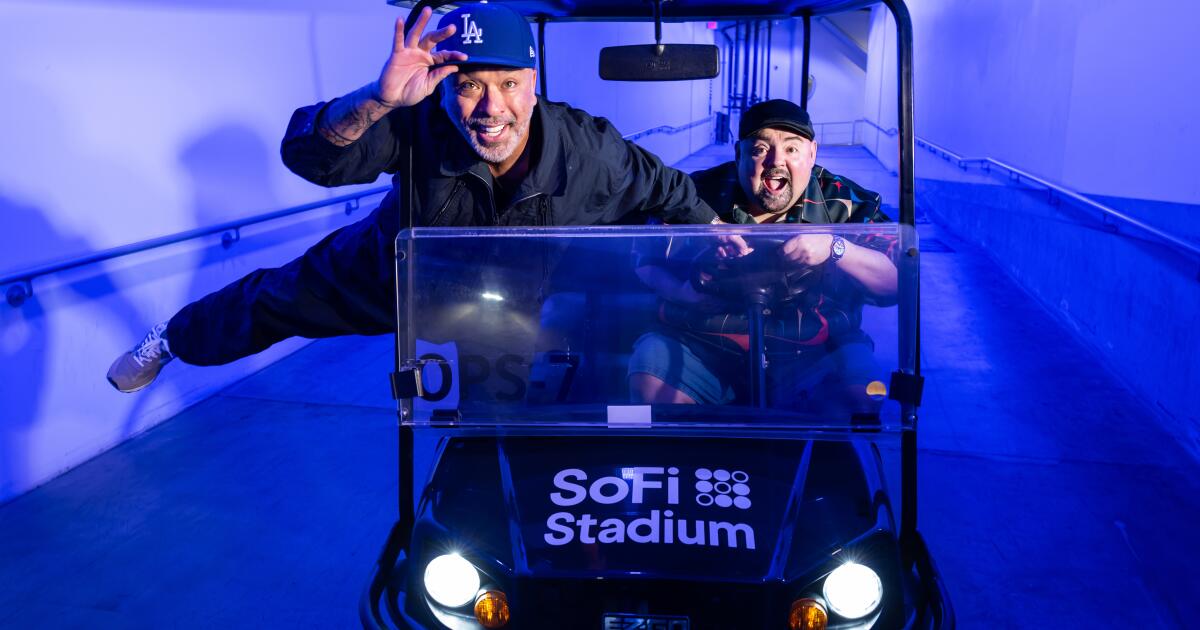
Running free during a game of catch on the empty field at SoFi Stadium is a fantasy most Angelenos will never experience. For comedians Jo Koy and Gabriel Iglesias, it’s just a warm-up to a dream that’s been a lifetime in the making.
Gripping the football with fingers covered in Filipino tribal tattoos extending in a sleeve up his arm, Koy looks across the expanse of emerald green turf at his son jogging toward the south end zone of the Inglewood stadium on a recent afternoon. “To be able to throw at SoFi is crazy,” Koy said with a sparkling grin of bright white veneers.
The 54-year-old comedian with a beard full of gray stubble drops back to pass, launching a tight spiral underneath SoFi’s massive technicolor halo scoreboard hovering above a sea of empty stands. Joseph Jr. — a wiry 22-year-old with a head full of curly dark brown hair — runs briskly toward the goal line with a black cast on his left arm. He raises his right arm just in time to scoop it into his chest for a touchdown. The imaginary crowd goes wild.
“Yes!!!” Koy shouts, his excitement echoing in the stadium. He jogs over to Joseph in his navy blue coverall jumpsuit and L.A. Dodgers cap to deliver a satisfying father-son chest bump.
A few yards away, Iglesias is watching Roka, his tiny black chihuahua, dart around the field like four pounds of rambunctious entitlement. The plus-sized comedian — better known as “Fluffy” — is sporting his typical loose-fitting vintage Hawaiian shirt, denim shorts and black flat cap. Whenever they stand together, the duo’s dynamic is like a modern-day Laurel and Hardy.
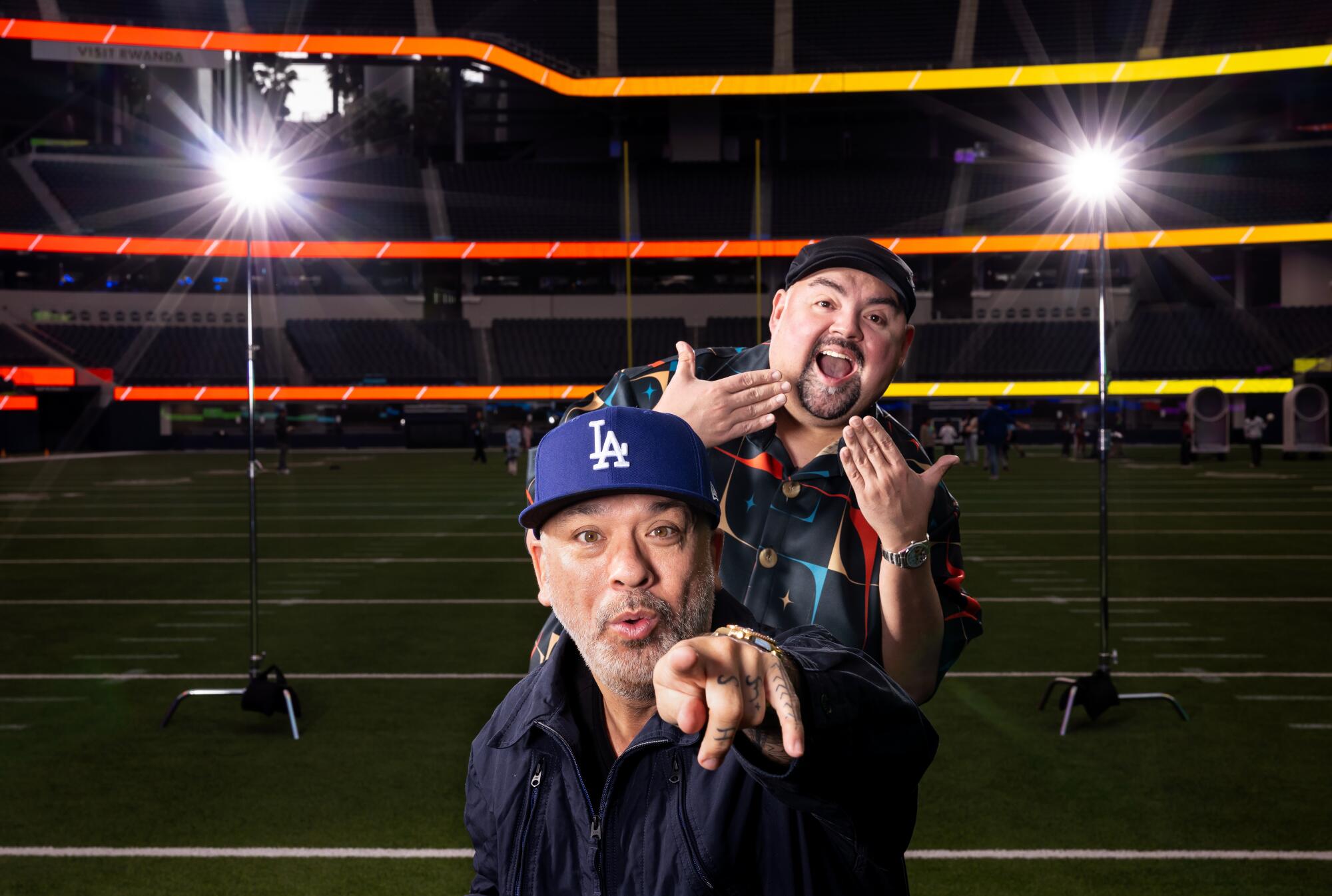
Nearly 70% of tickets for Koy and Iglesias’ SoFi show sold within days, making this the largest stadium stand-up performance to date.
(Christina House/Los Angeles Times)
“The fact that we’ve known each other as long as we have is wild … we’ve known each other since we both had hair,” Iglesias, 49, says as they both lift up their caps in unison, laughing and exposing their shiny bald heads.
On March 21, this stadium will be filled with more than 70,000 guests as the pair takes center stage at the Super Bowl of comedy — the largest stadium stand-up show to date. Koy and Iglesias are now part of a small fraternity of comics, including Kevin Hart, Dane Cook, Bill Burr and Larry the Cable Guy, who’ve sold out stadiums across the country.
The one-night-only show, which won’t be televised or recorded as a special, is meant to be one giant party for comedy fans who’ve supported Koy and Iglesias since their early days. The comics will be passing the mic back and forth throughout the night, which will feature special guests, surprise moments and plenty of other unplanned interruptions that will make for a roughly four-hour show. Though the L.A. comedy scene tends to exist in the shadow of Hollywood, this feat managed by two of its biggest names puts a historic spotlight on stand-up.
“It’s more sweet because it’s taken so long,” Iglesias said. “This wasn’t an overnight thing. Nowadays, everybody wants everything so fast. Between the two of us, we’ve got about 60 years of comedy experience.”
“It’s insane. I can’t explain it,” Koy adds, staring up at the stadium’s glass roof, preparing to crack it with decibels of laughter. “Every time we come in here and look up, I’m like, ‘There’s going to be a stage here the size of the end zone.’ We took the stage from the arenas that we normally play and injected steroids into it.”
For comedians who’ve witnessed their ascent, which now literally includes hands and feet cemented in front of TCL Chinese Theatre and a star for Fluffy on the Hollywood Walk of Fame, the journey has been incredible to watch.
“It’s huge for stand-up, it used to be just in dingy clubs and bars and always something small and intimate and kinda like an afterthought,” said fellow comedy star Tiffany Haddish, a longtime friend to both Koy and Iglesias. “To be honest I never thought comedy would be this big.”
Jay Leno, a confidant to Iglesias and the man who inspired him to start his own insane car collection and offered Koy his first late-night appearance on “The Tonight Show,” agrees that a show like this is a huge step for comedy.
“My attitude when I came to this town was if you can’t get in through the front door, go in the back door,” Leno said. “And they didn’t do it the traditional way, they got to where they are as comedians, one audience member at a time.”

For the two L.A. comedians, the historic milestone represents decades of work and signals comedy’s arrival in mainstream entertainment venues.
(Christina House/Los Angeles Times)
When the pair of arena-selling comics announced last year they’d be joining forces to perform at SoFi, the task of filling the massive concert venue and football stadium seemed laughable. But within a week, it clearly wasn’t a joke. Nearly 70% of the tickets were sold just days after going on sale. Now, weeks before the gig, the show is completely sold out with more seats being added. If there’s one person who is not necessarily surprised, it’s Iglesias. By his calculations — including his ability to sell out Dodger Stadium twice for the filming of his 2022 Netflix special, “Stadium Fluffy,” and Koy’s ability to sell out the Forum a record-setting six consecutive times (more than any other comedian) — the math checked out.
“At a certain point it’s like we’ve been doing [huge stand-up shows] for so many years, it becomes normal,” Iglesias said. “What do you do to change things? What do you do to grow? The worst thing that happens is it fails. But at least we know we tried it. Then we know what our ceiling is. But as of now, this isn’t the ceiling.”
Despite the logic, looking at the stadium’s massive seating chart during an initial meeting with the venue made the task feel akin to climbing Mt. Everest.
“SoFi is the size of like five Forums. That seating chart on a wall was the most discouraging thing I could possibly look at,” Koy said. “And then looking at the amount of money it was gonna cost us even before we sell one ticket. Me and Gabe should’ve been looking at that and been like, ‘What … are we thinking? Hell nah we ain’t doing this … !’”
It took more than a little convincing from Iglesias to get Koy on board. “[Jo] does not like change. I had to break down the math for him and I pushed it a lot,” Iglesias said. “And I’m glad we did because now that it’s sold out, the hard part is over. We just have to show up and deliver a kick-ass show. And then we can both celebrate after, crack a couple bottles and I know I’m taking a week off after that.”
Unlike a typical arena show, which takes several months to coordinate, their big night at SoFi required a full year of planning. The production and stage will be three times the size of the comedians’ normal stages and will be managed by the same team that produces stadium shows for acts like Los Bukis and Bad Bunny.
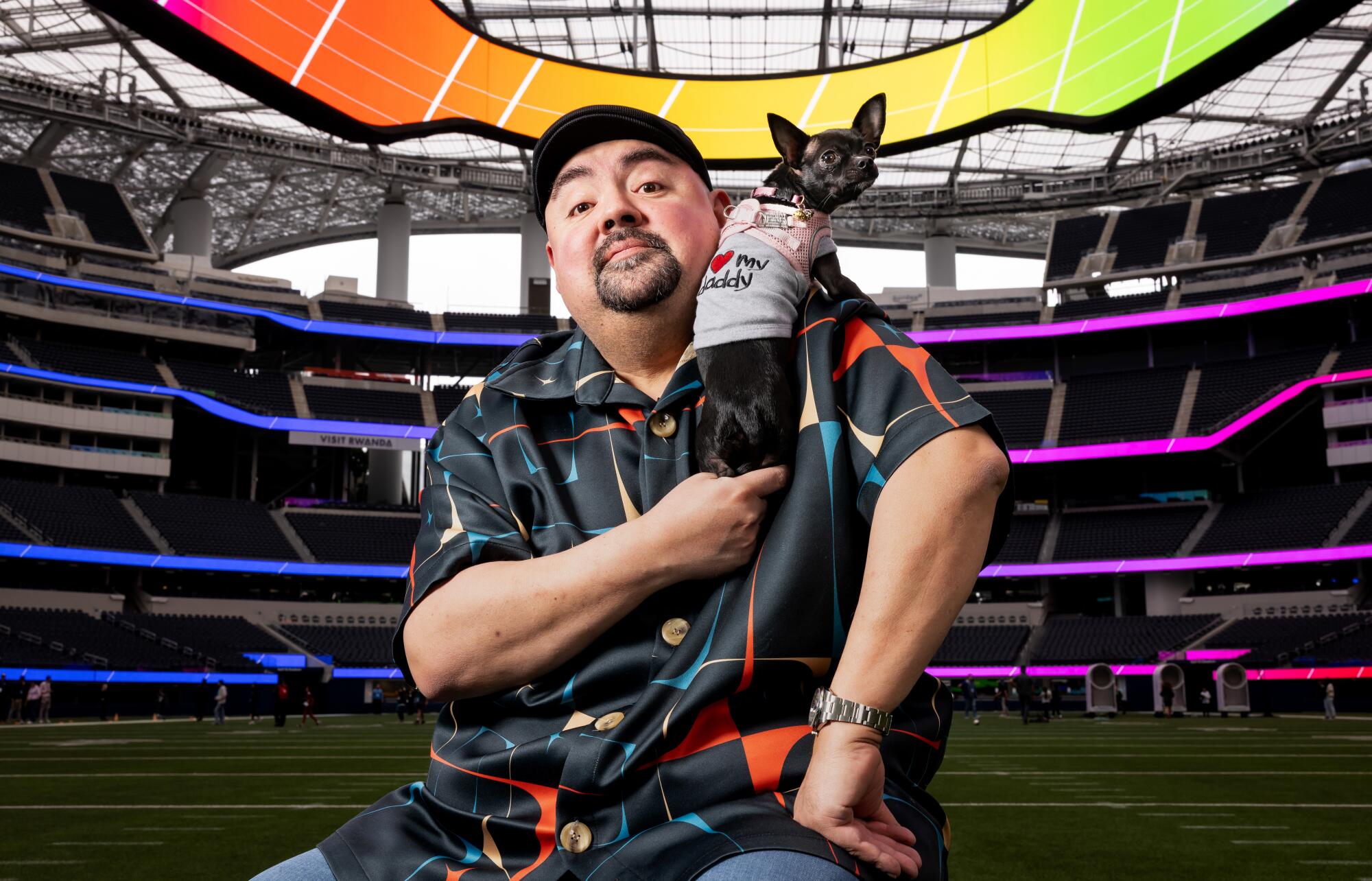
“It’s more sweet because it’s taken so long,” Iglesias said. “This wasn’t an overnight thing. Nowadays, everybody wants everything so fast. Between the two of us, we’ve got about 60 years of comedy experience.”
(Christina House/Los Angeles Times)
“It’s almost like a chessboard,” Iglesias said. “You got to do a bunch of moves in order to pull something like this off, it’s not just we’re gonna do it. This took a lot of planning, a lot of coordinating.”
When asked how the tickets could’ve possibly moved so fast, outside of typical avenues of good marketing and promotion, Koy says it was really comedy fans making a statement of support for them and for stand-up.
“There’s no such thing as marketing on this one, to me it’s a phenom,” he said, noting the pride both he and Iglesias have to see the excitement and support from local fans, especially Filipino and Latin communities across L.A. that have been a major part of their respective fanbases. “That type of reaction and that response to us saying we’re gonna be at SoFi is almost like a bragging right and it’s ‘our night, we’re gonna be there, I don’t care where we’re sitting.’”
The SoFi gig was conceived in February of 2024 during Koy’s sixth sold-out show at Kia Forum. In the hoopla of Koy breaking his own audience record at the venue, Iglesias crashed the show, presented his friend with a plaque and laid down the gauntlet in front of 17,500 fans. When Iglesias asked Koy if they should contemplate performing “across the street” together, the crowd erupted with excitement.
“Our agents and managers were like, ‘Are you sure you wanna do that?’’’ Iglesias said. “I think they missed a couple bonuses. But at the end of the day, it’s part of history.”
“That’s what’s beautiful about Gabe, he’s not scared to take on those big risks,” Koy said. “But the whole thing was a risk. We gotta alter our tour dates and sacrifice other opportunities to make this happen.”
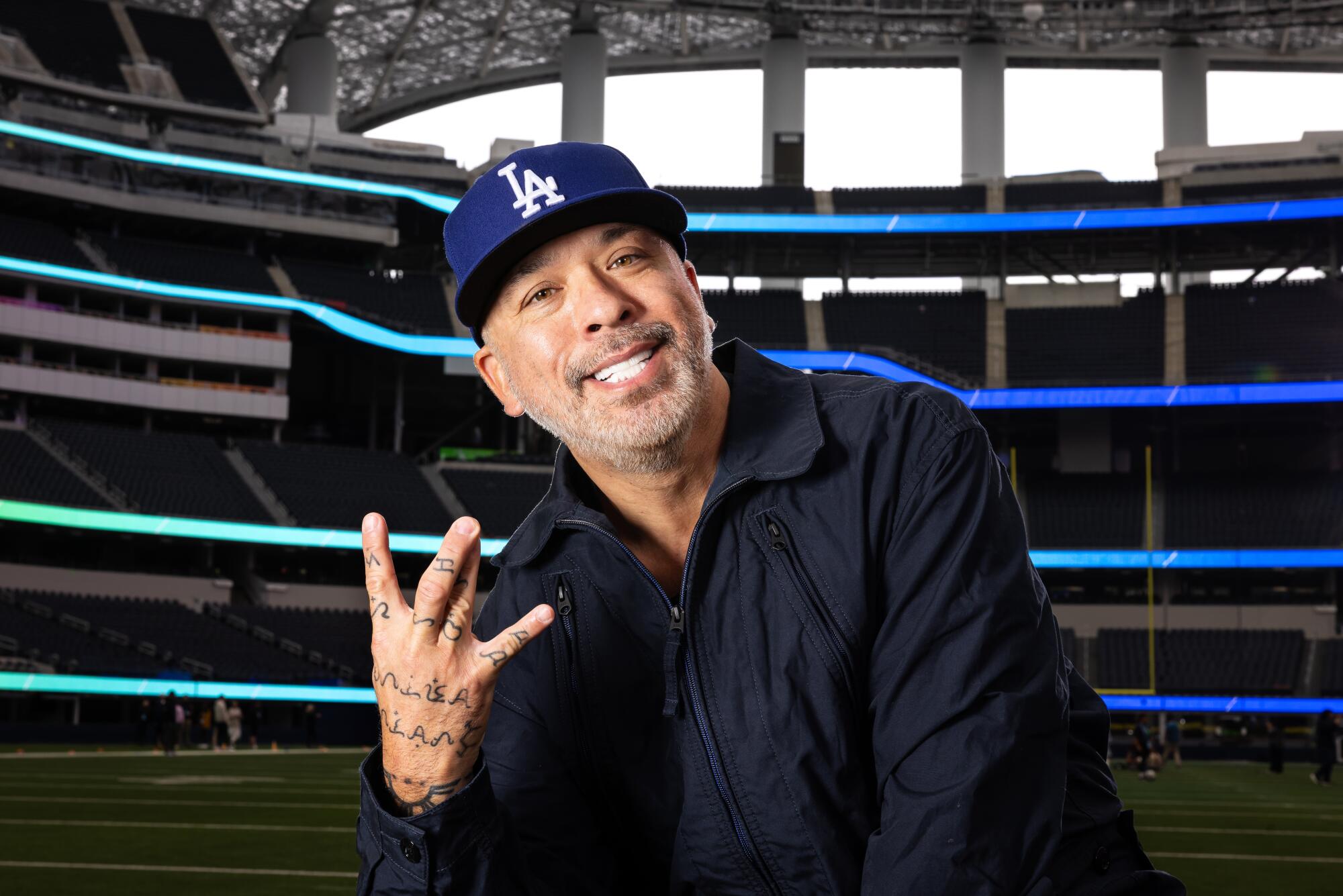
“Every time we come in here and look up, I’m like, ‘There’s going to be a stage here the size of the end zone,‘” Koy said about the upcoming SoFi show on Mar. 21. “We took the stage from the arenas that we normally play and injected steroids into it.”
(Christina House/Los Angeles Times)
For Koy, a life of comedy was a risk inspired by his heroes while growing up in Tacoma, Wash. He traces it back to being 15 and seeing Eddie Murphy perform at Climate Pledge Arena during his “Raw” tour in Seattle. He remembers taking a panoramic look at the sold-out crowd roaring in the darkness before the leather-suited legend even took the stage. “I’m like, ‘Wait a minute, this guy got this many people in here?’ I just thought that was the most impossible thing,” Koy remembers. “And now I get to share this moment with my son and let him walk with me and let him see that this is possible.”
When Koy was moving up the comedy ranks under his real name Joseph Glenn Herbert, the thought of calling himself a comedian felt like a pipe dream. Koy, the son of a white father and Filipina mother, saw comedy as a way to channel an overactive personality and need to make people laugh into a career. Going from coffee shop open mics in Tacoma to clubs and casinos in Las Vegas in 1989, Koy scratched out a living doing random jobs to move to L.A. in 2001 with hopes of making it big.
Working at a bank or Nordstrom Rack offered some stability as he drove up and down Sunset Boulevard in his battered Honda Prelude with one broken headlight, looking for a way forward to pursue his passion. Haddish, his longtime friend, spent years working with Koy, who served as her mentor at the Laugh Factory. Between sets on stage, the two would often take breaks to fantasize about fame.
“Jo and I would sit outside of the Laugh Factory and have these conversations and we’d be eating hot dogs wrapped in bacon and we’d be dreaming about being in a big movie, playing big theaters and helping people heal through laughter,” Haddish said. “Now here we are.”

“At the end of the day, this is a big stamp. And I think it also lets other comics know, ‘Hey, man, step up your game. Let’s grow this,’” Iglesias said.
(Christina House/Los Angeles Times)
Pulling off a show of this magnitude is jaw-dropping to think about, Iglesias said, even after having achieved a similar feat just a few years ago at Dodgers Stadium where he filmed his special over the course of two shows. He also set a record for fines incurred by a performer for going over his allotted time slot (a hefty $250,000 for not leaving the venue until 4 a.m.). The SoFi gig leaves him only one shot to get it right. This time around, Iglesias feels infinitely less pressure despite the bigger venue.
“[Dodger Stadium] for me was grueling,” Iglesias said. “I didn’t know what to expect, I didn’t know how it was gonna go. Every day we were pulling our hair out trying to figure it out. Fortunately we were still able to pull it off and we learned a lot from it. This time around, believe me when I tell you the stress of this show is not even there.”
Iglesias, a native of Long Beach, has spent over 30 years rising up the comedy ranks. Among his accomplishments are seven major comedy specials, a TV show (“Mr. Iglesias”) and becoming the first Mexican American comic with a top-grossing worldwide tour. Like Koy, who also has seven major specials, Iglesias went through a lot of metamorphosis on stage prior to finding his calling as a gregarious, fun-loving comedian with a penchant for doing cartoon-ish voices.
Leno says one of the key factors in Fluffy’s mass appeal is his likability.
“The great thing about Gabriel is that the kindness comes across, there’s not a mean spirit in his body,” he said. “There’s a lot of comics who are really funny but people don’t like them because they think they’re mean-spirited. … When you watch Gabe even when he does something that’s not fall-down hysterical, you smile because you like him. … I find him a joy to watch.”
Much of what Iglesias learned about marketing himself was inspired by the WWE. The costumes, witty banter and theatrics of the wrestling ring influenced his consistent look and even allowed the name “Fluffy” to become his calling card.

Comedians Gabriel Iglesias, aka, “Fluffy,” in front, and Jo Koy are photographed at SoFi Stadium in Inglewood on February 10, 2026, ahead of their March 21st show.
(Christina House/Los Angeles Times)
“There is a certain level of pandemonium, as they say in wrestling, that’s needed to get people excited,” Iglesias said. “Then there’s the marketing and the way that you do it — so I did study wrestling a lot.”
Handing the kingdom of SoFi over to the court jesters for a night is a feat worthy of celebration.
“At the end of the day, this is a big stamp. And I think it also lets other comics know, ‘Hey, man, step up your game. Let’s grow this,’” Iglesias said. “And it’s not, ‘Step up your game,’ like we’re competing with each other. It’s more so like, ‘Let’s elevate the game of comedy.’”
Right now Koy feels plenty elevated, as though he’s floating every time he enters the stadium and looks up at the stands — like the night he saw Eddie Murphy all those years ago.
“You should’ve heard the whispers me and Gabe had to ourselves walking out of the stadium tunnel, like, ‘Yo, is this really happening?!’” Koy said with a megawatt smile. “Coming from an open mic night at a coffee house, never in my wildest dreams did I say, ‘Someday, a football stadium’ … we’re literally living our dreams right now.”

GLP-1 Drugs Linked to Osteoporosis and Gout: Here’s How To Stay Safe
No matter what happens at the Oscars, Delroy Lindo embraces ‘the joy of this moment’

Amazon.com says things are fixed after some issues with logging in and checking out

Private flights account for 30% of departures from Oman airport as wealthy evacuate Middle East

DOJ continues Biden autopen probe despite former president unlikely to face charges

Florida High School Football Rankings: Top 25 teams – Oct. 21

Cleary's 21 help Le Moyne down Central Connecticut State 69-64 in OT

How old is Bo Nix? What to know about Oregon quarterback ahead of 2024 NFL Draft

99th annual Pony Swim held in Virginia

Indiana Members Credit Union announced as new anchor tenant at Bottleworks District
DOJ continues Biden autopen probe despite former president unlikely to face charges
Fact check: Did French border guards mock influencers returning from Dubai amid Iran war?

Iran’s fight for survival / The widening war / Trump’s nebulous goals : Sources & Methods

Map: 4.9-Magnitude Earthquake Shakes Louisiana

Paxton vows he’s ‘staying in this race’ even if Trump backs Cornyn in Texas GOP clash
-

 World1 week ago
Exclusive: DeepSeek withholds latest AI model from US chipmakers including Nvidia, sources say
-

 Wisconsin4 days ago
Setting sail on iceboats across a frozen lake in Wisconsin
-

 Massachusetts1 week ago
Mother and daughter injured in Taunton house explosion
-

 Maryland5 days ago
AM showers Sunday in Maryland
-

 Massachusetts3 days ago
Massachusetts man awaits word from family in Iran after attacks
-

 Florida5 days ago
Florida man rescued after being stuck in shoulder-deep mud for days
-

 Denver, CO1 week ago
10 acres charred, 5 injured in Thornton grass fire, evacuation orders lifted
-

 Oregon6 days ago
2026 OSAA Oregon Wrestling State Championship Results And Brackets – FloWrestling