Entertainment
In the new musical 'Regency Girls,' young women in trouble discover empowerment on a road trip


“Regency Girls,” a new musical comedy set in the period of Jane Austen’s novels, begins on a note that fans of “Pride and Prejudice” will savor.
The fate of the Benton family depends on finding husbands for the two oldest daughters, Elinor (Isabelle McCalla) and Jane (Kate Rockwell), both of whom are being courted by wealthy scions. Distress ensues when these savior suitors, who are bound for a yearlong voyage, fail to show up at the appointed hour to bid the ladies farewell. But at the last minute they not only appear but propose, saving the Benton daughters from a fate worse than spinsterhood: family insolvency.
A boisterously vivacious opening number, “A Happy Ending Beginning,” sets the household into ecstatic motion early on in “Regency Girls,” which is having its world premiere at San Diego’s Old Globe. But happy endings aren’t meant to come at the start of romantic tales and the exuberance proves to be premature.
Elinor, who seems modeled on Austen’s Elizabeth Bennet, does something her lively, intelligent and fiercely independent counterpart from “Pride and Prejudice” would never do: She gets pregnant before her wedding day. On the night of their engagement, Elinor and Stanton (a winning Nik Walker) apparently succumbed to their passion, and now that Stanton is at sea with Dingley (Gabe Gibbs), Jane’s horribly snooty fiancé, there seems little hope that Elinor’s situation can be rectified by a rushed wedding.
Jane, far more conventional than her older sister, can only think of how Elinor’s disgrace will ruin her own future. Haughty, hypocritical Dingley, she fears, won’t want anything to do with the family once this scandal goes viral, which in the Regency period translates into a wildfire of whispering throughout polite society.
Elinor finds an ally in her quick-thinking maid, Dabney (Krystina Alabado), who has a handbill listing the services of Madame Restell (Janine LaManna), a London-based midwife who helps women in distress. It’s not immediately clear why Dabney has this advertisement, but Elinor discovers that she doesn’t have to go through this difficulty alone.
Petunia (Ryann Redmond), a married family friend exhausted by pregnancy and motherhood, volunteers to accompany Elinor to London. Jane, anxious to see that her sister’s awkward matter is discreetly handled, agrees to go too. And Dabney, suspiciously eager, insists that she be included, even if she has “to ride atop the luggage.”
Before you know it, “Regency Girls” transforms into a rowdy road trip. Try to imagine “Thelma & Louise” crossed with Austen’s romantic comedy of manners, “Bridgerton” and some naughty sketch comedy, and you’ll have an approximation of the melange the creators are attempting.
The musical’s book, written by Jennifer Crittenden and Gabrielle Allan, TV writers with illustrious comedy credits, trades freely in anachronisms for laughs. The score follows suit, with Curtis Moore’s music and Amanda Green’s lyrics setting up the period flavor only to bust out in Broadway-style pop, rock and even hip-hop.
Regency girls just want to have fun, so why confine them to one particular genre or historical epoch? Put them instead in a slow-trotting carriage and see how far they can go.
The show is both genuinely funny and unabashedly silly, and director and choreographer Josh Rhodes has his hands full reining in some of the sitcom dopiness. This “pre-Broadway engagement” reveals the production’s bright potential. Who could resist a musical comedy road trip celebrating girl power? But the humor grows broader and more ridiculous, as though scripted for a laugh track.
Crittenden and Allan have lively imaginations, but the wild situations they concoct are treated like joke machines. The introduction of Galloping Dick (Gibbs, energetically doing double duty), a Robin Hood-esque Lothario who excites Jane’s romantic interest on the road to London, pushes the zaniness into overdrive.
There are early signs of buffoonery involving a maternal wig. And a cartoonish note is struck when Lady Catherine (LaManna, also pulling off a dual role), arrives on the scene. Stanton’s dragon aunt is up in arms that her nephew is engaged to Elinor when he’s already promised to one of her two daughters, whose names and identities she can’t even keep straight.
But all hell breaks loose when Elinor and her crew discover a chest of bondage toys and dominatrix accouterments during a particularly challenging moment in their journey. At this point, the show crosses a Rubicon — or should I say jumps the shark? The gag, frantic to get a rise, runs roughshod over character and story.
Janine LaManna as Lady Catherine and Sav Souza as Scutter in “Regency Girls.”
(Jim Cox)
Some might appreciate the slide into burlesque more than I did, but I was drawn to the complexity of the show’s protagonist, who, in noble Jane Austen tradition, refuses to compromise her intelligence for the sake of men. In a bright, charismatic performance, McCalla’s Elinor brings to life the character’s brainy charm and self-possession. She is the radiant center of “Regency Girls.”
But don’t underestimate Alabado’s Dabney, the nimble-witted maid, who is too dazzlingly resourceful not to make her presence known. Facing class prejudice along with gender oppression, she points out just how unequal English society happens to be. Alabado’s stunning portrayal elevates Dabney from servant to second protagonist.
Together, all of the women rise above their circumstances. Rockwell’s Jane and Redmond’s Petunia, while conceived in more flamboyant comic terms, are granted their own moments of self-discovery. Jane comes to understand that marrying for money isn’t half as satisfying as marrying for love, while Petunia assumes control over her own sexuality, rejecting the idea that she was born to be a baby machine.

Isabelle McCalla and Nik Walker, center, as Elinor and Stanton with the cast of “Regency Girls.”
(Jim Cox)
“Regency Girls” is the only musical comedy I can think of that includes an abortionist as a key character. Madame Restell, who operates a clinic offering reproductive services for women, delivers “How Long (In 1810)?” a powerful anthem decrying “the holy war” the patriarchy is waging against female autonomy. She can’t believe this militant opposition is still happening in 1810, though she might as well be singing about 2025, so persistent are the parallels.
LaManna brings down the house in a number that spells out what’s at stake in the musical. Marriage might be the all-consuming obsession, but “Regency Girls” makes clear that self-determination is really what these adventurous young women are fighting for.
The production could use some fine-tuning before it heads to New York. The staging, moving from antique to comic kink, accommodates the rapidly shifting story. (Anna Louizos’ mobile scenic design and David I. Reynoso’s playful costumes conjure Regency refinement without being trapped by it.) But sometimes the cast seems a bit frazzled by the musical’s leaps from a more character-based comedy to all-out travesty.
The happy ending that begins “Regency Girls” is eventually earned, though the conventional romantic story lines are rewritten. Elinor and her posse deserve more fulfilling lives, and with the help of canny Madame Restell, they manage to make their dreams come true on their own terms.
‘Regency Girls’
Where: Old Globe Theatre, 1363 Old Globe Way, Balboa Park, San Diego
When: 7 p.m. Tuesdays-Thursdays, 8 p.m. Fridays, 2 and 8 p.m. Saturdays, 2 and 7 p.m. Sundays. Ends May 11
Tickets: Start at $45
Contact: theoldglobe.org or (619) 234-5623
Running time: 2 hours, 40 minutes, with one intermission.

Movie Reviews
Movie Review: Travolta’s “Propeller: One-Way Night Coach” is One for the Ages — All Ages

Back in the good ol’days — the ’90s — John Travolta would love to get off the topic of “Michael,” “Pulp Fiction” or “Get Shorty” in interviews with film journalists like me and regale us with how utterly besotted he had been with his first flying experience, how that drove his passion for piloting and buying planes and airfield-adjacent luxury houses.
He didn’t even seem to mind having to move house when this or that development balked at him flying his Boeing 707 out of there on the way to locations.
Travolta would tell any journalist who asked that he was writing a kid-friendly book, “Propeller: One Way Night Coach,” based on his first flights as a child in old propeller driven airliners — cheap red-eye overnight treks with too many connections for your average jet age traveller to tolerate.
I remember picking up the book when it came out later in the ’90s — at an airport gift shop — and thinking “Well, that’s as cute as I figured.”
And now, decades later and trapped in the B-movie hell of his post “Gotti” career, Travolta’s turned that cute book into the most delightful, fanciful and colorful bon bon of a movie.
“One Way Night Coach” is a child’s fantasy of flight and flying the way it used to be — with pristine, uncrowded, futuristic airports, an early ’60s era of jets and prop planes with over-uniformed stewardesses in white gloves, the days “Back before every Joe Sweatsock could wedge himself behind a lunch tray and jet off to Raleigh-Durham,” as Sideshow Bob memorably sneered on “The Simpsons’.”
It’s a fictionalized account of Travolta’s childhood about an only child (at least two Travolta siblings have bit parts in this movie) of a never-made-it/never-will actress/single-mom (Kelly Eviston-Quinnett) who indulges her aviation-obsessed eight-year-old with a cheap cross-country overnight flight.
Little Jeff (Clark Shotwell) will revel in almost every Idlewild to Pittsburgh to Dayton to Chicago to Kansas City to Denver and Los Angeles minute. He strolls into the cockpit to meet pilots, charms the stewardesses and checks out the sleeping bunks on the TWA Lockheed Super Constellation, loving even the delays if not the Chicken Cordon Bleu he’s offered on legs of the journey that offer a meal.
And as he’s an observant child, he comments (Travolta narrates) on his 50ish mother’s vamping and posing, her choice of cigarettes (Newports) and drinks, the solo traveling men whose attention she pursues and earns.
“I was her best audience,” adult Jeff remembers of the mother who’d read him plays as bedtime stories and delusionally hopes that this trip to Los Angeles might be her “big break” even though she’s pushing 50.
“Hollywood called,” she’d explain about their overnight cheap flight arrangements to ticket agents and crew. “They told me to take the next flight!”
At every turn, Jeff meets or sees kindness — stewardesses who indulge his many questions and bump them up to first class on the mostly-empty planes, a captain who fixes his toy model of a Constellation, a mentally ill flyer who flips out but is calmed by a flight attendant who isn’t overworked and frazzled in jet-powered tin-can jammed with Joe and Jane Sweatsocks who think nothing of traveling in their pajamas.
Normally, I cringe at pictures this reliant on voice-over narration. I recoil from stars who populate their picture with Sandler etc. offspring. But “Propeller” is unfailingly sweet and never cloying.
Sure, it’s fictionalized. But if you’ve followed Travolta’s life and career, a lot of him is in this — his raptoruous engagement with flying, an indulged child who developed a taste for fine food and creature comforts, a mother who was his guiding star as an actor.
I get why there are less adoring reviews than mine floating around “Propeller.” It’s unfailingly sweet. Mom’s man-hunting is seriously dated. This TWA tale is decorated with Gershwin’s majestic “Rhapsody in Blue” — United Airlines’ signature tune. And Travolta’s been around long enough for recent generations to come up and not feel a connection to the “Saturday Night Fever/Get Shorty” star whose career has fallen off and life has been visited by too much tragedy.
But I’d hate to be seated next to anybody who doesn’t appreciate this adorable, pristine and nearly perfect aviation fantasy on any flight, much less an overnight one.
Rating: TV-PG
Cast: Clark Shotwell, Kelly Eviston-Quinnett, Ellen Travolta, Ella Beau Travolta, Olga Hoffmann and John Travolta.
Credits: Scripted and directed by John Travolta, based on his book. An Apple TV+ release.
Running time: 1:01

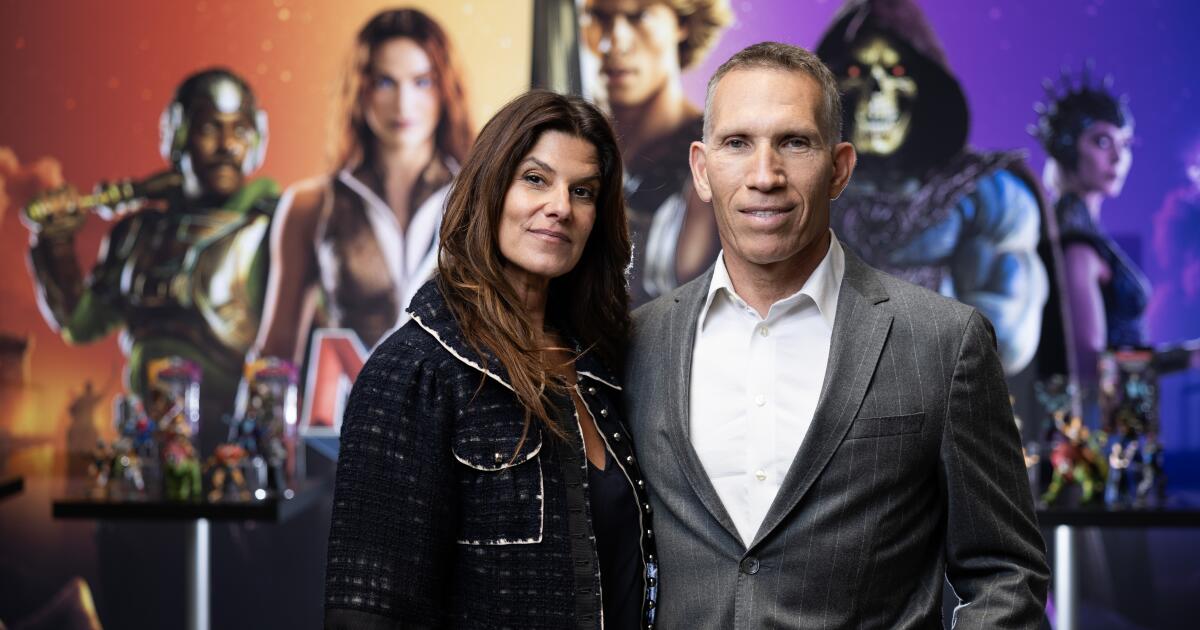
Three years ago, Mattel Inc. struck box-office gold — or rather, pink — with the billion-dollar success of “Barbie.”
In its first return to theaters since the female-forward phenomenon, the El Segundo toymaker is turning to the brawny He-Man for another box-office lift.
Its latest film, “Masters of the Universe,” opens this weekend, as Mattel looks to build on that previous success and continue extending its signature toy brands into the entertainment arena.
“The movie is very much in tune with culture,” said Mattel Chief Executive Ynon Kreiz. “Everything is much more contemporary relative to what was created more than 40 years ago, but it’s still very true to the origin story and to the DNA of the brand.”
The new film arrives at a pivotal time for Mattel, which is facing pressure from investors to grow its business. The maker of Hot Wheels, American Girl and Uno has recently confronted a challenging market for toys, beset by tariffs on goods produced overseas and weaker-than-expected demand for Barbie dolls and Fisher-Price preschool products.
Amid uncertainty in the toy market and the fallout from tariffs, Mattel’s net income dropped 25% to $398 million in 2025. And since the company announced disappointing holiday sales totals in February, its stock has dropped more than 30%, closing at $14.34 on Wednesday.
“Masters of the Universe” toys at Mattel headquarters in El Segundo.
(Myung J. Chun / Los Angeles Times)
The share price slide prompted investor Southeastern Asset Management to send a letter last month to Mattel leadership suggesting the toy maker should sell itself and go private. Southeastern manages about 4% of the company’s stock on behalf of its clients.
“The frustration among investors has been the fact that if you look at the business from 2021 through 2025 and even this year … the business really hasn’t grown,” said Eric Handler, a Roth Capital senior media and entertainment analyst, referring to Mattel. “This is a company that needed something fresh in the portfolio, and there’s a wide range of investments being made, of which ‘Masters of the Universe’ is one part.”
Kreiz pushed back on the idea that the company is not growing. In the fourth quarter of 2025, net sales were up 7% to $1.8 billion, though the result was not as strong as the company expected.
Mattel has spent $1.2 billion in the last three years to buy back shares, with an additional $1.5-billion share repurchase planned for the next three years.
“We’re investing in our own stock because we believe it is undervalued,” he told The Times in an interview at his office, which has floor-to-ceiling windows that give an expansive view of El Segundo. “We absolutely agree that the share price doesn’t reflect the progress that we’ve achieved over the last few years financially, operationally, our place in culture, the strength of our brands, and the continued expansion of the business. And more importantly, the potential that we have down the road.”
“Masters of the Universe” is a key variable in that equation.

Ynon Kreiz, chief executive of Mattel.
(Myung J. Chun / Los Angeles Times)
The movie, which had a budget of roughly $170 million, is expected to bring in $25 million to $35 million in the U.S. and Canada during its debut weekend. That’s a far cry from the $162-million opening haul of “Barbie,” but box-office analysts say that film captured the cultural zeitgeist in a way that’s hard to replicate.
The ‘80s-era “Masters of the Universe” is “a property that was famous with a certain group of fans, but it hasn’t had much of a pop culture presence,” said Shawn Robbins, who directs movie analytics at Fandango and founded the forecasting site Box Office Theory. The movie has notched a respectable 74% approval rating from critics on aggregator Rotten Tomatoes.
“There’s been so many callbacks to nostalgic franchises,” he said. “Some people are always on board for them, and maybe the positive reviews bring people in who were on the fence. But people are also ready for something fresh and new and exciting.”
Kreiz said he’s often asked how the company will match the success of “Barbie.”
“The answer is, we don’t need to match ‘Barbie’s’ success for movies to have a meaningful economic impact on the company,” he said. “Not every movie will be ‘Barbie.’ If we create quality content that people want to watch and create quality experiences that people are engaged with, good things happen, and these brands will resonate and will be here for years to come.”
While theatrical revenue is important, the measure of success for “Masters of the Universe” could also include its eventual reception on streaming platforms and, of course, toy sales, analysts said.
There are hundreds of products tied to the movie, from collectible action figures of Nicholas Galitzine’s He-Man and Camila Mendes’ Teela, to branded Uno decks, Legos, clothing and skateboards.

Skeletor from “Masters of the Universe.”
(Myung J. Chun / Los Angeles Times)
“For us, it’s a huge win already,” said Robbie Brenner, president of Mattel Studios and chief content officer, who also served as a producer on the film. “We have reinvigorated and relaunched this brand that has been around for decades … and done it in a way with just the best-in-class toys. Obviously that’s our bread and butter. And then to have made an epic, incredible movie … is a huge win.”
While Mattel does not yet have sales totals for its “Masters of the Universe” toys, executives said during an earnings call in late April that product sales were “growing double digits” amid strong customer demand, particularly from adults.
When Kreiz was named CEO in 2018, he saw the potential for Mattel to expand beyond toys. In an entertainment landscape dominated by known franchises and intellectual property, the former TV and media executive wanted to leverage the company’s IP in new ways to attract consumers.
Hence, Mattel has expanded into real-world experiences such as a Barbie pop-up at Coachella or a traveling Hot Wheels monster truck show. In February, the company fully acquired Mattel163 mobile game studio after buying out a stake held by Chinese tech firm NetEase. The studio has released games based on Uno, Skip-Bo and other Mattel intellectual property.
And on the film and television front, the Mattel Studios division now has 51 people — most of whom are based in El Segundo — focused on projects across platforms.
After “Masters of the Universe,” Mattel Studios plans to release a “Matchbox” streaming movie in October. The division has more than a dozen films in development that have been announced, including an American Girl movie with Paramount, Polly Pocket with Amazon MGM Studios, as well as a live-action Magic 8 Ball series from M. Night Shyamalan.
“The journey for the company was to evolve from being a toy manufacturer that was making items to become an IP company that is managing franchises,” Kreiz said. “It’s not that we’re not creating toys — it’s obviously a big part of our business — but the opportunity is to expand so much more than the physical product.”
“Masters of the Universe” was in development for years at several different studios before it was picked up by Amazon MGM.
That partnership stemmed from Mattel’s work on the “Barbie” movie with Courtenay Valenti, then president of production and development at Warner Bros. Pictures who is now head of film at Amazon MGM.
“Masters of the Universe” felt like a good property for Mattel to bet on because of its nostalgia factor and deep bench of colorful characters, from the green tiger Battle Cat to the heavily armored Ram Man and ever meme-able Skeletor, which the company hopes will attract new audiences, Brenner said.
The movie is directed by Travis Knight — chief executive of stop-motion studio Laika who also led the 2018 “Transformers” spin-off “Bumblebee” — who Brenner said “nailed” the narrative’s tone. (It didn’t hurt that Knight was already a fan of the franchise and had sported the He-Man haircut as a child.)
“It’s a property that’s kind of out there,” said Brenner, who grew up watching He-Man and his twin sister She-Ra. “It’s got all these crazy characters. But just riding that line between what is funny and kind of irreverent and then kind of heartfelt, that is a very hard thing to put in a blender and to get right.”

Let’s just say that the wedding band has never occupied the most exalted rung of the ladder in music.
Playing “September” and “Celebration” is often what’s most required. As one member of the Bride and the Groove, the band at the center of John Carney’s new film, puts it: They’re not rock stars. They’re human jukeboxes.
But in “Power Ballad,” a wedding band singer and pop star cross paths. For one night, all of the stratification of the music world falls away. “Power Ballad” starts like a fairy tale.
Since 2007’s “Once,” the Irish writer-director has focused his films on the redemptive capacity of music. Carney, who was once a bassist for the Frames, knows from experience. From “Sing Street” to “Flora and Son,” he has made unabashedly earnest tales where a song, or just picking up an instrument, changes lives.
This can, undoubtedly, lead Carney into sentimental territory. Lucky for him, his chosen subject — music — is more worthy of sentiment than almost anything else. Yet the song doesn’t quite remain the same in “Power Ballad,” a movie that begins with the gentle sweetness Carney is known for, but detours into something more discordant.
Rick (Paul Rudd) is an American musician who gave up on his once-promising rock band’s future to instead live with his wife (Marcella Plunkett) and teenage daughter (a spunky, underused Beth Fallon) in Dublin. His former group was called Octagon, a perfect former band name if there ever were one.
But for years, Rick has fronted the Bride and the Groove. It’s an unromantic day job (or rather a night one) that hasn’t entirely sapped his belief in his own songwriting. During an encore at one wedding, he plays an original tune and is mentally transported to an arena full of swaying fans. When he snaps out of it, he’s staring at an empty dance floor and faces that say: That wasn’t Kool & the Gang.
At another wedding at at a castle, the band is asked to let a friend of the newlyweds sit in. They reluctantly agree, and are surprised to see the very popular boy band veteran, Danny (Nick Jonas), step on stage. He sings Stevie Wonder’s “I Wish,” and it’s great. Though Rick had just dismissed Danny’s music as “manufactured content for young, excitable teens,” he discovers Danny is a genuine musician.
But, later that night, something even more remarkable transpires. Rick bumps into Danny, and the two quickly hit it off. They begin jamming together and sharing songs that need work. They are both so jazzed by their unlikely collaboration that they play into the next morning.
The actual moment of artistic creation, and the craft it requires, is something the movies almost always skip over. But capturing collaborative juices flowing is exactly what Carney excels at. You can feel his joy in it. So it’s fitting that one of the unfinished songs Rick plays for Danny, “How to Write a Song (Without You),” is about creative invention.
It’s here when you wonder where “Power Ballad” is headed. Is this, for Rick, the beginning of a beautiful friendship? Will they turn into the next great songwriting duo, lifting Rick out of weddings and proving to the world that Danny is more than a boy-band pretty face?
That is very possibly the movie Carney might have made a decade ago. But “Power Ballad,” which he co-wrote with Peter McDonald (who also co-stars as a band member), shifts six months ahead in time. Rick is standing in a shopping mall when the familiar lyrics of “How to Write a Song” softly float through the stores. He stands dumbfounded in the gleaming halls of commerce, a befuddlement that slowly turns into outrage the bigger and bigger Danny’s smash hit grows.
“Power Ballad” loses some of its steam in its second half, which follows Rick’s struggle for justice. Making things considerably harder is that he can find no recorded demo of the song. His family and his band don’t even really believe him.
But even as the movie struggles to sustain its opening refrain, Carney’s film is always riffing on ideas of authenticity and aspiration in music. That Jonas is, himself, a former boy band star who has at times gone it alone, lends the movie a direct connection to contemporary music, where tussles over authorship are increasingly common.
Jonas has been good in other films (notably the “Jumanji” movies), but this is his most ambitious and convincing performance to date. It’s a testament to the movie that Danny’s theft isn’t a purely villainous act. He gives the song a bridge and the vocal power to take it to another level. He’s under mounting pressure from his label to deliver a hit. An executive (Jack Reynor) wants “Danny 2.0” but has little faith he can supply it.
But it’s an even more well-tailored role for Rudd. He memorably and very goofily played a bassist in the 2009 comedy “I Love You, Man.” But while he sings well, it’s not his musical chops that lift the performance. It’s more that Rick, a contented family man with unrealized rock-star dreams, gives the exceptionally genial Rudd more notes to play as an actor. Rudd makes for a very likeable everyman out to convince the world he is capable of a beautiful song.
And that’s the abiding belief of Carney’s. No matter all the struggles, the artistic injustices, the corporate hegemony, he still believes that if you make something truly soulful, it will break through. It will claw its way to the surface, and move people. It’s undoubtedly gotten harder since “Once,” this movie seems to admit. The world is against you. But what one person can offer, a ballad or otherwise, still has power. Fairy tale or not, that’s worth believing in.
“Power Ballad,” a Lionsgate release in theaters Friday, is rated R by the Motion Picture Association for “language throughout and some drug use.” Running time: 108 minutes. Three stars out of four.
-

 Texas2 minutes ago
Peanuts, beans and more: Texas Roadhouse discontinued these menu items
-

 Utah9 minutes ago
Here’s what Utah football player Lance Holtzclaw told U.S. senators about student-athletes’ pay
-

 Vermont12 minutes ago
New UVA Coach Cassese Makes Splash, Hires Feifs as Top Assistant
-

 Virginia17 minutes ago
VSP issues senior alert for missing 63-year-old
-

 Washington24 minutes ago
Washington priest removed as exorcist after linking UFOs to work of demons
-

 Wisconsin27 minutes ago
Free fishing, trails and parks kick off Wisconsin’s summer | Paul A. Smith
-

 West Virginia39 minutes ago
West Virginia High School Football: Huntington-Spring Valley to clash at Marshall university stadium.
-
 Wyoming42 minutes ago
Wyoming reports first rabies case of season in Sheridan County

