Entertainment
In 'A Man in Full,' Jeff Daniels plays a real estate mogul whose life crumbles. Sound familiar?

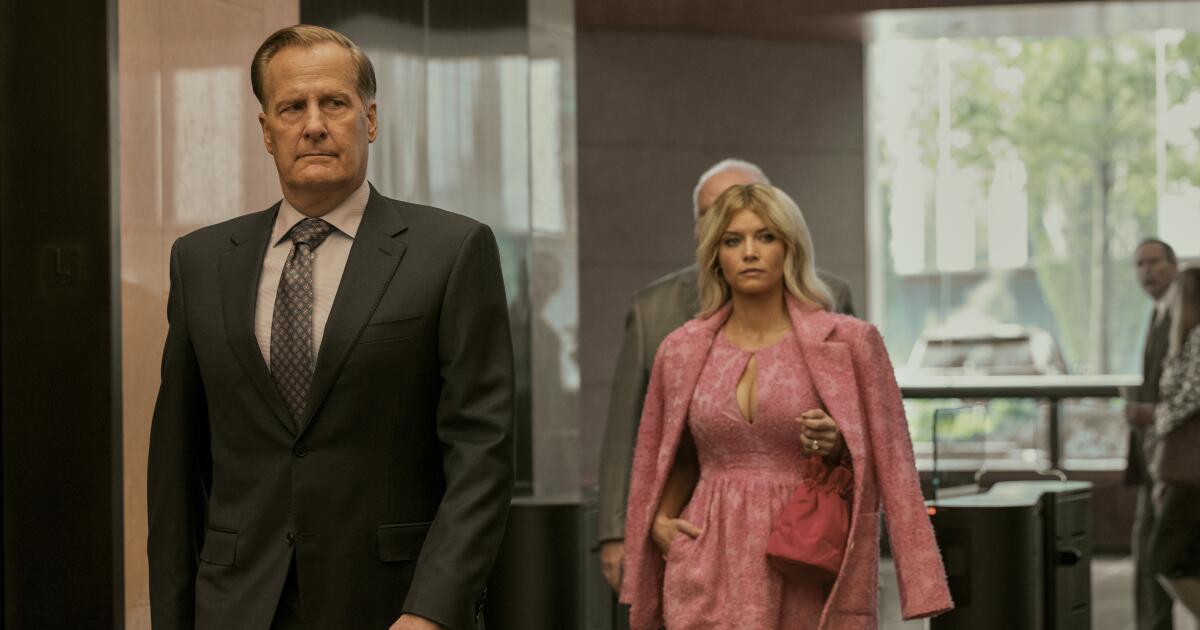
In 1998, Tom Wolfe published “A Man in Full,” a novel about (among other things) Charlie Croker, an Atlanta real estate developer whose business and world fall apart, and Conrad Hensley, a worker at one of Croker’s subsidiary businesses whose world also falls apart when he’s laid off.
Now David E. Kelley has written a television miniseries, premiering Thursday on Netflix, with similar characters in similar situations in the same setting, but so much is different, lost or added that adaptation hardly seems the right word. “David E. Kelley’s Tom Wolfe’s ‘A Man in Full’” might be closer to the mark.
Jeff Daniels stars as Charlie, a former college football star and celebrated businessman, whom we meet at his 60th birthday party being serenaded by Shania Twain. He has a young wife, Serena (Sarah Jones), an ex-wife Martha (Diane Lane), and a teenage son, Wally (Evan Roe), who has been suspended from school for expressing nonconformist thoughts.
Diane Lane plays Martha Croker, Charlie’s ex-wife, in “A Man in Full.”
(Mark Hill / Netflix)
He has private planes, a big house in leafy Buckhead, a country place called Turpmtine [sic] where he shoots quail and studs horses, and a skyscraper that ostentatiously bears his name, Croker Concourse. He also has debt amounting to more than a billion dollars and a bank that wants its money, stat. Oh, and a bad knee. Though the details are different, and Wolfe evidently had Atlanta figures in mind as models, one’s thoughts float easily toward Donald Trump, given the profession, the tower and the debt. And the narcissism, of course.
Charlie’s appointed persecutors are Raymond Peepgrass (Tom Pelphrey), a weedy midlevel bank officer who was involved in writing his loans and now is gleefully assisting in his downfall, and Harry Zale (Bill Camp), who specializes in working over big-shot deadbeats. Raymond, in his Dean Cain Clark Kent Collection glasses, and Harry, doing push-ups on his office floor, are caricatures of weakness and aggression.
Down among the little people, we find Conrad (Jon Michael Hill) driving a forklift in a Croker warehouse. Attempting to keep his car from being towed, he tussles with a policeman, and winds up in jail awaiting trial, surrounded by dangerous characters. In Kelley’s rejiggered flow chart, Conrad’s wife, Jill (Chanté Adams), has become Charlie’s executive secretary. Conrad and Jill, who are white in the book — and living in California — are Black in the series, which gives their storyline, heavily altered in other respects, a different sociopolitical flavor. (Charlie has his faults — indeed, he’s almost nothing but faults — but racism is not among them.) They are, unlike most of the people here, morally straight and pure of heart.
Meanwhile! Atlanta mayor Wes Jordan (William Jackson Harper) has called upon his old friend Roger White (Aml Ameen), whom Kelley also has working for Charlie as a general counsel, to help in a scheme to ensure his reelection — a scheme that requires the participation of Charlie, whose woes are not yet public and whom Atlanta reveres as a football hero.
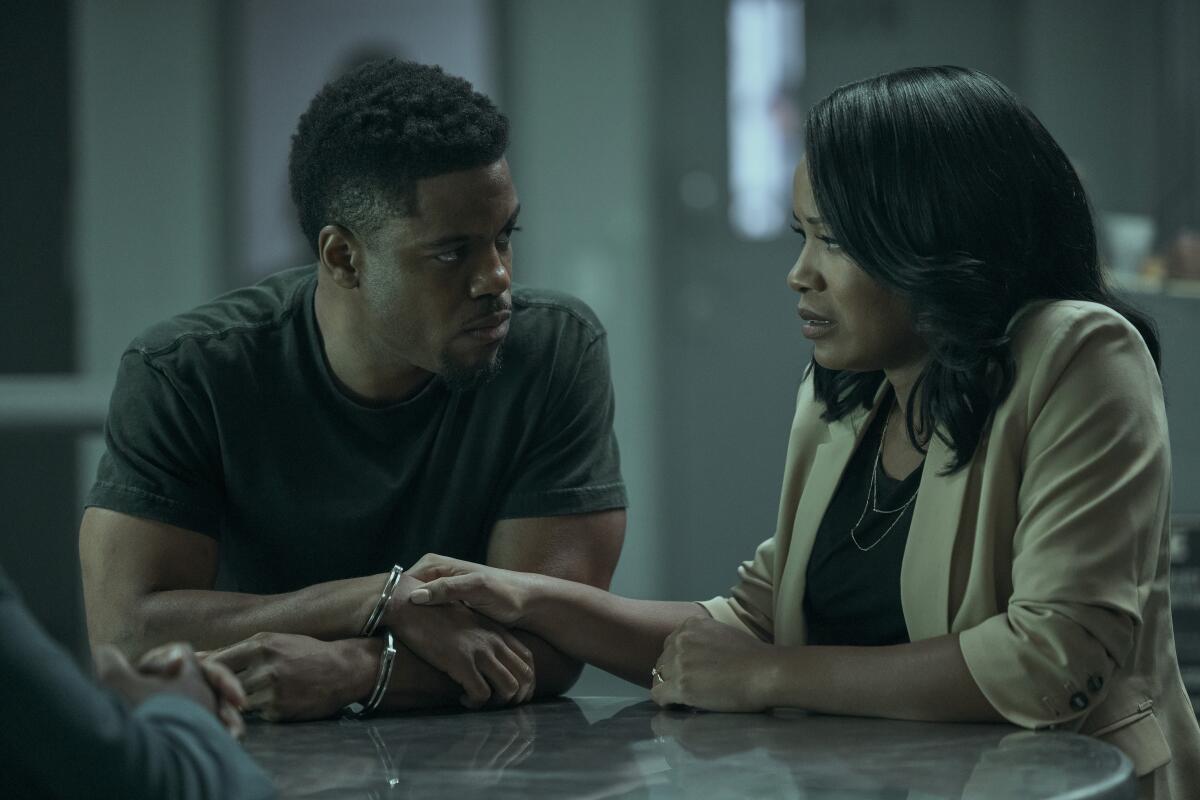
Conrad (Jon Michael Hill), left, and Jill (Chanté Adams) are among the characters whose backgrounds differ in the series from those in the book.
(Mark Hill / Netflix)
Performative manliness, which is to say sexual insecurity, is practically the theme of the series, expressed in petty power plays and phrases unrepeatable here except by tortuous euphemism, when one man describes what he’s going to do to another man by way of humiliating him. (Dudes are such children.) Conversely Kelley has given the women — including Lucy Liu as Martha’s friend Joyce, Jerrika Hinton as Roger’s wife, Henrietta, and Eline Powell as Sirja, who has a paternity suit against Raymond — more dimension and agency than Wolfe thought to. And they’re mostly decent.
If we take the position that character is as important, or more important, than plot, “A Man in Full” succeeds at least in that it gives Daniels a role to make a meal of. He brings Wolfe’s Charlie to bigger-than-life life, and manages even to evoke a viewer’s sympathetic interest, between conscientiously undermining it. But apart from Charlie, through whom each story thread passes, most other characters don’t have enough, or good enough material to seem quite real, and many are just unpleasant. An unlikable character without an inner life is merely unlikable — and uninteresting.
Does a dramatic adaptation of a literary work need to stick strictly to the source? Not really, if the new version is successful in its own right, on a par with the original in ambition or energy or tone, or is so weird as to make comparisons moot. And for what it’s worth, Kelley has completely rewritten the ending.
Wolfe’s book is big and long and packed with characters and conversation; there’s an earthquake, and a prison escape, which are not on the menu here. (Streamlining is unavoidable, and earthquakes are expensive to stage.) “A Man in Full” comes off as smaller and shallower and more obvious than the novel, and on its own feels like not the best episode of one of Kelley’s old soap-operatic lawyer shows. As television, it’s very much like … television. Which, depending what you’re after, might be enough.



That’s both a promise and a challenge she delivers, since what follows may rub some viewers the wrong way. Yet Gyllenhaal’s full-throttle commitment to her vision is compelling in and of itself, and she has marshalled an absolutely smashing-looking and -sounding production. The story proper begins in 1936 Chicago, which, like everything and everyplace else in the movie, has been luminously shot by cinematographer Lawrence Sher and sumptuously conjured by production designer Karen Murphy. Her involvement is appropriate given that her previous credits include Bradley Cooper’s A STAR IS BORN and Baz Luhrmann’s ELVIS, since among other things, THE BRIDE! is a nostalgic musical. Its Frankenstein (Christian Bale), who has taken the name of his maker, is obsessed with big-screen tuners, and imagines himself in elaborate song-and-dance numbers. (Considering the reception to JOKER: FOLIE À DEUX, one must applaud the daring of Warner Bros. for greenlighting another expensive film in which a tormented protagonist has that kind of fantasy life.)
THE BRIDE! may be revisionist on many levels, but its characterization of its “monster” holds true to past screen incarnations from Karloff’s to Elordi’s: His scarred appearance masks a lonely soul who desires companionship. Frankenstein has arrived in Chicago to seek out Dr. Cornelia Euphronious (Annette Bening), correctly believing she has the scientific know-how to create an appropriate mate for him. Rather than piece one together, Dr. Euphronious resurrects the corpse of Ida (Jessie Buckley), whose consorting with underworld types led to her brutal death. Previously chafing against the man’s world she inhabited in life, she becomes even more defiant and unruly as a revenant, apparently possessed by the spirit of Shelley herself, declaiming in free-associative sentences and quoting rebellious literature.
Buckley, currently an Oscar favorite for her very different literary-inspired role in HAMNET, tears into the role of the Bride (who now goes by the name Penny) with invigorating abandon that bursts off the screen. Unsure of her identity yet overflowing with self-confident bravado, she’s the opposite of the sensitive “Frank,” but they’re united by the world that stands against them. That becomes literal when a violent incident sends them on the lam, road-tripping to New York City and beyond, on a trail inspired by the films of Ronnie Reed (Jake Gyllenhaal), Frank’s favorite song-and-dance-man star.
With THE BRIDE!, Gyllenhaal has made a film that’s at once her very own and a feverish homage to all sorts of cinema past and present. It’s a horror story, a lovers-on-the-run movie, a crime thriller, a musical and more, and historical fealty be damned if it makes for a good scene (as when Penny and Frank sneak into a 3D movie over a decade before such features became popular). In-references are everywhere: It might just be a coincidence that the couple’s travels take them past Fredonia, NY (cf. “Freedonia” in the Marx Brothers’ DUCK SOUP), but it’s certainly no accident that the former Ida is targeted by a crime boss named Lupino, referencing the actress and pioneering filmmaker whose works included noirs and women’s-issues stories. Penny’s exploits lead legions of admiring women to adopt her look and anarchic attitude, echoing the first JOKER (while a headline calls them “Twisted Sisters”), and the use of one Irving Berlin song in a Frankensteinian context immediately recalls a classic comedic take on the property.
Whether the audience should be put in mind of a spoof at a key point in a film with different goals is another matter. At times like these, Gyllenhaal’s pastiche ambitions overtake emotional investment in the story. As strong as the two lead performances are (Bale is quite moving, conveying a great deal of soul from behind his extensive prosthetics), it’s easier to feel for them in individual scenes than during the entire course of the just-over-two-hour running time. The diversions can be entertaining, to be sure, but they also result in an uncertainty of tone. The dissonance continues straight through to the end, where the filmmaker’s choice of closing-credits song once again suggests we’re not supposed to take all this too seriously.
There’s nonetheless much to admire and enjoy about THE BRIDE!, and this kind of risk-taking by a major studio is always to be encouraged (especially considering that we’ll see how long that lasts at Warner Bros. once Paramount takes it over). Beyond the terrific work by the aforementioned actors, there’s fine support from Peter Sarsgaard and Penelope Cruz as detectives on Penny and Frank’s heels, with Sandy Powell’s lavish costumes and Hildur Guðnadóttir’s rich, varied score vital to fashioning this fully imagined world. Kudos also to makeup and prosthetics designer Nadia Stacey and to Chris Gallaher and Scott Stoddard, who did those honors on Frank, for their visceral, evocative work. Uneven as it may be, THE BRIDE! is also as alive! as any film you’ll likely see this year.

New animated sequences of songs from “Encanto,” “Frozen 2” and “Moana 2” are headed to Disney+.
Disney Animation announced Wednesday that “Songs in Sign Language,” comprised of three musical numbers from recent Disney movies newly reimagined in American Sign Language, will debut April 27 in honor of National Deaf History Month.
Directed by veteran Disney animator Hyrum Osmond, “Songs in Sign Language” will feature fresh animation for “Encanto’s” chart-topper “We Don’t Talk About Bruno,” “Frozen 2’s” poignant ballad “The Next Right Thing” and “Moana 2’s” anthem “Beyond.” Produced by Heather Blodget and Christina Chen, the new versions of these songs were created in collaboration with L.A.-based theater company Deaf West Theatre.
“In the majority of cases, we created entirely new animation,” Osmond said in a press statement. “There were a lot of adjustments that we had to do within the animation to be true to the original intention.”
Deaf West Theatre artistic director DJ Kurs, sign language reference choreographer Catalene Sacchetti and a group of eight performers from Deaf West worked together to craft and choreograph the ASL version of the musical numbers for “Songs in Sign Language.” The creatives focused on being true to the concepts and emotion of the songs rather than direct translations of the lyrics.
Kurs said his team jumped at the chance to collaborate and integrate ASL into “the fabric of Disney storytelling.”
“Disney stories are the universal language of childhood,” Kurs said in a statement. “The chance to bring our language into that world was a historic opportunity to reach a global audience. Working on this project was very emotional. For so long, we have known and loved the artistic medium of Disney Animation. Here, the art form was adapting to us. I hope this unlocks possibilities in the minds and hearts of Deaf children, and that this all leads to more down the road.”
Osmond, who led a team of more than 20 animators on this project, said animation was the perfect medium to showcase sign language, which he described as “one of the most beautiful ways of communication on Earth.” The director, whose father is deaf, also saw this project as an opportunity to connect with the Deaf community.
“Growing up, I never learned sign language, and that barrier prevented me from really connecting with my dad,” Osmond said. “This reimagining of Disney Animation musical numbers helps bring down barriers and allows us to connect in a special way with our audiences in the Deaf community. I’m grateful that the Studio got behind making something so impactful.”

(Credits: Far Out / Elevation Pictures)
Maxime Giroux – ‘In Cold Light’
The action is relentless in the complex thriller In Cold Light, a tense combination of crime and fugitive tale and family drama. It is the third feature and first English language film by Maxime Giroux, best known for a very different kind of film, the critically acclaimed 2014 drama Felix & Meira.
The tension and high energy of In Cold Light almost overwhelm the film, but are relieved, barely, by moments of character development and introspection that keep the audience pulling for the restrained and outwardly cold main character.
Speaking at the film’s Canadian premiere, director Giroux admitted he found creating an action film a challenge. Part of his approach was using very minimal dialogue, especially for the central character, letting the action speak for itself, and allowing silence to intensify suspense. Giroux has said he likes the lack of dialogue and speaks highly of the importance of silence in cinema; he prefers using “physical aspects of communication” in his films.
Young Ava Bly (Maika Monroe) is a competent and businesslike drug dealer, working in partnership with her brother Tom (Jesse Irving) and a small team. As the film begins, Ava has just been released from a brief prison sentence. She is hoping to return to her former position, but her brother’s associates consider her a risk due to her recent incarceration. While she works to re-establish herself, a shocking encounter with a corrupt police officer sends Ava’s life into chaos and forces her to go on the run.
Ava’s fugitive experience introduces a new character, to whom Ava turns for help: her father, Will Bly, played by Troy Kotsur, known for his excellent performance in CODA. Their first interaction is handled in a fascinating way, as Will is deaf and the two communicate through sign language. This, of course, provides another form of the silent interaction the director prefers; he explained that much of the father-daughter interaction was rewritten with the actor in mind. Their conflict is nicely expressed through a scene in which their initial conversation is intermittently cut off by a faulty light which goes out periodically, making communication through sign momentarily impossible, nicely expressing the rift between father and daughter.
As Ava continues to evade danger, her escape becomes complicated by new information, placing her in a painful dilemma. We gradually learn more about Ava, her background, and her character through occasional flashbacks and glimpses of her dreams. The plot becomes more complex and more poignant, and gains features of a mystery as well as an action tale, as she is pressed to choose from among equally unacceptable alternatives.
The climax of her efforts to protect both herself and those close to her comes to a head as she meets with the director of a rival drug gang. Veteran actress Helen Hunt is perfect in the minor but significant role of Claire, the rival drug lord, who plays odd mind games with Ava in an intriguing psychological fencing match. It’s an unusual scene, in which Ava’s personality is made clearer, and Claire’s understated dominance and casual speech do not quite conceal the threat she represents.
The frantic pace and emotional turmoil are enhanced by the camera work, which tends to focus tightly on Ava, and by a harsh, minimal musical score that sets the tone without distracting from the action. Giroux chose to shoot the film in Super 60; he describes digital as “too perfect” for the look he was going for, and since “Ava is rough,” the film portrays her better. The director describes the entire movie as “rough,” in fact, and deliberately chose a dark, washed-out look for much of the footage, occasionally using light and colour, in the form of fireworks, lightning, or a colourful carnival, to both relieve and emphasise the darkness.
The dynamic, intense story holds the attention in spite of the lengthy, sometimes repetitive chase scenes and subdued dialogue. Ava’s predicament, and the difficult decisions she is forced to make, are made surprisingly relatable, from the initial disaster that starts the action to the surprising flash-forward that concludes the film, on as high a note as the situation could allow. Fans of action movies will definitely enjoy this one.

Detroit Tigers 2026 roster prediction 2.0: Is Kevin McGonigle ready?

Latest California-based gig work app lets people book content creators, editors

Study says the real value of a $100K salary in Dallas is…less than that

Miami’s own Marcello Hernandez delivers special tribute to former teacher on SNL

When did Southie get richy-rich? – The Boston Globe

Florida High School Football Rankings: Top 25 teams – Oct. 21

Cleary's 21 help Le Moyne down Central Connecticut State 69-64 in OT

How old is Bo Nix? What to know about Oregon quarterback ahead of 2024 NFL Draft

99th annual Pony Swim held in Virginia

Indiana Members Credit Union announced as new anchor tenant at Bottleworks District

DHS defends McLaughlin against allegations husband’s company profited millions from ad contracts: ‘Baseless’

Sánchez defies Trump in political gamble as Madrid say no to war

Satellite images show Iran school strike hit more buildings than earlier reported

US submarine sinks Iranian warship by torpedo in a first since World War II

Which oil and gas facilities in the Gulf have been attacked?
-

 World1 week ago
Exclusive: DeepSeek withholds latest AI model from US chipmakers including Nvidia, sources say
-

 Massachusetts1 week ago
Mother and daughter injured in Taunton house explosion
-

 Wisconsin3 days ago
Setting sail on iceboats across a frozen lake in Wisconsin
-

 Maryland4 days ago
AM showers Sunday in Maryland
-

 Denver, CO1 week ago
10 acres charred, 5 injured in Thornton grass fire, evacuation orders lifted
-

 Florida4 days ago
Florida man rescued after being stuck in shoulder-deep mud for days
-

 Oregon6 days ago
2026 OSAA Oregon Wrestling State Championship Results And Brackets – FloWrestling
-

 Massachusetts2 days ago
Massachusetts man awaits word from family in Iran after attacks