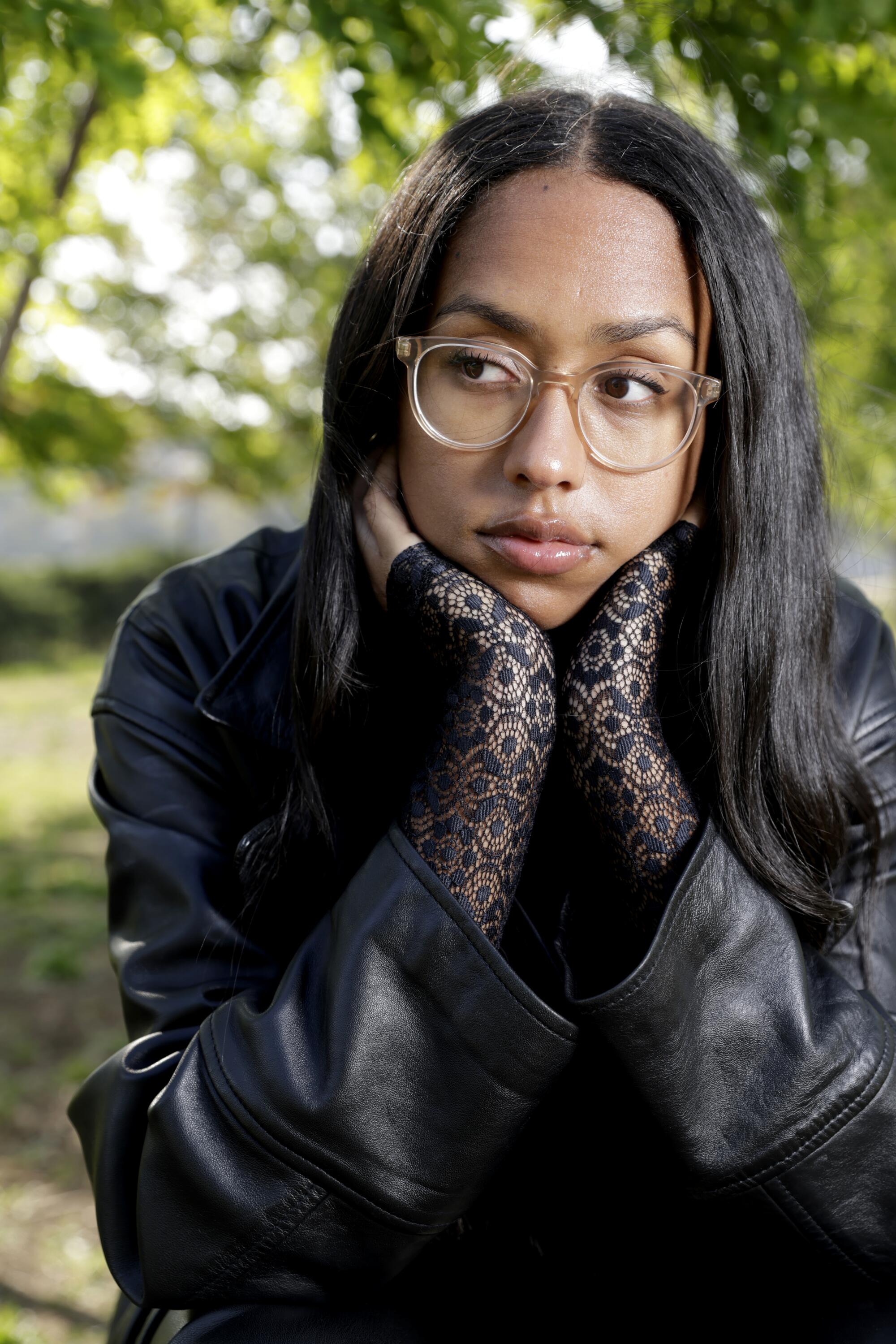
Jensen McRae is still chewing over something her therapist told her during their first session together.
“I was talking about how sensitive I am and how I was feeling all these feelings,” the 27-year-old singer and songwriter recalls, “and she was like, ‘You have yet to describe a feeling to me — everything you’ve described is a thought.’” McRae’s eyes widen behind her stylish glasses. “That destroyed me. She said, ‘Feelings are in your body. Thoughts are in your head.’
“This was like six years ago, and I think about it constantly.”
A proudly bookish Los Angeles native whose academic ambitions took her to the competitive Harvard-Westlake School, McRae wrote her first song at around age 8; by the time she was a teenager, music had become her way to cope with the cruelty of the world. Yet when she looks back at the stuff she wrote when she was younger, what strikes her isn’t that it was too raw — it’s that it wasn’t raw enough.
“I think I was trying to intellectualize my feelings to get away from being vulnerable,” she says. “Now I know there’s room for both — there’s a way to be intellectually rigorous about my sensitivity.”
Advertisement
Indeed there is, as McRae demonstrates on her knockout of a sophomore album, “I Don’t Know How But They Found Me!” Released in April by the respected indie label Dead Oceans (whose other acts include Mitski and Phoebe Bridgers), the LP documents the dissolution of two romantic relationships in gleaming acoustic pop songs that use gut-punch emotional detail to ponder complicated ideas of gender, privilege and abuse.
In “Massachusetts,” a snippet of which blew up when she posted it on TikTok in 2023, she captures the private universe she shared with an ex, while “Let Me Be Wrong” thrums with an overachiever’s desperation: “Something twisted in my chest says I’m good but not the best,” she sings, the rhyme so neat that you can almost see her awaiting the listener’s approving nod.
“I Can Change Him” is an unsparing account of the narrator’s savior complex that McRae was tempted to leave off the album until her team convinced her otherwise. “I think of myself as an evolved and self-actualized woman,” she says with a laugh. “So the admission that I thought it would be my love that transforms this person — I mean, it’s super embarrassing.” Then there’s “Savannah,” which lays out the lasting damage left behind after a breakup, and the chilling “Daffodils,” in which McRae sings about a guy who “steals base while I sleep.”
Advertisement
McRae’s songs don’t flinch from trauma, but they can also be very funny. “I’d like to blame the drugs,” she sings, longing for toxic old comforts in a song called “I Don’t Do Drugs.” And here’s how she brings the guy in “I Can Change Him” to life in just a few lines:
Same old eight-dollar cologne Same old he can’t be alone Same old cigarettes he rolls Same old Cozmo’s “Plastic Soul”
Asked whether she’d rather make someone laugh or cry, McRae needs no time to think. “I’m always proud when I make someone cry,” she says as she sits on a park bench in Silver Lake on a recent afternoon. “But more important to me than being the sad girl is that I’m funny — that’s way more important to my identity.” She smiles.
“I’ve definitely made dark jokes where people are like, ‘That’s horrible that you think you can joke about that,’” she says. “I’m like, ‘It’s my thing — the sad thing happened to me.’”
McRae’s music has attracted some famous fans. In 2024 she opened for Noah Kahan on tour, and she recently jammed with Justin Bieber at his place after the former teen idol reached out on Instagram with kind words about “Massachusetts.” Last month, McRae — a graduate of USC’s Thornton School of Music — played a pair of packed hometown shows at the El Rey where she introduced “Savannah” by telling the crowd, “You are not defined by the worst thing that ever happened to you.”
Advertisement
“Jensen is extremely … if I say the word ‘gifted,’ you’ll be like, ‘okay’ — but she truly is a gifted individual,” says Patrice Rushen, the veteran jazz and R&B musician who mentored McRae as chair of the Thornton School’s popular music program. (Among the classics McRae learned to perform during her studies was Rushen’s 1982 “Forget Me Nots.”) Rushen praises the depth and precision of McRae’s songwriting — “her ability to see beyond what’s right in front of her and to find just the right word or texture in her storytelling.”
“I adored her as a student,” Rushen adds.
McRae was born in Santa Monica and grew up in Woodland Hills in a tight-knit family; her dad is Black and her mom is Jewish, and she has two brothers — the older of whom is her business manager, the younger of whom plays keyboard in her road band.
The singer describes herself as both a goody two-shoes and a teacher’s pet, which she affectionately blames on her father, a lawyer who went to UCLA and Harvard Law School. “He was born in 1965 — his birth certificate says ‘Negro’ on it, which is crazy,” she says. “His whole life, it was: ‘You have to be twice as good to get half as far.’ And even though I was born in the ’90s, that was still kind of instilled in us.
“Especially being at Harvard-Westlake,” she adds. “I was one of the few Black kids, and I didn’t want to be underestimated. Now, I find being underestimated kind of funny because I have so much confidence in my own ability that when someone thinks I’m not gifted in whatever way, I’m like, ‘Oh, you’ll find out you’re wrong soon enough.’”
Advertisement
McRae studied songwriting at USC’s Thornton School of Music.
(Michael Rowe / For The Times)
Having absorbed the songwriting fundamentals of James Taylor, Sara Bareilles and Taylor Swift, McRae entered USC in 2015 and played her first gig — “the first one that wasn’t a school talent show,” she clarifies — at L.A.’s Hotel Cafe after her freshman year.
“I don’t know if my mom knows this, but I told her not to come,” she recalls with a laugh. “I was like, ‘I’m 18 — I’m grown up now — and I’m gonna be hanging with all these cool people.’” In fact, her audience that night consisted of only the bartender and the other acts on the bill.
Her creative breakthrough came when she wrote her song “White Boy” when she was 20. It’s about feeling invisible, and McRae knew she’d achieved something because “when I finished it, I was like, ‘I can never play this in front of anyone.’” A few years later, during the COVID-19 pandemic, she fired off a jokey tweet imagining that Bridgers would soon write a song about “hooking up in the car while waiting in line to get vaccinated at dodger stadium”; the post went viral, racking up shares from thousands of people, including Bridgers.
Advertisement
“I had to put my phone in a drawer because it was buzzing so much,” says McRae, who ended up writing the song herself and calling it “Immune.”
For “I Don’t Know How But They Found Me!” — the title borrows a line of dialogue from “Back to the Future” — McRae sought a lusher sound than she got on her folky 2022 debut; she recorded the album in North Carolina with the producer Brad Cook, who’s also worked with Bon Iver and Waxahatchee and who helped fill out the songs with appealing traces of turn-of-the-millennium pop by Avril Lavigne and Ashlee Simpson.
As a singer, McRae can expertly control the sob in her voice, as in “Tuesday,” a stark piano ballad about a betrayal made all the more painful by how little it meant to the traitor. At the El Rey, McRae doubled down on that theme in a florid yet intimate rendition of “I Can’t Make You Love Me,” the Mike Reid/Allen Shamblin tune that Bonnie Raitt turned into one of pop’s greatest anthems of dejection.
What did McRae learn about songwriting at USC? She mentions a technique called “toggling,” which one professor illustrated using John Mayer’s “Why Georgia.”
“The first line is, ‘I’m driving up ’85 in the kind of morning that lasts all afternoon,’” McRae says. “That’s a description of the outside world. Then the next line is, ‘I’m just stuck inside the gloom,’ toggling back to the internal emotion. That’s something I pay attention to now. If I’m writing a verse, I’ll do scene-setting, scene-setting, scene-setting, then how do I feel about it?”
Advertisement
McRae is particularly good at dropping the listener into a scenario, as in “Savannah,” which starts: “There is an intersection in your college town with your name on it.” To get to that kind of intriguing specificity, she’ll sometimes write six or eight lines of a verse, to discard the first few — “Those are often just filler words,” she says — and “rearrange the rest so that whatever I had at the end goes at the top. Now I have to beat that.”
For all her craft, McRae knows that songwriting is just one of the skills required of any aspiring pop star. She loves performing on the road, though touring has become “physically punishing,” as she puts it, since she was diagnosed a few years ago with a thyroid condition and chronic hives, both of which have led to a severely restricted diet. She recently posted a TikTok in which she detailed her regimen of medications — one attempt, she says, to bring some visibility to the topic of chronic illness. (That said, McRae admits to being unsettled by the DM she received the other day from a fan who recognized her at her allergist’s office: “They’re like, ‘Hey, I saw you — I was going in to get my shots too.’”)
McRae views social media more broadly as “a factory that I clock into and clock out of.” She’s well aware that it’s what enabled her to start building an audience. And she’s hardly anti-phone. “I love being on my phone,” she says. “I literally was born in the right generation. But when it comes to constantly looking at images of myself, that’s my business card or my portfolio — it’s not actually me, the human being.”
In January, she deleted TikTok during the brief outage related to President Trump’s ban of the app. “Then, of course, it came back right away, but I couldn’t re-download it. So for a month I didn’t have TikTok. As it turns out, I was fine.”
Advertisement
Arguably better?
“Probably, yeah. I’m back on it now, obviously, because I have to do promo. At first I thought it was the loudest, most overstimulating thing in the world — I couldn’t believe I used it. Then after a week, I was like, oh yeah, no, I’m reacclimated.”
Selected by Tajikistan but ultimately not accepted by the Academy to compete in the Oscar international feature category, “Black Rabbit, White Rabbit” begins ambitiously, with a famous quote from playwright Anton Chekhov about setups and payoffs — about how if a gun is established in a story, it must go off. Moments later, an inviting long take involving a young man selling an antique rifle ends in farcical tragedy, signaling an equally farcical series of events that grow stranger and stranger. The film, by Iranian director Shahram Mokri, folds in on itself in intriguing (albeit protracted) ways, warping its meta-fictional boundaries until they supersede its characters, or any underlying meaning.
Still, it’s a not-altogether-uninteresting exercise in exploring the contours of storytelling, told through numerous thematically interconnected vignettes. The opening Chekhov quote, though it might draw one’s attention to minor details that end up insignificant, ensures a heightened awareness of the movie’s artifice, until the film eventually pulls back and becomes a tale of its own making. But en route to this semi-successful postmodern flourish, its character drama is enticing enough on its own, with hints of magical realism. It begins with the tale of a badly injured upper-class woman, Sara (Hasti Mohammai), discovering that her car accident has left her with the ability to communicate with household objects.
Sara’s bandages need changing, and the stench of her ointment becomes a quick window into her relationships. Her distant husband rejects her; her boisterous stepdaughter is more frank, but ultimately accepting; her gardener and handyman stays as diplomatic as he can. However, the film soon turns the gunfire payoff in its prologue into a broader setup of its own, as a delivery man shows up at Sara’s gate, insisting that she accept delivery for an object “the deceased man” has paid for.
Mokri eventually returns to this story (through a slightly tilt-shifted lens), but not before swerving headfirst into a seemingly unrelated saga of extras on a film set and a superstitious prop master, Babak (Babak Karimi), working on a shot-for-shot remake of an Iranian classic. A mix of rapid-fire Tajik, Persian and Russian dialogue creates dilemma upon dilemma when Babak’s ID goes missing, preventing him from being able to thoroughly check the prop ammunition for an assassination scene.
Danger begins to loom — a recent Alec Baldwin case even warrants a mention on-screen — as the notion of faulty firearms yanks Chekhov’s wisdom front and center once more, transforming it from a writing tip into a phantasmagorical inevitability. In keeping with the previous story, the props even communicate with each other (through subtitles) and begin gossiping about what might come to pass.
Advertisement
After establishing these narrative parameters through unbroken, fluid shots filmed at a sardonic distance, Mokri soon begins playing mischievous temporal games. He finds worthwhile excuses to revisit scenes from either different angles or with a slightly altered aesthetic approach — with more proximity and intimacy — in order to highlight new elements of his mise-en-scène. What’s “real” and “fictional,” even within the movie’s visual parlance, begins to blur in surreal ways, largely pivoting around Babak simply trying to do his job. However, the more this tale engorges through melodic, snaking takes, the more it circles around a central point, rather than approaching it.
The film’s own expanse becomes philosophically limiting, even though it remains an object of curiosity. When it’s all said and done, the playfulness on display in “Black Rabbit, White Rabbit” is quite remarkable, even if the story’s contorting framework seldom amounts to much, beyond drawing attention to itself. It’s cinema about cinema in a manner that, on one hand, lives on the surface, but on the other hand, invites you to explore its texture in ways few other movies do.
Abraham Quintanilla, father and manager of the late Tejano pop icon Selena Quintanilla, has died. He was 86.
“It’s with a heavy heart to let you guys know that my Dad passed away today,” Quintanilla’s son, A.B. Quintanilla III, wrote on his Instagram account on Saturday. The cause of death has not been disclosed to the public.
As patriarch of the famous Mexican American music family, Quintanilla played a critical role in the development of his daughter Selena’s career. After her tragic death in 1995, he dedicated his life to safeguarding her legacy and overseeing primary control over her estate. This included managing the rights to her image, name and likeness — at times, to controversial ends.
Born in Corpus Christi, Texas, in 1939, Quintanilla began his music career as a member of the singing group the Dinos in 1956, a Chicano rock group that was met with racial discrimination. In one instance, a club owner paid the group not to perform after realizing they were Mexican American youth; but the group was also sidelined by its Mexican counterparts for not making Spanish-language music.
Quintanilla’s exasperation informed a real quote that was later made famous by actor Edward James Olmos, who played Quintanilla in the 1997 “Selena” biopic: “We have to be more Mexican than the Mexicans and more American than the Americans, both at the same time. It’s exhausting!”
Advertisement
Quintanilla would eventually step away from the group in the 1960s to start a family with Marcella Samora, whom he met in Tacoma, Wash., while serving in the U.S. Air Force. The family quickly grew following the births of A.B., Suzette and Selena. In them, he saw the potential to fulfill his own dreams of musical stardom.
With A.B. on bass, Suzette on drums and Selena as the tender vocalist, the trio would often perform at the family restaurant, PapaGayo’s, which later closed following the 1981 recession. The family was forced to sell their home in Lake Jackson, Texas, and move to Corpus Christi. In order to make ends meet, Selena y Los Dinos would perform on street corners, family parties and other social functions. Under the guidance of their father, who assumed the position of band manager, Los Dinos eventually signed with Freddie Records in 1984.
Selena was met with much skepticism from an early age as a young girl in a male-dominated genre, including by their first label head, Freddie Martinez. Still, Los Dinos persevered in the Tejano music scene, hopping from label to label before the group finally released eight albums under Manny Guerra’s independent labels, GP Productions and Record Producer Productions. With multiple albums under her belt, Selena was then able to dominate the Tejano Music Awards; she won the title of Female Vocalist of the Year in 1987.
Selena eventually caught the attention of Jose Behar, the former head of Sony Music Latin, who saw her crossover appeal — despite Selena’s primary language being English — and signed her to EMI Latin (Capitol Records) in 1989. This led to the release of her most career-defining hits across five albums, such as “Como la Flor,” “Amor Prohibido,” “Bidi Bidi Bom Bom” and the posthumously released ballad, “Dreaming of You.”
Following Selena’s murder in 1995 — by Yolanda Saldivar, the former president of her fan club — Quintanilla became a fierce protector of her image, which was often sensationalized by the public.
Advertisement
Because of the grisly and highly publicized nature of Selena’s death, Quintanilla felt that the film needed to be made sooner than later, in order to do justice to his daughter’s legacy, said “Selena” director Gregory Nava in a 2025 interview with De Los.
“For me, as a filmmaker, I wanted to really tell a true story,” said Nava. “I had conflict, not really with the family, but with Abraham. Her father was very protective of her.”
Tensions flared most when Nava began to shape the story of the singer’s elopement with guitarist Chris Perez, whom she married in 1992.
“You can’t put on the screen that it’s right for a young girl to disobey her father,” Nava recalled Quintanilla saying.
“Isn’t it a more important point to make that she is doing what she knows is right? And [that] she’s doing the right thing because she knows she loves Chris and Chris loves her?” Nava responded.
Advertisement
Eventually, Quintanilla relented. “I guess if I have to look bad to make Selena look good, I’ll do it,” Nava recalled him saying. “He has a soft heart. He finally saw that was the right thing to do, but it took hours of heated discussion.”
Although Suzette has said that the 1997 biopic came too soon in her eyes — and prompted criticism of her father, who some viewed as money-hungry and opportunistic — she ultimately stood by his decision, stating that there was a pressure within the family to control the narrative at the time.
Nava agreed.
“Abraham was very wise in pushing it through quickly,” he said. “Selena brought us all together, and it cemented her legacy in a positive way. All the negativity was dispelled by that movie. You see that in the film and you feel it.”
Kunal Nayyar in ‘Christmas Karma’
| Photo Credit: True Bit Entertainment/YouTube
Christmas jumpers are all I can remember of this film. As this reimagining of Charles Dickens’ A Christmas Carol dragged on with sickly-sweet sentimentality and song, my eyes constantly tried to work out whether those snowflakes and reindeer were printed on the jerseys or, if knitted, how complicated the patterns would have been.
Christmas Karma (English)
Director: Gurinder Chadha
Starring: Kunal Nayyar, Leo Suter, Charithra Chandran, Pixie Lott, Danny Dyer, Boy George, Hugh Bonneville, Billy Porter, Eva Longoria, Mia Lomer
Storyline: A miserly businessman learns the true meaning of Christmas when visited by ghosts of Christmas past, present and future
Advertisement
Runtime: 114 minutes
Gurinder Chadha, who gave us the gorgeous Bend it Like Beckham (who wants to make aloo gobi when you can bend the ball like Beckham indeed) has served up an unappetising Bollywood song-and-dance version of Dickens’ famous Christmas story.
A still from the film
| Photo Credit:
True Bit Entertainment/YouTube
A curmudgeonly Indian businessman, Ishaan Sood (Kunal Nayyar), fires his entire staff on Christmas Eve—except his accountant, Bob (Leo Suter)—after catching them partying at the office. Sood’s nephew, Raj (Shubham Saraf) invites him for a Christmas party which he refuses to attend.
He returns home after yelling at some carol singers for making a noise, the shopkeeper (Nitin Ganatra) at the corner for his business decisions and a cabbie (Danny Dyer) for being too cheerful.
His cook-housekeeper, Mrs. Joshi (Shobu Kapoor) tells him to enjoy his dinner in the dark as he has not paid for heat or electricity. He is visited by the spirit of his dead business partner, Marley (Hugh Bonneville), who is in chains with the spirits of all the people he wronged. Marley’s spirit tells Sood that he will be visited by three spirits who will reveal important life lessons.
Advertisement
A still from the film
| Photo Credit:
True Bit Entertainment/YouTube
The Ghost of Christmas Past (Eva Longoria), with Day of the Dead makeup and three mariachis providing musical accompaniment, shows Sood his early, happy days in Uganda as a child and the trauma of being expelled from the country by Idi Amin.
Sood comes to Britain where his father dies of heartbreak and decides the only way out is to earn a lot of money. He meets and falls in love with Bea (Charithra Chandran) but loses her when he chooses paisa over pyaar even though he tries to tell her he is being ruthless only to earn enough to keep her in luxury.
The Ghost of Christmas Present (Billy Porter) shows Bob’s twee house full of Christmas cheer, despite the roast chicken past its sell-by date, and his young son, Tim, bravely smiling despite his illness.
The Ghost of Christmas Future (Boy George, Karma is sure a chameleon!) shows Sood dying alone except for Bob and Mrs. Joshi. He sees the error of his ways and throws much money around as he makes everything alright. He even ends up meeting up with his childhood friend in Uganda.
Apart from the mixed messages (money makes everything alright, let us pray for the NHS but go to Switzerland to get well) and schmaltzy songs, Christmas Karma suffers from weak writing and wooden acting.
Advertisement
Priyanka Chopra’s Hindi rendition of George Michael’s ‘Last Christmas’ runs over the end credits featuring Chadha and the crew, bringing back fond memories of Bina Mistry’s ‘Hot Hot Hot’ from Bend it Like Beckham. Even a sitar version by Anoushka Shankar is to no avail as watching this version of A Christmas Carol ensures bad karma in spades.