

Tuner, now playing in theaters throughout Israel, is an offbeat, interesting drama and crime caper, with some funny moments.
Entertainment
Fashion model Peggy Moffitt has died

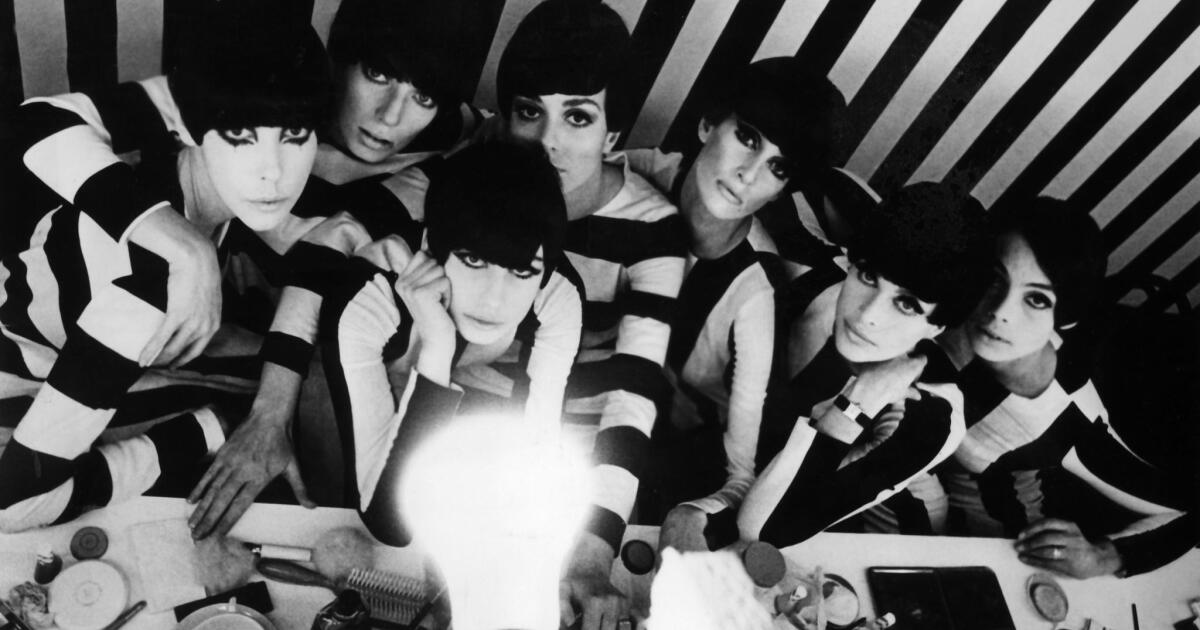
Peggy Moffitt, the L.A. fashion model whose Harlequin-like makeup and mime-inspired poses set her apart during the fashion free-for-all of the 1960s, has died at her home in Beverly Hills. She was 86.
Seemingly never out of vogue, Moffitt died Saturday from complications of dementia, her son, Christopher Claxton, told the New York Times.
As the muse of avant-garde designer Rudi Gernreich, she helped convey the futuristic themes of his collections with her unconventional style. She was known for her striking appearance, which included a mask-like white complexion, extended black lashes, black or bright colored eye shadows and an occasional sprinkling of daisies, teardrops or silver triangles on her cheeks.
Her haircut, a short geometric shape by Vidal Sassoon, added to her stylized look, which became an embodiment of the ’60s. She maintained the look long after her modeling career ended.
Moffitt caused a fashion sensation in 1964 when she posed in a topless swimsuit Gernreich designed. It was a racy variation on a schoolboy’s shorts, with suspenders rising between the cleavage. The suit was condemned by the Vatican, the Kremlin and the governments of the Netherlands, Denmark and Greece.
“I agreed to do it only when I finally believed that Rudi wasn’t exploiting me,” Moffitt said. “There really was a message and that message was ‘freedom.’”
Moffitt struck a shy schoolgirl pose before the camera as her husband, William Claxton, a well-known commercial photographer, took the picture in their living room. Several magazines requested something less revealing and Claxton took a second image, this time from the back. One or the other photograph appeared in newspapers and magazines around the world.
The following year, 1965, Moffitt posed in another bold Gernreich invention, a sheer “no-bra” with minimal structure that defied the padded underwear of the 1950s.
“In those days if a model was photographed in lingerie, that was it, she was definitely B-team,” Moffitt told the London Independent newspaper in an interview in 1992.
Richard Avedon, a top photographer for Vogue magazine, was hired to take the picture and Moffitt agreed to pose. “My teenage dream was to have a swimming pool and to work with Avedon every day,” she later confessed.
Her early modeling risks paid off. During Gernreich’s comet ride through fashion’s memorable decade, Moffitt was the free spirit at his side.
“Peggy Moffitt was the epitome of the muse,” said Patty Fox, a former fashion director for Saks Fifth Avenue. “Someone who not only inspired a certain designer but was identified with his work and became a lifelong friend.
“You can’t compare her to supermodels,” Fox said. “They are classically beautiful. She had a look. She created it and stayed with it, something more artificial than natural. She pushed it over the top.”
Moffitt’s distinctive appearance and manner made strong impressions.
“I was told I couldn’t model by every tacky editor and photographer in the world,” Moffitt told author Joel Lobenthal for his book “Radical Rags: Fashions of the Sixties.” Moffitt‘s answer was that she wanted to invent a new way of modeling that raised “the possibility of it being a new art form.”
In carefully planned fashion shows, she changed her attire to suggest first a “Japanese school girl,” then a “Chinese opera star,” among other roles.
“I entertained myself and the audience by regarding the collection as a play, with each outfit a new act or a new character,” Moffitt wrote in “The Rudi Gernreich Book,” which she and Claxton released in 1991. “That meant … drama, jokes, tension and slapstick. I really didn’t model the clothes so much as perform them.”
By the mid-1960s her face and Gernreich’s fashions were inseparable. “We were like Tweedledum and Tweedledee, Gilbert and Sullivan, ham and eggs,” she said. They hardly bothered to explain new ideas to each other. “We just knew,’’ Moffitt said. “We became one entity.”
Born in Los Angeles in 1937, the only child of film reviewer and writer Jack Moffitt, Moffitt traced her interest in extreme fashion and makeup to her high school years at the Marlborough School in Los Angeles. Students were required to wear uniforms and forbidden to wear lipstick. ‘’Perhaps therein lies the key to what came next,” she told the Independent in 1992.
At 17, she worked after school at Jax, a Rodeo Drive boutique that carried designer brand clothes including some by Gernreich. But she planned to be an actress, not a fashion model. She graduated from school and went to New York City, where she studied acting at the Neighborhood Playhouse for two years. Back in Los Angeles she got small parts in several movies, including “You’re Never Too Young” with Jerry Lewis in 1955 and “The Birds and the Bees” with David Niven and Mitzi Gaynor in 1956.
She met Claxton when he was on assignment photographing an actor friend of hers. They were engaged within a few months and married within the year.
Gernreich, Moffitt and Claxton worked to create fashion photographs that were instantly identified with Gernreich’s designs. One of the best known shows Moffitt wearing a stretch knit swimsuit with fencer’s visor and tall boots. In another she wears a mini-dress with clear vinyl stripes that expose bits of her midriff and thigh. The white seamless background in the photos kept the attention on Gernreich’s creations and Moffitt’s evocative poses.
She continued testing new ways to mix fashion and theater. “I’ve got 47 seconds to knock them into Peggy-land,” Moffitt told The Times in 1967. She had recently modeled in a fashion show that ended with her playing mad Ophelia from Shakespeare’s “Hamlet.” Dressed in a mini-wedding dress by Gernreich, she entered mumbling and staring and ended by screaming as she ran out of the room. “I’m a Method actress at heart,” she explained.
Her modeling style didn’t set trends but Twiggy, London’s waif-like teenage supermodel, credited Moffitt with influencing her. “She taught me how much more a model puts into her work than just a pretty face,” Twiggy wrote in “Twiggy: An Autobiography.” “She consciously controlled the sort of shape she presented to the camera.”
Moffitt admitted her close association with Gernreich came with its limitations. “People thought we were joined at the hip,” she told the Independent in 1992. “It was essential to separate from time to time.”
In the mid-1960s Moffitt and Claxton began spending more time in Europe than Los Angeles. He had photography assignments in London and Paris. She modeled and got a small part in “Blow Up,” the 1966 film classic about the British modeling scene, directed by Michelangelo Antonioni.
In the early 1970s they returned to Los Angeles where their only child, Christopher, was born. Moffitt is survived by her son. Claxton died in 2008.
She continued working with Gernreich. That, and her distinctive appearance, limited her options. When Gernreich died in 1985, Moffitt quit the fashion scene.
Decades after she first posed in Gernreich’s styles, the A-line minidresses of that time made a fashion comeback. Moffitt said in interviews that she hoped to find investment partners, reproduce Gernreich’s designs and put her name on the label with his.
“I said to the trademark office that my physicality is representative of Rudi in the way that Mickey Mouse represents Walt Disney,” she explained in a 1998 interview with Vanity Fair magazine.
Even late in life, Moffitt never stopped wearing Gernreich’s designs. She owned more than 300 pieces, some of which were featured in 2012’s “The Total Look,” an exhibition at the Museum of Contemporary Art at the Pacific Design Center, which explored her creative collaboration with Gernreich.
She owned the legal rights to all of the late designer’s creations and had hoped to relaunch the Gernreich brand.
“That I am still wearing his clothes 50 years later is as good a recommendation for someone’s talent as any,” she told The Times in 2013. “The times have changed, but his clothes still hold up for the way we live today.”


In 2015, musician Roberto Carlos launched Boleros de Noche, an annual concert series held in Los Angeles that aimed at preserving and showcasing the Latin American bolero music genre.
This year, the event is celebrating its 10th anniversary with performances at the Ford on Aug. 1 by Puerto Rican singer and former Calle 13 member iLe and L.A.-based bolero trio Voz Bohemia
On Friday, the city of L.A. honored the series’ decade-long run and legacy of uplifting bolero music by declaring Aug.1 “Día del Bolero.”
Boleros are ballads noted for their slow tempo and romantic lyrics accompanied by a crooning vocal style. Though the genre originated in Cuba, it quickly gained popularity across Latin America, with each culture putting their own spin on it. In the early 20th century, the evolving sound of boleros was shaped by the Cuban group Trio Matamoros, Mexican composer Agustín Lara, Puerto Rican artist Rafael Hernández and Ecuadorian singer Julio Jaramillo.
The genre saw a resurgence in popularity in the 1980s and ‘90s when famed Mexican artists Juan Gabriel and Luis Miguel embraced the bolero sound. In recent years, the bolero movement has been modernized and electrified by artists such as Mon Laferte, Romeo Santos, Adrian Quesada and Kali Uchis. In the last five years, Quesada has released two bolero albums, “Boleros Psicodélicos” and “Boleros Psicodélicos II,” that mix the genre’s classic sounds with elements of psychedelic rock.
“Over the past decade, Boleros de Noche has presented numerous concerts featuring both local and international artists, has brought together thousands of people across the city to bask in the lush orchestration of this music,” said City Councilmember Nithya Raman, who presented Carlos with the honor. “For so many in the Latino community and beyond, this isn’t just music, it’s memory, it’s home, and perhaps most importantly, it’s heritage being carried forward.”
Raised in L.A. County by parents who immigrated from the Mexican state of Oaxaca, Carlos says he first fell in love with live performance and bolero music in his midteens, when he would frequent the now-defunct Teatro los Pinos in South Gate.
He yearned for that same level of comfort and awe at music and wanted to share that with a larger audience. The first iteration of Boleros de Noche took place in 2015 at an art gallery in Echo Park.
“Over the years, I have heard countless stories from audience members who tell me how this music reminds them of their parents, grandparents, first loves and family traditions,” Carlos said Friday at City Hall. “Ten years ago, bolero was rarely part of our city’s cultural conversation, and today bolero programming can be found across Los Angeles, and I’m honored that Boleros de Noche has been a driving force behind its growth.”
Boleros de Noche has sold out shows at the Ford over the last few years and has featured artists such as Gaby Moreno, Marisoul and the legendary trio Los Panchos. In 2025, the event made its debut at Chicago’s historic Symphony Center.
The bolero genre’s popularity and cultural significance has been spotlighted outside of L.A. in recent years as well.
On Dec. 5, 2023, UNESCO, the United Nation’s agency aimed at safeguarding social and cultural foundations, recognized the musical genre as an Intangible Cultural Heritage of Humanity.
As part of Friday’s ceremony, Carlos and his bolero group Los Rebeldes Románticos performed several tunes, including the Mexican bolero classic “Sabor a Mí.”
Last year, Carlos spoke with The Times about his ambitions for Boleros de Noche and the mentality that drives the event series.
“At Boleros de Noche, [I want] for us to speak in Spanish, to feel recognized, to do this music as a celebration for all these artists that unfortunately became background music for a lot of like weddings and quinceañeras,” he said. “How about if we celebrate them and give them recognition? How about if, through my events, I can take people back to the 1940s to my experience at Teatro los Pinos?”
Given recent attacks on Latinos on the local and national levels, Carlos said he hoped his events would create a safe and welcoming gathering place.
“It’s about bolero music. It’s about community. It’s about people. It’s about the musicians,” he said. “Many of the musicians were undocumented. They brought this music to L.A. through their hometowns.”
Movie Reviews
Film review: ‘Tuner’ mixes classical music, crime, and Dustin Hoffman | The Jerusalem Post

It co-stars Dustin Hoffman in a story of a young piano tuner, Niki (Leo Woodall), a former music prodigy with perfect pitch who suffers from hyperacusis, a condition that makes him extraordinarily sensitive to loud noises.
In a series of events that are a bit improbable but that seem quite credible while you’re watching, Niki discovers his finely tuned hearing gives him a great talent for safecracking, which brings him to the attention of a crime gang.
It features a clever, often surprising screenplay, co-written by its director, Daniel Roher (who won an Oscar for the documentary, Navalny) and Robert Ramsey. There are also wonderful performances from the cast, which also includes distinguished actress Tovah Feldshuh of Nobody Wants This and Fauda star Lior Raz.
The characters have a nice, funny raport
When Tuner opens, Niki is working in a piano-tuning business in New York with a former musician, Harry Horowitz (Hoffman).
The beefy, laconic, young man treats the garrulous, wisecracking Harry with respect, listening patiently to all his jokes and stories about the good old days when he worked with jazz greats.
These two have a nice rapport, as Niki drives Harry all over the New York area in an old van and eats in diners with him.
Niki does the work while Harry sits on a sofa, critiquing him.
The two stick out like sore thumbs in the many mansions where they work on spectacular pianos that haven’t been played in decades, for clients who ask them if they can also repair toilets and modems.
Harry, who never made much of a living despite his talent, has fallen on hard times, and he and his wife, Marla (Feldshuh), are barely scraping by. Niki is also broke.
Recognizing what a great musician Niki is, Harry tries to cajole him into playing again, but the younger man refuses, living an isolated life and trying not to draw attention to himself.
The three incidents that set the plot in motion
Harry has forgotten the combination to his safe and needs to open it. When Niki goes on YouTube to look at a video on how to do it, he discovers that his sensitive hearing makes him a genius at safecracking.
Harry becomes ill and, due to a mess with Medicare, suddenly falls into a huge debt; and Niki meets Ruthie (Havana Rose Liu), an extremely ambitious pianist and composing student, who is astounded by his perfect pitch.
Soon, Niki’s talent for safecracking draws the attention of Uri (Lior Raz), an Israeli who runs a bogus security company, where he uses his knowledge of his client’s homes and passwords to steal what he contends are minor trinkets, but which add up to big money for his gang, much like Jon Hamm’s character in the Apple TV series, Your Friends and Neighbors.
Raz hams it up as a character who fits the stereotype of the obnoxious Israeli in the US, and lords it over his supposedly bright accomplice, Yoni (Gil Frank), and his much dimmer nephew, Benny (Nissan Sakira).
Much of the comedy in the movie comes from Uri browbeating the two, and if you can understand the Hebrew, it’s even funnier than the subtitles.
Criticisms of Tuner
Niki’s romance with Ruthie, which develops quickly, feels a little convenient at times, though the screenplay paints a realistic picture of the competitive world of high-level music students. You know, for most of the movie, that eventually Niki will reveal to her that he was once a great pianist, and when it comes, it’s something of an anti-climax.
After Hoffman’s character gets sick, he disappears from the rest of the movie except for a couple of scenes, and that’s too bad. It’s great to see Hoffman having fun as Harry, and the scenes where he and Niki banter help humanize the younger man, making him more likable and less self-centered.
Woodall is one of the most in-demand young actors. He played a hunky love interest in both Bridget Jones: Mad About the Boy and the Netflix series Vladimir; he also appeared in the second season of The White Lotus.
He has a buff body and conventional leading-man good looks, and generally plays confident, happy-go-lucky guys, which means he is cast against type here.
Niki is the kind of role that might seem better suited for actors like Josh O’Connor, Jeremy Allen White, or Timothée Chalamet. Woodall has to work hard to convince us he is withdrawn and feels out of place in all the mansions where he tunes pianos, but his charm wins out, and soon, you come to accept him in the role.
Mixed music and mixed genres
The soundtrack features a mix of classical music and jazz, and it’s clear it was made by a director who appreciates both.
Tuner settles neatly into a mini-genre of movies that feature plot lines that combine piano-playing characters and crime, that include James Toback’s Fingers with Harvey Keitel, and Jacques Audiard’s remake of it, The Beat that My Heart Skipped with Romain Duris; Francois Truffaut’s Shoot the Piano Player with Charles Aznavour; and Eugenio Mira’s Grand Piano with Elijah Wood. It also recalls the spirit of Bob Rafelson’s Five Easy Pieces, which features Jack Nicholson in one of his best performances; here as a piano prodigy who has rejected his oppressive family and become an oil field worker.
Tuner shares some of the bleakness typical of 1970s films, like Fingers and Five Easy Pieces. At times, the movie moves jarringly between brooding, almost noir-like darkness and scenes with the chatty Harry or the bumbling gangsters.
It might have been a stronger film if Roher had gone in one direction instead of mixing genres, but it would likely have been less entertaining.

Tom Sandoval’s girlfriend Victoria Lee Robinson was arrested after the two had an altercation that involved her father being pushed into a lit fire pit.
Sandoval, known for the cheating “Scandoval” that erupted on the reality television series “Vanderpump Rules,” filed a restraining order against the model and her father J. Will Robinson (who goes by Will) over a June 3 incident that was partially caught on video. He was granted a temporary restraining order and a subsequent hearing was set for July 16.
According to court documents obtained by The Times, the altercation involving Sandoval, Victoria Robinson and J. Will Robinson happened in the early morning hours after the couple returned home from a night out at a bar. Sandoval claimed in the petition that since the two became a couple in February 2024, Victoria Lee Robinson has been violent and attacked him physically, as well as changing the passwords on his phone and social media and tracking him using Airtags.
“The most recent physical incident occurred on June 3 when [she] punched my face and injured my neck and ear. During this same incident, Mr. Robinson, grabbed me and punched an approximately 12-inch hole in the door of my spare bedroom where I was barricading myself,” reads the petition.
In a video, obtained by TMZ, that captured part of the June 3 incident, Victoria Robinson and Will Robinson are seen sitting next to a lit fire pit on the patio when Sandoval and Will Robinson begin arguing. Sandoval is heard yelling at Will Robinson before he asks Victoria Robinson if she is recording and approaches her. Will Robinson stands and wraps his arms around Sandoval, seemingly to get him to back away from Victoria Robinson, and Sandoval turns and pushes Will Robinson, who falls backward into the lit fire pit.
After Will Robinson gets back up, he rushes after Sandoval into the home while Victoria Robinson screams for the men to stop.
According to the petition, the fight escalated, and Will Robinson phoned the police while Sandoval hid inside a spare bedroom. When police arrived, the petition claims that they initially put Sandoval in handcuffs, but after reviewing footage, Victoria Robinson was arrested for intimate partner battery with physical violence.
Robinson bonded out and was released the same day. The Los Angeles Police Department was not able to confirm the reason for Victoria Robinson’s arrest.
Representatives for Sandoval did not immediately respond to The Times’ request for comment. Victoria Robinson could not be reached for comment.
According to the petition, both Victoria Robinson and her father have lived in the Los Angeles rental home with Sandoval. According to the filing, the reality star hopped between hotels and friends’ houses after the June 3 incident.
Will Robinson told TMZ, “The DA did not file the case for a reason. I lifted Tom off of my daughter because he was overpowering and twisting her arm and trying to take her phone aggressively after yelling at us in a very aggressive and threatening manner.”
“This is my daughter’s home and we just want Tom as far away from us as possible and to keep his lies and drunken abuse away,” Robinson said.
-
World6 minutes ago
Cape Verde’s dream run continues, becoming smallest country into World Cup knockout round
-
 Lifestyle44 minutes ago
Amateurs now conduct most weddings. Here is some basic advice
-

 Technology53 minutes ago
It’s the last day of Prime Day — here are over 140 great deals to choose from
-

 World59 minutes ago
Rubio announces framework deal between Israel and Lebanon as experts warn Iran will fight to sabotage it
-

 Politics1 hour ago
Lawyer who beat Hawaii gun law calls state’s reliance on Black Code ‘disgraceful’
-

 Sports1 hour ago
2026 World Cup Group Scenarios: What Remaining Teams Need To Advance To Round of 32
-

 Technology1 hour ago
Ohio robot cop retires after zero arrests
-
 Business1 hour ago
Commentary: Puncturing the myth of Alan Greenspan, whose policies gave us the Great Recession

