Entertainment
Everyone was feeling 'A Real Pain' at Sundance this year


The title of Jesse Eisenberg’s “A Real Pain,” a sharp, funny and moving highlight of this year’s Sundance Film Festival, is an inspired bit of wordplay. At first it would appear to refer, unambiguously, to Benji (Kieran Culkin), a gregarious, tortured, filter-free loudmouth who often annoys his milder-mannered cousin, David (Eisenberg), as they travel around Poland with a tour group. As these two men retrace their Jewish ancestral footsteps, visiting cemeteries, war memorials and, eventually, Majdanek concentration camp, the title’s second meaning emerges: Faced with these horrors, can either of them — even Benji with his nettlesome demons — really claim to have experienced real pain? After their taste of world-historical tragedy, do they have a right to complain about anything?
The question may be beside the point, since Benji and David scarcely need permission to complain to (and often about) each other. Theirs is a familiar, bickersome buddy-comedy dynamic, with Eisenberg playing the exasperated straight man to Culkin’s volatile post-“Succession” comic fireworks. But Eisenberg, in a major leap forward from his 2022 writing-directing debut, “When You Finish Saving the World,” doesn’t hurl contrived obstacles into his characters’ path or force them into a tearjerking reconciliation. Over a fleet, deceptively light 90 minutes, he grounds the comedy in an exquisite understanding of character, an ear for Chopin and an eye for the loveliness of Polish towns, cities and landscapes. (The cinematographer is Michał Dymek, who filmed last year’s staggeringly beautiful donkey drama, “EO.”)
The story in “A Real Pain,” which was acquired by Searchlight Pictures during the festival, isn’t strictly autobiographical; if it were, it might well lend the title a third meaning. But it has a potent personal dimension nonetheless. One key location that the characters visit, late in the movie, is a house that belonged to members of Eisenberg’s family before World War II. It’s not the kind of detail you’d know to look for beforehand, but think about it afterward and it starts to feel revelatory, giving rise to a sense of loss and longing that reverberates, almost retroactively, across every frame.
Sundance has long been a haven for semiautobiographical stories from up-and-coming filmmakers, particularly those with less firmly established Hollywood roots than Eisenberg. The old adage to “write what you know” can, at worst, give young auteurs license to indulge their most solipsistic instincts; it has also happily yielded some of the festival’s standout entries in recent years, including Lulu Wang’s “The Farewell,” Lee Isaac Chung’s “Minari,” Radha Blank’s “The 40-Year-Old Version” and Celine Song’s “Past Lives.” The tradition, of course, goes back further still; watching the now 40-year-old Eisenberg in “A Real Pain,” I couldn’t help but flash back on the fresher-faced version of him who appeared onscreen in 2005’s “The Squid and the Whale,” Noah Baumbach’s wonderful Sundance-premiered dramedy about his own parents’ divorce.
André Holland and Andra Day in the movie “Exhibiting Forgiveness,” which premiered at Sundance.
(Sundance Institute)
This year’s U.S. dramatic competition offers its own semiautobiographical bounty, including two I’m looking forward to catching up with: Sean Wang’s “Dìdi (弟弟),” which won an audience award and an ensemble acting prize, and Laura Chinn’s “Suncoast,” which drew an acting award for its young star, Nico Parker. (“A Real Pain,” meanwhile, won the competition’s Waldo Salt Screenwriting award.) They were joined in that section by “Exhibiting Forgiveness,” an often heavy-handed but forcefully acted drama of intergenerational anguish drawn from the personal experience of its first-time filmmaker, the painter Titus Kaphar.
His alter ego here is a successful artist, Tarrell (André Holland), whose happy home life with his singer-songwriter wife (Andra Day) and their young son stands in stark contrast to the pain of his own upbringing. That trauma, always present, comes flooding to the surface when La’Ron (John Earl Jelks), the father Tarrell hasn’t seen in years, suddenly walks back into his life, reopening a Pandora’s box of memories involving neglect, abuse and alcoholism.
The one who unexpectedly nudges Tarrell toward forgiveness is his mother, Joyce (Aunjanue Ellis-Taylor), whose Christian faith has enabled her to release her own anger toward La’Ron. Watching “Exhibiting Forgiveness” often reminded me of the lessons of my own distant evangelical upbringing: namely, that forgiveness is primarily a release of anger and ill will toward an offender, rather than a commitment to trust or reconcile. Kaphar has a tendency to overstate these and other ideas, including the therapeutic value of art, but his work with his actors is consistently superb: To watch Joyce and Tarrell struggle with their convictions and emotions in one furious argument is to witness Ellis-Taylor and Holland at the peak of their powers. Here, too, a real pain seems to break through the surface of the filmmaking.
Sebastian Stan in the movie “A Different Man.”
(A24)
But what if that pain isn’t recognized as real by those around us? What if a spectacle of authentic human suffering is obscured by disfiguring layers of flesh — or, in a bitterly ironic twist, concealed by a physical beauty that people assume to be superficial and depthless? These and many other questions arise over the course of Aaron Schimberg’s “A Different Man,” a self-deconstructing meta-pretzel of a dark comedy that premiered in the festival’s high-profile Premieres section. By turns a Woody Allen-style riff on life-art mimicry and a Cronenbergian study in flesh, blood and identity transference, it was by far the most daring and continually surprising movie I saw in Park City, and one I’ll avoid spoiling before you have a chance to see it. (Set to premiere in competition at next month’s Berlin International Film Festival, it will be released by A24 later this year.)
Sebastian Stan plays Edward, an actor with the genetic condition known as neurofibromatosis, visualized here by large, fleshy facial prosthetics. The movie’s inciting twist is the discovery of an experimental procedure that might heal Edward of his disfigurement — a scientific miracle that Schimberg wisely leaves unexplained. What follows is a roundelay of mistaken identities and bewildering coincidences involving Edward 2.0 (now played by Stan in the unobscured flesh), his playwright neighbor (Renate Reinsve of “The Worst Person in the World”) and an insistent third party, Oswald, played by the English actor Adam Pearson, who has neurofibromatosis himself.
Pearson previously worked with Schimberg on 2018’s “Chained for Life,” five years after his memorable screen debut in Jonathan Glazer’s “Under the Skin,” a title that might have worked just as well for “A Different Man.” His arrival in this movie sends it careening wildly (but with just enough control) in multiple provocative directions, nearly all of which end in a question mark. By introducing an actor with a disorder in a movie starring an actor feigning that disorder, is Schimberg’s movie trying to court or preempt its own representational criticism? Does Edward’s transformation reassert — or make a mockery of — the increasingly held notion that only authentically lived experience can entitle an artist to tell a particular story? It’s neither the first nor the last time that question will surface at Sundance, though at present, it’s hard to imagine it being raised in a more deliriously out-there fashion.


The Invite is a remake of the Spanish film The People Upstairs, itself based on a play by the same director Cesc Gay. With all remakes, the question is: What’s this version bringing to the table. In this case, it’s a rock solid cast with great chemistry and some very snappy direction by Olivia Wilde.
Joe (Seth Rogen) and Angela (Olivia Wilde) are a dysfunctional couple with some noisily amorous upstairs neighbours. They invite Hawk (Edward Norton) and Piña (Penélope Cruz) to dinner and hijinks ensue.
There’s a lot to like about The Invite. Each member of the cast is funny in their own way. Rogen plays his usual schlub but his character is more nuanced than usual, with the rapid-fire jokes masking a deep frustration and melancholy. Wilde‘s Angela is a persnickety neurotic, but it’s not hard to see why. Cruz plays a sultry therapist who’s in permanent flirt mode but is also holding something back. Norton steals the show with a quietly hilarious performance as a retired firefighter who is all too eager to share his new age insights. The way each person interacts with the other results in a rollercoaster of cringe comedy, acerbic satire and genuine gut-busters. This is a film that relies entirely on performance and actually succeeds.
The story itself is a little masterpiece. Adapted from Gay’s original by Rashida Jones and Will McCormack, the dialogue is quick, laden with not-very-subtextual motivations and always up to something. It’s very even-handed, and all the characters are sympathetic but flawed in amusing ways. Watching the increasingly desperate Joe and Angela bouncing off the Hawk and Piña is both funny and excruciating. Joe’s attraction to Piña is played fairly straight, but Angela’s attraction to Hawk becomes side-splitting as she pours out her soul to his Zen-calm ears and gets responses that make her even more attracted to him and by the end she’s practically hyperventilating.
The Invite does take something of a turn towards the end, although the film is in a state of continual twist throughout. This final shift throws the couples’ dysfunction into stark terms but doesn’t ruin anything. In the end, it moves from a somewhat misanthropic tone to a sincere and compassionate one. It skillfully makes you complicit in Joe and Angela’s spatting and then forces you to reconsider. The comedy is so intense throughout the film that when this happens it might lose some viewers, but it’s well-earned, true to the characters and it’s a very satisfying payoff.
The Invite is a small film that feels like a return to a better era in cinema. It’s a remake that is worth watching for its performances, and it’s very, very funny. It’s the sort of film that can be watched at home given its confined setting, but it generates enough laughs that seeing with an audience is a real pleasure.
Entertainment
Jesús Ortiz Paz and Jimmy Humilde took their legal dispute to Instagram. Here’s the breakdown
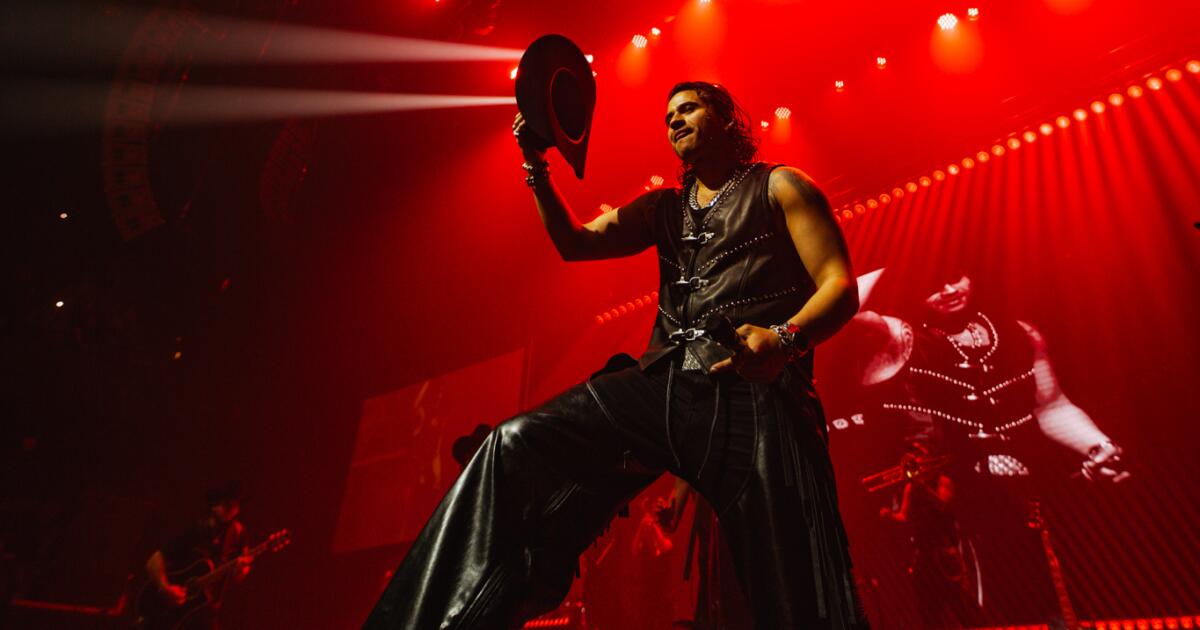
What started off as a trailblazing music partnership between música mexicana band Fuerza Regida and L.A. label Rancho Humilde has now fizzled into a sticky online drama.
On Saturday, Fuerza Regida frontman Jesús Ortiz Paz, better known as JOP, took to his personal Instagram account to post a statement addressing the band’s ongoing legal battle with the independent label led by music mogul Jimmy Humilde, who signed the band in 2018.
“To everyone who supports Fuerza Regida, you deserve to hear our music,” Ortiz Paz wrote in a public statement. “You deserve to see us perform at the World Cup. You deserve to listen to us on the MLB [Major League Baseball] album.”
This statement, which has since disappeared from JOP’s Instagram post, alleged that music created by the música mexicana group “keeps disappearing.”
Among the songs that have been taken down from streaming platforms by Rancho Humilde are “Triston,” “Todos nos Shipean” and “67,” according to the band’s publicist.
In September 2025, Rancho Humilde filed a lawsuit against Fuerza Regida, alleging breaches of contract for unilaterally collaborating with artists outside the label — such as Chino Pacas and Drake — and signing exclusive live performance deals with Apple Music and Live Nation.
Fuerza Regida countersued, alleging that Rancho Humilde withheld millions in royalties and attempted to “sabotage” the band’s success, including by neglecting to submit its music for consideration ahead of the 2024 Latin Grammys.
The case is still making its way through the courts.
“Everyone knows [what’s] going on[.] [You see] it [in the] media, [that’s] why I’m going to let justice do its job, everyone is going to know who you really are,” the post by JOP continued in both English and Spanish. “[He who has nothing to hide has nothing to fear], go let [Jimmy Humilde] & [Rancho Humilde] know how you feel, make your voice heard. Our story isn’t over I promise.”
Humilde responded to the artist in the comment section shortly after the post was made public.
“You asked me for a bigger [deal], I got it done. You asked me for your [masters], I fought to make it happen. You wanted to become one of the biggest artists in the [world], I have everything I had to help build that dream,” wrote Humilde.
“When you needed help, I didn’t just bring business. I brought my lawyers, my doctors, my relationships, my time, and my heart. I stood by you when it mattered the most,” Humilde continued. “You walked away with the biggest check of your [life,] over $50 million. I never complained. I was happy to see you win because your success was our success.”
“What hurts is seeing everything we’ve built together reduced to a public narrative that doesn’t tell the whole story. If you believe people deserve the truth, then honor the agreement we made. Complete the contract the same way I honored every commitment I made to you. I never stopped looking out for you. I only ask that you do the same. [He who has nothing to hide has nothing to fear].”
In a separate comment — which Humilde uploaded to his own Instagram account with Fuerza Regida’s own song “El Dinero Los Cambio” (which describes how money can change someone) — the label head pushed back on allegations of robbery: “I robbed you? Robbed you of what, fool. You didn’t even have a dollar for me to rob.”
The music mogul also accused JOP — who founded his own label Street Mob Records in 2018 — of sabotaging his own bandmates. “Let’s talk about [how] your own band members went from partners to being employees. They didn’t have much of a choice.”
“And let’s not forget I helped you land a $15 million deal for your label. After that, how you choose to take care of your artists is on you. [Let’s] ask Chinito [Pacas], Calle [24] and Armenta!!” added Humilde, including the names of artists signed to Street Mob Records.
JOP of Fuerza Regida performs at South By Southwest on March 13 in Austin, Texas.
(Cat Cardenas / For De Los)
In an email to De Los, Humilde’s lawyer, Mike Trauben, pushed back on claims that Rancho Humilde is trying to stop Fuerza Regida from making music and obtaining other opportunities.
They cite two recent deals that were approved by Rancho Humilde, including Fuerza Regida’s appearance on “Grand Theft Auto” and in the online video game “Fortnite,” which aligns with the contractual framework both parties had negotiated.
With regards to the proposed MLB and FIFA collaborations, Humilde’s council said that Fuerza Regida sought to prevent Rancho Humilde from exercising its claimed contractual rights, which was ultimately denied by a federal court.
The reason certain songs were removed from streaming platforms is because Fuerza Regida chose to release music outside the agreed Rancho/Sony distribution structure and without the approvals required under the parties’ agreements, per Humilde’s lawyers.
“Ultimately, this case is not about stopping an artist from succeeding,” wrote Trauben to The Times. “It is about whether sophisticated parties are required to honor the agreements they voluntarily negotiated after success had already arrived.”
According to Trauben, Rancho Humilde and Fuerza Regida, both parties entered a completely new agreement in 2022 that fundamentally restructured their entire business relationship, fully terminating the initial 2018 contract in place. As a result, Fuerza Regida received a flat million-dollar bonus, Rancho Humilde converted its ownership of existing masters into a 50/50 structure and the two entered into a new agreement, which Humilde’s lawyers claim favors Fuerza Regida.
“This case is not about whether artists should have rights. They absolutely should. Nor is it about preventing Fuerza Regida from making music,” wrote Trauben. “Rather, this case asks a much broader question that affects the entire music industry: Do contracts still matter after artist success arrives?”
The Times reached out to Fuerza Regida’s attorney but did not hear back as of this publication.

NEW YORK (OSV News) – At what is meant to be a poignant moment in the DC Comics adaptation “Supergirl” (Warner Bros.), the title character, played by Milly Alcock, is told by her mother (Emily Beecham) that she doesn’t have to be nice but she must be good. The recipient of this advice takes it to heart in a way that lends the whole film an unpleasant tone.
We’re not talking Deadpool depths of obscene snark here. Yet scrappy Supergirl, aka Kara Zor-El, in contrast to her affable cousin — and fellow Kryptonian — Superman (David Corenswet), does not come across as especially likeable.
Nor is she a figure to be imitated since, before she embarks on the quest to which most of the running time is devoted, early scenes show her waking up with a succession of staggering hangovers. She gets blotto, we later learn, in an effort to blot out her troubled past. The only positive ingredient in her current life is the bond she shares with her beloved dog, Krypto.
So when evil alien Krem of the Yellow Hills (Matthias Schoenaerts) wounds Krypto with a poisoned dart, leaving him with only hours to live, Supergirl is desperate to help the pup survive. Learning that Krem carries the antidote with him wherever he goes, she sets off on an interplanetary hunt for the villain, racing against time.
Supergirl has already crossed paths with another of Krem’s victims, Ruthye (Eve Ridley). Having watched as Krem slaughtered her entire family, Ruthye is out for revenge and wants to join forces with Supergirl.
Since Ruthye, though courageous, is undersized and completely untrained for combat, Supergirl initially tries to ditch her. But Ruthye is not to be so easily rebuffed.
The unlikely duo eventually acquire an informal ally in the person of cigar-chomping, motorcycle-riding freelance warrior Lobo (Jason Momoa). Lobo has reasons of his own for hating the band of brigands Krem leads.
As scripted by Ana Nogueira, director Craig Gillespie’s scifi adventure includes more than one exchange in which Supergirl warns Ruthye about the morally corrupting effects of exacting vengeance. Yet this thoroughly respectable ethical message is completely undermined as the action reaches its climax.
“Supergirl” may not be a dose of Kryptonite. But it’s no energy-infusing sunbath either.
The film contains much harsh but bloodless violence, a scene of urination, a passing reference to nonscriptural religious ideas, a couple of mild oaths, several uses each of crude and crass language and an obscene gesture. The OSV News classification is A-III – adults. The Motion Picture Association rating is PG-13 — parents strongly cautioned. Some material may be inappropriate for children under 13.
Read More Movie & Television Reviews
Copyright © 2026 OSV News
-

 Iowa2 minutes ago
Iowa City braces for hundreds of thousands of visitors this weekend
-
 Kansas5 minutes ago
New food trucks join Love Lot in Kansas City, benefit from World Cup excitement
-

 Kentucky10 minutes ago
Kentucky Cares, Lexington Humane Society offer free pet food after floods
-

 Louisiana17 minutes ago
Louisiana man sentenced in child sex crimes case involving dolls now banned by state law
-

 Maine20 minutes ago
Maine driver to honor friend Kyle Busch during Celebration of America 300
-

 Maryland25 minutes ago
Maryland man sentenced for making online threats toward Black and Muslim communities
-

 Michigan32 minutes ago
Michigan Lottery Daily 3, Daily 4 results for June 29, 2026
-

 Massachusetts35 minutes ago
Millions of gallons of wastewater discharged into Merrimack River due to broken pipe

