
Connect with us

Entertainment

Emma Myers leads a suspenseful teen mystery in 'A Good Girl's Guide to Murder'

Published

on

Emma Myers leads a suspenseful teen mystery in 'A Good Girl's Guide to Murder'

As someone who grew up reading the Hardy Boys, collecting a long shelf of those beautiful blue spines, I am all about the teenage detective. Nancy Drew, “Scooby-Doo,” Shelby Woo, Hayley Mills in “The Moon-Spinners.” As for the teens and tweens such stories nominally target, that is a population into whose lives every day brings some new mystery — mysteries of the heart, mysteries of the changing body, mysteries of the weird parents, mysteries of the missing friends with apparently new friends. These stories can be empowering, like spiritual krav maga.

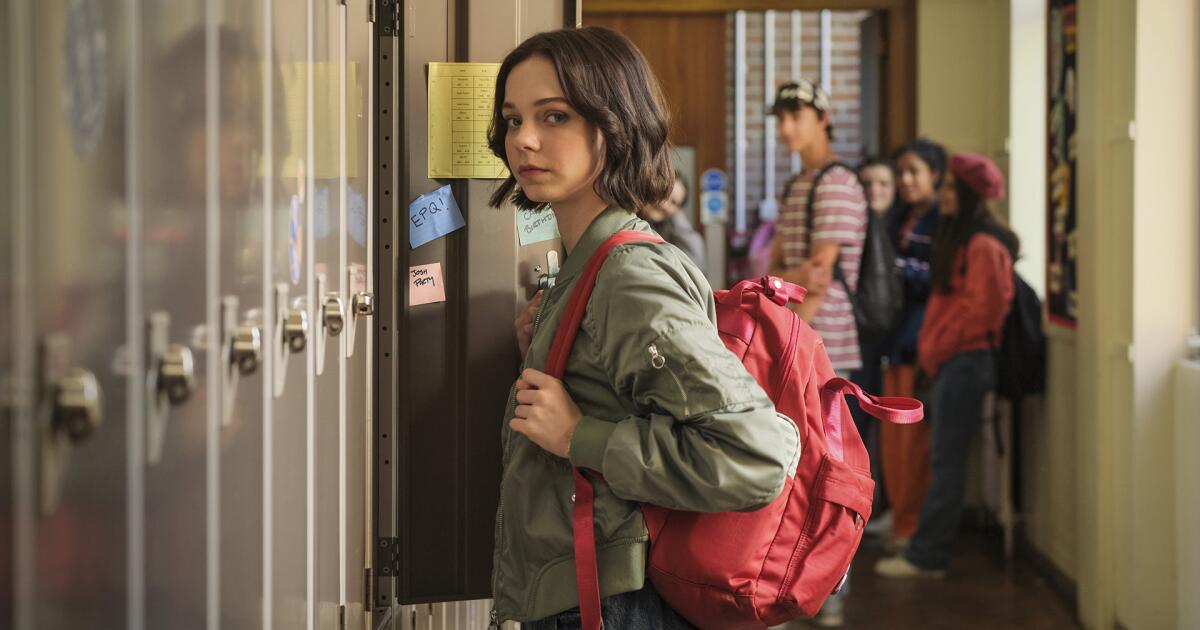
Adapted by Poppy Cogan from British writer Holly Jackson’s popular 2019 YA novel, “The Good Girl’s Guide to Murder,” premiering Thursday on Netflix, is an involving ride — not so much for the plot as for the characters (which is how all detective stories live or die) and a great performance by Emma Myers (“Wednesday”) as its central sleuth, Pippa Fitz-Amobi. It’s less whimsical than the title might lead one to expect, but short on grit and long on feeling.

We are in Little Kilton, a picturesque English village, the sort of place where, sayeth Miss Marple, “you turn over a stone and have no idea what will crawl out” — and Miss Marple is rarely wrong. Five years earlier, the town was roiled by the disappearance of teenager Andie Bell (India Lillie Davies) and the confession and apparent suicide of her boyfriend, Sal Singh (Rahul Pattni). Though the villagers seem intent on leaving the past in the past, there is also a big mural honoring her and what looks like a steady stream of flowers and mementos marking the shrine. So that book is not entirely closed.

Pippa or Pip, now a senior herself, remembers seeing Andie and Sal on the day of her disappearance, and also that Sal was always nice to her; she doesn’t think he’s someone who could kill anyone, and for her senior project, or under cover of same, has decided to investigate the case.

Ravi (Zain Iqbal) steps in to help Pip (Emma Myers) solve the mystery of Andie and his brother, Sal.

Advertisement

(Sally Mais/Netflix)

This connects her with Ravi (Zain Iqbal), Sal’s younger brother, who, like everyone but Pip, accepts the accepted verdict; at least, he has put it behind him, until Pip gets him interested, and together they turn sleuth — he calls her “Sarge,” as in detective sergeant, and they spar over who’s Holmes and who’s Watson, or more specifically, who’s Cumberbatch and who’s Freeman. But it’s clearly Pip leading the way.

Pip turns her bedroom wall into a murder board, pasted with clippings and photographs and various notes to self. (It takes her mother a while to notice this.) Across six 40-minute episodes, she moves about the town, from garden party to rave to locker room, as her “project” morphs from schoolwork to amateur police work. Threatening notes and texts arrive warning her to “stop digging.” But she has also has reason to question her own motives.

“I’m just trying to find out the truth,” Pip tells Andie’s lookalike sister Becca (Carla Woodcock).

Advertisement

“It’s not about the truth,” Becca replies. “People act like this stuff is for the dead person, but it’s not, it’s for them.”

As the title indicates, Pip’s a good girl, who doesn’t exactly go bad, but she will lie to her parents (Anna Maxwell Martin and Gary Beadle), ignore their orders, do shots in exchange for information and commit a fair amount of breaking and entering — entering, anyway — in order to find clues and steal evidence. Which, frankly, is good training to be a detective in crime fiction.

It’s a big cast, replete with siblings, friends, townfolk and parents, including Mathew Baynton of “The Wrong Mans” and the U.K. version of “Ghosts,” as Pip’s teacher and the father of her friend Cara (Asha Banks). But above all, it’s Myers’ show. (The actor is American, reversing the more common situation of Britons playing Yanks, but, really, I had no idea.) Small and slight, with big, expressive, wide-set eyes, a forehead made for writing thoughts upon and the mouth of a silent movie star; at 22, she makes an entirely credible 17-year-old — scared and excited, sure of herself even as she’s unsure of herself. Myers is especially fine conveying a sort of shyness seasoned with bravado, along with various degrees of worry that only increase as she blusters her way into ever more perilous situations.

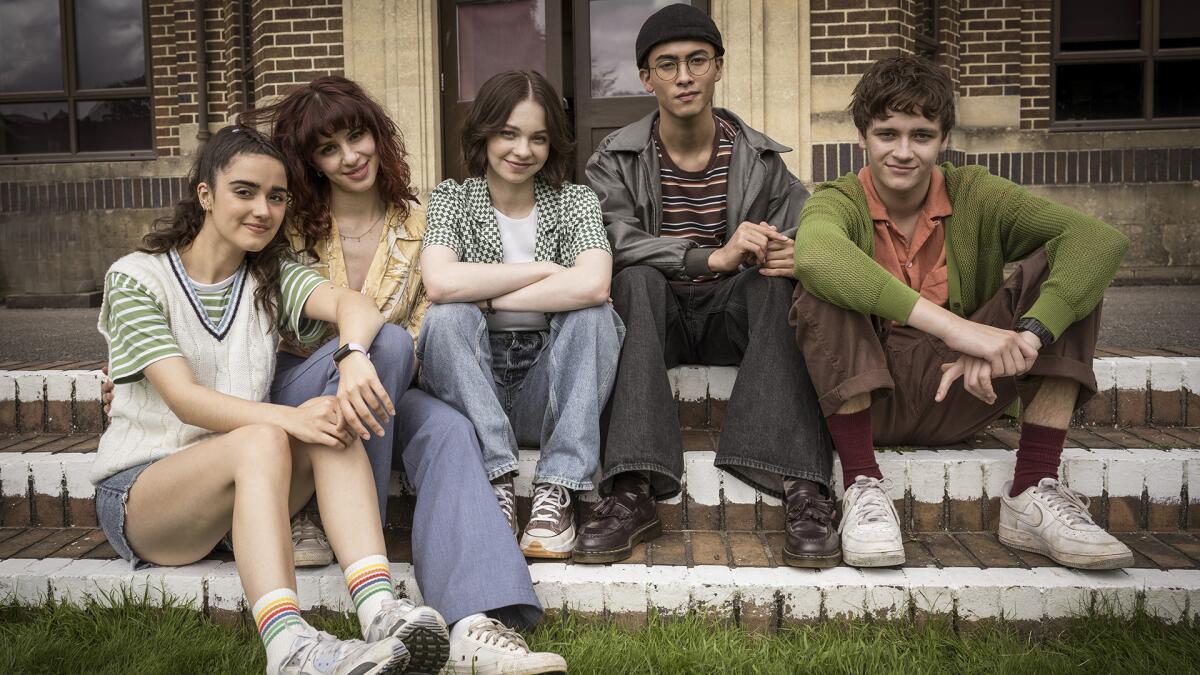
Five teenagers sitting on stairs.

The cast of Netflix’s “A Good Girl’s Guide to Murder,” from left: Asha Banks as Cara Ward, Yali Topol Margalith as Lauren Gibson, Emma Myers as Pip Fitz-Amobi, Raiko Gohara as Zach Chen, and Jude Morgan-Collie as Connor Reynolds.

(Sally Mais/Netflix)

Advertisement

The direction, by Dolly Wells and Tom Vaughan, is admirably straightforward; the show is suspenseful because it’s full of suspenseful situations, not for being overloaded with dark music, disturbing sound effects and shocking camera moves. As is true of the best British mysteries, we’re in a real place among plausible people. There’s no attempt to make the teenage characters glamorous or sexy or overly adult — a couple of the older-generation youngsters fancy themselves to be so, but they’re fairly transparent. Pip’s friends trend nerdy and late-blooming, which should make them relatable to a large segment of the show’s young, and for that matter, formerly young, audience. (I’d advance them as role models, as well, but that is perhaps wishful thinking.) They may be pushed out of their comfort zone by circumstances, but they are not pushed out of it by the writers, if you see what I mean.

Not everything Pip does when faced with trouble makes much sense, but in this she has plenty of adult detective company. You can often find me yelling through the screen at gumshoes who, alone with a killer, announce that they know what they did and how they did and therefore must wriggle out of danger one more time. It goes with the territory.

As to the endgame — no spoilers here — the details are not predictable in themselves, but, to put it in musical terms, there’s a sort of half cadence followed by an authentic cadence followed by a plagal cadence. You will have guessed some of it from the first episode, if you have any experience with mysteries, or even movies, though you could not possibly see the rest coming, because essential information is held back until late and guilty parties in TV mysteries are extraordinary good at seeming innocent. They tend not to play fair, and “Good Girl’s Guide” is no exception.

I probably should have mentioned, though it should be obvious from the above, that this is also a coming-of-age story, centered on a partnership that becomes a friendship that might one day turn into something more — and which, like every screen romance ever, will run into trouble about two-thirds of the way through.

I can say no more.

Advertisement

Movie Reviews

Movie Review: The Mortuary Assistant – HorrorFuel.com: Reviews, Ratings and Where to Watch the Best Horror Movies & TV Shows

Published

on

Movie Review: The Mortuary Assistant – HorrorFuel.com: Reviews, Ratings and Where to Watch the Best Horror Movies & TV Shows

Forget the “video game movie” curse; The Mortuary Assistant is a bone-chilling triumph that stands entirely on its own two feet. Starring Willa Holland (Arrow) as Rebecca Owens, the film follows a newly certified mortician whose “overtime shift” quickly devolves into a grueling battle for her soul.

What Makes It Work

The film expertly balances the stomach-churning procedural work of embalming with a spiraling demonic nightmare. Alongside a mysterious mentor played by Paul Sparks (Boardwalk Empire), Rebecca is forced to confront both ancient evils and her own buried traumas. And boy, does she have a lot of them.

Thanks to a full-scale, practical River Fields Mortuary set, the film drips with realism, like you can almost smell the rot and bloat of the bodies through the screen.

The skin effects are hauntingly accurate. The way the flesh moves during surgical scenes is so visceral. I’ve seen a lot of flesh wounds in horror films and in real life, and the bodies, skin, and organs. The Mortuary Assistant (especially in the opening scene) looks so real that I skipped supper after watching it. And that’s saying something. Your girl likes to eat.

Co-written by the game’s creator, Brian Clarke, the movie dives deeper into the demonic mythology. Whether you’ve seen every ending or don’t know a scalpel from a trocar, the story is perfectly self-contained. If you’ve never played the game, or played it a hundred times, the film works equally well, which is hard to do when it comes to game adaptations.

Advertisement

Nailed It

This film does a lot of things right, but the isolation of the night shift is suffocating. Between the darkness of the hallways and the “residents” that refuse to stay still, the film delivers a relentlessly immersive experience. And thankfully, although this movie is filled with dark rooms and shadows, it’s easy to see every little thing. Don’t you hate it when a movie is so dark that you can’t see what’s happening? It’s one of my pet peeves.

The oh-so-awesome Jeremiah Kipp directs the film and has made something absolutely nightmare-inducing. Kipp recently joined us for an interview, took us inside the film, discussed its details and the game’s lore, and so much more. I urge you to check out our interview. He’s awesome!

The Verdict

This isn’t just a cash-grab; it’s a high-effort adaptation that respects the source material while elevating the horror genre. With incredible special effects and a powerhouse cast, it’s the kind of movie that will make you rethink working late ever again. Dropping on Friday the 13th, this is a must-watch for horror fans. It’s grisly, intelligent, and genuinely terrifying.

Continue Reading

Entertainment

Former Live Nation executive says he was fired after raising ‘financial misconduct’ concerns

Published

on

Former Live Nation executive says he was fired after raising ‘financial misconduct’ concerns

A former executive at Live Nation, the world’s largest live entertainment company, is suing the company, alleging that he was wrongfully terminated after he raised concerns about alleged financial misconduct and improper accounting practices.

Nicholas Rumanes alleges he was “fraudulently induced” in 2022 to leave a lucrative position as head of strategic development at a real estate investment trust to create a new role as executive vice president of development and business practice at Beverly Hills-based Live Nation.

In his new position, Rumanes said, he raised “serious and legitimate alarm” over the the company’s business practices.

As a result, he says, he was “unlawfully terminated,” according to the lawsuit filed Thursday in Los Angeles County Superior Court.

“Rumanes was, simply put, promised one job and forced to accept another. And then he was cut loose for insisting on doing that lesser job with integrity and honesty,” according to the lawsuit.

Advertisement

He is seeking $35 million in damages.

Representatives for Live Nation were not immediately available for comment.

The lawsuit comes a week after a federal jury in Manhattan found that Live Nation and its Ticketmaster subsidiary had operated a monopoly over major concert venues, controlling 86% of the concert market.

Rumanes’ lawsuit describes a “culture of deception” at Live Nation, saying its “basic business model was to misstate and exaggerate financial figures in efforts to solicit and secure business.”

Such practices “spanned a wide spectrum of projects in what appeared to be a company-wide pattern of financial misrepresentation and misleading disclosures,” the lawsuit states.

Advertisement

Rumanes says he received materials and documents that showed that the company inflated projected revenues across multiple venue development projects.

Additionally, Rumanes contends that the company violated a federal law that requires independent financial auditing and transparency and instead ran Live Nation “through a centralized, opaque structure” that enables it to “bypass oversight and internal checks and balances.”

In 2010, as a condition of the Live Nation-Ticketmaster merger, the newly formed company agreed to a consent decree with the government that prohibited the firm from threatening venues to use Ticketmaster. In 2019 the Justice Department found that the company had repeatedly breached the agreement, and it extended the decree.

Rumanes contends that he brought his concerns to the attention of the company’s management, but his warnings were “repeatedly ignored.”

Advertisement
Continue Reading

Movie Reviews

‘Madhuvidhu’ movie review: A light-hearted film that squanders a promising conflict

Published

on

‘Madhuvidhu’ movie review: A light-hearted film that squanders a promising conflict

At the centre of Madhuvidhu directed by Vishnu Aravind is a house where only men reside, three generations of them living in harmony. Unlike the Anjooran household in Godfather, this is not a house where entry is banned to women, but just that women don’t choose to come here. For Amrithraj alias Ammu (Sharafudheen), the protagonist, 28 marriage proposals have already fallen through although he was not lacking in interest.

When a not-so-cordial first meeting with Sneha (Kalyani Panicker) inevitably turns into mutual attraction, things appear about to change. But some unexpected hiccups are waiting for them, their different religions being one of them. Writers Jai Vishnu and Bipin Mohan do not seem to have any major ambitions with Madhuvidhu, but they seem rather content to aim for the middle space of a feel-good entertainer. Only that they end up hitting further lower.

Continue Reading
Advertisement

Trending
