Connect with us

Entertainment

Ellen DeGeneres just canceled 4 dates on her comedy tour — no explanation given

Published

on

Ellen DeGeneres just canceled 4 dates on her comedy tour — no explanation given
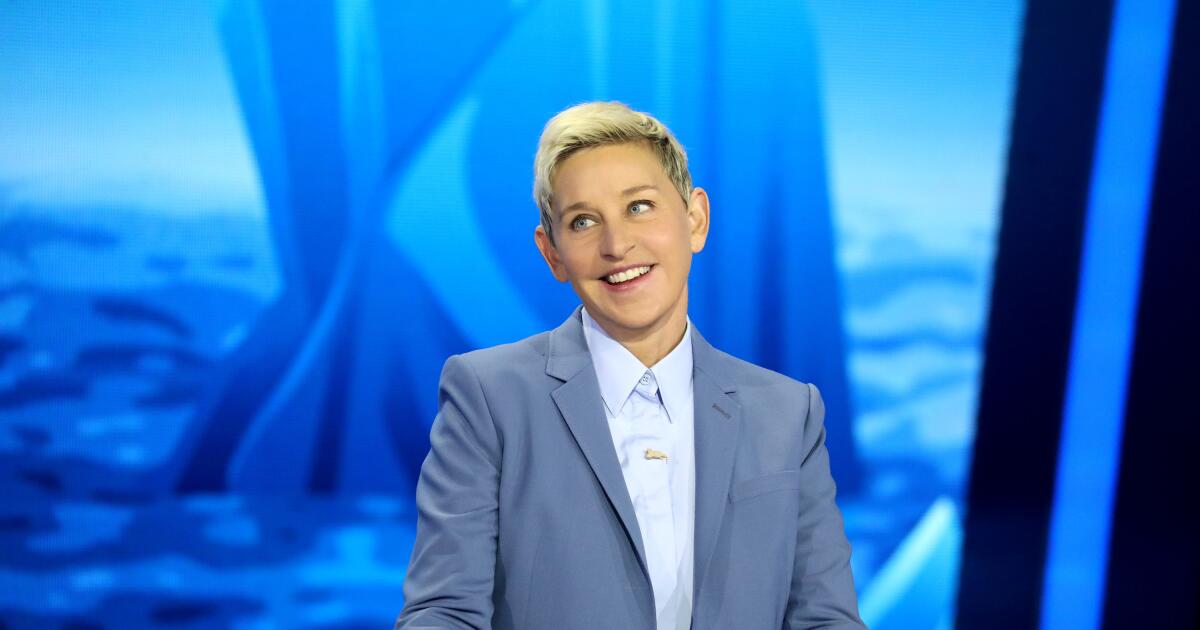
Ellen DeGeneres has abruptly canceled four of her stand-up tour dates — and didn’t give a reason why.

Those who bought tickets to the former talk show host’s performances in Dallas (July 10), San Francisco (July 21), Seattle (July 23) and Chicago (Aug. 11) were informed by concert promoter Live Nation that “unfortunately, the Event Organizer has had to cancel your event.”

Ticket holders will be issued full refunds in the next two to three weeks, Live Nation said. The company did not respond to a request for comment.

The Ellen’s Last Stand … Up Tour is being billed in a press release as her “long-awaited comeback to stand-up comedy” and “the last opportunity for fans to witness a comedy legend in her final curtain call.” according to a press release. Eight of the 27 dates are sold out, with the two final shows in Minneapolis being filmed for a Netflix special.

DeGeneres’ return to the stage follows a fall from grace that came when “The Ellen DeGeneres Show” — which ended in 2022 after a nearly two-decade run — was hit with allegations that it was a toxic workplace. A 2020 BuzzFeed News investigation revealed allegations of intimidation, racism and sexual misconduct by producers.

Advertisement

It’s a tumble that DeGeneres makes light of in her stand-up, , riffing on getting “kicked out of show business.”

“This is the second time I’ve been kicked out of show business,” DeGeneres said in April during a set at Largo at the Coronet. “Eventually they’re going to kick me out for a third time because I’m mean, old and gay.”

Entertainment

The 5 best science books of 2025

Published

on

The 5 best science books of 2025

It’s been an uneasy year for science. While there were significant milestones, like breakthroughs in gene editing for rare diseases and novel insights into early human evolution (including fire-making), the U.S. science community at large was rocked by institutional challenges. Drastic federal cuts froze thousands of research grants, and the Trump administration began actively working to dismantle the National Center for Atmospheric Research. Meanwhile, fraudulent scientific research papers are on the rise — casting a shadow over academic integrity.

Best of 2025 Infobox

Our picks for this year’s best in arts and entertainment.

Thankfully, we can still turn to our bookshelves — and podcasts — to ground us. We tapped science doyenne Alie Ward, the host of the funny cult favorite “Ologies” podcast, to share her picks for the best science books of 2025.

Advertisement

Spanning fascinating subjects from bees to human anatomy, Ward’s insightful list reminds us that books remain a timeless vessel for truth and knowledge.

"Ferns: Lessons in Survival From Earth's Most Adaptable Plants."

“Ferns: Lessons in Survival From Earth’s Most Adaptable Plants”
By Fay-Wei Li and Jacob S. Suissa
Hardie Grant Books: 192 pages, $45

“Dr. Li is the botanist of our dreams… the way he talks about ferns and why he loves them, and about growing up in Taiwan (in essentially a fern forest), and how the sexual reproduction of ferns has been a great way to draw attention to the LGBTQ and nonbinary community is so charming and funny. They even named a whole genus after Lady Gaga because they were listening to ‘Born This Way’ a lot in the lab and also because there are sequences in their DNA that are ‘GAGA.’

“Laura Silburn’s illustrations are gorgeous — they really put a lot of texture into some of these plants that are really tiny. Every page is like looking at a botany poster. As we’ve seen so much science research being underfunded, especially in the last year, there’s this big question by the culture at large of why does it matter? Why does studying the fern genome matter? It has real-world impacts — that’s fewer pesticides on your crops because we figured out something from a foreign genome. I always love when something is overlooked or taken for granted and because of someone’s passion and their dedication to studying it, we learn that it can change our lives.”

"The ABCs of California's Native Bees" by Krystle Hickman

“The ABCs of California’s Native Bees”
By Krystle Hickman
Heyday: 240 pages, $38

Advertisement

“Krystle is an astounding photographer and an incredible visual artist. Her passion for native bees is infectious. A lot of people, when they think of bees, they think of honeybees. And honeybees are not even native to North America. They’re not native to L.A. They’re not native to this country. They’re feral livestock. What I love about her book is it opens your eyes to all of these species that are literally right under our noses that we wouldn’t even consider — and that a lot of people wouldn’t even identify as bees.

“The other reason why I love this book is that she puts these essays into it that are about her experiences going to find the bees. So you’re getting to see these gorgeous landscape pictures. You’re getting to see what it took to find the bee, how to look for it, and more about this particular species. It’s organized in these ABCs that you can pick up at any chapter and check out a bee you’ve never heard of before.”

"Humanish: What Talking to Your Cat or Naming Your Car Reveals About the Uniquely Human Need to Humanize."

(Little, Brown and Company)

“Humanish: What Talking to Your Cat or Naming Your Car Reveals About the Uniquely Human Need to Humanize”

By Justin Gregg

Advertisement

Little, Brown: 304 pages, $30

“Justin is hilarious. He is such a good writer, and his voice is really, really approachable. The way that he writes about science is through such a wonderful pop culture and pop science lens. You feel like you’re reading a friend’s email who just has something really interesting to tell you.

“This book is all about anthropomorphizing everything from our toasters to why we like some spiders but hate other spiders. This is a discussion that is so important in this time when we literally have bots on our phones that are like, ‘I’ll be your best friend.’

“Justin speaks to human psychology and our need to want to be friends or villainize objects —or technology or animals — and project our own humanity onto them in ways that are sometimes helpful and sometimes dangerous.

“As a science communicator, you can tell people the most fascinating facts and can give them the best stories. But unless you can give people a takeaway, then a lot of times it doesn’t stick or the interest isn’t there. He really addresses the question of ‘Well, what does this mean for my life?’”

Advertisement
"Replaceable You: Adventures in Human Anatomy" by Mary Roach

“Replaceable You: Adventures in Human Anatomy”
By Mary Roach
W.W. Norton & Co: 288 pages, $28.99

“I’m a long term simp for Mary Roach.

“The humanity that she brings is such a wonderful base for how our bodies fail us sometimes and what we are trying to do to bring them back. From her being present during orthopedic surgeries and the way that she describes the sound of hammer on bone (and just the kind of jovial atmosphere in an operating room that, as a patient, you would never be clued in about because you are passed out half dead on a slab). She really soaks up a vibe that you would never have access to. She goes to Mongolia to learn about eye surgery there in yurts. She takes you to places you would never be able to go. She’s rooting around in archives and old papers — she just makes anything interesting.

“Mary really is both an ally and an outsider, and I think that that’s a really beautiful thing in her book.”

"The Double Tax: How Women of Color Are Overcharged and Underpaid" by Anna Gifty Opoku-Agyeman

“The Double Tax: How Women of Color Are Overcharged and Underpaid”
By Anna Gifty Opoku-Agyeman
Portfolio: 256 pages, $29

Advertisement

“Anna Gifty Opoku-Agyeman is an absolute force. I’ve followed her work in economics and in equity for years, and I was really excited for this book to come out. We did an episode on kalology, which is the study of beauty standards, years ago and I have always loved the conversation of how different members of society have a certain tax on them — these extra resources that they are expected to provide.

“I was really excited to read about specifically women of color, because that is something that I don’t feel is discussed at large. Anna combines the sociology of it with the reality of her experience and other women of color. Because she is so deft when it comes to policy and economics, she also considers, ‘What can we do about this?’ It’s not just enough to discuss this, but what can be done?

“She has totals of what the gender gap is and what the double tax is, and it’s written up like a receipt. This book really addresses the double tax in a way that, even if you have no insight or it’s something that you haven’t thought about — or you are someone who hasn’t experienced this — it’s laying it out economically in a way that is really accessible and has a lot of impact.”

Recinos is an arts and culture journalist and creative nonfiction writer based in Los Angeles. Her first essay collection, “Underneath the Palm Trees,” is forthcoming in early 2027.

Advertisement
Continue Reading

Movie Reviews

Movie Review: An electric Timothée Chalamet is the consummate striver in propulsive ‘Marty Supreme’

Published

on

Movie Review: An electric Timothée Chalamet is the consummate striver in propulsive ‘Marty Supreme’

“Everybody wants to rule the world,” goes the Tears for Fears song we hear at a key point in “Marty Supreme,” Josh Safdie’s nerve-busting adrenaline jolt of a movie starring a never-better Timothée Chalamet.

But here’s the thing: everybody may want to rule the world, but not everybody truly believes they CAN. This, one could argue, is what separates the true strivers from the rest of us.

And Marty — played by Chalamet in a delicious synergy of actor, role and whatever fairy dust makes a performance feel both preordained and magically fresh — is a striver. With every fiber of his restless, wiry body. They should add him to the dictionary definition.

Needless to say, Marty is a New Yorker.

Also needless to say, Chalamet is a New Yorker.

Advertisement

And so is Safdie, a writer-director Chalamet has called “the street poet of New York.” So, where else could this story be set?

It’s 1952, on Manhattan’s Lower East Side. Marty Mauser is a salesman in his uncle’s shoe store, escaping to the storeroom for a hot tryst with his (married) girlfriend. Suddenly we’re seeing footage of sperm traveling — talk about strivers! — up to an egg. Which morphs, of course, into a pingpong ball.

This witty opening sequence won’t be the only thing recalling “Uncut Gems,” co-directed by Safdie with his brother Benny before the two split for solo projects. That film, which feels much like the precursor to “Marty Supreme,” began as a trip through the shiny innards of a rare opal, only to wind up inside Adam Sandler’s colon, mid-colonoscopy.

Sandler’s Howard Ratner was a New York striver, too, but sadder, and more troubled. Marty is young, determined, brash — with an eye always to the future. He’s a great salesman: “I could sell shoes to an amputee,” he boasts, crassly. But what he’s plotting to unveil to the world has nothing to do with shoes. It’s about table tennis.

Advertisement

This image released by A24 shows Timothée Chalamet in a scene from “Marty Supreme.” (A24 via AP)

Advertisement

How likely is it that this Jewish kid from the Lower East Side can become the very face of a sport in America, soon to be “staring at you from the cover of a Wheaties box?”

To Marty, perfectly likely. Still, he knows nobody in the U.S. cares about table tennis. He’s so determined to prove everyone wrong, starting at the British Open in London, that when there’s a snag obtaining cash for his trip, he brandishes a gun at a colleague to get it.

Advertisement

Shaking off that sorta-armed robbery thing, Marty arrives in London, where he fast-talks his way into a suite at the Ritz. Here, he spies fellow guest Kay Stone (Gwyneth Paltrow, in a wise, stylish return to the screen), a former movie star married to an insufferable tycoon (“Shark Tank” personality Kevin O’Leary, one of many nonactors here.)

Kay’s skeptical, but Marty finds a way to woo her. Really, all he has to say is: “Come watch me.” Once she sees him play, she’s sneaking into his room in a lace corselet.

Gwyneth Paltrow in a scene from

This image released by A24 shows Gwyneth Paltrow in a scene from “Marty Supreme.” (A24 via AP)

Advertisement

This would be a good time to stop and consider Chalamet’s subtly transformed appearance. He is stick-thin — duh, he never stops moving. His mustache is skimpy. His skin is acne-scarred — just enough to erase any movie-star sheen. Most strikingly, his eyes, behind the round spectacles, are beady — and smaller. Definitely not those movie-star eyes.

But then, nearly all the faces in “Marty Supreme” are extraordinary. In a movie with more than 100 characters, we have known actors (Fran Drescher, Abel Ferrara); nonacting personalities (O’Leary, and an excellent Tyler Okonma (Tyler, The Creator) as Marty’s friend Wally); and exciting newcomers like Odessa A’Zion as Marty’s feisty girlfriend Rachel.

There are also a slew of nonactors in small parts, plus cameos from the likes of David Mamet and even high wire artist Philippe Petit. The dizzying array makes one curious how it all came together — is casting director Jennifer Venditti taking interns? Production notes tell us that for one hustling scene at a bowling alley, young men were recruited from a sports trading-card convention.

Elsewhere on the creative team, composer Daniel Lopatin succeeds in channelling both Marty’s beating heart and the ricochet of pingpong balls in his propulsive score. The script by Safdie and cowriter Ronald Bronstein, loosely based on real-life table tennis hustler Marty Reisman, beats with its own, never-stopping pulse. The same breakneck aesthetic applies to camera work by Darius Khondji.

Back now to London, where Marty makes the finals against Japanese player Koto Endo (Koto Kawaguchi, like his character a deaf table tennis champion). “I’ll be dropping a third atom bomb on them,” he brags — not his only questionable World War II quip. But Endo, with his unorthodox paddle and grip, prevails.

Advertisement

After a stint as a side act with the Harlem Globetrotters, including pingpong games with a seal — you’ll have to take our word for this, folks, we’re running low on space — Marty returns home, determined to make the imminent world championships in Tokyo.

But he’s in trouble — remember he took cash at gunpoint? Worse, he has no money.

So Marty’s on the run. And he’ll do anything, however messy or dangerous, to get to Japan. Even if he has to totally debase himself (mark our words), or endanger friends — or abandon loyal and brave Rachel.

This image released by A24 shows Odessa A'zion in a scene from

This image released by A24 shows Odessa A’zion in a scene from “Marty Supreme.” (A24 via AP)

Advertisement

Advertisement

Is there something else for Marty, besides his obsessive goal? If so, he doesn’t know it yet. But the lyrics of another song used in the film are instructive here: “Everybody’s got to learn sometime.”

So can a single-minded striver ultimately learn something new about his own life?

We’ll have to see. As Marty might say: “Come watch me.”

“Marty Supreme,” an A24 release, has been rated R by the Motion Picture Association “for language throughout, sexual content, some violent content/bloody images and nudity.” Running time: 149 minutes. Four stars out of four.

Advertisement

Continue Reading

Entertainment

Scared of AI? 11 essential books for navigating our new normal

Published

on

Scared of AI? 11 essential books for navigating our new normal

Despite its ubiquity in our machines and in the news, artificial intelligence remains both a mystery and a source of deep anxiety across occupations and generations. My students, my readers, my colleagues and kids: We are all bewildered by the mix of hype and hope, optimism and doomerism making up the discourse around AI. On the one hand, the quest for artificial general intelligence (AGI) and a utopian belief in the life-improving promise of these emergent technologies; on the other, new algorithmic forms of injustice, the displacement of whole work forces and the limitless sloppification of language, music, video and other aesthetic forms — to say nothing of the threat of human extinction.

The 11 books described below, all published recently, give us helpful sight lines into our turbulent AI age. Some titles are hard-hitting trade nonfiction. One is an academic critique. Others are novels, fictional accounts that imagine how our world is being reshaped (and will be further transformed) by the many technologies grouped under the term artificial intelligence: deepfakes and autonomous drones, AI-enhanced medical scans and self-driving cars.

What all these books have in common is their awareness that AI is transforming our world in ways all too easy to imagine yet nearly impossible to predict.

“Vantage Point: A Novel” by Sara Sligar

(MCD)

Advertisement

“Vantage Point”
By Sara Sligar
MCD: 400 pages, $29

This twisty and brilliantly written thriller about a Maine family spins a tale of ambition, trauma and privilege around the proliferation of so-called deepfakes. Those AI-generated videos play an increasing role in the spread of slanderous accusations and political disinformation in today’s public sphere. Whether the footage at the center of the plot is real or computer-generated is one of the burning questions at the heart of the novel, which plumbs the nature of reality in our age of digital disinformation and virtual selves.

"The Worlds I See: Curiosity, Exploration, and Discovery at the Dawn of AI" by Dr. Fei-Fei Li

“The Worlds I See: Curiosity, Exploration, and Discovery at the Dawn of AI” by Dr. Fei-Fei Li

(Flatiron Books: A Moment of Lift)

Advertisement

“The Worlds I See: Curiosity, Exploration, and Discovery at the Dawn of AI”
By Fei-Fei Li
Flatiron: 336 pages, $20

Though it’s been out for two years already, Li’s account of the early years of computer vision and deep learning is a refreshing break from the LLM-centric discourse dominating many discussions of AI. Li shows us the broader computational context of AI’s emergence, explaining key concepts and breakthroughs in vivid, comprehensible detail. “The Worlds I See” is also a scientific autobiography, a compelling account of Li’s personal and intellectual journey from the impoverished circumstances of a Chinese immigrant family life to a wealthy and world-leading university lab.

"Death of the Author: A Novel" by Nnedi Okorafor

“Death of the Author: A Novel” by Nnedi Okorafor

(William Morrow)

Death of the Author
By Nnedi Okorafor
William Morrow: 448 pages, $30

Advertisement

“Rusted Robots” is the title of the AI-themed novel-within-a-novel that Zelu, Okorafor’s MFA-wielding protagonist, writes in the wake of a creative and professional calamity. As we encounter excerpts from the book — an Africanfuturist (Okorafor’s preferred term) narrative set in a postapocalyptic West Africa — we learn how the novel achieves phenomenal sales and success that eluded Zelu when she was writing literary fiction, even as Okorafor explores the perils of fame and new fortune. The result is a powerful meditation on the roles of disability, autonomy and privilege in the shaping of literary making in an age when art itself is increasingly threatened by machines.

"Searches: Selfhood in the Digital Age" by Vauhini Vara

“Searches: Selfhood in the Digital Age” by Vauhini Vara

(Pantheon)

“Searches: Selfhood in the Digital Age”
By Vauhini Vara
Pantheon: 352 pages, $30

Vara’s moving account of her uncanny exchanges with a chatbot about her sister’s death became a viral sensation after it appeared in the Believer in 2021, at the dawn of our LLM-obsessed age. In a series of further essays, reflections and fragments, Vara — a Pulitzer Prize finalist for her novel “The Immortal King Rao as well as a former technology reporter for the Wall Street Journal — investigates the role of digital technologies in making us who we are, and may want to become. The book bristles with insight and originality, interspersing Vara’s more journalistic expositions with excurses and fragments curated from the author’s expansive digital life.

Advertisement
"Notes on Infinity: A Novel" by Austin Taylor

“Notes on Infinity: A Novel” by Austin Taylor

(Celadon)

Notes on Infinity: A Novel
By Austin E. Taylor
Celadon: 400 pages, $30

Though Taylor’s absorbing debut swings more biotech than AI, the novel beautifully captures the extreme techno-optimism of the multibillionaire set — in this case around the possibility of eternal human life. As Zoe, one of the protagonists, notes early on, her interest in a particular professor’s work stems from his success in “using AI neural networks to understand biological neural networks and the processes of thinking.” “Notes on Infinity” combines the traditional campus novel with the zeitgeisty tech novel, featuring Harvard students with “edge” placing “bets on the next Zuck in the dining halls.”

"Ideal Subjects: The Abstract People of AI" by Olga Goriunova

“Ideal Subjects: The Abstract People of AI” by Olga Goriunova

(Minnesota)

Advertisement

“Ideal Subjects: The Abstract People of AI”
By Olga Goriunova
Minnesota: 232 pages, $32

This deeply researched study examines how AI systems create “abstract people”: statistical confections, subject profiles and anthropomorphic personages that increasingly substitute for humans in digital environments. Goriunova, a cultural theorist and digital curator based in London, examines how these constructed figures and abstractions shape surveillance, governance and everyday life. What is a “digital person,” and why should we care? Goriunova’s answers prove as complex as they are fascinating.

"Annie Bot" by Sierra Greer

“Annie Bot” by Sierra Greer

(Mariner)

Advertisement

“Annie Bot”
By Sierra Greer
Mariner: 240 pages, $19

The success of the two “M3gan” films suggests a never-ending fascination with human-like cyborgs — though in the case of “Annie Bot,” this fascination is laced with a prurient eroticism that Greer both exploits and cleverly frustrates in her insightful debut. Annie is a sexbot companion operating in autodidactic mode, learning her owner’s sexual proclivities in much the same way AlphaGo perfected the ancient game of Go. At the heart of novel, though, is a thoughtful and darkly humorous meditation on the politics of AI personhood and subjection comparable to Kazuo Ishiguro’s project in “Klara and the Sun,” and with equally harrowing implications.

"Empire of AI: Dreams and Nightmares in Sam Altman's OpenAI" by Karen Hao

“Empire of AI: Dreams and Nightmares in Sam Altman’s OpenAI” by Karen Hao

(Penguin Press)

“Empire of AI: Dreams and Nightmares in Sam Altman’s OpenAI”
By Karen Hao
Penguin Press: 496 pages, $32

Advertisement

Hao’s bestselling account of OpenAI and its neoimperial ambitions has received lots of coverage, though it deserves an even wider readership. Formerly an application engineer at a Google spinoff, Hao writes with an insider’s knowledge about the relationship between technological innovation and socioeconomic inequality around the world, from resource-guzzling data centers in Chile to ego-filled executive suites in San Francisco. Full of industry anecdotes and sobering analyses, the book is a riveting introduction to the corporate culture of artificial intelligence and its designs on all of us.

"Who Knows You by Heart: A Novel" by C.J. Farley

“Who Knows You by Heart: A Novel” by C.J. Farley

(William Morrow)

“Who Knows You by Heart”
By C. J. Farley
William Morrow: 288 pages, $30

Algorithmic bias and injustice are at the heart of this ingenious novel of technological innovation and corporate malfeasance. Farley’s protagonist is Octavia Crenshaw, a down-on-her-luck coder recently hired by Eustachian, an audio entertainment company exploiting new ways to bring stories to the world. After a series of mishaps and disturbing incidents at the company, Octavia teams up with another coder named Walcott to develop a bias-free AI storytelling model — only to discover the limits of her computational and political ideals. The novel is a riveting critique of Big Tech and its faux-liberal aspirations to correct the world’s wrongs.

Advertisement
"If Anyone Builds It, Everyone Dies: Why Superhuman AI Would Kill Us All" by Eliezer Yudkowsky and Nate Soares

“If Anyone Builds It, Everyone Dies: Why Superhuman AI Would Kill Us All” by Eliezer Yudkowsky and Nate Soares

(Little, Brown and Company)

“If Anyone Builds It, Everyone Dies: Why Superhuman AI Would Kill Us All”
By Eliezer Yudkowsky and Nate Soares
Little, Brown: 272 pages, $30

Earning its apocalyptic title, this doomerist manifesto by two of the leading figures in the tech world appears in an era saturated with reckless optimism and hype. The book provides a sobering look at issues such as potential misalignments between human designers and the AI systems they release into the world, systems with goals of their own that we may not understand in time to thwart their most catastrophic outcomes. The main message: Be afraid. Be very afraid. The book offers a glimmer of hope as well, albeit a faint one, and concludes with some plainspoken recommendations about proceeding with extreme caution and slowing down.

"UnWorld: A Novel" by Jason Greene

“UnWorld: A Novel” by Jason Greene

(Knopf)

Advertisement

“UnWorld”
By Jayson Greene
Knopf: 224 pages, $28

This deeply moving novel explores the aftermath of loss and the shape of grief in an age of avatars and algorithmically mediated emotion. When a teenager named Alex dies of mysterious causes, part of the burden of mourning falls on Aviva, an upload virtually confected out of pain. By imagining technologies that can shoulder our memories, our labor and our most shattering emotions, Greene questions whether AI risks nurturing a fantasy that code can heal what hurts in our inner lives. A timely meditation on AI’s allure as an escape hatch from the strain of modern consciousness, the novel quietly insists that any lasting tranquility must still be cultivated from within and shared between humans, with all our flaws.

Holsinger’s most recent novel is “Culpability,” an Oprah’s Book Club pick for summer 2025.

Advertisement
Continue Reading

Trending