
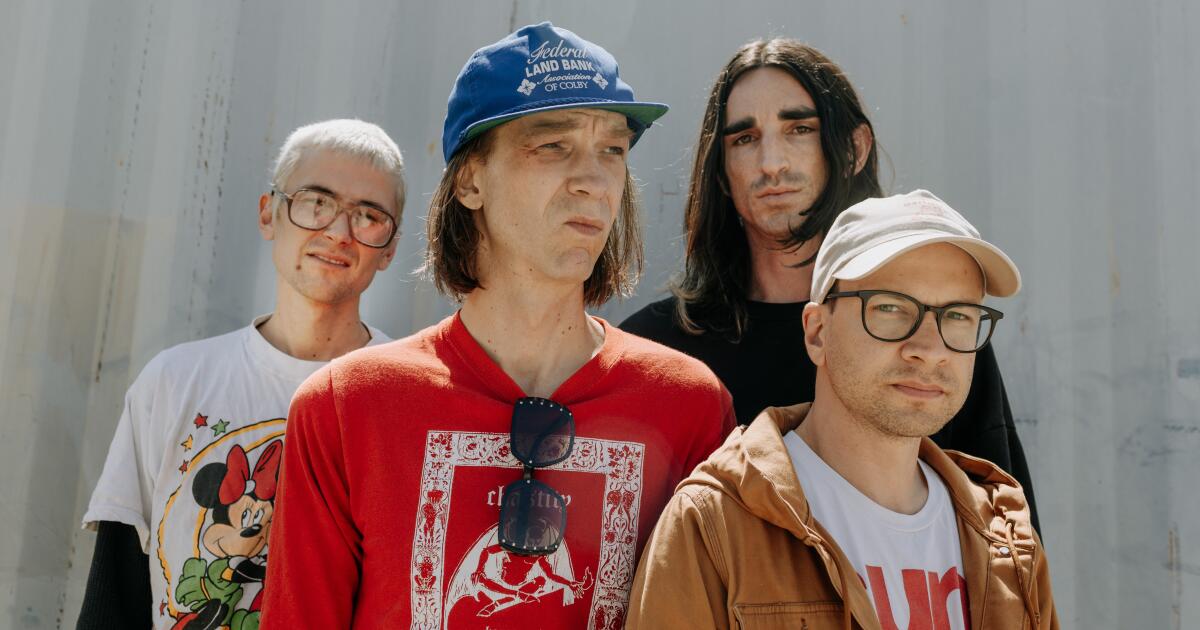
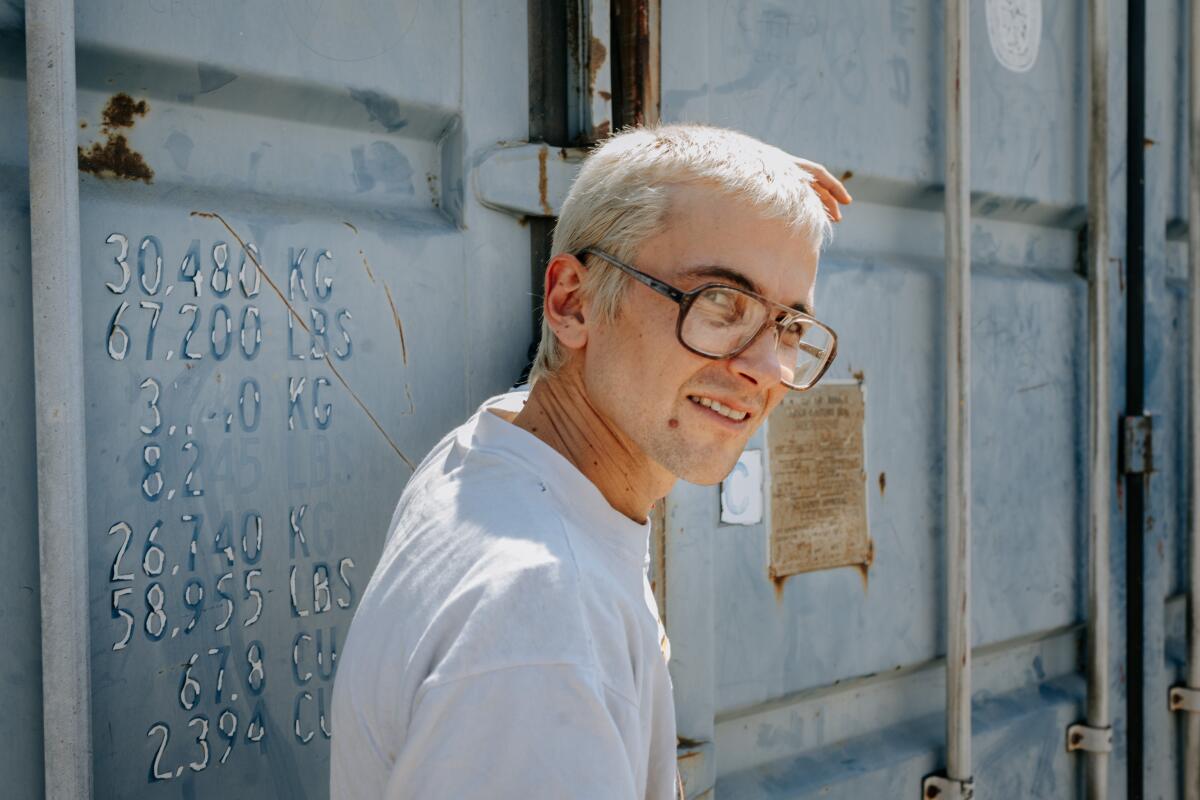
Two days before they’re due to play the first date of a headlining theater tour, the members of the rock band Diiv are sitting around a picnic table in the parking lot of a Burbank rehearsal studio, reminiscing about the arena shows they opened last fall for Depeche Mode.
They talk about the glittery jackets frontman Dave Gahan wore onstage (only to slip them off after a few minutes) and the moves he’d bust every night on a catwalk; they talk about the confidence they developed by playing in front of thousands of people who hadn’t turned up to see Diiv (but who were open to being won over by the right performance).
Also: They talk about catering. “Man, I miss that,” guitarist Andrew Bailey says as though lost in a memory of endless chafing dishes.
Diiv is going without many of the borrowed perks of A-list rock stardom on the road behind its latest album, “Frog in Boiling Water.” After launching in early June, the tour stops at the Wiltern in Los Angeles — Diiv’s hometown, more or less, since three of the four members moved here from New York a few years ago — on Saturday night.
Yet the musicians, all in their mid to late 30s, seem no less eager to be out playing their new songs; indeed, they say the music reflects the fact that “we’ve committed our lives to this band,” as bassist Colin Caulfield puts it, even minus the kind of “long-term infrastructure” that might appeal to people their age. Adds Caulfield, wryly: “No one’s matching our 401(k).”
Advertisement
Diiv’s determination is warranted. Easily the most impressive of the group’s four LPs, “Frog in Boiling Water” is probably also the best rock record released so far this year: a dense and luxurious set of hooky post-shoegaze guitar jams that evokes a dream-pop Nirvana. With their layers of fuzz and their trippy yet propulsive grooves, songs like “Brown Paper Bag” and “Raining on Your Pillow” fit easily into the shoegaze revival that’s taken off lately on TikTok and introduced bands from the 1980s and ’90s such as My Bloody Valentine and Slowdive — noisy but sensitive types known for staring down at their effects pedals — to a new generation of young fans. Yet Diiv pairs those immersive textures with songwriting much sturdier than what you’ll find on, say, Spotify’s popular Shoegaze Now playlist.
“When it comes to music in this genre, there’s a lot of trying to emulate what’s come before,” says Jasamine White-Gluz of the Montreal band No Joy, which has toured with Diiv. “So you’re kind of just doing a ‘Loveless’ or doing a ‘Souvlaki’ — trying to fit in the box of what shoegaze is,” she adds, referring to the seminal albums by MBV and Slowdive, respectively. “Diiv doesn’t do that — they’ve got their own sound. They’re in the box but they’re making the box bigger.”
Part of what distinguishes “Frog in Boiling Water” is the political thrust of singer Zachary Cole Smith’s lyrics, which ponder the brutality of late-stage capitalism and the deceptions of the military-industrial complex — ideas he says he was drawn to after he and his wife brought their first child into the world about a year ago. (That his words about “rotating villains profit[ing] off suffering” are intelligible at all represents something of a break from a lot of shoegaze music, in which vocals serve as just one more instrumental component.)
Advertisement
“I think the record has a sense of hope,” Smith says, “despite all the evidence that we’re heading toward total f—ing collapse.”
Optimistic or not, the album’s focus on the outside world represents Smith’s effort to move beyond the personal demons that long defined Diiv. In 2013, Smith was arrested in New York with his then-girlfriend, singer Sky Ferreira, for possession of heroin; he exhaustively detailed his experiences with addiction and recovery on Diiv’s 2016 “Is the Is Are” and 2019 “Deceiver.” Of the latter, Smith says his hope was that it “took the trash out a little bit, so that now we can talk about other things in our music.”
Yet a recent review of “Frog in Boiling Water” in Pitchfork made him wonder if he’s attained that leeway. In a thread on X that went indie-rock viral, Smith wrote about seeing his music “met with an unwillingness to accept me as the person I’ve worked so diligently the last eight years to become”; he also lamented that his bandmates — Diiv’s fourth member is drummer Ben Newman — are “still at the mercy of a public tendency to root discussion of our band around a past that they personally suffered from as well.” (The review, which was positive, opened with a mention of Smith’s arrest.)
“These events in my life, I don’t get to decide when people stop talking about them,” Smith acknowledges in Burbank. “But not including the rest of the story or where it led me, I think that’s a damaging mind-set for people in sobriety. It makes me sad to think about somebody who’s experiencing addiction seeing that and being like, ‘Damn, I’m just always going to be this destructive force,’” he says. “People can change — profoundly.”
Zachary Cole Smith of Diiv
(Jason Armond / Los Angeles Times)
Advertisement
One effect of Smith’s change is a democratizing of Diiv’s creative process. During the band’s early days, the music was unquestionably a product of Smith’s vision, a situation he looks back at with complicated feelings: “In my active addiction I was selfish and ego-driven in a really unsustainable way,” he admits; recovery led him to “want to retreat from a leadership role” and invite more participation from his bandmates à la Sonic Youth, to name one touchstone act with more than one person in a controlling role.
“I think that choice to open it up to being everyone’s band is what made the record great,” says Chris Coady, who produced “Frog in Boiling Water” and who’s known for his work with TV on the Radio and the Yeah Yeah Yeahs. “As a producer, it was a bit of a nightmare,” he adds with a laugh, explaining that getting everyone to agree on every decision meant that the sessions at his studio in northeast L.A. weren’t brief. “But all four of them are good at all kinds of stuff, and this allowed them to come together in such a cool way.”
That shared investment in Diiv — and in the belief that together they’ve hit a new artistic peak with “Frog in Boiling Water” — has buoyed the band’s members after a long stretch of turmoil, even at a moment when making a living as a musician feels more precarious to many than it has in decades.
“All our eggs are in this basket,” Smith says as he heads back into rehearsal. “It’s scary — and thrilling.”
At the centre of Madhuvidhu directed by Vishnu Aravind is a house where only men reside, three generations of them living in harmony. Unlike the Anjooran household in Godfather, this is not a house where entry is banned to women, but just that women don’t choose to come here. For Amrithraj alias Ammu (Sharafudheen), the protagonist, 28 marriage proposals have already fallen through although he was not lacking in interest.
When a not-so-cordial first meeting with Sneha (Kalyani Panicker) inevitably turns into mutual attraction, things appear about to change. But some unexpected hiccups are waiting for them, their different religions being one of them. Writers Jai Vishnu and Bipin Mohan do not seem to have any major ambitions with Madhuvidhu, but they seem rather content to aim for the middle space of a feel-good entertainer. Only that they end up hitting further lower.
After more than two and a half years of research, planning and construction, Dataland, the world’s first museum of AI arts, will open June 20.
Co-founded by new media artists Refik Anadol and Efsun Erkılıç, the museum anchors the $1-billion Frank Gehry-designed Grand LA complex across the street from Walt Disney Concert Hall in downtown Los Angeles. Its first exhibition, “Machine Dreams: Rainforest,” created by Refik Anadol Studio, was inspired by a trip to the Amazon and uses vast data sets to immerse visitors in a machine-generated sensory experience of the natural world.
The architecture of the space, which Anadol calls “a living museum,” is used to reflect distant rainforest ecosystems, including changing temperature, light, smell and visuals. Anadol refers to these large-scale, shimmering tableaus as “digital sculptures.”
“This is such an important technology, and represents such an important transformation of humanity,” Anadol said in an interview. “And we found it so meaningful and purposeful to be sure that there is a place to talk about it, to create with it.”
The 35,000-square-foot privately funded museum devotes 25,000 square feet to public space, with the remaining 10,000 square feet holding the in-house technology that makes the space run. Dataland contains five immersive galleries and a 30-foot ceiling. An escalator by the entrance will transport guests to the experiences below. The museum declined to say how much Dataland, designed by architecture firm Gensler, cost to build.
Advertisement
An isometric architectural rendering of Dataland. The 25,000-square-foot AI arts museum also contains an additional 10,000 square feet of non-public space that holds its operational technology.
(Refik Anadol Studio for Dataland)
Dataland will collect and preserve artificial intelligence art and is powered by an open-access AI model created by Anadol’s studio called the Large Nature Model. The model, which does not source without permission, culls mountains of data about the natural world from partners including the Smithsonian, London’s Natural History Museum and the Cornell Lab of Ornithology. This data, including up to half a billion images of nature, will form the basis for the creation of a variety of AI artworks, including “Machine Dreams.”
“AI art is a part of digital art, meaning a lineage that uses software, data and computers to create a form of art,” Anadol explained. “I know that many artists don’t want to disclose their technologies, but for me, AI means possibilities. And possibilities come with responsibilities. We have to disclose exactly where our data comes from.”
Advertisement
Sustainability is another responsibility that Anadol takes seriously. For more than a decade, Anadol has devoted much thought to the massive carbon footprint associated with AI models. The Large Nature Model is hosted on Google Cloud servers in Oregon that use 87% carbon-free, renewable energy. Anadol says the energy used to support an individual visit to the museum is equivalent to what it takes to charge a single smartphone.
Anadol believes AI can form a powerful bridge to nature — serving as a means to access and preserve it — and that the swiftly evolving technology can be harnessed to illuminate essential truths about humanity’s relationship to an interconnected planet. During a time of great anxiety about the power of AI to disrupt lives and livelihoods, Anadol maintains it can be a revolutionary tool in service of a never-before-seen form of art.
“The works generate an emergent, living reality, a machine’s dream shaped by continuous streams of environmental and biological data. Within this evolving system, moments of recognition and interpretation emerge across different forms of knowledge,” a news release about the museum explains. “At the same time, the exhibition registers loss as part of this expanded field of perception, most notably in the Infinity Room, where visitors encounter the 1987 recording of the last known Kauaʻi ʻŌʻō, a now-extinct bird whose unanswered call becomes part of the work.”
“It’s very exciting to say that AI art is not image only,” Anadol said. “It’s a very multisensory, multimedium experience — meaning sound, image, video, text, smell, taste and touch. They are all together in conversation.”
IE 11 is not supported. For an optimal experience visit our site on another browser.
Fans reignite Drake vs Kendrick feud after album announcement
03:35
Now Playing
Michael Jackson documentary set to release after massive re-write
02:57
UP NEXT
Patrick Brammall on How He Got His Role in ‘Devil Wears Prada 2’
05:43
Henry Winkler on ‘Hazardous History’ S2, Zip lining With Grandkids
07:38
Did Harry Styles and Zoë Kravitz Get Engaged?
04:05
Ana Gasteyer on Role in ‘Schmigadoon!’ Musical: ‘I’m Very Mean’
06:03
Laufey Talks Children’s Book ‘Mei Mei the Bunny,’ Coachella, More
05:15
Shania Twain to Host the 2026 Academy of Country Music Awards
00:26
Colman Domingo and Nia Long Talk New Michael Jackson Biopic
04:50
Charlize Theron Talks Intense Training for New Thriller, ‘Apex’
06:30
Jimmy Kimmel Shares Photo of His Son to Mark His 9th Birthday
00:39
Could Rocky Score an Oscar for ‘Project Hail Mary’ Movie?
01:36
‘The Pitt’ Season 2 Finale Sees Huge Surge in Streams
01:23
‘Top Gun’ Movies Are Returning to Theaters for 40th Anniversary
01:24
Chicago collectible store is latest target in Pokemon card crime spree
01:59
Victoria Beckham Shares Hot Takes on Chores, Nicknames, More
07:34
John Legend Talks New Book, ‘The Voice’ Finale, Marriage, More
06:37
Victoria Beckham Talks Family, Marriage, Navigating Tough Times
07:58
Steve Schirripa Joins TODAY With Dog WillieBoy to Talk New Book
04:32
Stars of ‘Running Point’ Discuss What to Expect From Season 2
06:34
Top Story
‘Michael’ — a new movie about the King of Pop – is drumming up big buzz. The film was produced in-part by the co-executors of the late singer’s estate, and has some critics questioning whether it is too focused on sanitizing the singer’s troubled image.April 23, 2026
Advertisement
Fans reignite Drake vs Kendrick feud after album announcement
03:35
Now Playing
Michael Jackson documentary set to release after massive re-write
02:57
UP NEXT
Patrick Brammall on How He Got His Role in ‘Devil Wears Prada 2’
05:43
Henry Winkler on ‘Hazardous History’ S2, Zip lining With Grandkids
07:38
Did Harry Styles and Zoë Kravitz Get Engaged?
04:05
Ana Gasteyer on Role in ‘Schmigadoon!’ Musical: ‘I’m Very Mean’
