Entertainment
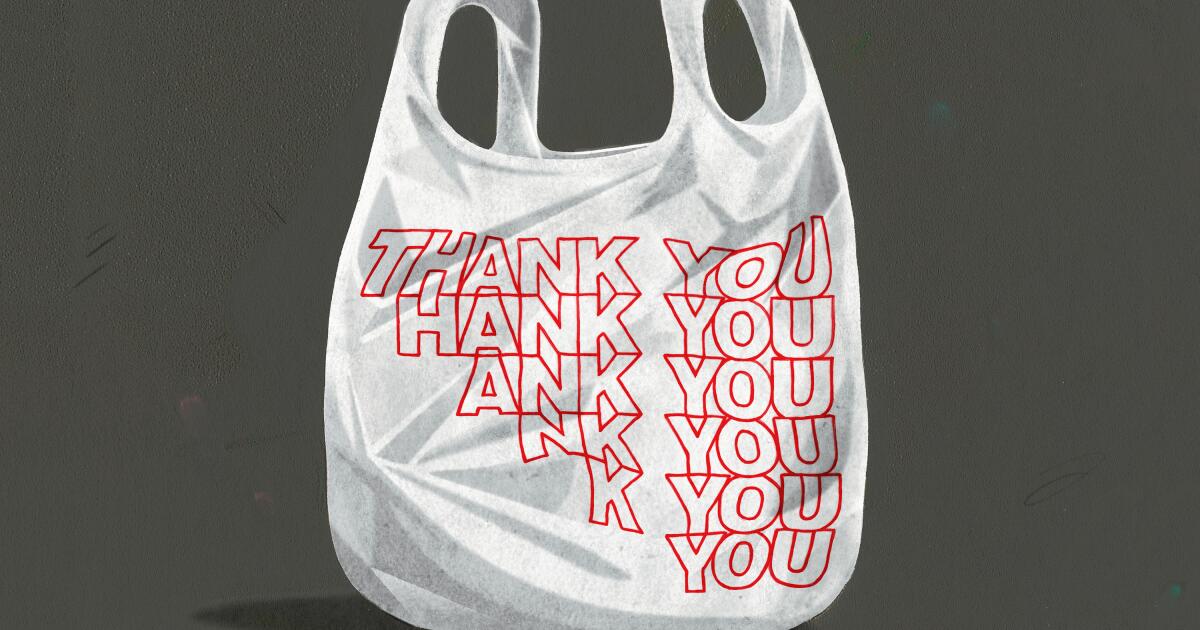
Commentary: My travel nightmare made me realize that self-service culture is capitalism’s greatest con
The sun is shining, the fire threat is low and for the first time in 25 years, no part of California is experiencing drought. Except of course in the hope and joy department.
It’s the middle of January, which means the holidays are well and truly over and whatever fanciful shine the prospect of a “new” year held as it approached has already dimmed into grim reality.
Of course I want to face this year determined to be a happier, kinder, more empathetic and more just person. But just as it’s tough to honorably pay one’s taxes knowing millionaires and billionaires are weaseling out of theirs, it’s hard to gin up personal-improvement energy when every news cycle brings proof that an alarming number of people are perfectly willing to believe that black is white, science is fake, we should all be cooking with beef tallow and failure to stop when an unidentified ICE agent tells you to is, apparently, punishable by death.
Also all that water everyone has been telling us to drink may be full of microplastics.
See, now I’m just getting upset again. Which is just too 2025 to bear. Mercifully, I have just discovered a cache of surviving holiday mint M&M’s (which may or may not contain beef tallow) and, equally important, I have a plan to make life better for everyone.
(At least until the midterms, when we will discover once and for all if this democratic experiment has any hope of lasting another year.)
It’s very simple, really: We need to demand the resurrection of customer service and put large numbers of well-paid and trained employees back in charge.
Seriously. I know it’s fun, and purportedly “convenient,” to be able to accomplish our banking/shopping/travel/bill paying/ticket buying/food ordering/health monitoring/everything else through a series of apps, websites and self-checkout kiosks.
But the lack of trained and helpful humans is getting out of control.
How many of us have stood, casting wild-eyed glances for help, when the grocery checkout sensors failed to register a carton of eggs that is clearly in the bagging area and there is only one store attendant tasked with aiding 20 or more finicky machines?
Or searched, panic-stricken, for the payment confirmation email that we may or may not have received because we forgot to screenshot an online transaction that is now being called into question via some upsetting email with a DO NOT RESPOND return address?
A friend of mine recently went to her doctor for ongoing treatment of her arthritic hands only to be told that she needed to fill out all her personal information, including her medical history, again because the office had switched systems. Apparently, the job of transferring file information was too difficult (read: expensive) to be accomplished by software, so it was being handed to … the patients. “Don’t worry,” said the guy sitting directly in front of the office computer. “You can just do it now on your phone.”
Yeah, that won’t take time and effort, and did I mention she was there for treatment of her arthritic hands?
The abandonment of any notion of customer service — now often called “customer assistance” or, even better, “customer support” (as in we will supportively assist you by directing you to our website or app, which may or may not be helpful/functioning) — is never clearer than when one travels.
Hideous delays and last-minute cancellations of flights have become so commonplace that airlines now advise building in a cushion of an extra day or two on each end of one’s journey. In other words, in addition to the cost of your actual flight, you should be prepared to pay even more in time or money because the airlines certainly are not.
On a long-planned holiday trip to London and Antwerp, Belgium, in December, our flight from LAX was abruptly moved to the next day — no warning, no explanation, no American Airlines personnel at the gate. Just a series of alerts that those who had the AA app received, along with the reassurance that those who qualified would be issued vouchers via email for lodging and food. Since we lived in the L.A. area (albeit a 90-minute drive from LAX at that time of day), we were out of luck — we could either pay hundreds of dollars for back and forth cab fare or book our own hotel near the airport.
(Other family members, leaving via Charlotte, N.C., had it even worse — a malfunction trapped a plane full of people, including my son and his girlfriend, on the runway for five hours before they were released, after midnight. When they finally tracked down an actual staff member, they were given vouchers to a motel that appeared, as Melissa McCarthy’s character says in “Spy,” “so murdery” that they decided to book their own.)
As if that were not enough to prevent us from ever traveling again, we were victims of the great Dec. 30 Eurostar shutdown, during which all trains into, and out of, the U.K. were abruptly canceled for more than 24 hours due to a power-grid failure in the English Channel Tunnel.
We had just been assured that we would soon be boarding our train from Brussels when the news came down over a loudspeaker, in four languages.
Picture, if you will, hundreds of now-stranded travelers, clamoring in panic-stricken English, French, Dutch and German as they streamed into the Brussels-Midi station where one Eurostar agent, one, stood, not suggesting alternate means of reaching our destination but handing out Xeroxed pages directing everyone to the Eurostar app and website.
Where no tickets were available for days and the process of claiming a refund or compensation for lodging and other expenses was an endless maze of questions that needed to be answered when all anyone wanted to know was how in the hell do we get to London now.
With no flights available until Jan. 3, days after we were scheduled to fly out of Heathrow Airport, we finally rented a car, at hideous cost, and fled Europe, with some historical poignancy, via midnight-landing ferry from Dunkirk. (If it sounds fun, I am not telling it right.)
My point is not that travel should always go smoothly — things break, weather turns, accidents happen. My point is that if you are a company that is paid to get people from one place to another, you should have enough personnel to help those people reach their destinations as quickly and seamlessly as possible should things go wrong.
Instead of, you know, casting them literally onto the street and forcing them to conjure up their own imperfect, and very expensive, DIY solutions.
Because that’s what the digital age has made us — a DIY economy in which millions of jobs no longer exist not because computers do the work, but because the work has been shifted, via computers, directly onto the consumer.
Who increasingly has little or no choice in the matter. Try to get a car at an auto rental agency without booking it online first; you might as well attempt to barter your watch and three chickens as payment.
It would be one thing if, by scheduling your own appointments, keeping track of your own medical tests, bagging your own groceries and filling out all the information needed to book your own reservations for planes, trains and automobiles, you got a discount.
But no; half the time, corporations have the audacity to charge a service fee on top of the money they have saved by not hiring someone to do the work you, the consumer, just did.
Is it any wonder why people are so testy these days?
Especially when, having done all the work only to be informed by alert that it was all in vain; they have to wait in line for the one teller/manager/gate agent available to explain to them that they “just” need to manage their booking/transaction online.
How much better it would be if there were actual people, trained and experienced, in numbers large enough to prevent endless queues, to make customers feel like customers again, instead of isolated pioneers quietly losing their minds in an effort to buy whatever goods and services companies are selling.
I’m not saying it would solve all of our problems, but it would go a long way to lowering the national temperature. It is amazing what a genial, helpful interaction can do to lift everyone’s spirits and make people feel like they are respected and valued, as individuals with reasonable needs, and not just faceless bundles of credit card information and regrettable meltdown moments.
Not to mention all the jobs, and career paths, at all levels, restoring customer service could provide.
Because being unemployed tends to make people quite aggravated and unhappy too.

Movie Reviews
‘Hen’ movie review: György Pálfi pecks at Europe’s migrant crisis through the eyes of a chicken
A rogue chicken observes the world around it—and particularly the plight of immigrants in Greece—in Hen, which premiered at last year’s Toronto International Film Festival and is now playing in Prague cinemas (and with English subtitles at Kino Světozor and Edison Filmhub). This story of man through the eyes of an animal immediately recalls Robert Bresson’s Au Hasard Balthazar (and Jerzy Skolimowski’s more recent EO), but director and co-writer György Pálfi (Taxidermia) maintains a bitter, unsentimental approach that lands with unexpected force.
Hen opens with striking scenes inside an industrial poultry facility, where eggs are laid, processed, and shuttled along assembly lines of machinery and human hands in an almost mechanized rhythm of production. From this system emerges our protagonist: a black chick that immediately stands apart from the others, its entry into the world defined not by nature, but by an uncaring food industry.
The titular hen matures quickly within this environment before being loaded onto a truck with the others, presumably destined for slaughter. Because of her black plumage, she is singled out by the driver and rejected from the shipment, only to be told she will instead end up as soup in his wife’s kitchen. During a stop at a gas station, however, she escapes.
What follows is a journey through rural Greece by the sea, including an encounter with a fox, before she eventually finds refuge at a decaying roadside restaurant run by an older man (Yannis Kokiasmenos), his daughter (Maria Diakopanayotou), and her child. Discovered by the family’s dog Titan, she is placed in a coop alongside other chickens.
After finding a mate in the local rooster, she lays eggs that are regularly collected by the man; in one quietly unsettling scene, she watches him crack them open and cook them into an omelet. The hen repeatedly attempts to escape, as we slowly observe the true function of the property: it is being used as a transit point for migrants arriving in Greece by boat, facilitated by local criminal figures.
Like Au Hasard Balthazar and EO, Hen largely resists anthropomorphizing its animal protagonist. The hen behaves as a hen, and the humans treat her accordingly, creating a work that feels unusually grounded and almost documentary in texture. At the same time, Pálfi allows space for the audience to project meaning onto her journey, never fully closing the gap between instinct and interpretation.
There are moments, however, where the film deliberately leans into stylization. A playful montage set to Ravel’s Boléro captures her repeated escape attempts from the coop, while a romantic musical cue underscores her brief pairing with the rooster. These sequences do not break the realism so much as refract it, gently encouraging us to read emotion into behavior that remains, on the surface, purely animal.
One of the film’s central narrative threads is the hen’s search for a safe space to lay her eggs without them being taken away by the restaurant owner. This deceptively simple instinct becomes a powerful thematic mirror for the film’s human subplot involving migrant trafficking. Pálfi draws a stark, often uncomfortable parallel between the treatment of animals as commodities and the treatment of displaced people as disposable bodies moving through a similar system of exploitation.
The film takes an increasingly bleak turn toward its climax as the migrant storyline comes fully into focus, sharpening its allegorical intent. The juxtaposition of animal and human vulnerability becomes more explicit, reinforcing the film’s central critique of systemic indifference and violence. While effective, this escalation feels unusually dark, and our protagonist’s unknowing role feels particularly cruel.
The use of animal actors in Hen is remarkable throughout. The hen—played by eight trained chickens—is seamlessly integrated into the film’s world, with seamless editing (by Réka Lemhényi) and staging so precise that at times it feels almost impossible without digital augmentation. While subtle effects work must assist at certain moments, the result is convincing throughout, including standout sequences involving a fox and a dog.
Zoltán Dévényi and Giorgos Karvelas’ cinematography is also impressive, capturing both the intimacy of the hen’s low vantage point and the broader Greek landscape with striking clarity. The camera’s proximity to the animal world gives the film a distinct visual grammar, grounding its allegory in tactile observation rather than abstraction.
Hen is a challenging but often deeply affecting allegory that extends the tradition of animal-centered cinema while pushing it into harsher political territory. Pálfi’s approach—unsentimental, patient, and often confrontational—ensures the film lingers long after its final images. It is not an easy watch, nor a comfortable one, but it is a strikingly original piece of filmmaking that uses its unusual perspective to cast familiar human horrors in a stark, unsettling new light.
Entertainment
Karol G at Coachella was a global hit. Yet other foreign acts fear touring the U.S.
On the first Sunday night of Coachella, headliner Karol G told her American fans, and her global audience, to keep fighting.
“This is for my Latinos that have been struggling in this country lately,” the Colombian superstar told the tens of thousands watching her in person, and many more on the fest’s livestream. She’d recently criticized ICE in a Playboy interview, but this set was about her fans’ resolve. “We want everyone to feel welcome to our culture, so I want everyone to feel proud of where you come from. Don’t feel fear — feel pride!” she said.
Any artist would be proud to play that caliber of headline slot. But right now, many foreign acts also feel fear — or at least wariness — about booking substantial tours in the United States. A year of brutal ICE raids, tensions at border crossings and policed political speech, coupled with sky-high prices for expedited visas, fuel and other touring logistics, could push international acts away from the U.S.
“The fears that ICE would raid shows didn’t really materialize, but there is a chilling effect,” said Andy Gensler, editor of the touring-biz trade bible Pollstar. “Trump’s only been back in office a year, so we haven’t fully seen the effects, but it does send a message that if you’re a political artist you won’t get a visa. With the economic shock of gas prices and tourism way down, the signifiers are out there.”
The music economy is still thriving in SoCal. Coachella sold out with record spending from fans, and fears that ICE might show up for a prominent Latin headliner proved unfounded. (The agency did not respond to a request for comment on Coachella, and Lt. Deirdre Vickers of the Riverside County Sheriff’s office said that their office “does not participate in immigration enforcement operations.”)
But in smaller venues featuring emerging and mid-tier global acts, some see trouble ahead.
Pollstar’s Gensler estimates that the total number of concerts in the U.S. they tracked for the first quarter of 2026 was down about 17% from last year. That could be due to many economic factors — but slower international touring could be contributing.
“The U.S. is still incredibly lucrative market, the arena and stadium level buildings are vast and you can make more money here than any market in the world,” Gensler said. “But I’ve heard anecdotally that fewer people are going to South by Southwest, and tourism from Canada is way down, and that includes music tourism to California. As barriers go up, and the economic shock of gas prices impacts touring, it’s hard to know how that will all shake out.”
Talent firms who specialize in bringing young acts to the U.S. began noticing pullback before this year’s festival season. Adam Lewis is the head of Planetary Group, a marketing agency that produces and promoting musician showcases in the U.S., with a significant roster of artists from abroad. He said that performers who ordinarily would leap at the chance to play U.S. festivals are taking hard looks at the payoffs and risks.
“Artists are thinking twice, based on what the government is doing right now,” Lewis said. “You can look at the economics — the fees are cost prohibitive to get a visa. People are scared, at the bottom line. Artists and industry people are afraid to come to the U.S. for any music event. The money is going elsewhere.”
South by Southwest, the March Texas confab for music, film and tech, was among the first festivals to feel a pinch this year. Several sources said they saw fewer foreign showcases and acts amid a broader culling of music. In 2025, Canada canceled its popular annual showcase, after deciding that hostile policies made the risks not worth the rewards. Many still pulled off successful events, but acknowledged the mood has shifted.
“The perception of how hard it’s gotten has taken root, and that has meant that not as many acts will take the chance on the threat of being turned away or risking future entry,” said Angela Dorgan, the director of Music From Ireland, the Irish Music Export office (which is funded by Culture Ireland). That organization has helped break acts like CMAT (a hit at Coachella this year) and Fontaines DC in the U.S.
“Artists want to continue to come here in spite of the trouble and not stay away because of it. There’s a unique pull to America for all Irish people, so we don’t want to see you hurting,” Dorgan said. ”Irish artists feel that their U.S. fans need music more than ever now and want to continue to connect with and support their fans.”
Takafumi Sugahara, the organizer of “Tokyo Calling X Inspired By Tokyo,” a Japanese showcase at South by Southwest, agreed: “Bringing artists to the United States has always been challenging when it comes to obtaining visas, but it feels like the process has become even more difficult than before — perhaps due to the current political climate under the current administration.”
Fans watch Karol G perform at the Coachella stage last weekend. “We want everyone to feel welcome to our culture, so I want everyone to feel proud of where you come from. Don’t feel fear — feel pride!” the Colombian superstar said.
(Christina House / Los Angeles Times)
After high-profile incidents of tourist detainments and fear of reprisals for political speech, those worries and long-dreaded expenses may shift their priorities. “From my point of view, the impact of global conflicts or wars does not seem to be affecting artists’ decisions very strongly for now,” they said. “However, if the current situation were to worsen, it’s possible that we could begin to see that change.”
Coachella usually hits a few visa snafus every year (this year, the English electronic artist Tourist had to cancel. Last year, it was FKA Twigs). Yet the Grammy-winning Malian Algerian group Tinariwen had to cancel a major tour this year, after the Trump administration placed severe new travel restrictions on 19 countries, including Mali. Folk legend Cat Stevens scotched a book tour after visa problems. Outspoken acts like the U.K.’s Bob Vylan have been denied U.S. visas for criticizing Israel, and the Irish rap group Kneecap faced hurdles after their visa sponsor, Independent Artist Group, dropped them for similar reasons last year.
The Times spoke to one European band (who asked not to be named, for fear of reprisals from the U.S. government) who had a substantial tour of U.S. theaters booked last year, before their visas were denied just days before the tour was due to begin. They were forced to cancel those dates and reschedule for spring 2026, losing tens of thousands of dollars in up-front costs and non-refundable fees. (A performance visa routinely costs $6,000 with now-necessary expedited processing.)
“Our manager said, ‘This has never happened before, but even though you paid lot of money and the check cleared, you won’t have visas,’” the band said. They wondered if their pro-Palestinian advocacy might have played a role, but now believe it was due to changes in their application forms.
That small discrepancy “meant we lost tens of thousands of [dollars], which for a mid-tier band with a loyal cult following, was quite ruinous,” they said. “We had to put on fundraising shows to get to zero, then re-apply for visas, and paid four grand extra to expedite them. We took out a loan to pay it. We felt relentlessly fleeced,” they said. “We love the U.S., but now there is a reality in which we have to cut our losses and stop coming. A lot of bands are giving up on the U.S., for sure.”
“It’s a different feeling now where the U.S. government can do anything to us, and we just have to take it,” they added. “They’re moving the goalposts the whole time. It’s scary.”
That fate can befall even major acts, particularly those from Latin America.
Last year, superstar Mexican singer Julión Álvarez canceled his concert for a planned 50,000 fans in Arlington, Texas, when his touring visa was revoked. Grupo Firme faced a similar fate at the La Onda festival in Napa Valley. Los Alegres del Barranco saw their visas canceled after they projected an image of drug kingpin “El Mencho” during a concert.
“That was a moment where people realize how serious or scary it can get for promoters with this administration when comes to the visa situation, how quickly things can change and you can lose millions,” said Oscar Aréliz, a Latin music expert at Pollstar.
An act the caliber of Karol G might not face quite the same risks, though she told Playboy that “If you say the thing, maybe the next day you’ll get a call: ‘Hey, we are taking your visa away.’ You become bait, because some people want to show their power.”
If it can happen to a stadium-filler like Álvarez, it can happen to anyone. That might make some Latin acts prioritize other regions.
Bad Bunny demurred on touring the continental U.S. for fear of ICE raids at his shows, opting for a lengthy residence in his home territory of Puerto Rico instead.
Local Latin music hubs like Santa Fe Springs and Pico Rivera have suffered greatly under recent ICE raids and have seen fans retreat in fear. Las Vegas is a major touring destination for acts during Mexican independence celebrations in September, but now “it feels different,” Aréliz said. He expects the city — typically boisterous with Latin acts then — to lose a big chunk of music tourism from the north and south.
“Vegas’ top tourist countries are Canada and Mexico, so we’re going to see other countries benefit from this. If acts struggle to tour here because of the visa situation, they’re going to tour Mexico and Latin America instead,” he added.
Tours typically book a year in advance, so the full effects of the visa issues and ICE fears may not be felt until later in 2026 or 2027. The results of the midterm elections may change global perception of America’s safety. The country is still an incredibly valuable touring market for acts that can make it work.
But the world’s music community now looks at the U.S. like an old friend going through a rough patch: They’ll be happy to see us once we pull it together.
“Certainly over the last number of years in the U.S., we have been thinking of where we could find these new audiences for Irish music,” Dorgan said. “The unofficial theme of our at home showcase Ireland Music Week was, ‘America. We are not breaking up with you, but we are seeing other people.’”
Movie Reviews
Movie Review: ‘The Drama’ – Catholic Review
NEW YORK (OSV News) – Many potential brides and grooms-to-be have experienced cold feet in the lead-up to their nuptials. But few can have had their trotters quite so thoroughly chilled as the previously devoted fiance at the center of writer-director Kristoffer Borgli’s provocative psychological study “The Drama” (A24).
Played by Robert Pattinson, British-born, Boston-based museum curator Charlie Thompson begins the film delighted at the prospect of tying the knot with his live-in girlfriend Emma Harwood (Zendaya). But then comes a visit to their caterers where, after much wine has been sampled, the couple wanders down a dangerous conversational path with disastrous results.
Together with their husband-and-wife matron of honor, Rachel (Alana Haim), and best man, Mike (Mamoudou Athie), Charlie and Emma take turns recounting the worst thing they’ve ever done. For Emma, this involves a potential act of profound evil that she planned in her mind but was ultimately dissuaded from carrying out, instead undergoing a kind of conversion.
Emma’s revelation disturbs all three of her companions but leaves Charlie reeling. With only days to go before the wedding, he finds himself forced to reassess his entire relationship with Emma.
As Charlie wavers between loyalty to the person he thought he knew and fear of hitching himself to someone he may never really have understood at all, he’s cast into emotional turmoil. For their part, Rachel and Mike also wrestle with how to react to the situation.
Among other ramifications, Borgli’s screenplay examines the effect of the bombshell on Emma and Charlie’s sexual interaction. So only grown viewers with a high tolerance for such material should accompany the duo through this dark passage in their lives. They’ll likely find the experience insightful but unsettling.
The film contains strong sexual content, including aberrant acts and glimpses of graphic premarital activity, cohabitation, a sequence involving gory physical violence, a narcotics theme, about a half-dozen uses of profanity, a couple of milder oaths, pervasive rough language, numerous crude expressions and obscene gestures. The OSV News classification is L — limited adult audience, films whose problematic content many adults would find troubling. The Motion Picture Association rating is R — restricted. Under 17 requires accompanying parent or adult guardian.
Read More Movie & Television Reviews
Copyright © 2026 OSV News
-
Sports5 minutes agoRyan Ward has a solid debut, but bullpen blows it again as Dodgers lose to Rockies
-
World17 minutes agoSchools, shops shut in northern Israel to protest the Lebanon ceasefire
-
News47 minutes agoCommunities launch cleanup after severe weather and tornadoes churn across Midwest
-
Detroit, MI3 hours agoGame 21: Tigers at Red Sox, Garrett Crochet battles both Detroit and the weather
-
San Francisco, CA3 hours agoWhy do gray whales keep dying in San Francisco’s waters?
-
Dallas, TX3 hours agoDallas Mavericks Owners Might Be Making Big Mistake in Search for New GM
-
Miami, FL3 hours agoDefense dominates, Mensah flashes in Miami’s spring game – The Miami Hurricane
-
Boston, MA3 hours ago
A crowd scientist is helping the Boston Marathon manage a growing field of 30,000-plus runners