Entertainment
Commentary: 'Murderbot' is the latest show to explore how humans might coexist with robots and AI


The titular character of the Apple TV+ series “Murderbot” doesn’t call itself Murderbot because it identifies as a killer; it just thinks the name is cool.
Murderbot, a.k.a. “SecUnit,” is programmed to protect people. But the task becomes less straightforward when Murderbot hacks the governor module in its system, granting itself free will. But the freedom only goes so far — the robot must hide its true nature, lest it get melted down like so much scrap metal.
The android, played by Alexander Skarsgård, is often fed up with humans and their illogical, self-defeating choices. It would rather binge-watch thousands of hours of trashy TV shows than deal with the dithering crew of space hippies to which it’s been assigned. On Friday, in the show’s season finale, the security robot made a choice with major implications for the relationships it formed with the Preservation Alliance crew — something the series could explore in the future (Apple TV+ announced Thursday it was renewing the show for a second season).
Though “Murderbot” is a unique workplace satire set on a far-off world, it’s one of several recent TV series dealing with the awkward and sometimes dangerous ways that humans might coexist with robots and artificial intelligence (or both in the same humanoid package).
Other TV shows, including Netflix’s “Love, Death & Robots” and last year’s “Sunny” on Apple TV+, grapple with versions of the same thorny technological questions we’re increasingly asking ourselves in real life: Will an AI agent take my job? How am I supposed to greet that disconcerting Amazon delivery robot when it brings a package to my front door? Should I trust my life to a self-driving Waymo car?
But the robots in today’s television shows are largely portrayed as facing the same identity issues as the ones from shows of other eras including “Lost in Space,” “Battlestar Galactica” (both versions) and even “The Jetsons”: How are intelligent robots supposed to coexist with humans?
They’ll be programmed to be obedient and not to hurt us (a la Isaac Asimov’s Three Laws of Robotics) until, for dramatic purposes, something goes wrong. The modern era of TV robots are more complex, with the foundational notion that they will be cloud-connected, accessing the same internet bandwidth as humans, and AI-driven.
In HBO’s “Westworld,” Evan Rachel Wood played Dolores Abernathy, a sentient android. (HBO)
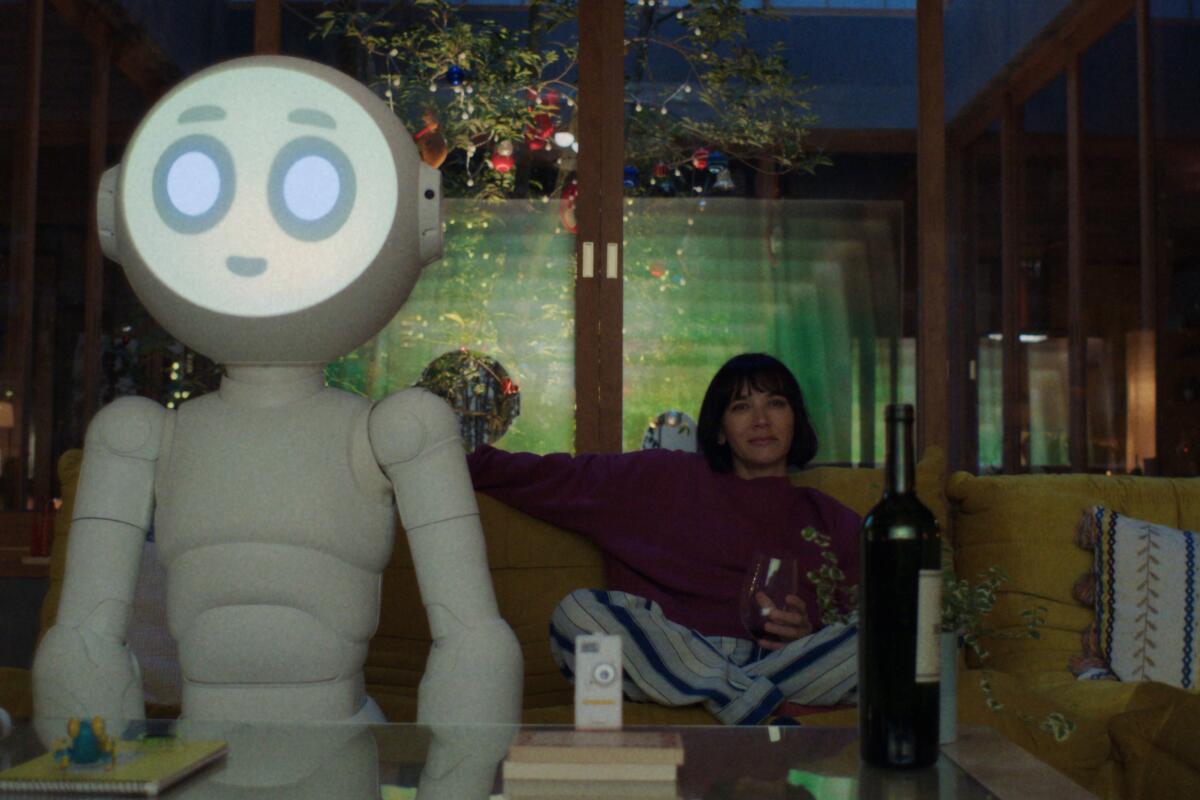
The robot in Apple TV+’s “Sunny” was designed to be a friendly helper to Rashida Jones’ Suzie. (Apple)
Often, on shows such as AMC’s “Humans” and HBO’s “Westworld,” these AI bots become self-actualized, rising up against human oppressors to seek free lives when they realize they could be so much more than servants and sex surrogates. A major trope of modern TV robots is that they will eventually get smart enough to realize they don’t really need humans or come to believe that in fact, humans have been the villains all along.
Meanwhile, in the tech world, companies including Tesla and Boston Dynamics are just a few working on robots that can perform physical tasks like humans. Amazon is one of the companies that will benefit from this and will soon have more robots than people working in its warehouses.
Even more than robotics, AI technologies are developing more quickly than governments, users and even some of the companies developing them can keep up with. But we’re also starting to question whether AI technologies such as ChatGPT might make us passive, dumber thinkers (though, the same has been said about television for decades). AI could introduce new problems in more ways than we can even yet imagine. How will your life change when AI determines your employment opportunities, influences the entertainment you consume and even chooses a life partner for you?
So, we’re struggling to understand. AI, for all its potential, feels too large and too disparate a concept for many to get their head around. AI is ChatGPT, but it’s also Alexa and Siri, and it’s also what companies such as Microsoft, Google, Apple and Meta believe will power our future interactions with our devices, environments and other people. There was the internet, there was social media, now there’s AI. But many people are ambivalent, having seen the kind of consequences that always-present online life and toxic social media have brought alongside their benefits.
Past television series including “Next,” “Person of Interest,” “Altered Carbon” and “Almost Human” addressed potential abuses of AI and how humans might deal with fast-moving technology, but it’s possible they all got there too early to resonate in the moment as much as, say, “Mountainhead,” HBO’s recent dark satire about tech billionaires playing a high-stakes game of chicken while the world burns because of hastily deployed AI software. The quickly assembled film directed by “Succession’s” Jesse Armstrong felt plugged into the moment we’re having, a blend of excitement and dread about sudden widespread change.
Most TV shows, however, can’t always arrive at the perfect moment to tap into the tech anxieties of the moment. Instead, they often use robots or AI allegorically, assigning them victim or villain roles in order to comment on the state of humanity. “Westworld” ham-handedly drew direct parallels to slavery in its robot narratives while “Humans” more subtly dramatized the legal implications and societal upheaval that could result from robots seeking the same rights as humans.
But perhaps no show has extrapolated the near future of robots and AI tech from as many angles as Netflix’s “Black Mirror,” which in previous seasons featured a dead lover reconstituted into an artificial body, the ultimate AI dating app experience and a meta television show built by algorithms that stole storylines out of a subscriber’s real life.
Season 7, released in April, continued the show’s prickly use of digital avatars and machine learning as plot devices for stories about moviemaking, video games and even attending a funeral. In that episode, “Eulogy,” Phillip (Paul Giamatti) is forced to confront his bad life decisions and awful behavior by an AI-powered avatar meant to collect memories of an old lover. In another memorable Season 7 episode, “Bête Noire,” a skilled programmer (Rosy McEwen) alters reality itself to gaslight someone with the help of advanced quantum computing.
TV shows are helping us understand how some of these technologies might play out even as those technologies are quickly being integrated into our lives. But the overall messaging is murky when it comes to whether AI and bots will help us live better lives or if they’ll lead to the end of life itself.
According to TV, robots like the cute helper bot from “Sunny” or abused synthetic workers like poor Mia (Gemma Chan) from “Humans” deserve our respect. We should treat them better.
The robots and AI technologies from “Black Mirror?” Don’t trust any of them!
And SecUnit from “Murderbot?” Leave that robot alone to watch their favorite show, “The Rise and Fall of Sanctuary Moon,” in peace. It’s the human, and humane, thing to do.


It’s a good year when we get movies like Remarkably Bright Creatures and The Sheep Detectives at the same time. If there’s one type of emotional draw we’ll never say no to when it comes to the fiction we consume, it’s wholesome. The kind of movies and TV shows that leave you with a bit more hope than you expected. The kind of stories that make you believe that humanity isn’t as broken as it really is.
The Sheep Detectives is essentially tailor-made for anyone who loves a good whodunnit that’s rich with nuance and humor. The clever decision to shift the genre into something both kids and adults could appreciate together is no small feat, and that’s largely where its mass appeal lies. Murder is a heavy subject to deal with—as is grief—yet this story makes sitting with the weight of both a little easier. It could kickstart a number of thoughtful conversations while it simultaneously delivers plenty of laughs along the way.
For adults, there’s also a huge appeal in the casting—the voice actors especially. Anyone who knows me knows that Ted Lasso is the kind of show I’ll always put first, so hearing Brett Goldstein voice a sheep is the kind of A+ decision that’s effortless to appreciate. Hugh Jackman, Nicholas Galitzine, Molly Gordon, Nicholas Braun, Emma Thompson, Julia Louis-Dreyfus, Bryan Cranston, Bella Ramsey, Regina Hall, Rhys Darby, Patrick Stewart, Hong Chau, and the whole cast do an exceptional job as well, making every moment of The Sheep Detectives thoroughly entertaining.

It’s hard to imagine anyone coming out of the movie not thinking it’s one of the best things we’ll watch all year, and that’s a high compliment considering 2026 is full of gems like Project Hail Mary and the upcoming The Odyssey. It’s the exact kind of movie we could all use, but more than anything, the kind of story we could use more of. If there’s any sort of sequel, sign me up. Let’s make it a trilogy. Give us more of the sheep.
The cinematography is gorgeous, the writing is sharp, the performances are thrilling, and the message is a gem worth holding onto. The Sheep Detectives is the kind of feel-good treasure that does an excellent job of reminding us why movies like this will always matter. There’s a thoughtful message about how grief is meant to be shared and why it’s so important to carry those who’ve passed with us. Yes, it’d be convenient to forget our pain by sheer mental willpower, but we aren’t meant to do that. As humans and as animals, I imagine that the good, bad, and ugly are all part of what makes life beautiful, and that’s a comforting message to sit with.
The concept of a whodunnit featuring sheep solving a murder sounds so wild on paper, yet everything about it results in the kind of movie that should signal to Hollywood we want more creative approaches to what’s familiar. There’s a reason The Muppets are so popular, and we shouldn’t be afraid of making things that sound a bit too whimsical on paper. In other words, The Sheep Detectives embraces the whimsy, and it’s exactly what makes it so delightful.
The Sheep Detectives is now streaming on Prime Video.
First Featured Image Credit: ©Amazon MGM Studios
Related
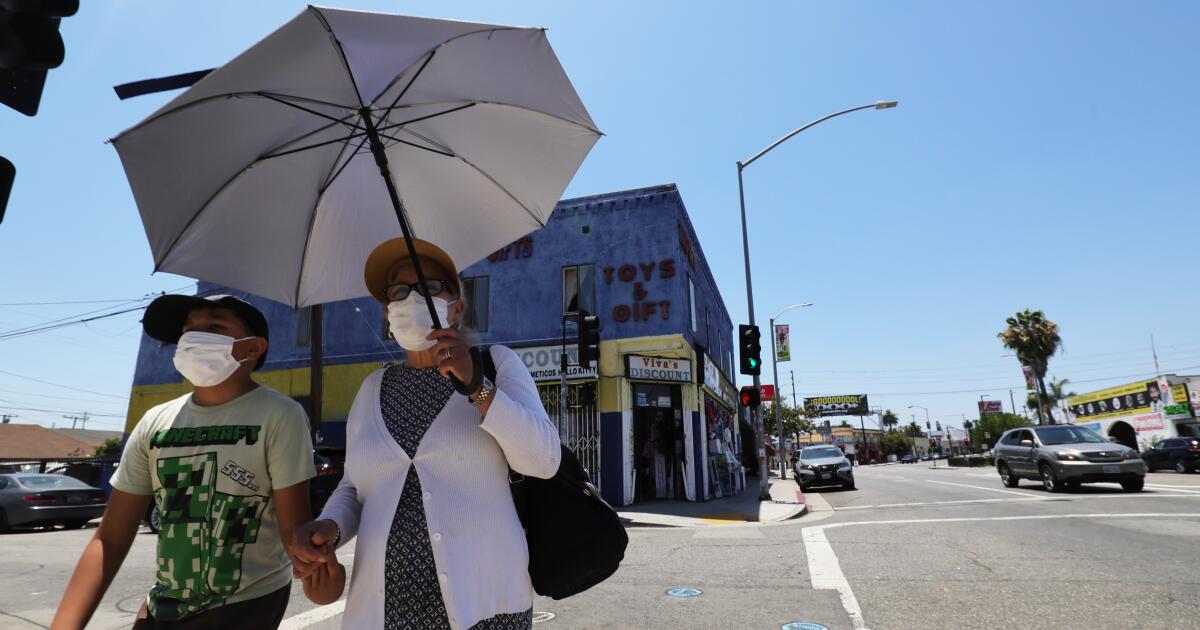
The National Weather Service has issued a heat advisory for this week that includes Los Angeles County and other parts of the Southland, especially in valleys and away from the coast.
Temperatures are expected to rise in the Santa Clarita Valley, the east and west San Fernando Valley, as well as parts of the San Gabriel Valley and northwest L.A. County mountains beginning Tuesday and lasting through Thursday, with warm, seasonably elevated fire weather conditions, according to the National Weather Service.
Forecasts indicate the mercury will reach 90 to 105 degrees in the interior, 80 to 90 degrees in the inland coastal plain — including downtown L.A. — with highs in the 80s and lower 90s in the foothills and canyons of southwest Santa Barbara County.
Rose Schoenfeld, meteorologist with the National Weather Service in Oxnard, said temperatures should be five to 10 degrees above normal for this time of year thanks to a high-pressure system building up over the region.
Though temperatures are expected to drop after Thursday, don’t expect that cooling to last.
“Looking ahead, you might be seeing some outlooks that look pretty favorable, but that heat will linger and redevelop with a pretty impressive heat wave for much of the west, that would be starting next weekend or so,” Schoenfeld said. “It doesn’t seem like we’re out of the woods, even if temperatures start to drop after Thursday.”
The rising mercury coincides a with major marine heat wave across the Pacific Ocean that has the potential to affect weather events around the world, bringing months of warmer oceans, which trigger thunderstorms and extreme heat thousands of miles away.
In recent weeks, record heat waves have baked parts of Europe, with temperatures hitting 104 degrees in some countries. France has reported more than 1,000 heat-related deaths.
In the U.S., record heat has gripped much of the Midwest and East Coast, with temperatures between 110 and 115 degrees in major metropolitan areas, with the National Weather Service issuing an extreme heat warning for much of the Midwest, Mid-Atlantic and Northeast.
The sweltering temperatures have disrupted travel and led to a number of cancellations planned for celebrations over the Fourth of July weekend, including Philadelphia’s Salute to Independence parade. The Great American State Fair, on the National Mall in Washington, was forced to shut down for a few hours.
Amtrak canceled some trains in the Northeast because of excessive heat that could affect the tracks.

The Isolate Thief, 2026.
Directed by John Suits.
Starring Mackenzie Foy, Odeya Rush, Joe Pantoliano, Sean Bean, Jack Kesy, Ty Simpkins, Bryan Martin, and Martin Sensmeier.
SYNOPSIS:
A young woman struggles to conceal the gold she stole from violent outlaws who have seized control of her remote outpost, outwitting them amid a deadly winter where survival becomes a game of cunning and betrayal.

Set at a Union outpost in frigid temperatures, John Suits’ The Isolate Thief transcends what was likely a small budget with a fittingly chilly, oppressive look, and an ensemble that sneaks up on you as not only packed but smartly cast. Front and center is Mackenzie Foy shedding her Twilight and Disney-oriented roots for gritty period-piece work that she handles capably and convincingly, whether it be fending off wolves at the outpost, bandaging a wound, playing a deceitful game for survival, or wielding a firearm.
That’s only the start, though, as Joe Pantoliano shows up as a harmless graverobber only to re-enter the picture as the hostage of a group of Union soldiers led by Sean Bean on a search for gold thought to be discovered by him, which in reality has been hidden away by Mackenzie Foy’s parentless (her father recently died in the war, meaning she is all alone at the outpost), grieving, underestimated caretaker waiting for the right moment to make a break with the gold for San Francisco. The merciless candor with which the Union soldiers are comfortable torturing the drifting graverobber should also be enough to signal that something is off about the group and that our hero probably shouldn’t trust them.

Without giving too much away, Ada (Mackenzie Foy) is up against a violent group of outlaws posing as Union soldiers under orders from Sean Bean’s Fiddler, who will stop at nothing for this gold (accompanied by fellow evildoers played by a range of underappreciated names such as Ty Simpkins and Jack Kesy). In the forest, she also stumbles across a badly injured Emily (Odeya Rush), who has a connection to these outlaws, reduced to being treated as a sex object (they refer to her as an unflattering term for a prostitute, which feels inaccurate given that such a term would imply she has a choice rather than having her agency regularly taken as it is here), so broken by her experiences with them that she advises Ada to give in to their demands as defying them typically results more horrifying outcomes.
Even if the screenplay from Kevin Lefler doesn’t necessarily crackle the way a pressure-cooker story like this should (there’s a lot of The Hateful Eight in the film’s DNA, but without anywhere near that level of character and thematic complexity), the cast elevates the material and provides a quiet intensity simmering underneath the casual conversations and deceptions that we know will eventually blow up in Ada’s face. It’s also a story that isn’t afraid to go to some fairly bleak places and put these women through the wringer as they fight back and try to make it out alive.

What it boils down to is a simplistic cautionary tale of ruthless, misogynistic outlaws underestimating the women they are up against. That is also desperately felt when the women turn the tables in the third act. Effectively accomplishing what it sets out to do. A freezing locale is used for atmospheric advantage (the ground is frozen solid, meaning graves can’t be dug, to give an idea of just how cold it is) while allowing Mackenzie Foy to tap into some new acting tools demonstrating resourcefulness, alongside Sean Bean believably going from calm to terrifying on a dime. The Isolate Thief is a feminist period-piece Western that organically empowers through familiar, albeit competent and engaging, storytelling, culminating in some tense battle-of-the-sexes action.
Flickering Myth Rating – Film: ★ ★ ★ / Movie: ★ ★ ★
Robert Kojder
https://www.youtube.com/watch?v=embed/playlist
-

 San Francisco, CA9 minutes ago
San Francisco’s fireworks show ends in hours of gridlock involving Waymo cars
-

 Dallas, TX12 minutes ago
FIFA Fan Fest in Dallas paused due to lighting in the area Sunday evening
-

 Miami, FL17 minutes ago
Venezuelan Independence Day: Aid efforts continue after devastating earthquake
-

 Boston, MA24 minutes ago
Timeline: Looking back on Jaylen Brown’s Celtics career – The Boston Globe
-

 Denver, CO27 minutes ago
Denver police arrest suspect in fatal July 4 triple stabbing
-

 Seattle, WA32 minutes ago
UPDATE: Water-rescue response off west end of Alki Beach
-
 San Diego, CA39 minutes ago
San Diego County Gas Prices Still Dropping
-

 Milwaukee, WI42 minutes ago
Two Milwaukee officers hurt over Fourth of July weekend

