Entertainment
Column: When it comes to Vili Fualaau, 'May December' wants to have its cake and eat it too

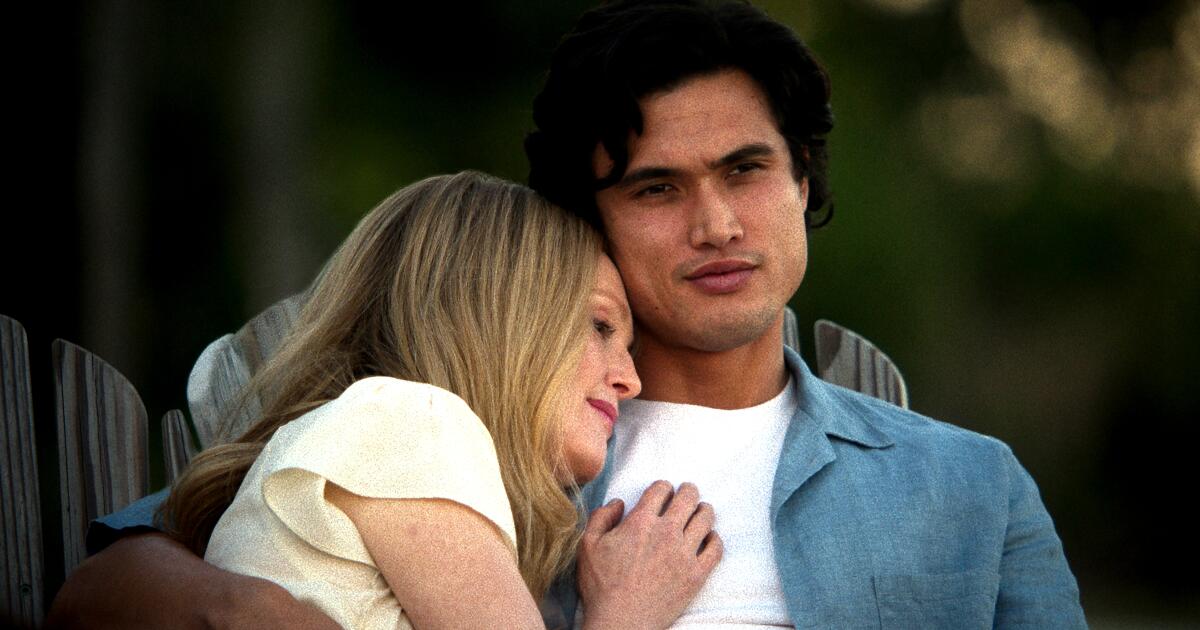
As the critically acclaimed “May December” heads toward what will no doubt be a multiple-nomination awards season, director Todd Haynes and screenwriter Samy Burch find themselves on the receiving end of one of the questions their film asks: What do filmmakers owe the people who inspire the stories they tell, particularly when those stories involve abuse or exploitation?
“May December” follows Elizabeth (Natalie Portman), an actor, as she visits the home of Gracie (Julianne Moore) and Joe (Charles Melton), an infamous couple who began an intimate “relationship” when Gracie was in her 30s and Joe was 13. Gracie was convicted of rape and spent several years in jail, but they eventually married; they have three children, and live with as much privacy as their small town will allow. Elizabeth has been cast to play Gracie in a film and wants to spend time with them as research.
Though certain details have been changed and the main storyline is fiction, “May December” is obviously and admittedly inspired by the headline-generating scandal of Mary Kay Letourneau, who raped and then eventually married her former sixth-grade student Vili Fualaau. Indeed, some of the dialogue was drawn directly from interviews given by the couple over the years.
This week Fualaau, who divorced Letourneau in 2017 but was with her until her death in 2020, expressed unhappiness with the film, and the fact — ironically, given the film’s narrative — that no one had consulted him while making it.
“If they had reached out to me, we could have worked together on a masterpiece. Instead, they chose to do a ripoff of my original story,” he told the Hollywood Reporter. “I’m offended by the entire project and the lack of respect given to me — who lived through a real story and is still living it.”
This is not a good look for “May December,” which Burch described in these pages as a “satire of the industry and the vampiric nature of playing real people who are alive,” but neither the filmmakers’ decision not to involve Fualaau nor his unhappiness is unusual.
When working with historical or well-publicized material, writers and filmmakers often decide that the story they want to tell will not benefit from consulting or informing those who inspired it. Even when it comes to biopics, which “May December” certainly is not.
“Maestro” may have been made with the full participation and well-publicized blessings of Leonard Bernstein’s children, but Sean Durkin, who made “The Iron Claw,” another awards contender this year, did not reach out to the surviving Von Erich brother, Kevin, until after he had written the script detailing the famous wrestling family’s story, which, for dramatic purposes, omitted one of the brothers entirely. Kevin Von Erich (played by Zac Efron in the film) has said he understands the omission but pushed back against the depiction of his father, Fritz (Holt McCallany).
Inevitably, any film or television series made about or inspired by actual events is going to make someone, somewhere, deeply unhappy.
Vili Fualaau, center, in 1998.
(John Froschauer / Associated Press)
The late, great Olivia de Havilland famously sued, at age 100, Ryan Murphy for his profane and gossipy depiction of her in “Feud: Bette and Joan.” Football star Michael Oher, who earlier this year accused the Tuohy family of cutting him out of money earned by their participation in “The Blind Side,” took issue early on with the film’s depiction of him as “dumb.” Amanda Knox has repeatedly called out cinematic versions of her story — she was wrongly convicted of murder in Italy and imprisoned for four years before being exonerated — particularly the Matt Damon-starring film “Stillwater,” in which the Knox-inspired lead was actually guilty.
More recently, almost every living historical figure depicted in HBO’s “Winning Time: The Rise of the Lakers Dynasty” disparaged its accuracy, and friends and supporters of the British royal family recently pressured Netflix to add a “this is a fictionalized dramatization” disclaimer to “The Crown.”
De Havilland lost her suit (and her attempt to take it to the Supreme Court); laws regarding free speech offer wide protections to fiction and fictionalized accounts, with good reason — without an acceptance of literary license, some of the best, most powerful films, series and novels would not exist.
But if writers and directors do not have a legal obligation to the public figures at the center of their stories, do they have a moral one? Not every public-figure inspiration is created equal; there is a difference between the queen of England and a man who is known for marrying the woman who raped him when he was a child.
In recent years, there has been a growing awareness of the effect that true crime stories, however fictionalized, can have on the people involved. For instance, films coming off #MeToo have stressed the importance of respecting survivors’ experiences, and Ryan Murphy’s “Dahmer — Monster: The Jeffrey Dahmer Story” was criticized for re-traumatizing the families of Dahmers victims.
No one would compare “May December” with “Dahmer” or even “Stillwater” — as Haynes and Burch have said repeatedly, the Letourneau/Fualaau relationship was a springboard, not a blueprint — but there is no reading of that story, from the initial crime to the subsequent salacious publicity around their eventual marriage, in which Fualaau is not a victim. No matter how sincere and fine a re-imagining of his life might be, the decision not to involve him in some way is, at the very least, troubling.
Especially since the film directly addresses the exploitation of Hollywood adaptations. In “May December,” Elizabeth’s encounters with Joe seem to offer, at first, hope of deliverance. She sees what the young man, still very much in thrall to Grace, does not: that the “relationship” began when Joe was too young to consent to it and continued when he was still too young to understand what it would cost him.
But Elizabeth uses Joe as well — her “research” extends to having sex with him and then all but shoving him out the door. As far as the Elizabeth character, rich with “creative-process” narcissism, embodies Hollywood, “May December” portrays our thirst for retelling sensational events as destructive. Glimpsed at the end, the film Elizabeth is working on appears far from high art, adding insult to injury.
The power of “May December” comes from Grace and Elizabeth’s relentless battle for, if not truth, then narrative control. Indeed, the only “good” major character in the film is Joe, who is depicted, tragically, as something of a hapless bystander in his own life.
Which, given the decision not to involve Fualaau, feels uncomfortably as if the filmmakers were trying to have their cake and eat it too.
Yes, the people who inspire “based on real events” films and series we love are often unhappy with the cinematic results. But, as with the renewed discomfort over “The Blind Side,” Fualaau’s words feel more poignant, and important, than, say, Magic Johnson refusing to watch “Winning Time” or Judi Dench protesting the inaccuracies of “The Crown.”
Unlike the Lakers or the royal family or Olivia de Havilland, Fualaau is not a public figure beyond the one thing the world knows about him; like Knox and, to a lesser extent, Oher, he was pushed into the public eye when he was young, vulnerable and a victim of circumstance, which in Fualaau’s case meant the victim of a crime.
Mary Kay Letourneau in court in 1998.
(Alan Berner / AP)
There is, as Knox recently pointed out in a lengthy social media thread reacting to Fualaau’s comments, no legal way for public figures to control the way they are used in fiction. Again, for very good reason. Writers and artists use familiar figures as cultural touchstones to tell all sorts of stories, many of which have little to do with the actual people or events that inspired them, and audiences are expected, reasonably, to understand this.
Some of these stories will be good, some bad, a few great; historians will make lists of corrections, critics will express outrage or appreciation, and we can all discuss the complicated nature of fact, fiction, myth, memory and storytelling, which is always a good thing.
But sometimes, it is worth remembering that at the center of those touchstones are real people who, often through no intention of their own, watched helplessly as their stories became public domain.
This is one of those times.



Movie Reviews
‘Thrash’ Review: It’s Netflix and Chomp, as Phoebe Dynevor Stars in a Familiar but Gruesomely Competent Shark Thriller

“Thrash,” like just about every shark thriller, has a grade-Z son-of-“Jaws” quality. (The one exception: the ingenious “Open Water.”) Everything in the movie, from the chomping shark attacks that splash up the waves with Hawaiian Punch foam to the way a humongous great white meets her fate at the end, takes an obvious page from Steven Spielberg’s gambits and techniques. But shark movies, because of that derivative quality (and because the directors are not Spielberg), often tend to be dreary and claustrophobic affairs. Whereas “Thrash” has a lively competence about it, a touch of fluid originality in the staging.
It’s set in the small town of Annieville, S.C., which in the first half hour gets subjected to a hurricane so intense it’s like a tsunami, bolstered by vintage stupido lines like, “If they ever considered creating a Category 6, this would be it. It’s a monster!” It’s all part of the film’s environmental message (the storm starts off as a Category 2 until it hits record-temperature warm waters off the coast). But once Hurricane Henry floods the town, the film’s writer-director, Tommy Wirkola, turns a submerged neighborhood block into a kind of water-world stage set, like a giant pond with the top halves of houses poking out the top. They’re places of refuge, only they keep shifting and collapsing.
The storm has brought with it a school of bull sharks, who are smaller and faster than great whites, but just as ravenous. The movie wastes no time delivering the gory goods, which are served up for our delectation like the killings in a slasher movie. If fear was once the pulse of a shark thriller, now it’s voyeurism — our chance to feast on what it looks like when a shark feasts. In this case, though, only the unappealing characters get eaten. That’s part of the lip-smacking quality of it all — the idea that certain movie characters deserve to have their limbs bitten off.
Of the ones in “Thrash” who don’t, the most original character is Lisa (played by Phoebe Dynevor, from “Fair Play”), not because there’s anything complex in how she’s drawn, but because she’s pregnant — as in not just about to have a baby, but she’s going to have it during the movie, as she struggles to wriggle away from the sharks. That sounds precarious, and is, but once her infant son has popped out, talk about providing someone with motivation to take on nature’s predators. She’s assisted by Dakota (Whitney Peak), the film’s other, younger heroine, who at one point makes her way over a floating rooftop and rickety branches, improvising the acrobatics of survival. Dakota, whose mother recently died, is being raised by her marine-biologist uncle, played by Djimon Hounsou as the film’s token scientist-philosopher of disaster.
Wirkola, who’s Norwegian, has written a bare-bones script, but he knows how to play with space. He stages an encounter in which Ron (Stacy Clausen), a teenage okie foster child, is swimming around in a basement, with that great white on his tail, and the sequence has a delectably flowing sense of danger.
Mostly, though, we’re watching the kills come right on cue. This is a Netflix and Chomp movie, just 80 minutes long (if you don’t count the closing credits), and the compact run time does more than keep “Thrash” from wearing out its welcome. It’s part of the film’s lean-and-mean structural unity — the way it treats an entire underwater street and its houses like the shark boat in the last act of “Jaws,” as a safety zone that’s rapidly disintegrating. Ron and his two siblings have been living with foster parents who are government-sponging creeps (they eat steak in the basement while tossing their meal-ticket kids packages of Wonder Bread), and when Bob (Josh McConville), the loathsome father, gets what’s coming to him, it’s not scary — it’s closer to mutilation porn. He’s the steak, there to sate our hunger.
Entertainment
Review: As Trump rains down terror on Iran, Sanaz Toossi’s Pulitzer-winning ‘English’ has its L.A. premiere

War has a way of curtailing imagination. When the news breaks of faraway civilian casualties — an erroneous air strike on a school that relied on outdated intelligence, for example — the mind takes refuge in abstractions and statistics.
Grief isn’t an infinite resource. There’s only so much distant suffering anyone can take in. Yet our moral health as a society depends on the recognition of our common humanity. We share something with the inhabitants of those countries whose civilization our government has threatened to destroy.
This is an important moment to experience “English,” Sanaz Toossi’s Pulitzer Prize-winning drama, set in an English-language classroom outside of Tehran in 2008. The play, now having its L.A. premiere at the Wallis Annenberg Center for the Performing Arts, reminds us of the lives — the hopes, the dreams, the sorrows — on the other side of the headlines. (As I write this, the New York Times homepage has a story that stopped me dead in my tracks: ”Iranian Schools and Hospitals Are in Ruins, Times Analysis Shows.”)
Babak Tafti, left, and Marjan Neshat in “English” at The Wallis.
(Kevin Parry)
“English” isn’t trying to win any political arguments. Its focus is on the characters, who are in a Test of English as a Foreign Language (TOFL) prep class. The exam will have an oversize effect on the future possibilities of this small, mishmash group of students.
Elham (Tala Ashe) needs a high score to pursue her medical education in Australia. Roya (Pooya Mohseni) wants to join her son in Canada to be part of her granddaughter’s life, but Persian is frowned upon in her son’s assimilated, English-language household. Omid (Babak Tafti), whose English is far beyond anyone else’s level in the class, has a U.S. green card interview coming up. And Goli (Ava Lalezarzadeh), the youngest of the students, wants at the very least to be fluent in the lingua franca of American pop culture.
Marjan (Marjan Neshat), the teacher whose love for the English language is infused with longing and regret, harks back nostalgically on her years in Manchester before she returned to Iran. She insists for pedagogic reasons that the students only speak English in the classroom. But Elham, a contentious and fiercely competitive student, suspects that Marjan’s zeal for anglophone culture, including Hollywood romantic comedies, masks a resentment for the Iranian life she is now stuck with. (Neshat and Ashe are gracefully reprising their Tony-nominated performances.)

Tala Ashe, left, and Pooya Mohseni in “English” at The Wallis.
(Kevin Parry)
Mastering English can open doors, but what if you wish you didn’t have to walk through them? Elham is angry that she has to leave to pursue her medical dreams. When she speaks English, she feels like a diminished version of herself. She calls her accent “a war crime,” and grows frustrated in class that she can’t easily explain what she’s thinking and feeling in her halting English.
The other students might not be as truculent as Elham, but they are just as ambivalent about the necessity of learning English. Toossi doesn’t grapple explicitly with the fraught internal politics of the Iran of the period. The conversation in the classroom doesn’t turn to the repressive regime or the state requirement of headscarves or the geopolitical strategies that have alienated the Islamic Republic of Iran from the global community.
When I saw “English” in 2024 at the Old Globe in San Diego, I was acutely aware of what the playwright was not addressing. At the Wallis in 2026, in the wake of Operation Epic Fury and the blitzkrieg of unhinged rhetoric from President Trump, whose rationales and goals for the war seem to change with every public utterance, I was intensely appreciative of what Toossi was putting front and center — the variegated humanity of her characters.

Tala Ashe and Marjan Neshat in “English” at the Wallis.
(Kevin Parry)
This Atlantic Theater Company & Roundabout Theatre production, directed by Knud Adams, had a critically touted Broadway run, receiving four Tony nominations, including best play. The physical staging, featuring a rotating cube from set designer Martha Ginsberg, shows us the classroom from different vantages, bringing the play’s shifting perspective to three-dimensional life.
Toossi follows the interplay of the differing viewpoints and lived experiences. She’s not as concerned with settling differences as with understanding the thoughts and emotions animating the clashes of her divergent characters. The actors relish the pesky, droll, frequently adorable, sometimes incendiary individuality of their roles.
The play does something unique with language. When a character speaks English, an accent is employed and the manner is often a bit stumbling. When a character speaks Persian, the English that is heard is natural and relaxed, the sound of a native speaker.
The result is that these Iranian characters, when talking among themselves in their native tongue, sound awfully like Americans having a conversation in the mall or at a nearby table at a restaurant. We are no longer separated by language. The notion of the Iranian “other” falls by the wayside.

The cast of “English” at the Wallis.
(Kevin Parry)
It’s hard not to wonder if one of those missiles raining down on schools in recent weeks hit when Marjan was showing “Notting Hill” or another favorite rom-com to one of the students she was hoping might realize her dreams of living abroad. Omid, whose English surpasses Marjan’s own level, has excited such hopes, and the touchingly Chekhovian quasi-romance between them adds a gentle note of amorous wistfulness.
Adams’ production creates a cinematic penumbra through the projections of Ruey Horng Sun, a soundscape by Sinan Refik Zafar that lyrically underscores the actions and the emotionally attuned lighting of Reza Behjat. The effect heightens the romanticism of characters who are no longer lost to us in translation.
But the destination of the play is less about what these students sound like to an American audience than what they sound like to themselves. And that is a universal journey that transcends even the starkest barriers of language, culture and politics.
‘English’
Where: Wallis Annenberg Center for the Performing Arts, Bram Goldsmith Theater, 9390 N. Santa Monica Blvd., Beverly Hills
When: 7:30 p.m. Tuesdays to Fridays, 2 and 7:30 p.m. Saturdays, 2 and 7 p.m. Sundays. (Check for exceptions.) Ends April 26
Tickets: Start at $53.90
Contact: (310) 746-4000 or TheWallis.org
Running time: 1 hour, 40 minutes (no intermission)

The Video Age was an amazing boost to the film industry. Not only did it open up a whole new marketplace for studios to sell successful films too, it also became a secondary outlet to eventually recoup losses if a film performed poorly in theaters. It even opened up some films to a wider audience.Most Mom and Pop stores didn’t care that you weren’t seventeen and would rent you anything on their shelves, outside of those tapes behind the saloon doors in the back corner (from an industry that, let’s face it, probably profited more than any others since you no longer had to go to a gross and grimy theater), because every rental simply meant profit.This era also expanded an already moderately active subculture: The Cult Film. Some of those movies that didn’t do well in the theaters caught on with the rental audiences, and so did some that you might not have heard about until you stepped into the store that day. Video also helped bring into your home those movies you only heard about as being shown in midnight screenings in larger cities.There were also those that somehow became legendary through rumor. Movies whispered about in school halls or at recess. Movies that someone’s brother/cousin/friend-of-a-friend had seen at a sleepover. Movies so taboo that you’d be grounded for life if your parents found out you’d watched them. One of the most legendary of these was Faces of Death.A documentary supposedly featuring footage of real deaths, it was the king of the no-no videos, going well beyond anything else on the Video Nasties list. Though later debunked as containing faked scenes, it still holds a solid spot in the pantheon of Cult Cinema. This being the 21st century, where any past property is fair game, we of course now have a meta-reimagining also titled Faces of Death.Margot (Barbie Ferreira) works for Kino, an app similar to TikTok, as a content moderator. Every day she sits at her computer, watches the first moments of a video submitted for review and decides if it violates company standards or can stay on the platform.Margot has personal reasons for doing this, having gone horribly viral in a video, and she wants to make sure the internet is a safer place. When a series of videos come across her desk featuring deaths that look too real, she tries to get her boss, Josh (Jermaine Fowler), to go further than simply banning them, but he refuses. Since no one will listen to her, she violates the terms of the company’s NDA and begins investigating them in her free time.During her investigation, she discovers the existence of a movie called Faces of Death, and her horror-loving roommate, Ryan (Aaron Holliday), happens to have a copy. It turns out that someone is recreating scenes from the video, using the voiceover from the movie and possibly performing actual murders. That someone is Arthur (Dacre Montgomery), and Margot’s investigating puts her directly in his crosshairs.If you’re going to do anything modern with the rights to the original Faces of Death, this is definitely the direction to go. The film is a creative look into the desensitized modern screen culture and the Insta-fame of influencers. Director Daniel Goldhaber and his co-writer Isa Mazzei, who together in the same capacities brought us the excellent Netflix film Cam, have created an interesting and surprisingly entertaining treatise on the extremes that current society can make a person go to, similar to the message behind their other film How to Blow Up a Pipeline.While based on such a grotesquery as Faces of Death, Goldhaber has decided to hold back on the gore created for this version. There’s still a good amount of blood, but not as much as you might expect from something carrying this brand.Instead, the film’s more of a psychological cat-and-mouse thriller, where the emphasis is put on Margot’s investigation. Yes, through that we get to see not only Arthur’s recreations but also clips from the original video, but the filmmakers graciously curb the content shown. Plus, the slightly grainy look and the subdued lighting the Goldhaber gives to the film helps make it feel like a videotape from the 1980s, dipping us deeper into the intended effect I believe he is going for, here.Ferreira makes for an interesting choice for a Final Girl. While she’s a beautiful woman, she’s not the person would typically get hired for this role being that she’s also plus sized. This makes her more relatable than your usual Hollywood beauty. She’s not Jamie Lee or Neve, she’s you and me, and that makes the situation she finds herself in even more frightening.Montgomery is well cast as Arthur, too. He has the ability to put on this nerdy kind of public face, but his private persona is much more dangerous and off kilter. I look forward to viewing this where I can pause and see what videotape titles the filmmakers decided to put on the bookcase/door to his secret studio to see if that gives even more insight into Arthur’s mental state.While it didn’t blow me away, I really had no idea what to expect from Faces of Death. So, therefore, I can honestly say that my expectations were exceeded.
The Video Age was an amazing boost to the film industry. Not only did it open up a whole new marketplace for studios to sell successful films too, it also became a secondary outlet to eventually recoup losses if a film performed poorly in theaters. It even opened up some films to a wider audience.
Most Mom and Pop stores didn’t care that you weren’t seventeen and would rent you anything on their shelves, outside of those tapes behind the saloon doors in the back corner (from an industry that, let’s face it, probably profited more than any others since you no longer had to go to a gross and grimy theater), because every rental simply meant profit.
This era also expanded an already moderately active subculture: The Cult Film. Some of those movies that didn’t do well in the theaters caught on with the rental audiences, and so did some that you might not have heard about until you stepped into the store that day. Video also helped bring into your home those movies you only heard about as being shown in midnight screenings in larger cities.
There were also those that somehow became legendary through rumor. Movies whispered about in school halls or at recess. Movies that someone’s brother/cousin/friend-of-a-friend had seen at a sleepover. Movies so taboo that you’d be grounded for life if your parents found out you’d watched them. One of the most legendary of these was Faces of Death.
A documentary supposedly featuring footage of real deaths, it was the king of the no-no videos, going well beyond anything else on the Video Nasties list. Though later debunked as containing faked scenes, it still holds a solid spot in the pantheon of Cult Cinema. This being the 21st century, where any past property is fair game, we of course now have a meta-reimagining also titled Faces of Death.
Margot (Barbie Ferreira) works for Kino, an app similar to TikTok, as a content moderator. Every day she sits at her computer, watches the first moments of a video submitted for review and decides if it violates company standards or can stay on the platform.
Margot has personal reasons for doing this, having gone horribly viral in a video, and she wants to make sure the internet is a safer place. When a series of videos come across her desk featuring deaths that look too real, she tries to get her boss, Josh (Jermaine Fowler), to go further than simply banning them, but he refuses. Since no one will listen to her, she violates the terms of the company’s NDA and begins investigating them in her free time.
During her investigation, she discovers the existence of a movie called Faces of Death, and her horror-loving roommate, Ryan (Aaron Holliday), happens to have a copy. It turns out that someone is recreating scenes from the video, using the voiceover from the movie and possibly performing actual murders. That someone is Arthur (Dacre Montgomery), and Margot’s investigating puts her directly in his crosshairs.
If you’re going to do anything modern with the rights to the original Faces of Death, this is definitely the direction to go. The film is a creative look into the desensitized modern screen culture and the Insta-fame of influencers. Director Daniel Goldhaber and his co-writer Isa Mazzei, who together in the same capacities brought us the excellent Netflix film Cam, have created an interesting and surprisingly entertaining treatise on the extremes that current society can make a person go to, similar to the message behind their other film How to Blow Up a Pipeline.
This content is imported from YouTube.
You may be able to find the same content in another format, or you may be able to find more information, at their web site.
While based on such a grotesquery as Faces of Death, Goldhaber has decided to hold back on the gore created for this version. There’s still a good amount of blood, but not as much as you might expect from something carrying this brand.
Instead, the film’s more of a psychological cat-and-mouse thriller, where the emphasis is put on Margot’s investigation. Yes, through that we get to see not only Arthur’s recreations but also clips from the original video, but the filmmakers graciously curb the content shown. Plus, the slightly grainy look and the subdued lighting the Goldhaber gives to the film helps make it feel like a videotape from the 1980s, dipping us deeper into the intended effect I believe he is going for, here.
Ferreira makes for an interesting choice for a Final Girl. While she’s a beautiful woman, she’s not the person would typically get hired for this role being that she’s also plus sized. This makes her more relatable than your usual Hollywood beauty. She’s not Jamie Lee or Neve, she’s you and me, and that makes the situation she finds herself in even more frightening.
Montgomery is well cast as Arthur, too. He has the ability to put on this nerdy kind of public face, but his private persona is much more dangerous and off kilter. I look forward to viewing this where I can pause and see what videotape titles the filmmakers decided to put on the bookcase/door to his secret studio to see if that gives even more insight into Arthur’s mental state.
While it didn’t blow me away, I really had no idea what to expect from Faces of Death. So, therefore, I can honestly say that my expectations were exceeded.

How North Carolina Developed Its 2026 NFL Draft Class

Man arrested in North Dakota six months after Durham County murder

Police responded to a report of a ‘domestic dispute’ at Ohio governor candidate’s home in 2019

TIMELINE: Rounds of storms in Oklahoma continue throughout weekend
Oregon Lottery Mega Millions, Pick 4 results for April 10

Florida High School Football Rankings: Top 25 teams – Oct. 21

How old is Bo Nix? What to know about Oregon quarterback ahead of 2024 NFL Draft

Cleary's 21 help Le Moyne down Central Connecticut State 69-64 in OT

99th annual Pony Swim held in Virginia

Indiana Members Credit Union announced as new anchor tenant at Bottleworks District

Trump adversary running for Senate borrows his filibuster playbook

Russian propaganda unit targets Hungary’s elections

WATCH: Artemis II astronauts splash down on Earth

Swalwell’s former female staffer drops bombshell allegations of sexual assault, exposing himself: report

NASA’s Artemis II prepares for splashdown on Earth
-

 Atlanta, GA6 days ago
1 teenage girl killed, another injured in shooting at Piedmont Park, police say
-

 Education1 week ago
Video: Toy Testing with a Discerning Bodega Cat
-

 Movie Reviews1 week ago
Vaazha 2 first half review: Hashir anchors a lively, chaos-filled teen tale
-

 Georgia4 days ago
Georgia House Special Runoff Election 2026 Live Results
-

 Pennsylvania5 days ago
Parents charged after toddler injured by wolf at Pennsylvania zoo
-

 Arkansas21 hours ago
Arkansas TV meteorologist Melinda Mayo retires after nearly four decades on air
-
 Milwaukee, WI5 days ago
Potawatomi Casino Hotel evacuated after fire breaks out in rooftop HVAC system
-
 Entertainment1 week ago
Inside Ye’s first comeback show at SoFi Stadium