A notable similarity marks a subcategory of once woefully under-recognized female artists of the past. Their resolute endurance of trauma is proposed as a primary reason to reassess their work today.
At age 18, Artemisia Gentileschi (1593-1653) survived the abusive manipulations of rape by the painter Agostino Tassi, a colleague in her studio. Public humiliation followed the private ordeal when she courageously took his assault to trial.
Frida Kahlo (1907-54) endured decades of grueling pain after a bus she was riding in — also at age 18 — smashed into a trolley and forced a long metal rod to rip through her midsection. The vehicular wreck caused internal injuries that would plague her throughout her life.
Then there is Camille Claudel (1864-1943). Her trauma came later, when mental and emotional deterioration led to her confinement in a psychiatric institution, far from the Paris studio of Auguste Rodin, in which her own brilliant work as a sculptor had blossomed. The cause for the internment was said to be paranoid psychosis. She was 48 and remained hospitalized for 30 years, the remainder of her life.
“Camille Claudel,” a fascinating exhibition at the J. Paul Getty Museum, unwinds the traumatic tale, and in the process refocuses the story in important ways. In the popular telling, Claudel is to France what Gentileschi was to Italy and Kahlo to Mexico: the overlooked artist as victim — a casualty not just once, but twice. The active personal trauma experienced in life was joined by passive negligence after death from the culture at large.
Advertisement
Camille Claudel, “Crouching Woman,” about 1884-85, patinated plaster
(J. Paul Getty Museum)
The welcome revival of interest in the paintings and sculptures of Gentileschi, Kahlo and Claudel since the 1970s and ’80s was led by second-wave feminists, and it represented an effort to transform victimhood into survivorship in the cultural sphere. Which sounds good, but has a catch. The narrative focus tends to linger on the artist, not the art.
Biography, framed by dramatic events, often overwhelms the paintings and sculptures, which are admired for the reductive ways in which they illuminate the artist’s tumultuous life. It can lead to travesty, such as a current Gentileschi exhibition at the Palazzo Ducale in Genoa, Italy, reported to feature what some critics have witheringly described as a “rape room” — a darkened chamber with a bloodied bed in the center, surrounded by projections of Gentileschi’s often gory paintings.
Advertisement
It’s no accident that multiple movies and plays have been produced about Gentileschi, Kahlo and Claudel, with various incidents vividly sensationalized to court pop culture success. A lead actress Oscar nomination, for example, deservedly went to Isabelle Adjani for the 1989 film “Camille Claudel,” and then to Salma Hayek for the 2002 movie “Frida.” The talented actors were given lots of cinematic scenery on which to chew.
In the case of Claudel, a subtle but opportune correction of the narrative arrives in the new museum show.
Curators Anne-Lise Desmas at the Getty and Emerson Bowyer at the Art Institute of Chicago, where the show was seen last fall, make no bones about articulating the sculptor’s very real travails. Outlined in the superb and detailed catalog are the artist’s sometimes difficult personal affair with Rodin, 24 years her senior and a commanding figure in the art life of late 19th century Paris; a rapidly industrializing society in flux, for artists as for others, that nonetheless saw exceptionally high fences erected around a woman’s potential for success as a sculptor; and internal family issues that left Claudel without much immediate personal support when she very much needed it.
“This biographical miasma,” the curators write in the catalog introduction, “has tended to obscure — or even excise — the sculptor’s art and agency.” Those subjects get put in appropriate context by an enlightening exhibition.
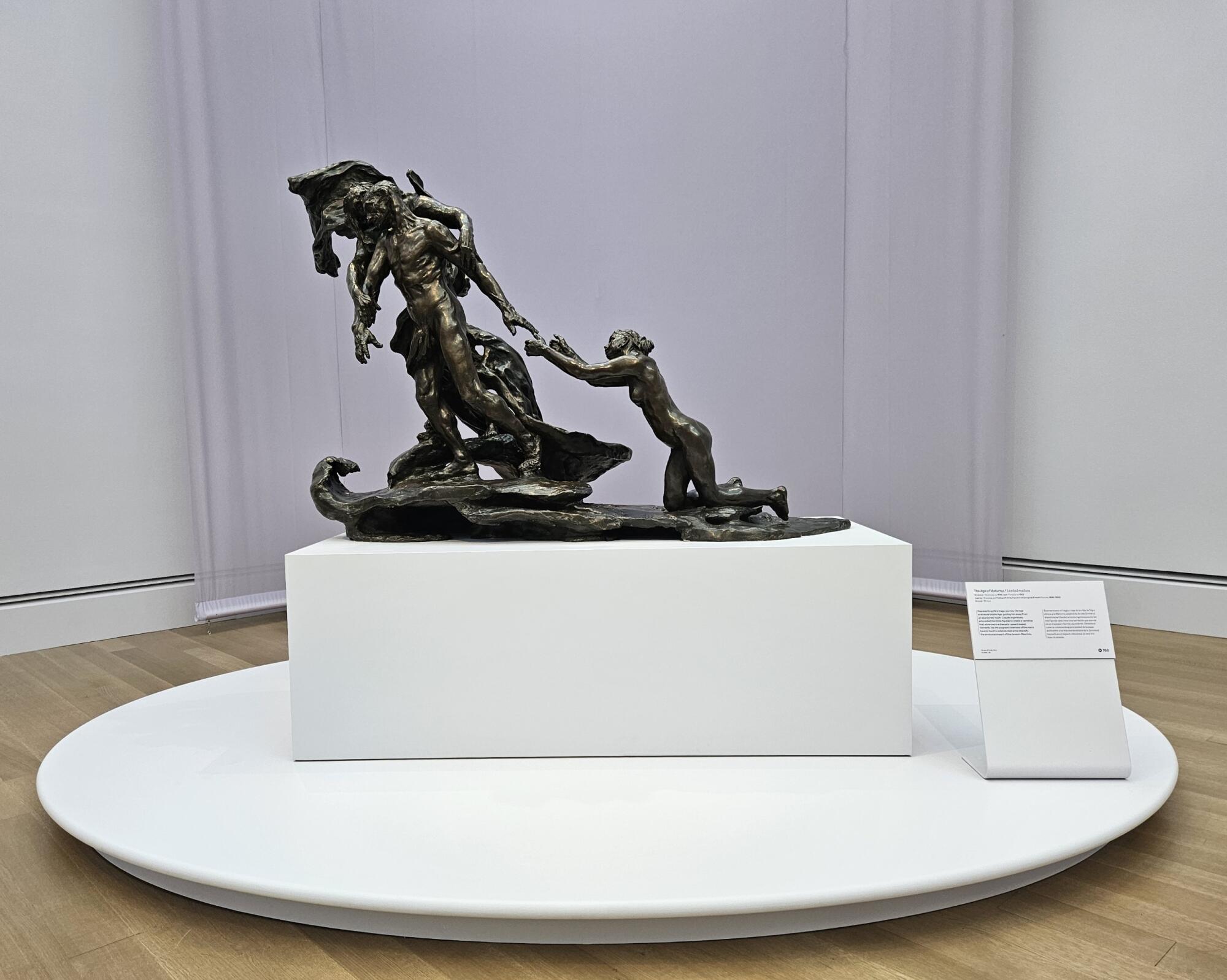
Camille Claudel, “The Age of Maturity,” 1890-99, bronze
(Christopher Knight / Los Angeles Times)
Advertisement
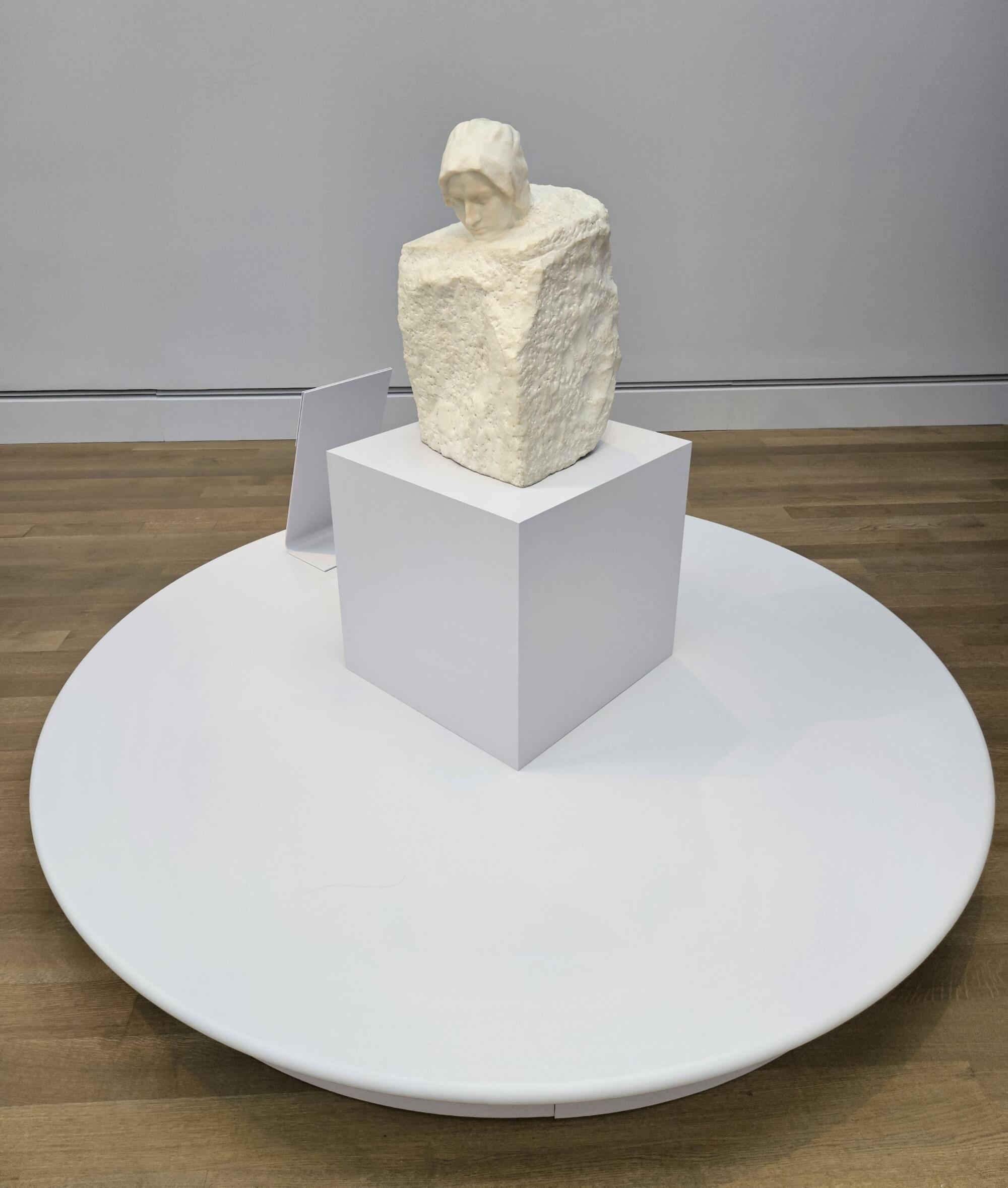
Fifty-eight sculptures have been assembled, including works in clay, plaster, marble and bronze. They include the major 1890-99 ensemble “The Age of Maturity,” a large, three-figure allegory of aging that unfolds in multiple bronze sections, in which youth gives way to the inevitability of old age and death. There’s a stunning and compact portrait-bust of Rodin, in which the focused concentration of his life-size head seems to rise up out of a tumult below, represented by his lengthy, swirling, thickly tangled beard. And, for contrast, we get Rodin’s winsome portrait of Claudel, the lowered gaze of her intensely alert but ethereal head emerging from a hefty block of chiseled white marble.
At first, her portrait appears unfinished, but that’s a misperception. Rodin titled his sculpture “Thought.” Perhaps he recognized what emerges from encounters with Claudel’s art. Repeatedly, her figures stoop, crouch, look down or away, resulting in a concentrated bodily sense of intense interiority. Experiential subjectivity forms the essence of her human forms.
In a beautiful installation, many works are smartly shown on a pedestal positioned atop a circular base, which wordlessly leads a viewer all the way around — ideal for an art that needs to be seen in four dimensions of space and time. Revealing labels are sometimes nicely tucked away, as in one on the far side of “The Age of Maturity” informing that the baroque flourish of drapery billowing at the apex is actually a precise facsimile, the original bronze piece currently undergoing conservation back in Paris.
The number of works is relatively modest — understandably so, given the comparative brevity of her career (barely two decades, while Rodin’s was more than twice as long) and her need to devote years as a studio assistant. They range from a remarkably adept terracotta portrait bust of an elderly household member, “Old Helen,” made when Claudel was 21, to a complicated state commission for a mythological subject in bronze, “Wounded Niobid,” dated 1907, near the end of a tough career that had left her nearly destitute.
Advertisement
Claudel was born into a solidly middle-class family in 1864, daughter of a registrar of deeds in a small medieval town 60 miles from Paris. Her mother bore four children, one of whom — Paul — would go on to become a well-known poet and an influential diplomat posted to China, Brazil, the United States and elsewhere. With her father regularly being transferred to various provincial towns, Claudel and her siblings settled in Paris with their mother in 1881. There she began her serious study of sculpture, met Rodin during student critiques and within three years was employed in his studio.
Auguste Rodin gave the title “Thought” to his 1895-1901 marble portrait of Camille Claudel
(Christopher Knight / Los Angeles Times)
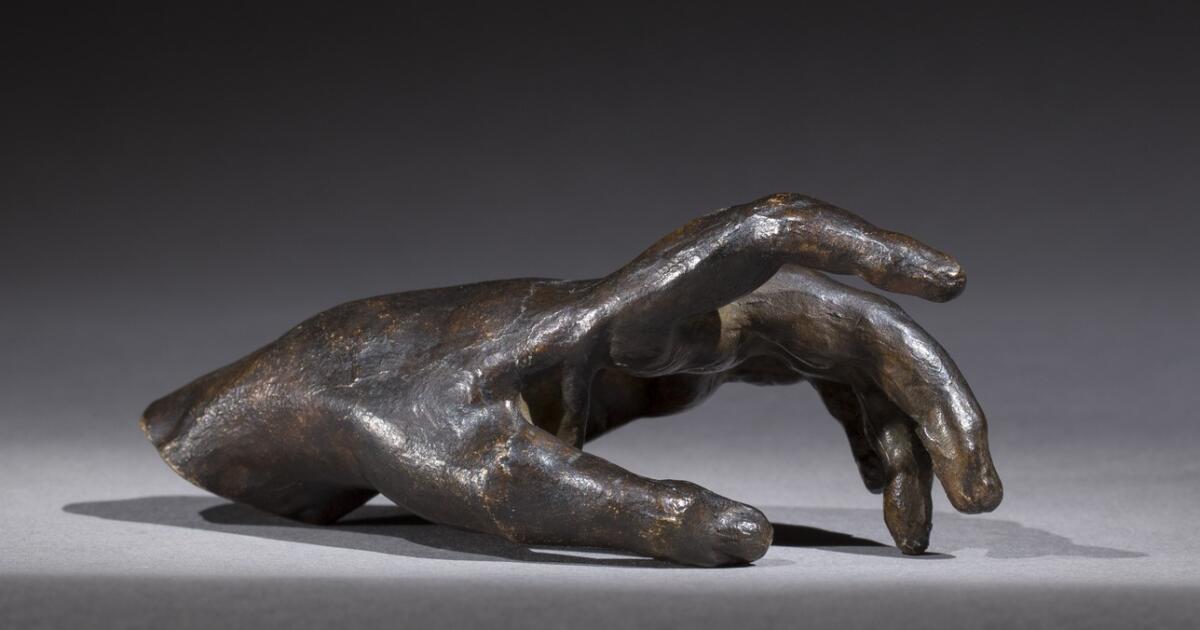
Rodin relied on his assistant’s formal skills, especially Claudel’s talents with the difficult task of successfully rendering expressive hands and feet. She’s credited with work on major commissions, including the monumental bronze sculptural group “The Gates of Hell” — the one with the “Thinker” poised on the doorway’s head jamb like an inquisitive crow, puzzling over humanity’s infernal chaos on its way to eternal doom — and, most important, “The Burghers of Calais.” (Check out the animated hands of those sacrificial citizens!) Perhaps the show’s most riveting small work is a little bronze study of a hand, just 10 inches wide, no doubt informed by Claudel’s careful scrutiny of her own. A curved index finger rises up from the rest like a speaker separating from a crowd and preparing to expound.
The exhibition was inspired by Getty and Art Institute of Chicago acquisitions in recent years. (Only 10 Claudel sculptures are in American museums, according to press materials.) Chicago’s is a plaster portrait bust of Camille’s brother Paul, made when he was a teenager and layered in thin glazes of paint to create an illusion of the patina on an ancient Roman bronze head. The Getty’s is one of the show’s knockouts.
Advertisement
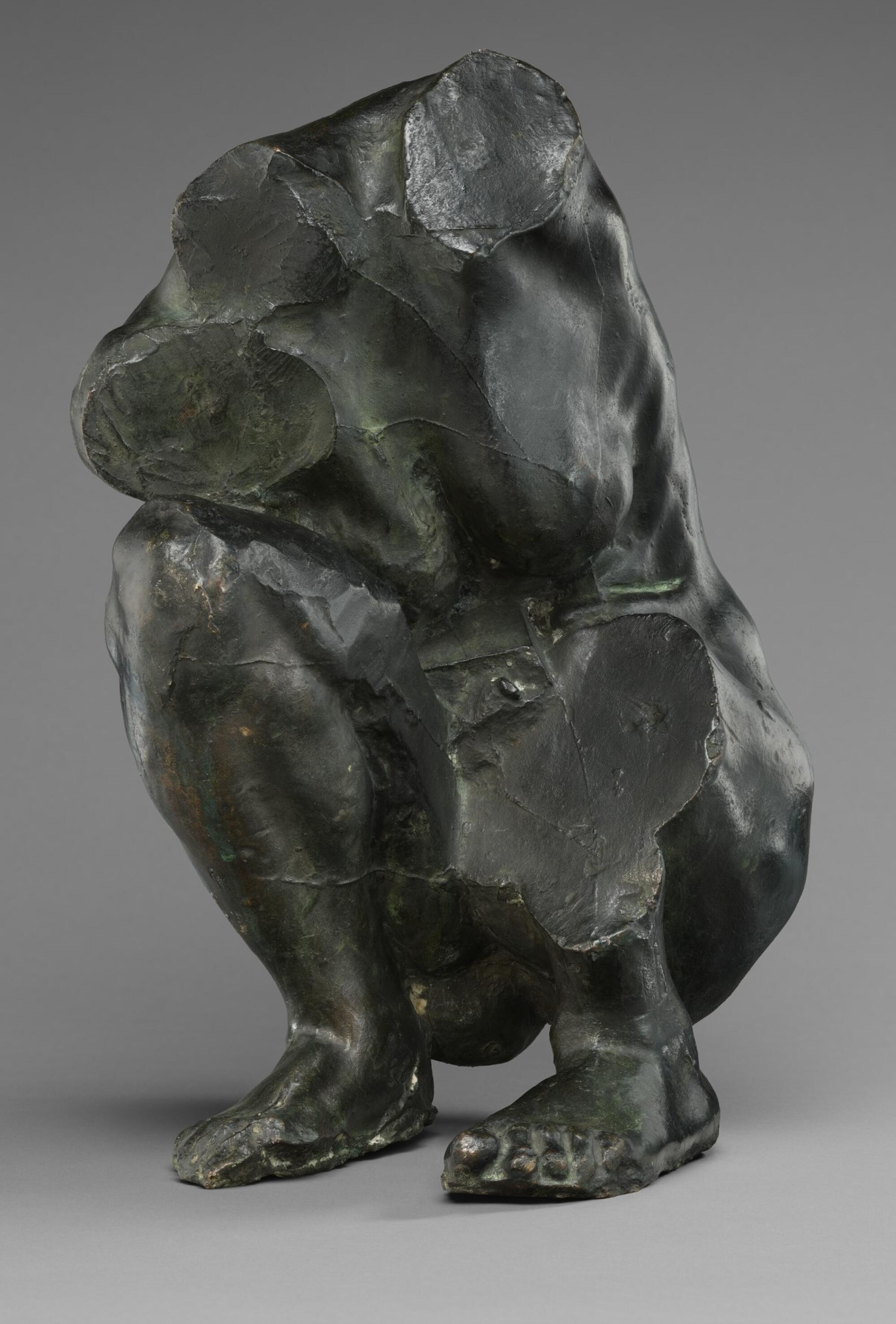
A sculpture as fresh and contemporary as anything you’ll find in a gallery crawl today, the dark bronze “Torso of a Crouching Woman,” about three feet tall, is a headless, armless figure surely inspired by a famous Greek example of Aphrodite emerging from the bath, which the artist would have known from prowls in the Louvre Museum. Feet squarely planted, center of gravity low, Claudel’s version rests firmly on the ground while twisting in space. The movement pulls skin taut over the ribs, spine and musculature of her back, enlivening the subject’s tactile sensuality.
With one notable exception, the sliced off body parts allude to the fragmentary quality of the ancient original, which has lost its head and arms from time’s vicissitudes. The exception is the missing left knee. Gone is most of the leg.
Camille Claudel, “Torso of a Crouching Woman,” modeled circa 1884-85, bronze cast about 1913
(The J. Paul Getty Museum)
Cut off just above the ankle all the way to mid-thigh, the omission isn’t found in the classical Greek original or its many Roman copies, where the leg is a prominent protrusion. The vivid erasure also seems different from just being overkill in a nod to history by a young sculptor earnestly figuring things out. (Claudel is thought to have made the sculpture when she was about 20.) Instead, the radical cut reads as a determined compositional move. You imagine the jutting knee was there in her clay model, thought better of, then given a chop.
Advertisement
The result further exposes the torso in its most vulnerable feminine places, while accelerating the figure’s spatial turn. Claudel’s visceral cut invigorates the form — a seeming contradiction for a removal to accomplish, but one that is as modern as will be found in any contemporaneous bather painted in oil or drawn in pastel by Edgar Degas.
It’s also hard to imagine Rodin doing something like that. Claudel surely benefited from her artistic relationship with the revered sculptor. But he benefited from it as well, modeling some of his work on her inventive forms, plus using all those eloquent hands and feet. A good bit of the scholarship around Claudel in the last few decades has been directed at correcting attributions to him for sculptures she made but did not sign.
A modern cliché has it that an artist must suffer to achieve true success in their art, and Claudel, like Gentileschi and Kahlo, surely did. But for female artists throughout history, the marvelous Getty exhibition handily demonstrates that there’s much more to it than only surviving trauma. Everyone needs to labor to get through the day. A powerful artist needs to do more, and Claudel does.
‘Camille Claudel’
Where: J. Paul Getty Museum, 1200 Getty Center Drive, Brentwood When: Through July 21; closed Mondays Info: (310) 440-7300, www.getty.edu
A crazed newscaster prompts his viewers to do a wild thing: open their windows and shout, “I’m as mad as hell and I’m not going to take this anymore.” And they do it, from Atlanta to Baton Rouge, so much yelling. It’s a prescient scene in “Network” from 1976, the year of America’s bicentennial. Fast forward to the semiquincentennial and Americans holler versions of that slogan through windows in real life, just on phones and computers.
When the national mood wobbles, we turn to the arts, which have the power to free buried desires, soothe souls and cross divides. So as America turns 250, the Entertainment team considered how this country’s ups and downs have shaped what we watch, listen to and read. Throughout this week those stories will appear here. Bookmark this page to come back for more.
To start, “Network” makes our list of movies that illustrate frictional historical moments. (“Team America: World Police” does too so expect range!) We also spotlight a new generation of playwrights reimagining Americanness with a sense of hope that America’s best years are still ahead of us. —Brittany Levine Beckman, Entertainment and Features editor
In K M Chaitanya’s Aa Dinagalu (2007), actor Atul Kulkarni, playing gangster Agni Sreedhar, says man is the biggest weapon in the underworld. “The rest are just properties,” he adds. The yesteryear Kannada crime drama, based on the real incidents from a big chapter of the Bengaluru underworld, stood out for its understated storytelling.
In Balaramana Dinagalu, which has the skeleton of a sequel to Aa Dinagalu, weapons are seen in the first scene. As the film progresses, we encounter an arsenal of knives, razors, machetes, and guns — each an extension of the gangsters’ identities and an indispensable tool in their quest to remain feared and lethal. Chaitanya attempts to make the movie a mix of reality and entertaining tropes.
Storyline: Balarama, an ordinary young man from a remote village in Karnataka, becomes a dreaded gangster who rules Bengaluru
The director has roped in the same cast, who played the dreaded gangster trio of Kotwal Ramachandra (essayed by Sharath Lohitashwa), Jayaraj (Ashish Vidyarthi), and Agni Sreedhar (Atul) in Aa Dinagalu. That’s what makes one instantly curious about Balaramana Dinagalu. The only difference in the latest movie from the previous one is the fictionalised names of the real dons. Jayaraj becomes Jayaram, Sreedhar is Shashidhar, and Muthappa Rai is called Monnappa Rai (played by Ramesh Indira).
Even if these characters are the big draw in the movie, the plot revolves around the journey of Balarama, a character with a small yet significant presence in Aa Dinagalu. Vinod Prabhakar’s portrayal of the titular role is the film’s biggest takeaway. He makes us feel for the character, and is quite impressive in the final portions of the movie, where Balarama struggles to break free from the underworld’s trap.
Balaramana Dinagalu is impressive when it reflects the psychology of a gangster. Jayaram is shown helping the needy while Balarama urges young boys to focus on education. It’s as if these men who commit heinous acts, have a heart as well. Shashidhar is often called “intellectual gangster”, as the film reflects how the underworld fears well-read men in the field. Politicians and policemen, the supposedly the protectors of people being part of the crime nexus, strengthen the movie’s world-building.
The film falters in its inability to rise above the plot’s predictability. Balarama’s journey is no different from the often-seen life of an innocent man from a small town who becomes a gangster owing to uncontrollable circumstances. I wish the film had delved a bit more into Balaram’s personality. Why does he not resist becoming a gangster? What dreams did he have when he moved to Bengaluru from a small town?
Advertisement
“My hands speak louder than my words,” says Balarama. This signals that he is someone who settles conflicts with fists rather than conversations. Despite this detail, Balaram’s entry into the underworld feels too sudden. The predictability strips the sheen away from the well-shot action sequences, as the result of every fight is known beforehand.
Chaitanya is careful not to glorify the act of violence. He wants to portray the negative effects of violence on the children in a family, as the movie ends with a hard-hitting frame. It’s impressive that the actor-director duo has delivered a non-hero-worshipping gangster saga.
That said, the movie could have benefited from a couple of gripping episodes. While it’s important not to romanticise the life of a gangster, there is no harm in delivering moments of peak tension, the biggest plus of the genre.
The assassination of Jayaram, the impact of Kotwal’s elimination on the underworld, or the Sakleshpura incident involving Monnappa Rai, had the potential to offer edge-of-the-seat, high-stakes portions, but they are rushed. The love story is simple, but it lacks emotional intensity between the lead couple. Santhosh Narayanan’s dance numbers are forgettable (despite it being his forte) while his montage melodies are beautiful.
Balaramana Dinagalu adopts a restrained, almost clinical approach to the gangster genre. While that keeps it from glorifying violence, it also leaves the narrative feeling a touch too neat and emotionally muted.
Advertisement
Balaramana Dinagalu is currently running in theatres
It seems “Love Island USA” producers pulled one bombshell aside for a chat, one that has led to her firing from the hit reality dating series.
Contestant Alannah Keyser’s time in Fiji has officially come to an end as she faces backlash for apparently using a racial slur in a video and social media comments that recently resurfaced on social media. “Love Island USA” streamer Peacock confirmed to The Times on Friday that Keyser, a film student at USC from Miami, will no longer appear on the series. She is the second contestant Peacock dismissed this season over a racial slur scandal.
Keyser made her “Love Island USA” debut last week as one of the six women hopeful to strike up a connection with the male contestants in Casa Amor, testing the men’s relationship with their partners back in the villa. Keyser appeared to pair up with contestant Zach Georgiou. In her debut episode, she informed Georgiou she had a brief romance with his older brother Charlie, a previous “Love Island USA” contestant.
“Love Island USA” parted ways with contestant Alannah Keyser after she used a racial slur in social media comments and posts.
(Ben Symons / Peacock)
Advertisement
She faced allegations of racism amid her first “Love Island USA” episode when a social media user surfaced screenshots of Keyser allegedly using the N-word on Snapchat and Instagram. A user on X (formerly Twitter) also published video of Keyser seemingly saying the slur as she sings along to Roddy Ricch’s “The Box” at a party. Some viewers — and other contestants on the series — also observed that Keyser interacted less with the Black men on the series in her debut episode.
A source familiar with “Love Island USA” production said the controversial video and posts only became public on social media after Keyser’s first episode and that the posts were not viewable during the series’ vetting process. Peacock confirmed Kesyer’s firing hours after the U.S. Sun reported her exit and minimized screen time. “Producers were disappointed and embarrassed that this has become another mishap,” a source told the outlet.
Keyser did not immediately respond to a request for comment via social media.
Keyser is the fourth “Love Island USA” contestant in two years to face scrutiny for her past use of racial slurs. Earlier this month, Peacock pulled beauty technician Vasana Montgomery from its Season 8 lineup before the season started. Last year, contestant Cierra Ortega prematurely left the villa as she faced criticism for her past social media posts that included a slur for Chinese (and, more generally, Asian) people. A month before that, contestant Yulissa Escobar was dismissed by the season’s second episode amid social media outcry over her use of the N-word.
Advertisement
Those three contestants have since publicly apologized for their posts.