Entertainment
Big changes afoot at 3 great San Francisco classical music institutions


The weather was a pleasure. While much of the rest of the country roasted, San Francisco last weekend appeared a beatific city lorded over by mild yet sunny cerulean skies and ideally chilly nights.
Civic Center and the adjacent Hayes Valley neighborhood offered their own musical gratifications. June is a special month for the San Francisco Symphony, whose music director is allowed to indulge his passions. San Francisco Opera boasts a June festival of three operas, and the incomparable Kronos Quartet mounts its own festival.
Symphony, opera and Kronos were all marvelous. Esa-Pekka Salonen conducted an exalted performance of Bruckner’s Fourth Symphony in Louise M. Davies Symphony Hall, the orchestra brass as golden as a certain nearby bridge. Next door at the War Memorial Opera House, a gripping performance introduced America to Kaija Saariaho’s opera “Innocence,” a shocking drama of gun violence. A couple of blocks away at SF Jazz, Kronos celebrated its 50th anniversary, reminding us that this ensemble has changed music like no other.
All venues were full. All audiences I joined were infectiously rapt. All three institutions, it might be added, still provided large glossy program books with extensive notes, something nearly extinct in the rest of the country.
Yet everywhere I went there was an inescapable feeling of doom, of disquieting calm before the storm. Lovely days now, but summer forebodes fires. Apparent urban bliss camouflages San Francisco’s seemingly insoluble urban ills.
As I headed into Davies Hall for the Sunday matinee, I was greeted by a longtime member of the orchestra handing out yellow fliers on which was a message from the musicians to patrons. “The board is trying to turn us into a regional orchestra,” the bass player angrily announced.
The symphony is indeed in a state of turmoil that feels existential. Four years ago, Salonen became music director with the mandate to foster innovation, following what he had accomplished in his 17 years at the helm of the Los Angeles Philharmonic.
Unfortunately, the city and its orchestra were hard hit by the pandemic. Rather than give Salonen the support to realize his bold vision, the San Francisco Symphony, which sits on a $345-million endowment (the second largest of any American orchestra), slashed, slashed and slashed some more. Management insists the institution will otherwise run out of cash. Dire financial projections have become self-fulfilling prophecy.
Salonen has refused to renew his contract (which runs for one more season) after the board scaled back a European tour, new commissions, innovative programming and staged productions with Peter Sellars, its much-heralded digital media, its “Concerts for Kids” series and the far-reaching creative partners from various walks of music and technology Salonen appointed. A black-box series, SoundBox, a hit with young audiences, has been downgraded as well. Frank Gehry’s proposals for inexpensive experimental new halls made by refashioning warehouses on Treasure Island should be a no-brainer, but for this board they are a nonstarter. A musicians strike looks likely in the fall.
Still, one ironic outcome from these troubles is an orchestra hell-bent on proving its worth. There was in its performance Sunday — which opened with a wondrous performance of Schumann’s Piano Concerto and soloist Yefim Bronfman — unrelenting intensity. Meanwhile, Bruckner’s brazen rhythmic patterns in his “Romantic” symphony sounded like bodacious calls for change and expletives against the board. In the composer’s grand lyrical phrases, the orchestra seemed to say, with profound expression, Read our collective hearts.
A scene from the San Francisco Opera production of Kaija Saariaho’s “Innocence.”
(Corey Weaver / San Francisco Opera)
The atmosphere at San Francisco Opera feels to an outsider more accepting than bellicose. But it, too, has instituted large cutbacks. Facing rising costs in producing opera, it will reduce the number of operas performed from eight to six next season. That’s a third the number the company once presented. The big difference between this company and the orchestra, however, is that the will to continue its mission appears unchanged, and new ways are being explored to pay for it.
I met with Matthew Shilvock, the company’s general director and a trained musicologist. He says costs are rising so rapidly that every year an additional $2 million to $3 million is needed for even this modest number of productions.
Shilvock’s strategy is to productively tap into the kind of crisis intensity felt by his neighboring symphony. Every production, every performance needs to matter. That includes continuing to present new and challenging work.
“Innocence,” which has been a hit, gives him confidence that this is the right approach. The opera, which had its premiere in Aix-en-Provence, France, in 2021, was the last for Saariaho, who died a year ago. It is also a change of direction from her earlier profoundly philosophical and poetic pieces, all done in collaboration with Sellars.
There is little of that poetry or profundity here; “Innocence” is more akin to a Netflix drama. Ten years after a school shooting in which 10 students and their teacher were killed, the mother of one of the victims and the young shooter confront each other at a party. The students are ghosts, actors with speaking roles. There are strange and startling twists of plot keeping the audience in suspense.
The issue of gun violence was presented with complexity. The fashionable production by Simon Stone is cleverly devised on a revolving stage. The large cast of singing actors proved uniformly excellent Friday night, the last of the six performances. The enthusiastic conductor, Clément Mao-Takacs, could be overly flashy, but the real glory in the opera, its saving grace in many ways, was the exceptional beauty and expression of Saariaho’s orchestral writing, and this came through spectacularly well.
Under a surface of undulating sonic beauty, the roots of the shattering elements in “Innocence” can be found in Saariaho’s 1987 “Nymphéa” for string quartet and electronics. That happens to be one of more than 1,000 string quartets Kronos has commissioned over the last half century. Thanks to Kronos, Steve Reich, Terry Riley, Philip Glass and many of the great names of the 20th and 21st centuries — along with composers in rock, jazz, country, folk, raga, Chinese pipa music and other global traditions from every continent — turned to this unlikely medium.
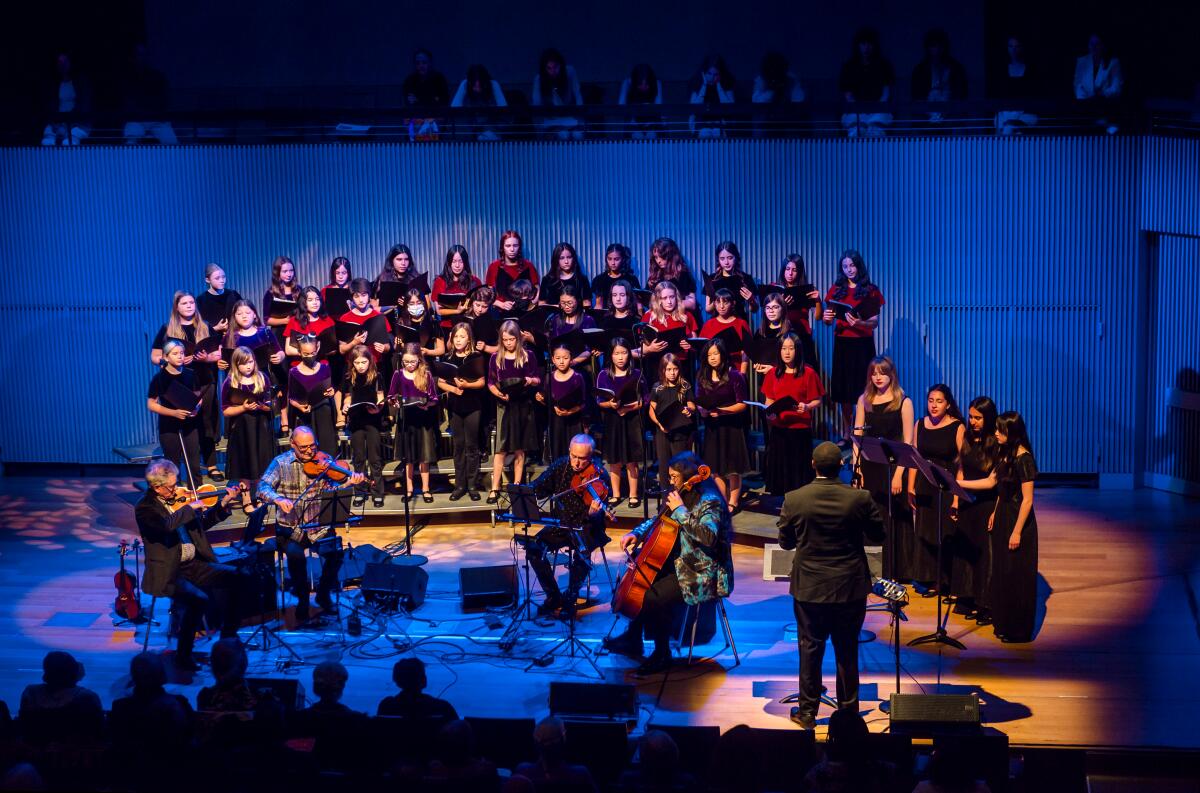
The Kronos Quartet performs with the San Francisco Girls Chorus at SF Jazz on Saturday night in San Francisco.
(Lenny Gonzalez / Kronos Quartet)
No ensemble in the history of music has come close to doing so much, and a four-night festival can’t come close to exhibiting it. So with but a little looking back, Kronos did what it always does: look ahead, performing new music.
Saturday night, the first of the two programs I heard, was the premiere of Mary Kouyoumdjian’s spiritually spellbound “The Space Between.” There was a movement from Riley’s new, otherworldly “This Assortment of Atoms — One Time Only!” This is one of the Kronos Quartet’s “50 for the Future” commissions from composers, Glass and Laurie Anderson among them, producing works suitable for young string quartets. All the scores are made available for free on the Kronos website, and more than 38,000 scores have been downloaded in 108 countries and territories.
The concert also included two feisty new works by teenage composers Hannah Wolkowitz and Ilaria Hawley. The San Francisco Girls Chorus joined Kronos for works by the likes of Yoko Ono, Pete Seeger and Mali singer Hawa Kassé Mady Diabaté. At the end, the guest was Iranian singer Mahsa Vahdat.
The festival ended Sunday with Sam Green’s live Kronos documentary film “A Thousand Thoughts,” which includes live performances by the Kronos. This was the 46th and last time the film will be shown. Two key members of the quartet from the last four-plus decades, violinist John Sherba and Hank Dutt, are retiring. It was a bittersweet, deeply moving and loving finale.
What will happen next to the Kronos? The ensemble also is losing its first and only manager, Janet Cowperthwaite, who behind the scenes made the commissions and all else possible. First violinist David Harrington, the quartet’s visionary founder, will soldier on with cellist Paul Wiancko and two new young players, violinist Gabriela Díaz and violist Ayane Kozasa.
An era has ended. But Harrington is the most optimistic musician I know. His record of accomplishing the unthinkable has made him an unerring San Francisco symbol for the future.
It would be a poor investment not to bet on Kronos. Harrington has made the impossible happen not by cutting back but by tirelessly seeking more. He has gained international support by not letting anything stop him.
The San Francisco Symphony and San Francisco Opera could do the same by believing in the future, beginning with digging into the damn endowments. The city, too, could (and typically does) do worse than following Kronos’ extraordinary belief in the possible. We all could. The model exists.

Movie Reviews
‘Night Nurse’ Review: A Caretaker Explores Her Kink for Elder Abuse in the Year’s Strangest Erotic Thriller

There are any number of erotic thrillers in which rich old men are robbed blind and/or left for dead, but Georgia Bernstein’s admirably bizarre “Night Nurse” might be the first movie of its kind where elder abuse is the source — and possible subject— of its erotic thrills. If there are others, I’m not sure I want to know.
But this woozy debut feature doesn’t rely on its audience being turned on by the relationship between a nubile caretaker and her dementia-addled patient. Their psychosexual bond, meanwhile, hinges on cold-calling vulnerable old people under the guise of a grandchild in financial distress. (“I’m in trouble, nana, send me $10,000 or I’ll be left to rot in jail!” That sort of thing). With its slim wisp of a premise stretched into a Strickland-esque dreamscape that substitutes kink for conflict, the film itself hardly seems convinced by its own wrinkled lust — all desperate kisses and non-touching poses of subservience. More important to Bernstein is what that lust reveals about her characters’ deepest needs, specifically how their need to care and be cared for can be as easily perverted as any other form of desire.

As moody and weightless as the noir-accented score that blows through the movie like a curlicue gust of wind in an old cartoon (credit to musicians Sam Clapp and Steven Jackson), “Night Nurse” lacks the pulse required for its stray feelings to come alive. Still, the film ambiently taps into the latent eroticism of teasing out the distance between how you see yourself and who you really are. Bernstein plays with that distance like a telephone cord wrapped around her fingers, and Eleni — played by the excellent newcomer Cemre Paksoy, powerfully helpless — only frays even more as the receiver is brought near the hook. “Everything I did before today wasn’t me,” the nurse tells co-worker Mona (Eleonore Hendricks) after starting a new job at an Illinois retirement home. “It was somebody else.”
What she did before today remains unexplored (specifically, what she did to get herself fired from her last gig), but I’m guessing she’s probably changed less than she thought. There’s a faraway flicker in her eyes the moment she catches the vibe between Mona and Douglas (a ribald and elusive Bruce McKenzie), a white-haired seventysomething who shows early signs of dementia but still commands an undiminished sexual energy. “I’m not an invalid,” he coos as Mona bathes him in the tub, to which she replies, “yes, you are,” in a supplicant tone that hints at a rich history of power games between them.
Later that same night, Douglas will force Eleni to call a stranger, pretend that she’s their granddaughter, and ask for money — he’ll wrap the phone cord around the nurse’s body as she talks and shove her against the wall as they kiss. She’s into it. So into it that he has to clarify the terms of his whole deal: “If you’re looking for a pogo stick, I’m really not your guy.” But Eleni isn’t looking for anything to bounce on. She just wants to be needed, and maybe to need someone in return. Someone who will see her for who she really is and allow her the fantasy of pretending she isn’t being herself when she cons vulnerable strangers out of their money — when she exploits how enthralled those strangers are by the care they have for their loved ones.
“Night Nurse” doesn’t belabor the psychology, as Bernstein prefers to express her story through heavy-lidded suggestion. Somnambulating from the moment it starts, the film moves through a series of beautifully arranged poses that stretch their latent meaning thin across the surface (Lidia Nikonova’s cinematography lacquers every shot with a seductive dreaminess). We see Douglas smoking in a lawn chair with Mona and Eleni curled around his feet. Eleni riding in the backseat of a convertible as the wind blows through her curls. The full staff of nurses — all of them under Douglas’ sway — stumbling around his condo in a state of zonked out bliss as they roll on the prescription drugs they’ve stolen from the residents.
Once you’ve seen one shot of this movie, you’ve practically seen them all, at least until things escalate during a rushed and unsatisfying third act that forces Eleni into an honest confrontation with herself. People will do just about anything to feel needed — they’ll give whatever degree of care allows them to receive it in return. “Night Nurse” understands that desire, but remains far too numb to treat it.
Grade: C+
The Independent Film Company will relase “Night Nurse” in theaters on Friday, July 10.
Entertainment
Lucas Museum to give free annual passes to South L.A. neighbors, host community preview day

The Lucas Museum of Narrative Art, which is moving at light speed toward its Sept. 22 opening, announced Thursday that it will give free annual passes to its South L.A. neighbors living in the 90037 ZIP Code. The 300,000-square-foot, $1-billion museum located in Exposition Park will also host a special community preview day on Sept. 13, more than a week before the general public gets to step inside.
The 90037 ZIP Code has a population of more than 65,000 and is bordered roughly by the 110 Freeway to the west, Slauson Avenue to the south, Central Avenue to the east and Martin Luther King Jr. Boulevard to the north. Residents can register for passes at lucasmuseum.org/lm37 and will be alerted in August when the program launches. Pass holders can reserve tickets for themselves and one guest.
Tickets for non-pass holders go on sale July 21. They cost $25 for adults and $21 for seniors. Kids 17 and under are free.
“Storytelling has the power to bring people together and create a sense of community,” said Lucas Museum Chief Executive Tracey Bates in a news release about the program. “Through LM37, we are inviting our South Los Angeles neighbors to make the museum part of their lives and take their own path of discovery through the art, programs and experiences that will help shape this new cultural hub for Los Angeles.”
The community preview day is designed to give local business owners, community partners, civic leaders and registered LM37 pass holders a sneak peak of the 10,000 square feet of exhibition space, as well as the expansive gardens with 11 acres of park space.
The opening programming, curated by co-founder George Lucas, features 20 inaugural exhibitions across more than 30 galleries, including one titled “Star Wars in Motion,” containing vehicle designs, high-speed racers, flying vessels, props, costumes and illustrations from the first six films in the beloved franchise.
More than 1,200 objects will be on display from Lucas’ personal collection of narrative art. Highlights include work by Norman Rockwell and Dorothea Lange, as well as a variety of manga, children’s book illustrations and comics.

Last year’s “Superman” ended with Iggy Pop singing “Because I’m a punk rocker, yes I am” — an ironic coda for a superlatively square hero. But it rings straightforwardly true for Superman’s cousin.
Milly Alcock’s Kara Zor-El, or Supergirl, sports not a spandex suit but a Blondie T-shirt. When we meet her in Craig Gillespie’s “Supergirl,” she’s been on an interstellar bender for days. She’s more Courtney Love than Clark Kent.
Nonchalant and sarcastic, Kara is also a little Han Solo-ish, you might say, given that she moves capriciously through the galaxy in her junky spaceship while getting in fights in extraterrestrial bars. She’s a welcome, jagged riff on more buttoned-up superheroes, and Alcock is terrific in the role. If only “Supergirl” was as good as she is.
While the latest DC release, and second under James Gunn’s stewardship, has its moments, “Supergirl” struggles to match Kara’s punk-rock energy with an equally spirited supporting cast and story.
Skepticism seems to have gathered for “Supergirl” ahead of its release. Many fans have argued it wasn’t the right next step for DC Universe. But I’m not so sure. Alcock’s breezy cameo in “Superman” was one of that movie’s highlights. Handing the follow-up to her, and her faithful floating dog Krypto, strikes me as an extremely natural next step. When in doubt, follow the dog.
And much of “Supergirl” is winning. It resides almost entirely in space, touching down only momentarily on Earth. In its consistently creative production design, clever needle drops and underdog story arc, “Supergirl” resides a little closer to Gunn’s “Guardians of the Galaxy” movies than other DC entries. Its outer space is filled with cosmic detritus, mean characters and cute critters. Seth Rogen as the voice of a tiny alien co-piloting a space bus is an inspired concoction, as is a shabbier sci-fi realm with rest stops along the intergalactic highway.
-

 New Hampshire2 minutes ago
Trans athletes drop lawsuit to gain access to girls’ sports in New Hampshire after SCOTUS ruling
-

 New Jersey7 minutes ago
Family describes frantic moments delivering baby on the NJ Turnpike
-

 New Mexico14 minutes ago
Hidden gem in Cloudcroft, New Mexico has best BBQ in US
-

 North Carolina17 minutes ago
North Carolina Airport Looks to Expand Commercial Service | AirlineGeeks.com
-

 North Dakota22 minutes ago
San Francisco plots risky socialist bank modeled after controversial experiment
-

 Ohio29 minutes ago
Feeling itchy? Ohio leads nation with 6 cities on Orkin’s 2026 bed bug list
-

 Oklahoma32 minutes ago
Oklahoma’s Brent Venables named to 2026 Dodd Trophy Preseason watch list
-

 Oregon37 minutes ago
Ryan Reynolds-backed Aviation Gin shutters Oregon distillery

