Entertainment
Amyl and the Sniffers move to L.A. and get a whiff of punk glory on 'Cartoon Darkness'


Amyl and the Sniffers have always appreciated any small bit of good news. Even when the Australian punk rock quartet recorded its charmingly raw debut EP, “Giddy Up,” in a single night and released it online in 2016, the initial 100 streams were reward enough.
“To us, that was massive,” says singer Amy Taylor, aka “Amyl,” with a grin. “We get one play on local community radio and we’re like, ‘We’re massive. We’ve made it.’ You get a support slot in a 200-capacity room, we’re like, ‘We’ve made it.’ It’s really hard to get a perspective bigger than what we can see. … We’re very much appreciative of what’s happening rather than thinking about what might happen so much.”
Amyl and the Sniffers feel the same way about their third album, “Cartoon Darkness,” released Oct. 25, a potent collection of snarly, ecstatic rock tunes and the occasional ballad. Its first single, “U Should Not Be Doing That,” quickly earned millions of Spotify listens and heavy rotation for its music video (1.6 million views on YouTube alone), showing Taylor and a new companion stomping across Los Angeles as she sings lyrics of defiant self-worth.
“I am trying my best to get it on,” she sings, in her distinctively combative, percussive, very Australian voice. “Not everybody makes it out alive / When they are young.”
Fans are drawn to the Sniffers’ sound and attitude, which taps into the rowdy spirit of first-generation punk rock, along with a feisty, euphoric blond singer moving nonstop and usually dressed in a bikini top and shorts. The album comes two months after the band opened for a Foo Fighters concert at BMO Stadium in August, followed days later by two sold-out shows at the Fonda Theatre in Hollywood.
“Right now I think they’re the best rock band on the planet,” says Nick Launay, producer of “Cartoon Darkness,” in a phone interview. Launay has frequently worked with modern rock acts such as the Yeah Yeah Yeahs, Idles and Nick Cave, but his career stretches back to the early U.K. punk and postpunk scenes.
“If they had been around in the ’70s, they would’ve been just as important back then,” he declares of the Sniffers. “They would’ve given everybody a run for their money.”
Launay says his mission in the studio was simply to fully capture the urgency of the band’s live shows. Aside from that, the new album’s 13 songs show a noticeable evolution to their punk rock sound, which remains connected to their early pub-crawling days without getting in the way of growth and the increasing power of their delivery.
“I think we’ve always been confident,” says Taylor. “It’s just that we’ve gotten better. Even when we weren’t very good, we were confident, but now the skills are slowly catching up to the confidence.”
Amyl and the Sniffers perform the second of two sold-out nights at the Fonda Theater in Hollywood, Calif. (Left to right) Guitarist Declan Mehrtens, singer Amy Taylor, and drummer Bryce Wilson.
(Steve Appleford/Steve Appleford)
The Aussie quartet is gathered on a recent afternoon around a Griffith Park picnic table, where a small herd of little kids makes a racket on the grass nearby. Taylor is dressed in a short black leather jacket, matching shorts and knee-high boots with stiletto heels. Pinned to her chest is a 2 Live Crew button.
Her three male bandmates are stylishly scruffy and tattooed rockers: guitarist Declan Mehrtens, drummer Bryce Wilson and bassist Gus Romer. Earlier this year, Taylor and Mehrtens moved to the U.S. and found places in L.A., while the others theoretically remain based in Melbourne. That kind of distance between bandmates might seem like a problem for a thriving rock act, but they’ve rarely been apart this last year, with only short breaks between recording the album, shooting music videos, a U.S. tour, then linking up again in Australia.
“We’ve been together this year pretty much every day, it feels like,” says Wilson.
Taylor adds, “We see each other all the time. It’s such an international project, we don’t live anywhere anyway.” She turns to Romer and Wilson and adds, “They might live in Australia, but it’s just where they store their crap.”
Los Angeles already feels very much like home to the singer and the guitarist. Mehrtens decided to move here after enjoying a Dodgers-Padres postseason game, and Taylor has befriended local rockers including Karen O of the Yeah Yeah Yeahs and Arrow De Wilde of Starcrawler.
They are back on the road for a European tour that started Nov. 3 in Dublin and return for a North American tour in the spring.

Their work with producer Launay began by recording two songs last year at Sunset Sound, including “U Should Not Be Doing That,” released as a single in May. In the lyrics, Taylor pushes back against the naysayers that she says the band has faced at every step.
“At the end of the day, nothing’s really stopped me, and nothing probably will because I like doing it more than I care about what other people think,” Taylor says with casual defiance.
The new album opens with the driving noisy rock riffing of “Jerkin,’” as Taylor pushes back against haters with boasts and joyous profanity: “Last time I checked, I got success / Cuz the losers are online and they are obsessed / Typin’.”
There’s also the crazed racket of “Motorbike Song” and the alluring ballad “Big Dreams,” written on acoustic guitar and matched in tone by a wistful music video directed by longtime collaborator John Angus Stewart. The clip has each of the band members on the back of motorcycles cruising across a wide-open desert landscape.
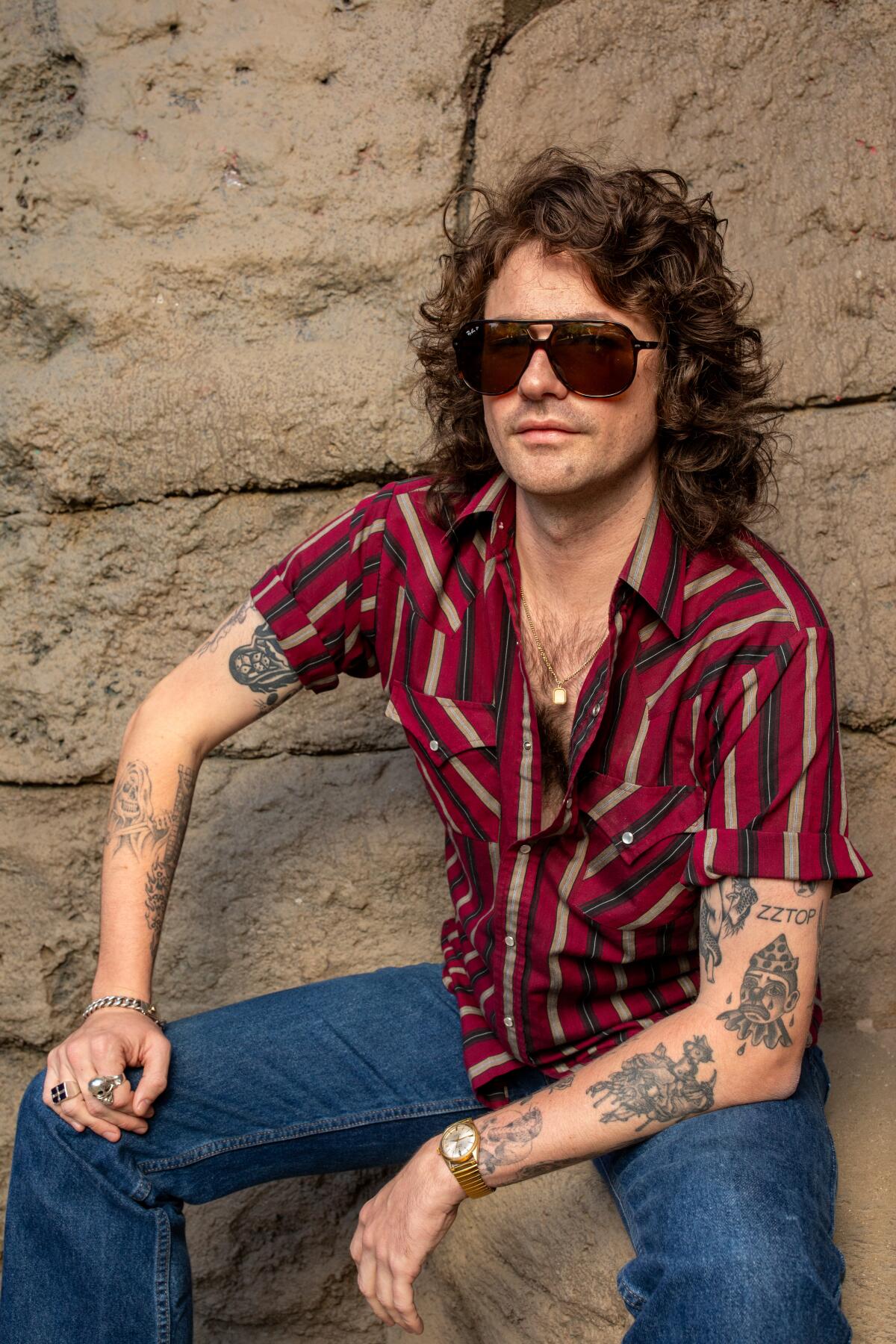
Guitarist Declan Mehrtens of Amyl and the Sniffers poses for a portrait a the Old Zoo in Griffith Park, in Los Angeles.
(Steve Appleford)
Out front, Taylor sings from the back of a chopper, her vocals understated and almost resigned as she laments for those who feel stuck in place: “It isn’t easy when the town’s full of broken hearts / Can you be holding on any tighter? / Just take a breath and get out of this place / I know you can just get yourself together.”
There are hip-hop influences too, says Taylor. “Beastie Boys was big on this album,” she explains, “just ’cause they’re awesome and their phrasing is cool and we listen to a lot of them.”
Along the way, their producer has learned how to interpret what he calls “Amy Language.”
As one example, while Launay was mixing tracks for 2021’s “Comfort to Me,” Taylor was unhappy with the sound of “Hertz,” calling the song mix “too Lambo” — short for the luxury sports car Lamborghini. So she sent Launay a picture of a Subaru doing doughnuts on the asphalt as a better example to follow. “Like that,” she wrote him, “only driven by a hot Aussie chick … but she’s a politician.”
“Even though that sounds like crazy instructions, I knew exactly what she meant,” says Launay, who lived in Australia for a decade. “I mixed it rawer, wilder, sexier and put a couple of clever bits in there, sent it to her, and she goes, ‘Yep, that’s it. Next!’”
Taylor grew up there in Mullumbimby, a small hamlet in northern New South Wales, and a town she describes as “dirty hippie, no shoes, like antivax, organic food.” Rapper Iggy Azalea is also from there, and left for the U.S. at age 16. Azalea’s mother had a cleaning business that Taylor’s mom worked for briefly.
The band began in a house shared by Taylor, Mehrtens, Wilson and former member Calum Newton in beachside St. Kilda, a suburb of Melbourne. Taylor worked at a supermarket and had purchased a used drumkit for about $50 that she kept in her bedroom.

Singer Amy Taylor of Amyl and the Sniffers poses for a portrait a the Old Zoo in Griffith Park, in Los Angeles.
(Steve Appleford)
“We went to live music all the time — five, six nights a week,” says Taylor of their nightlife habits. “There’d be lots of house parties and bands would play in the backyard. I would freestyle rap a lot at the parties. It was my party trick. If it was a house show, I’d be like, can I get on the mic? Some bands were playing and I’d just like yelp words.”
That impulse evolved into forming a band. “We kind of wanted to sound like a B-52’s when we started,” says Taylor. “But we just couldn’t play good enough. So we sounded like this. But we liked the aggression of the music.”
As a new group, they were part of an Aussie garage-band scene with contemporaries like the Cosmic Psychos, Drunk Mums and Dumb Punts. At those first club performances, it was largely an older crowd turning out, no doubt connecting the Sniffers’ racket to their memories of early punk rock. “When we first started it’d probably be like 80% men over 50 — like looking out at a bloody dozen eggs,” she says of the gathering of gray and bald heads.
Their crowds have evolved a lot since then. During their two-night run at the Fonda, the dance floor was filled with young fans whom Taylor happily describes as “young frothers, just frothing about life, like rabid frothing,” she says with a laugh. “They’re excited and they’re young and they’re drinking for the first time and they’ve got mullets and they’re like, ‘Yeah!’ Our crowd’s usually very excitable people in the same way that I’m excitable.”
One more thing has changed: For most of the band’s career, Mehrtens spelled his last name as “Martens,” partly for simplicity’s sake but also because he wore Doc Martens boots. He adopted “Dec Martens” as a kind of punk rock alias, like the Germs’ Darby Crash or Pat Smear. He’s reverted to the correct spelling as a sign that the band has lasted well beyond its initial existence as a lark among friends.
“When I did that, I didn’t know that we were going to be getting three, four … albums in,” he says of his earlier nickname. “Now there’s visas involved, and I want people to know that it’s me who’s on the album.”
Being in the band also has changed Taylor’s perspective on many things. Now that she’s an accomplished lyricist, she pays more attention to the written word.
“I hated books. Now I love reading books and read all the time,” the singer says, then adds with a laugh, “Before, my God, I only had like 20 words in my vocabulary. Now I’ve got at least a hundred, so that helps. I love the riddles of phrasing and trying to get phrasing in a different kind of puzzle-y way.”
Romer jumps in, adding with a grin, “Sometimes she has a new big word and I’m very impressed.”







Movie Reviews
Movie Review: A real-life ’70s hostage drama crackles in Gus Van Sant’s ‘Dead Man’s Wire’

It plays a little loose with facts but the righteous rage of “Dog Day Afternoon” is present enough in Gus Van Sant’s “Dead Man’s Wire,” a based-on-a-true-tale hostage thriller that’s as deeply 1970s as it is contemporary.
In February 1977, Tony Kiritsis walked into the Meridian Mortgage Company in downtown Indianapolis and took one of its executives, Dick Hall, hostage. Kiritsis held a sawed-off shotgun to the back of Hall’s head and draped a wire around his neck that connected to the gun. If he moved too much, he would die.
The subsequent standoff moved to Kiritsis’ apartment and eventually concluded in a live televised news conference. The whole ordeal received some renewed attention in a 2022 podcast dramatization starring Jon Hamm.
But in “Dead Man’s Wire,” starring Bill Skarsgård as Kiritsis, these events are vividly brought to life by Van Sant. It’s been seven years since Van Sant directed, following 2018’s “Don’t Worry, He Won’t Get Far on Foot,” and one of the prevailing takeaways of his new film is that that’s too long of a break for a filmmaker of Van Sant’s caliber.
Working from a script by Austin Kolodney, the filmmaker of “My Own Private Idaho” and “Good Will Hunting” turns “Dead Man’s Wire” into not a period-piece time capsule but a bracingly relevant drama of outrage and inequality. Tony feels aggrieved by his mortgage company over a land deal the bank, he claims, blocked. We’re never given many specifics, but at the same time, there’s little doubt in “Dead Man’s Wire” that Tony’s cause is just. His means might be desperate and abhorrent, but the movie is very definitely on his side.
That’s owed significantly to Skarsgård, who gives one of his finest and least adorned performances. While best known for films like “It,” “The Crow” and “Nosferatu,” here Skarsgård has little more than some green polyester and a very ’70s mustache to alter his looks. The straightforward, jittery intensity of his performance propels “Dead Man’s Wire.”
Yet Van Sant’s film aspires to be a larger ensemble drama, which it only partially succeeds at. Tony’s plight is far from a solitary one, as numerous threads suggest in Kolodney’s fast-paced script. First and foremost is Colman Domingo as a local DJ named Fred Temple. (If ever there were an actor suited, with a smooth baritone, to play a ’70s radio DJ, it’s Domingo.) Tony, a fan, calls Fred to air his demands. But it’s not just a media outlet for him. Fred touts himself as “the voice of the people.”
Something similar could be said of Tony, who rapidly emerges as a kind of folk hero. As much as he tortures his hostage (a very good Dacre Montgomery), he’s kind to the police officers surrounding him. And as he and Dick spend more time together, Dick emerges as a kind of victim, himself. It’s his father’s bank, and when Tony gets M.L. Hall (Al Pacino) on the phone, he sounds painfully insensitive, sooner ready to sacrifice his son than acknowledge any wrongdoing.
Pacino’s presence in “Dead Man’s Wire” is a nod to “Dog Day Afternoon,” a movie that may be far better — but, then again, that’s true of most films in comparison to Sidney Lumet’s unsurpassed 1975 classic. Still, Van Sant’s film bears some of the same rage and disillusionment with the meatgrinder of capitalism as “Dog Day.”
There’s also a telling, if not entirely successful subplot of a local TV news reporter (Myha’la) struggling against stereotypes. Even when she gets the goods on the unspooling news story, the way her producer says to “chop it up” and put it on air makes it clear: Whatever Tony is rebelling against, it’s him, not his plight, that will be served up on a prime-time plate.
It doesn’t take recent similar cases of national fascination, such as Luigi Mangione, charged with killing a healthcare executive, to see contemporary echoes of Kiritsis’ tale. The real story is more complicated and less metaphor-ready, of course, than the movie, which detracts some from the film’s gritty sense of verisimilitude. Staying closer to the truth might have produced a more dynamic movie.
But “Dead Man’s Wire” still works. In the film, Tony’s demands are $5 million and an apology. It’s clear the latter means more to him than the money. The tragedy in “Dead Man’s Wire” is just how elusive “I’m sorry” can be.
“Dead Man’s Wire,” a Row K Entertainment release, is rated R for language throughout. Running time: 105 minutes. Three stars out of four.

In a bid for greater user engagement, Walt Disney Co. will introduce vertical videos to its Disney+ app over the next year, a company executive said Wednesday.
The move is part of the Burbank media and entertainment company’s effort to encourage more frequent app usage, particularly on smartphones.
“We know that mobile is an incredible opportunity to turn Disney+ into a true daily destination for fans,” Erin Teague, executive vice president of product management, said during an onstage presentation in Las Vegas at the Consumer Electronics Show. “All of the short-form Disney content you want, all in one unified app.”
Teague said the company will evolve that capability over time to determine new formats, categories and content types.
Disney’s presentation also touched on its interest in artificial intelligence. Last month, San Francisco startup OpenAI said it had reached a licensing deal with Disney to use more than 200 of the company’s popular characters in its text-to-video tool, Sora. Under the terms of that deal, users will be able to write prompts that generate short videos featuring Disney characters and use ChatGPT images to create those characters’ visages. Some of those Sora-generated videos will be shown on Disney+, though the companies said the deal did not include talent likenesses or voices.
Disney also said it would invest $1 billion into the AI company.
Part of Disney’s move toward AI is to appeal to young Gen Alpha viewers, who are more comfortable with AI and “expect to interact with entertainment” instead of simply watching stories on the screen, Teague said.
“AI is an accelerator,” she said. “It’s why collaborations with partners like OpenAI are absolutely crucial. We want to empower a new generation of fandom that is more interactive and immersive, while also respecting human creativity and protecting user safety.”

.
Is This Thing On?
Cinematic stories of disintegrating marriages are fairly commonplace—and often depressing emotional endurance tests, besides—so it’s interesting to see co-writer/director Bradley Cooper take this variation on the theme in a fresher direction. The unhappy couple in this place is Alex and Tess Novak (Will Arnett and Laura Dern), who decide matter-of-factly to separate. Then Alex impulsively decides to get up on stage at an open-mic comedy night, and starts turning their relationship issues into material. The premise would seem to suggest an uneven balance towards Alex’s perspective, but the script is just as interested in Tess—a former Olympic-level volleyball player who retired to focus on motherhood—searching for her own purpose. And the narrative takes a provocative twist when their individual sparks of renewed happiness lead them towards something resembling an affair with their own spouse. The screenplay faces a challenge common to movies about comedians in that Alex’s material, even once he’s supposed to be actively working on it, isn’t particularly good, and Cooper isn’t particularly restrained in his own supporting performance as the comic-relief buddy character (who is called “Balls,” if that provides any hints). Yet the two lead performances are terrific—particularly Dern, who nails complex facial expressions upon her first encounter with Alex’s act—as Cooper and company turn this narrative into an exploration of how it can seem that you’ve fallen out of love with your partner, when what you’ve really fallen out of love with is the rest of your life. Available Jan. 9 in theaters. (R)
JANUARY SPECIAL SCREENINGS
KRCL’s Music Meets Movies: Dig! XX @ Brewvies: As part of a farewell to Sundance, Brewvies/KRCL’s regular Music Meets Movies series presents the extended 20th anniversary edition of the 2004 Sundance documentary about the rivalry between the Dandy Warhols and Brian Jonestown Massacre as they chart different music-biz paths. The screening takes place at Brewvies (677 S. 200 West) on Jan. 8 @ 7:30 p.m., $10 at the door or 2-for-1 with KRCL shirt. brewvies.com
Trent Harris weekend @ SLFS: Utah’s own Trent Harris has charted a singular course as an independent filmmaker, and you can catch two of his most (in)famous works at Salt Lake Film Society. In 1991’s Rubin & Ed, two mismatched souls—one an eccentric, isolated young man (Crispin Glover), the other a middle-aged financial scammer—wind up on a comedic road trip through the Utah desert; 1995’s Plan 10 from Outer Space turns Mormon theology into a crazy science-fiction parody. Get a double dose of uncut Trent Harris weirdness on Friday, Jan. 9, with Rubin & Ed at 7 p.m. and Plan 10 from Outer Space at 9 p.m. Tickets are $13.75 for each screening. slfs.org
Rob Reiner retrospective @ Brewvies Sunday Brunch: Last month’s tragic passing of actor/director Rob Reiner reminded people of his extraordinary work, particularly his first handful of features. Brewvies’ regular “Sunday Brunch” series showcases three of these films this month with This Is Spinal Tap (Jan. 11), The Princess Bride (Jan. 18) and Stand By Me (Jan. 25). All screenings are free with no reservations, on a first-come first-served basis, at noon each day. brewvies.com
David Lynch retrospective @ SLFS: It’s been a year since the passing of groundbreaking artist David Lynch, and Salt Lake Film Society’s Broadway Centre Cinemas marks the occasion with some of his greatest filmed work. In addition to theatrical features Eraserhead (Jan. 11), Inland Empire (Jan. 11), Mulholland Dr. (Jan. 12), Twin Peaks: Fire Walk With Me (Jan. 14), Blue Velvet (Jan. 19) and Lost Highway (Jan. 19), you can experience the entirety of 2017’s Twin Peaks: The Return on the big screen in two-episode blocs Jan. 16 – 18. The programming also includes the 2016 documentary David Lynch: The Art Life. slfs.org
Death by Numbers @ Utah Film Center: Directed by Kim A. Snyder (the 2025 Sundance feature documentary The Librarians), this 2024 Oscar-nominated documentary short focuses on Sam Fuentes, survivor of a school shooting who attempts to process her experience through poetry. This special screening features a live Q&A with Terri Gilfillan and Nancy Farrar-Halden of Gun Violence Prevention Center of Utah, with Zoom participation by Sam Fuentes. The screening on Wednesday, Jan. 14 at 7 p.m. at Utah Film Center (375 W. 400 North) is free with registration at the website.

Community reacts to ICE shooting in Minnesota. And, RFK Jr. unveils new food pyramid

Woman suspected to have been killed in Colorado’s first fatal mountain lion attack in over two decades

Noem puts Newsom on notice, vows California probe after Minnesota fraud bust

Body found during search for missing Texas teen Camila Mendoza Olmos as another teen girl disappears

Dem governor-elect taps Crockett’s former ‘chief brand strategist’ for top DEI role

Florida High School Football Rankings: Top 25 teams – Oct. 21

Cleary's 21 help Le Moyne down Central Connecticut State 69-64 in OT

How old is Bo Nix? What to know about Oregon quarterback ahead of 2024 NFL Draft

99th annual Pony Swim held in Virginia

Video: ‘It Didn’t Have to Happen This Way:’ U.Va. Faculty Call for Review of Police Response to Protests
Community reacts to ICE shooting in Minnesota. And, RFK Jr. unveils new food pyramid

Video: Minnesota Governor Condemns ICE Shooting

Trump greenlights Russian sanctions bill, paving way for 500% tariff on countries supporting Moscow: Graham

Saudi-led coalition says STC’s al-Zubaidi fled to UAE via Somaliland

U.S. to exit 66 international organizations in further retreat from global cooperation
-

 Detroit, MI5 days ago
2 hospitalized after shooting on Lodge Freeway in Detroit
-

 Dallas, TX3 days ago
Defensive coordinator candidates who could improve Cowboys’ brutal secondary in 2026
-

 Technology2 days ago
Power bank feature creep is out of control
-

 Health4 days ago
Viral New Year reset routine is helping people adopt healthier habits
-

 Nebraska1 day ago
Oregon State LB transfer Dexter Foster commits to Nebraska
-

 Politics4 days ago
Dan Bongino officially leaves FBI deputy director role after less than a year, returns to ‘civilian life’
-
 Nebraska2 days ago
Nebraska-based pizza chain Godfather’s Pizza is set to open a new location in Queen Creek
-
 Entertainment24 hours ago
Spotify digs in on podcasts with new Hollywood studios