Entertainment
All the looks from the 2024 Grammys red carpet

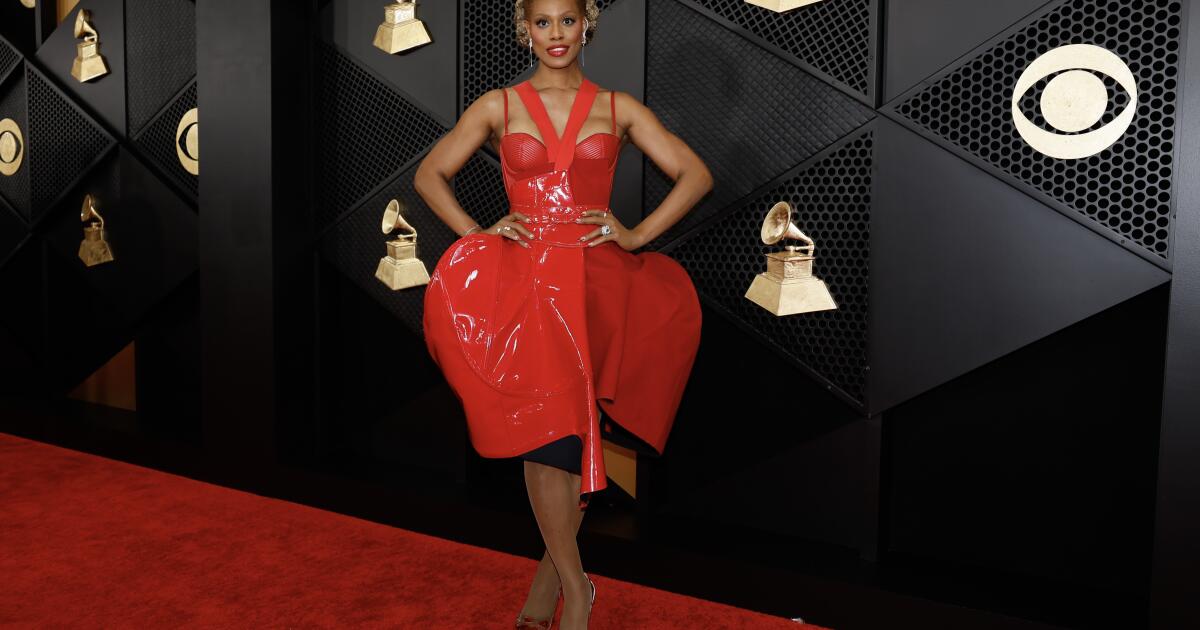
Not even historic rains can dampen the glitter and gold of the Grammys red carpet. From glam rock fashion to Old Hollywood glam, glamour’s the word of the day.
Music’s biggest night is sure to deliver big red carpet moments. SZA, the most-nominated artist of the 66th Grammy Awards, with nine noms, will make a splash with her comfy-chic cool girl style. Miley Cyrus, meanwhile, is bound to opt for a daring number. At 20 years old, Olivia Rodrigo is already a fashion favorite who’s expected to sport another knockout look. Billie Eilish will surely serve signature grunge. Janelle Monáe, the women of Boygenius, Kylie Minogue and Ice Spice also will take the red carpet by storm, along with fashionable men Drake, Burna Boy, Jon Batiste and Davido.
But all eyes will be on Taylor Swift, who could make history tonight. Swift will ditch her “tight little skirt” for another jaw-dropping gown — perhaps incorporating the Kansas City Chiefs team colors of red, white and gold (she already has “that red lip classic thing that you like”).
Here are all the looks from the 2024 Grammys, updating live.
Montana Tucker
Montana Tucker adorns her sheer gown with a massive yellow ribbon.
(Allen J. Schaben / Los Angeles Times)
Victoria Monet
Victoria Monet makes it a family affair.
(Allen J. Schaben / Los Angeles Times)
Catherine Shepherd and Brandi Carlile
Catherine Shepherd, left, and Brandi Carlile rock retro suits.
(Allen J. Schaben / Los Angeles Times)
Dawn Richard
Singer Dawn Richard makes a statement with a flowering red dress.
(Allen J. Schaben/Los Angeles Times)
Boygenius
Boygenius’ Phoebe Bridgers, left, Lucy Dacus and Julien Baker coordinate in white suits and black combat boots.
(Allen J. Schaben / Los Angeles Times)
Angela V. Benson
Angela V. Benson, CEO and co-founder of Vitae Records, rocks another regal look at the Grammys.
(Allen J. Schaben / Los Angeles Times )
Tessa Brooks
Tessa Brooks stuns in a gold sleeved gown with cutouts at her hip.
(Allen J. Schaben / Los Angeles Times)
Haley Kalil
Model Haley Kalil channels Batman villain Poison Ivy in this sequined green number.
(Allen J. Schaben / Los Angeles Times)
Arielle Vandenberg
Arielle Vandenberg is elegant in a strapless V-neck gown.
(Allen J. Schaben / Los Angeles Times)
James Blake and Jameela Jamil
James Blake and Jameela Jamil make a lovely pair at the Grammys.
(Allen J. Schaben / Los Angeles Times)



Modern Whore, 2025.
Directed by Nicole Bazuin.
Starring Andrea Werhun.
SYNOPSIS:
Modern Whore follows Andrea Werhun as she portrays her past roles as escort Mary Ann, stripper Sophia, and her OnlyFans presence – all part of her Toronto sex work journey.

Writer/director Nicole Bazuin makes her feature debut with Modern Whore, a hybrid documentary detailing the experiences of Andrea Werhun based on her memoir of the same name. Bazuin and Werhun make an insightful and funny adaptation of Werhun’s life as a former sex worker in Toronto, examining the hows and whys of the industry and her participation in it.
Modern Whore takes an interesting approach to the way it tells Werhun’s story as half of it is a documentary of Werhun relaying her experiences and speaking with family, friends and colleagues while the other half is scripted with Werhun and others acting out the stories. It is unconventional, but its uniqueness makes Werhun’s story entertaining with a tight and witty script by her and Bazuin.

The scripted portions display Werhun’s fun personality with the cast and material – after all, literally telling and acting in her own story makes for a great performance as she opens herself up to some of her most vulnerable moments knowing the stigma against sex workers whether they are/were escorts or OnlyFans creators. There’s plenty of light self-awareness along with quirky fourth-wall breaking humour as she recounts her stories or that of her clients skewed perspectives of their interactions. It is also not afraid to shy away from the more difficult subject matter of being a sex worker like meeting with really sketchy clients or some taking it too far, looking at the impact it has and the little support system in place.
The switches from the scripted scenes to the talking heads or interviews is well paced with the formats complimenting each other. The interviews are interesting and insightful, digging into why someone chooses to enter sex work and the stigma they feel from family or friends. Werhun digs into the different personas she put on, how some were closer to her real self than others, and the necessity for those identities in her work. Much of the conversations revolve around the taboo of sex work and how the discussions are slowly shifting so it is less shameful, but still plenty of work needed to be done towards that front.

Modern Whore showcases great writing from Werhun and Bazuin with plenty of entertaining sequences, not to mention Werhun’s performance. It is insightful, funny and creative with its hybrid format, making it very memorable in several aspects.
Flickering Myth Rating – Film: ★ ★ ★ ★ / Movie: ★ ★ ★ ★
Ricky Church – Follow me on Bluesky for more movie news and nerd talk.

The L.A. man who was filmed punching and kicking the Mercedes-Benz of “Gown and Out in Beverly Hills” stars Patrik Simpson and Pol’ Atteu in Hollywood was arrested this week and booked on felony vandalism.
The reality stars shared the dramatic video of the incident on social media with the caption, “Emergency! We need your help! We were just attacked at an intersection.”
“This man just blocked the intersection of our car at Melrose and Vine and then kicked our door in attacking us. Police were called and the license plate is on the video. If you know who this is, call the police immediately and send me a DM. He is dangerous and the police are looking for him!”
In the video, a man wearing a Cheech & Chong tee that reads “Don’t Panic, It’s Organic” blocked the Melrose Avenue and Vine Street intersection Sunday around 9:20 a.m. and hopped out of his Toyota 4Runner.
Contrary to instructions on the man’s shirt, the married co-stars of the Amazon Prime reality series did begin to panic as the man, who has been identified as Los Angeles resident Kevin Antonio Hernandez, approached their vehicle and punched the driver’s side window and kicked the driver’s side door. “Lock the door!” Simpson is heard saying in the video. “Call the police!”
Hernandez continued to yell at the fashionistas as he returned to his vehicle, but it’s unclear what he was saying because the techno music playing on the radio in Simpson and Atteu’s Benz drowned out any outside noise. Hernandez climbed into the driver’s side of his Toyota and pointed at the couple, yelling one last time, before speeding off.
“Go get him!” Simpson is heard yelling as they continue to film, while chasing the Toyota through the streets of Hollywood and calling 911. The reality stars’ exchange with the emergency dispatcher played out in the video, with the dispatcher urging the couple to stop following the car.
According to Simpson and Atteu, Hernandez had a baby in the car during the heated exchange and ran stop signs and ignored traffic lights as he sped away.
“This is it, I’m going to die here,” Atteu told KTLA of his headspace during the ordeal. “I’ve never been faced with that kind of fear in my life on the streets of L.A.”
The Los Angeles Police Department told The Times that Hernandez was arrested Wednesday. He has since been released.
Movie Reviews
Little Amélie or the Character of Rain Movie Review: A quiet story that speaks louder than most

The Times of India
Apr 04, 2026, 1:12 PM IST
4.0
Story: A quiet child named Amélie grows up in Japan, barely reacting to the world until a small moment begins to pull her into it. As she slowly becomes aware of people and emotions, she starts to understand life through experiences.Review: Oscar-nominated in the Best Animated Feature category, ‘Little Amélie or The Character of Rain’ is a gentle film that draws you in with its simplicity and honesty. It does not rely on tricks or dramatic moments to grab your attention. The story trusts itself completely and moves at its own pace with quiet confidence. The film feels calm and still, giving each scene time instead of rushing ahead. At times, it may seem like very little is happening, but that is when you realise it wants you to slow down and stay in the moment. Set in Japan, it follows a French family from Belgium with a sense of warmth and care. There are moments when it may feel like the film is holding back, but there is also something real in the way it avoids rushing or explaining everything. Beneath its soft surface, there is a deeply philosophical and thoughtful layer that reflects on life in a simple and honest way.The story follows Amélie (voiced by Loise Charpentier), a young Belgian child growing up in Japan, who spends the early part of her life in a strange, distant state. She barely reacts to the world around her and seems lost in her own space. Her parents, especially her mother, try to reach out to her in simple ways, hoping to see some response. Things begin to change when her grandmother arrives from Belgium and tries to bond with baby Amélie, and the offering of a piece of white Belgian chocolate makes all the difference. Around the same time, we meet Nishio San, the gentle caregiver, who becomes an important part of her daily life. The white Belgian chocolate becomes a turning point in the film, and from that moment, Amélie begins to respond to people and her surroundings, as if she is discovering everything for the first time.The way the film opts to showcase Amélie’s inner world stays with you. It does not explain her thoughts in a clear or direct way. Instead, it lets you sit inside her perspective, even when it feels distant or hard to read. The animation plays a big role here. It has a soft, almost calming quality, like a memory that keeps changing shape. Some moments feel very personal, while there are also sequences that may test your patience. There are stretches where the film stays on a plot point a little longer than expected, and you might find your attention slipping. At the same time, when it works, it really works. It brilliantly captures small feelings that are tough to put into words, and that is not something many films manage to do.The voice performances match this tone well. The actor voicing Amélie keeps things very minimal, which suits the character. There is very little need for long dialogue in this film, as the performance is carried more through tone and the way the moments play out. The voices of her parents and Nishio San bring warmth into the film and give it some emotional grounding. They feel natural, like people you might actually know, rather than characters trying to make a strong impression. Absolutely nothing feels forced in the film, and that helps the film stay believable even when it moves into more abstract spaces.‘Little Amélie or The Character of Rain’ leaves an impression in a quiet and unexpected way. It is thoughtful and gentle, though there are moments where it may feel a bit too soft or even repetitive. The mixed reactions around it make sense because it speaks in a very specific tone and sticks to it. It asks you to meet it halfway, to be patient and open to its rhythm. That may not work for everyone, but if you do connect with it, the film stays with you as a simple and sincere look at how a person slowly begins to understand the world.

Mitch Albom: Detroit Opening Day tradition embraces the local perfectly

San Francisco man missing from Seaside motel under suspicious circumstances

Logan Farrington, Petar Musa stay hot in leading Dallas to 4-0 victory over D.C. United – WTOP News

Nu Stadium party! Inter Miami host epic home opener | MLSSoccer.com

Boston Celtics Upgrade Breakout Player To Remake Bench, Complete Tax-Saving Plan

Florida High School Football Rankings: Top 25 teams – Oct. 21

How old is Bo Nix? What to know about Oregon quarterback ahead of 2024 NFL Draft

Cleary's 21 help Le Moyne down Central Connecticut State 69-64 in OT

99th annual Pony Swim held in Virginia

Indiana Members Credit Union announced as new anchor tenant at Bottleworks District

FBI’s Patel delivers blunt warning to law enforcement attackers: ‘We’re going to put you down’

Indonesia receives bodies of peacekeepers killed in southern Lebanon

Judge halts Trump effort requiring colleges to show they don’t consider race in admissions

Trump says ‘America needs God’ in Good Friday message touting ‘resurgence of religion’
Fact check: How can a country actually withdraw from NATO?
-

 South-Carolina7 days ago
South Carolina vs TCU predictions for Elite Eight game in March Madness
-

 Education1 week ago
Video: Transgender Athletes Barred From Women’s Olympic Events
-

 Miami, FL1 week ago
Jannik Sinner’s Girlfriend Laila Hasanovic Stuns in Ab-Revealing Post Amid Miami Open
-

 Minneapolis, MN1 week ago
Boy who shielded classmate during school shooting receives Medal of Honor
-

 Vermont7 days ago
Skier dies after fall at Sugarbush Resort
-

 Politics7 days ago
Trump’s Ballroom Design Has Barely Been Scrutinized
-

 Atlanta, GA7 days ago
Fetishist ‘No Kings’ protester in mask drags ‘Trump’ and ‘JD Vance’ behind her wheelchair
-
 Entertainment3 days ago
Inside Ye’s first comeback show at SoFi Stadium