Entertainment
A guide to everyone Taylor Swift sings about in 'Tortured Poets Department' — and their reactions


Taylor Swift didn’t hold back on calling everyone out on her newest album, “The Tortured Poets Department,” and the reactions are rolling in.
The surprise double album was released in two parts on April 19, giving exuberant Swifties plenty of material to analyze — including multiple celebrity call-outs.
Kim Kardashian
(Susan Walsh / Associated Press)
Swift and Kardashian have a long-standing feud, which started with Swift and Ye back in the day and goes back to Kimye’s infamous doctored phone call, which appeared to prove Taylor had given consent for a nude wax figure of her to appear in Kanye’s “Famous” music video. TLDR: The call was edited, but Swift was ripped to shreds online anyway, an experience that inspired her now legendary “Reputation” album.
Swift isn’t quite letting Kardashian off the hook, and “TTPD’s” “thanK you aIMee” pointedly had the letters of Kardashian’s first name capitalized in the title.
“And so I changed your name and any real defining clues / And one day, your kid comes home singin’ / A song that only us two is gonna know is about you,” Taylor wrote, apparently referencing daughter North West’s TikToks that have featured her songs in the past.
Kardashian didn’t respond directly to the taunt, but she did post a throwback photo with Swift’s ex-best friend Karlie Kloss on mutual pal Derek Blasberg’s birthday. Whether it was a coincidence is anyone’s guess.
Matty Healy

(Paul R. Giunta / Invision / Associated Press)
The 1975 frontman was the surprise “TTPD” guest star. He and the “Bejeweled” singer appeared to have had a short fling following her split from Joe Alwyn, but the lyrics in “TTPD” have led to speculation that the two were involved for far longer.
The title track is particularly damning: “You left your typewriter at my apartment,” Swift sings, referencing Healy’s apparent penchant for the old-school device. (“Who uses typewriters anyway?” she later asks.)
Swift goes on to call him a “tattooed golden retriever” before describing his smoking habits.
“But you tell Lucy you’d kill yourself if I ever leave / And I had said that to Jack about you so I felt seen,” she continues, referencing Boygenius member Lucy Dacus, who performed with Swift on the Eras tour, and her producer and bestie Jack Antonoff. Sounds super healthy and normal!
And all that’s from just one song. “But Daddy I Love Him,” “Fresh Out the Slammer,” “Guilty as Sin?,” “I Can Fix Him (No Really I Can)” and “The Smallest Man Who Ever Lived” all pile on the blame.
Healy responded coolly on Wednesday. “I haven’t really listened to that much of it,” the singer told paparazzi, “but I’m sure it’s good.”
His tone marks a stark difference from when he called dating Swift “emasculating.”
His mom, Denise Welch, was similarly unbothered, saying on British talk show “Loose Women” that she “wasn’t aware [Swift] had an album out at all.”
Unlikely, considering “TTPD” just became Spotify’s most-streamed album in a single day, but whatever.
Joe Alwyn

(Evan Agostini / Invision / Associated Press)
Just as fans predicted, Taylor’s ex-boyfriend of six years was spared little sympathy. Even the album title is supposedly a reference to the name of a group chat between the actor, Paul Mescal and Andrew Scott, called the “Tortured Man Club.”
“So Long, London” is Taylor’s most obvious hit at Alwyn, considering he inspired the track “London Boy” on her 2019 album “Lover.”
“I didn’t opt in to be your odd man out,” she sings about the end of their relationship. “I founded the club she’s heard great things about / I left all I knew, you left me at the house by the Heath.”
It’s clear Alwyn promised Swift a lot more than what he gave her. In “LOML” she laments how “You s—-talked me under the table / Talkin’ rings and talkin’ cradles / I wish I could unrecall / How we almost had it all.”
The marriage references don’t stop. In “imgonnagetyouback,” Swift tries to decide “whether I’m gonna be your wife or gonna smash up your bike.”
Fans have also latched onto a line in “Fortnight,” which features Post Malone, as proof that Alwyn wasn’t always faithful to Swift. “My husband is cheating, I wanna kill him,” Swift sings.
According to a source, Alwyn “has listened to the album, and he is slightly disappointed, but not surprised at all.” Maybe he’s upset about Healy stealing his spotlight?
Travis Kelce
(Mark Brown / Getty Images )
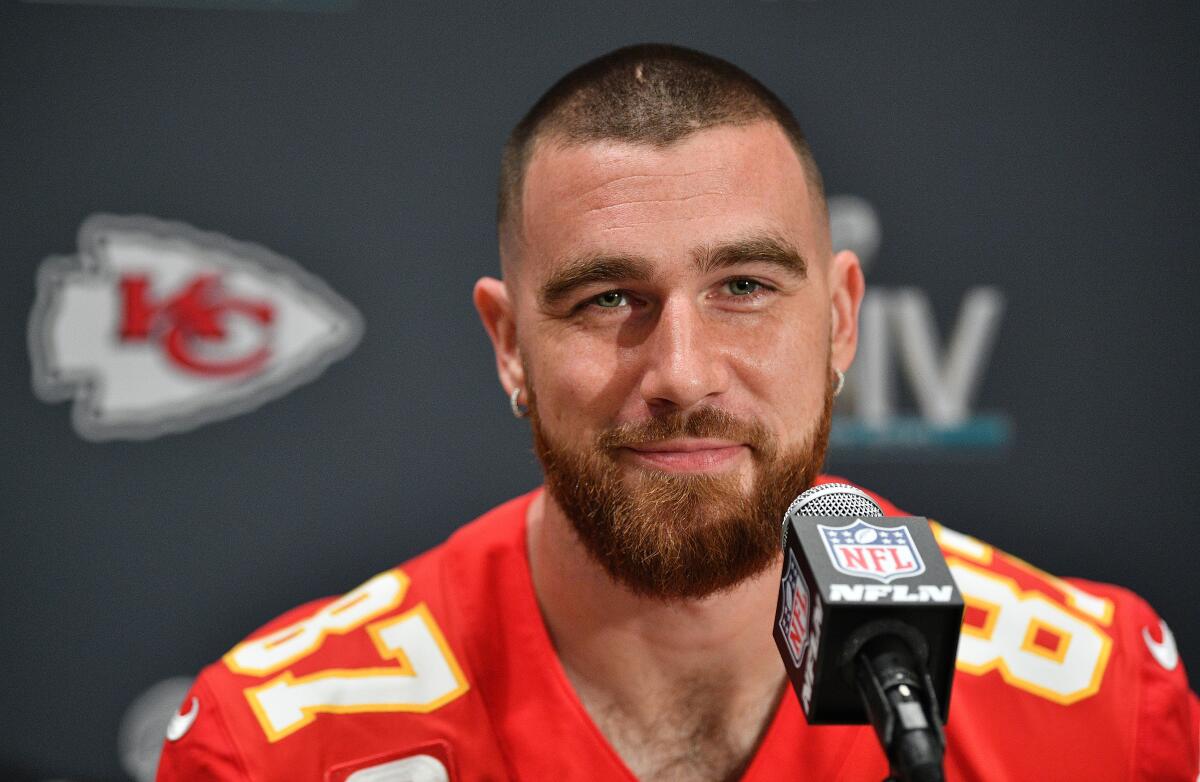
Of course, Swift couldn’t leave current beau Kelce behind. The Kansas City Chiefs tight end is the apparent subject of “The Alchemy” and “So High School,” both of which are riddled with football metaphors.
“The greatest in the league / Where’s the trophy? / He just comes running over to me,” she sings in “The Alchemy,” referencing the couple’s viral kiss after Kelce‘s team won the Super Bowl in February.
“You know how to ball, I know Aristotle,” she added in “So High School.” “You knew what you wanted and, boy, you got her,” she concludes in the song, alluding to how Kelce pursued her after seeing her perform on the Eras tour.
“I have heard some of it, yes, and it is unbelievable,” Kelce said at a sports event in February, ahead of the album’s release. “I can’t wait for her to shake up the world when it finally drops.”
He’s “very proud of her,” a source told E! News after the record dropped earlier this month.
“Travis is so supportive of the entire album,” the source continued, “and loves that he is a part of Taylor’s story.”
Kelce’s mom, Donna, even chimed in the conversation with her own praise. “I listened to the whole album, and I listened to it all morning long when it was released,” she told People this week.
“I was just very impressed,” she said. “She is a very talented woman, and I think it is probably her best work.”
Charlie Puth
(Jordan Strauss / Invision / Associated Press)
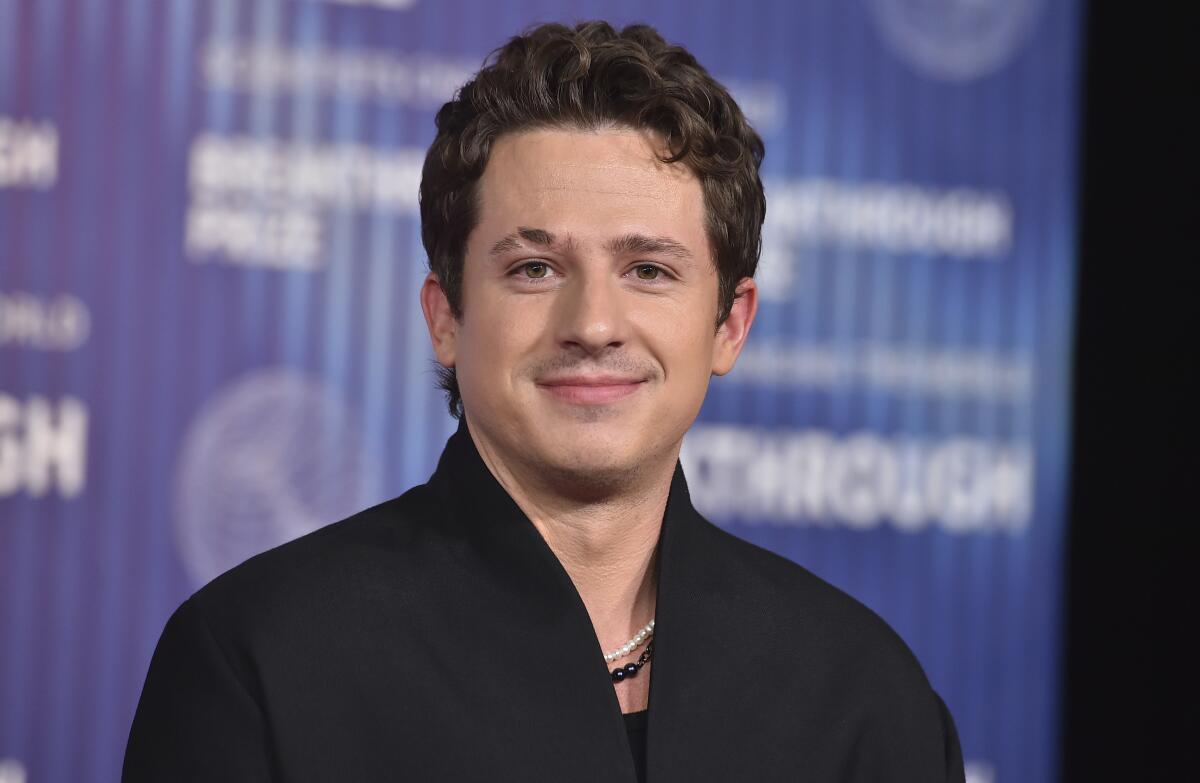
Finally, in a seemingly random shout-out on the title track, Swift sings, “You smokеd, then ate seven bars of chocolate / We declared Charlie Puth should be a bigger artist.”
Fans rushed into a frenzy online, flooding the “We Don’t Talk Anymore” singer’s social media with notifications about his name drop.
“literally honored lol,” he replied in the comments of a now-deleted Instagram post of the song.


In Sender, writer-director Russell Goldman’s high-anxiety debut, the filmmaker expands on his 2022 short Return to Sender, in which Allison Tolman starred as a woman who receives packages she didn’t order. That may not sound like a premise that would result in a paranoid, darkly comedic thriller, much less a feature. But in extending his story from 18 minutes to just over 90, Goldman follows a maddening scenario involving an online retailer called Smirk, a fictionalized Amazon counterpart. More significantly, he captures the frenzied mindset of his protagonist, who grapples with staying sober and several other major life changes—all compounded by a layer of justifiable paranoia brought on by the endless packages. Goldman’s tweaky style and elusive scripting create a peculiar, out-of-whack presentation that destabilizes the viewer, firmly placing us in his main character’s perspective. However, by the end, the journey through this cine-manic headspace doesn’t add up to much, and the potential character study at the center feels somewhat lost in the mechanics of the conspiracy.
Britt Lower (AppleTV’s Severance) stars as Julia, who has just lost her job and moved into a rental home to get her life on track. She is backed financially by her overbearing sister Tatiana (Anna Baryshnikov), who occasionally comes nosing around to verify that Julia doesn’t backslide. And she doesn’t. Julia attends regular Alcoholics Anonymous meetings, where she meets the steely Whitney (Rhea Seehorn), who isn’t interested in being her sponsor. But at home, Julia receives a Smirk package with her brand of lipstick. The problem? She didn’t order it. She calls customer service, and the representative doesn’t help much before telling her, “Be sure to stay alert and aware.” Wait, what? Sender is loaded with nagging, unplaceable details like this. They’re often amusing, intriguing, and exasperating in the same moment. But these pieces don’t complete a whole picture, at least not a narratively satisfying one.
The Smirk packages, delivered by the outwardly helpful, nice-guy driver Charlie (David Dastmalchian), contain a random assortment of objects, from drum kits to protein powder. The squirrelly Julia, already coming apart at the seams from her recent drama, doesn’t know what to make of it. She’s convinced there’s some plot against her, perhaps by someone at Smirk. To what end, she doesn’t know. But Goldman gives us a glimpse of the long-term consequences of her ordeal in the prologue, which features Jamie Lee Curtis (also a producer) as Lisa, a woman in circumstances similar to Julia’s. Lisa’s response to receiving a box of soil with a broken shin pad (with “Can’t Can’t Can” scrawled on it) entails an attempt to suffocate herself with the bubble wrap, only to do far worse with a sharp edge of the shin pad. To show Lisa’s fate, Goldman’s imagery becomes twisted and surreal but also cryptic.
Sender’s disorienting mood is matched by a skewed formal presentation. Cinematographer Gemma Doll-Grossman’s wide-angle lenses and arch angles might feel at home in a Ken Russell or Terry Gilliam feature such as The Devils (1971) or 12 Monkeys (1996). Julia’s half-remembered drinking binges, accented by blurry close-ups, suggest she may have slept with any number of coworkers. She can’t remember, and it embarrasses her. Her rental is dressed in simple if shabby décor, which gives way to Julia’s erratic collage-like overhaul. Melisa Myers’ stuffed production design makes the most of heightened colors and banal, cluttered rooms that lend a normality to the bizarre, ever more disturbing predicament. Nathan Ruyle’s erratic music delivers what must be described as a soundscape rather than a traditional score, with collusive sound effects and tones driving our certainty that Julia is onto something. Along with Marco Rosas’ discordant editing, Goldman’s technical approach effectively reflects Julia’s fragmented, sleep-deprived mind. But his work as a writer hasn’t done enough to justify this level of technique.
After Julia makes a revelatory discovery that small cameras have been embedded in the products from those mysterious packages, the eventual explanation about what has been happening and why strains logic and underwhelms. It also raises even more unanswered questions. Although well-made and acted—Lower and Seehorn should be on track to movie stardom—Goldman’s script could have used another draft to better work through what unfolds. Sender doesn’t give us enough of its characters’ inner lives beyond the situation at hand, so Julia, Charlie, Tatiana, and Whitney feel like devices in a scenario rather than well-drawn human beings. Even so, Goldman fills his film with deeply broken people who try to gain control of their lives by controlling others, exposing and preying on their weaknesses. Despite the material’s potential resonance, Goldman’s style is overpowering. Still, his kernel of an idea and the way he explores it demonstrate his clear skill, and for much of Sender, its sheer oddball energy earns admiration.

“Lethal Weapon” star Danny Glover has revealed he has been living with Alzheimer’s disease for years.
In an interview with NBC’s Lester Holt that aired on the “Today” show on Wednesday, the 79-year-old actor and activist opened up about living with the disease. According to People, he received his diagnosis in 2023, which was not long after he was awarded an honorary Oscar in 2022.
“I could live with it, in a sense,” Glover says of his condition, which has been affecting his movement, speech and memory. “I’m sure as it advances, things are going to be different and changing.”
A neurodegenerative disease, Alzheimer’s is a type of dementia that affects memory, thinking and behavior and worsens over time, according to the Alzheimer’s Assn. Holt reports that more than 7 million Americans over 65 are living with Alzheimer’s, with Black men suffering at a rate double the national average.
Glover and his family say the Hollywood icon is sharing his story now to “have ownership of his life” and to help remove the stigma around the disease.
“They’ve got my back,” Glover says of his family’s support.
Besides his portrayal of L.A. police Det. Roger Murtaugh in the “Lethal Weapon” film series, Glover is known for roles in movies including “Places in the Heart” (1984), “The Color Purple” (1985), “To Sleep With Anger” (1990), “Angels in the Outfield” (1994), “Dreamgirls” (2006) and “The Last Black Man in San Francisco” (2019). He’s also been a vocal advocate for social justice and humanitarian causes both in the U.S. and abroad.
He was the recipient of the Academy of Motion Picture Arts and Sciences’ Jean Hersholt Humanitarian Award in 2022.
“I don’t feel like it’s the end of my life,” he said in his interview with People about living with Alzheimer’s. “There’s work to do.”

Enter your email and we’ll send a secure one-click link to sign in.
WKRN is provided by Nexstar Media Inc., and uses the My Nexstar sign-in, which works across our media network.
Nexstar Media Inc. is a leading, diversified media company that produces and distributes engaging local and national news, sports, and entertainment content across its television and digital platforms. The My Nexstar sign-in works across the Nexstar network—including The CW, NewsNation, The Hill, and more. Learn more at nexstar.tv/privacy-policy.
-

 South Dakota1 minute ago
Families celebrate 250th in South Dakota
-

 Tennessee6 minutes ago
Parasite-induced ‘explosive’ diarrhea cases rise in Tennessee. Here’s what to know
-

 Texas13 minutes ago
New date set for opening of Six Flags Over Texas’ Tormenta Rampaging Run coaster after delay
-

 Utah16 minutes ago
Wasatch Front cities running out of water called a ‘myth’
-
Vermont21 minutes ago
VT Lottery Powerball, Gimme 5 results for July 1, 2026
-

 Virginia28 minutes ago
House Bill 301 takes effect in VA, ending 50 years of limits on adoptee birth records
-

 Washington31 minutes ago
Where Texas became Texas: Washington-on-the-Brazos plans July 4 celebrations
-

 Wisconsin36 minutes ago
How much will Shawn Eichorst make as Wisconsin Badgers’ athletic director?

