Culture
Meet the guy who has pitched for five MLB teams in 2024: Sliders


For Mike Baumann, it started the same way as his first seven seasons in professional baseball. He was, as always, employed by the Baltimore Orioles, the team that drafted him in the third round in 2017. He wanted to help a familiar organization while advancing his own career.
“My expectation was to take a step forward with the Orioles and to be a part of the bullpen,” Baumann said this week. “I was really excited. I was really looking forward to it. I didn’t perform like I wanted to, things just didn’t go my way and that’s the nature of the business.”
The business, though, has treated Baumann in a way that only one other player in the history of the sport has been treated. Baumann has appeared for five major league teams in 2024: the Orioles, Seattle Mariners, San Francisco Giants, Los Angeles Angels and Miami Marlins. He’s made so many stops, he should have his own concert-tour T-shirt:
Baltimore, March 28-May 17
Baumann played his entire career with the Orioles until he was traded to the Mariners on May 17. (Tommy Gilligan / USA Today)
Seattle, May 23-July 11

His stint with the Mariners only lasted seven weeks. (D. Ross Cameron / USA Today)
San Francisco (One Night Only!) – July 26

Baumann gave up two runs on three hits in two-thirds of an inning for the Giants against the Rockies. (Stan Szeto / USA Today)
Los Angeles, July 31-August 22

His tenure with the Angels consisted of 10 appearances. (Mark Goldman / Icon Sportswire via Getty Images)
Miami, August 27-present

Baumann has now been with the Marlins for 10 days. (John Hefti / USA Today)
According to the Elias Sports Bureau, Baumann’s busy itinerary ties him with pitcher Oliver Drake (2018) for most MLB teams in a single season. Twenty others have played for four teams in a season, including relievers Yohan Ramirez and Matt Bowman this year. But only Drake and Baumann have made it to five.
“It’s been a roller coaster of emotions, going from highs to lows, but every time I’ve been claimed, I’ve been grateful,” Baumann said. “I’ve been given a ton of opportunities, and I’ve been fortunate for that.”
Zipping through five teams in one season takes several converging factors. Typically, the player needs a skill that teams want; a minimal salary; success in the past and less success in the present.
Baumann fits every category. He throws 96 mph and earns $749,000. He was 10-1 with a 3.76 ERA in 60 games for Baltimore last season, but has a 7.26 ERA since leaving the Orioles in May.
Most importantly, Baumann is out of minor-league options, meaning he cannot be sent to the minors without passing through waivers. Appearances aside, that made the stakes much different for him this season, especially with a strong team.
“I knew I was out of options, and I knew the Orioles had a ton of good depth,” Baumann said. “So going into the season, I told myself I’ve got to perform if I want to be a part of it.”
After a shaky start to the season, Baumann pitched well in his final six outings for Baltimore. But he was designated for assignment when starter Grayson Rodriguez returned from the injured list in mid-May, and the Orioles worked out a trade with the Mariners to send him on his way.
“I wasn’t too surprised,” Baumann said. “I knew I was kind of the last guy in the bullpen. They had a lot of good arms in Triple A and some guys coming back from injury. So it was bittersweet; I loved the Orioles. But when I found out it was Seattle, they were a first-place team at the time and I was really looking forward to the opportunity.”
In his second game as a Mariner, Baumann worked a scoreless 10th inning to beat the rival Houston Astros. But with a 5.51 ERA for Seattle in 18 games, he lost his roster spot again and was traded to the Giants for cash.
With San Francisco, Baumann reunited with pitcher Sean Hjelle, a former teammate at Mahtomedi (Minn.) High School. The fun lasted for two-thirds of an inning against Colorado on July 26, and then it was onto the Angels, who acquired Baumann for cash.
“That one happened so fast,” he said of his Giants tenure. “I didn’t get time to settle in or even get to know a lot of people’s names.”
Five days after facing the Colorado Rockies in his Giants debut, Baumann faced them again in his first game with the Angels. After 10 games with the Angels (and a 6.75 ERA), he joined the Marlins and debuted on Aug. 27 against — who else? — the Rockies.
If they didn’t know better, they’d think he was stalking them. But Baumann just goes where teams tell him to go, without getting too attached.
“I’ve been living in hotels, checking in and out,” he said. “It’s been the easiest way rather than actually getting apartment leases. I’ve kind of been narrowing down my suitcases. I’ve been traveling really light.”
If he’s looking for a higher meaning to all this, Baumann got it with the waiver claim by the Marlins on August 25. When he found out, he was home in Jacksonville, Fla., with his wife, Nicole, who was eight months pregnant with their first child and due this month. To join a team in the same state — albeit a five-hour drive from home — was an ideal fit.
“When we were out West, it was kind of like, ‘Am I going to be able to make the birth of my own child?’” Baumann said. “I remember I was so excited because after going back and forth across the country, I could just go down to Miami.”
The Marlins liked Baumann’s velocity (not just on the fastball, but also his 92 mph slider) and his knuckle curve. With better control, they believe Baumann could be a keeper. He’s had four outings for Miami through Thursday, two scoreless and two in which he allowed three runs.
It’s a fitting performance for an historically uneven season that began on one coast, traversed another and wound up close to home.
Everyday Willy A
Adames, on a power surge, eyes 162
Willy Adames celebrated his 29th birthday on Monday by homering in his fifth game in a row, tying a Milwaukee Brewers club record. The five-game stretch included 11 RBIs, and even when the streak ended on Tuesday, Adames drove in another run to make him the first National Leaguer with 100 RBIs this season.
For Adames — who is positioning himself for a lucrative winter in free agency — another number might matter more: 162 games played. Adames has started every Brewers game at shortstop since Sept. 27, and he hopes to make it all the way this season.
“It’s fun to be out there every day, competing with the boys and just having fun,” Adames said. “I’ve never done it, so I want to do it. I keep fighting with the guys here that want to give me an off-day, but we’re trying to do it this year — and hopefully we can continue to play all the games in the postseason.”

Adames led the National League in RBIs with 100 heading into Thursday’s games. (Katie Stratman / USA Today)
Adames, whose career high in games is 152, is one of seven players who have played every game this season, with the Atlanta Braves’ Matt Olson and Marcell Ozuna, the New York Mets’ Pete Alonso and Francisco Lindor, the Philadelphia Phillies’ Nick Castellanos and the Kansas City Royals’ Bobby Witt Jr.
Players sometimes take a break once playoff spots are decided, but it’s worth watching to see how many get to 162. The last time seven players appeared in all 162 games was 2007, with Jeff Francoeur, Carlos Lee, Juan Pierre, Jimmy Rollins, Grady Sizemore, Delmon Young and Ryan Zimmerman.
The majors’ longest active streak belongs to Olson, Atlanta’s first baseman, at 598 games. It appears that Cal Ripken Jr.’s record of 2,632, which stretched from 1982 to 1998, is safe.
“I think that’s going to be forever there,” Adames said. “I mean, playing two seasons (of consecutive games) is impressive. Imagine playing 2,000-plus.”
Gimme Five
Five bits of ballpark wisdom
Braves catching coach Sal Fasano on the masters of the position
For most of Sal Fasano’s formative years, a baseball team in his hometown sent a catcher to the All-Star Game. He was a Chicago kid in the 1980s, and if the White Sox’ Carlton Fisk didn’t make it, the Cubs’ Jody Davis usually did. Fasano paid attention to them and other standouts, especially Bob Boone, who made the punishing position seem alluring.
“I always had an affinity for catching,” Fasano said. “It’s like in football, I was an offensive lineman. Nobody loves offensive linemen. I do, and I love catching. I love the backbone. And that’s what we call them: the backbone.”
Fasano, 53, served nine teams as a backbone backup from 1996 through 2008. His finest contemporaries, he said, were Jorge Posada, Jason Varitek and Bengie Molina. They combined for just three Gold Gloves, but invariably led their teams to the World Series.
“Some guys always win,” Fasano said, “and there’s a reason.”

Fasano (left) with Braves catcher Sean Murphy (right) in June. (David Butler II / USA Today)
The Braves have always won since Fasano joined their staff in 2018, the start of their six-year reign atop the National League East. Fasano, who also managed and coached in the Toronto Blue Jays’ and Angels’ farm systems, is the catching coach for the Braves, who are now chasing the Phillies in the East.
Both teams’ success, Fasano said, has a lot to do with catchers coaxing the best from their pitchers.
“Look at what (J.T.) Realmuto’s done with their pitching staff, and look at what our guys have done with our pitchers,” Fasano said. “You’ve got to have guys who know how to control the pitching staff — because it all revolves around that dude in the middle.”
Here are some of Fasano’s insights about five aspects of catching, and who has done it best.
Receiving: “The way we did it in our day, it was treated differently. You didn’t want to move the ball very much, you wanted to keep your body still. It was a different technique, and I think Tyler Flowers became revolutionary. I mean, people caught on one knee before; Manny Sanguillen, Tony Peña, they did their thing and basically made it unique, so it was almost like their art form. … But Tyler Flowers came in and decided to say, ‘Hey, I might be able to create value for myself by stealing strikes.’ So when he went onto one knee, he basically revolutionized the whole system of catcher, because everybody does it now. Teams were studying what he was doing, so when I got hired over here, I was like, ‘You do your mechanic, I’ll learn what you’re doing.’ And then we tried to implement it throughout the system, and we’ve had a lot of success doing it.”
Quick release: “When you watch Realmuto, he’s one of the best athletes I’ve ever seen, (with) probably the best exchange I’ve ever seen in my life. Last year we broke him down for the playoffs and he’s averaging 1.78 to second base. Nobody’s doing that. Pudge (Rodriguez) might have been closest to that. Pudge was the best thrower in my era, like a 1.8. It’s just a math equation. And J.T., in this era, there’s not too many guys like that.”
Balls in the dirt: “If blocking was at zero when I played, blocking is at, like, plus-20 now. Guys block way better. I think Sean Murphy does a tremendous job. He’s one of my favorites when it comes to blocking. In the old days, when we had two knees up, it was really hard to get your knees down at the same time. That’s why being on one knee is actually easier. If both knees hit (the ground) off-time, it stiffens your body. Think about it: if you jump and land one foot at a time, your body’s actually going to vibrate, your eyes are going to vibrate, it’s chaos for your body. On one knee, it’s a slide, so you’re calmer. You can absorb the ball better, you can do a lot of things. But blocking is really a state of mind. I don’t care what technique you have, guys who love blocking are really good at blocking.”
Plays at the plate: “I watched Mike Macfarlane take beatings at home plate — but guys were out. You’ve gotta protect yourself, catch the ball, put the tag on, and if all else fails, complete the play. Those are my rules. Mike was really, really good at protecting home plate. I saw him get crushed by so many people. It was really difficult to watch. I’d say, ‘Mike, man, how do you do that?’ He said, ‘I just want to get into a turtleback. You know you’re gonna get hit and you’re gonna roll.’ It’s against the rules now if you’re in the lane, so we’ve had to make amendments to how we (protect) home plate, because we have to give them a lane. How can we put our left knee down and still create a lane? Or if it’s done early enough, I can take away the lane? And that’s what a lot of people don’t understand. So the little idiosyncrasies of what we can do behind the plate, a lot of people don’t know the rules. There’s a lot of practice and a lot of technique, and that’s what spring training is for.”
Communicating with pitchers: “I was doing catching (instruction) for the Blue Jays, and I remember seeing Dan Jansen, he’s 18 years old at the time and he’s walking to the clubhouse and surrounded by three pitchers, and they’re just having a nice conversation. And I’m like, ‘Oooh, that guy’s born to be a catcher.’ We had just drafted him, he was raw, we didn’t know he was going to be a big league catcher. But once you realize, ‘Oh my gosh, his gift is communication,’ then I don’t care how he catches, I don’t care how he throws it, let’s nurture that. When you give him information, is he able to make the pitchers better? Because that’s really what our position is: can you make the people around you better? That’s the sign of greatness. It’s like Travis (d’Arnaud). We were in Double A, and Travis isn’t the most rah-rah, pump-your-fist kind of guy. He’s kind of like a comedian on the field, he has a good time. But when he has a man-to-man conversation, it’s always in the clubhouse, and he’s always talking to them on a personal level. So his personal relationships with pitchers are huge. Think about when he took the Mets to the World Series with all those young pitchers, and then he did it with us, too. I mean, does he throw the best? No. Does he catch the best? No. Does he block the best? No. But does he call a great game? Yes, and he’s able to get the most out of his pitchers.”
Off the Grid
A historical detour from the Immaculate Grid
Cliff Dapper – Dodgers catcher
In the long and lively history of the Dodgers’ franchise — from Brooklyn to Los Angeles, as the Bridegrooms, Superbas, Robins and Dodgers — 209 players have suited up as catcher. The one with the highest batting average (minimum 10 plate appearances) is also the only one to have been traded for a broadcaster. Cliff Dapper, then, made for a really fun answer on Monday’s grid.
After three seasons with his hometown Hollywood Stars in the old Pacific Coast League, Dapper dazzled with Brooklyn for eight games near the start of the 1942 season, going 7-for-18 (.471) with a homer and nine RBIs in eight games. He spent the next three years in military service and never returned to the majors.
In 1948, though, Dapper was still a Dodger farmhand when a need arose in the Brooklyn broadcast booth. The venerable voice of the team, Red Barber, had a bleeding ulcer and the Dodgers — always shrewd judges of talent — fixed their ears on Ernie Harwell, who was working for the minor-league Atlanta Crackers on WSB, a station with a powerful signal.
The Dodgers wanted Harwell but the Crackers needed something in return. That something turned out to be Dapper, who would spend 1949 as player-manager for the Crackers. Harwell, meanwhile, went on to a Hall of Fame career in the booth, spending most of his 55 major league seasons with the Detroit Tigers.
To mark Harwell’s retirement in 2002, the Tigers invited Dapper to a ceremony at Comerica Park. It was the first time the two had ever met.
“It was the biggest thrill I have ever had in baseball,” Dapper, then 82, told his local paper, the North County Times in Escondido, Calif., after the event. “I still feel honored that I was traded for a great radio announcer. I’m just some rinky-dink.”
Dapper explained that Branch Rickey, the celebrated Dodgers general manager, was concerned that the trade would be embarrassing for him. In fact, Dapper said, he was eager to get a chance to manage, and thrilled to finally meet Harwell so many years later.
“He said to me, ‘I really appreciate you coming back here, Cliff,’” Dapper said. “He is such a gracious man.”
Harwell died in 2010 at age 92, a year before Dapper died at 91. The Tigers honored Harwell with a statue at the ceremony when the two met.
“When I see a statue, I think of history, of Washington and Lincoln, generals Grant and Lee,” Harwell said that day, as reported by the Detroit Free Press. “I don’t deserve a statue or part of history. But let me tell you, from my heart, I’m proud this statue is me.”
Classic clip
Mark McGwire on “The Simpsons”
Monday marks the 26th anniversary of Mark McGwire’s 62nd home run in 1998, which made him the first player to break Roger Maris’ single-season record. It’s a moment viewed much differently now, but at the time — when we really should have known better — it was hailed as a soaring triumph.
With that, naturally, came television appearances for McGwire. In 1999, he appeared in Helen Hunt’s bedroom on “Mad About You,” wearing only a pillow. He was also on “The Simpsons” that year, distracting the ever-gullible citizens of Springfield with his home run prowess.
McGwire — dispatched by MLB to recover evidence that it was monitoring the town — utters a truly remarkable line, given everything that would surface about his use of steroids. It’s another celebrated instance of “The Simpsons” supposedly predicting the future.
In 1998, when the league and the media should have aggressively challenged the players’ association on the necessity of drug testing (“privacy” was the union’s rationale), we instead built up McGwire and Sammy Sosa into larger-than-life Greek Gods.
As it turned out, McGwire’s big line on “The Simpsons” said it all: “Do you want to know the terrifying truth,” he asked, “or do you want to see me sock a few dingers?”
(Top photo of Mike Baumann: Lachlan Cunningham / Getty Images)



Welcome to Lit Trivia, the Book Review’s regular quiz about books, authors and literary culture. This week’s challenge is all about an influential group of writers, editors and other creative types known as the Algonquin Round Table. In the five multiple-choice questions below, tap or click on the answer you think is correct. After the last question, you’ll find links to related books and other information about the era if you’d like to do further reading.

A strong sense of place can deeply influence a story, and in some cases, the setting can even feel like a character itself. But as it’s summer here in the Northern Hemisphere and travel adventures abound, this week’s literary geography quiz takes you on a trivia tour of notable libraries around the world. To play, just make your selection in the multiple-choice list and the correct answer will be revealed. At the end of the quiz, you’ll find links to more information if you’d like to do further reading.

Welcome to Literary Quotable Quotes, a quiz that tests your recognition of classic lines. This week’s installment highlights observations from future or alternate worlds depicted in popular science fiction. In the five multiple-choice questions below, tap or click on the answer you think is correct. After the last question, you’ll find links to the books if you’re intrigued and inspired to read more.
-

 Technology24 seconds ago
Zoox robotaxi redesign brings big rider upgrades
-
 Business5 minutes ago
Commentary: It’s not just vaccines — from infancy to adolescence, Republicans are waging war on children’s health
-
 Entertainment13 minutes ago
Taylor Swift, Travis Kelce married at lavish Madison Square Garden wedding
-
 Lifestyle15 minutes ago
How to have the best Sunday in L.A., according to Ken Marino
-
Politics20 minutes ago
Trump administration sues California over ‘Glock ban’ law targeting machine gun pistols
-
 Sports31 minutes ago
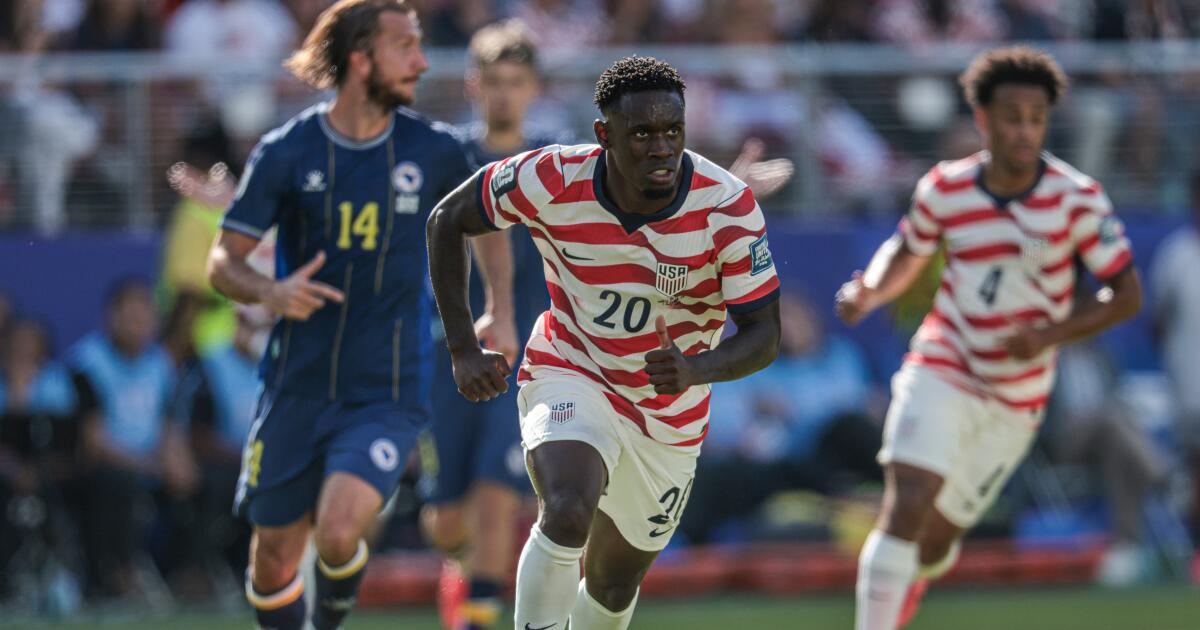
Folarin Balogun urges U.S. to focus on beating Belgium despite red card he calls unjust
-

 World43 minutes ago
Belgian diamond group that won tariff relief gifts Trump ring
-

 News1 hour ago
Family-owned company prepares to put on the largest fireworks display in history: “It is the biggest show that we’ve ever done”


