Crypto
You’ve Seen These Words. You Have No Idea What They Mean. Unfortunately, You Really Need To Now.


This is part of Trump’s Great American Crypto Scam, a series about the catastrophic collision between the second Trump administration and the wild world of cryptocurrency. Read it all here.
Crypto is hard to talk about. Not in that it’s an emotionally heavy subject—it very much is not—but in that crypto people have, in the span of just a few years, created an entire new cottage industry of jargon that is exhausting to follow. If you are not totally enmeshed in the world of crypto, then first, congratulations. But second, you may find it useful to know a few of the terms that tend to fly around during conversations about crypto and its connoisseurs.
cryptocurrency (noun)—Electronic money, basically. Cryptocurrency is different from regular money in that it lacks the backing of either some precious metal (like gold) or the full faith and credit of a country. It does have a ledger of transactions in a place (the blockchain) where everyone can see how it has changed hands (if not exactly to whom).
What gives cryptocurrency value if not physical or governmental backing, then? For now, not much, other than the belief that other people will ultimately want to buy it. (It can get a little more complicated. See: stablecoin (noun).)
blockchain (noun)—The place where records of crypto transactions are kept, like a bank statement, but for crypto. One thing that makes cryptocurrency so different is that because it is on the blockchain, the transaction list is accessible to anyone who knows how to peruse it. (Actually, though, navigating to a blockchain explorer is a bit like putting a fire hose in your mouth.)
But to back up even further, the creation of the blockchain is what enabled cryptocurrency’s existence. To not get too computers about it, the blockchain is a digital record that cannot be hacked or changed, even though it is accessible. Its creation in 2009 was heralded as a breakthrough for important innovations like unhackable elections and recordkeeping, but it also established a system that could essentially work to undergird the basis of an online monetary system, aka cryptocurrency.
Bitcoin (noun)—The main cryptocurrency and the one that the most people are willing to buy at any given time. Its creator is an anonymous white paper author who goes by the name Satoshi Nakamoto. A Bitcoin is worth about $80,000 these days, give or take, though it crossed $100,000 for the first time in 2024. It goes up and down a lot, but if you were to pick one direction over its history to date, it’s definitely been up.
Coinbase (noun)—The most prominent American crypto exchange, run by Brian Armstrong. Like a bank for crypto. Publicly traded, which makes its operations more transparent than most of its peers’. Not especially decentralized, despite its CEO’s constant reminders that crypto is decentralized.
crypto exchange (noun)—A hub for people to put their crypto, and where the exchange takes over the management of that crypto. A way to own crypto without having to think too much about the mechanics of it or risk losing it (unless the exchange turns out to be fraudulent, as some have, in which case customers without any insurance may lose their deposits). Think of a crypto exchange as the bank and the blockchain as the vault.
NFT (noun)—Some digital thing that is minted as being a novelty—not unlike a special-edition baseball card with only one copy made. The market has cooled a lot since NFTs went mainstream in early 2021. Some are sort of passable as being real, unique things (like specially coded NBA highlight videos on digital cards, licensed by the NBA), while other NFTs bear no connection to the object being represented and amount to pure theft. Related to crypto in that people tend to buy NFTs with crypto, and NFTs draw on crypto tech like blockchains.
tokenize (verb)—To take a real thing and embody it in a token. As in: My name is Alex, and I could tokenize myself by launching AlexCoin. Would you buy me?
Bitcoin mine (verb)—To drain the world’s power grids so that some guys can get more Bitcoins after they are launched into circulation. The actual act of mining involves computer whizzes trying to solve a numerical puzzle; the first miner to solve it gets the newly created Bitcoin.
Ethereum (noun)—Another cryptocurrency. It’s the Scottie Pippen to Bitcoin’s Michael Jordan. As a piece of crypto technology, its people like the term digital vending machine, because it automates the process of paying for something, eliminating the need for a middleman. Most crypto is a payment object, but Ethereum is also a payment process.
stablecoin (noun)—A crypto token whose value is pegged to something else, like a currency.
Tether (noun)—The biggest stablecoin, pegged to the U.S. dollar. In case the U.S. dollar wasn’t working for you.
pump and dump (noun, verb)—The practice of owning an asset, talking it up, and selling it at an inflated price to the losers who believe you. Historically popular with stocks (see: GameStop) but now a real boom sector in crypto. Because in crypto, the literal creators of coins can be the ones doing it. See: “Hawk Tuah” Girl, the twentysomething who tried to capitalize on her viral fame by launching a crypto project that quicky fell apart. (She claims she didn’t personally sell any holdings, but some major holders made a few million dollars off the whole thing.)
rug pull (noun, verb)—In crypto, often the dump part of pump and dump, when a coin’s developers exit the project and leave poor saps holding worthless junk.
shit coin/meme coin (noun)—A crypto token that has no animating ideology behind it other than to have a little fun. Can morph into a regular-ish coin with enough momentum (see: the next item on this list).
Doge (cryptocurrency) (noun)—Dogecoin is a crypto token (not exactly a cryptocurrency, in that I’m not aware of many people dreaming about using it as currency) based on a picture of a dog that got really hot during the GameStop/AMC meme stock mania of early 2021. The dog looks like this:

The coin has hung around, thanks in part to publicity from celebrities like Elon Musk. It is currently valued at about 20 cents, which is not that much.
DOGE (pseudo–governmental entity) (noun)—Elon Musk’s crew of often unqualified and sometimes wildly racist underlings who began torching the federal government as the Department of Government Efficiency in winter 2025. Not related to the coin, but the acronym isn’t a coincidence.
Poloniex (noun)—A crypto exchange that lost $120 million in a hack in 2023. Put your money wherever you want. It’s not my money! But yes, this kind of thing can happen.
World Liberty Financial (noun)—A crypto venture designed to migrate money from enthusiastic supporters of Donald Trump to the president and his business associates. It created both the Trump coin and the Melania coin, both of which launched soon after the inauguration and are largely viewed as a money grab.
Tron (noun)—A blockchain that works kind of like Ethereum, with its “smart contract” functionality. But also: founded by a guy whom the Securities and Exchange Commission has accused of a variety of financial misdeeds, including fraud.
broligarchy (noun)—Slang for Silicon Valley guys who think they should be the world’s molders. As of early 2025, their project had momentum. (See: Musk, Elon, and the All-In podcast, which features a co-host who is a South African investor—and now the White House’s A.I. and crypto “czar.”)
Fairshake (noun)—Just some crypto professionals who believe that their industry deserves a fair shake! In reality, this is an industry super PAC that wants favorable crypto laws and regulations. It spent about half the corporate money of the entire 2024 election cycle to make sure the industry would get them.
Securities and Exchange Commission (noun)—A governmental agency that at one point was hostile to crypto but now lets crypto companies do whatever they want.
Federal Trade Commission (noun)—An agency that was very hawkish on antitrust and consumer protections during the Biden administration. Has a webpage on how to spot crypto scams, which hasn’t yet been taken down, but stay tuned.
Consumer Financial Protection Bureau (noun)—Federal agency signed into creation by Barack Obama, with the idea being that it would protect consumers from scams. For some reason, the crypto industry doesn’t like it. It’s been one of DOGE’s first targets, and its survival is the subject of ongoing litigation.
This work is made possible by Slate Plus. Please consider supporting our coverage of the second Trump administration—we won’t even make you pay in $bwainwuhm.
Sign up for Slate’s evening newsletter.




July 16, 2026, 5:00 AM HST
Starting Oct. 1, cryptocurrency kiosk/ATMs that accept deposits will no longer be allowed in Hawai’i as a new consumer protection law takes effect.
Hawai’i is now the 35th state to enact a law to protect consumers from losing money in scams involving cryptocurrency kiosk/ATMs and is the first state to ban kiosks that accept deposits. Four other states have completely banned these machines. Other states have imposed transaction limits, mandated refunds for fraud, increased warning signs, required printed receipts and passed other consumer safeguards.
“The use of cryptocurrency kiosks in scams was increasing exponentially in Hawai’i and across the nation. Last year, the FBI said Hawai’i consumers reported losing $3.85 million through fraud involving cryptocurrency kioks. That’s nearly four times the amount reported lost in 2024,” said Keali’i Lopez, AARP Hawai‘i state director. “That’s why AARP fought hard to pass Act 224. We’re grateful to our advocacy volunteers and others who shared fraud stories, testified, called and sent letters and emails to help pass the law. We’re also thankful to lawmakers who acted decisively to protect consumers.”
The FBI said kupuna were especially vulnerable to cryptocurrency kiosk/ATM fraud and accounted for the majority of the losses. The machines look like bank ATMS and could be found in grocery stores, convenience stores, pharmacies, gas stations and other locations.
“Fraudsters use cryptocurrency kiosks like a getaway car in a bank robbery,” Lopez said. “They convince consumers through romance scams, by posing as an IRS agent or other official, or through a technology scam, to take money out of their banks and deposit it in the cryptocurrency kiosk and once the money is put into a scammer’s cryptocurrency wallet, it is gone.”

Key Takeaways
- Luno challenged South Africa’s draft capital flow rules in 2026, arguing the executive-led plan is unconstitutional.
- Restrictive rules could penalize CASPs up to 1 million rand, pushing South Africa’s crypto market underground.
- Next, Luno wants Parliament to enact a fair Act of 5 key rules to protect bitcoin and stablecoin innovation.
Strict Enforcement and Steep Penalties
Cryptocurrency exchange Luno has launched a formal challenge against a proposed overhaul of South Africa’s foreign exchange laws, arguing that the National Treasury’s plan to bring digital assets under an apartheid-era capital flow regime is unconstitutional because it bypasses Parliament. The challenge was detailed in Luno’s formal submission to the National Treasury on the Draft Capital Flow Management Regulations.
The draft rules, jointly published by the Treasury and the South African Reserve Bank for public comment, aim to modernize the country’s exchange controls. However, Luno warns that the proposal contains highly restrictive measures that threaten fundamental property and privacy rights.
As previously reported by Bitcoin.com News, the draft regulations seek to replace South Africa’s 1961 Exchange Control Regulations with a risk-based system focused on monitoring cross-border transactions and combating illicit financial flows. Violations could carry penalties of up to five years in prison, a fine of $53,000 (1 million South African rand), or both.
In its submission, Luno raised serious alarms over three specific enforcement provisions: asset seizure without court orders, forced liquidations and business-ending sanctions. Marius Reitz, Luno’s general manager for Africa, argued that changes of this magnitude must not be enacted via ministerial regulation.
“By proceeding through ministerial regulation, the executive branch effectively bypasses the democratic process for changes that will affect the fundamental property and privacy rights of millions of South Africans,” Reitz said. “They should, in our view, have been enacted as a new Act passed through Parliament.”
Luno further charged that the National Treasury is contradicting the central bank’s own policy roadmap, which identifies stablecoins as potential future money capable of facilitating low-cost, borderless payments. Yet, Luno argues, the Treasury’s draft regulations treat all digital assets as identical, bringing bitcoin, stablecoins and tokenized real-world assets under the same restrictive capital flow framework.
“By attempting to capture every digital asset regardless of utility or economic function, Treasury risks unintentionally stifling South Africa’s broader blockchain technology sector,” Luno stated.
Proposed Solutions for Industry Growth
The exchange warned that the proposed reporting requirements for transactions above an unspecified threshold would create an “unmanageable administrative burden” for platforms and the state alike, given that large transaction volumes are processed within seconds.
“Our experience demonstrates that overly restrictive regulation simply pushes digital asset activity underground or offshore, beyond the reach of domestic regulators and tax authorities,” the company added.
Meanwhile, the crypto exchange’s submission also shared several key recommendations to resolve some of the friction points. First, Luno calls for the enactment of the final crypto capital flow framework through an Act of Parliament rather than executive regulation. It also recommends the designation of crypto assets bought and held on South African-licensed exchanges as onshore assets.
Luno wants regulations to distinguish between digital asset classes based on economic function while dropping the proposed forced-sale and warrantless asset seizure mechanisms. Non-resident international trading firms must also be allowed to continue operating in the South African market under appropriate registration to preserve market liquidity.
“South Africa needs a regulatory framework that protects the integrity of the digital asset system without stifling the innovation, investment and economic growth that the digital asset sector is uniquely positioned to deliver,” Reitz said.

Key Takeaways
- Blackrock’s Q2 2026 revenue hit $7.1 billion as Fink filed new SEC papers for tokenized funds.
- Ishares products crossed $6 trillion in assets while Blackrock’s digital currency and tokenized exchange-traded fund (ETF) business held near $110 billion.
- Blackrock raised its 2026 buyback plan to $2 billion as Fink pointed to accelerating momentum ahead.
The New York-based asset manager posted adjusted earnings per share of $13.91, up 15% from a year ago, and adjusted operating income of $2.9 billion, a 39% increase. On a GAAP basis, diluted earnings per share reached $12.19, up 20% year over year.
Blackrock’s assets under management (AUM) reached a whopping $15.3 trillion, driven by $868 billion in net inflows over the trailing 12 months and 10% organic base fee growth.
Record Inflows Push Assets to $15.3 Trillion
According to the firm’s second-quarter 2026 earnings, Blackrock brought in $192 billion of net inflows during the second quarter alone, contributing to the strongest first half in the firm’s history. Flows through the first six months of 2026 topped $321 billion, more than double the total from the same period last year.
During the earnings call, Chief Financial Officer Martin Small told analysts on the earnings call that the results reflect Blackrock’s position at the center of mega trends reshaping public markets, private markets, and technology. The company’s adjusted operating margin hit 45.9%, its highest level in nearly five years, expanding 260 basis points from a year earlier.
Ishares, Blackrock’s exchange-traded fund platform, crossed $6 trillion in assets under management, roughly doubling in three years. The unit pulled in $178 billion of net inflows in the quarter, led by $85 billion into core equity ETFs and $61 billion into index bond ETFs. Active ETFs added another $20 billion.
Tokenization Push Moves From Concept to Filings
Blackrock disclosed it has filed two registration statements with the Securities and Exchange Commission (SEC) for tokenized money market funds. One would create a tokenized share class on ethereum for an existing fund. The other is described as a digitally native strategy with features like daily dividend reinvestment.
Small explained that the filings are meant to connect Blackrock’s cash management products to investors who already hold assets in digital wallets. He noted the funds are expected to operate across multiple blockchains, with stablecoins supporting subscriptions and redemptions directly on chain.
“When we talk about tokenized assets, tokenized assets are the spear tip into an entirely new distribution channel,” Small explained, pointing to an estimated 5 billion digital wallets worldwide as a long-term growth opportunity for the firm.
Bitcoin, Ethereum and Stablecoin Business Expands
Blackrock now has roughly $110 billion in AUM connected to digital assets, according to Small. The firm’s Ishares Bitcoin Trust, Ethereum Trust, and its BUIDL tokenized fund remain the largest products in their respective categories. Blackrock has set an internal target of turning digital assets into a $500 million revenue business as part of its 2030 growth plan.
The company also manages $60 billion in reserves for stablecoin issuer Circle, which Small disclosed represents about a quarter of the $300 billion stablecoin market.
Despite a decline in bitcoin and ethereum prices during the quarter, Small detailed that Blackrock’s European bitcoin ETF took in more than $650 million in international demand. He attributed the flows to investors treating bitcoin as a small, diversifying allocation inside broader portfolios rather than a core holding.
Blackrock’s financial tables showed digital assets as a product category recorded $3.1 billion in net outflows for the quarter, with digital asset AUM falling to $48.8 billion from $60.7 billion in the first quarter, reflecting the price declines Small referenced.
Fink Points to Strong Market Fundamentals
Fink used much of his prepared remarks and the question and answer session to lay out his view of the broader economy. He described a market environment marked by rising corporate earnings and technology-driven productivity gains.
“Market fundamentals are strong and well supported, with higher margins and earnings momentum catalyzed by new technology,” Fink said in the earnings release.
Fink added:
“The scale and depth of our client relationships globally have never been greater.”
On the call, Fink pointed to U.S. equity markets climbing to new highs and said returns are broadening beyond American stocks. He also addressed the dollar’s role in global portfolios, noting the currency’s volatility is tied closely to Federal Reserve policy on interest rates.
Fink also highlighted Blackrock’s role supporting the U.S. Treasury Department’s newly launched Trump Accounts program, with two Ishares ETFs expected to become investment options later this year. He closed the call on an optimistic note.
“Our momentum is accelerating, and I’ve never been more optimistic about the growth ahead,” Fink stressed.
What Comes Next
Blackrock raised its planned 2026 share repurchases to $2 billion, up from prior guidance, after buying back $450 million in stock during the quarter. Executives said they expect quarterly buybacks of at least $550 million going forward, citing confidence in free cash flow growth.
The firm’s private markets business, built around its HPS and Global Infrastructure Partners acquisitions, added $15 billion in net inflows during the quarter. Executives said infrastructure and private credit deployment activity have been among the busiest periods on record for the platform, with insurance companies increasingly seeking higher yields through private market allocations. Fink remarked that the firm has closed about $10 billion in high-grade and infrastructure debt mandates for insurers so far this year, a trend he expects to keep building.
-
 Business6 minutes ago
Netflix reports higher profits as investors worry about growth
-
 Entertainment12 minutes ago
Kris Jenner’s mom, beloved matriarch Mary Jo ‘MJ’ Shannon, dies at 91
-
 Politics24 minutes ago
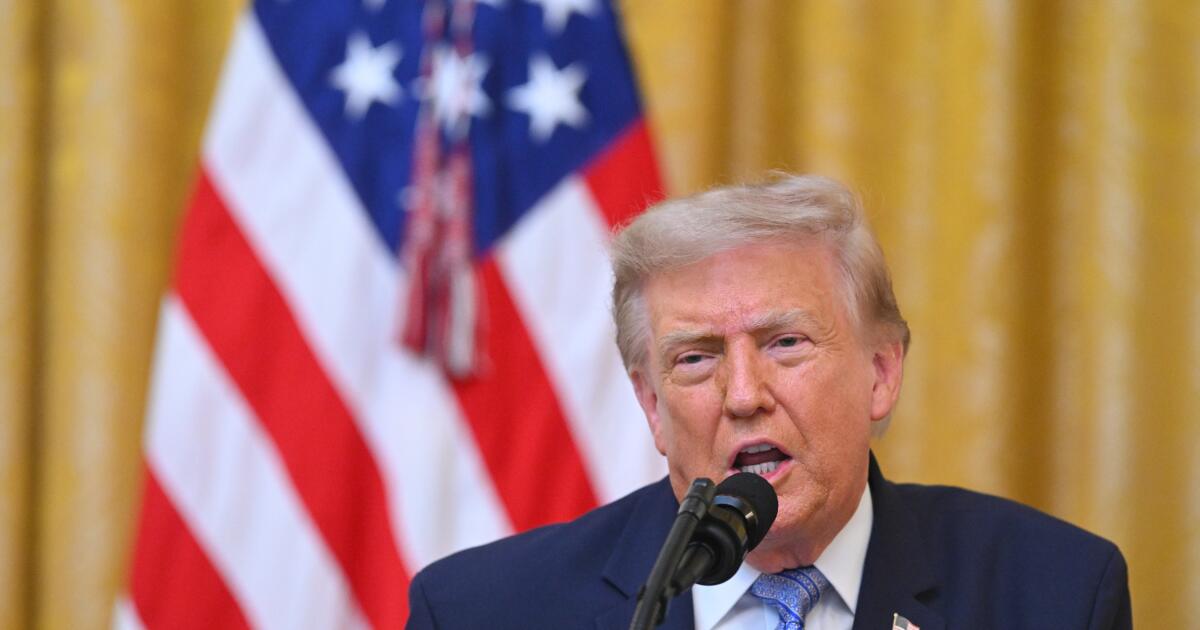
Trump repeats debunked claims about voting vulnerabilities in prime-time speech
-
 Science30 minutes ago
Bass administration quietly replaced chief heat officer a month ago
-
 Sports36 minutes ago
UCLA women embrace new players, tougher standards in bid to repeat as champs
-

 World48 minutes ago
China rebukes UK over nationalisation of British Steel
-
 News1 hour ago
Flood sirens blare in South Central Texas as rivers reach perilous heights
-

 Los Angeles, Ca3 hours ago
Arrest made in deadly shooting at 4th of July gathering in Compton; search for 2nd suspect continues

