Crypto
Crypto and Human Trafficking: 2026 Crypto Crime Report


TL;DR
- Cryptocurrency flows to suspected human trafficking services, largely based in Southeast Asia, grew 85% in 2025, reaching a scale of hundreds of millions across identified services.
- Telegram-based “international escort” services show sophisticated integration with Chinese-language money laundering networks (CMLNs) and guarantee platforms, with nearly half of transactions exceeding $10,000.
- Analysis reveals global reach of Southeast Asian trafficking operations, with significant cryptocurrency flows from destinations across the Americas, Europe, and Australia.
- CSAM networks have evolved to subscription-based models and show increasing overlap with sadistic online extremism (SOE) communities, while strategic use of U.S.-based infrastructure suggests sophisticated operational planning.
- Unlike cash transactions, cryptocurrency’s inherent transparency creates unprecedented opportunities for law enforcement and compliance teams to detect, track, and disrupt trafficking operations.
The intersection of cryptocurrency and suspected human trafficking intensified in 2025, with total transaction volume reaching hundreds of millions of dollars across identified services, an 85% year-over-year (YoY) increase. The dollar amounts significantly understate the human toll of these crimes, where the true cost is measured in lives impacted rather than money transferred.
This surge in cryptocurrency flows to suspected human trafficking services is not happening in isolation, but is closely aligned with the growth of Southeast Asia–based scam compounds, online casinos and gambling sites, and Chinese-language money laundering (CMLN) and guarantee networks operating largely via Telegram, all of which form a rapidly expanding local illicit ecosystem with global reach and impact. Unlike cash transactions that leave no trace, the transparency of blockchain technology provides unprecedented visibility into these operations, creating unique opportunities for detection and disruption that would be impossible with traditional payment methods.
Our analysis tracks four primary categories of suspected cryptocurrency-facilitated human trafficking:
- “International escort” services: Telegram-based services that are suspected to traffic in people
- “Labor placement” agents: Telegram-based services that facilitate kidnapping and forced labor for scam compounds
- Prostitution networks: suspected exploitative sexual service networks
- Child sexual abuse material (CSAM) vendors: networks of individuals engaged in the production and dissemination of CSAM
Payment methods vary significantly across these categories. While “international escort” services and prostitution networks operate almost exclusively using stablecoins, CSAM vendors have traditionally relied more heavily on bitcoin. However, even within CSAM operations, bitcoin’s dominance has decreased with the emergence of alternative Layer 1 networks. Broadly, the predominant use of stablecoins by “international escort” services and prostitution networks suggests that these entities prioritize payment stability and ease of conversion over the risks that these assets might be frozen by centralized issuers.
As we detail below, the “international escort” services are tightly integrated with Chinese-language money laundering networks. These networks rapidly facilitate the conversion of USD stablecoins into local currencies, potentially blunting concerns that assets held in stablecoins might be frozen.
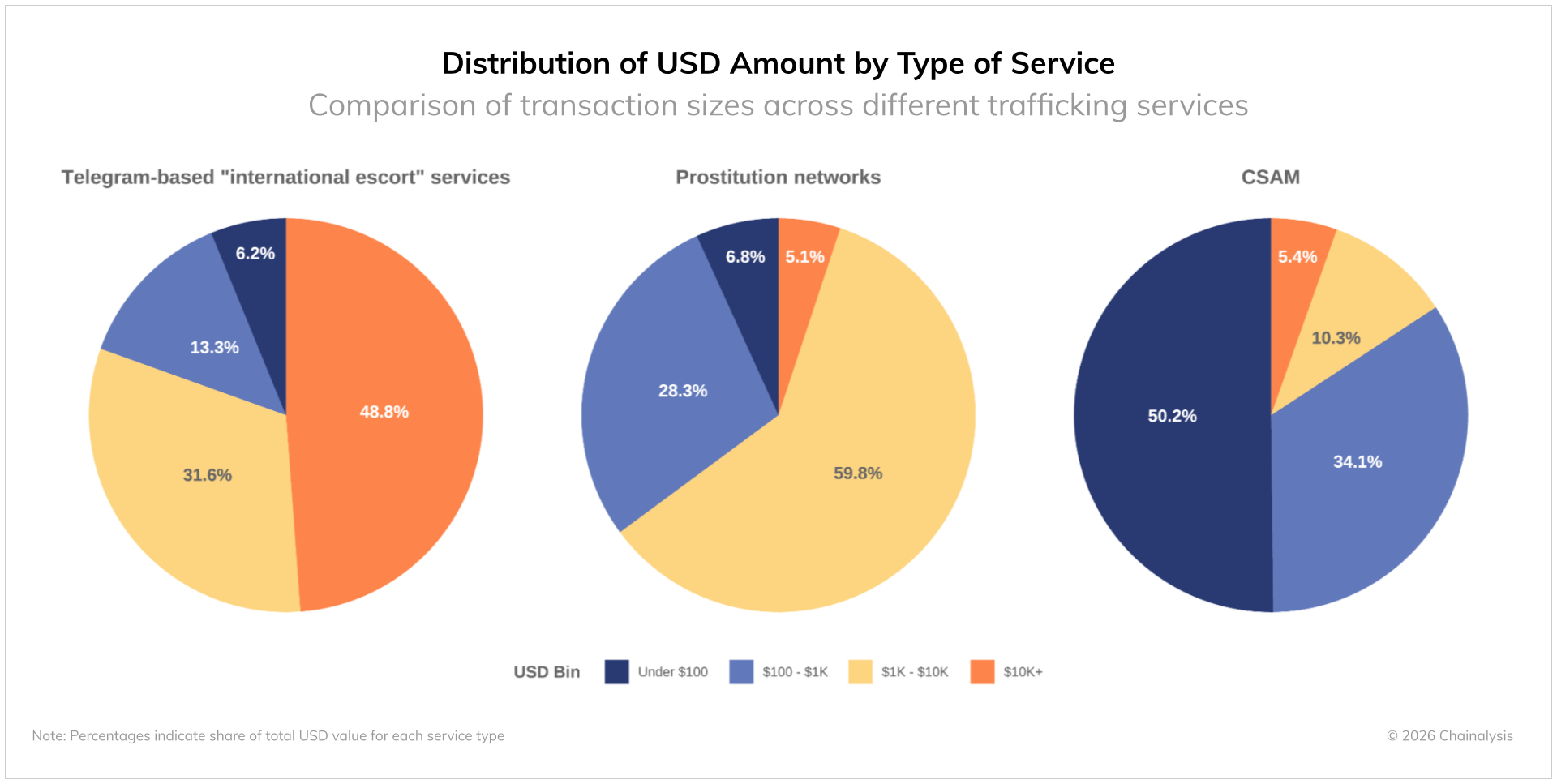
Nearly half of Telegram-based “international escort” service transactions exceed $10,000, demonstrating professionalized operations
The distribution of transaction sizes reveals distinct operational models across different types of suspected trafficking services. “International escort” services show the highest concentration of large transactions, with 48.8% of transfers exceeding $10,000, suggesting organized criminal enterprises operating at scale. In contrast, prostitution networks cluster in the mid-range, with approximately 62% of transactions between $1,000-$10,000, indicating potential agency-level operations.
These “international escort” services operate with sophisticated business models, complete with customer service protocols and structured pricing. For example, one prominent operation advertises across major East Asian cities with a tiered pricing system ranging from 3,000 RMB ($420) for hourly services to 8,000 RMB ($1,120) for extended arrangements, including international transport. These standardized pricing models create identifiable transaction patterns that investigators and compliance teams can use to detect suspicious activity at scale.

CSAM vendors and marketplaces
CSAM operations demonstrate different but equally concerning patterns. While approximately half of CSAM-related transactions are under $100 – unfortunately, there’s more CSAM on the internet than ever before, and it’s never been cheaper to produce – these operations have evolved sophisticated financial and distribution strategies. In 2025, we observed that, while these networks still collect payments in mainstream cryptocurrencies, they increasingly use Monero for laundering proceeds. Instant exchangers, which provide rapid and anonymous cryptocurrency swapping without KYC requirements, play a crucial role in this process.
The business model for CSAM operations has largely consolidated around subscription-based services rather than pay-per-content transactions, generating more predictable revenue streams while simplifying administration. These subscriptions typically cost less than $100 per month, creating a lower barrier to entry while establishing regular revenue for operators.
A disturbing trend emerged in 2025 with increasing overlap between CSAM networks and sadistic online extremism (SOE) communities. Following law enforcement actions against groups like “764” and “cvlt,” we observed SOE content appearing within CSAM subscription services, commonly advertised as “hurtcore.” These SOE groups specifically target and manipulate minors through sophisticated sextortion schemes, with the resulting content being monetized through cryptocurrency payments, perpetuating cycles of abuse.
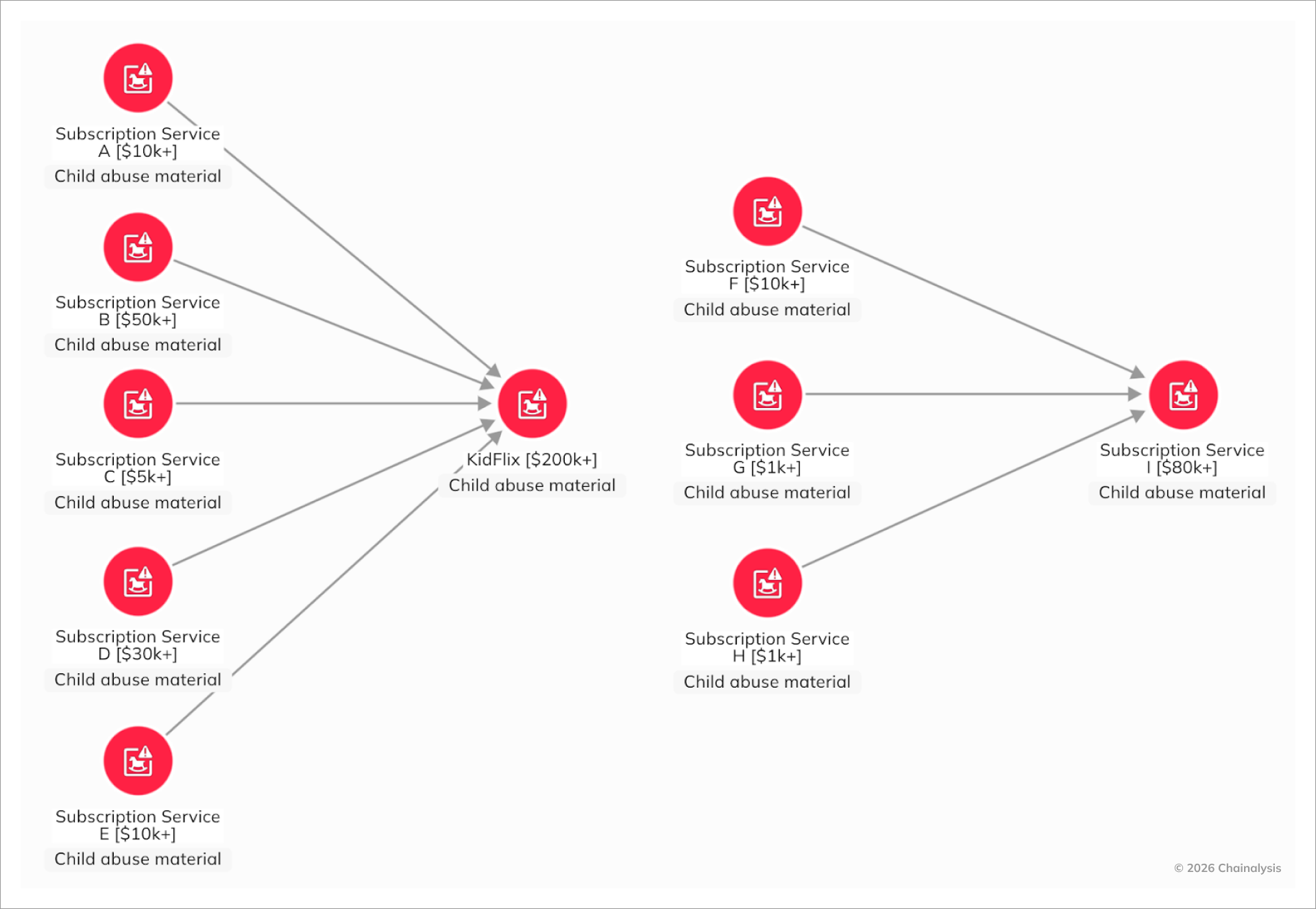
The scale of these operations became particularly evident in July 2025, when Chainalysis identified one of the largest CSAM websites operating on the darkweb following a UK law enforcement lead. This single operation utilized over 5,800 cryptocurrency addresses and generated more than $530,000 in revenue since July 2022, surpassing the notorious “Welcome to Video” case from 2019.
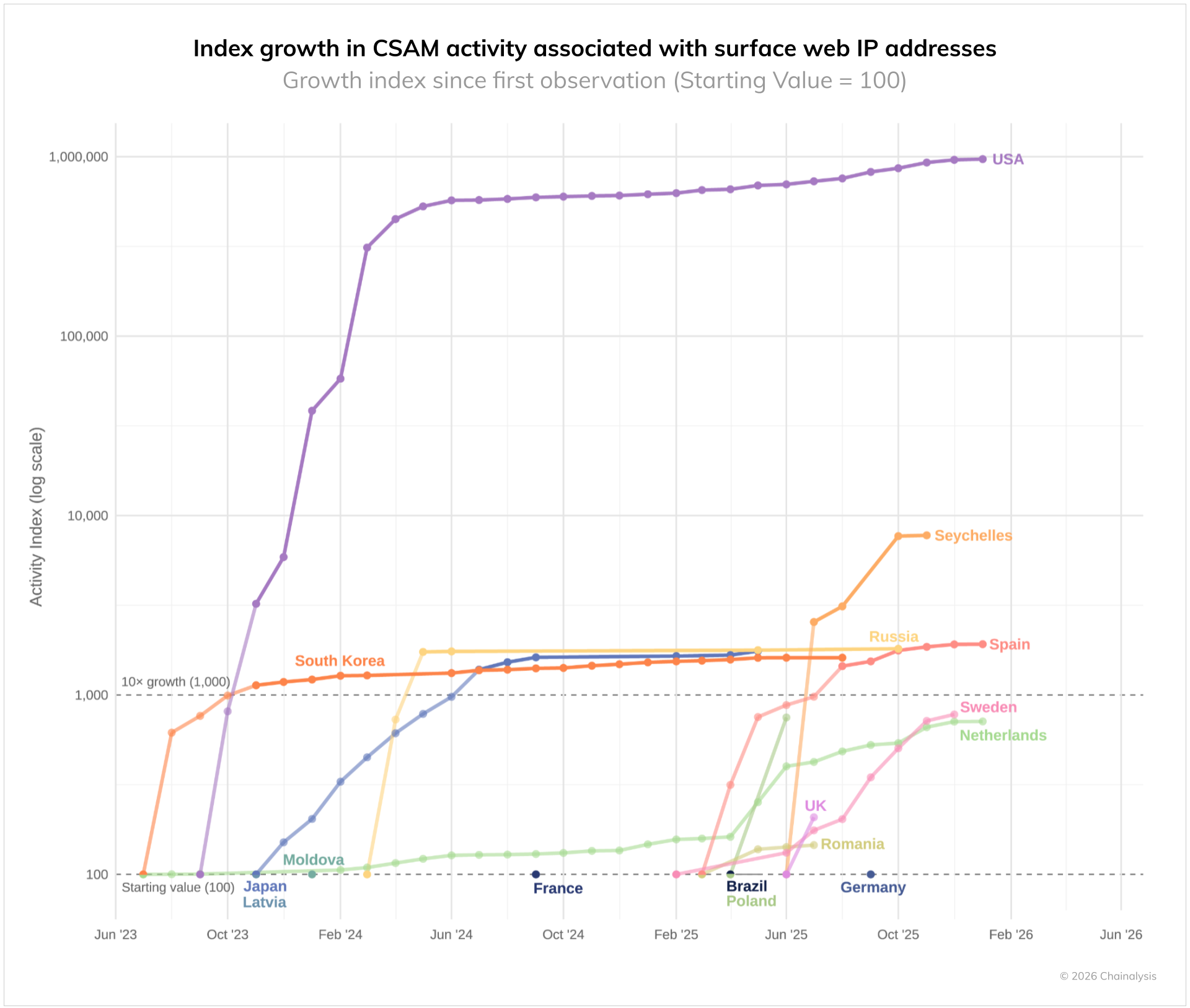
Geographic analysis of clearnet CSAM operations reveals strategic use of U.S. infrastructure [1]. While U.S.-based IP addresses account for a large portion of CSAM activity associated with surface websites, IPs from other countries like South Korea, Spain, and Russia show smaller flows. This suggests that these operations leverage U.S.-based infrastructure for scale, reliability, and an initial appearance of legitimacy that helps the activity blend into normal traffic and delays detection. Further, if the operators are outside the U.S., it reduces their personal exposure.
Chris Hughes, Internet Watch Foundation Hotline Director, told us, “In 2025, the Internet Watch Foundation identified 312,030 reports containing child sexual abuse images and videos. This is more than ever before, with an increase of 7% from the previous year. Early analysis of IWF data indicates that most clearweb sites offering virtual currency as a payment for child sexual abuse are hosted in the US, while darkweb sites were the second highest. Any payment information that we identify on commercial websites is captured and shared with global law enforcement and organisations like Chainalysis to disrupt further distribution of criminal imagery and to help in the investigation of those who create, share and profit from the sale of child sexual abuse material.”
Despite these concerning trends, 2025 saw significant law enforcement successes, including the takedown of “KidFlix” by German authorities and increased arrests of CSAM consumers across the United States. These cases demonstrate how blockchain analysis can provide critical evidence for identifying, investigating, and prosecuting both operators and consumers of CSAM networks.
Telegram-based services show deep integration with Chinese-language money laundering networks (CMLNs) and guarantee platforms
“International escort” services
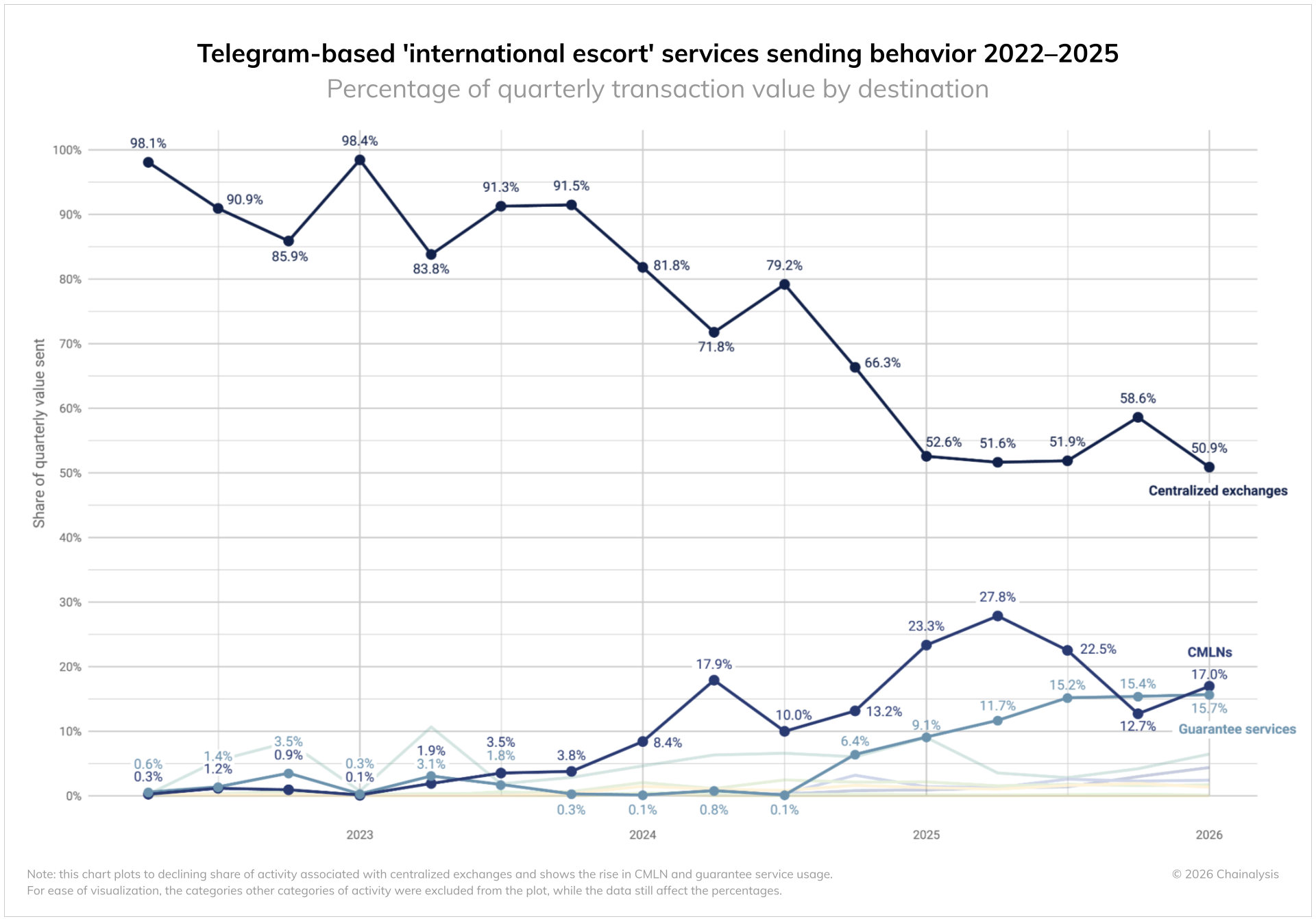
The cryptocurrency footprint of escort services reveals sophisticated integration with established financial infrastructure, particularly CMLNs and guarantee platforms. While some escort services operate legally, cryptocurrency transaction patterns help identify potential trafficking operations through their distinct financial behaviors.
The majority of cryptocurrency movements flow through a combination of mainstream exchanges, institutional platforms, and guarantee services like Tudou and Xinbi. This creates both vulnerabilities and opportunities: while these platforms provide easier access to the financial system, they also serve as critical chokepoints where compliance teams can detect and investigate suspicious patterns.
“Labor placement” agents
It’s been widely reported that scam operations — pig butchering schemes in particular — are deeply intertwined with human trafficking. Victims are often lured by fake job offers before being forced to work in Southeast Asian scam compounds, where they face brutal conditions and are coerced into operating romance/investment scams under threat of violence.
These operations utilize guarantee services’ “human resource” vendors to facilitate recruitment. Channel participants inquire about methods to transport workers who have been detained at immigration checkpoints, while compound administrators provide updates concerning regional developments that might affect their operations, such as the ongoing border tensions between Thailand and Cambodia.

Blockchain analysis shows that recruitment payments typically range from $1,000 to $10,000, aligning with advertised pricing tiers. This provides another opportunity to leverage identifiable transaction patterns to detect suspicious activity at scale. These agents maintain presence across multiple guarantee platforms to maximize their reach, with some operating through mainstream cryptocurrency exchanges.
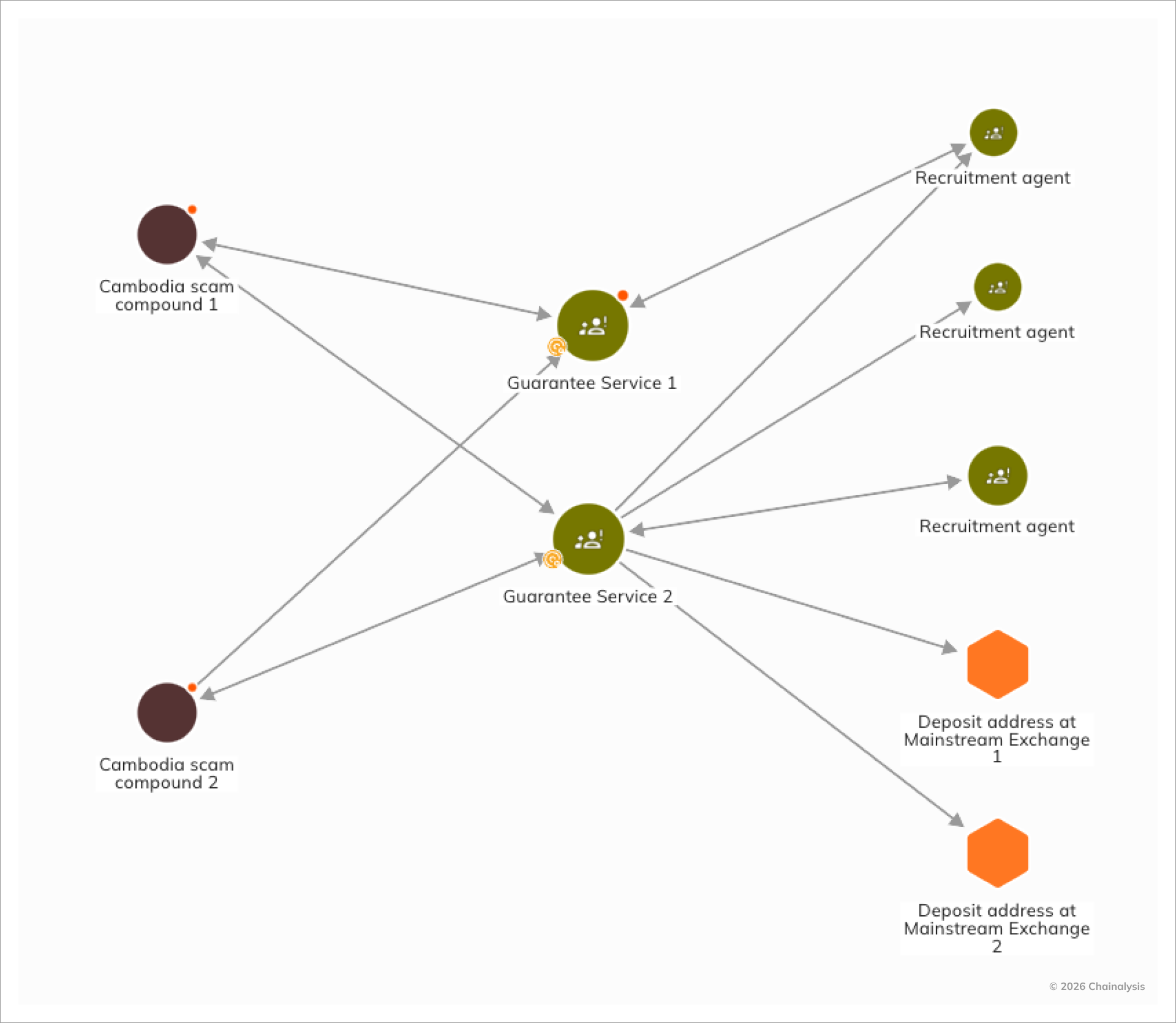
The involvement of established criminal organizations became evident through our analysis of trafficking-related channels. For example, we identified an administrator account linked to the “Fully Light Group,” a Kokang-based organization previously flagged by the United Nations Office on Drugs and Crime (UNODC) for illegal gambling and money laundering. Their presence in channels facilitating transactions between scam compounds and “labor placement” agents suggests how established criminal networks provide critical financial infrastructure for trafficking operations.

Southeast Asian organizations facilitating potential trafficking show global reach through cryptocurrency
Geographic analysis of “international escort” services in 2025 reveals how Southeast Asian services, particularly Chinese-language operations, have expanded their reach globally through cryptocurrency adoption [2]. The transparency of the blockchain provides valuable insight into broader trafficking patterns and financial flows of these types of operations.
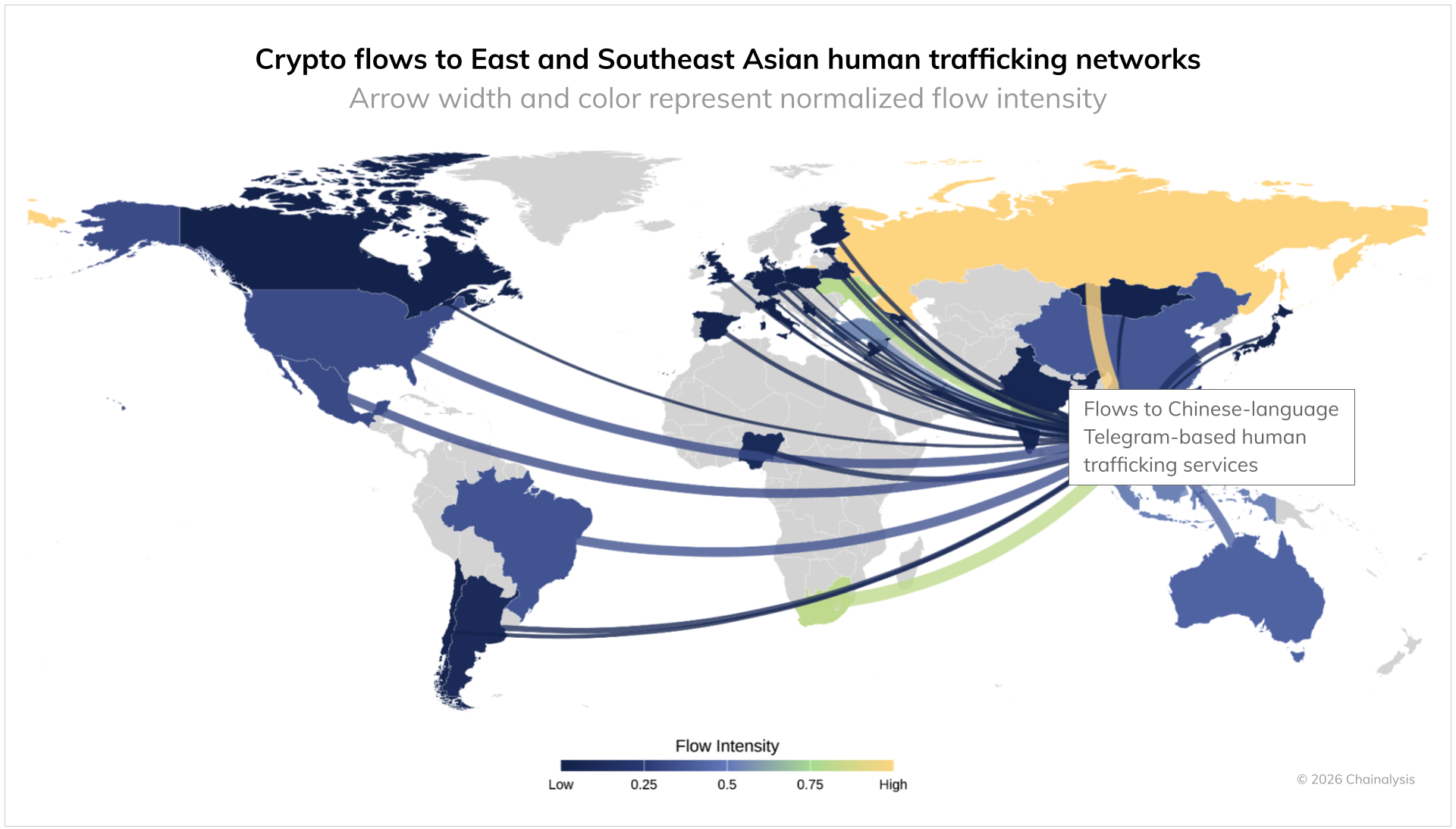
Based on our data, Chinese-language services operating through networks spanning mainland China, Hong Kong, Taiwan, and various Southeast Asian countries demonstrate sophisticated payment processing capabilities and extensive international reach. Their large-scale cryptocurrency transactions show significant flows from countries including Brazil, the United States, the United Kingdom, Spain, and Australia, indicating the truly global scope of these operations.
While traditional trafficking routes and patterns persist, these Southeast Asian services exemplify how cryptocurrency technology enables trafficking operations to facilitate payments and obscure money flows across borders more efficiently than ever before. The diversity of destination countries suggests these networks have developed sophisticated infrastructure for global operations.
Key risk indicators and monitoring strategies
While the sophistication of cryptocurrency-facilitated trafficking operations continues to grow, the transparent nature of blockchain technology provides powerful tools for detection and prevention. Our analysis has identified several key indicators that compliance teams and law enforcement can monitor:
- Large, regular payments to labor placement services paired with cross-border transactions
- High-volume transactions through guarantee platforms
- Wallet clusters showing activity across multiple categories of illicit services
- Regular stablecoin conversion patterns
- Concentrated fund flows to regions known for trafficking operations
- Connections to Telegram-based recruitment channels
The increasing sophistication of these operations, particularly their growing intersection with legitimate businesses and professional money laundering networks, requires a comprehensive monitoring approach that leverages blockchain analysis alongside traditional anti-trafficking efforts and public education. As these networks continue to evolve, the transparency of blockchain technology provides unprecedented opportunities for detection, disruption, and enforcement that would be impossible with traditional payment methods.
[1] This analysis is limited to the clearweb portion of the CSAM industry. A significant portion of CSAM transactions are conducted peer-to-peer through encrypted messaging apps or the darkweb, where reliable IP addresses can not be obtained for this analysis.
[2] This analysis involved a combination of signals to estimate the country of origin, including web traffic data and the use of regional crypto exchanges.
This website contains links to third-party sites that are not under the control of Chainalysis, Inc. or its affiliates (collectively “Chainalysis”). Access to such information does not imply association with, endorsement of, approval of, or recommendation by Chainalysis of the site or its operators, and Chainalysis is not responsible for the products, services, or other content hosted therein.
This material is for informational purposes only, and is not intended to provide legal, tax, financial, or investment advice. Recipients should consult their own advisors before making these types of decisions. Chainalysis has no responsibility or liability for any decision made or any other acts or omissions in connection with Recipient’s use of this material.
Chainalysis does not guarantee or warrant the accuracy, completeness, timeliness, suitability or validity of the information in this report and will not be responsible for any claim attributable to errors, omissions, or other inaccuracies of any part of such material.



Crypto
Morgan Stanley Targets Ethereum and Solana ETF Market Share Amid Intensifying Fee Competition

Key Takeaways
- Morgan Stanley’s ethereum and solana filings extend the bank’s proprietary crypto ETF strategy beyond its existing Bitcoin fund.
- The proposed pricing suggests crypto ETFs are shifting from product novelty toward competition for investor assets.
- Both trusts would include staking and institutional custody but remain preliminary offerings without confirmed launch dates.
Why the Crypto ETF Market May Be Entering a Commodity Phase
Morgan Stanley’s proposed ethereum and solana exchange-traded funds (ETFs) would enter a market where issuers increasingly offer similar exposure to the same assets. The firm recently amended both filings with the U.S. Securities and Exchange Commission (SEC) to include a 0.14% management fee, below Grayscale’s 0.15% and Franklin Templeton’s 0.19%. The narrow spread signals intensifying price competition.
Brian Rudick, chief strategy officer at Solana treasury company Upexi and formerly head of research at crypto trading firm and liquidity provider GSR, argued that the fee matters less than what it suggests about the market’s development. On July 9, he shared on X:
“Issuers don’t compete on price until the product is close to a commodity and the fight is for share, the same compression the spot BTC ETFs went through.”
“ SOL ETF AUM already crossed $1B, led by Bitwise’s BSOL, so there is real share to fight over,” he added.
The argument places the 0.14% fee within a shift from product creation to asset gathering. Once several issuers offer similar exposure, management costs become one of the clearest points of distinction. His comparison with spot bitcoin ETFs suggests ethereum and solana products may be entering the same phase of fee compression.
Bitwise launched its solana ETF, BSOL, on NYSE Arca in October 2025, marking the first U.S.-listed vehicle to provide direct exposure to spot SOL. The fund goes beyond simple price tracking by actively staking its holdings, allowing staking rewards to contribute to fund returns after applicable expenses.
How Morgan Stanley Designed the Ethereum and Solana Trusts
The Morgan Stanley Ethereum Trust would trade on NYSE Arca under the ticker MSSE and track the Coindesk Ether Benchmark 4PM NY Settlement Rate. Alongside its proposed 0.14% fee, Morgan Stanley Investment Management intends to stake 50% to 80% of the trust’s ether under normal conditions.
BNY and Coinbase Custody would hold the ethereum trust’s assets. Staking providers and custodians would receive an aggregate 5% of staking rewards, leaving the remainder with the trust. Net rewards would be distributed monthly, but at least quarterly, though the filing does not guarantee the amount.
The Morgan Stanley Solana Trust would trade on NYSE Arca under the ticker MSOL and track the Coindesk Solana Benchmark 4PM NY Settlement Rate. It would also carry a proposed 0.14% fee. The trust may stake up to 100% of its SOL while keeping some holdings unstaked for redemptions, expenses and distributions.
BNY and Coinbase Custody would also serve as custodians for MSOL. Staking providers and custodians would receive 5% of staking rewards, leaving 95% with the trust. Net rewards would be distributed monthly, but at least quarterly, while validator block rewards and transaction fees would not accrue to shareholders.
What Morgan Stanley’s Bitcoin ETF Shows About the Strategy
Morgan Stanley has already used the same fee level in its spot bitcoin product. The Morgan Stanley Bitcoin Trust began trading under the ticker MSBT on April 8, 2026, with a 0.14% annual management fee. That undercut Blackrock’s IBIT at 0.25% and Bitwise’s spot bitcoin ETF at 0.20%.
MSBT became the first proprietary spot cryptocurrency ETF launched under the name of a major U.S. commercial bank. As of July 10, 2026, it traded at $18.47 per share and held about $364.23 million in total net assets. Its debut ranked in the top 1% of ETF launches by volume and early adoption.
The proposed ETH and SOL funds remain preliminary, and shares cannot be sold until the registration statements become effective. No firm launch dates have been announced. SEC effectiveness and subsequent asset flows would show whether Morgan Stanley’s combination of low fees, staking income and bank-backed distribution can win market share.

The cryptocurrency market dynamics have been consistent over the years, with prices fluctuating in cycles and trends. Such a pattern triggers discussions among crypto community members, particularly key opinion leaders and experts who explore researched data and historical trends to predict the future.
Notably, the evolving nature of the Bitcoin ecosystem triggers sentiments that differ from the digital asset’s early days. Experts analyzing this new phase, alongside developments in alternative cryptocurrency ecosystems, are projecting the crypto market, leaving pointers of what users should expect.
Bitcoin is a Scarce Commodity
One such expert and key opinion leader is Samson Mow, CEO of Jan3, a blockchain project that aims to accelerate hyperbitcoinization. In a recent interview, Mow highlighted the scarcity of Bitcoin that many users have yet to recognize. According to Mow, most people still don’t get what true scarcity means.
🚨 BIG Bitcoin Scarcity Warning from @Excellion (SAMSON MOW, CEO of @JAN3com) 🚨 — COACHTY (@TheRealTRTalks) July 8, 2026
Most people still don’t get what true scarcity means.
“There’s so much demand right now — from $Strategy, ETFs, nation-states, and regular HODLers — that most of the year’s mined $BTC supply is… pic.twitter.com/i2v1BvUadC
The renowned Bitcoin expert explained that there is so much demand for Bitcoin from Michael Saylor’s Strategy, ETFs, nation-states, and regular HODLers. He noted that demand is so high that most of the year’s mined $BTC supply has already been taken up multiple times over.
Mow cited a pattern among many Bitcoiners who typically postpone buying $BTC during pullbacks, expecting that the price would drop further. He emphasized that “there is no later” with Bitcoin, predicting the price will return above $100,000 soon. According to Mow, every institution on earth wants a share of the 21 million Bitcoin supply, which would make the cryptocurrency more expensive in the future.
For context, BlackRock has reportedly resumed accumulating $BTC. After recording steady outflows for approximately two weeks, the asset manager reversed course by purchasing $250 million worth of Bitcoin over the past two days. Besides direct purchases, on-chain data show several $BTC transfers from Coinbase Prime to the IBIT BlackRock wallet, valued at around $17 million to $19 million.
BlackRock’s crypto asset holdings have crossed $50.3 billion, comprising 730,440 $BTC, equivalent to $45.52 billion, and 2.752 million $ETH worth $4.79 billion. According to experts, BlackRock’s crypto accumulation pattern indicates that institutional demand for $BTC and $ETH remains unabated.
Ethereum Remains in Demand
Popular crypto influencer, identified as Tanaka on X, aligns with the growing $ETH demand philosophy. Tanaka described the propagation of settlement layers, such as the Robinhood Chain and the Arbitrum Orbit, as clear examples of how TradFi can move on-chain via L2s. He noted that these solutions create scenarios that funnel into increased demand for $ETH.
Tanaka highlighted the recent surge in meme activity on these chains, noting that the solutions go beyond that, covering real-world assets (RWAs), stock tokens, lending, and DeFi. According to Tanaka, L2 activities settle back to Ethereum, $ETH gas creates demand for using the cryptocurrency, while stock tokens, such as NVDA, AAPL, and GOOG, are going on-chain, all boosting demand for $ETH.
Meanwhile, Tanaka cited a scenario that could create more demand for Ethereum—Robinhood onboarding retail TradFi into tokenized stocks and DeFi. According to him, that would be a very positive signal for $ETH. In the meantime, Ethereum is used as the settlement layer for RWA, DeFi, and traditional financial products.
It is worth noting that developments around the Robinhood Chain are not the only factors behind $ETH’s potential demand. Tanaka noted that, despite considering it a positive catalyst, $ETH still depends on $BTC, macro, ETF flows, and Ethereum upgrades to sustain its momentum and remain relevant in the cryptocurrency ecosystem.
The Latest Meme Coin Narrative
Besides Bitcoin and Ethereum, crypto experts consider the meme coins ecosystem another relevant sector of the crypto market, despite the changing dynamics. Zippy, a key opinion leader in the meme coin sector, stated that the lifecycle of meme narratives is getting shorter with every cycle. According to him, what used to last for days or even weeks now often fades within 24 hours.
Zippy noted that most meme tokens experience sharp corrections as soon as liquidity rotates elsewhere. He explained that the new pattern does not mean the meme market is over. Instead, it signifies that capital is rotating at a much faster pace, and rather than staying with one token, the market is constantly chasing the next story.
The meme coin opinion leader noted that the new ecosystem narrative has emerged with meme waves led by ecosystems attracting fresh liquidity rather than old narratives trying to recover. He identified Robinhood as one of the leading ecosystems currently drawing attention in the meme coin sector.
However, Zippy noted that timing matters as much as conviction in the current meme ecosystem dispensation. According to him, sometimes, knowing when to exit is more valuable than knowing when to buy.
Related:Bitcoin Scarcity Gets Real as 403K $BTC Leaves Exchanges
Crypto
Bitdeer Invests $36 Million in First US Sealminer Factory as Bitcoin Mining Margins Stay Tight

Key Takeaways
- Bitdeer is building a $36M Nevada plant to produce 10,000 Sealminer units monthly by 2026.
- Sealminer efficiency targets weak mining margins as hashprice stays near historic lows.
- Bitdeer is expanding U.S. manufacturing and AI infrastructure to strengthen long-term growth.
Bitdeer Targets 10,000 Monthly Sealminer Units With New $36 Million Nevada Factory
Bitdeer is moving ahead with a major U.S. manufacturing push, breaking ground on a $36 million advanced electronics facility in Sparks, Nevada, even as bitcoin mining economics remain near historic lows.
The 187,000-square-foot plant will be the company’s first domestic manufacturing and assembly site in the U.S. It is expected to be completed by the end of 2026 and is designed to produce 10,000 Sealminer units per month.
Bitdeer said the project will create about 70 local jobs across engineering, skilled technician and support roles. The facility will expand the company’s U.S. footprint beyond mining and data centers, adding a domestic production base for its proprietary mining machines.
“Producing our advanced Sealminer units right here in Nevada reflects our long-term commitment to building capacity and nurturing the talent necessary to support our growing digital infrastructure operations in America,” remarked Paul Hanson, Chairman of Bitdeer Industrial.
Vertical Integration During a Mining Slump
The timing is notable. Bitcoin miners are still dealing with weak hashprice, a key measure of mining revenue per unit of computing power.
Spot hashprice was recently around $29.81 per PH/s/day, after touching a daily low of $27.89 on Feb. 24. March also marked a record-low monthly average of $31.27, according to industry data.
The pressure reflects several factors: the April 2024 halving, rising network hashrate, and low transaction-fee revenue. Together, they have reduced revenue for miners using the same amount of computing power.
At these levels, profitability is increasingly concentrated among operators with cheap power and newer, more efficient machines.
Bitdeer is trying to address that pressure through vertical integration. The company has been developing its own Sealminer hardware and deploying the machines across its self-mining fleet.
Catherine Guo, CEO of Bitdeer Industrial, commented that the Sparks plant reflects the company’s contribution to Nevada’s diversifying economy.
“Our commitment underscores the state’s strategic advantages, including a highly accessible and skilled workforce, robust logistics networks, and a consistently business-friendly environment,” Guo said.
U.S. Expansion Meets AI Demand
The Nevada facility will complement Bitdeer’s existing U.S. data centers and its innovation hub in San Jose, California.
The project also comes as Bitdeer expands across mining and AI infrastructure. In its May operating update, the company reported 70.2 EH/s of self-mining hashrate, 921 bitcoin mined during the month, and about $69 million of annualized recurring revenue from its AI Cloud business.
Bitdeer also said it was in advanced talks with a potential colocation tenant at its Tydal, Norway site. That follows a broader industry trend in which miners are exploring AI and high-performance computing uses for power-rich data center assets.
The facility is expected to begin contributing to Bitdeer’s manufacturing capacity as the mining hardware market becomes more selective. Weak hashprice can slow equipment demand, but it can also push well-capitalized miners to replace older machines with more efficient models.
-

 North Dakota2 minutes ago
West Fargo attorney named to North Dakota Ethics Commission
-

 Ohio10 minutes ago
Struggling Ohio county seeks funds to care for 16 kids rescued from squalor and prosecute their family
-

 Oklahoma12 minutes ago
Martha Lillard, last US polio patient using iron lung, dies at 78 in Oklahoma
-

 Oregon18 minutes ago
Greater Idaho effort seeks federal help as Oregon lawmakers keep border plan stalled
-

 Pennsylvania25 minutes ago
GALLERY | The best of Big Boy in central Pennsylvania
-

 Rhode Island27 minutes ago
How did Jake Bauer win the 2026 State Amateur? With an all-time comeback
-

 South-Carolina32 minutes ago
South Carolina sees second straight year of declining overdose deaths
-

 South Dakota40 minutes ago
MN officials warn dogs adopted from South Dakota show ‘high prevalence of canine brucellosis’

