Crypto
Crypto and Human Trafficking: 2026 Crypto Crime Report


TL;DR
- Cryptocurrency flows to suspected human trafficking services, largely based in Southeast Asia, grew 85% in 2025, reaching a scale of hundreds of millions across identified services.
- Telegram-based “international escort” services show sophisticated integration with Chinese-language money laundering networks (CMLNs) and guarantee platforms, with nearly half of transactions exceeding $10,000.
- Analysis reveals global reach of Southeast Asian trafficking operations, with significant cryptocurrency flows from destinations across the Americas, Europe, and Australia.
- CSAM networks have evolved to subscription-based models and show increasing overlap with sadistic online extremism (SOE) communities, while strategic use of U.S.-based infrastructure suggests sophisticated operational planning.
- Unlike cash transactions, cryptocurrency’s inherent transparency creates unprecedented opportunities for law enforcement and compliance teams to detect, track, and disrupt trafficking operations.
The intersection of cryptocurrency and suspected human trafficking intensified in 2025, with total transaction volume reaching hundreds of millions of dollars across identified services, an 85% year-over-year (YoY) increase. The dollar amounts significantly understate the human toll of these crimes, where the true cost is measured in lives impacted rather than money transferred.
This surge in cryptocurrency flows to suspected human trafficking services is not happening in isolation, but is closely aligned with the growth of Southeast Asia–based scam compounds, online casinos and gambling sites, and Chinese-language money laundering (CMLN) and guarantee networks operating largely via Telegram, all of which form a rapidly expanding local illicit ecosystem with global reach and impact. Unlike cash transactions that leave no trace, the transparency of blockchain technology provides unprecedented visibility into these operations, creating unique opportunities for detection and disruption that would be impossible with traditional payment methods.
Our analysis tracks four primary categories of suspected cryptocurrency-facilitated human trafficking:
- “International escort” services: Telegram-based services that are suspected to traffic in people
- “Labor placement” agents: Telegram-based services that facilitate kidnapping and forced labor for scam compounds
- Prostitution networks: suspected exploitative sexual service networks
- Child sexual abuse material (CSAM) vendors: networks of individuals engaged in the production and dissemination of CSAM
Payment methods vary significantly across these categories. While “international escort” services and prostitution networks operate almost exclusively using stablecoins, CSAM vendors have traditionally relied more heavily on bitcoin. However, even within CSAM operations, bitcoin’s dominance has decreased with the emergence of alternative Layer 1 networks. Broadly, the predominant use of stablecoins by “international escort” services and prostitution networks suggests that these entities prioritize payment stability and ease of conversion over the risks that these assets might be frozen by centralized issuers.
As we detail below, the “international escort” services are tightly integrated with Chinese-language money laundering networks. These networks rapidly facilitate the conversion of USD stablecoins into local currencies, potentially blunting concerns that assets held in stablecoins might be frozen.
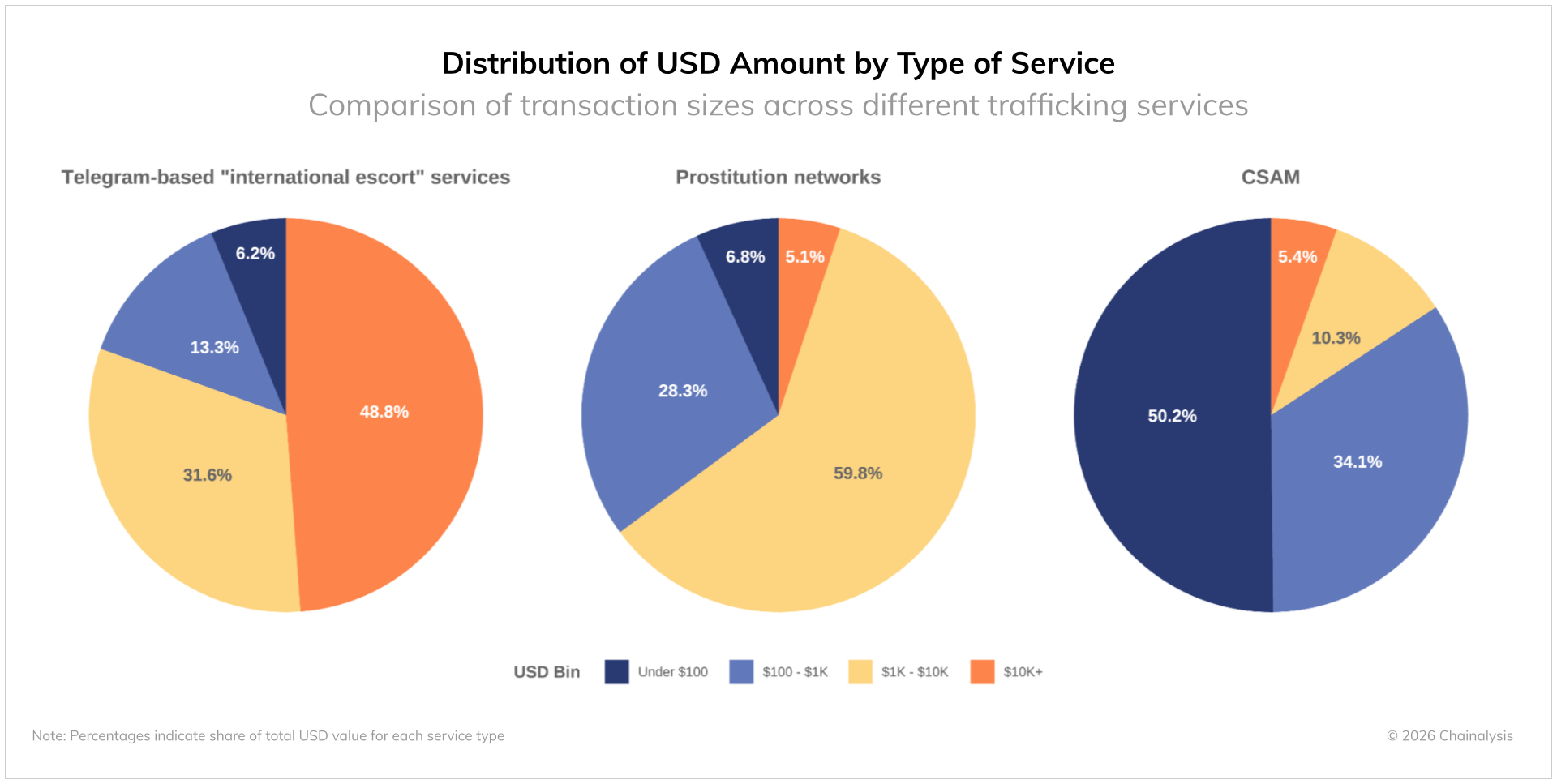
Nearly half of Telegram-based “international escort” service transactions exceed $10,000, demonstrating professionalized operations
The distribution of transaction sizes reveals distinct operational models across different types of suspected trafficking services. “International escort” services show the highest concentration of large transactions, with 48.8% of transfers exceeding $10,000, suggesting organized criminal enterprises operating at scale. In contrast, prostitution networks cluster in the mid-range, with approximately 62% of transactions between $1,000-$10,000, indicating potential agency-level operations.
These “international escort” services operate with sophisticated business models, complete with customer service protocols and structured pricing. For example, one prominent operation advertises across major East Asian cities with a tiered pricing system ranging from 3,000 RMB ($420) for hourly services to 8,000 RMB ($1,120) for extended arrangements, including international transport. These standardized pricing models create identifiable transaction patterns that investigators and compliance teams can use to detect suspicious activity at scale.

CSAM vendors and marketplaces
CSAM operations demonstrate different but equally concerning patterns. While approximately half of CSAM-related transactions are under $100 – unfortunately, there’s more CSAM on the internet than ever before, and it’s never been cheaper to produce – these operations have evolved sophisticated financial and distribution strategies. In 2025, we observed that, while these networks still collect payments in mainstream cryptocurrencies, they increasingly use Monero for laundering proceeds. Instant exchangers, which provide rapid and anonymous cryptocurrency swapping without KYC requirements, play a crucial role in this process.
The business model for CSAM operations has largely consolidated around subscription-based services rather than pay-per-content transactions, generating more predictable revenue streams while simplifying administration. These subscriptions typically cost less than $100 per month, creating a lower barrier to entry while establishing regular revenue for operators.
A disturbing trend emerged in 2025 with increasing overlap between CSAM networks and sadistic online extremism (SOE) communities. Following law enforcement actions against groups like “764” and “cvlt,” we observed SOE content appearing within CSAM subscription services, commonly advertised as “hurtcore.” These SOE groups specifically target and manipulate minors through sophisticated sextortion schemes, with the resulting content being monetized through cryptocurrency payments, perpetuating cycles of abuse.
The scale of these operations became particularly evident in July 2025, when Chainalysis identified one of the largest CSAM websites operating on the darkweb following a UK law enforcement lead. This single operation utilized over 5,800 cryptocurrency addresses and generated more than $530,000 in revenue since July 2022, surpassing the notorious “Welcome to Video” case from 2019.
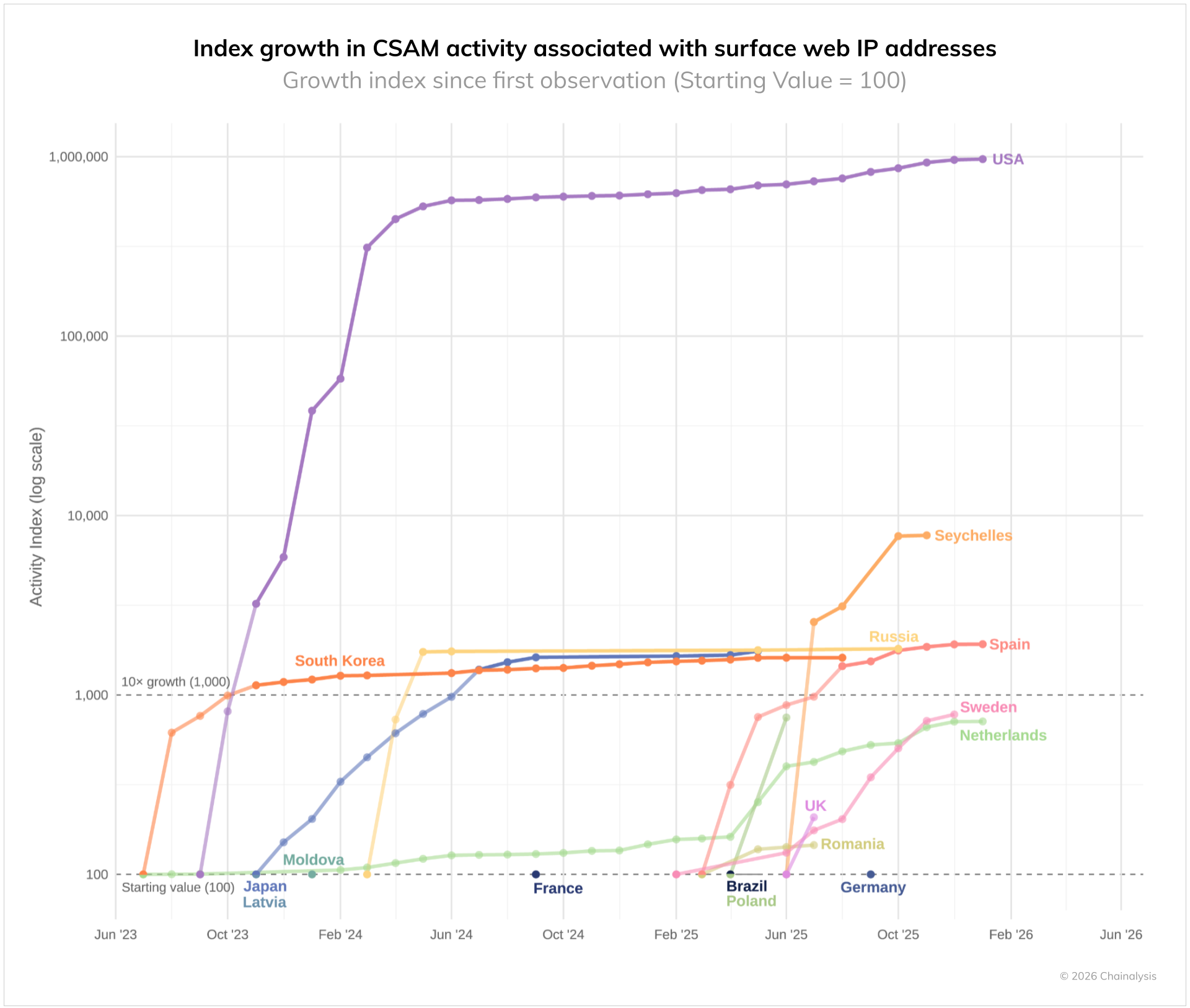
Geographic analysis of clearnet CSAM operations reveals strategic use of U.S. infrastructure [1]. While U.S.-based IP addresses account for a large portion of CSAM activity associated with surface websites, IPs from other countries like South Korea, Spain, and Russia show smaller flows. This suggests that these operations leverage U.S.-based infrastructure for scale, reliability, and an initial appearance of legitimacy that helps the activity blend into normal traffic and delays detection. Further, if the operators are outside the U.S., it reduces their personal exposure.
Chris Hughes, Internet Watch Foundation Hotline Director, told us, “In 2025, the Internet Watch Foundation identified 312,030 reports containing child sexual abuse images and videos. This is more than ever before, with an increase of 7% from the previous year. Early analysis of IWF data indicates that most clearweb sites offering virtual currency as a payment for child sexual abuse are hosted in the US, while darkweb sites were the second highest. Any payment information that we identify on commercial websites is captured and shared with global law enforcement and organisations like Chainalysis to disrupt further distribution of criminal imagery and to help in the investigation of those who create, share and profit from the sale of child sexual abuse material.”
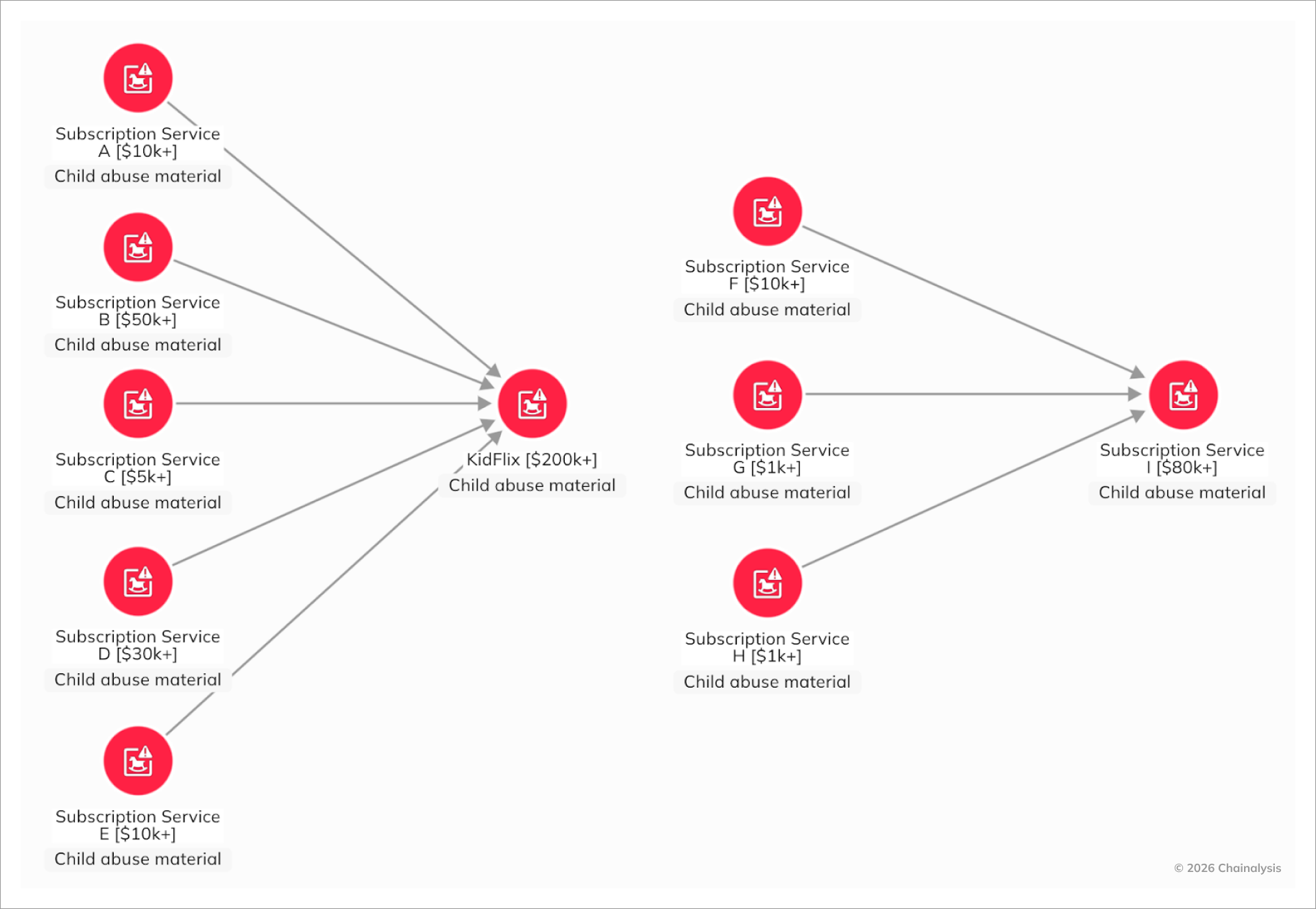
Despite these concerning trends, 2025 saw significant law enforcement successes, including the takedown of “KidFlix” by German authorities and increased arrests of CSAM consumers across the United States. These cases demonstrate how blockchain analysis can provide critical evidence for identifying, investigating, and prosecuting both operators and consumers of CSAM networks.
Telegram-based services show deep integration with Chinese-language money laundering networks (CMLNs) and guarantee platforms
“International escort” services
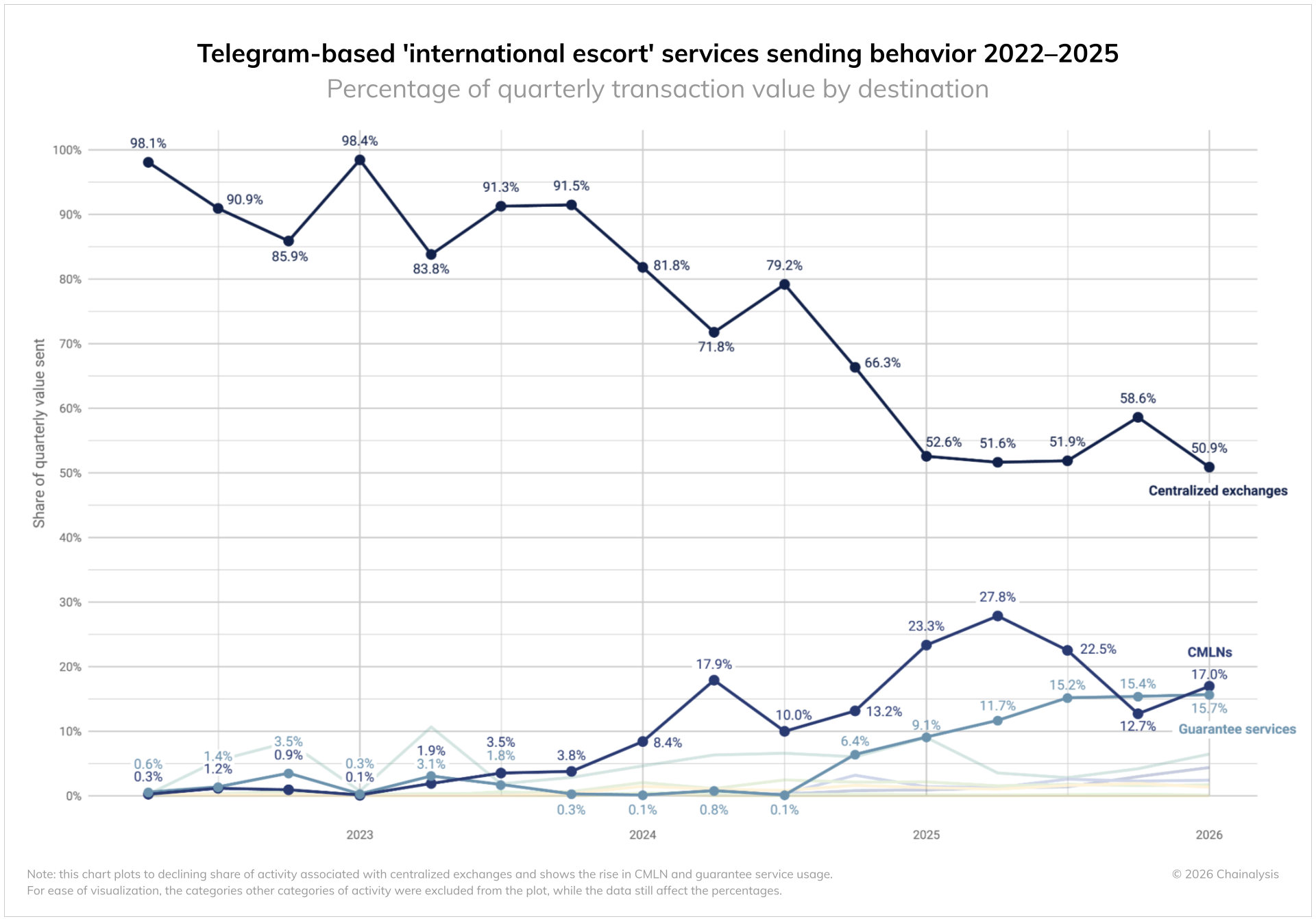
The cryptocurrency footprint of escort services reveals sophisticated integration with established financial infrastructure, particularly CMLNs and guarantee platforms. While some escort services operate legally, cryptocurrency transaction patterns help identify potential trafficking operations through their distinct financial behaviors.
The majority of cryptocurrency movements flow through a combination of mainstream exchanges, institutional platforms, and guarantee services like Tudou and Xinbi. This creates both vulnerabilities and opportunities: while these platforms provide easier access to the financial system, they also serve as critical chokepoints where compliance teams can detect and investigate suspicious patterns.
“Labor placement” agents
It’s been widely reported that scam operations — pig butchering schemes in particular — are deeply intertwined with human trafficking. Victims are often lured by fake job offers before being forced to work in Southeast Asian scam compounds, where they face brutal conditions and are coerced into operating romance/investment scams under threat of violence.
These operations utilize guarantee services’ “human resource” vendors to facilitate recruitment. Channel participants inquire about methods to transport workers who have been detained at immigration checkpoints, while compound administrators provide updates concerning regional developments that might affect their operations, such as the ongoing border tensions between Thailand and Cambodia.

Blockchain analysis shows that recruitment payments typically range from $1,000 to $10,000, aligning with advertised pricing tiers. This provides another opportunity to leverage identifiable transaction patterns to detect suspicious activity at scale. These agents maintain presence across multiple guarantee platforms to maximize their reach, with some operating through mainstream cryptocurrency exchanges.
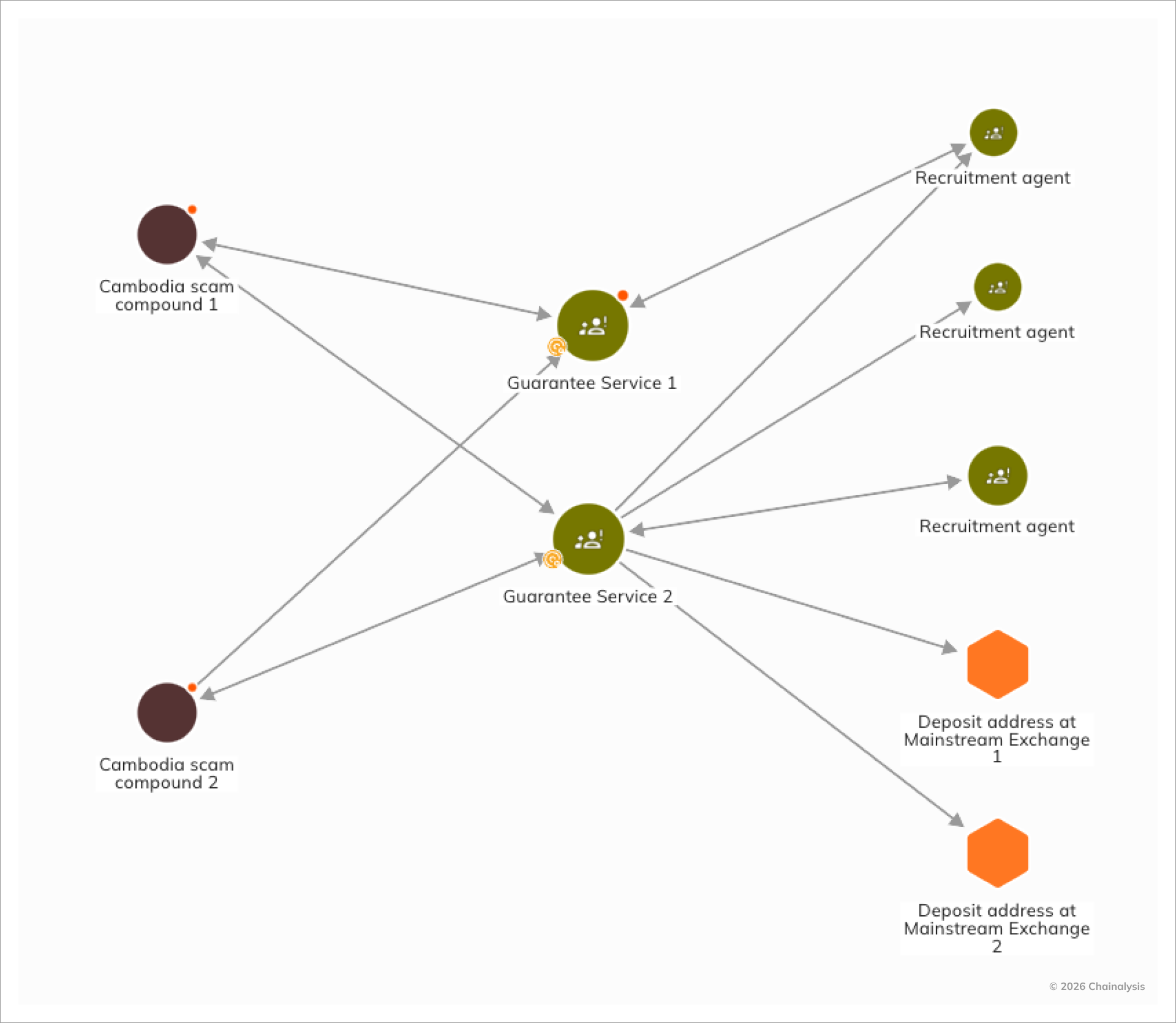
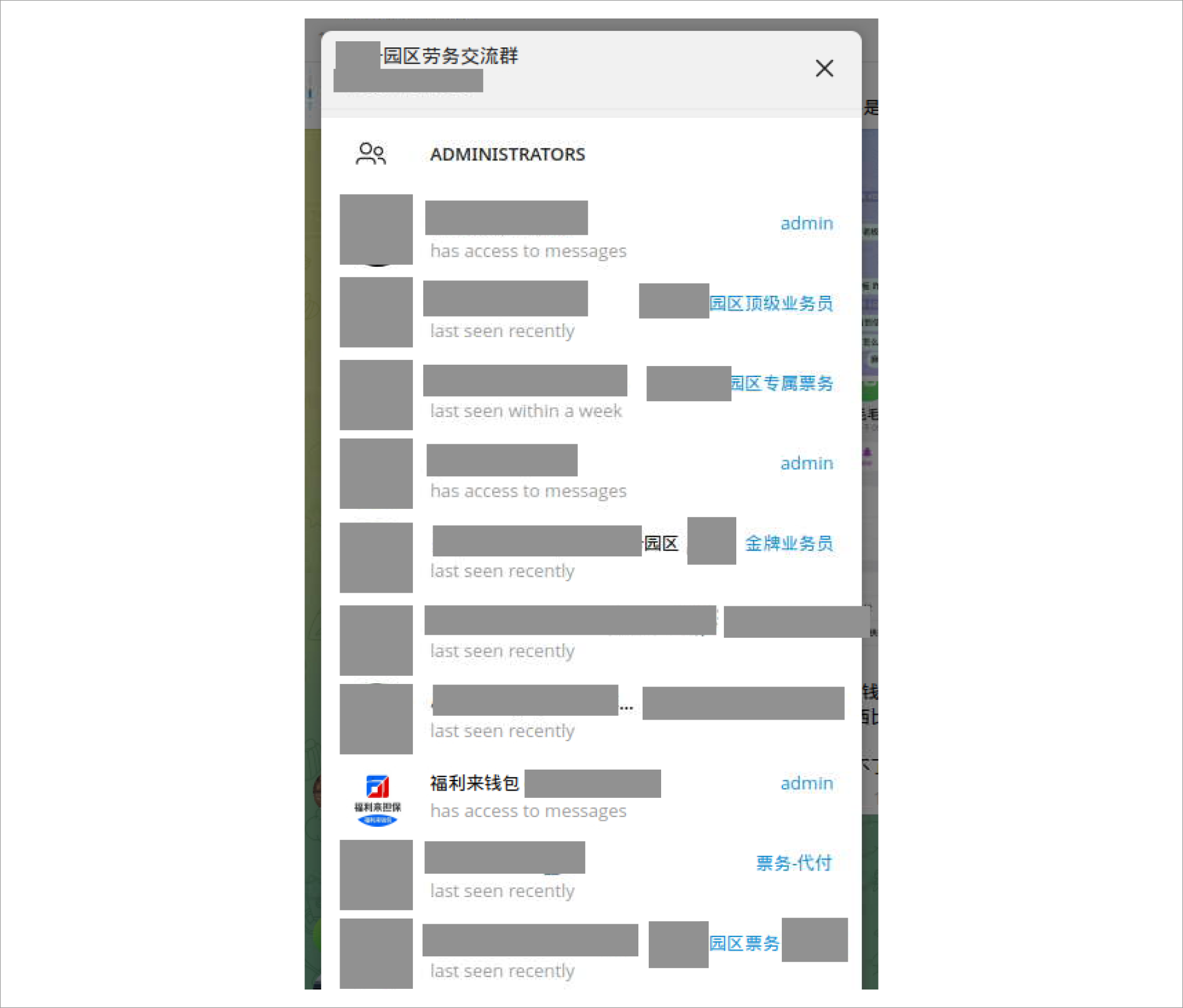
The involvement of established criminal organizations became evident through our analysis of trafficking-related channels. For example, we identified an administrator account linked to the “Fully Light Group,” a Kokang-based organization previously flagged by the United Nations Office on Drugs and Crime (UNODC) for illegal gambling and money laundering. Their presence in channels facilitating transactions between scam compounds and “labor placement” agents suggests how established criminal networks provide critical financial infrastructure for trafficking operations.
Southeast Asian organizations facilitating potential trafficking show global reach through cryptocurrency
Geographic analysis of “international escort” services in 2025 reveals how Southeast Asian services, particularly Chinese-language operations, have expanded their reach globally through cryptocurrency adoption [2]. The transparency of the blockchain provides valuable insight into broader trafficking patterns and financial flows of these types of operations.
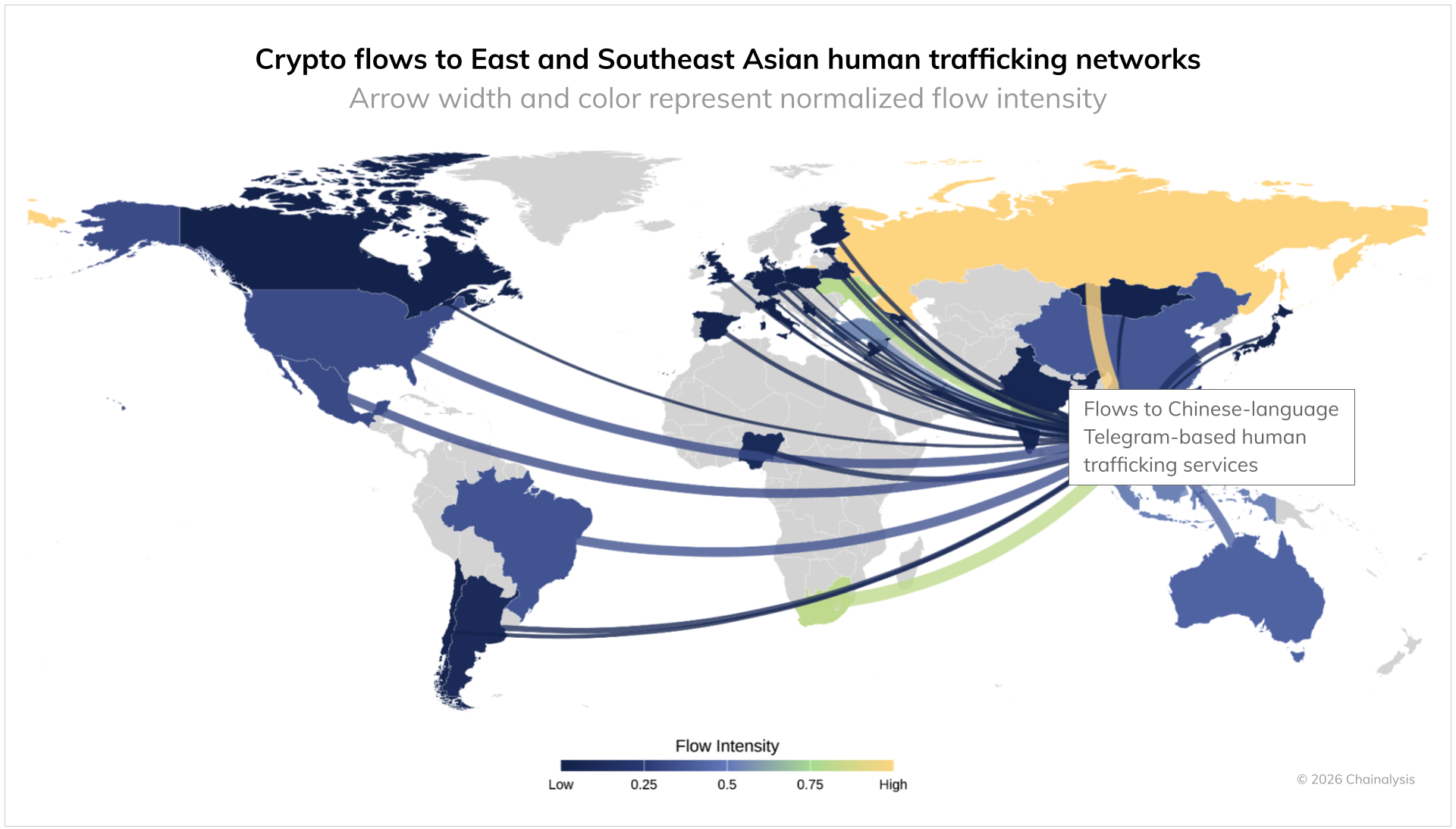
Based on our data, Chinese-language services operating through networks spanning mainland China, Hong Kong, Taiwan, and various Southeast Asian countries demonstrate sophisticated payment processing capabilities and extensive international reach. Their large-scale cryptocurrency transactions show significant flows from countries including Brazil, the United States, the United Kingdom, Spain, and Australia, indicating the truly global scope of these operations.
While traditional trafficking routes and patterns persist, these Southeast Asian services exemplify how cryptocurrency technology enables trafficking operations to facilitate payments and obscure money flows across borders more efficiently than ever before. The diversity of destination countries suggests these networks have developed sophisticated infrastructure for global operations.
Key risk indicators and monitoring strategies
While the sophistication of cryptocurrency-facilitated trafficking operations continues to grow, the transparent nature of blockchain technology provides powerful tools for detection and prevention. Our analysis has identified several key indicators that compliance teams and law enforcement can monitor:
- Large, regular payments to labor placement services paired with cross-border transactions
- High-volume transactions through guarantee platforms
- Wallet clusters showing activity across multiple categories of illicit services
- Regular stablecoin conversion patterns
- Concentrated fund flows to regions known for trafficking operations
- Connections to Telegram-based recruitment channels
The increasing sophistication of these operations, particularly their growing intersection with legitimate businesses and professional money laundering networks, requires a comprehensive monitoring approach that leverages blockchain analysis alongside traditional anti-trafficking efforts and public education. As these networks continue to evolve, the transparency of blockchain technology provides unprecedented opportunities for detection, disruption, and enforcement that would be impossible with traditional payment methods.
[1] This analysis is limited to the clearweb portion of the CSAM industry. A significant portion of CSAM transactions are conducted peer-to-peer through encrypted messaging apps or the darkweb, where reliable IP addresses can not be obtained for this analysis.
[2] This analysis involved a combination of signals to estimate the country of origin, including web traffic data and the use of regional crypto exchanges.
This website contains links to third-party sites that are not under the control of Chainalysis, Inc. or its affiliates (collectively “Chainalysis”). Access to such information does not imply association with, endorsement of, approval of, or recommendation by Chainalysis of the site or its operators, and Chainalysis is not responsible for the products, services, or other content hosted therein.
This material is for informational purposes only, and is not intended to provide legal, tax, financial, or investment advice. Recipients should consult their own advisors before making these types of decisions. Chainalysis has no responsibility or liability for any decision made or any other acts or omissions in connection with Recipient’s use of this material.
Chainalysis does not guarantee or warrant the accuracy, completeness, timeliness, suitability or validity of the information in this report and will not be responsible for any claim attributable to errors, omissions, or other inaccuracies of any part of such material.



Key Takeaways:
- Arthur Hayes ties bitcoin’s outlook to global liquidity, with upside dependent on policy-driven liquidity.
- Geopolitics create a bearish setup as war risk, deleveraging, and AI-driven stress weigh on markets.
- Liquidity injections could lift bitcoin once credit stress forces intervention.
Bitcoin Outlook Hinges on Liquidity
Arthur Hayes’ latest market note, titled “No Trade Zone,” signals that bitcoin’s outlook is increasingly tied to global liquidity conditions rather than traditional macro indicators. On April 15, the Bitmex co-founder and Maelstrom CIO outlined a cautious stance, citing geopolitical tensions and artificial intelligence-driven economic risks as key constraints. The essay presents BTC as vulnerable in the short term but positioned to respond to future monetary expansion.
Hayes centered his outlook on monetary conditions rather than conventional valuation models. He asked, “Do you believe the quantity or the price of money is more important when valuing bitcoin?” He then answered with a direct thesis:
“I believe the quantity of money determines the price of bitcoin, not its price.”
That view underpins his broader market framework, which expects bitcoin to struggle during periods of forced deleveraging, then strengthen when policymakers expand credit. He tied that dynamic to several geopolitical outcomes involving the Strait of Hormuz, as well as to a domestic economic slowdown driven by job losses among white-collar workers. In Hayes’ view, those pressures could hit credit quality, weigh on banks, and delay any durable crypto rally until authorities supply fresh liquidity to stabilize the system.
War Risk and Credit Stress Threaten Rally
That caution appears clearly in one of the essay’s most specific forecasts. “ Bitcoin might bounce a bit after the situation reverts to the pre-war status quo,” Hayes wrote. “However, the AI agentic deflation bomb still ticks below the surface. Until the Fed provides the liquidity needed to plug the black hole in banks’ balance sheets caused by consumer credit defaults, bitcoin will not meaningfully rise.” He further shared:
“That’s not to say it couldn’t spike to $80,000 to $90,000, but for me putting new units of fiat at risk requires an all-clear from the Fed.”
The statement shows that he still sees upside potential, but not before broader financial stress is addressed.
Hayes also warned that market stress could produce another sharp bitcoin selloff before any recovery takes hold. “As investors de-risk their portfolios because of higher volatility and lower prices, investors sell bitcoin to meet margin calls,” he described, adding: “Only when things get bad enough will bitcoin rise, as expectations of a bailout become the consensus.” In the most extreme scenario, even a liquidity-fueled rally may not last. As Hayes put it: “The rally in bitcoin, inspired by money printing, might be short-lived because the destruction of the Iranian state materially raises the prospect of WW3.” Taken together, the essay presents a conditional forecast: near-term volatility remains high, while any lasting upside still depends on crisis-era money creation.

Key Takeaways:
- Chainalysis flags Grinex swaps as inconsistent with typical law enforcement seizures.
- Tron-based conversions show illicit actors avoiding stablecoin issuer intervention.
- Grinex activity does not clearly align with patterns of a conventional external hack.
Grinex Shutdown Raises Questions About Crypto Laundering Tactics
Sanctions pressure continues to test the resilience of crypto networks tied to restricted financial activity. Blockchain intelligence firm Chainalysis on April 17 examined Grinex after the sanctioned exchange suspended operations. The review described the shutdown as a new stress point for infrastructure tied to sanctions evasion.
Grinex claimed a cyberattack cost about 1 billion rubles, or $13.7 million, and published the source and destination addresses involved. Chainalysis then assessed the transfers using on-chain data rather than relying on the exchange’s narrative. The analysis found that the stolen assets were mainly a fiat-backed stablecoin before being moved through a Tron-based decentralized exchange into TRX.
“In the case of the alleged Grinex hack, the stablecoin funds were quickly swapped for a non-freezable token, thereby avoiding the risk of having the stablecoins frozen by the issuer,” the blockchain analytics firm stated, adding:
“This frantic swapping from stablecoins to more decentralized tokens is a hallmark tactic of cybercriminals and illicit actors attempting to launder funds before a centralized freeze can be executed.”
Chainalysis argued that this behavior does not fit a typical Western law enforcement seizure because authorities can request freezes from centralized stablecoin issuers. The firm instead said the rapid conversion raises questions about whether the activity aligns with a conventional external hack.
Shadow Crypto Economy Shows Deep Interconnected Structure
Those conclusions rest on more than the attack claim alone. Chainalysis noted that the decentralized exchange used in the swap had previously served Garantex, the sanctioned predecessor to Grinex, as a liquidity source for hot wallets. That detail is notable because Chainalysis has already described Grinex as the direct successor to Garantex after international enforcement disrupted the earlier platform. The company also tied Grinex to A7A5, a ruble-backed token issued by sanctioned Kyrgyzstani company Old Vector.
According to the analysis, A7A5 was built for a narrow Russia-linked payments ecosystem aligned with cross-border settlement needs under sanctions pressure. Chainalysis added that the exfiltrated funds were still sitting in a single address at publication time, leaving a live trail for future forensic review.
The broader takeaway was less about one theft than about the financial system surrounding it. Chainalysis observed that the episode is the latest disruption inside a “shadow crypto economy.” That phrase captured the firm’s larger conclusion that Grinex, Garantex, A7A5, and related services formed an interlinked network designed to keep value moving despite sanctions. Chainalysis further disclosed that it labeled the relevant addresses in its products to help customers identify exposure as the funds move downstream. Even without final attribution, the firm made clear that Grinex’s suspension damages a key channel within that sanctioned ecosystem.

At 8:45 a.m. Eastern Time today, the market price for a single Bitcoin (BTC) is $75,746.90. That’s a $960.86 jump from where it was trading yesterday morning and about $9,200 lower than it was one year ago.
What is Bitcoin?
Bitcoin is widely recognized as the pioneering cryptocurrency and continues to hold the top spot in terms of name recognition and market size. Its market capitalization is roughly $1.33 trillion, putting it far ahead of second-place Ethereum with about $233 billion in market cap.
At a basic level, Bitcoin functions as a decentralized digital currency. Instead of relying on a central authority like a bank or government, it runs on a peer-to-peer network of computers. This design lets people transfer value straight to others without using a traditional financial intermediary.
Many investors turn to Bitcoin as a potential hedge against inflation in the U.S. dollar or as a way to branch out beyond conventional investments. Over the past decade, it has posted stunning gains, often outperforming major stock indexes, which has played a big role in its popularity.
At the same time, Bitcoin shares a key trait with other cryptocurrencies—it can be extremely volatile, with frequent and sometimes dramatic price changes.
Bitcoin price history
Since it was introduced in 2009, Bitcoin has been highly volatile and often headline-grabbing. One early milestone in its history involves developer Laszlo Hanyecz, who famously spent 10,000 Bitcoins on pizza. Today, those coins would be valued at more than 668 million dollars.
Over the last decade or so, Bitcoin’s price has climbed more than 15,000%. This tremendous growth comes with a trade-off, as cryptocurrencies are known for their unpredictability. Bitcoin has undergone severe pullbacks—sometimes dropping tens of thousands of dollars within months—as well as dramatic recoveries. At the close of 2025, it was trading roughly 30% below the all-time high it hit that very October.
What affects Bitcoin’s price?
Several different dynamics can move Bitcoin’s price up or down, including:
- Investor speculation: Like many speculative assets, Bitcoin’s short-term price is heavily driven by trader psychology and buzz. In the near term, prices usually reflect investor beliefs and trading activity more than anything else.
- Adoption by major companies: When large corporations embrace Bitcoin or broader crypto technology, it can help support further growth. For example, Bitcoin’s price rose after companies such as Tesla and Ferrari announced plans to accept Bitcoin as a payment option.
- Economy: Bitcoin doesn’t track inflation figures or central bank decisions in the same way many traditional investments do. Still, it often benefits when the U.S. economy is strong, because people who feel financially secure may be more willing to allocate money to alternative assets that are a bit riskier—like crypto.
- Regulatory developments: As a relatively young asset class, cryptocurrency is still in the process of being fully regulated. New rules or enforcement actions can either instill confidence or create fear. Both cases can significantly affect Bitcoin’s price.
How to buy and invest in Bitcoin
If you’ve decided to invest in Bitcoin, there are multiple ways to do it. Here are some of the main options.
Buy Bitcoin on a cryptocurrency exchange
The most straightforward route is to buy Bitcoin directly. You set up an account with a crypto exchange, connect it to your bank, and then use your deposited cash to buy Bitcoin.
Invest in Bitcoin ETFs
For those who prefer a more traditional investment vehicle, Bitcoin exchange-traded funds are an alternative. A Bitcoin ETF holds Bitcoin on behalf of its shareholders, and its shares trade on standard stock exchanges. This option lets you skip the process of managing your own crypto wallet and can reduce the risk of losing access to your funds because of a password mistake or wallet issue.
Buy crypto stocks
Investors who don’t want to buy Bitcoin directly can also consider stocks of companies in the crypto space. These might include tech companies that support blockchain technology, public crypto exchanges, even payment processors. Because these companies may earn revenue from Bitcoin-related activity, their share prices can offer indirect exposure to Bitcoin’s performance.
Open a Bitcoin IRA
For retirement-focused investing, a Bitcoin IRA is another great option. Like a standard IRA, it’s a tax-advantaged account with similar contribution limits and tax rules, but it lets you allocate some of your retirement savings to Bitcoin and other cryptocurrencies as alternative investments.
Bitcoin vs. other cryptocurrencies
Bitcoin might be the best-known name in crypto, but it is not your only choice. When weighing where to put your money, you may want to compare it with a few other major coins.
- Ethereum: Ethereum is currently the second-largest cryptocurrency by market cap. Unlike Bitcoin, which was designed mainly as a form of money, Ethereum was built as a decentralized computing platform and is widely used for running applications and smart contracts.
- Tether: Tether is a stablecoin, meaning that its value is directly tied to another asset—in this instance, the U.S. dollar. Its peg typically keeps price movements smaller than Bitcoin’s, but that also means there’s less opportunity for outsized growth.
- XRP: XRP is a digital asset created to make sending money across borders faster and cheaper, focusing specifically on international transfers with low transaction costs.
Crypto coverage from Fortune
See our newsroom’s recent coverage of what’s been happening on the cryptocurrency scene:
Is it a good time to invest in Bitcoin?
When compared with long-standing blue-chip names such as Procter & Gamble or Walmart, Bitcoin is still a newcomer. That makes predicting its long-term behavior challenging. But its recent history has been impressive. As more companies start accepting Bitcoin as a payment method, its price may get a further boost, and as the asset matures, it might eventually see somewhat smoother price movements.
However, Bitcoin should not be treated as a sure bet. It’s wise to invest only money you can afford to have tied up and to ensure your broader portfolio is diversified, so other investments can help offset Bitcoin’s volatility.
For most people, Bitcoin is better viewed as a long-term, higher-risk holding than as a quick trade. It is not ideal for investors who are uncomfortable watching large price swings. But if you plan to hold it for years and keep it as a piece of a balanced portfolio, investing in Bitcoin could make sense for a portion of your overall strategy.
Frequently asked questions
How much will Bitcoin be worth in 2030?
While the answer is obviously unknowable, crypto experts are generally optimistic about the short-term success of Bitcoin. Some models price it at more than $700,000 by 2030, with conservative estimates closer to $300,000.
What is Bitcoin’s all-time high price?
As of this writing, Bitcoin reached its highest price ever on Oct. 6, 2025, pricing at a whopping $126,198.07.
Can you buy a fraction of a Bitcoin?
Yes, you can buy a fraction of a Bitcoin. Most cryptocurrency exchanges offer fractional investing, meaning you can buy portions of crypto coins. Thanks to fractional investing, you can invest in Bitcoin with as little as a few dollars.
How do I start investing in Bitcoin as a beginner?
If you want to invest directly in Bitcoin by owning the currency, you’ll typically open an account with a cryptocurrency exchange. Once the account is created, you can transfer money to your crypto account from your bank and place an order for Bitcoin and other tokens or coins. You can also indirectly invest in Bitcoin via an ETF or a business that uses Bitcoin.
What can you buy with Bitcoin?
You can use your Bitcoin holdings in several ways, from selling for cash to trading it for other coins. In some cases, you can also pay for purchases, such as with Tesla and Microsoft.
Does Bitcoin outperform the stock market?
Bitcoin has well outperformed the stock market since its launch, but its extreme volatility makes it far less than a guarantee to be a better investment than stocks.
-

 Austin, TX9 seconds ago
Storms dump small hail throughout Austin area Saturday
-

 Alabama6 minutes ago
YMCA of South Alabama holds Healthy Kids Day in Spanish Fort
-
Alaska12 minutes ago
Bear injures two US soldiers during military training in Alaska | The Jerusalem Post
-

 Arizona18 minutes ago
NFL mock draft: 4-round projections for Arizona Cardinals
-

 Arkansas24 minutes ago
No. 6 Arkansas ends top-ranked OU’s 31-game home winning streak with 3-2 decision
-
California30 minutes ago
Billionaire Steyer’s spending binge dwarfs rival campaigns in California governor’s race
-

 Colorado36 minutes ago
Landeskog – April 18 | Colorado Avalanche
-

 Connecticut42 minutes ago
Overnight Forecast for April 19


