Business
With bird flu cases on the rise, staff at California lab say they are overworked and burned out


On a recent Friday morning, Alyssa Laxamana arrived at a laboratory on the UC Davis campus to continue California’s race against bird flu.
A note from her supervisor had alerted Laxamana that about 130 samples of cow milk and other dairy products were en route — a large but manageable workload. She got to work preparing the buffer solutions and other supplies she would need to test the samples for H5N1 influenza, the virus that causes the flu spreading through California’s cattle and poultry farms.
Laxamana’s plans, however, quickly went out the window. More samples kept popping up in a digital queue as another lab worker logged unexpected shipments. Around noon she had to draw a line. She calculated she could get through about 270 samples that day. The rest would have to wait.
“I can only do so much,” Laxamana recalled saying to herself.
Laxamana works in the biotechnology department of the California Animal Health and Food Safety Laboratory, the first line of defense in the state’s effort to track and prevent the spread of the H5N1 virus.
Far from working at full capacity, however, the Davis lab has been roiled over the past year by workplace tensions. Understaffing and poor management, Laxamana and other current and former employees say, have left lab employees overworked and struggling to keep pace with testing demands, while creating an environment where mistakes are more likely. An exodus of most of the staff this year left Laxamana and a co-worker for a period as the only two people testing for the virus on a daily basis.
The stakes for the lab are high: It is the only lab in the state with the authority to confirm bird flu cases. Although there is no evidence that the alleged workplace problems have contributed to an outbreak, processing tests quickly gives farmers a jump on quarantining or culling infected animals.
“Any potential delay in testing could result in greater spread,” said Richard Webby, a virologist at St. Jude Children’s Research Hospital in Tennessee, who specializes in influenza in birds and other animals.
The problems come amid a rising tide of bird flu cases at poultry and dairy farms and an increasing threat to humans. Last week the Davis lab confirmed the virus had been found in a retail sample of raw milk from a Fresno-based dairy, which health officials warn may have been sold in stores in Los Angeles County. And, so far, about 30 people in the state — the vast majority of them dairy workers — are known to have been infected.
Bill Kisliuk, a spokesperson for UC Davis, denied that workplace issues have left the lab ill-equipped to handle bird flu testing. He said the facility has “maintained the supervision, staffing and resources necessary to provide timely and vital health and safety information to those asking us to perform tests throughout the current outbreak of avian flu.”
After The Times inquired about staffing levels and other workplace issues, the Governor’s Office of Emergency Services inspected the lab in October, while UC Davis officials hired more staff and got help from a lab in Wisconsin, according to current staff. UC Davis officials declined to confirm the moves.
The spokesperson for the California Department of Food and Agriculture, which jointly operates the lab, deferred questions to UC Davis, saying, “CAHFS lab has done tremendous work under demanding circumstances.”
The virus is taking a rising toll on the state’s dairy and poultry industries. Since September, outbreaks at turkey farms, chicken broilers, egg-laying facilities and other producers around the state have affected more than 6 million birds, according to USDA data. And while the virus is less lethal in cows than birds, dead cows and calves have piled up along roadsides in Tulare County, with farmers and veterinarians reporting mortality rates far higher than expected. Also worrisome for a state that produces 20% of the country’s milk is the steep drop-off in milk production farmers have reported among cows that recover from the flu.
Discontent over staffing, pay and other alleged workplace issues has pervaded the lab over the past two years, emails and other communications reviewed by The Times show.
In May 2023, employees in the biotechnology section sent a petition to the lab’s managers demanding they address the staff’s concerns. After getting no reply, they sent another note viewed by The Times in November, accusing managers of refusing “time and again” to make improvements. Their workload, they added, had “measurably increased” since the temporary closure of the another CAHFS lab in Tulare earlier that year due to flooding.
California Animal Health and Food Safety Laboratory worker Alyssa Laxamana, left, and former worker Kayla Dollar at the UC Davis lab in September.
(Brian van der Brug / Los Angeles Times)
“We operate with the mindset that the next outbreak is always around the corner, and we need proper training opportunities and competitive salary to remain adequately staffed for that eventuality,” they wrote.
Several lab staff quit their jobs in the first half of 2024, leaving behind what they described as a relatively inexperienced, skeletal crew.
Helen Kado-Fong, a supervisor who had worked in the biotechnology department for about 12 years decided to retire early in May. She said she had become fed up with what she described as an attitude of indifference or hostility toward efforts by her and others in the lab to raise concerns.
In an email she sent a few months before she left to the dean of UC Davis veterinary school and CAHFS director, Kado-Fong warned the “high turnover and disengagement of technical staff is weakening the ability of the CAHFS laboratory to fulfill its mission.”
Another to quit was Kayla Dollar, a lab assistant in the department for about two years, who said she left in June after being rejected for a promotion to a lab technician. Dollar said she was told she didn’t get the job because she didn’t have sufficient experience. Dollar said she was perplexed by the explanation because her supervisor Kado-Fong had been trying to get the OK to have Dollar receive training to prepare her for the technician role.
“I was hitting a wall at every turn,” Dollar said.
Dollar was hired at a UC Davis veterinary genetics lab in June as a biotechnologist, the same position she had been rejected from at CAHFS.
And Jasmine Burke quit her post as one of the lab’s technicians in July, she said, after being threatened with discipline for raising concerns about long work hours and rushed testing procedures. She and others said that as the lab rushed to meet 24-hour turnaround times for bird flu testing, other types of tests became backlogged, and she and other staff failed at times to keep up with routine lab maintenance, such as recalibrating machines and ensuring refrigerators holding samples and chemical solutions were set at the correct temperature.
“Every attempt to communicate concerns here goes nowhere,” she wrote to the university’s human resources department, according to an email viewed by The Times. Burke now works as a barista at a coffee shop.
Kisliuk, the UC Davis spokesperson, declined to respond to questions about specific incidents involving employees. “When a staff member reports concerns about workplace safety or conditions, we review the matter and take the appropriate steps,” he wrote in an emailed statement.
By July, five employees had departed, leaving behind only Laxamana and colleague Victoria Ontiveros, who have worked in the lab for two years or less.
Late one afternoon on a day in September, Ontiveros recalled how she changed into scrubs and donned two sets of surgical gloves, goggles, an N95 mask, a lab coat and a hairnet — the required gear for entering the Biosafety Level 3 lab, or BSL-3, where samples suspected of containing the virus are tested. Only approved staff can enter the facility through a locked door that requires an iris scan to open.
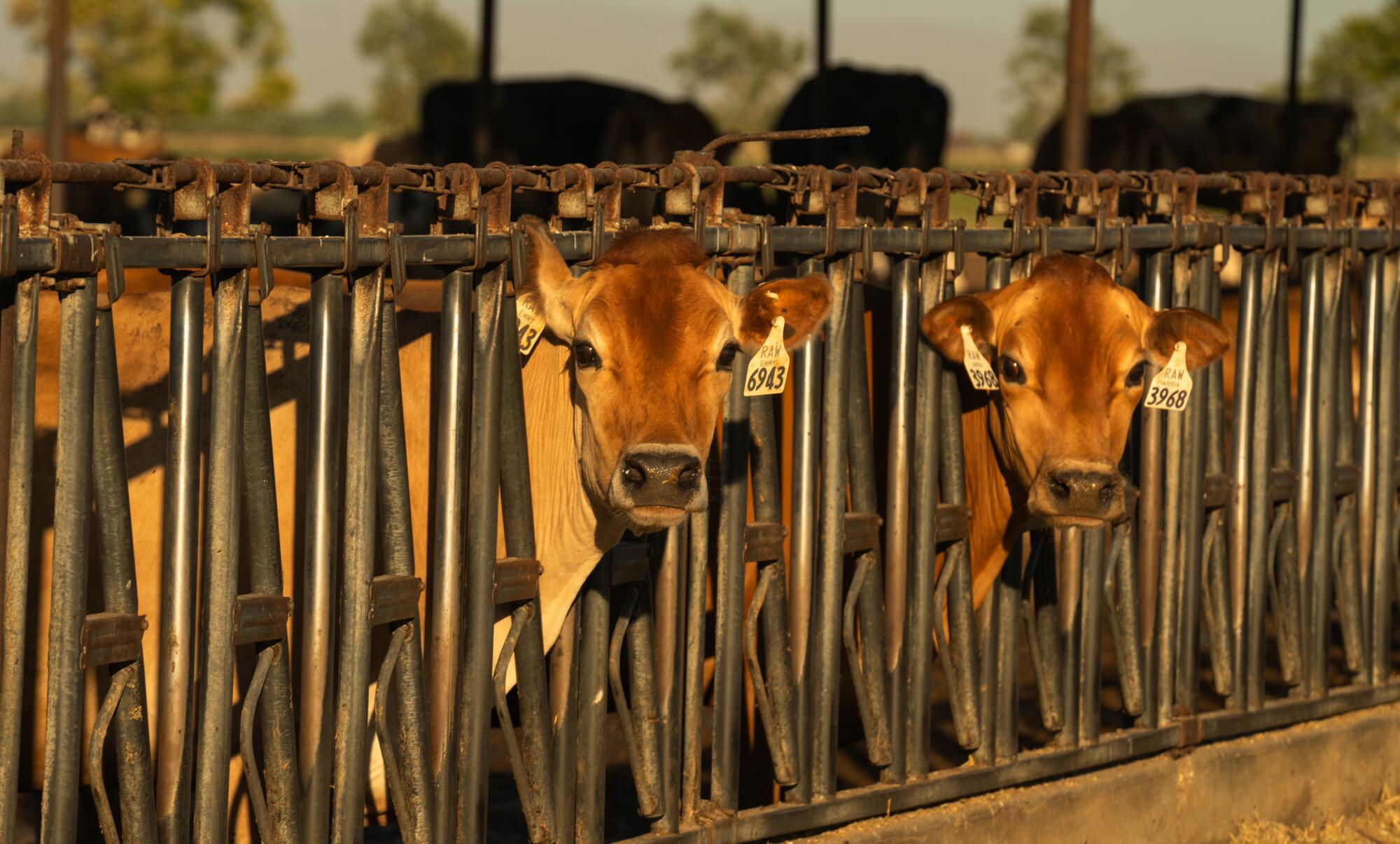
California officials have blocked Raw Milk dairy in Fresno from distributing its raw dairy products.
(Tomas Ovalle / For The Times)
Ontiveros had already done several long shifts in the BSL-3 that week, which with normal staffing would have been divided among multiple people, she said. Now, she was preparing to test cow milk samples that had arrived at the lab around 2 p.m. Typically, samples received after noon were tested the following day, but she said her supervisors had insisted these needed to be turned around quickly as infections spread.
She said she worked for hours, painstakingly pipetting drops of the samples into tiny glass wells as part of the testing process, which extracts genetic material in order to detect the presence of the virus. Then, late in the evening, she realized she had programmed one of the machines analyzing the samples incorrectly. Ontiveros felt a sharp pang of despair. All her work, and the hours Laxamana had spent earlier in the day mixing a chemical solution to wash the samples, had been wasted.
It was around 9 p.m. when she emerged from the lab. She had started her workday around 8 a.m. The tests would have to be redone the next day.
“We are stretched so thin that mistakes can happen,” Ontiveros said. “I was so tired and mentally drained.”
At the time, Ontiveros said she was handling the testing of cow milk largely on her own, although another worker was sometimes sent up from the Tulare lab to help on weekends. While Laxamana had the required security clearance, she hadn’t yet completed the necessary training.
“There’s this huge pressure on me and and responsibility to show up to work every day because I have no backup,” Ontiveros said.
Later in September, Laxamana described being put straight to work as the number of cattle milk samples was ramping up. She said she was asked to run 44 samples without ever having completed a practice run. The only hands-on training she had had was twice shadowing the testing process. As Laxamana worked, Ontiveros stood nearby, supervising.
Already nervous, Laxamana said she was distracted by a walkie-talkie that crackled with voices as she tried to work. Colleagues in the main lab were peppering her with questions about what to do about another batch of tests that appeared to have failed. Holding a pipette carefully in one hand, Laxamana talked through the radio to troubleshoot the problem.
At times this year understaffing has led to quality control missteps, current and former workers said.
Laxamana described coming to work one morning in October and realizing results of tests she had run the day before had not been analyzed properly by lab staff. She said a manager assured Laxamana the errors would be corrected, but when she checked later that day the results had not been changed.
She said she stopped a case coordinator from releasing the incorrect results to farmers, which would have resulted in the culling of birds.
Earlier this year, a poultry sample got misplaced and went untested for three weeks, Laxamana said. She attributed the mistake to being overworked, saying, “There were only two people handling the workload, and things were missed in all of that chaos.”
Kisliuk, the UC Davis spokesperson, declined to answer questions about specific incidents described where workers made mistakes or where managers made mistakes. “We have multiple levels of quality assurance and extensive training of staff,” he said.
In late summer the lab hired a supervisor and others to join the lab. The move created additional work for Laxamana and Ontiveros, who said they were required to juggle their own work while also helping with training the new arrivals.
In recent weeks the supervisor and another new hire took over testing of high-risk poultry samples, but Laxamana and Ontiveros said staffing shortages remain.
Still, Laxamana doesn’t think about leaving.
“There are things that I can do to help prevent a disaster,” she said.“I could not bear to leave the lab in the condition that it is right now.”


The luxury shopping center in Pacific Palisades will reopen next month after more than $100 million in renovations forced by the January 2025 wildfire that devastated the Los Angeles neighborhood.
Palisades Village will reopen Aug. 15, owner Rick Caruso announced Wednesday. The outdoor center survived the blaze that destroyed homes and other businesses but needed refurbishment to eliminate contaminants that the fire could have spread.
Crews are putting finishing touches on mall buildings after tearing them down to the studs, treating the wood and rebuilding the walls, Caruso said.
“Everybody’s working, and stores are moving their products in,” he said. “It’s a really cool feeling that people have really locked arms and are working together.”
An electrician installs lighting for a restaurant at Rick Caruso’s Palisades Village on Thursday. The shopping center is scheduled to reopen mid-August.
(Myung J. Chun / Los Angeles Times)
Pacific Palisades resident Allison Polhill, who is rebuilding the home of 30 years that her family lost in the blaze, said she is “thrilled” at the prospect of returning to the mall she used to frequent. Its comeback is a boost for the community, she said.
“Every single step that we make to reopen our commercial corridors is going to bring more people back into the Palisades,” said Polhill, who expects to move back into her home at the end of August.
A total of 6,822 structures were destroyed in the Palisades fire, including more than 5,500 residences and 100 commercial businesses, according to the California Department of Forestry and Fire Protection.
Caruso previously attributed the mall’s survival to the hard work of private firefighters and the fire-resistant materials used in the mall’s construction.
The $200-million shopping and dining center opened in 2018 with a movie theater and a roster of upmarket tenants, including Erewhon, which may be the only grocer in the heart of the fire-ravaged neighborhood when it opens.
Caruso’s company was able to fill the mall with tenants despite the long shutdown.
Palisades Village is 99% leased, with the majority of tenants returning, said Jackie Levy, chief financial and revenue officer. Nearly one-third of the shops and restaurants are new to the property.
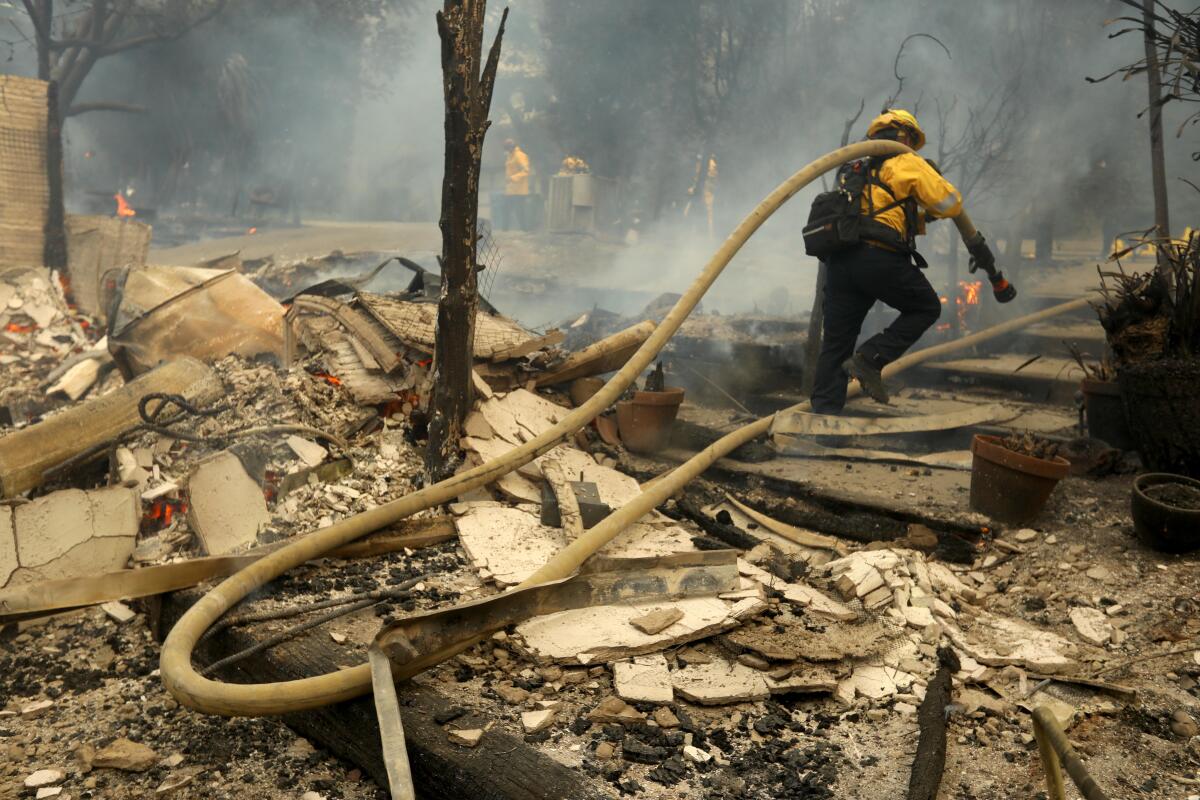
A firefighter carries a hose back to his rig while walking through a destroyed home from the Palisades fire in Pacific Palisades on Jan. 7, 2025.
(Genaro Molina / Los Angeles Times)
Last year, Pacific Palisades-based fashion designer Elyse Walker said she would reopen her eponymous store in Palisades Village after losing her 25-year flagship location on Antioch Street to the inferno.
Other neighborhood shops destroyed in the fire that are reopening at the mall include K Bakery and Loomey’s Toys, which caters to children up to age 12 and used to be across the street from Palisades Elementary Charter School.
“It’s been a journey and I’m excited because I wasn’t sure that there was going to be a place to come back to,” said toy store owner Amanda Rastegar. “Hopefully we can bring some of that magic back.”
Rastegar’s home in the Palisades survived but was damaged by the fire. The family returned about eight weeks ago. Her last memory of the fire was a burning supermarket.
“I just couldn’t wrap my brain around what was happening,” she said. “By the time I left, Gelson’s was on fire.”
Among the returning tenants is Angelini Ristorante & Bar. Well-known Los Angeles chef Gino Angelini said he will be in the kitchen next month for a return of the Italian restaurant.
“We won’t do a big celebrity open,” he said. “We want to have a very soft opening and see our customers come back.”

Construction takes place at Rick Caruso’s Palisades Village on Thursday. The shopping center is scheduled to reopen mid-August.
(Myung J. Chun / Los Angeles Times)
An elaborate celebration would not feel “correct for me,” Angelini said, because the devastation has been “very sad” for so many.
Other new tenants include local chef Nancy Silverton, who has agreed to move in with a new Italian steakhouse called Spacca Tutto. Women’s activewear retailer LESET will open its first West Coast location.
Caruso said he is optimistic that customers will return to the center, even though many Pacific Palisades residents are still dispersed. One tracking system estimated that about 30% of the Village’s customer base was impacted by the fire, he said.
“That means 70% did not get impacted, so there’s a lot of customers still left out there,” Caruso said. Historically, the center drew customers from as far away as Beverly Hills and Calabasas, as well as Malibu, Brentwood and Santa Monica.
He also hopes many will be inspired to visit the revived mall.
“I believe in the goodness of people and I believe that people are going to want to support the Palisades,” he said. “They’re going to want to be there and support the businesses that have had the courage and the heart to reopen.”

Walmart is rapidly expanding its network of electric vehicle chargers designed for customers to use while they shop.
The network could help fill gaps in EV infrastructure in states with greater need for chargers. Walmart, which has more than 5,000 locations in the U.S. and hundreds in California, says more than 90% of Americans live within 10 miles of one of its stores.
The chargers also offer an incentive for customers to choose Walmart — Walmart Plus members will receive a 10% discount off an average price of $0.46 per kilowatt-hour of energy at the company’s chargers.
Walmart chargers are already available at more than 75 locations in 17 states, with Texas boasting the most charging stations, followed by Florida and Arizona.
Matthew Nelson, Walmart’s director of energy policy, said last week on LinkedIn that the network will soon reach 29 states, including California.
“We are delivering on the promise of affordable, reliable and convenient charging,” Nelson said in his post.
According to Walmart’s website, six charging stations are coming to California soon, though the company did not offer a specific timeline.
The chargers will be installed at stores in Antelope, Brea, Fresno, Stockton, Suisun City and Vallejo.
Most charging sites in California will include eight to 16 fast-charging stalls, said Walmart spokesperson Kelsey Bohl.
The company first announced plans in April 2023 to install its own EV chargers at Walmart and Sam’s Club stores, with a goal of installing thousands of chargers by 2030. Partnering with ABB E-Mobility and Alpitronic, it added 25 new charging sites this past May and six more in June.
“Walmart is building a leading retail-integrated EV fast-charging network, focused on delivering an affordable, reliable and convenient charging experience where customers already shop,” Bohl said in an emailed statement. “Customers can charge while they shop, access stations through the Walmart app they already use, and benefit from affordable pricing.”
The charging stations already available include 612 individual charging stalls using 400-kilowatt chargers. Each stall has a dual charging cord with both Combined Charging System and North American Charging Standard connectors. The standard connectors, designed by Tesla, are smaller and lighter than the combined systems.
The primary way to pay for the chargers is through the Walmart app, but the company is also experimenting with built-in credit card readers to allow those without the app to use the stations.
Customers can check charger availability on the Walmart app. The company said the chargers will be available 24 hours a day.

Robotaxis could be turning into robocops.
A self-driving Waymo reported two teens to San Mateo, Calif., police on Monday after they were found drinking alcohol and shooting toy guns in the back of the vehicle.
According to a social media post from the San Mateo Police Department, officers detained two 15-year-olds after the Waymo they were riding in contacted the department and stopped in a parking lot until law enforcement arrived.
“Parents do you know where your teens are?” the San Mateo Police Department wrote on Facebook following the incident. “Waymo does!”
Officers removed both teens from the vehicle and determined they were using toy guns to shoot Orbeez out the windows. Orbeez are small, water-absorbing beads sold at toy stores.
“Toy guns, water guns, and BB guns all pose real dangers, especially to an untrained eye,” the Police Department said. “The simple handling of them can cause fear in [passersby].” “
A video posted on Facebook shows at least five officers and a police dog responding to the scene and approaching the Waymo with their weapons raised.
Waymo did not immediately respond to a request for comment.
Waymo vehicles have internal cameras and microphones that may be used in an emergency or to “promote safety and security,” according to Waymo’s online support page.
The cameras are also used to ensure the vehicles are clean and to help find lost items, according to the support page.
The company said it does not use facial recognition or other biometric identification technologies to identify individuals.
“In more urgent circumstances, support may access live video during a trip,” the Waymo page said.
The San Mateo Police Department’s Facebook post has garnered nearly 60 comments, with one user accusing Waymo of “snitching.”
“At least they got a designated driver?!” one user commented.
-

 Rhode Island1 minute ago
Handshake Initiative instills confidence, motivation in students
-

 South-Carolina6 minutes ago
ESPN recruiting writers break down five-star Josh Dobson’s fit with South Carolina
-

 South Dakota13 minutes ago
South Dakota man faces abuse charges after authorities called to NW Iowa casino
-

 Tennessee16 minutes ago
Data centers driving up Tennessee power bills, report finds
-

 Texas21 minutes ago
Family demands investigation after US man killed by ICE agent in Texas
-

 Utah28 minutes ago
Turn your miles into meals
-

 Vermont31 minutes ago
Poll: Most young Vermonters say they’re likely to leave state amid affordability concerns – VTDigger
-

 Virginia36 minutes ago
MEOC Organization hosts annual summer picnic for Southwest Virginia seniors

