Business
Why Fashion Nova bought a $118-million office space in Beverly Hills

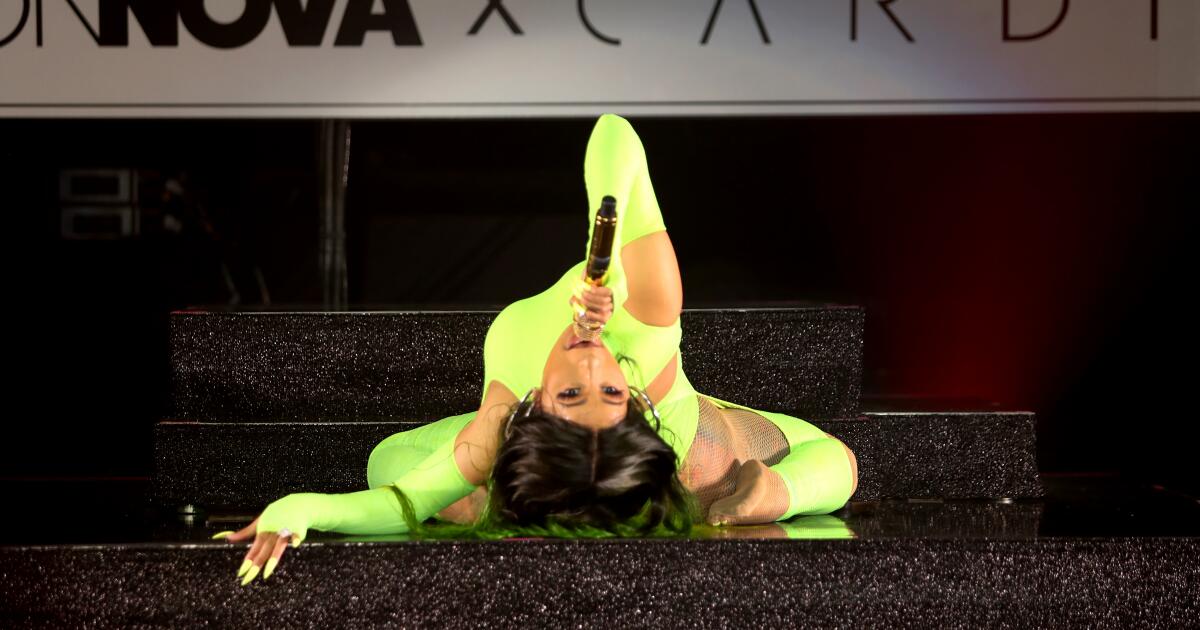
When fast-fashion retailer Fashion Nova was searching for a new headquarters, the pull of Beverly Hills was strong.
The city is one of the world’s luxury capitals, and its palm tree-lined streets are home to billionaires, Hollywood stars and high-end brands including Gucci and Dior. Compared with Fashion Nova’s current base in Vernon, a gritty, heavily industrial spit of land southeast of downtown L.A., the glitz of Beverly Hills offered the upgrade that founder and Chief Executive Richard Saghian wanted.
“Mostly all our celebrity partners, influencers, our employees, vendors, they all live and work around Beverly Hills,” Saghian said. “Plus, it’s close to where I live and I think it’s great for the brand.”
This month, the 43-year-old billionaire closed a deal on a contemporary office building at the edge of the city’s real estate “golden triangle.” He paid $118 million in cash for the property at 407 N. Maple Drive.
Fashion Nova’s new headquarters in Beverly Hills.
(Michael Allen Creative/Fashion Nova)
Celebrities including Cardi B and Megan Thee Stallion have helped boost Fashion Nova’s appeal as the company has produced low-cost, trendy clothes that offer women a way to tap into the latest fashion trends at a fraction of the cost of luxury brands.
Founded in 2006, Fashion Nova was ahead of the curve when it came to harnessing influencer marketing. As it cements its place in an upscale neighborhood of Beverly Hills, the brand continues to bet big on social media and star power.
The stakes are high in the relentless world of fast fashion as competition with other industry players heats up, most notably with Shein, a Singapore-based juggernaut that is growing its presence in the United States and releases new clothes at a breakneck pace. Shein also has operations in Los Angeles.
Neil Saunders, managing director at data analytics and consulting firm GlobalData Retail, said Fashion Nova will need to find ways to keep pace with Shein, which “has really just upped the tempo and it’s very cheap.”
“That’s definitely pulled a little bit of market share and spending away from some of the more traditional and more established players.”
The fast-fashion industry has become crowded with retailers such as H&M, ASOS, PrettyLittleThing and Forever 21 competing for sales that have stagnated as shoppers have pulled back on spending amid high inflation. Publicly traded companies such as H&M and ASOS have seen their sales drop this year.
“There’s no doubt the market has become a little bit more challenging,” Saunders said. “People have cut back slightly on the amount of things they buy because of pressures on their budgets.”
Fashion Nova, which is privately owned, has annual sales of approximately $2 billion and 40 million followers on social media, according to a news release about the new office space.
Over the years, the fast-fashion industry has also faced concerns about sustainability and cheap labor. Still, for many consumers, price and style are at the top of their minds, Saunders said. With consumers buying from various brands, there’s room for more than one retailer to dominate, he said.
Fashion Nova’s new office space is one way the brand is strengthening its relationship with celebrities and influencers in Los Angeles. The company is planning to open an invitation-only Nova Social Club — where creators, influencers, celebrities and VIP guests can collaborate — and a Nova Founders Lab to help emerging brands, designers, creatives and founders.
“If there’s a celebrity that wants to, for example, start a brand, we can partner together,” Saghian said.
The 175,000-square-foot building, purchased from real estate company Tishman Speyer, features an atrium sky bridge, a solarium, Zen-like gardens and an outdoor terrace. The retailer plans to add a fitness studio, a wellness spa, a cosmetic micro-treatment bar and other amenities.
Fashion Nova’s new headquarters for its more than 500 employees is scheduled to open later this year. Even as remote work becomes more popular, Saghian said interacting in the office is key to the brand’s success and growth.
Properties in the Beverly Hills area were selling for almost double the price a few years ago, Saghian said. The office building on Maple Drive wasn’t on the market, but Saghian said he made a compelling case with an all-cash offer.
The purchase is among the priciest office transactions this year for Beverly Hills, CoStar data show. Offices in that area typically sell for $344 per square foot; Saghian paid about $674 per square foot for the building. In 2005, Tishman Speyer paid more than $70.7 million for the building, so the purchase price represents a nearly 67% sales premium. The city’s office vacancy rate is 16.1%, above the national average of 13.8%.
Saunders said it’s a smart move for a brand like Fashion Nova to put its headquarters at the heart of where fashion and style are in California. Influencer marketing is just one piece of what entices people to buy clothes.
“Consumers will look at influencers and they’ll take cues from them, but the products have to be good, the designs have to be good, the price points have to be right,” Saunders said.
Fashion Nova has five brick-and-mortar stores in Southern California, including at the Shops at Montebello and the Northridge Mall. The brand has adapted to the rise of e-commerce, launching its online store in 2013 and releasing a shopping app.
The company isn’t done growing. The brand plans to expand in other cities including London, Hong Kong, Sydney and New York.
Saghian has snapped up other luxury real estate in Los Angeles. In 2022, he purchased “The One” megamansion for $141 million.
“I’ve always viewed real estate as a long-term, generational investment, and I just think it’s a great place to invest,” he said. “And why not purchase when the market’s down, you know?”
Times staff writer Roger Vincent contributed to this report.


Ethics experts sounded the alarm Wednesday after new financial disclosure reports revealed that President Trump’s income ballooned to $2.2 billion in 2025, with $1.4 billion coming from various new cryptocurrency-related businesses.
“It’s bribery. It’s graft. It’s exploitation of public power for private financial gain,” said Kathleen Clark, a law professor at Washington University and an expert in government ethics. “Trump has — with the acquiescence of a somnolent, GOP-controlled Congress and the active assistance of John Roberts’ Supreme Court — transformed the presidency into a massive corruption racket.”
Trump reported income of over $600 million in 2024. But after he entered the White House in 2025, he reported that his income had soared to more than $2.2 billion.
The 2025 annual disclosure report filed with the Office of Government Ethics shows that Trump ramped up his real estate business in countries across the globe, particularly in the Middle East, at a time when his government was negotiating over vital issues of military aid and economic tariffs. The president also expanded his dealings in the relatively new realm of cryptocurrency.
According to the 927-page report, Trump made $635 million in royalties from Celebration Coins and more than $500 million from his World Liberty Financial crypto firm. He drew in millions from a raft of Trump-branded merchandise including God Bless the USA Bibles and sneakers depicting him with his hand raised in a fist. He also brought in $10.4 million from a property in the United Arab Emirates and $9 million from a property in Saudi Arabia.
Noah Bookbinder, an ethics expert and former president of Citizens for Responsibility and Ethics, a nonprofit watchdog group in Washington, described Trump’s business dealings while in the White House as “entirely unprecedented, certainly in modern history, but I think by most ways of measuring, in all of American history.”
“This is corruption,” Bookbinder said. “You have a president who has been quite transparently using the presidency in ways that benefit his business interests and intertwining the presidency and business interests.”
But the president and the White House brushed aside ethics concerns about the money Trump is making.
Trump told reporters Wednesday that he made a lot of money before he came to the White House, he had “big institutions” run his money, and that he had benefited, like every other American, as the stock market went up.
“We’re all profiting,” he said. “I’m profiting because I have a lot of money and a lot of cash.”
In a statement, White House spokesperson Anna Kelly said: “Neither the President nor his family has ever engaged — or will ever engage — in conflicts of interest. … All actions by President Trump and his administration are taken in the best interest of the American people.”
Although the report does not show exactly how much Trump is earning — it provides details of revenue, rather than profit — the scale of the president’s cryptocurrency dealings elevated ethics watchdogs’ long-standing concerns.
Jordan Libowitz, a vice president at Citizens for Responsibility and Ethics, said the most concerning detail of the new report is the hundreds of millions of dollars coming in from various crypto ventures partnered with companies that the American public knows little about.
“At a time when his own administration itself is setting regulation for these types of companies,” Libowitz said, “there’s just this massive opportunity for corruption when foreign governments and foreign nationals can pour tens of millions of dollars into the president’s pocket.”
As a real estate mogul, Trump has long invested in hotels, condominiums and golf courses. But cryptocurrency, Libowitz said, offers vastly more potential for corruption.
“There’s only so many hotel rooms you can book, so many rounds of golf, but there’s no limit with crypto,” Libowitz said. “You can just buy his meme coin and he gets a cut, so you kind of take out the middleman, but also the cap or the amount of money you can funnel to the president.”
Libowitz said it was also problematic for Trump to expand his real estate empire in foreign countries, particularly in the Middle East.
“Now it seems that almost all his new developments are in foreign countries, and that opens up, if you’re building this giant resort, you’re going to need help from the local government, whether it’s tax breaks or utility issues, or building a road, or speeding up permits,” Libowitz said. “These are ways that foreign governments can do favors for the American president.”
In the half a century before Trump was elected, ethics experts say, presidents from Nixon to Obama publicly released their tax returns, sold properties or put the proceeds in a blind trust managed by someone they did not know.
“They weren’t doing it because they legally had to, but because they thought it was the right thing to do,” Libowitz said.
Ever since Trump was first elected in 2016 and opted to not sell his businesses or put them in blind trusts, ethics experts have urged Congress to impose more aggressive financial oversight over money in politics.
“Congress needs to update the law, and basically, mandate blind trusts and sale of assets and disclosure of tax returns,” Libowitz said.
Noting that the Constitution’s Emoluments Clause explicitly states that the president cannot accept things of value from foreign or domestic governments, ethics experts say Trump is flouting the law and Congress has chosen to not enforce it.
Richard Painter, a law professor at the University of Minnesota and former White House ethics lawyer under President George W. Bush, said Congress needed to close loopholes that exempt presidents from federal conflict of interest laws as well as enforce the Foreign Emoluments Clause.
“Nobody holding a position of trust with the United States government can accept emoluments, profits and benefits from foreign governments, and that is flatly prohibited under the United States Constitution,” Painter said. “Now, if the United Arab Emirates put money into Liberty Financial, as I understand they did … and then Trump makes money off Liberty Financial, that’s a Foreign Emoluments Clause problem.”
Congress, he said, should empower an independent prosecutor to investigate such conflicts.
“The problem with the Foreign Emoluments Clause is how do we enforce it?” Painter said. “The founders and head of the Congress enforced it by impeaching anybody who took a bunch of foreign government money, but I guess that system’s not working. That’s a serious problem.”

The race to bring air travel to the sky is heating up as Santa Cruz-based Joby Aviation and Toyota launch a joint venture to commercially produce air taxis.
The companies said in a news release Tuesday that they will work together on productivity, quality and costs and move toward mass production of Joby’s electric vertical takeoff aircraft. Joby and Toyota were first linked when Toyota made a nearly $400-million investment in the company in 2020. It has since increased its backing of the company to $900 million.
“It’s really meaningful for us to take on this challenge together with Joby, a partner that shares the same vision,” Toyota Chair Akio Toyoda said. “We believe this strengthened relationship is an important step forward in realizing the future mobility society.”
Joby‘s all-electric vertical takeoff vehicles are designed to hold four passengers and a pilot and can travel at up to 200 mph. The vehicle uses six tilting propellers to achieve vertical takeoff before switching to forward flight.
In February, Joby announced a partnership with Uber to start service in the United Arab Emirates this year, bringing on-demand air taxi rides to the country. It plans to expand to the U.S. after the completion of its final stage of Federal Aviation Administration testing.
Prior to its full FAA certification, Joby is hoping to launch early flight operations later this year as part of a White House program that will bring flights to several states, including New York, Texas and Arizona. Flights in California will not begin until after obtaining FAA certification.
Joby has been in a fierce battle to be the first with taxis in the sky with its Northern California competitor Archer Aviation. The two companies are involved in overlapping lawsuits, with Joby alleging corporate espionage against Archer, and Archer filing a suit alleging dubious ties to China that sparked an investigation into Joby by the U.S. International Trade Commission.
“Toyota has been by Joby’s side for nearly a decade, providing invaluable guidance and support as we built the foundation for manufacturing our aircraft,” JoeBen Bevirt, Joby’s chief executive and founder, said in the news release. “Together, we share a vision of making aerial mobility an everyday reality, and we look forward to delivering on that promise together.”
Joby Aviation’s shares, which have fallen more than 30% this year, climbed 3% on Tuesday to $8.92.
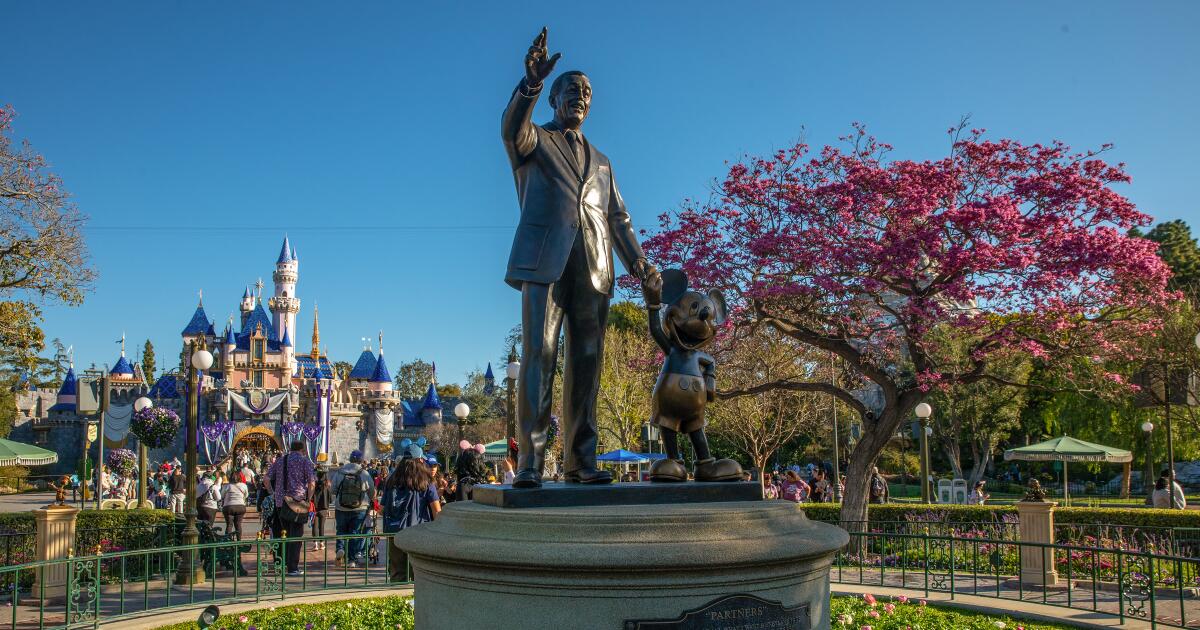
Disneyland Resort in Anaheim will offer $59 tickets for select evening admission to either theme park as part of a new promotion.
The one-day, one-park evening ticket offer will allow attendees to enter Disney California Adventure at 5 p.m. or Disneyland at 7 p.m. Park reservations are still required, as has been the case since the COVID-19 pandemic.
The offer only applies for admission from July 12 through Aug. 5 on Sundays to Wednesdays.
Disneyland Resort is commemorating its 70th anniversary through Aug. 9, and has introduced new shows and additions to rides as part of the occasion.
Walt Disney Co.’s theme parks and experiences business are a crucial boost to its finances, making up about 56% of the company’s operating income last fiscal year.
During the Burbank-based company’s most recent earnings call in May, Disney executives said attendance at its U.S.-based parks was down 1% compared with the prior year, a shift they attributed to “continued softness” in international visitations. However, the company said at the time that it was starting to move past those issues.
Disney’s experiences division reported $9.5 billion in revenue in that fiscal second quarter, up 7% compared with the same period a year ago, something executives said was due to higher guest spending domestically and more capacity on its cruise line.
-
 Entertainment2 minutes ago
When, unlike our upcoming 250th anniversary, a bicentennial mattered to orchestras
-
 Lifestyle9 minutes ago
DLTA’s former Ace Hotel is reborn as a ‘creative hub’ — and yes, you can still sleep there
-
 Politics12 minutes ago
Trump wants to show off D.C. for the Fourth. His construction is in the way
-
 Science17 minutes ago
Boyle Heights blaze choked L.A. with astronomical soot pollution
-
 Sports24 minutes ago
Lakers announce summer league schedule, roster
-
World32 minutes ago
How the Entry-Exit System is becoming a nightmare for Europe's summer travellers
-

 News57 minutes ago
Newsom’s office responds to SCOTUS ruling on women’s sports as California faces ongoing trans athlete wave
-

 Los Angeles, Ca2 hours ago
Family of boy, 8, killed by falling tree branch at Calabasas park to get $14.6M

