Business
What the new Tiana's Bayou Adventure ride means for Disneyland

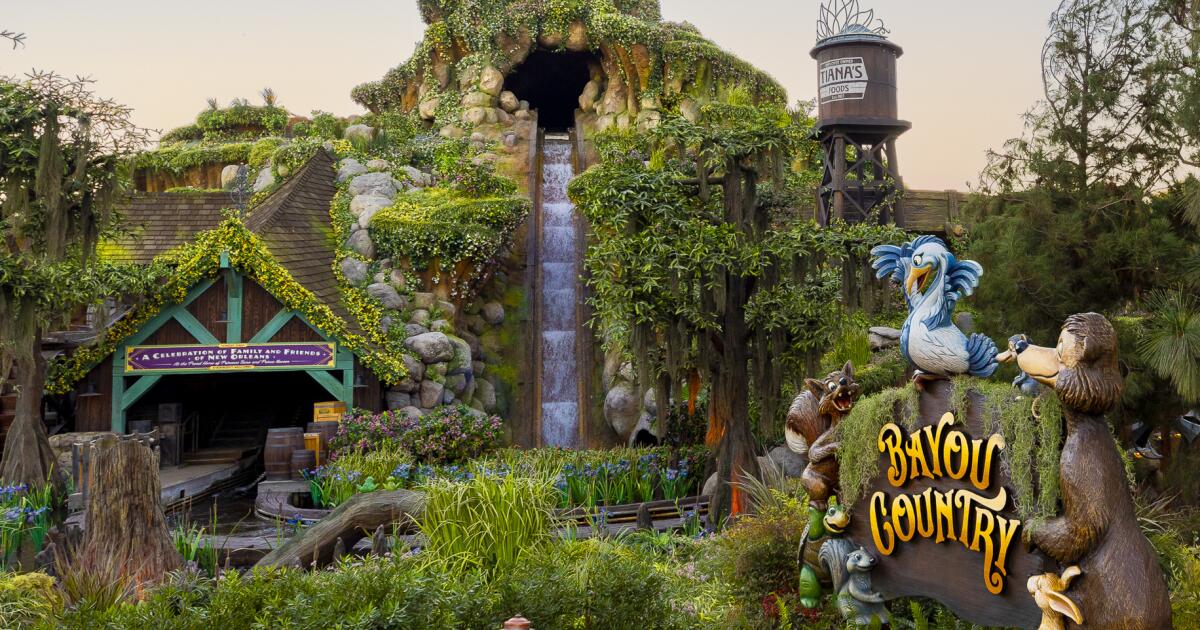
As people wind through the queue of the new Tiana’s Bayou Adventure ride, they’re greeted by a chalkboard message left by the princess.
“Don’t forget! Celebration at my house tonight! Everybody’s welcome!”
That message shows up again, both in signage and song, throughout the ride, which replaced Splash Mountain at Anaheim’s Disneyland Resort and is inspired by the 2009 film “The Princess and the Frog,” which features Disney’s first Black princess.
The ride represents a new chapter for Walt Disney Co., as the Burbank media and entertainment giant looks to increase investment in its lucrative parks business, fend off new theme park rivals and project a more inclusive message to attendees.
“We wanted to give that feeling for everyone coming off of [the ride], we are better together,” said Josef Lemoine, senior story editor at Walt Disney Imagineering. “The story as a whole, it’s all about getting everybody together and also to find those individuals who might be overlooked.”
For the record:
12:15 p.m. Nov. 15, 2024An earlier version of this article misstated the title of the 1946 Disney movie “Song of the South.”
The ride, which opens to the public Friday, has been five years in the making. In 2020, Disney said it would remove references to the racist 1946 film “Song of the South” from Splash Mountain, amid the nationwide protests following the murder of George Floyd.
Company officials said work on the Tiana concept actually began in 2019.
“Then the world changed,” said Carmen Smith, a senior vice president who heads inclusion strategies for Disney Imagineering, referring to both the Floyd killing and the COVID-19 pandemic. “Life kind of lets you know when it’s time for something to give birth to a concept, and it was without hesitation that leadership came together and said, ‘You’ve been working on it, you’ve got a good idea. Let’s move forward on this.’”
The ride continues the story of “The Princess and the Frog” and focuses on a party Tiana is throwing for family and friends in New Orleans, where the movie is set.
Riders journey through the bayou in search of the perfect band to perform before plunging down the attraction’s signature 50-foot drop. (In addition to the ride, Disney recently added two nearby stores that sell “Princess and the Frog” merchandise, created a Tiana-themed restaurant and re-themed the area around the ride as “Bayou Country.”)
The revamped ride follows other changes to offensive tropes in Disney attractions.
In 2017, Disney removed the bridal auction scene from the Pirates of the Caribbean ride and changed one of the women formerly being auctioned into a pirate leader. In 2021, the company eliminated “negative depictions of native people” from the Jungle Cruise ride, including racist scenes of people waving spears.
This summer, Disney said it would update Peter Pan’s Flight, one of the theme park’s original attractions, to remove a scene involving caricatures of Native Americans.
Updating the rides’ objectionable elements is challenging, but the company is “doing it sensitively and making sure that we keep things relevant,” said Kim Irvine, executive creative director for Disney Imagineering.
Adding popular intellectual property such as “The Princess and the Frog” to a ride fits with Disney’s virtuous cycle strategy of using its film and TV characters to drive attendance to the parks, merchandise sales and vice versa, said Gavin Doyle, founder of MickeyVisit.com, an independent trip-planning website focused on Disney and Universal theme parks.
“It’s more reinforcing,” said Doyle, who is also a small shareholder in Disney. “Having a known princess on the ride is better than unknown characters.”
The animated film received mostly positive reviews when it came out and was a modest box office success, grossing $267 million worldwide.
Changes to the theme parks are also part of Disney’s business strategy to keep its main economic engine humming. The company’s so-called experiences division, which consists of its theme parks, cruise line, luxury travel experiences and merchandise, contributed nearly 60% of Disney’s operating income this fiscal year.
Disney has promised to invest $60 billion over 10 years in the experiences division, highlighting its importance for future performance. At Disneyland Resort, that will mean a cash infusion of at least $1.9 billion into an expanded footprint with additional attractions, shopping, dining and entertainment options.
That’s important as the company prepares to face a new rival in Florida, when Universal opens its Epic Universe theme park in May in Orlando, Fla. Analysts have been carefully watching Disney’s theme park finances in anticipation of the new arrival.
Even with the new competition, Disney said it expects to see 6% to 8% growth in operating income next year in its experiences division.
During the company’s fiscal fourth-quarter earnings call Thursday, Chief Financial Officer Hugh Johnston said that early bookings for next summer were “positive” and that other theme parks and attractions opening up in Florida had “generally been beneficial to us.”
Adding rides like Tiana’s Bayou Adventure, which is also open in Orlando, helps Disney keep up with the competition, said Andi Stein, a communications professor at Cal State Fullerton who wrote a book about the Disney brand.
“Competition is a big part of the success of theme parks … making sure that you have the latest and greatest attraction before your competitor does,” she said. “And Disney wants to stay at the forefront of the theme park market, both in California and in Florida.”


StubHub is getting a red card from some World Cup fans
Two World Cup customers are suing the New York-based ticket-selling company, alleging “false and misleading” advertising that left them without tickets or a refund for the World Cup games they paid to attend.
In federal court in New York last week, two Californians — Julia Reeker Moghal and Reuben Renteria — sued StubHub seeking monetary damages and a ban on the company selling World Cup tickets. The lawsuit aims to become a class action and comes after weeks of fierce criticism and complaints from customers regarding the company’s practices.
Throughout the World Cup, videos have emerged on Instagram and TikTok of StubHub customers describing their nightmare experiences with the ticket-selling platform.
Some said they had purchased tickets to World Cup games as early as November of last year, booked flights and hotels and arranged travel plans, then StubHub notified them days to weeks before the match of a refund for their tickets, which they never requested.
There were similar complaints about last-minute cancellations from people who bought Coachella tickets on StubHub.
In the lawsuit, Moghal said she had purchased three tickets for nearly $2,000 for the June 18 match between Switzerland and Bosnia-Herzegovina at SoFi Stadium in Inglewood, which were then canceled by StubHub. Moghal said she was contacted by StubHub and told her tickets would remain canceled, then was later told the tickets would be available one hour before the game.
When the match began, Moghal said she was at SoFi Stadium, but the tickets never came.
Renteria said he paid around $2,300 for the June 18 Mexico versus South Korea match in Guadalajara, Mexico, but they were canceled
“Devoted soccer fans have traveled from around the world to attend World Cup matches — and they reasonably relied on StubHub to provide the tickets they paid for as well as on StubHub’s warranty,” Blake Hunter Yagman, the attorney representing the two, said in a statement. “Instead of rewarding their business, StubHub sold them World Cup tickets that they either could not provide or on speculation, only to be stranded, in many cases, at the stadium gates without any recourse.”
According to StubHub’s website, its Fan Protect Guarantee states the platform will deliver valid tickets or refund in the event of a ticket issue, and that it will “go out of our way to find replacement tickets” of a comparable value. The lawsuit alleges the replacement tickets many fans were given by StubHub were worse than their original tickets.
FIFA, the World Cup organizer, states in its terms and conditions that the FIFA Marketplace, its own ticket-selling platform, is the only authorized platform for World Cup tickets, and that only tickets purchased through it are guaranteed by FIFA to be valid.
Despite the risk of purchasing through a third-party platform such as StubHub, many fans opted to do so to avoid the 30% FIFA resale tax, believing that the Fan Protect Guarantee would safeguard their order.
Since World Cup tickets began selling on FIFA Marketplace last September, fans have expressed disappointment in the expensive price tag. FIFA utilized a dynamic pricing system for the sale, and as sales phases progressed leading up to the games, the cost of tickets increased tremendously. In March, the extreme cost of tickets prompted 69 members of Congress to write a letter to FIFA urging them to lower their prices.
Tickets for the upcoming Friday match between Spain and Belgium in Los Angeles are selling on StubHub for over $1,300.
StubHub said in various statements to the news and in legal proceedings that ticket cancellations were a result of transfer problems and issues with FIFA’s ticketing infrastructure.
StubHub did not respond to requests for comment.
A FIFA spokesperson responded to this accusation in a statement, saying, “FIFA has no visibility over, or control of, secondary market ticket transactions carried out on third-party platforms. The transactions facilitated on these platforms occur entirely independently of FIFA’s official ticketing platform. With reference to the reliability of the services available to fans on FIFA’s official ticket platform, FIFA rejects any suggestion that the functional issues being experienced by users of third-party platforms with respect to FIFA World Cup 2026 tickets are the result of FIFA’s ticketing infrastructure.”
Business
Commentary: Trump wants to let companies make fewer disclosures, thus keeping investors in the dark

Trump’s SEC is considering eliminating the mandate for quarterly corporate financial reports, but even some big investors call it a lousy idea.
This being the “information age,” it would be understandable if investors sometimes feel inundated with too much information to wade through about the stocks in their mutual fund portfolios.
The Securities and Exchange Commission, bowing like a puppy to the urgings of President Trump, is considering exactly the wrong solution to this supposed burden. It’s proposing to allow public companies to give their investors less information, as though that’s a good thing.
On May 8, the SEC proposed rescinding its mandate that public companies report financial results on a quarterly schedule. Instead, it suggests, semiannual and annual reports should suffice.
This takes an already-unlevel playing field where Main Street investors are already disadvantaged, and makes it more unlevel.
— Dennis Kelleher, Better Markets
The SEC left its proposal open for public comment for 60 days, meaning the window closed Monday. By then, the agency had received more than 68,000 comments, according to a tracker posted online by accounting professor Tzachi Zach of Ohio State.
Almost 99.9% of the comments were negative. Several organizations of institutional investors and auditing professionals, as well as a tsunami of individual investors, expressed opposition.
A similar initiative the SEC aired in 2018, during Trump’s first term, received an overwhelmingly negative response and was eventually dropped.
The tide of opposition coming from individual investors shouldn’t be surprising. “Taking away basic quarterly information means investors are blind for six months at a time,” says Dennis Kelleher, co-founder and chief executive of the investor advocacy nonprofit Better Markets.
That’s especially true for small investors, though perhaps not so much for major institutions, insiders or deep-pocketed individuals. “If you’re a big dog, you’ll get the information anyway,” Kelleher told me. “And insiders, who are trading in their own stock all the time, will have the information. This takes an already-unlevel playing field where Main Street investors are already disadvantaged, and makes it more unlevel.”
Trump set off the latest initiative with a social media post on Sept. 15, advocating the move to a six-month reporting schedule. It read, in part, “This will save money, and allow managers to focus on properly running their companies. Did you ever hear the statement that, ‘China has a 50 to 100 year view on management of a company, whereas we run our companies on a quarterly basis???’ Not good!!!”
As was usual with Trump, his argument was a string of uninformed and irrelevant non sequiturs.
It’s doubtful that eliminating quarterly reports will save much, if any, money. Most 10-Qs are cookie cutter documents disclosing financial figures already embedded in corporate records.
The idea that managers would become empowered to “focus on properly running their companies” if only they were relieved of the burden of preparing a report every three months is just malarkey: Any CEOs who feel the impulse to drop everything and involve themselves in what is essentially an automated process can’t be very good at their jobs.
As for China’s “50 to 100 year view on management of a company,” what would that even mean, even if it were true? China doesn’t operate on a 50 to 100 year corporate horizon, but rather on a string of five-year plans. The most recent of these was adopted by the government in March, covers the period up to 2030, and is its 15th in a row.
Despite the flaws in Trump’s arguments, Trump’s SEC Chairman Paul Atkins, a former corporate lawyer and securities industry consultant, fell into line. Within a few days of Trump’s post, he showed up on CNBC to minimize the potential effect of the change. Private companies rely on semiannual reports, after all, he noted, although the idea of taking private companies as models for publicly traded corporations might not strike experienced investors as the wisest thing.
Atkins cited an enduring chestnut, for which there’s no evidence, that quarterly reporting is responsible for “short-term thinking” in corporate suites (though he admitted that his evidence was “anecdotal”). And he suggested that small investors have ample access to corporate information even without quarterly reports — why, he said, they can just tune in to CNBC!
“To propose change in what our rules are now would be a good way forward,” he said. “So I welcome the president’s putting this up for discussion.”
Something more insidious undergirds the SEC’s proposal than its immediate effect on corporate behavior. The agency rationalizes its proposal as seeking “a tradeoff between reducing regulatory burdens … and promoting efficient financial markets through timely disclosure.”
The problem here, Kelleher points out, is that “reducing regulatory burdens” isn’t part of the SEC’s mission in any way, shape or form. It’s a regulatory agency, and its mission since its founding in 1934 has been to protect investors, not to make things fluffier for stock issuers.
The history of financial disclosure in the U.S. shows a long-term trend favoring more disclosure, not less. In the 1880s, quarterly reporting by railroads and other transportation companies were common.
Early on, pressure for more frequent disclosure came not from government regulators, who barely existed before 1934, but from investors. The reporting of quarterly earnings, notes corporate finance expert Owen Lamont of Acadian Asset Management, was “a bottom-up historical phenomenon reflecting voluntary arrangements between firms and investors, not a top-down phenomenon imposed by law.”
By 1931, according to financial historians, 63% of New York Stock Exchange-listed firms were publishing their quarterly earnings. The Big Board mandated that frequency for most listed companies in 1939. The SEC mandated semiannual reports in 1955 and quarterly reports, as Atkins said, in 1970.
The evidence in favor of dropping the quarterly reports is uniformly thin. Some advocates cite a 2018 op-ed in the Wall Street Journal by JPMorgan Chase CEO Jamie Dimon and Warren Buffett that was headlined “Short-Termism Is Harming the Economy.”
Couple of points about this: First, the target of Dimon and Buffett wasn’t quarterly financial reporting, but quarterly earnings guidance — that is, the practice of some top executives who project their earnings into the future. (This guidance usually comes at the same time they issue their SEC disclosures.)
It’s guidance, they wrote, that is “a major driver” of short-termism in corporate behavior. That’s because management is giving itself a target it feels obligated to meet, even if factors outside its control interfere with the quest.
Furthermore, Dimon and Buffett wrote, “Our views on quarterly earnings forecasts should not be misconstrued as opposition to quarterly and annual reporting.” They called transparency about financial and operating results “an essential aspect of U.S. public markets … so that the public, including shareholders and other stakeholders, can reliably assess real progress.”
Individual investors may be unmoved by the SEC’s proposal because — let’s be candid — how many of them read quarterly earnings reports, anyway? But that’s unimportant, Kelleher says, because other market participants are reading them. “So that information is in the marketplace, and that’s what actually enables price discovery, so stock prices roughly reflect what’s going on at a company, most of the time.”
More to the point, the quarterly reports reflect the highest-quality, detailed information, the information the SEC requires executives to disclose on pain of facing a civil lawsuit from the agency or even criminal liability for faking data. “Main Street investors, whether they read quarterly reports or not, are the real beneficiaries,” Kelleher says.
That’s so. The bottom line is that quarterly financial reporting helps investors. It doesn’t promote short-term behavior and its costs, modest as they are, don’t outweigh its benefits.
Over the decades, scandal-ridden corporations have hidden fraudulent behavior in the interstices between mandated disclosures—think Enron, WorldCom and Tyco, among others. Why give any corporation, even an honest one, the opportunity to disclose less?

The luxury shopping center in Pacific Palisades will reopen next month after more than $100 million in renovations forced by the January 2025 wildfire that devastated the Los Angeles neighborhood.
Palisades Village will reopen Aug. 15, owner Rick Caruso announced Wednesday. The outdoor center survived the blaze that destroyed homes and other businesses but needed refurbishment to eliminate contaminants that the fire could have spread.
Crews are putting finishing touches on mall buildings after tearing them down to the studs, treating the wood and rebuilding the walls, Caruso said.
“Everybody’s working, and stores are moving their products in,” he said. “It’s a really cool feeling that people have really locked arms and are working together.”
An electrician installs lighting for a restaurant at Rick Caruso’s Palisades Village on Thursday. The shopping center is scheduled to reopen mid-August.
(Myung J. Chun / Los Angeles Times)
Pacific Palisades resident Allison Polhill, who is rebuilding the home of 30 years that her family lost in the blaze, said she is “thrilled” at the prospect of returning to the mall she used to frequent. Its comeback is a boost for the community, she said.
“Every single step that we make to reopen our commercial corridors is going to bring more people back into the Palisades,” said Polhill, who expects to move back into her home at the end of August.
A total of 6,822 structures were destroyed in the Palisades fire, including more than 5,500 residences and 100 commercial businesses, according to the California Department of Forestry and Fire Protection.
Caruso previously attributed the mall’s survival to the hard work of private firefighters and the fire-resistant materials used in the mall’s construction.
The $200-million shopping and dining center opened in 2018 with a movie theater and a roster of upmarket tenants, including Erewhon, which may be the only grocer in the heart of the fire-ravaged neighborhood when it opens.
Caruso’s company was able to fill the mall with tenants despite the long shutdown.
Palisades Village is 99% leased, with the majority of tenants returning, said Jackie Levy, chief financial and revenue officer. Nearly one-third of the shops and restaurants are new to the property.

A firefighter carries a hose back to his rig while walking through a destroyed home from the Palisades fire in Pacific Palisades on Jan. 7, 2025.
(Genaro Molina / Los Angeles Times)
Last year, Pacific Palisades-based fashion designer Elyse Walker said she would reopen her eponymous store in Palisades Village after losing her 25-year flagship location on Antioch Street to the inferno.
Other neighborhood shops destroyed in the fire that are reopening at the mall include K Bakery and Loomey’s Toys, which caters to children up to age 12 and used to be across the street from Palisades Elementary Charter School.
“It’s been a journey and I’m excited because I wasn’t sure that there was going to be a place to come back to,” said toy store owner Amanda Rastegar. “Hopefully we can bring some of that magic back.”
Rastegar’s home in the Palisades survived but was damaged by the fire. The family returned about eight weeks ago. Her last memory of the fire was a burning supermarket.
“I just couldn’t wrap my brain around what was happening,” she said. “By the time I left, Gelson’s was on fire.”
Among the returning tenants is Angelini Ristorante & Bar. Well-known Los Angeles chef Gino Angelini said he will be in the kitchen next month for a return of the Italian restaurant.
“We won’t do a big celebrity open,” he said. “We want to have a very soft opening and see our customers come back.”

Construction takes place at Rick Caruso’s Palisades Village on Thursday. The shopping center is scheduled to reopen mid-August.
(Myung J. Chun / Los Angeles Times)
An elaborate celebration would not feel “correct for me,” Angelini said, because the devastation has been “very sad” for so many.
Other new tenants include local chef Nancy Silverton, who has agreed to move in with a new Italian steakhouse called Spacca Tutto. Women’s activewear retailer LESET will open its first West Coast location.
Caruso said he is optimistic that customers will return to the center, even though many Pacific Palisades residents are still dispersed. One tracking system estimated that about 30% of the Village’s customer base was impacted by the fire, he said.
“That means 70% did not get impacted, so there’s a lot of customers still left out there,” Caruso said. Historically, the center drew customers from as far away as Beverly Hills and Calabasas, as well as Malibu, Brentwood and Santa Monica.
He also hopes many will be inspired to visit the revived mall.
“I believe in the goodness of people and I believe that people are going to want to support the Palisades,” he said. “They’re going to want to be there and support the businesses that have had the courage and the heart to reopen.”
-

 Nebraska2 minutes ago
Nebraska ag experts say early detection for livestock parasites, illnesses will be important during summer show season
-

 Nevada9 minutes ago
Local artists on Northern Nevada stages, now through Labor Day weekend
-

 New Hampshire12 minutes ago
Trans athletes drop lawsuit to gain access to girls’ sports in New Hampshire after SCOTUS ruling
-

 New Jersey17 minutes ago
Family describes frantic moments delivering baby on the NJ Turnpike
-

 New Mexico24 minutes ago
Hidden gem in Cloudcroft, New Mexico has best BBQ in US
-

 North Carolina27 minutes ago
North Carolina Airport Looks to Expand Commercial Service | AirlineGeeks.com
-

 North Dakota32 minutes ago
San Francisco plots risky socialist bank modeled after controversial experiment
-

 Ohio39 minutes ago
Feeling itchy? Ohio leads nation with 6 cities on Orkin’s 2026 bed bug list

