Business
What Caused the Air India Plane Crash? Here’s What Investigators Are Examining.


Investigators have begun sorting through the wreckage of Thursday’s plane crash in India, the nation’s deadliest in three decades. It could take months before a definitive explanation emerges, but videos of the accident and other evidence have begun to offer clues about what may have brought down the Air India flight, killing more than 260 people.
Here are some questions that investigators hope to answer in days and weeks ahead, according to aviation safety experts.
Were the wing flaps and slats properly extended?
Thursday’s crash occurred moments after the plane departed the airport in Ahmedabad, India. A short, blurry video showed what appeared to be the start of a routine takeoff, aviation safety experts said. But soon after leaving the ground, the plane, a Boeing 787 Dreamliner, began to descend before crashing and exploding.
At its most basic, the crash reflected a failure to meet the fundamental requirements of flight. To fly, a plane needs to generate enough lift to overcome gravity and enough thrust to overcome the air’s resistance, known as drag. The flight on Thursday seemed to fail on both accounts.
“There appeared to be an issue with the thrust and there appeared to be an issue with the lift,” said Anthony Brickhouse, an aviation safety consultant. “And we unfortunately saw what the result was.”
When an airplane takes off, flaps at the rear of the wing and slats at the front are typically extended to provide more surface area to create more lift as the plane gains speed.
“Just given the fact that this was a takeoff accident, begs the question regarding the settings of the wing slats and flaps, which is critical for taking off in a big jet that’s fully loaded with fuel,” said Jeff Guzzetti, a former accident investigator for the Federal Aviation Administration and National Transportation Safety Board.
It was not clear whether those flaps and slats were properly extended. If they weren’t, experts said, investigators will want to know why. Did the pilots choose not to extend them or fail to do so? Was there some kind of mechanical failure that prevented the pilots from extending those parts? Even if the slats and flaps were extended, it would be difficult to know if they were appropriately deployed because they can be configured differently for different situations. It’s also possible that they were extended but retracted too soon.
“The video is just too grainy, but that is something that’s clearly recorded in the flight data recorder,” said Mr. Guzzetti. “So hopefully, the recorders will tell the tale.”
Why was the landing gear down?
The video shows that the landing gear remained extended throughout the plane’s ascent and descent, which experts described as unusual. Landing gear creates drag, so retracting it is typically one of the first actions a plane’s pilots take after the plane is off the ground.
But experts said the pilots may not have retracted the gear for a number of reasons. A mechanical problem may have prevented the pilots from lifting the landing gear, for example. Or the pilots may have been preoccupied with another, more pressing problem.
“The airplane will climb fine leaving the gear down,” said Shawn Pruchnicki, a former accident investigator at the Air Line Pilots Association and an assistant professor of aviation safety at Ohio State University. If something else had gone wrong in the plane, the pilots may have focused on addressing that first, he said: “You have bells and alarms going off — there’s all kinds of stuff happening.”
Were there engine problems?
Engines provide thrust and investigators will want to know if they failed for any reason. An engine breakdown sometimes comes with telltale signs — smoke, fire, a flash — but experts said none of those are clearly apparent in the blurry videos of the crash.
One video shows what appears to be a dust cloud shortly after the plane leaves the ground. That could have been caused by an engine or it could have been caused by the wingtips disturbing the air, experts said.
Planes are designed to fly with just one engine, a situation that commercial airline pilots train for “excessively,” Mr. Pruchnicki said, adding that he believed the 787 Dreamliner probably didn’t experience a single engine failure, but both engines could have malfunctioned.
If that were the case, it would have happened at the “absolute worst time,” said Mr. Pruchnicki. A double engine failure occurring shortly after takeoff, when the plane was only several hundred feet off the ground, would have left the pilots without sufficient time to respond to the emergency.
“You can’t manage a double engine failure that close to the ground,” he said, recalling the 2009 “Miracle on the Hudson,” when a US Airways jetliner landed in the Hudson River after the aircraft lost power in both engines after striking a flock of birds. “These guys were in a residential area, a business area. They had no place to go either. There was no field to set it down gently. So, unfortunately, they ended up in buildings.”
A failure of both engines could have many causes: a bird or drone strike, inadvertent fuel shut-off, issues with automated thrust management. There is no evidence that these problems played a role in Thursday’s crash.
“There’s easily a hundred different explanations of possibilities,” Mr. Pruchnicki said. Analyzing the flight data recorder and inspecting the engine itself would provide an “unbelievably forensic” look at what happened, he added.
What was happening in the flight deck?
Investigators will also probably be sharply focused on what unfolded in the flight deck, or cockpit, before the crash.
There were two pilots on the Air India flight, which is typical in commercial aviation, with one pilot in charge of flying and the other providing support, monitoring the plane’s various systems. Were those duties split appropriately? What were the pilots saying to one another? And did they perform their jobs adequately?
Planes are also equipped with various warning systems to alert pilots of problems. Investigators will want to know if those warning systems worked as intended.
“Did they get the warning that they were supposed to receive or were they misconfigured? If they didn’t get a warning, then why? If they did, what did the crew do when they heard it?” said Mr. Guzzetti.
What other sources of evidence are there?
Investigators will also be on the hunt for more evidence.
Typically, they scour and analyze wreckage for clues and collect testimony from witnesses, such as airport personnel who may have seen the crash. They will also look for additional videos.
But their most important task will be recovering the wealth of technical information and audio recordings contained in the plane’s black boxes: a flight data recorder and a cockpit voice recorder, both of which have been recovered.
“Once they have that information, it will help focus the investigation into specific areas,” said John Cox, a former airline pilot and chief executive of Safety Operating Systems, a consulting firm. “So right now, it’s about gathering of documentation and evidence and keeping an open mind.”




A constellation of stars are lining up against Paramount’s proposed takeover of Warner Bros. Discovery, expressing fears the blockbuster merger would devastate the industry and shrink production jobs.
The letter was signed by nearly 1,000 artists and movie creators, including such big names as Ben Stiller, Bryan Cranston, Noah Wyle, Joaquin Phoenix, Kristen Stewart and Jane Fonda, whose Committee for the First Amendment helped organize the campaign.
“This transaction would further consolidate an already concentrated media landscape, reducing competition at a moment when our industries — and the audiences we serve — can least afford it,” according to the letter. “The result will be fewer opportunities for creators, fewer jobs across the production ecosystem, higher costs, and less choice for audiences in the United States and around the world.”
Paramount, in a statement, pushed back against the artists’ concerns. Tech scion David Ellison and his team believes the blockbuster deal makes sense — particularly because of turmoil in the entertainment business, the company said.
“This is also a moment when the industry has been facing significant disruption—and the need for strong, creative-first and well-capitalized companies that can continue to invest in storytelling has never been greater,” Paramount said.
The Hollywood workforce has shrunk by more than 42,000 jobs between 2022 and 2024, according to a recent study. The economy has not bounced back following shutdowns due to the COVID-19 pandemic, followed by the twin labor strikes three years ago.
Thousands of film workers have been searching for work — but many of the big opportunities have moved abroad.
The strikes prompted studio executives to reset their output after previously spending big to build streaming services to compete with Netflix.
Two other consolidations led to widespread cutbacks: Walt Disney Co.’s acquisition of Fox entertainment assets in 2019, and Discovery’s takeover of AT&T’s WarnerMedia four years ago.
The resulting entity — Warner Bros. Discovery, led by David Zaslav — instituted deep cost cuts and thousands of layoffs to cut expenses because the firm was nearly drowning in deal debt — $43 billion — from the day Zaslav took the helm.
Paramount’s proposed takeover of Warner Bros. would result in a significantly higher debt load, $79 billion in debt, prompting concerns from the group and others about further downsizing.
Ellison, the 43-year-old son of billionaire Oracle co-founder Larry Ellison, is leading the effort to buy Warner Bros. Discovery to prop up Paramount, which the family acquired in August.
In late February, Ellison’s Paramount Skydance prevailed in a nearly six-month bidding war after Netflix unexpectedly bowed out when the elder Ellison agreed to financially back his son’s $111-billion deal.
“We have been clear in our commitments to do just that: increasing output to a minimum of 30 high-quality feature films annually with full theatrical releases, continuing to license content, and preserving iconic brands with independent creative leadership,” Paramount said, adding that such promises should ensure that “creators have more avenues for their work, not fewer.”
Warner shareholders will be asked to approve the merger April 23.
Ellison is pushing to wrap the deal up this summer.
“We are deeply concerned by indications of support for this merger that prioritize the interests of a small group of powerful stakeholders over the broader public good,” the letter said. “The integrity, independence, and diversity of our industry would be grievously compromised. Competition is essential for a healthy economy and a healthy democracy. So is thoughtful regulation and enforcement.”
The group urged California Atty. Gen. Rob Bonta and his fellow state attorneys general to sue to block the transaction.
Bonta has told The Times that his office is reviewing the transaction to see if it violates antitrust rules. Two historic movie studios, several streaming services and dozens of cable channels would be brought under one roof.
“Media consolidation has already weakened one of America’s most vital global industries,” the group said, “one that has long shaped culture and connected people around the world.”
Bonta’s office is leading the charge against another merger, TV station giant Nexstar Media Group’s $6.2-billion takeover of Virginia-based Tegna. Eight state attorneys general, including Bonta, have sued to block that deal. A judge is expected to rule on whether to issue a preliminary injunction later this week.
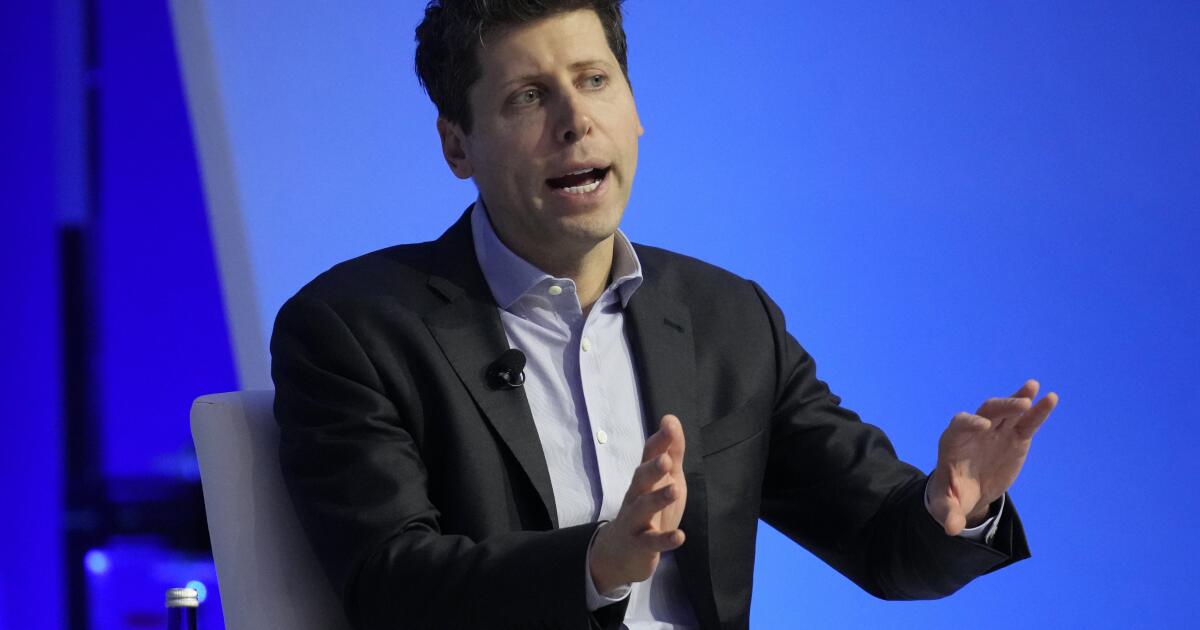
Hours after a Molotov cocktail was thrown at his San Francisco home, OpenAI Chief Executive Sam Altman addressed the criticism surrounding artificial intelligence that appears to have been the impetus for the attack.
In a lengthy blog post, Altman shared a family photo of his husband and child, stating he hopes it might convince people not to repeat the attack despite their opinions on him.
The San Francisco Police Department arrested a 20-year-old man in connection with the Friday morning attack but did not publicly comment on the motivation. Altman and his company, the maker of ChatGPT, have been at the center of a heated debate about whether AI will change the world for better or worse.
“While we have that debate, we should de-escalate the rhetoric and tactics and try to have fewer explosions in fewer homes, figuratively and literally,” Altman wrote.
The rise of AI chatbots that can generate text, images and code has raised concerns about whether there are enough guardrails around the development of the powerful technology.
From job displacement to the effects of AI on mental health and war, critics have been vocal about their fears. Families have also sued technology companies including OpenAI and Google, alleging in lawsuits that their chatbots contributed to the death of their loved ones. OpenAI has faced backlash after striking a deal with the Department of Defense shortly after its rival Anthropic raised AI safety concerns and lost its contract.
Politicians in California and other states have been passing new laws that target AI safety. And groups that aim to stop the development of AI have regularly protested outside OpenAI’s San Francisco headquarters.
In the blog post, Altman acknowledged the fear and anxiety surrounding AI was “justified” because “we are in the process of witnessing the largest change to society in a long time, and perhaps ever.” But he also said that people will do “incredible things” with AI and that “technological progress can make the future unbelievably good.”
Altman has become a controversial figure as companies race to advance AI. In 2023, OpenAI’s board of directors fired Altman, stating that he wasn’t “consistently candid” in his communications with the board and that board members had lost confidence in his ability to lead the company. OpenAI’s mission is to “ensure that artificial general intelligence benefits all humanity,” the board said at the time. Facing pressure from its employees and investors, OpenAI reinstated Altman as chief executive less than a week after he was pushed out. A new board was put in place and members who supported ousting Altman left.
Altman said in the blog post that he has made mistakes and done things he’s not proud of, describing himself as “conflict-averse.”
“I am not proud of handling myself badly in a conflict with our previous board that led to a huge mess for the company,” he wrote.
Since his return, OpenAI has expanded its presence in healthcare, retail, defense and other industries. But controversy has followed the company. OpenAI is currently in a legal battle with billionaire Elon Musk, who has accused the company of abandoning its nonprofit founding mission in a case that’s expected to head to trial. Musk, a co-founder and early investor in OpenAI, alleges he was manipulated into funding what he thought was a nonprofit but turned into a “moneymaking endeavor.” OpenAI alleges that Musk, who runs rival xAI, is suing to slow down a competitor.
Last week, the New Yorker published a lengthy story about Altman that posed the question about whether he could be trusted.
In his blog post, Altman referenced an “incendiary article” published about him but didn’t name the publication, adding that “words have power.” OpenAI didn’t immediately respond to a request for comment on Saturday. On the social media site X, Altman said he regretted using certain words in his blog after an editor from the AI newsletter Transformer pointed out that Altman implied that a critical piece of journalism was responsible for the attack.
Altman said the attack happened at 3:45 a.m. on Friday but the Molotov cocktail “bounced off the house and no one got hurt.”
The San Francisco Police Department and OpenAI previously confirmed the attack on Friday. The suspect allegedly made threats to OpenAI’s headquarters after the attack at Altman’s home.
Several news outlets, including the San Francisco Chronicle, identified the suspect as Daniel Alejandro Moreno-Gama.
Moreno-Gama was booked on Friday on suspicion of making criminal threats, arson, attempted murder, possession of a destructive device and other charges. The Chronicle also cited a Substack that appeared to be from the suspect that includes posts titled “AI Existential Risk.”
The Times asked the San Francisco Police Department on Saturday whether the account belonged to the suspect.
“At this time we have no further updates to provide,” the department said in an e-mail.

Survivors of the devastating Eaton fire called on state lawmakers on Wednesday to pass a bill requiring audits of spending by Southern California Edison and the state’s two other big for-profit electric companies on wildfire prevention.
The survivors pointed to an investigation by The Times that found that Edison had not spent hundreds of millions of dollars that it told regulators before the fire was needed to keep its transmission system safe. Edison had begun charging customers for the costs.
“Californians funded the wildfire prevention,” Joy Chen, executive director of Every Fire Survivor’s Network, told members of the Assembly Utilities and Energy Commission on Wednesday. ”And we survivors paid the price when that work was not done.”
While the government’s investigation into the fire has not yet been released, Edison has said it believes that a century-old transmission line, which had not carried power since 1971, may have briefly re-energized on the night of Jan. 7, 2025, to ignite the fire. The inferno killed 19 people and destroyed thousands of homes and other structures in Altadena.
Chen’s wildfire survivors group and Consumer Watchdog sponsored the bill, known as Assembly Bill 1744. It would require the wildfire safety spending by Edison, Pacific Gas & Electric and San Diego Gas & Electric to be audited by an independent accounting firm.
The state Public Utilities Commission would have to consider the audits’ findings before agreeing to raise customer rates to cover even more wildfire spending.
“Had Edison known it would be accountable for those funds, that wildfire may not have started,” Jamie Court of Consumer Watchdog told the committee, referring to the Eaton fire.
All three utilities said at the hearing they opposed the bill.
A lobbyist for San Diego Gas & Electric said he believed the audits were unnecessary because the commission was already reviewing the spending.
“We think it creates a duplicative process,” he said.
At the committee hearing, Edison’s lobbyist did not say why the company was opposed to the bill.
The company has previously said that safety is its top priority and that it does not believe maintenance on its transmission lines suffered before the Eaton fire.
Also voicing support for the bill at the hearing were survivors of other deadly wildfires in the state, including the 2018 Camp fire, which killed 85 people and destroyed much of the town of Paradise. Investigators found that the fire was ignited when equipment failed on a decades-old PG&E transmission line.
The bill’s author, Assemblywoman Tasha Boerner, an Encinitas Democrat, pointed to how independent audits of the three companies’ wildfire spending from 2019 to 2020 found that $2.5 billion could not be accounted for.
Those were the last independent audits of the three companies’ wildfire spending.
Despite the findings, the commission did not require the companies to return any of the questioned amounts to electric customers. Instead, the commission agreed the companies could spend billions of dollars more, Boerner said.
“This is frankly unacceptable,” she said.
Asked for a response to those audits, the lobbyist from San Diego Gas & Electric told the committee he wasn’t familiar with the findings.
California electric rates are the nation’s second highest after Hawaii.
In 2024, wildfire expenses amounted to 17% to 27% of the costs the three companies charge to consumers, according to a legislative analysis of Boerner’s bill. The average residential customer pays $250 to $490 a year for that spending.

Detroit Chinatown Vision Committee discusses Detroit Chinatown

Bay Area bike program pays commuters to ditch their cars

TxDOT Dallas Seeks Input on Proposed Widening of FM 740/FM 548

Man seriously hurt in Dorchester crash – Boston News, Weather, Sports | WHDH 7News

Historic 84-year-old Bonnie Brae gas station in Denver officially listed for sale by family

Florida High School Football Rankings: Top 25 teams – Oct. 21

How old is Bo Nix? What to know about Oregon quarterback ahead of 2024 NFL Draft

Cleary's 21 help Le Moyne down Central Connecticut State 69-64 in OT

99th annual Pony Swim held in Virginia

Indiana Members Credit Union announced as new anchor tenant at Bottleworks District

Embattled Rep Tony Gonzales announces plans to resign amid sexual misconduct allegations

UN experts slam attacks on Gaza shelters, forced displacement in West Bank

DOJ fires at least 4 prosecutors involved in FACE Act cases during Biden administration

Melania Trump’s Epstein remarks turn up the heat on DOJ, Acting AG Todd Blanche to do more
Newsletter: Cautious optimism in Brussels as Orbán ousted in landslide Hungarian opposition win
-

 Atlanta, GA1 week ago
1 teenage girl killed, another injured in shooting at Piedmont Park, police say
-

 Georgia7 days ago
Georgia House Special Runoff Election 2026 Live Results
-

 Arkansas4 days ago
Arkansas TV meteorologist Melinda Mayo retires after nearly four decades on air
-

 Pennsylvania1 week ago
Parents charged after toddler injured by wolf at Pennsylvania zoo
-
 Milwaukee, WI1 week ago
Potawatomi Casino Hotel evacuated after fire breaks out in rooftop HVAC system
-

 Technology1 week ago
Anthropic essentially bans OpenClaw from Claude by making subscribers pay extra
-

 Austin, TX6 days ago
ABC Kite Fest Returns to Austin for Annual Celebration – Austin Today
-

 World1 week ago
Zelenskyy warns US-Iran war could divert critical aid from Ukraine