Business
'We will not be closing.' Amid the fires, employers and employees walk a fine line between work and safety


When Brigitte Tran arrived Wednesday morning at the Rodeo Drive boutique where she works as a sales associate, she was on edge.
Smoke from multiple wildfires raging across Los Angeles County billowed overhead. The luxury shopping corridor usually bustling with tourists appeared a ghost town.
Tran’s co-worker texted their boss to let her know neighboring stores had closed, and described the acrid smoke in the air. But the woman, at home in Orange County, did not seem to grasp their concerns. “We will not be closing unless the mall instructs us to close,” she replied.
Tran, who, fearing professional repercussions, asked that her place of work not be named, grew more anxious as the hours ticked by. Around 3 p.m., she and the two other employees working that day mutinied. They packed up, told the security guard to head home, and locked the doors a few hours before closing time.
As the wildfires have raged across Los Angeles County, choking the air, closing schools and forcing tens of thousands of people to evacuate, employers and employees alike have had to manage a difficult balancing act between work and well being. Some employers responded swiftly to the crisis, shutting down offices and shifting to remote work, providing outdoor workers with masks and other protective equipment, and offering support for employees forced to evacuate. Others have been less adept, clumsy in their communications or wholly unmoved by worker concerns — sparking anger among their ranks as a result.
The fires have underscored the need for companies to have a clear plan in place to respond to emergencies, said Jonathan Porter, a meteorologist at private weather forecaster AccuWeather. The obligation, he said, goes beyond monitoring whether an office is in an evacuation zone. For example, as the current devastation unfolds, businesses should be aware of the “copious amounts of dangerous smoke that’s wafting into the air” and be prepared to provide outdoor workers with quality respirators or move them away from polluted air.
Some employers gave employees flexibility. Snap, the Santa Monica-based creator of the photo messaging app Snapchat, for example, kept its offices open on Wednesday but encouraged employees to work remotely, said a company spokesperson.
Others changed course after fielding criticism.
An announcement by UCLA that the campus would remain open for classes and regular operations on Wednesday drew anger from some instructors and students on social media.
Victor Narro, project director for the UCLA Labor Center and a lecturer on campus, said in a post on X he would ignore UCLA’s mandate and hold an optional class online.
“Students have been up all night panicked about sleeping through evacuation orders, winds still high, branches falling all over Westwood, power outages across city, & our new chancellor (on his 2nd day) thought this should be his first bold call…” wrote Nour Joudah, an assistant professor in UCLA’s Asian American Studies Department, in another X post.
That evening, UCLA changed course as conditions worsened, announcing it would close campus.
On Saturday, UCLA Chancellor Julio Frenk released a statement saying classes would be held remotely for at least another week and campus operations would be curtailed. “We ask for continued flexibility and understanding as we all work through these difficult times,” Frenk wrote.
But for many workers, the chaos of the last few dayshas left them feeling like they are fending for themselves.
Tim Hernandez, a driver with Amazon Flex, an on-demand Uber-like program in which people use their own cars to deliver packages, was assigned a route Tuesday along the Pacific Coast Highway toward Malibu, which was rife with closures.
When he questioned whether making the delivery was safe, he said dispatchers at a Amazon facility in Camarillo brushed him off, leaving him to choose between concerns for his safety and worries that his rating in the Flex app would be hurt if he refused to go. He decided to try to make the deliveries, battling gusts of wind that knocked him over at one point. He lost cell signal, however, and was forced to return to the warehouse without completing the vast majority.
And when he arrived for his shift Tuesday, Alfred Muñoz, 43, an Amazon delivery driver who works out of a warehouse in the City of Industry, said he was handed an N95 mask but given little other instruction.
“It was just kind of business as usual,” Muñoz said.
High package counts and the number of stops on his assigned routes this week have made work even more difficult. On Tuesday, with wind gusts whipping debris around making it difficult to see, he had about 180 stops and 290 packages to deliver. On Thursday, the air thick with smoke and ash, he had more than 300 packages.
He woke up Thursday morning with a bloody nose and a sooty black crust in the corners of his eyes.
In response to a request for comment, Montana MacLachlan, an Amazon spokesperson, said the company was “closely monitoring the wildfires across Southern California and adjusting our operations to keep our employees and those delivering for us safe.”
“If a driver arrives at a delivery location and the conditions are not safe to make a delivery, they are not expected to do so and the driver’s performance will not be impacted,” she said.
At the Brentwood location of popular Italian eatery Jon & Vinny’s, staff complained of headaches and sore throats in a text message group chat. An employee, who asked not to be named fearing retaliation at work, said that on Tuesday, staff huddled around an iPad with a fire map pulled up to keep an eye on the expanding evacuation zone. From the front of the restaurant, they could see the glow of the Palisades fire.
The employee said they were frustrated management kept the restaurant open when the perimeter of the mandatory evacuation zone was just two blocks away. On Wednesday, every server scheduled to work called in to say they were not coming, the employee said.
A spokesperson for Joint Venture Restaurant Group, which owns Jon & Vinny’s, did not immediately respond to a request for comment.
During natural disasters and extreme weather, employers’ choices can sometimes mean life or death, said David Michaels, a professor at the Milken Institute School of Public Health and a former assistant secretary of labor for the Occupational Safety and Health Administration.
He pointed to recent floods from Hurricane Helene that killed several workers at a plastics manufacturer. The tragedy has drawn scrutiny from state investigators, and a wrongful death lawsuit accuses the company of requiring employees to stay on site amid flooding after they requested permission to leave.
“It’s incumbent on employers to ensure the safety of their workers,” Michaels said. “The safety of their employees must take precedence over business concerns.”
Yasha Timenovich, 48, a driver for rideshare app Lyft and food delivery platform DoorDash, is more worried about declining earnings than on-the-job safety. With many restaurants and other businesses closed and would-be customers fleeing the city, he said that rides and deliveries have been slow. Traffic patterns have been strange and unpredictable with families piling into vehicles to flee fires.
Timenovich, who faced an order to evacuate his Hollywood apartment with his fiance and 6-year-old daughter Wednesday night, said he planned to stay with relatives for a few days in San Luis Obispo, where he hopes business will be better.
“I’m going to get out of here because it’s too crazy with these fires,” Timenovich said.

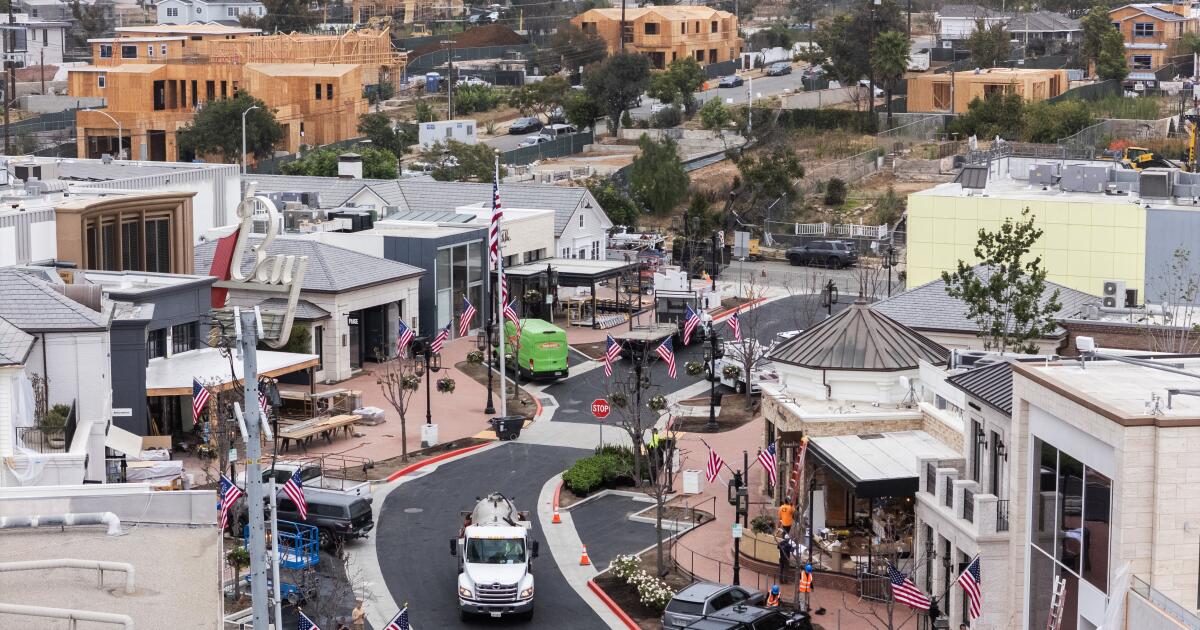
The luxury shopping center in Pacific Palisades will reopen next month after more than $100 million in renovations forced by the January 2025 wildfire that devastated the Los Angeles neighborhood.
Palisades Village will reopen Aug. 15, owner Rick Caruso announced Wednesday. The outdoor center survived the blaze that destroyed homes and other businesses but needed refurbishment to eliminate contaminants that the fire could have spread.
Crews are putting finishing touches on mall buildings after tearing them down to the studs, treating the wood and rebuilding the walls, Caruso said.
“Everybody’s working, and stores are moving their products in,” he said. “It’s a really cool feeling that people have really locked arms and are working together.”
An electrician installs lighting for a restaurant at Rick Caruso’s Palisades Village on Thursday. The shopping center is scheduled to reopen mid-August.
(Myung J. Chun / Los Angeles Times)
Pacific Palisades resident Allison Polhill, who is rebuilding the home of 30 years that her family lost in the blaze, said she is “thrilled” at the prospect of returning to the mall she used to frequent. Its comeback is a boost for the community, she said.
“Every single step that we make to reopen our commercial corridors is going to bring more people back into the Palisades,” said Polhill, who expects to move back into her home at the end of August.
A total of 6,822 structures were destroyed in the Palisades fire, including more than 5,500 residences and 100 commercial businesses, according to the California Department of Forestry and Fire Protection.
Caruso previously attributed the mall’s survival to the hard work of private firefighters and the fire-resistant materials used in the mall’s construction.
The $200-million shopping and dining center opened in 2018 with a movie theater and a roster of upmarket tenants, including Erewhon, which may be the only grocer in the heart of the fire-ravaged neighborhood when it opens.
Caruso’s company was able to fill the mall with tenants despite the long shutdown.
Palisades Village is 99% leased, with the majority of tenants returning, said Jackie Levy, chief financial and revenue officer. Nearly one-third of the shops and restaurants are new to the property.
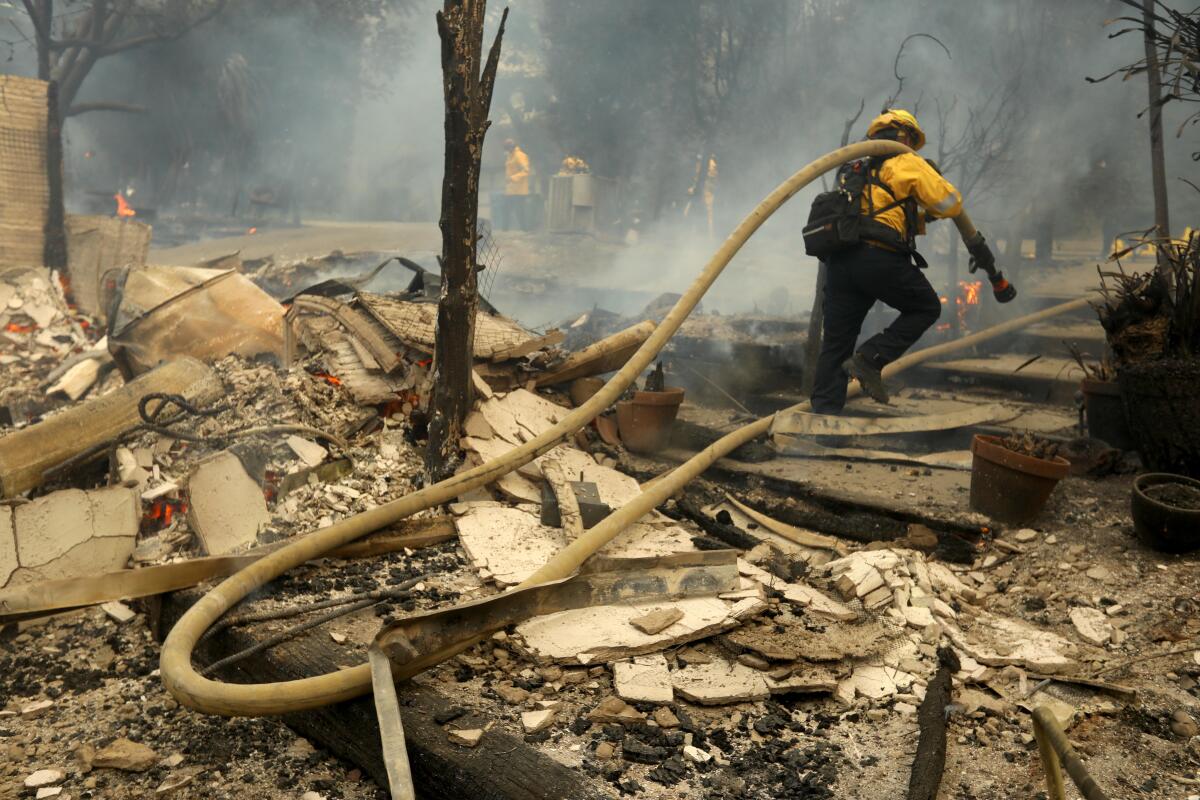
A firefighter carries a hose back to his rig while walking through a destroyed home from the Palisades fire in Pacific Palisades on Jan. 7, 2025.
(Genaro Molina / Los Angeles Times)
Last year, Pacific Palisades-based fashion designer Elyse Walker said she would reopen her eponymous store in Palisades Village after losing her 25-year flagship location on Antioch Street to the inferno.
Other neighborhood shops destroyed in the fire that are reopening at the mall include K Bakery and Loomey’s Toys, which caters to children up to age 12 and used to be across the street from Palisades Elementary Charter School.
“It’s been a journey and I’m excited because I wasn’t sure that there was going to be a place to come back to,” said toy store owner Amanda Rastegar. “Hopefully we can bring some of that magic back.”
Rastegar’s home in the Palisades survived but was damaged by the fire. The family returned about eight weeks ago. Her last memory of the fire was a burning supermarket.
“I just couldn’t wrap my brain around what was happening,” she said. “By the time I left, Gelson’s was on fire.”
Among the returning tenants is Angelini Ristorante & Bar. Well-known Los Angeles chef Gino Angelini said he will be in the kitchen next month for a return of the Italian restaurant.
“We won’t do a big celebrity open,” he said. “We want to have a very soft opening and see our customers come back.”

Construction takes place at Rick Caruso’s Palisades Village on Thursday. The shopping center is scheduled to reopen mid-August.
(Myung J. Chun / Los Angeles Times)
An elaborate celebration would not feel “correct for me,” Angelini said, because the devastation has been “very sad” for so many.
Other new tenants include local chef Nancy Silverton, who has agreed to move in with a new Italian steakhouse called Spacca Tutto. Women’s activewear retailer LESET will open its first West Coast location.
Caruso said he is optimistic that customers will return to the center, even though many Pacific Palisades residents are still dispersed. One tracking system estimated that about 30% of the Village’s customer base was impacted by the fire, he said.
“That means 70% did not get impacted, so there’s a lot of customers still left out there,” Caruso said. Historically, the center drew customers from as far away as Beverly Hills and Calabasas, as well as Malibu, Brentwood and Santa Monica.
He also hopes many will be inspired to visit the revived mall.
“I believe in the goodness of people and I believe that people are going to want to support the Palisades,” he said. “They’re going to want to be there and support the businesses that have had the courage and the heart to reopen.”

Walmart is rapidly expanding its network of electric vehicle chargers designed for customers to use while they shop.
The network could help fill gaps in EV infrastructure in states with greater need for chargers. Walmart, which has more than 5,000 locations in the U.S. and hundreds in California, says more than 90% of Americans live within 10 miles of one of its stores.
The chargers also offer an incentive for customers to choose Walmart — Walmart Plus members will receive a 10% discount off an average price of $0.46 per kilowatt-hour of energy at the company’s chargers.
Walmart chargers are already available at more than 75 locations in 17 states, with Texas boasting the most charging stations, followed by Florida and Arizona.
Matthew Nelson, Walmart’s director of energy policy, said last week on LinkedIn that the network will soon reach 29 states, including California.
“We are delivering on the promise of affordable, reliable and convenient charging,” Nelson said in his post.
According to Walmart’s website, six charging stations are coming to California soon, though the company did not offer a specific timeline.
The chargers will be installed at stores in Antelope, Brea, Fresno, Stockton, Suisun City and Vallejo.
Most charging sites in California will include eight to 16 fast-charging stalls, said Walmart spokesperson Kelsey Bohl.
The company first announced plans in April 2023 to install its own EV chargers at Walmart and Sam’s Club stores, with a goal of installing thousands of chargers by 2030. Partnering with ABB E-Mobility and Alpitronic, it added 25 new charging sites this past May and six more in June.
“Walmart is building a leading retail-integrated EV fast-charging network, focused on delivering an affordable, reliable and convenient charging experience where customers already shop,” Bohl said in an emailed statement. “Customers can charge while they shop, access stations through the Walmart app they already use, and benefit from affordable pricing.”
The charging stations already available include 612 individual charging stalls using 400-kilowatt chargers. Each stall has a dual charging cord with both Combined Charging System and North American Charging Standard connectors. The standard connectors, designed by Tesla, are smaller and lighter than the combined systems.
The primary way to pay for the chargers is through the Walmart app, but the company is also experimenting with built-in credit card readers to allow those without the app to use the stations.
Customers can check charger availability on the Walmart app. The company said the chargers will be available 24 hours a day.

Robotaxis could be turning into robocops.
A self-driving Waymo reported two teens to San Mateo, Calif., police on Monday after they were found drinking alcohol and shooting toy guns in the back of the vehicle.
According to a social media post from the San Mateo Police Department, officers detained two 15-year-olds after the Waymo they were riding in contacted the department and stopped in a parking lot until law enforcement arrived.
“Parents do you know where your teens are?” the San Mateo Police Department wrote on Facebook following the incident. “Waymo does!”
Officers removed both teens from the vehicle and determined they were using toy guns to shoot Orbeez out the windows. Orbeez are small, water-absorbing beads sold at toy stores.
“Toy guns, water guns, and BB guns all pose real dangers, especially to an untrained eye,” the Police Department said. “The simple handling of them can cause fear in [passersby].” “
A video posted on Facebook shows at least five officers and a police dog responding to the scene and approaching the Waymo with their weapons raised.
Waymo did not immediately respond to a request for comment.
Waymo vehicles have internal cameras and microphones that may be used in an emergency or to “promote safety and security,” according to Waymo’s online support page.
The cameras are also used to ensure the vehicles are clean and to help find lost items, according to the support page.
The company said it does not use facial recognition or other biometric identification technologies to identify individuals.
“In more urgent circumstances, support may access live video during a trip,” the Waymo page said.
The San Mateo Police Department’s Facebook post has garnered nearly 60 comments, with one user accusing Waymo of “snitching.”
“At least they got a designated driver?!” one user commented.
-

 Washington34 seconds ago
Future uncertain for site of former Mount Washington church destroyed in massive fire
-

 Wisconsin3 minutes ago
South Milwaukee, Wisconsin, officials in standoff with homeowner over year-round skeleton display
-

 West Virginia9 minutes ago
West Virginia coach Rich Rodriguez wants to save college football. Here’s his pitch:
-

 Wyoming16 minutes ago
Cathy Holman named 2026 Mick & Susie McMurry Cowboy Code Try Award recipient
-

 Crypto18 minutes ago
LAB Token Crashes 80% to $1.25 as $5B Market Cap Vanishes in 48 Hours
-

 Finance24 minutes ago
Intact Financial provides update on Q2 catastrophe and large losses
-

 Fitness31 minutes ago
Wellness Wednesday: Exercise & heart disease
-

 Movie Reviews38 minutes ago
‘The Guest’ Review: Trine Dyrholm Gives a Scorcher of a Performance in a Gutsy Danish Party-Gone-Wrong Drama

