Business
US and China Meet for First Time Since Trump Imposed Tariffs


Top economic officials from the United States and China are meeting in Geneva on Saturday for high-stakes negotiations that could determine the fate of a global economy that has been jolted by President Trump’s trade war.
The meetings, scheduled to continue on Sunday, are the first since Mr. Trump ratcheted up tariffs on Chinese imports to 145 percent and China retaliated with its own levies of 125 percent on U.S. goods. The tit-for-tat effectively cut off trade between the world’s largest economies while raising the possibility of a global economic downturn.
While the stakes for the meetings are high, expectations for a breakthrough that results in a meaningful reduction in tariffs are low. It has taken weeks for China and the United States to even agree to talk, and many analysts expect this weekend’s discussions to revolve around determining what each side wants and how negotiations could move forward.
Still, the fact that Beijing and Washington are finally talking has raised hopes that the tension between them could be defused and that the tariffs could ultimately be lowered. The impact of the levies is already rippling across the global economy, reorienting supply chains and causing businesses to pass additional costs onto consumers.
The negotiations will be watched closely by economists and investors, who fear that a U.S.-Chinese economic war will lead to slower growth and higher prices around the world. Businesses, particularly those that rely on Chinese imports, are also on high alert about the talks as they grapple with how to cope with the new taxes and the uncertainty about whether they will remain in place.
“Both the U.S. and China have strong economic and financial interests in de-escalating their trade hostilities, but a durable détente is hardly in the offing,” said Eswar Prasad, a former director of the International Monetary Fund’s China division.
“Nevertheless,” he added, “it represents significant progress that the two sides are at least initiating high-level negotiations, offering the hope that they will temper their rhetoric and pull back from further overt hostilities on trade and other aspects of their economic relationship.”
The Trump administration’s negotiators are being led by Treasury Secretary Scott Bessent, a former hedge fund manager who has said the current tariff levels are unsustainable. He will be joined by Jamieson Greer, the U.S. trade representative, who helped design Mr. Trump’s first-term trade agenda, which included a “Phase 1” deal with China. Mr. Trump’s hawkish trade adviser, Peter Navarro, was not scheduled to participate in the talks.
He Lifeng, China’s vice premier for economic policy, is leading the talks on behalf of Beijing. The Chinese government has not confirmed who else will be with Mr. He at the meetings or if Wang Xiaohong, China’s minister of public security, who directs its narcotics control commission, will attend. Mr. Wang’s participation would be a sign that the two sides might discuss Mr. Trump’s concerns about China’s role in helping fentanyl flow into the United States.
The trade fight has started to take a toll on the world’s largest economies. On Friday, China reported that its exports to the United States in April dropped 21 percent from a year earlier. Some of the largest U.S. companies have said they will have to raise prices to deal with the tariffs, cutting against Mr. Trump’s promise to “end” inflation.
On Friday, Mr. Trump signaled that he was prepared to begin lowering tariffs, suggesting that an 80 percent rate on Chinese imports seemed appropriate. Later in the day, referring to the China trade talks, Mr. Trump said, “We have to make a great deal for America.” He added that he would not be disappointed if a deal was not reached right away, arguing that not doing business is also a good deal for the United States.
The president also reiterated that he had suggested lowering the China tariffs to 80 percent, adding, “We’ll see how that works out.”
The Trump administration has accused China of unfairly subsidizing key sectors of its economy and flooding the world with cheap goods. The United States has also been pressuring China to take more aggressive steps to curb exports of precursors for fentanyl, a drug that has killed millions of Americans.
China has been steadfast in saying it does not intend to make trade concessions in response to Mr. Trump’s tariffs. Officials have insisted that the nation agreed to engage in talks at the request of the United States.
“This tariff war was launched by the U.S. side,” Liu Pengyu, the spokesman for the Chinese Embassy in Washington, said this week. “If the U.S. genuinely wants a negotiated solution, it should stop making threats and exerting pressure, and engage in talks with China on the basis of equality, mutual respect and mutual benefit.”
An 80 percent tariff, while a big drop from the current 145 percent, would still most likely shut off most trade between the countries.
China and the United States could take other concrete gestures to help pave the way for future negotiations, other experts said.
One option would be to scale back tariffs to about 20 percent, where they were in early April before Mr. Trump announced 34 percent levies on goods from China and mutual retaliation ensued, said Wu Xinbo, the dean of the Institute of International Studies at Fudan University in Shanghai.
“If we can scale back to that stage, then I think it will be a major progress in leading towards more constructive negotiations,” Mr. Wu said.
He said China was prepared to talk about fentanyl as a separate issue, adding that China had offered to sit down with the Trump administration in February after Mr. Trump first announced plans to impose tariffs on Chinese goods, citing the flow of illegal fentanyl into the United States.
The United States and China are meeting in proximity to the headquarters of the World Trade Organization, which has sharply criticized Mr. Trump’s tariff wars. The group has forecast that the continued division of the global economy into “rival blocs” could cut global gross domestic product by nearly 7 percent over the long run, particularly harming the world’s poorest countries. A spokesman for the W.T.O. said it welcomed the talks as a step toward de-escalation.
The alternative — a world in which the United States and China no longer engage in trade — could be economically painful and destabilizing. American consumers, who have come to rely on cheap goods from China, could soon confront thinly stocked store shelves and high prices for the products that remain.
The National Retail Federation said on Friday that import cargo traffic in the United States is expected to decline this year for the first time since 2023, when supply chain problems were persistent, and attributed the decline to Mr. Trump’s tariffs.
“We are starting to see the true impact of President Trump’s tariffs on the supply chain,” said Jonathan Gold, the retail federation’s vice president for supply chain and customs policy. “In the end, these tariffs will affect consumers in the form of higher prices and less availability on store shelves.”
The Trump administration has been racing to make trade deals with 17 other major trading partners after the president’s decision to pause the reciprocal tariffs he announced in April. On Friday, he hailed a preliminary agreement with Britain as evidence that his tariff strategy was working.
Economists have been heartened by signs that the White House appears ready to scale back tariffs.
“This rush to demonstrate progress on ‘deals’ reveals a rising desperation within the administration to roll back tariffs before they hit G.D.P. growth and inflation,” Paul Ashworth, chief North America economist for Capital Economics, wrote in a note to clients. “With the slump in incoming container ships from China raising fears of imminent shortages in the U.S., the pressure is building on the Trump administration to de-escalate that tariff buildup.”
Capital Economics estimates that if the United States lowered its tariffs on China to 54 percent, the overall effective tariff rate on imports for the United States would fall to 15 percent from 23 percent. That would put its growth and inflation forecasts back in line with its estimates from earlier this year that were based on Mr. Trump’s campaign pledges.
It remains unclear whether Mr. Trump would accept a 54 percent tariff rate.
On Friday, he suggested that he was prepared to lower tariffs to 80 percent as he gave Mr. Bessent the authority to make a deal.
“80% Tariff on China seems right! Up to Scott B.,” Mr. Trump wrote on Truth Social, his social media platform.
Later in the day, his press secretary, Karoline Leavitt, said that 80 percent figure was not an official offer and was instead “a number that the president threw out there.” She added that Mr. Trump would not lower tariffs on China unless Beijing also reduced its levies.



Business
Consumers aren’t clicking the PayPal button. It’s a big problem for California’s fintech pioneer

PayPal, once the cutting-edge trailblazer of digital payments, is struggling to cash in on consumer clicks like it used to.
The San José fintech giant is losing market share to competitors and had to swap out its leadership recently as its shares plunged, and it scrambled for a faster fix.
When online shoppers reach the checkout screen, they’re not clicking on the PayPal button to buy items as much as they did in the past. People have payment options from Apple, Google and others, some of which are easier to use on their smartphones.
A slowdown in PayPal’s branded checkout is at the core of the company’s biggest challenges, analysts and company executives said.
In February, PayPal let go of its chief executive, who had been working to fix the problem, but the company said his “pace of change and execution” over two years didn’t meet the board’s expectations.
In the fourth quarter, PayPal’s online branded checkout growth slowed to 1%. The company reported an adjusted profit of $1.23 per share on revenue of $8.68 billion, missing Wall Street’s expectations.
Since January, PayPal’s stock price has fallen by more than 20%.
“The problem is that transition and push for branded checkout really has not paid off,” said Grace Broadbent, a senior analyst of payments for eMarketer.
PayPal attributed the slowdown partly to the “K-shaped economy,” in which wealthier Americans see their incomes rise while lower-income Americans struggle financially. PayPal has many middle-income customers and some lower-income customers, so a pullback in spending affects use of its payments platform.
Other factors that have hurt it recently include product execution and a hit in high-growth areas such as crypto, gaming and ticketing.
The slowdown raised questions about whether PayPal’s turnaround efforts were working. The company makes most of its money by charging fees for payment services.
“The vast majority of PayPal’s profits come from the branded checkout button,” said Mizuho analyst Dan Dolev. “The yield they get when you click on the branded checkout button is multiples of any other product that they have.”
Now the pressure is on Enrique Lores, who became PayPal’s president and chief executive in March, to get the company back on track. Lores was on PayPal’s board for nearly five years and came from computer and printer maker HP, where he served as chief executive. PayPal is investing $400 million to improve and grow branded checkout this year.
“The payments industry is changing faster than ever, driven by new technologies, evolving regulations, an increasingly competitive landscape, and the rapid acceleration of AI that is reshaping commerce daily,” Lores said in a February statement. “PayPal sits at the center of this change, and I look forward to leading the team to accelerate the delivery of new innovations.”
PayPal has seen growth in its subsidiary Venmo, a social mobile payment app, and its buy-now-pay-later services. The company is scheduled to report its first-quarter earnings in May.
“They’re going through some hard times, but I still think there’s a lot of value in PayPal,” Dolev said. “Not that many companies out there that have this kind of moat, which is a global wallet that everyone recognizes.”
Before PayPal transformed into a multibillion-dollar company with 23,800 employees and 439 million active consumer and merchant accounts across roughly 200 markets, the startup weathered a lot of change.
Founded in 1998 under a different company name by Max Levchin, Peter Thiel and Luke Nosek, the startup initially focused on security software for handheld devices before shifting to digital payments.
After merging with Elon Musk’s online bank X.com, the company was renamed PayPal. The platform made it possible for people to securely send money digitally using their email address, which was easier than writing up a check or filling out a money order.
PayPal went public in 2002 and shortly after EBay acquired the startup for $1.5 billion. In 2013, PayPal acquired the fintech company Braintree, which owned the social payment service Venmo, giving PayPal an edge in mobile commerce.
Two years later, it became an independent company when it split from EBay.
PayPal’s founders and early employees, dubbed the “PayPal Mafia” by Fortune magazine in a 2007 story, would go on to invest or build successful Silicon Valley companies.
During the COVID-19 pandemic in 2020, PayPal was flying high. People spent a lot of time stuck at home and online shopping skyrocketed. PayPal’s stock price peaked in July 2021, but has plummeted since then.
Over the last five years, its share price has dropped more than 80%.
“Now the industry is maturing, so there’s less growth to go around,” Broadbent said.
The competition is heating up, especially in the United States.
PayPal’s core users in the United States are projected to grow by fewer than 1% year-over-year to 92.1 million in 2026, eMarketer forecasts. Nationwide, Apple and Google are expected to see their digital wallet users grow more, reaching 90.5 million and 55 million U.S. users, respectively.
Apple Pay is popular among Gen Z and makes it easy to pay by double-clicking the side of their phone.
“They do so much more shopping on their phone than ever before, so Apple Pay is ingrained in their iPhone,” Broadbent said.
Google has also integrated its payment service into products such as its browser, Google Chrome. Then there are more buy-now-pay-later services that people are taking advantage of as they spread out their spending on expensive items.
Other challenges are on the horizon for payment services.
Tech companies are contending with the rise of artificial intelligence, which could disrupt the way people shop. Tech executives have talked about a future in which AI agents will shop and buy items on behalf of consumers, with their approval.
Last year, PayPal teamed up with AI company Perplexity so people could use its service to purchase products from retailers such as Abercrombie & Fitch and Ashley Furniture within Perplexity’s chat interface.
“That’s a future challenge for PayPal that opens up a lot of different dynamics of who’s gonna win,” Broadbent said.
Business
Downtown L.A.’s cratering real estate market is changing — rich renters are buying their buildings
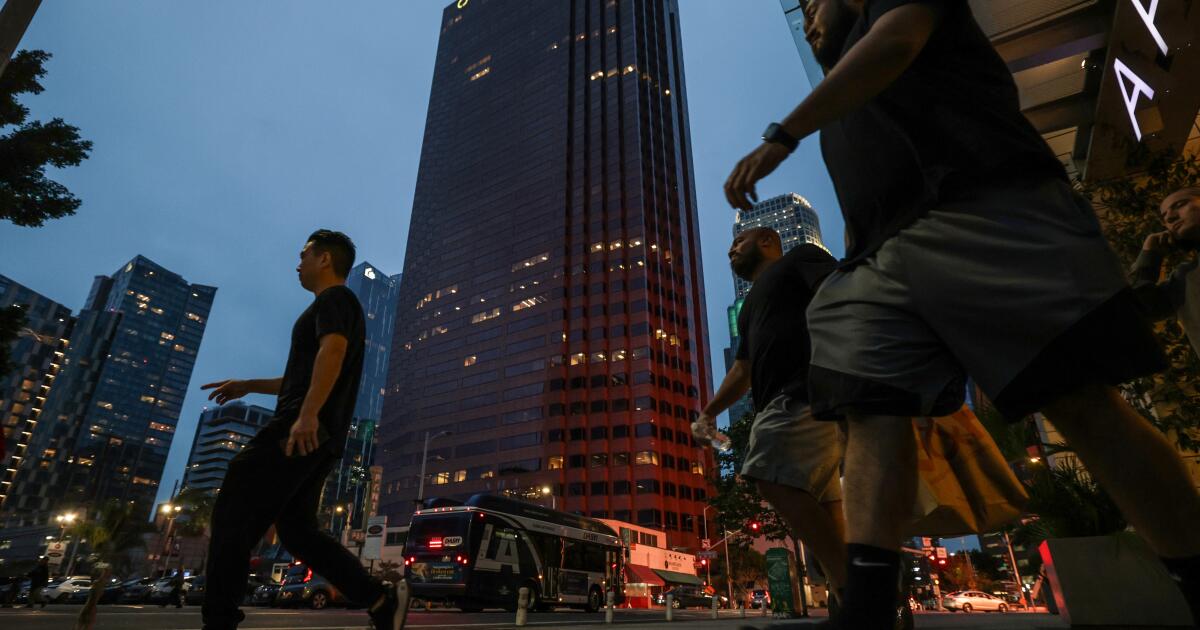
As the office market bottoms out after a long fall, renters are swooping in to buy their own buildings.
Occupant businesses are seizing the opportunity to become owners, especially in downtown Los Angeles, where glittering high-rises have plummeted in value since occupancy dropped during the pandemic. It has never fully recovered, but investors believe the market has at least stabilized.
Among the latest to snag a skyscraper is fund manager Capital Group, which has agreed to pay about $210 million for the 55-story Bank of America Plaza atop Bunker Hill, where it has offices. Others choosing to buy over rent include Riot Games and the Los Angeles Department of Water and Power.
“We knew the best landlord we could possibly have would be ourselves,” Capital Group Chief Executive Mike Gitlin said.
There are some good reasons tenants want to become landlords right now, Newmark property broker Kevin Shannon said, starting with timing.
“Everyone knows we’re near the bottom of this cycle, and it’s always good to buy near the bottom,” he said.
Downtown has suffered from an oversupply of office space since a building spree in the 1980s and early 1990s. The lack of rent-paying tenants that has driven down office values has become more acute since the pandemic. Nearly 40% of the office space in the financial district was available at the end of last year, according to CBRE. Overall vacancy downtown has climbed from 14% in 2019 to 34%.
Investors are finding deals to be had that include trophy properties such as San Francisco’s Transamerica Pyramid, a 48-story tower that has served as a symbol of the city since its completion in the 1970s. A European investment firm, Yoda PLC, recently paid around $690 million for the building, reflecting a deep loss for the previous owner, who had invested about $1 billion to buy and improve the famous skyscraper, according to CoStar.
A sign of the bottom of falling values is that office leasing levels seem to have stabilized, Shannon said.
“We’re far enough past COVID that office users are comfortable” and know how much space they’ll need going forward, he said.
Recent changes in federal tax laws regarding property depreciation benefits have added incentive, he said, and with office leasing improving around the country, lenders are looking more favorably on backing office purchases.
By owning their own buildings, white-shoe firms can maintain their properties in their own image.
Capital Group is already an anchor tenant in Bank of America Plaza, and it will consolidate other offices there after the sale closes.
Renters are taking advantage of the depressed office market and buying their own building, including Bank of America Plaza at 333 S. Hope St. which was just purchased by investment firm Capital Group.
(Robert Gauthier / Los Angeles Times)
“The best way to ensure a great environment in downtown L.A. is to create what we’re calling a vertical campus,” Gitlin said. “It was just this unique opportunity where the price was much lower than it had been historically, and it was for sale.”
Capital Group declined to confirm the reported $210-million sale price, but the building was last appraised in late 2024 at $212.5 million, down from $605 million 10 years earlier, according to Bloomberg.
Shannon said Capital Group paid about $150 per square foot for a property that would cost as much as $800 a foot to build at current costs. It will end up occupying the majority of the 1.4-million-square-foot building with 2,100 employees.
Owner-users have surged as key players in L.A.’s office market, now accounting for nearly half of all deals, real estate data provider CoStar said, while institutional investors’ share of purchases has fallen from 45% to 26%.
Office users from the public sector are among the buyers. The city of Los Angeles plans to buy a 35-story tower downtown for use by the Department of Water and Power.
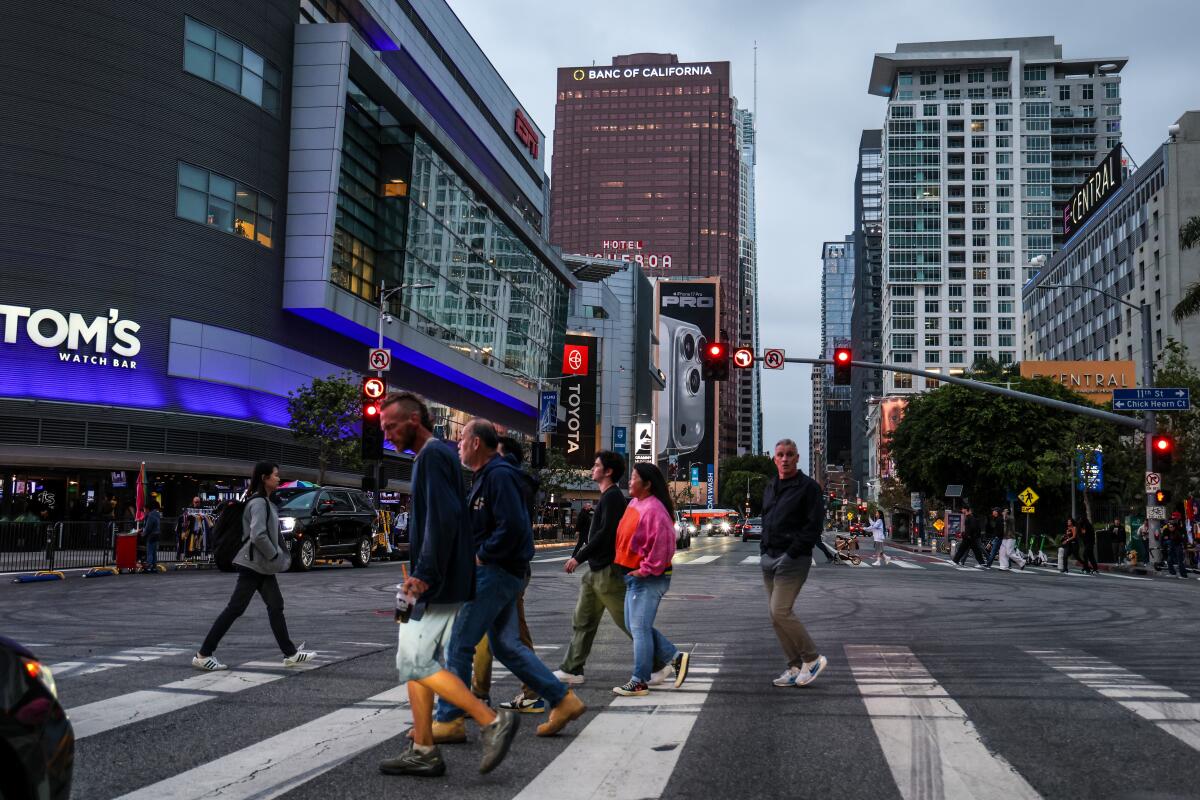
The depressed office market in downtown Los Angeles has some renters looking to buy their own buildings.
(Robert Gauthier / Los Angeles Times)
Manulife U.S. Real Estate Investment Trust said this week that it would sell its high-rise at 865 S. Figueroa St. for $92.5 million pending approval from Los Angeles officials. It has an assessed value of $248 million.
The DWP confirmed in a statement that its negotiators will bring a proposal to the Board of Water and Power Commissioners next month to buy the Figueroa Street property. The polished red granite-clad building north of L.A. Live has been a prestigious corporate address since its completion in 1990.
“If approved, this acquisition would provide needed office space to support the expansion of LADWP’s workforce, consolidate operations and maintain the reliable delivery of water and power to the city of Los Angeles,” spokeswoman Renee A. Vazquez said.
Another major public buyer of a downtown office building was Los Angeles County, which in 2024 bought Gas Co. Tower for $200 million, a steep drop from its $632-million valuation in 2020. County officials said at the time that the foreclosure sale was too good a deal to pass up.
The county is gradually moving workers into the 55-story skyscraper at the base of Bunker Hill that was widely considered one of the city’s most desirable office buildings when it was completed in 1991.
A major renter takeover on the Westside happened in December, when video game giant Riot Games bought its five-building headquarters campus in the Sawtelle neighborhood for $150 million, one of the priciest Los Angeles office sales of the year.
The campus is home to a movie-studio-like environment that includes theaters and one of the largest commercial kitchens on the Westside, serving a wide range of fare that changes daily and is provided free to the company’s employees. Among the company’s well-known products is “League of Legends,” a multiplayer online battle arena video game played daily by millions of people around the world.
The colorful campus “unlocks the creative heart and spirit of Riot,” Chief Executive Dylan Jadeja said. “When the opportunity came up to own the property, we knew it made sense to invest for the long term. This allows us to continue cultivating an environment that reflects our mission and enables Rioters to do their life’s best work.”
The Sawtelle complex has been Riot Games’ global headquarters since 2015.
“It’s become far more than just an office for us,” Jadeja said. “This is where Rioters have pushed the boundaries of game development in service of delivering incredible games and experiences to players around the world.”
Business
Gas is $10 a gallon at a Big Sur station. The owner explains why his prices can’t go higher
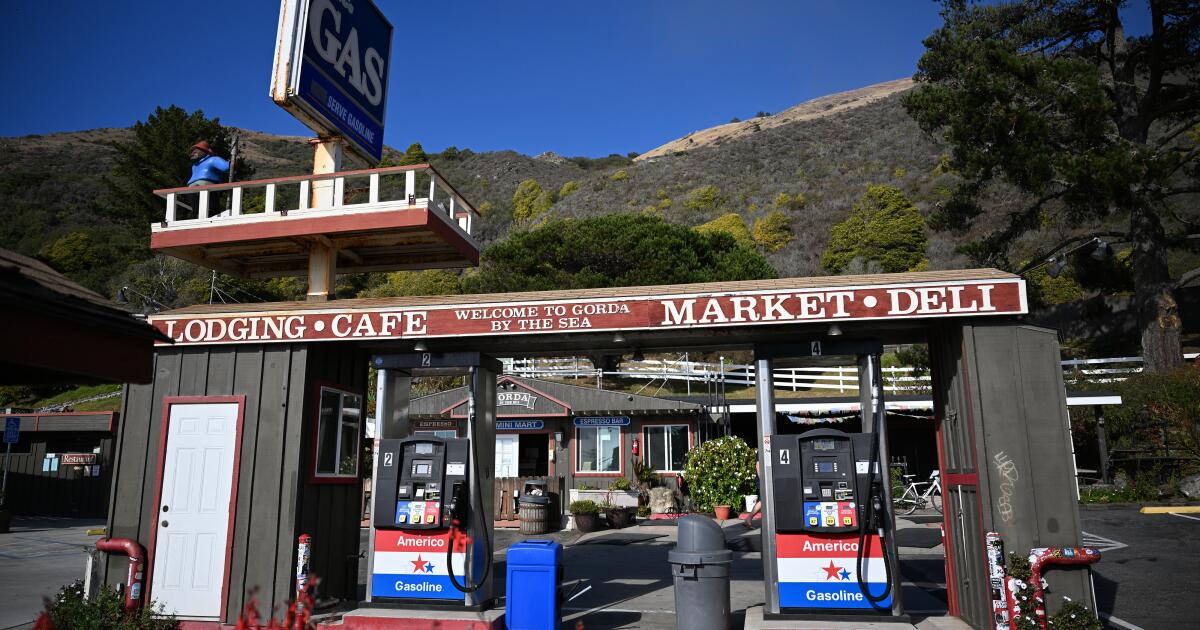
The owner of Gorda by the Sea, the lone gas station for several miles in any direction from this remote, scenic hamlet in Big Sur, is charging $9.99 for a gallon of gas because, well, that’s as high as the digital numbers on the gas pumps allow.
“The software only goes to $10,” said Leo Flores, owner of the gas station and mini-market. “I know, sometimes someone wants to make a good story because of it, but we have to tell you why.”
As the lone gas station for at least 12 miles along Highway 1, the service station often prompts drivers to gasp or clutch their wallets at the sight of a $9.99 price tag for a gallon, but Flores insists he’s not trying to price-gouge his customers. In fact, he’s worried that if gas prices go much higher, it might put him out of business.
“People think you make money, but I’m not,” he said in an interview with The Times.
Motorists across the country have been griping since gasoline prices began to surge last month after the start of the U.S.-Israeli war on Iran, which restricted the flow of oil from key oil-producing countries. Flores’ business is an example of how sky-rocketing fuel prices are having ripple effects throughout the economy.
The isolated gas station has been featured in the news in the past for its high prices, but Flores, who has owned the station for the last 30 years, said there’s a simple reason why the cost is so high.
“We run this place on generators,” he said. “The generators run on five to six gallons of gasoline every hour.”
It’s not just the gas station that runs on generators, he said. The small oceanside community surrounding the gas station — the mini-market, the cafe, the hotel and nearby cabins — is owned by Flores and runs on generators because there is no access to an outside electrical plant.
“When I explain why to people, they’re happy to pay what I ask them,” Flores said. “It costs me more to make my own electricity.”
According to AAA, as of Friday the national average cost of a gallon of regular gas is up to $4.09, and in California it’s $5.86. In Los Angeles County it’s even higher — about $6 a gallon. At gas stations around Gorda by the Sea, the average cost also sits at $6, according to AAA.
Flores said he has considered using solar panels to generate electricity, but the initial cost is high. To raise his gas prices any higher, he’d have to buy new pumps, an investment he’s not sure he could afford now.
High prices are not his only worry. The entire hamlet can operate only if Flores’ regular gasoline deliveries make it through on Highway 1 every two weeks.
When the highway shut down for three years because of landslides starting in 2023, he said, he struggled to get gas deliveries to run his generators and survived on only 10% to 20% of the business he normally sees. He barely made it, he said, until the highway reopening in January.
“It’s a big deal,” he said. “If the highway is closed in both directions, I’m screwed.”
Flores complained that no one pays attention to his struggles when Highway 1 closes, but it’s another story when gas prices spike.
“Why when the highway opens and I raise the price everyone points at me like I’m the bad guy?”

Greenpeace seeks new trial in $345M Dakota Access Pipeline lawsuit

April 9 concert pairs Marionaires with Ohio State Marion singers

Oklahoma Pitching Coach Jennifer Rocha ‘Forever Grateful’ to Karlie Keeney

Young Oregon Ducks running backs Davison, Hill ready to lead in 2026

MSU football locks in official visit with underrated CB prospect from Pennsylvania

Florida High School Football Rankings: Top 25 teams – Oct. 21

How old is Bo Nix? What to know about Oregon quarterback ahead of 2024 NFL Draft

Cleary's 21 help Le Moyne down Central Connecticut State 69-64 in OT

99th annual Pony Swim held in Virginia

Indiana Members Credit Union announced as new anchor tenant at Bottleworks District

DHS slams Democrat Sen Chris Van Hollen claim, says illegal alien caused crash while fleeing ICE

Zelenskyy warns US-Iran war could divert critical aid from Ukraine

After the Minnesota surge, ICE is moving to a quieter enforcement approach

FBI’s Patel delivers blunt warning to law enforcement attackers: ‘We’re going to put you down’

Indonesia receives bodies of peacekeepers killed in southern Lebanon
-

 South-Carolina1 week ago
South Carolina vs TCU predictions for Elite Eight game in March Madness
-

 Education1 week ago
Video: Transgender Athletes Barred From Women’s Olympic Events
-

 Miami, FL1 week ago
Jannik Sinner’s Girlfriend Laila Hasanovic Stuns in Ab-Revealing Post Amid Miami Open
-

 Minneapolis, MN1 week ago
Boy who shielded classmate during school shooting receives Medal of Honor
-

 Vermont1 week ago
Skier dies after fall at Sugarbush Resort
-

 Politics1 week ago
Trump’s Ballroom Design Has Barely Been Scrutinized
-

 Movie Reviews3 days ago
Vaazha 2 first half review: Hashir anchors a lively, chaos-filled teen tale
-

 Atlanta, GA7 days ago
Fetishist ‘No Kings’ protester in mask drags ‘Trump’ and ‘JD Vance’ behind her wheelchair