Business
Trump’s Economy at One Year: Food Prices, Stock Market and More


President Trump campaigned in 2024 on promises to “end inflation,” bring back manufacturing jobs and deliver an economic boom. A year after he returned to the White House, he has yet to deliver on those pledges. Still, there has been progress in some areas, and the economy has proved surprisingly resilient.
Here are eight of the promises Mr. Trump made as a candidate, and where things stand after his first year back in office.
Food Prices
Prices are down for a few specific grocery categories, like eggs, but are up sharply in others, like beef. Overall, food inflation has slowed significantly since peaking in 2022, but it has actually picked up somewhat since Mr. Trump returned to office — December saw the biggest one-month increase in grocery prices since 2022.
Mr. Trump often went even further on the campaign trail, promising to “bring down the prices of all goods.” Economists say that was never credible — and, indeed, outright declines in prices, known as deflation, are generally a sign of a deep economic slump. But they say inflation might have cooled more this year if Mr. Trump hadn’t imposed tariffs on a broad range of imported goods.
Gas Prices
Gas prices have fallen under Mr. Trump, though not to the sub-$2 level that he promised on the campaign trail. The average price of a gallon of regular gasoline was $2.78 in early January, according to the Energy Information Administration, down from just over $3 a year earlier. Gas prices hit a record high of more than $5 a gallon in the wake of Russia’s invasion of Ukraine in 2022, but had fallen significantly even before Mr. Trump returned to office.
Energy experts generally say presidents have little control over the price of oil. The major factors driving the recent decline, including robust domestic oil production, were in place long before Mr. Trump returned to office, although his trade policies may also have played a role by leading to lower forecasts for global growth. Still, prices at the pump are the lowest they’ve been in nearly five years.
Electricity Prices
Campaign rally in Asheville, N.C., Aug. 14, 2024
“Under my leadership, the United States will commit to the ambitious goal of slashing energy and electricity prices by half, at least half. We intend to slash prices by half within 12 months, at a maximum 18 months.”
Hasn’t happened
Unlike gasoline, the electricity market is extremely regional, with different parts of the country paying sharply different prices for power. On average, however, residential electricity prices in December were up 6.7 percent from a year earlier, and have risen far more in some areas.
Power prices are being driven in part by rising demand from the data centers used to train and run artificial intelligence models. That has created a political liability for Mr. Trump, whose administration has embraced the A.I. boom. Rising electric bills were a major issue in gubernatorial races last year, and are expected to feature heavily in midterm campaigns this year.
The Auto Industry
U.S. auto production peaked in the mid-1980s and has fallen steadily since then. That decline showed little sign of reversing during Mr. Trump’s first year back in office. Globally, U.S. carmakers have lost ground to foreign competitors, particularly Chinese companies specializing in affordable electric vehicles. Employment in the automaking sector has fallen by about 28,000 jobs in the past year.
Manufacturing Jobs
Campaign speech in Savannah, Ga., Sept. 25, 2024
“This new American industrialism will create millions and millions of jobs, massively raise wages for American workers, and make the United States into a manufacturing powerhouse like it used to be many years ago.”
Hasn’t happened
Manufacturing employment was roughly flat in Mr. Trump’s first few months back in the White House, but has now fallen for eight straight months. Wage growth for rank-and-file factory workers also slowed in 2025.
Mr. Trump’s supporters say it will take time for his trade policies to translate into factory jobs. But critics note that investment in factory construction, which should respond more quickly to policy changes, has also fallen.
Stock Market
NRA event in Dallas, May 18, 2024
“We are a nation whose stock market’s continued success is contingent on MAGA winning the next election.”
So far, so good
Mr. Trump’s first year was a wild one for the stock market. At one point last spring, the S&P 500 closed down nearly 18 percent from its peak, narrowly avoiding the 20 percent drop that is the conventional definition of a bear market. But despite several other jittery moments, stocks ended 2025 up 16 percent, making it a strong year.
Some of the ups and downs were the direct results of Mr. Trump’s policies. Stocks fell more than 10 percent in two days in early April after Mr. Trump announced tariffs on nearly all U.S. trading partners. They rallied by nearly as much when Mr. Trump rolled back many of those tariffs a few days later.
But the driving force behind the market gains was investor optimism about artificial intelligence. Companies tied to the A.I. boom saw their stock prices soar, even as some other sectors lagged. That increasing concentration has fueled concerns that the bull market could be vulnerable if A.I. proves to be a bubble.
Tariff revenue
Campaign rally in Juneau, Wisc., Oct. 6, 2024
“We will use the hundreds and billions — it’s really trillions, OK, but we’re going to use the hundreds of billions — of tariff dollars to benefit American citizens and to pay off debt because we have to start paying off debt.”
Some progress
The U.S. Treasury collected a record $264 billion in tariff revenue in 2025, more than three times the total in 2024. In November, the Congressional Budget Office estimated that the tariffs would bring in about $2.5 trillion in revenue through 2035, about half as much as the corporate income tax. That assumes the tariffs remain in place, however — the Supreme Court is considering a legal challenge that could invalidate some of the duties.
Even if tariffs remain in place, the debt will continue to grow because tariffs won’t fully offset the lost revenue from the tax cuts that Mr. Trump signed into law last year. That bill will add $3.4 trillion to the deficit over 10 years, according to the Congressional Budget Office.
Trade deficit
As a candidate, Mr. Trump promised his tariffs would discourage imports and encourage companies to shift production back to the United States, shrinking the trade deficit. In his first months back in office, the opposite occurred: The trade deficit exploded as companies rushed to import goods to get ahead of tariffs.
Imports dropped off sharply once Mr. Trump’s trade policies took effect, narrowing the deficit significantly late in the year. But imports could pick up again once companies sell through their inventories, and there has been little evidence of companies moving production back to the United States in a major way.
China is a somewhat different story. The U.S.-China trade deficit peaked during Mr. Trump’s first term and has declined since then, as both the Trump and Biden administrations imposed tariffs and other restrictions on trade with China. But some Chinese companies are routing trade through other countries to avoid U.S. duties, making it hard to estimate exactly how much imports from China have fallen.



Netflix is going bite-sized. In a pivot toward the short-form content dominating TikTok and YouTube, the streaming giant announced it will start hosting three- to 20-minute videos from top digital publishers right on its homepage starting Aug. 3.
The streamer said U.S. customers will see “fan-favorite videos” from brands run by digital publishers, including BuzzFeed Studios, Condé Nast, Hearst Magazines, PMX (a subdivision of Penske Media), People Inc. and Tastemade. The videos will cover a variety of topics, including gardening tips, travel and celebrity profiles.
The rollout comes as Netflix competes for audience time from YouTube and social media platforms such as TikTok that have viral videos that can occupy users for hours. By bringing series such as BuzzFeed Celeb’s “30 Questions,” on which celebrities provide answers, or Vanity Fair’s “Lie Detector,” on which celebrities are hooked up to polygraph machines, Netflix users can learn more information about the people they already watch on the streamer, but in shorter videos.
“Members don’t just want to watch a show or film and move on. They want to keep exploring the stories and personalities they love long after the final credits roll,” said John Derderian, a Netflix vice president overseeing the initiative. “These partnerships help us deepen fandom and create more ways for members to carry those stories with them throughout their day.”
Netflix said it will offer licensed archival and ongoing series, including Harper’s Bazaar’s “Burning Questions,” Billboard’s “24 Hrs With” and People’s “My Life in Pictures” that provide an inside look at celebrities.
The videos from digital publishers will also be available to Netflix customers in Canada, the United Kingdom, Ireland, Australia and New Zealand on Aug. 3.
The Los Gatos, Calif., streamer over time has been expanding its library of content, adding games, live programming such as boxing matches and football games, alongside movies and TV shows.
Business
Commentary: While Trump declares that U.S. is enjoying ‘best economy ever,’ manufacturing jobs have been disappearing
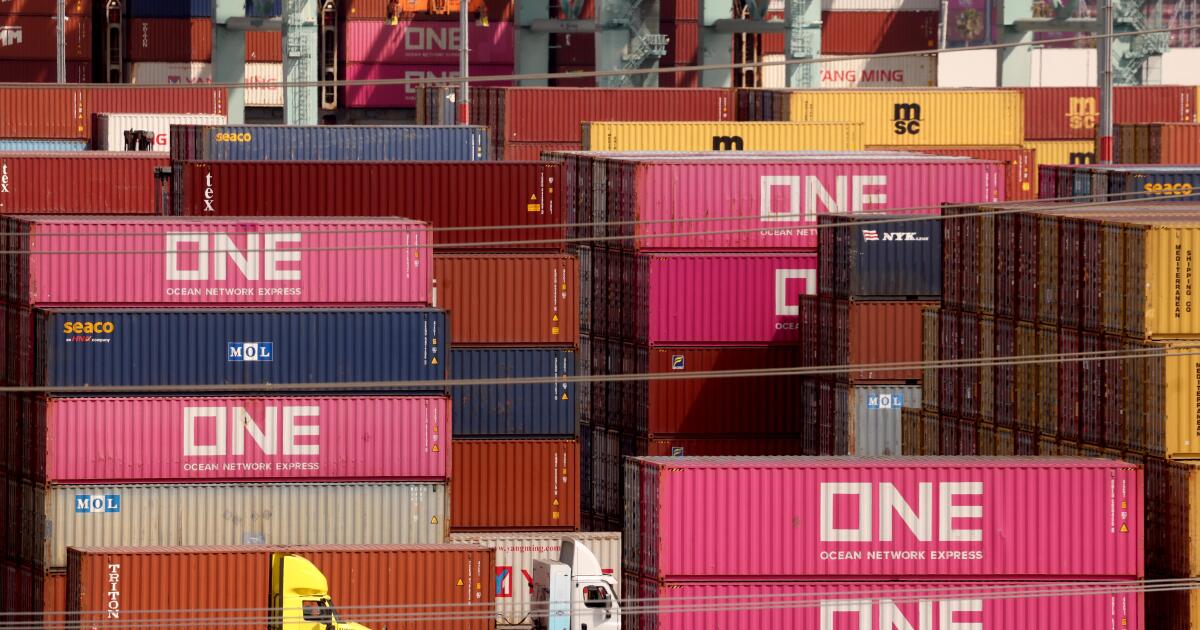
Based on the words of President Trump, America is well on the way to becoming a “global superpower in manufacturing” — indeed, as he declared in a Father’s Day social media post, we are already experiencing the “BEST ECONOMY EVER.” (Capitalization’s his.)
Here’s what the government’s own statistics tell us: Manufacturing investment has crashed during his watch, with construction spending in the manufacturing sector down 26.4% from Trump’s inauguration through May, to $174.8 billion. That’s the lowest figure since February 2023, when the economy was in the midst of a post-pandemic recovery.
White House spokesman Kush Desai told me by email that “the last two jobs reports” showed manufacturing job growth. The Bureau of Labor Statistics reported a seasonally-adjusted decline of 2,000 manufacturing workers in May and a gain of 3,000 in June. But the June 2026 figure was 38,000 jobs, or about 0.3% below the level in June 2025, and 75,000 or about 0.6% below the level in January 2025, when Trump took office.
Desai said that “thanks to President Trump’s proven agenda of tariffs, deregulation, and tax cuts, American manufacturing will continue to rebound.”
There’s little mystery about what has come between Trump’s ambition and the real world. To a large extent it’s Trump’s economic program, particularly his tariff policies and, more recently, his war with Iran. Those have injected a level of uncertainty for corporate managements pondering whether to spend money on expansion that they haven’t had to confront in years.
From where we’re standing, we are not seeing signs of a manufacturing renaissance in the U.S.
— Didi Caldwell, Global Location Strategies
The tariffs and the war have driven up manufacturers’ costs for raw materials and overseas shipping. The general economic atmosphere doesn’t help. U.S. gross domestic product growth came in at a 2.1% annualized rate in the first quarter of this year, but the Federal Reserve Bank of Atlanta expects it to have fallen to 1.3% in the second quarter ended June 30.
Meanwhile, the University of Michigan consumer confidence index reached 44.8 in May, its lowest level ever (though it improved to 49.5 in June). Wages have been rising modestly, according to the Bureau of Labor Statistics, but those gains have been eaten up by higher prices, especially for gasoline and food.
To put things another way, the actual figures show the U.S. economy to be sputtering, and the “vibe economy” as measured by consumer confidence is doing even worse.
Now that Trump’s second term is about to reach its 18-month mark, let’s unpack the factors causing the discrepancy between his ambitions and claims, and the reality.
Trump declared economic victory just as his term was starting. On March 20, 2025, he proclaimed a “manufacturing renaissance” in the U.S. That was based on what he said were “trillions of dollars in new investments” he had “already secured in tech-based manufacturing.”
A White House statement said “the list of manufacturing wins is endless.” The provided list was a roster of announcements, not groundbreakings, much less completed ventures.
Business executives quite properly have taken these pledges with mounds of salt. “Announcements are what people say they’re going to do, but dollars spent is what’s actually happening,” Didi Caldwell, chief executive of a firm that helps companies find factory sites, told the Financial Times. “From where we’re standing, we are not seeing signs of a manufacturing renaissance in the U.S.”
Indeed, at least some of these announcements have had the flavor of performative efforts to satisfy Trump’s amour propre and extract government concessions.
For example, Apple Chief Executive Tim Cook appeared with Trump at the White House in August to announce a $600-billion U.S. spending plan to take place over four years. That was a $100-billion increase over its previously-announced program.
More to the point, however, it incorporated spending with suppliers that Apple had been working with for years. Mentioned in the news announcement was a commitment to buy cover glass for iPhones from Corning. But Corning has been supplying that glass since the first iPhone appeared in 2007. In any case, the announcement appeared to secure a commitment from Trump to exempt Apple from tariffs imposed on imported chips.
Apple’s announcement Wednesday that it will spend $30 billion to buy chips from Broadcom was similarly ambiguous. The announcement didn’t provide details about the terms of the commitment or the timing of its expenditures. I asked Apple for details and whether the deal was related to a desire to remain in Trump’s favor, but didn’t hear back.
A similar phenomenon occurred during Trump’s first term; Trump had built much of his 2016 presidential campaign on a promise to increase manufacturing jobs in the United States. He blamed shrinkage in the manufacturing sector on trade agreements such as NAFTA and the policies of the Chinese, and took credit when an American manufacturer agreed to create or save jobs in the United States.
As I reported in 2019, many of those arrangements turned out to be exaggerated or bogus, or predated Trump’s claim. Some disappeared as soon as public attention turned elsewhere, or were outweighed by job cuts made elsewhere by the same companies.
Trump’s tariffs appear to have had a direct effect on manufacturing employment in the U.S. Since Trump’s inauguration, the manufacturing sector has shed about 75,000 jobs, or 0.6%. After April 2, 2025, when he announced global “liberation day” tariffs supposedly as a response to years of unfair treatment of American exports, the decline picked up pace, with a shrinkage of 68,000 manufacturing jobs.
The Supreme Court invalidated those tariffs in February, but others are still in place, including tariffs on imported steel and aluminum and on goods from China. Nor has he ceased threatening partners with trade wars. As recently as Tuesday, he said he would cut off all trade with Spain because of that country’s disagreement with him over its defense spending and its criticism of his Iran war.
As it happens, Spain is one of the few countries with which the U.S. has a trade surplus. That means that any cutoff, which trade experts think will be unlikely, would come at a cost to the U.S.
One might have hoped that Trump had learned a lesson from his first-term trade war with China. That conflict provoked a sharp contraction in the manufacturing economy, with the Institute for Supply Management’s purchasing managers index falling to 49.1 by mid-2019. (A reading below 50 signifies contraction.)
The ISM index began to recover toward the end of Trump’s term but fell again during the pandemic. Lately it has been falling again, to 53.3 in June from 54 in May.
The Iran war is another deadweight on domestic manufacturing. That’s partially the consequence of blockages of the Strait of Hormuz, the crucial thoroughfare not only for middle eastern oil, but also for such industrial inputs as fertilizer and aluminum. Cement, concrete, olive oil and spices are also among commodities produced in the region that use the strait as an outlet to reach the outside world.
Uncertainties in the region, tensions between the U.S. and China, and heightened concerns over the safety of shipping overall have driven up shipping costs between the far east and the U.S. The price of shipping a benchmark 40-foot container from China to the West Coast has nearly quadrupled to $6,687 now from about $1,700 just before the Iran war began, according to an index maintained by the cargo firm Freightos — even though shipping prices typically decline during this time of year.
There can be little doubt that the U.S. would benefit from an industrial policy — if it’s coherent. China supplanted America as the world’s leading exporter of manufactured goods in 2010, and the gap has only widened since then. China’s dominance may be hard to reverse, as it’s built on lower labor costs and transport infrastructure that enjoys focused government investment.
Tariffs could be a component of a new industrial policy, but Trump’s tariffs aren’t rationally geared to protecting domestic industries that need protection. They’re expressions of his whims, and as such they’re totally ineffective. If there are government investment policies targeting industries that need assistance, they’re not apparent to economists or industrialists.
Trump can talk as much as he likes about a golden age for U.S. manufacturing, but from his first term through this one, it’s nothing but talk. And talk, of course, is cheap.

Walt Disney Co.’s “Moana” lost its way at the box office this weekend as the company’s latest live-action remake opened to a sluggish $43 million in the U.S. and Canada.
The domestic haul for “Moana” underperformed studio expectations, which ranged from $60 million to $65 million. Globally, the film brought in a total of $95 million on a production budget of about $250 million.
Despite its lackluster debut, the film still came in first at the box office during a weekend where it had few new competitors in the family film space.
The “Moana” franchise has been a box-office and streaming juggernaut. The original 2016 animated movie brought in more than $643 million worldwide and is the most-watched movie on Disney+, while a 2024 sequel grossed more than $1 billion at the global box office. On the merchandise side, more than 22 million “Moana”-themed toys have been sold. “Moana” also appears in the Disney theme parks.
But the theatrical reception for the live-action film may signal that audiences think there’s been too much “Moana” in just 10 years. (The 2024 film sequel was originally set to be a streaming series before it was moved to Disney’s theatrical calendar.)
Most of Disney’s previous live-action remakes have come decades after the original animated movie, such as 2025’s “Lilo & Stitch,” which arrived 23 years after its animated predecessor and grossed more than $1 billion in worldwide box office receipts.
The theatrical haul for the latest “Moana” may also have suffered from poor reviews — the film got a 34% on aggregator Rotten Tomatoes, with several critics highlighting its nearly frame-by-frame similarity to the original film. The audience score on Rotten Tomatoes, however, was 90%.
Still, as the last of this summer’s major family films, “Moana” could see a longer tail in theaters, particularly with many children still on break from school. Disney’s live-action “Mufasa: The Lion King” opened in 2024 to a middling $35 million, but ended up grossing more than $722 million globally through the holiday season.
Universal Pictures and Illumination’s “Minions & Monsters” came in second at the domestic box office this weekend with $20.5 million. Disney and Pixar’s “Toy Story 5” continued its strong run with an $18.5-million haul, enough for third place and contributing to a total global gross of $879.1 million.
Warner Bros.’ “Evil Dead Burn” ($13.7 million) and Angel Studios’ “Young Washington” ($6.4 million) rounded out the top five.
Also notable this weekend: Lionsgate’s musical biopic “Michael” crossed $1 billion in worldwide box office revenue, the first time that the studio has reached that milestone and the second film this year after “The Super Mario Galaxy Movie” to hit that mark.
-

 Videos1 hour ago
New explosions near Iranian port cities, says state media | BBC News
-

 Los Angeles, Ca1 hour ago
Big rig crash spills cinder blocks on 101 Freeway; lanes blocked in Tarzana
-
 Detroit, MI2 hours ago
How to watch ‘The Odyssey’ in IMAX, 70mm and more in metro Detroit
-

 San Francisco, CA2 hours ago
Sold-Out SF Marathon 2026: The Races, Routes and Road Closures (Plus How to Watch It All) | KQED
-

 Dallas, TX2 hours ago
Top 10 Dallas Cowboys of 2026: Rashan Gary is Complete EDGE Dallas Needed
-

 Miami, FL2 hours ago
Girl, 12, shot while sitting in parked car in northwest Miami-Dade, deputies say
-

 Boston, MA2 hours ago
GBH Daily: Come sail away
-

 Denver, CO2 hours ago
New ice cream shop with a ‘waffle theater’ bets big on downtown Denver

