Business
They lost their home insurance policies. Then came the fires

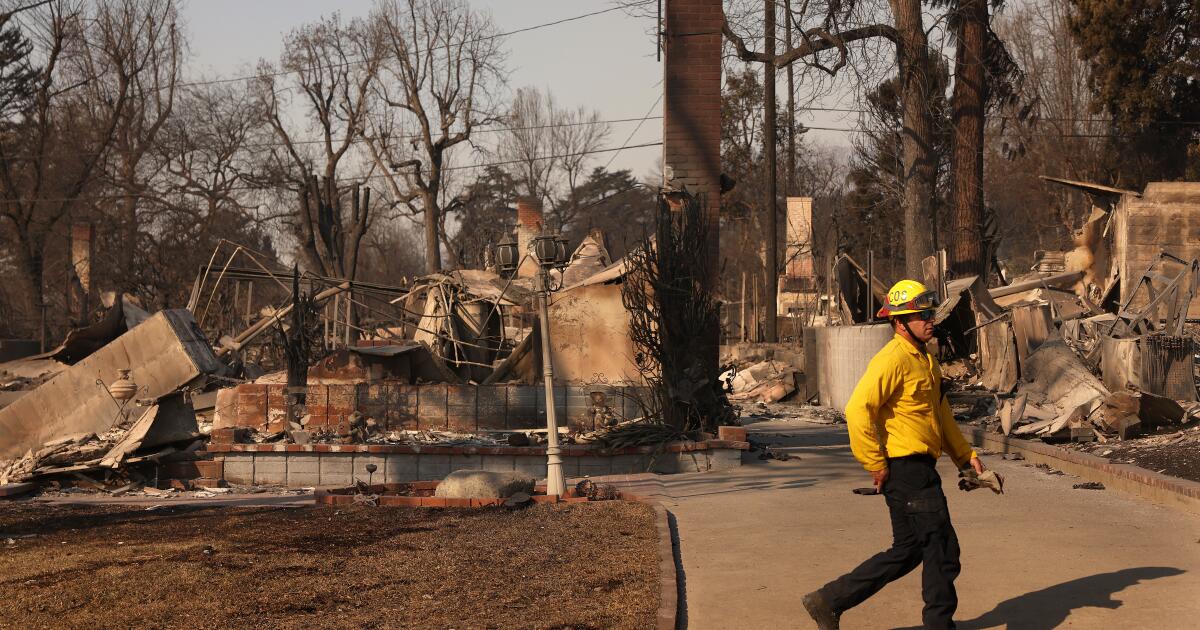
Last year, Francis Bischetti said he learned that the annual cost of the homeowners policy he buys from Farmers Insurance for his Pacific Palisades home was going to soar from $4,500 to $18,000 — an amount he could not possibly afford.
Neither could he get onto California FAIR Plan, which provides fewer benefits, because he said he would have to cut down 10 trees around his roof line to lower the fire risk — something else the 55-year-old personal assistant found too costly to manage.
So he decided he would do what’s called “going bare” — not buying any coverage on his home in the community’s El Medio neighborhood. He figured if he watered his property year round, that might be protection enough given its location south of Sunset Boulevard.
It wasn’t. The home he lived in for nearly all his life burned down Tuesday along with more than 10,000 other homes and structures damaged or destroyed in the worst fire event in the history of Los Angeles. Sixteen deaths have been confirmed countywide.
“It was surrealistic,” he said. “I’ve grown up and lived here off and on for 50 years. I’ve never in my entire time here experienced this.”
Farmers Insurance declined to comment, saying it does not discuss individual policyholders.
‘A train wreck coming down the track’
Bischetti was far from the only homeowner living in Pacific Palisades, Altadena or other fire-prone hillside neighborhoods who struggled to maintain their insurance amid sharply rising costs and the decision by many insurers to reduce their exposure to catastrophic wildfire claims by not renewing the policies of even longtime customers. Many fire victims reported that insurers had dropped their policies last year.
The fires — expected to be among the costliest natural disasters in U.S. history — have deepened a crisis in the state’s home insurance market that was already reeling before the devastation came.
The state’s largest home insurer, State Farm General, announced in March it would not renew 30,000 homeowner and condominium policies — including 1,626 in Pacific Palisades — when they expired.
Chubb and its subsidiaries stopped writing new policies for high-value homes with higher wildfire risk. Allstate has stopped writing new policies, and Tokio Marine America Insurance Co. and Trans Pacific Insurance Co. pulled out of the state, though Mercury Insurance offered to take their customers.
Liberty Mutual was sued last month by a homeowner who accused the insurer of dropping her over a bogus claim that her roof had mold damage.
“Driven by a desire to maximize profits, property casualty insurance companies … have engaged in a troubling trend of dropping California homeowners’ insurance policies like flies,” said the complaint, filed in San Diego County Superior Court. A spokesperson for Liberty Mutual declined to comment on the litigation.
The inability to get coverage is reflected in the number of policies picked up by California FAIR Plan, which as of September had about 452,000 policies, up from a little over 203,000 four years ago. FAIR Plan’s website says its claims exposure is nearly $6 billion in Pacific Palisades alone.
“The situation has been a train wreck coming down the track for a while,” said Rick Dinger, president of Crescenta Valley Insurance, an independent brokerage in Glendale.
Not enough insurance money to rebuild
Peggy Holter spent decades as a television journalist, a peripatetic career that took her all over the world, but there was one place she called home and always returned to: the Pacific Palisades condo she moved into on Jan. 1, 1978. That all changed after Tuesday’s firestorm, when her condo burned to the ground along with the rest of the 36 units in the Palisades Drive complex.
Holter, 83, who only retired last year, is now facing uncertainty after she said State Farm didn’t renew her individual condo insurance, citing the condition of her roof.
But with the loss of her documents she isn’t sure if and when the policy lapsed — and she hadn’t yet secured a new carrier. The insurance typically covers personal belongings and a unit’s interior and provides benefits such as living expenses if a condo becomes unusable.
“I’m not a big keeper of things, but what I did have was a whole wall of pictures and albums of all the places I had been, family photos. I had a picture of my mother on a camel when she was 52 in front of the Sphinx,” Holter recalled. “The only thing I am concerned about is the future, because that is what you have to do.”
Her biggest question is whether she can rebuild. The homeowners association had a master policy from FAIR Plan, which totaled only $20 million. That would pay out only about $550,000 per unit if the complex were not rebuilt — far below the $1 million-plus the condos commanded in recent sales. The land could be sold off to a developer.
Holter, who is now living with her son in the Hollywood Hills, had paid off her condo.
She went back to the complex after the fires died down to get a closer look at the damage. There was nothing left of her unit, but the complex’s koi pond survived, along with the fish.
State Farm has declined to comment on its non-renewals, saying in a recent statement: “Our number one priority right now is the safety of our customers, agents and employees impacted by the fires and assisting our customers in the midst of this tragedy.”
‘We don’t cover anything in California’
Matt Knight considers himself fortunate: He and his family could have lost it all in the Eaton fire, just like Bischetti and Holter in the Palisades fire.
The trouble started last year he said when he received a notice from Safeco Insurance that the policy on his Sonoma Drive home in Altadena, where he lives with his wife and three children, would not be renewed due to a tree overhanging his garage.
The 45-year-old Covina elementary school teacher said he dutifully trimmed the tree only to be told the ivy growing on the garage also was a problem. After removing that, he said he was told he had to fix his damaged stucco, which forced him to paint his house and in the process replace his old roof. Yet he said he still couldn’t get insurance after spending $30,000 on the repairs.
A spokesperson for Safeco, a subsidiary of Liberty Mutual, said the carrier does not comment on individual policyholders.
“So we went looking company after company after company, and some of them would say, ‘No, we don’t cover anything in California.’ Some said, ‘We’re not doing any new policies.’ Some said, ‘No, we don’t do 91001 because it’s in a fire zone, and we were were like, ‘That’s crazy.’”
Just a day before his policy was set to expire last summer, Knight said he finally managed to secure similar coverage with Aegis Insurance. But in the haste to get the policy in force, the home he has lived in for 16 years was left wildly under-insured for less than $300,000. The home is valued at $1.13 million on Zillow.
The ferocious winds that fanned the Eaton fire started a power outage Tuesday evening, so Knight decided to drive his children over to his parents’ home on the other side of Altadena where they could do their homework. From there, he saw the fire start on a street hugging the mountains near what appeared to be a power line.
“Within minutes it was taken up the hillside. It was unbelievable,” he said.
His parents’ home on Roosevelt Avenue escaped the devastation, and throughout the night he drove over to check on his home. By 6 a.m., he had joined a brigade of homeowners to fight the encroaching flames on Sonoma Drive. “The whole neighborhood was there grabbing hoses and fighting fires,” he said.
In the late afternoon, he said, the water ran out for the homeowners and firefighters alike, forcing him and his neighbors to pack up and go. He was sure he would lose his home, but the winds died down.
“I think that was the ultimate good fortune,” he said, though some other neighbors were not so lucky.
Bischetti was not so lucky either.
On Tuesday, when the fires started in the hills and all of his Palisades neighbors started to pack their cars, Bischetti stayed behind to keep hosing down his property, including his lawn, roof, rafters and walls.
“I thought everything would be relatively safe,” he said. “I was sticking around trying to protect the house with water.”
He gradually started packing his car with a change of clothes, one of his guitars, tax papers, property deeds and hard drives from his computer. He left his computer itself back in the house, along with his amps, music equipment and tools.
His entire street was a ghost town by 5 p.m. By then, Bischetti had already watered down his property multiple times. It was dusty and smoky, and a voice in his head told him it was time to go. “I’m going to come back for this tomorrow,” he recalled thinking. “I don’t want to weigh down my car.”
It didn’t work out that way.
Bischetti drove near Palisades High School and saw a house on the corner of the street start to burn down. He then tried going on El Medio Avenue and drove into black smoke, with flames on both sides of his car. He started panicking and realized he couldn’t get through.
After making it to his sister’s home in Mar Vista, he found out from a neighbor that all of the homes on his block had been leveled.
Bischetti said his siblings lost family mementos and photos and he lost thousands of dollars’ worth of tools and musical instruments. They also had spent nearly $4,000 fixing up the home in order to rent out some of the rooms.
Bischetti and his family have signed up for Federal Emergency Management Agency disaster relief funds and are trying to get help with cleaning up the property, which he said could cost at least $10,000.
“I was getting ready for this,” he said of his one-man firefighting efforts. “That was the last hurrah.”



The rolling robots that deliver groceries and hot meals across Los Angeles are getting an upgrade.
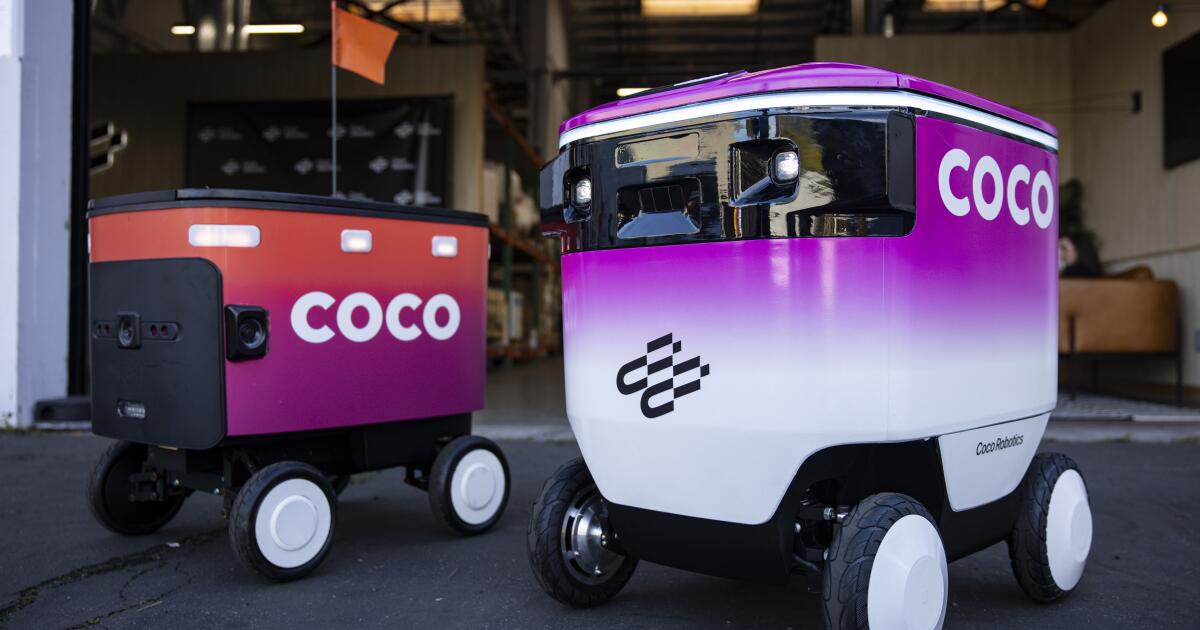
Coco Robotics, a UCLA-born startup that’s deployed more than 1,000 bots across the country, unveiled its next-generation machines on Thursday.
The new robots are bigger, tougher and better equipped for autonomy than their predecessors. The company will use them to expand into new markets and increase its presence in Los Angeles, where it makes deliveries through a partnership with DoorDash.
Dubbed Coco 2, the next-gen bots have upgraded cameras and front-facing lidar, a laser-based sensor used in self-driving cars. They will use hardware built by Nvidia, the Santa Clara-based artificial intelligence chip giant.
Coco co-founder and chief executive Zach Rash said Coco 2 will be able to make deliveries even in conditions unsafe for human drivers. The robot is fully submersible in case of flooding and is compatible with special snow tires.
Zach Rash, co-founder and CEO of Coco, opens the top of the new Coco 2 (Next-Gen) at the Coco Robotics headquarters in Venice.
(Kayla Bartkowski/Los Angeles Times)
Early this month, a cute Coco was recorded struggling through flooded roads in L.A.
“She’s doing her best!” said the person recording the video. “She is doing her best, you guys.”
Instagram followers cheered the bot on, with one posting, “Go coco, go,” and others calling for someone to help the robot.
“We want it to have a lot more reliability in the most extreme conditions where it’s either unsafe or uncomfortable for human drivers to be on the road,” Rash said. “Those are the exact times where everyone wants to order.”
The company will ramp up mass production of Coco 2 this summer, Rash said, aiming to produce 1,000 bots each month.
The design is sleek and simple, with a pink-and-white ombré paint job, the company’s name printed in lowercase, and a keypad for loading and unloading the cargo area. The robots have four wheels and a bigger internal compartment for carrying food and goods .
Many of the bots will be used for expansion into new markets across Europe and Asia, but they will also hit the streets in Los Angeles and operate alongside the older Coco bots.
Coco has about 300 bots in Los Angeles already, serving customers from Santa Monica and Venice to Westwood, Mid-City, West Hollywood, Hollywood, Echo Park, Silver Lake, downtown, Koreatown and the USC area.

The new Coco 2 (Next-Gen) drives along the sidewalk at the Coco Robotics headquarters in Venice.
(Kayla Bartkowski/Los Angeles Times)
The company is in discussion with officials in Culver City, Long Beach and Pasadena about bringing autonomous delivery to those communities.
There’s also been demand for the bots in Studio City, Burbank and the San Fernando Valley, according to Rash.
“A lot of the markets that we go into have been telling us they can’t hire enough people to do the deliveries and to continue to grow at the pace that customers want,” Rash said. “There’s quite a lot of area in Los Angeles that we can still cover.”
The bots already operate in Chicago, Miami and Helsinki, Finland. Last month, they arrived in Jersey City, N.J.
Late last year, Coco announced a partnership with DashMart, DoorDash’s delivery-only online store. The partnership allows Coco bots to deliver fresh groceries, electronics and household essentials as well as hot prepared meals.
With the release of Coco 2, the company is eyeing faster deliveries using bike lanes and road shoulders as opposed to just sidewalks, in cities where it’s safe to do so. Coco 2 can adapt more quickly to new environments and physical obstacles, the company said.

Zach Rash, co-founder and CEO of Coco.
(Kayla Bartkowski/Los Angeles Times)
Coco 2 is designed to operate autonomously, but there will still be human oversight in case the robot runs into trouble, Rash said. Damaged sidewalks or unexpected construction can stop a bot in its tracks.
The need for human supervision has created a new field of jobs for Angelenos.
Though there have been reports of pedestrians bullying the robots by knocking them over or blocking their path, Rash said the community response has been overall positive. The bots are meant to inspire affection.
“One of the design principles on the color and the name and a lot of the branding was to feel warm and friendly to people,” Rash said.
Coco plans to add thousands of bots to its fleet this year. The delivery service got its start as a dorm room project in 2020, when Rash was a student at UCLA. He co-founded the company with fellow student Brad Squicciarini.
The Santa Monica-based company has completed more than 500,000 zero-emission deliveries and its bots have collectively traveled around 1 million miles.
Coco chooses neighborhoods to deploy its bots based on density, prioritizing areas with restaurants clustered together and short delivery distances as well as places where parking is difficult.
The robots can relieve congestion by taking cars and motorbikes off the roads. Rash said there is so much demand for delivery services that the company’s bots are not taking jobs from human drivers.
Instead, Coco can fill gaps in the delivery market while saving merchants money and improving the safety of city streets.
“This vehicle is inherently a lot safer for communities than a car,” Rash said. “We believe our vehicles can operate the highest quality of service and we can do it at the lowest price point.”

President Trump on Friday directed federal agencies to stop using technology from San Francisco artificial intelligence company Anthropic, escalating a high-profile clash between the AI startup and the Pentagon over safety.
In a Friday post on the social media site Truth Social, Trump described the company as “radical left” and “woke.”
“We don’t need it, we don’t want it, and will not do business with them again!” Trump said.
The president’s harsh words mark a major escalation in the ongoing battle between some in the Trump administration and several technology companies over the use of artificial intelligence in defense tech.
Anthropic has been sparring with the Pentagon, which had threatened to end its $200-million contract with the company on Friday if it didn’t loosen restrictions on its AI model so it could be used for more military purposes. Anthropic had been asking for more guarantees that its tech wouldn’t be used for surveillance of Americans or autonomous weapons.
The tussle could hobble Anthropic’s business with the government. The Trump administration said the company was added to a sweeping national security blacklist, ordering federal agencies to immediately discontinue use of its products and barring any government contractors from maintaining ties with it.
Defense Secretary Pete Hegseth, who met with Anthropic’s Chief Executive Dario Amodei this week, criticized the tech company after Trump’s Truth Social post.
“Anthropic delivered a master class in arrogance and betrayal as well as a textbook case of how not to do business with the United States Government or the Pentagon,” he wrote Friday on social media site X.
Anthropic didn’t immediately respond to a request for comment.
Anthropic announced a two-year agreement with the Department of Defense in July to “prototype frontier AI capabilities that advance U.S. national security.”
The company has an AI chatbot called Claude, but it also built a custom AI system for U.S. national security customers.
On Thursday, Amodei signaled the company wouldn’t cave to the Department of Defense’s demands to loosen safety restrictions on its AI models.
The government has emphasized in negotiations that it wants to use Anthropic’s technology only for legal purposes, and the safeguards Anthropic wants are already covered by the law.
Still, Amodei was worried about Washington’s commitment.
“We have never raised objections to particular military operations nor attempted to limit use of our technology in an ad hoc manner,” he said in a blog post. “However, in a narrow set of cases, we believe AI can undermine, rather than defend, democratic values.”
Tech workers have backed Anthropic’s stance.
Unions and worker groups representing 700,000 employees at Amazon, Google and Microsoft said this week in a joint statement that they’re urging their employers to reject these demands as well if they have additional contracts with the Pentagon.
“Our employers are already complicit in providing their technologies to power mass atrocities and war crimes; capitulating to the Pentagon’s intimidation will only further implicate our labor in violence and repression,” the statement said.
Anthropic’s standoff with the U.S. government could benefit its competitors, such as Elon Musk’s xAI or OpenAI.
Sam Altman, chief executive of OpenAI, the company behind ChatGPT and one of Anthropic’s biggest competitors, told CNBC in an interview that he trusts Anthropic.
“I think they really do care about safety, and I’ve been happy that they’ve been supporting our war fighters,” he said. “I’m not sure where this is going to go.”
Anthropic has distinguished itself from its rivals by touting its concern about AI safety.
The company, valued at roughly $380 billion, is legally required to balance making money with advancing the company’s public benefit of “responsible development and maintenance of advanced AI for the long-term benefit of humanity.”
Developers, businesses, government agencies and other organizations use Anthropic’s tools. Its chatbot can generate code, write text and perform other tasks. Anthropic also offers an AI assistant for consumers and makes money from paid subscriptions as well as contracts. Unlike OpenAI, which is testing ads in ChatGPT, Anthropic has pledged not to show ads in its chatbot Claude.
The company has roughly 2,000 employees and has revenue equivalent to about $14 billion a year.

new video loaded: The Web of Companies Owned by Elon Musk

By Kirsten Grind, Melanie Bencosme, James Surdam and Sean Havey
February 27, 2026

Iran fires missiles at US bases across Middle East after American strikes on nuclear, IRGC sites

Common nighttime noise exposure may trigger heart problems, study suggests

MLB pitcher Merrill Kelly says California tax rate swayed decision to reject Padres’ free agency offer

Google dismantles 9M-device Android hijack network
A new delivery bot is coming to L.A., built stronger to survive in these streets

Florida High School Football Rankings: Top 25 teams – Oct. 21

Cleary's 21 help Le Moyne down Central Connecticut State 69-64 in OT

How old is Bo Nix? What to know about Oregon quarterback ahead of 2024 NFL Draft

99th annual Pony Swim held in Virginia

Indiana Members Credit Union announced as new anchor tenant at Bottleworks District
Iran fires missiles at US bases across Middle East after American strikes on nuclear, IRGC sites

Israel strikes two schools in Iran, killing more than 50 people

Anthropic CEO says he’s sticking to AI “red lines” despite clash with Pentagon

ICE blasts Washington mayor over directive restricting immigration enforcement

Did the EU bypass Hungary’s veto on Ukraine’s €90 billion loan?
-

 World2 days ago
Exclusive: DeepSeek withholds latest AI model from US chipmakers including Nvidia, sources say
-

 Massachusetts3 days ago
Mother and daughter injured in Taunton house explosion
-

 Montana1 week ago
2026 MHSA Montana Wrestling State Championship Brackets And Results – FloWrestling
-

 Louisiana5 days ago
Wildfire near Gum Swamp Road in Livingston Parish now under control; more than 200 acres burned
-

 Denver, CO3 days ago
10 acres charred, 5 injured in Thornton grass fire, evacuation orders lifted
-

 Technology1 week ago
YouTube TV billing scam emails are hitting inboxes
-

 Technology1 week ago
Stellantis is in a crisis of its own making
-

 Politics1 week ago
OpenAI didn’t contact police despite employees flagging mass shooter’s concerning chatbot interactions: REPORT