Business
The Big Number: 2.7%


Productivity is usually measured as a simple ratio: the total amount of output an economy produces per hour worked by its labor force. When that ratio picks up, it can create a positive cascading effect.
Gains in productivity mean businesses can make more money per hour, reinvest it in their operations and, at least theoretically, pay workers more.
Ruth Fremson/The New York Times




Actor Chris Pine was just 13 when his family’s finances took a turn and his parents lost their home.
So when the “Star Trek” actor read the Pulitzer Prize-winning book “Evicted: Poverty and Profit in the American City” from author Matthew Desmond, about eight families who fight to stay housed in Milwaukee, he knew he had to make a film out of it.
For the record:
10:40 a.m. Feb. 17, 2026A previous version of this article stated that investor Shauna Ockey was from West Point, Utah. She is from Calgary. Also investor Lloyd Roberts was listed as being from Calgary; he is from West Point, Utah.
“The power of what we do as filmmakers … is really to remind people that we are not alone, that our experiences are transcendent,” Pine recently told an audience at the Sundance Film Festival. “This is one of those stories.”
Pine is producing a documentary based on the book and it’s among several projects backed by Harbor Fund, an emerging Utah-based nonprofit investment group that leverages the donations of high-net-worth individuals and other investors to support films, television shows and documentaries that have a positive social message.
“Good stories can change how people feel,” Lindsay Hadley, Harbor Fund’s co-founder and chief executive, said in an interview. “We just really believe in the power of film and the entertainment world to harness a society of compassion.”
Since it began about a year and a half ago, the fund has raised $15 million from 82 donors with an average contribution of $250,000. Already, Hadley said, $10 million has been deployed across 22 projects, including “Evicted.”
“It’s rooted in housing policy and economics, but at its core, it’s about people — and stories like this aren’t always easy to back in an industry built to minimize risk,” Pine said in a statement.
“Harbor Fund immediately understood the moral center of the film and why it needed to be told honestly. Their mission goes beyond financing films. They care about what happens after a premiere — about bringing films into communities that initiate civic conversation and making sure the conversation continues beyond the screen.”
Finding a consensus on what constitutes a social good can be tricky, especially in the current fraught and deeply partisan political climate.
Hadley said she gets extensive advice on pitches from the fund’s advisory board, which includes filmmakers like Patty Jenkins, David Oyelowo, Amy Redford and Mark Burnett. The projects seek to home in on shared values and avoid works that dehumanize other people, she said.
Harbor Fund wants to reach $100 million in the next two years, said Hadley, who previously served as chief development officer for advocacy organization Global Citizen and has produced its annual festival in New York’s Central Park that supports social issues.
Efforts to finance socially conscious films aren’t new. Culver City-based production company Participant built its reputation around projects that prioritized social commentary, including Al Gore’s 2006 environmental documentary “An Inconvenient Truth” as well as Oscar-winning feature films such as 2015’s “Spotlight” and 2018’s “Green Book.” But the company closed in 2024 as the market for independent films changed drastically.
The traditional business model for indie films has broken down as audiences still have not shown up to theaters with the same enthusiasm as before the pandemic. Add to that a shrinking number of distributors — though some new ones recently emerged — and the inherent risk of funding a movie, and it’s no surprise investors have shied away.
“Theatrical windows used to be the lifeblood of independent film, and now it’s basically gone,” said David Offenberg, an associate professor of finance at Loyola Marymount University and author of the book “Independent Film Finance.”
Harbor Fund’s model for financing is rare, he said, though it taps into one of the big motivations for investors to fund movies and TV — social impact.
“A lot of investors are putting money into film because they want to make a change in the world and they want the movie to help make that change,” Offenberg said.
With a nonprofit venture capital-type structure, no costly production arm and a diversified portfolio, Harbor Fund aims to be sustainable, Hadley said. The fund also has invite-only forums, such as last year’s in Montana that featured actor Kevin Costner, where investors can hear about potential projects directly from those involved, which can include A-list stars.
Donors engage with the fund knowing they will not see a return on their investment. They choose projects they want to support, Harbor Fund takes an equity position in it, and any money it makes is invested back into the fund for future films and TV series.
“If it’s successful, it’s a gift that keeps giving,” Hadley said.
Investor Shauna Ockey of Calgary chose to contribute to the documentary “Orphan Myth,” which details the plight of children separated from family members in poverty, because she sees it as a social return rather than a financial one.
“Reuniting children with families so they don’t grow up in institutions is an important part of me and my husband’s value systems,” said Ockey, who has contributed $350,000 to Harbor Fund with her husband. “When you invest philanthropically in a film, of course you want to have the best outcome, but … not all films are going to be box office hits. But if it just impacts a few people, that’s a good enough return.”
The fund’s projects span a wide range of subjects, from “Hershey,” a film set for release this year about the philanthropic legacy of eponymous chocolate-maker Milton Hershey and his wife, Catherine, to “Flash Before the Bang,” a movie about a deaf track team.
The investments help pay the overhead costs for these films in part because of the belief that big-name stars will attract a larger audience and, hopefully, create more change, Hadley said.
For West Point, Utah-based investor Lloyd Roberts, the 2006 Will Smith drama “The Pursuit of Happyness,” about a father and son who struggle to find housing, changed his thinking about the role of perspective in feelings of fulfillment.
“You can have someone stand onstage and tell you these ideas, but you put it in a feature film like ‘The Pursuit of Happyness,’ and you feel like you have a firsthand view of how putting it into practice can help you,” said Roberts, who has invested a little more than $1 million in the fund and believes audiences will reap the benefits.
“One of the best mechanisms for an idea is not just documentaries but motion pictures that have an underlying message that pulls on their heartstrings,” he said.
Business
Altadena asked Edison to bury power lines. Some fire victims say that could cost them $40,000
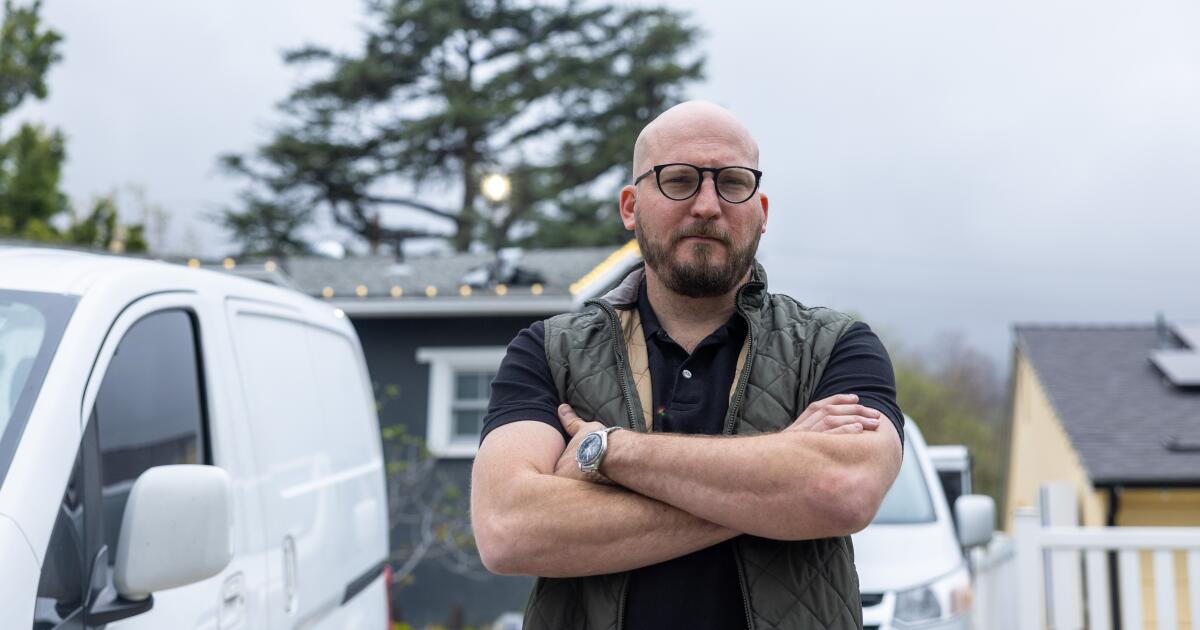
Connor Cipolla, an Eaton wildfire survivor, last year praised Southern California Edison’s plan of burying more than 60 miles of electric lines in Altadena as it rebuilds to reduce the risk of fire.
Then he learned he would have to pay $20,000 to $40,000 to connect his home, which was damaged by smoke and ash, to Edison’s new underground line. A nearby neighbor received an estimate for $30,000, he said.
“Residents are so angry,” Cipolla said. “We were completely blindsided.”
Other residents have tracked the wooden stakes Edison workers put up, showing where crews will dig. They’ve found dozens of places where deep trenches are planned under oak and pine trees that survived the fire. In addition to the added costs they face, they fear many trees will die as crews cut their roots.
“The damage is being done now and it’s irreversible,” homeowner Robert Steller said, pointing Maiden Lane to where an Edison crew was working.
For a week, Steller, who lost his home in the fire, parked his Toyota 4Runner over a recently dug trench. He said he was trying to block Edison’s crew from burying a large transformer between two towering deodar cedar trees. The work would “be downright fatal” to the decades-old trees, he said.
Altadena resident Robert Steller stands in front of his Toyota 4Runner that he parked strategically to prevent a Southern California Edison crew from digging too close to two towering cedar trees.
(Ronaldo Bolaños / Los Angeles Times)
The buried lines are an upgrade that will make Altadena’s electrical grid safer and more reliable, Edison says, and it also will lower the risk that the company would have to black out Altadena neighborhoods during dangerous Santa Ana winds to prevent fires.
Brandon Tolentino, an Edison vice president, said the company was trying to find government or charity funding to help homeowners pay to connect to the buried lines. In the meantime, he said, Edison decided to allow owners of homes that survived the fire to keep their overhead connections until financial help was available.
Tolentino added that the company planned meetings to listen to residents’ concerns, including about the trees. He said crews were trained to stop work when they find tree roots and switch from using a backhoe to digging by hand to protect them.
“We’re minimizing the impact on the trees as we [put lines] underground or do any work in Altadena,” he said.
Although placing cables underground is a fire prevention measure, consumer advocates point out it’s not the most cost-effective step Edison can take to reduce the risk.
Undergrounding electric wires can cost more than $6 million per mile, according to the state Public Utilities Commission, far more than building overhead wires.
Because utility shareholders put up part of the money needed to pay for burying the lines, the expensive work means they will earn more profit. Last year, the commission agreed Edison investors could earn an annual return of 10.03% on that money.
Edison said in April it would spend as much as $925 million to underground and rebuild its grid in Altadena and Malibu, where the Palisades fire caused devastation. That amount of construction spending will earn Edison and its shareholders more than $70 million in profit before taxes — an amount billed to electric customers — in the first year, according to calculations by Mark Ellis, the former chief economist for Sempra, the parent company of Southern California Gas and San Diego Gas & Electric.
That annual return will continue over the decades while slowly decreasing each year as the assets are depreciated, Ellis said.
“They’re making a nice profit on this,” he said.
Tolentino said the company wasn’t doing the work to profit.
“The primary reason for undergrounding is the wildfire mitigation,” he said. “Our focus is supporting the community as they rebuild.”
It’s unclear if the Eaton fire would have been less disastrous if Altadena’s neighborhood power lines had been buried. The blaze ignited under Edison’s towering transmission lines that run down the mountainside in Eaton Canyon. Those lines carry bulk power through Edison’s territory. The power lines being put underground are the smaller distribution lines, which carry power to homes.

A power line outside the home of Altadena resident Connor Cipolla.
(Ronaldo Bolanos/Los Angeles Times)
The investigation into the fire’s cause has not yet been released. Edison says a leading theory is that one of the Eaton Canyon transmission lines, which hadn’t carried power for 50 years, might have briefly reenergized, sparking the blaze. The fire killed 19 people and destroyed more than 9,000 homes, businesses and other structures.
Edison said it has no plans to bury those transmission lines.
The high cost of undergrounding has become a contentious issue in Sacramento because, under state rules, most or all of it is billed to all customers of the utility.
Before the Eaton fire, Edison won praise from consumer advocates by installing insulated overhead wires that sharply cut the risk of the lines sparking a fire for a fraction of the cost. Since 2019, the company has installed more than 6,800 miles of the insulated wires.
“A dollar spent reconductoring with covered conductor provides … over four times as much value in wildfire risk mitigation as a dollar spent on underground conversion,” Edison said in testimony before the utilities commission in 2018.
By comparison, Pacific Gas & Electric has relied more on undergrounding its lines to reduce the risk of fire, pushing up customer utility bills. Now Edison has shifted to follow PG&E’s example.
Mark Toney, executive director of the the Utility Reform Network, a consumer group in San Francisco, said his staff estimates Edison spends $4 million per mile to underground wires compared with $800,000 per mile for installing insulated lines.
By burying more lines, customer bills and Edison’s profits could soar, Toney said.
“Five times the cost is equal to five times the profit,” he said.
Last spring, Pedro Pizarro, chief executive of Edison International, told Gov. Gavin Newsom about the company’s undergrounding plans in a letter. Pizarro wrote that rules at the utility commission would require Altadena and Malibu homeowners to pay to underground the electric wire from their property line to the panel on their house. He estimated it would cost $8,000 to $10,000 for each home.
Residents who need to dig long trenches may pay far more than that, said Cipolla, who is a member of the Altadena Town Council.

An oak tree stands tall in an area impacted by the Eaton fires. Homeowners worry such trees could be at risk in the undergrounding work.
(Ronaldo Bolanos/Los Angeles Times)
Last week, Cipolla showed a reporter the electrical panel on the back of his house, which is many yards away from where he needs to connect to Edison’s line. The company also initially wanted him to dig up the driveway he poured seven years ago, he said. Edison later agreed to a location that avoids the driveway.
Tolentino said Edison’s crews were working with homeowners concerned about the company’s planned locations for the buried lines.
“We understand it is a big cost and we’re looking at different sources to help them,” he said.
At the same time, some residents are fuming that, despite the undergrounding work, most of the town’s neighborhoods still will have overhead telecommunications lines. In other areas of the state, the telecommunications companies have worked with the electric utilities to bury all the lines, eliminating the visual clutter.
So far, the telecom companies have agreed to underground only a fraction of their lines in Altadena, Tolentino said.
Cipolla said Edison executives told him they eventually plan to chop off the top of new utility poles the company installed after the fire, leaving the lower portion that holds the telecom lines.
“There is no beautification aspect to it whatsoever,” Cipolla said.
As for the trees, Steller and other residents are asking Edison to adjust its construction map to avoid digging near those that remain after the fire. Altadena lost more than half of its tree cover in the blaze and as crews cleared lots of debris.
1

2

3

1. A pedestrian walks past Christmas Tree lane in Altadena. Christmas Tree Lane was officially listed in the National Register of Historic Places in 1990. 2. A “We Love Altadena” sign hangs from a shrub on Christmas Tree Lane. 3. Parts of a chopped down tree rest on a street curb in Altadena.
Wynne Wilson, a fire survivor and co-founder of Altadena Green, pointed out that the lot across the street from the giant cedar trees on Maiden Lane has no vegetation, making it a better place for Edison’s transformer.
“This is needless,” Wilson said. “People are dealing with so much. Is Edison thinking we won’t fight over this?”
Carolyn Hove, raising her voice to be heard over the crew operating a jackhammer in front of her home, asked: “How much more are we supposed to go through?”
Hove said she doesn’t blame the crews of subcontractors the utility hired, but Edison’s management.
“It’s bad enough our community was decimated by a fire Edison started,” she said. “We’re still very traumatized, and then to have this happen.”

The chatbot wars entered the Super Bowl this year.
At Super Bowl LX, a ChatGPT competitor paid millions of dollars for commercials mocking the leading artificial intelligence chatbot’s plans to put advertisements in its chats.
One of the ads, titled “Betrayal,” showed a man seeking help to communicate better with his mother. His therapist, representing a sponsored bot, offers advice on mending the relationship, then suddenly suggests a mature dating site to connect with “roaring cougars.”
The ads from Anthropic, which has a chatbot named Claude, ends with the tagline: “Ads are coming to AI. But not to Claude.”
AI companies are spending hundreds of billions of dollars and need to generate more revenue to keep spending. Though much of the money comes from subscriptions from companies and other heavy users, companies serving regular consumers will probably need to increasingly rely on ads and other methods to monetize mass market users.
The Super Bowl Sunday ads launched a debate about what a future would look like in which the bots many people talk to all day start pitching products.
OpenAI, which has more than 800 million users, generated around $20 billion in revenue in 2025, according to its chief executive, Sam Altman. That still isn’t enough to cover what it has borrowed and plans to spend.
Last month, OpenAI said it will be testing ads for its free-tier users and its low-cost ChatGPT Go subscribers in the U.S.
“Subscriptions cover the committed users,” said former Google executive Justin Inman, who is the founder of Emberos, a startup that researches brand visibility in AI. “But they have a ton of free users as well.”
Ads have just started rolling out on ChatGPT, and the company has shared examples of what they look like in a chat.
One example showed a static link to purchase hot sauce at the bottom of the answer, labeled ‘sponsored’. Another was more conversational. After answering a user query about Santa Fe, the chatbox provided a link to a desert cottage in the locality.
OpenAI underlined that the ads won’t influence ChatGPT’s answers and will be separate and clearly labeled.
Altman responded to the Anthropic commercial on X, calling it funny but “dishonest.”
“We would obviously never run ads in the way Anthropic depicts them,” he said. “We are not stupid and we know our users would reject that.”
He suggested Anthropic was being elitist.
“Anthropic serves an expensive product to rich people,” he said, while OpenAI feels “strongly that we need to bring AI to billions of people who can’t pay for subscriptions.”
Anthropic was founded in 2021 by former OpenAI employees. Though the two companies have been long-term rivals, the Super Bowl ad was one of the first times the scuffle was so public.
While ChatGPT targeted everyday users, Anthropic has focused on selling chatbot services to business customers. The company has witnessed explosive growth, clocking a reported $9 billion in revenue in 2025, and is projected to reach $26 billion this year.
Demis Hassabis, the CEO of Google DeepMind, which operates Gemini, said in a recent interview that he was surprised by OpenAI’s decision to monetize the chatbot through ads this early. Pushing products mid-conversation inside a chatbot could hurt users’ trust in AI as a helpful assistant, he said.
Though Google’s Gemini chatbot doesn’t push ads, last year the company introduced ads in the AI-generated summaries users see atop Google search results. The company also began testing ads in “AI Mode,” a conversation feature on the Google homepage, where sponsored cards appear below the AI-generated search results.
Elon Musk’s Grok, the AI that is integrated into the platform X, also told advertisers last year that it would start testing ads inside chatbot responses as a way to boost revenue and pay for the expensive chips powering AI.
More U.S. shoppers are already turning to AI chatbots, and a Deloitte survey found that trust in generative AI has been steadily increasing. Younger shoppers are using chatbots for comparison shopping, finding deals, summarizing product reviews, and generating shopping lists.
Even without bribing the bots to provide direct advertising, brands are already trying to find ways to get into the good books of AI search results. An entire cottage industry of startups and consultants has emerged to help retailers and brands ensure their products appear in AI search results, a field called Generative Engine Optimization.
The market for traditional search engine optimization was $20 billion to $25 billion, but the potential for AI-driven commerce is much larger, said Amay Aggarwal, a co-founder of Anglera. His company helped Los Angeles-based e-bike and outdoor goods retailer Retrospec adapt its product catalog so that AI chatbots such as ChatGPT and Gemini could accurately recommend the right bikes for specific conditions.
Even as advertising evolves to embrace AI, many of the top AI companies saw value in old-school Super Bowl television ads. In the era of fragmented internet culture, the Super Bowl remains one of the last major shared American television viewing events that draws more than 100 million viewers. AI companies paid up to $10 million for a 30-second spot.
Super Bowl LX was overrun with advertisements from many AI majors, including OpenAI, which promoted its coding platform Codex, and Google’s Gemini, which spotlighted its photo-generation capabilities.
Despite being the “AI Super Bowl,” none of the major AI companies — OpenAI, Google, Anthropic — made the top 20 brands that performed well in generative AI search and conversation during Super Bowl week.
“Being an AI brand doesn’t automatically translate into being remembered by AI,” said Inman of Emberos, whose company produced The AI Influence Index, which tracked the top seven Super Bowl advertisers and how they were showing up in AI queries.
The seven brands that dominated chatbot searches were XFINITY, Bud Light, Squarespace, Ramp, Budweiser, Volkswagen and Dove.
“As ads move into chatbots, the real competition won’t be for attention — it’ll be for how clearly your message survives retelling by AI,” Inman said.

Long-term housing is the only way to avert tragedies like the one at South Station – The Boston Globe

Denver’s Underground Music Showcase moves to RiNo; “It’s sort of the perfect marriage”

Burien, WA cold weather shelter expected to hit capacity as temperatures fall

Second storm brings rain and strong winds to San Diego County

Jesse Jackson remembered by Dontre Hamilton’s family in fight for justice

Florida High School Football Rankings: Top 25 teams – Oct. 21

Cleary's 21 help Le Moyne down Central Connecticut State 69-64 in OT

How old is Bo Nix? What to know about Oregon quarterback ahead of 2024 NFL Draft

99th annual Pony Swim held in Virginia

Indiana Members Credit Union announced as new anchor tenant at Bottleworks District

Inside world’s top science society’s convention bashing Trump, pushing DEI, pronouns: ‘Felt like a funeral’

Romanian minister backs EU joint debt in push to reboot economy

The U.S. falters again in figure skating, but the women still have time to make it up

‘It is not going away’: Enten on Epstein files’ effect on Trump admin

‘ShamWow Guy’ reveals what is motivating him to run for Congress: ‘This woke mess won’t clean itself’
-

 Illinois1 week ago
2026 IHSA Illinois Wrestling State Finals Schedule And Brackets – FloWrestling
-

 Culture1 week ago
Try This Quiz on Passionate Lines From Popular Literature
-
 Science1 week ago
Torrance residents call for the ban of ‘flesh-eating’ chemical used at refinery
-

 Politics1 week ago
West Virginia worked with ICE — 650 arrests later, officials say Minnesota-style ‘chaos’ is a choice
-

 Health6 days ago
James Van Der Beek shared colorectal cancer warning sign months before his death
-

 Science1 week ago
Video: Why Mountain Lions in California Are Threatened
-
 Politics5 days ago
Culver City, a crime haven? Bondi’s jab falls flat with locals
-

 Atlanta, GA6 days ago
Fulton County man arrested after SWAT standoff over alleged dog beheading